
Our readers keep the lights on and the weekend projects moving. As an Amazon Associate, I earn from qualifying purchases.
The difference between a stained glass piece that looks like a treasured heirloom and one that looks like a hobby project often comes down to the seam. A clean, consistent bead requires a solder that flows lazily across the copper foil, giving you time to sculpt it before it freezes. Too many beginners blame their iron or their technique when the real culprit is an alloy that doesn’t suit the task.
I’m Rikta — the co-founder and writer behind FitlyFast. After analyzing dozens of alloy compositions, flux core ratios, and spool diameters across this specific consumables category, I’ve narrowed down which 60/40 formulas actually deliver on their promise for stained glass work.
Whether you’re foiling a small suncatcher or a large window panel, choosing the right material matters. This guide isolates the 60/40 solder for stained glass that balances fluidity, bead control, and value for artists of every skill level.
How To Choose The Best 60/40 Solder For Stained Glass
Not all 60/40 solder is created equal. The same alloy used for electronics repair can behave completely differently on copper foil. Here are the critical factors to consider before you buy.
Wire Diameter and Bead Profile
The standard diameter for stained glass work is 1/8-inch (3mm). This thickness deposits enough material to create a rounded, professional bead in a single pass. Thinner 0.8mm or 1.0mm wire — common for circuit board work — forces you to feed the iron repeatedly, leading to lumpy seams and uneven heating. For most panels, stick to 3mm to maintain a consistent, glossy bead.
Virgin Metal Purity and Flux Core
High-quality 60/40 solder uses virgin tin and lead, free from recycled impurities that cause pitting, dull finishes, or inconsistent flow. A flux content around 2.2% by weight (as a rosin core) helps the solder wet the copper foil instantly. Some stained-glass-specific options are solid wire, requiring you to apply liquid flux separately — this gives you more control over oxidation but adds a step to your workflow.
Paste Range and Working Time
The “pasty” range is the temperature window where the alloy is semi-solid. 60/40 (melting range roughly 361-374°F) has a narrow pasty phase, meaning it transitions from solid to fully liquid quickly. This gives you a longer liquidous stage to push the bead into shape before it sets. A wider pasty range (like 50/50) can feel gummy and harder to control on long seams.
Quick Comparison
On smaller screens, swipe sideways to see the full table.
| Model | Category | Best For | Key Spec | Amazon |
|---|---|---|---|---|
| AIM Artist Pure | Premium | Professional Bead Control | 3mm / 1lb solid wire | Amazon |
| Avril Premium | Premium | Long Seams, Large Panels | 3mm / 1lb solid wire | Amazon |
| Mastercraft 60/40 | Mid-Range | General Panel Assembly | 3mm / 1lb solid wire | Amazon |
| ANOSON 60/40 | Mid-Range | Budget-Friendly Crafting | 3mm / 1lb solid wire | Amazon |
| Weller WSW SnPb | Mid-Range | Precision Detail Work | 0.8mm flux core wire | Amazon |
| Canfield 50/50 | Specialty | Filling Foil Gaps | 3mm / 1lb solid wire | Amazon |
| HGMZZQ Rosin Core | Budget | Small Repairs & Touch-Ups | 1.0mm flux core wire | Amazon |
In‑Depth Reviews
1. AIM Artist Pure 60/40 Stained Glass Solder
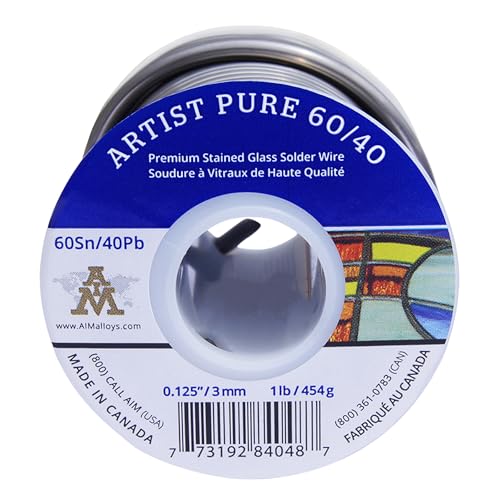
The AIM Artist Pure is formulated specifically for stained glass, and it shows. The 3mm solid wire is made from high-purity virgin metals that flow with a buttery consistency across copper foil, staying in the liquidous stage noticeably longer than generic electronics solder. This extended working time is the difference between a rushed, choppy bead and a polished, uniform seam you can be proud of.
Reviewers consistently note that this solder is “forgiving for beginners” and produces professional results without frustrating remelting issues. The 1-pound spool is a practical size for multiple panels, and the wire is soft enough to bend easily during feeding but firm enough to hold its shape on vertical work. Being manufactured in Canada with commercial-grade quality control adds to its reliability.
The only real consideration is that this is a solid wire — you’ll need to apply your own liquid flux separately. This is standard practice for stained glass work and actually gives you more control over oxidation, but it’s worth noting if you’re used to flux-core convenience. For artists who prioritize smooth, shiny beads, this is the benchmark.
Why it’s great
- Extended liquidous stage for sculpting beads
- Virgin metal purity ensures consistent flow
- Soft, bendable wire easy to control
- Large 1lb spool for multiple projects
Good to know
- Solid wire requires separate liquid flux
- Entry-level price point for premium segment
2. Avril 60/40 Premium Solder for Stained Glass

Avril has built a loyal following among stained glass artists for good reason. This 60/40 alloy flows exceptionally well and cleans up to a brilliant, mirror-like shine that makes your copper foil lines pop. Long-time users report repeatedly returning to Avril after trying other brands “in a pinch,” citing its predictable behavior on both flat panels and curved 3D sculpture work.
The wire is made in the USA from virgin materials, and the 1/8-inch diameter is perfectly matched for standard copper foil tape widths. Users note that with 60/40, you can achieve the desired rounded “bump” on soldered joints that makes a piece look professional rather than amateurish. The 50/50 comparisons favor Avril’s 60/40 for its smoother flow and better bead formation.
One thing to watch: the product dimensions listed are somewhat unusual (13.62 x 7.87 x 17.52 inches) which suggests the packaging may be larger than expected. The spool itself is a standard 1-pound size, but the box might not fit neatly in a small storage bin. For artists who demand reliable, consistent performance project after project, Avril is a trusted name.
Why it’s great
- Cleans up to a brilliant, high-shine finish
- Consistent flow for professional-looking beads
- Made in the USA with virgin materials
- Strong brand loyalty among experienced artists
Good to know
- Packaging dimensions may be oversized
- Solid wire requires external flux application
3. Mastercraft 60/40 Solder

Mastercraft strikes a sweet spot between cost and quality for stained glass work. The 60/40 blend is designed to stay in a liquid stage longer than lower-tin alloys, giving you ample time to produce smooth seams without rushing. Users consistently describe it as “the stuff” for stained glass, with multiple reviews specifically calling it out for panel assembly and copper foil soldering.
The wire thickness is notable — some buyers report it being slightly thinner than the typical 1/8-inch, which could be an advantage for finer detail work or a drawback if you prefer a fatter bead in a single pass. It flows readily and has a small pasty phase, meaning the transition from liquid to solid is clean and predictable. The 1-pound spool is a practical size that won’t gather dust between projects.
One caveat: a small number of users mention that the gauge varies slightly from the advertised thickness. If precise bead width is critical for your project, you may want to test a small section before committing to a full panel. For most artists, however, this is a reliable mid-range option that performs well above its tier.
Why it’s great
- Extended liquid stage for smooth bead sculpting
- Clean, predictable transition with small pasty phase
- Proven performer for stained glass work
Good to know
- Wire thickness may run slightly thinner than 1/8″
- Solid wire needs liquid flux
4. ANOSON 60/40 Solder for Stained Glass

ANOSON’s 60/40 solder has earned a reputation as a hidden gem for stained glass crafters. It’s made with high-purity alloy that flows beautifully and leaves minimal residue, cleaning up to a bright, shiny surface that rivals much more expensive options. Users specifically call out its smooth, even line at slightly cooler iron temperatures, making it a favorite for artists who prefer to work at lower heat settings to reduce stress on the glass.
The 3mm diameter is standard for copper foil work, and the 1-pound spool is generous for the price point. Reviews note that it’s “comparable to expensive solders” while being “better than cheap ones,” which is exactly the sweet spot most hobbyists are looking for. The wire is soft and flexible, feeding easily through your hands without kinking.
One honest reviewer raised a concern about internal strength on large panels — the solder is very soft and malleable, which is great for sculpting but may not provide the structural rigidity needed for big outdoor installations. It’s best suited for suncatchers, small panels, lampshades, and decorative pieces where the solder seam is aesthetic rather than load-bearing. The 1-year warranty provides peace of mind for quality issues.
Why it’s great
- Flows beautifully at lower iron temperatures
- Minimal residue, cleans to bright finish
- Soft wire easy to control and feed
- Great value for hobby-level projects
Good to know
- Not ideal for large outdoor panels
- Solid wire requires liquid flux
5. Weller WSW SnPb Solder Wire

Weller is a trusted name in soldering equipment, and their WSW SnPb wire brings pro-grade quality to the stained glass workspace. This is a 60/40 alloy with a 2.2% rosin flux core and a thin 0.8mm diameter — a very different tool from the 3mm solid wires above. It’s ideal for precision detail work: tacking small pieces, touch-ups on existing seams, or soldering tight interior corners where a thick bead would overwhelm the design.
The flux core means you don’t need to apply liquid flux separately, which speeds up small repairs and reduces smoke. Users describe it as “pro-grade” and note that it “flows and sticks the first time” with no waste or mess. The consistent flux levels inside the wire ensure even melting without cold joints. For stained glass artists who also do electronics or jewelry work, this dual-purpose solder is a space-saver.
That said, the 0.8mm wire is not designed for creating primary beads on copper foil. If you try to run a long seam with this gauge, you’ll be feeding wire constantly and the bead will be thin and flat. The 100g (3.53 oz) spool is also much smaller than the 1lb standard for stained glass, so you’ll burn through it quickly on larger projects. This is a specialist tool for detail work only.
Why it’s great
- Flux core eliminates need for extra flux
- Thin wire perfect for detail and touch-ups
- Pro-grade consistency and reliability
- Dual-purpose for electronics and stained glass
Good to know
- Too thin for primary bead formation
- Small spool (100g) not ideal for large panels
6. Canfield 50/50 Solder for Stained Glass

Canfield is a staple brand in the stained glass community, and their 50/50 alloy deserves a mention even in a 60/40 guide. The 50% tin / 50% lead ratio has a wider melting range (361°-421°F) compared to 60/40, which means it stays in a pasty, semi-solid state longer. This can be intentionally used to fill small gaps between foil pieces or to build up a thicker seam without the solder running everywhere.
Made in the USA from virgin material, this 1-pound spool delivers the quality that makes Canfield “the only brand I’ll buy” according to long-time users. The 3mm diameter is standard for stained glass, and the solder flows well for copper foil projects, creating an easy “bead” that looks clean and professional. It’s an excellent choice for artists who want a slightly different working characteristic from 60/40.
Be aware that 50/50 is harder to push into a smooth bead than 60/40 — the wider pasty range can feel gummy if you’re used to the quick liquid-to-solid transition of higher-tin alloys. It also produces a slightly duller finish. For artists who specifically want a firmer, more structural seam for large panels or who are joining lead came, this is a valid choice. For pure copper foil work, most will prefer the 60/40 options above.
Why it’s great
- Wider pasty range for filling gaps
- Virgin materials, made in the USA
- Trusted brand among stained glass artists
- 3mm diameter suits standard foil work
Good to know
- Pasty phase can feel gummy to control
- Duller finish compared to 60/40
- Not a 60/40 alloy — different behavior
7. HGMZZQ 60/40 Tin Lead Solder Wire with Rosin

HGMZZQ’s 60/40 solder is an entry-level option that serves a specific niche: small repairs, electronics cross-over work, and stained glass touch-ups. The 1.0mm diameter with a 2.2% rosin core makes it convenient for quick fixes where you don’t want to set up liquid flux. Its lower melting point (361°F / 183°C) means it flows easily even with modest irons, which is handy for beginners.
User reviews are straightforward — “good value, works nice” and “great for fine electronics boards” — which confirms its primary use case. It works well on 0.1-inch circuit board pads, and the 60/40 alloy is certainly usable for stained glass in a pinch. The 1-pound spool is a generous size for the budget tier, and the solder joints come out reliable and clean.
However, the 1.0mm wire is a significant downgrade from the 3mm standard for stained glass beads. You will struggle to create a rounded, professional seam on copper foil with this gauge — the bead will be thin and require multiple passes that can overheat the glass. It’s perfectly functional for soldering jump rings, findings, or small came joints, but for primary seam work on a panel, upgrading to a 3mm solid wire is strongly recommended.
Why it’s great
- Flux core for convenience on small jobs
- Low melting point works with modest irons
- Affordable 1lb spool
Good to know
- 1.0mm too thin for proper stained glass beads
- Better suited for electronics than large panels
FAQ
Can I use lead-free solder for stained glass instead of 60/40?
Why does my solder bead look lumpy instead of smooth?
What’s the difference between 60/40 and 50/50 for stained glass?
Final Thoughts: The Verdict
For most users, the clear winner for 60/40 solder for stained glass is the AIM Artist Pure because its virgin metal purity and extended liquidous stage deliver the smoothest, most professional beads on copper foil. If you want a premium USA-made option with a brilliant shine and loyal following, grab the Avril Premium. And for budget-conscious crafters working on smaller panels, the ANOSON 60/40 offers excellent flow and finish without breaking the bank.