
Our readers keep the lights on and the weekend projects moving. As an Amazon Associate, I earn from qualifying purchases.
Specs are compiled from manufacturer listings and verified buyer reviews and can change over time — please confirm the key details on the product page before buying.
When the lights go out, the first question isn’t how many watts you want — it’s which fuel you can get. Natural gas lines keep flowing during most outages, propane stores forever without going bad, and gasoline is everywhere until it isn’t. That fuel choice, more than any spec on the box, decides whether your 6000 watt generator is a lifesaver or a garage ornament. This guide walks you through the picks that genuinely deliver on their rated output, ranked by real owner experience and build quality.
I’m Rikta — the founder and writer behind FitlyFast. This guide is built by comparing the manufacturers’ published specifications and the patterns across verified customer reviews, so you get each pick’s real strengths and trade-offs instead of marketing spin.
Here is the honest field guide to the 6000 watt generator market, built from real owner experiences and the specs that actually matter.
Our Picks at a Glance

How To Choose The Best 6000 Watt Generator
Buying a generator is a multi-year purchase, so the wrong choice is expensive twice — once at the register and again when it won’t start at 2 a.m. Start with your actual load, not the biggest number on the box. Add up what you must run during an outage: a refrigerator pulls roughly 600-800 running watts, a well pump can spike to 2,000+, and a central AC unit needs several thousand just to kick on. A 6000-watt unit handles the essentials comfortably but will not run your whole house with electric heat and a water heater simultaneously.
Fuel Type: The Decision That Overrides Everything
Gasoline is the most portable and the most available, but it degrades in about three months without a stabilizer and becomes a fire hazard if stored carelessly. Propane stores indefinitely and burns cleaner, but you must track tank levels and swap cylinders during a long outage. Natural gas is the gold standard for whole-home backup — it never runs out — but it requires a plumber to connect a line and fixes you in place. The best units let you switch between two or three fuels with a dial, which is why tri-fuel models dominate the premium end of this list.
Inverter vs. Open-Frame: Clean Power or Raw Power
An open-frame generator connects straight to the engine and produces “dirty” power with more distortion, which is fine for lights, heaters, and power tools but can damage a laptop or a smart TV. An inverter generator runs the engine speed up and down to match demand, producing a clean sine wave (under 3% THD) that is safe for phones, computers, and audio equipment. Inverters are also dramatically quieter and more fuel-efficient, but they cost more per watt and rarely hit the same peak outputs as open-frames.
Start Method and Outlets: The Daily-Use Details
Recoil start means pulling a cord until it catches — reliable but tiring when you are dealing with a heavy engine. Electric start adds a battery and a push button, and the best units throw in a remote key fob so you can fire the generator from inside the house without walking out in a storm. On the outlet side, look for a 30-amp twist-lock or a 50-amp outlet for transfer-switch hookups, plus a dedicated RV outlet if you plan to power a camper. Every outlet should have rubber covers to keep water out.
Quick Comparison
| Model | Best For | Peak Watts | Runtime | Weight | Amazon |
|---|---|---|---|---|---|
| Westinghouse 14500★ Best Overall | Whole-home tri-fuel backup | 14,500 | 19 hrs (gas) | 230 lbs | Amazon |
| PowerSmart 7000WQuiet Performer | Quiet inverter value | 7,000 | 6 hrs | 113.5 lbs | Amazon |
| WEN DF1100X | Dual-fuel high output | 11,000 | 8.5 hrs | 213.8 lbs | Amazon |
| GENMAX GM12000ED | Economy-mode extended runtime | 12,000 | 14.5 hrs (econ) | 231.5 lbs | Amazon |
| Westinghouse 12500 | Proven dual-fuel home backup | 12,500 | 12 hrs | 210 lbs | Amazon |
| Champion 12,500 | Tri-fuel with strong warranty | 12,500 | — | 231 lbs | Amazon |
| A-iPower SUA7600iED | Quiet dual-fuel inverter camping | 7,600 | 10 hrs (25% load) | 130 lbs | Amazon |
Note: This list uses flexible matching for 6000-watt output or higher (accepting 6000–7000W), so not every pick is the exact number searched — the nearest same-type size/watt serves the same purpose.
In‑Depth Reviews
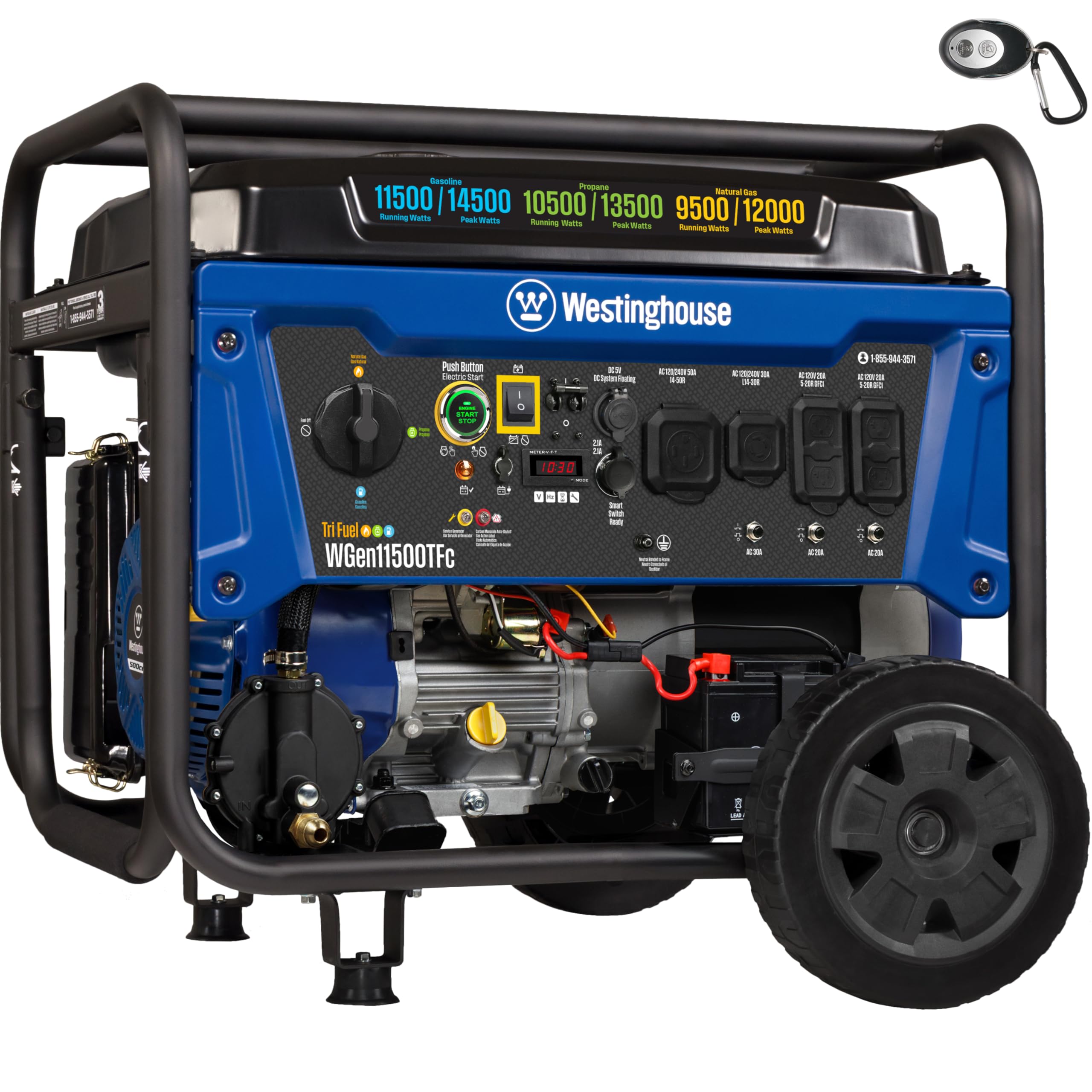
1. Westinghouse 14500 Peak Watt Tri-Fuel Home Backup Portable Generator
Our pick — over 4.5★ from 2,500+ verified ratings; the strongest balance of quality and price.
The whole-house heavyweight that runs your grid on whatever fuel the outage left behind.
You can run your whole house for a full day without refueling. This generator runs on gasoline, propane, or natural gas, and its 9.5-gallon tank delivers up to 19 hours on gas — enough to keep your fridge, lights, and internet going through a long outage. The 550cc engine with a cast iron sleeve is built for years of service, and buyers report it “Runs whole house; tri-fuel (natural gas, propane, gasoline) plumbed for NG; electric start, fuel selector, multiple connections; well-engineered, quality build.” An ex-Westinghouse employee even approves, which says something about the internals.
At 230 pounds, this is not a unit you toss in a truck bed — it is a permanent backup station for larger homes. The remote electric start with a key fob means you can fire it from the porch, and the built-in fuel gauge and hour meter keep maintenance honest. The thing everyone raves about is the build quality, with hundreds of owners calling out how solid and well-engineered it feels. Assembly is a two-person job with clear instructions, and the interface is intuitive enough that you will not need the manual after the first start.
It pushes out 14,500 peak watts and 11,500 running watts on gas, with slightly lower figures on propane (13,500 peak / 10,500 running) and natural gas (12,000 peak / 9,500 running). Its under-3% THD output is safe for sensitive electronics like phones, computers, and TVs. The honest trade-off is that this is overkill for a small apartment or a weekend camper — you are paying for capacity you may never use, and the 230-pound weight demands a dedicated storage spot. But for a home where the AC, well pump, and fridge all need to run simultaneously, this is the unit owners trust to carry the whole load.
What wins owners over
- Tri-fuel flexibility means an outage never leaves you stranded on one fuel source
- Remote start key fob fires it from inside the house in a storm
- Cast iron engine sleeve built for longevity under heavy load
- 19-hour runtime on a single 9.5-gallon tank of gas
Who should pass
- At 230 pounds, it needs two people and a permanent spot
- More capacity than a small home or camper ever needs
- Natural gas hookup requires a plumber if you want that fuel option
Your pick if: you own a larger home and want one machine that runs the essentials through any outage on any fuel.
Look elsewhere if: you need something you can load and haul to a jobsite or campsite every weekend.
2. Westinghouse 6600 Peak Watt Home Backup Portable Generator
The inverter that pairs camp-site quiet with contractor-grade muscle in a 106.9-pound frame.
This is the 6000-watt inverter for the buyer who wants clean power for electronics and tools without wrestling a 200-pound monster. At 106.9 pounds, GENMAX claims it is 30% lighter than a traditional 6000-watt generator, and the steel handle plus two rolling wheels make it genuinely manageable. The 312cc engine produces 6000 peak watts and 5250 rated watts with less than 3% THD — clean sine-wave power that is safe for laptops, phone chargers, and sensitive power tools.
The electric start with push-button ignition and included battery fires instantly, and Cold Start Technology helps on freezing mornings. Buyers who use it on jobsites report it ran a demo hammer and battery charging through a full shift while burning roughly a quarter tank at half load — that is contractor-grade stamina. The control panel is a highlight: an hour meter and LED indicators alert you to low oil, overload, or readiness, and the covered outlets include a 120/240V 30A locking outlet plus two GFCI-protected 120V household outlets with a dual USB adapter.
The 3.8-gallon steel tank delivers up to 9 hours of runtime at 50% load, and the CO detection system shuts the unit down automatically if carbon monoxide builds to unsafe levels. The value is what wins people over — owners consistently call it a great buy for the money, with reliable electric starting and good portability. The honest balance: it is an open-frame inverter, so it is not whisper-quiet, and a few owners found the noise level higher than they expected. One buyer also noted there is no extra 120V outlet, so check your cord needs. If you want inverter clean power at a weight you can actually move, this delivers.
The standout spec: 106.9-pound weight with inverter-clean power under 3% THD — a rare combination at this output.
The trade-off: It is quieter than an open-frame but louder than a fully enclosed inverter, and outlet count is limited.
Your pick if: you need clean power for tools and electronics and want to haul it yourself.
Look elsewhere if: you need near-silent operation for campgrounds — an enclosed inverter suits better.
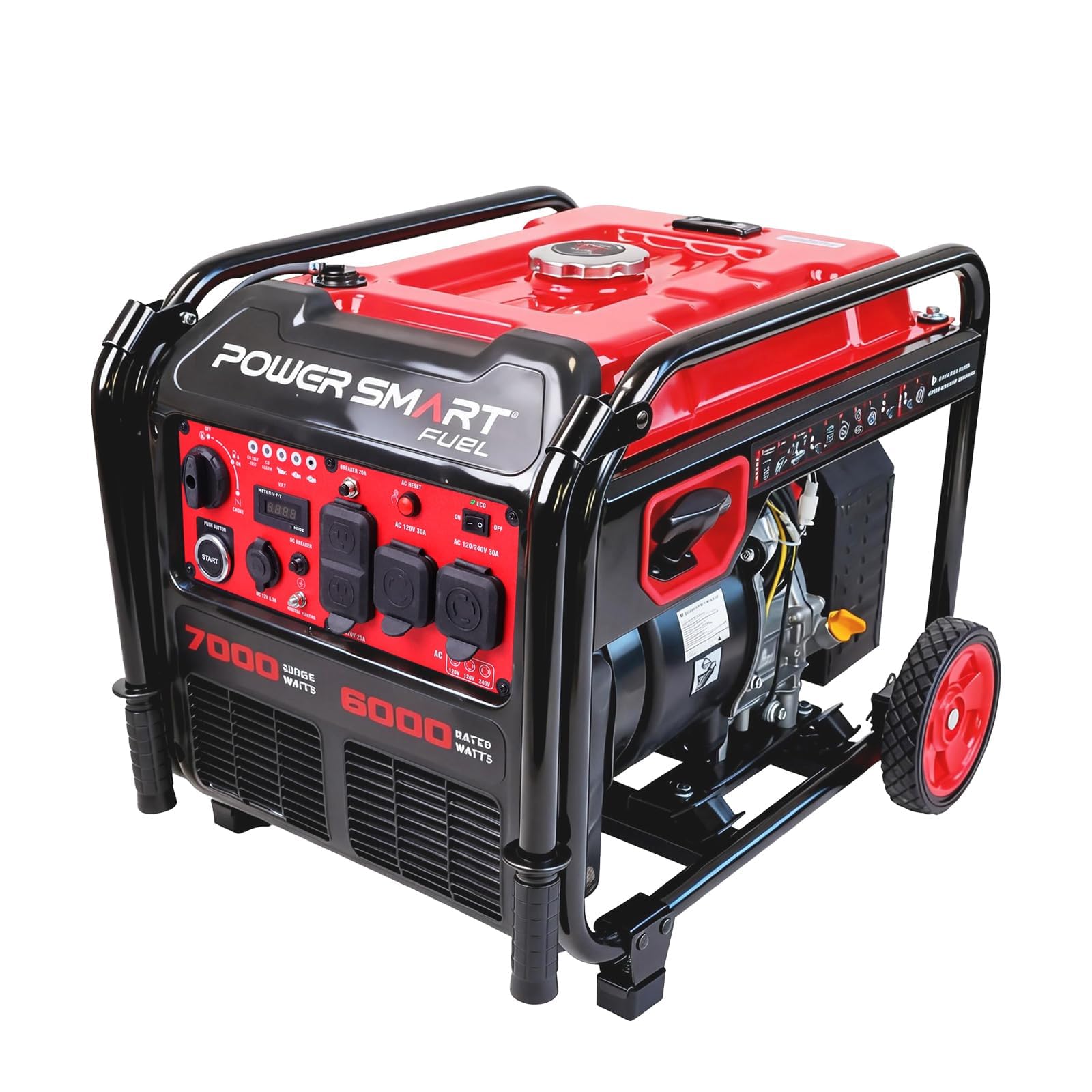
3. PowerSmart 7000W Surge / 6000W Rated Inverter Generator
The conversation-level quiet inverter that runs your camper AC at 7,000 feet without breaking a sweat.
You can plug your laptop straight into this inverter without worrying about damage. It delivers 7000 surge watts and 6000 rated watts with less than 3% THD (total harmonic distortion — the measure of how “clean” the electrical sine wave is), so laptops, phones, and cameras are safe to plug straight in. The 322cc four-stroke engine pushes that output at roughly 70dB — about the volume of a normal conversation from 23 feet away.
The push-button electric start with included battery and a recoil backup gives you two ways to fire it. The ECO throttle mode dials engine speed to the load, stretching a 3.2-gallon tank to up to 6 hours at 50% load — ideal for overnight backup. Customers note it runs a 13.5-BTU air conditioner effectively even at 7,000 feet elevation, which is a meaningful data point for mountain campers. The CO Protect Sensor shuts the engine down and flashes a red warning if carbon monoxide reaches unsafe levels, while low-oil shutdown adds extra protection.
At 113.5 pounds with fold-out handles and large transport wheels, it offers a strong power-to-weight ratio for its class. The build quality and power are what owners praise most, calling it a solid value that “punches above its weight.” The honest catch: reliability gets mixed reviews in the data, and a few owners hit real problems — one unit died after nine hours. Oil is not included (you need 30.4 fl. oz of 10W-30), and PowerSmart insists on fuel with 10% ethanol or less. For a camper or a modest home backup where quiet operation matters, this is a compelling inverter at a value price.
What wins buyers over
- ~70dB noise level — conversation-quiet operation
- 7000 surge watts with under 3% THD for clean electronics power
- ECO mode stretches runtime to 6 hours on a 3.2-gallon tank
- CO sensor shuts down automatically on unsafe carbon monoxide
Who should be cautious
- Reliability has mixed owner reports — a rare unit failed early
- Oil not included; must add 30.4 fl. oz of 10W-30 before first start
- Keep 2 feet of clearance on all sides during use
Reach for this if: quiet, clean inverter power for a camper or small home is your priority.
Think twice if: you need maximum reliability for whole-home backup — an open-frame with more owner history may suit better.
4. Westinghouse 6600 Watt Home Backup Portable Generator, Remote Electric Start

The dual-fuel beast that switches from gas to propane with a dial and runs a welder without flinching.
This WEN is built for the buyer who wants serious output with fuel flexibility. The 457cc engine pushes 11,000 surge watts / 8,300 running watts on gasoline, and drops to 9,500 surge / 7,500 running on propane — a simple dial lets you switch between them. That propane option is a lifesaver when gas is scarce or you want to protect the carburetor from stale fuel, and the 47-inch LPG hose is included right in the box.
Shoppers say it “handles their welder well” and “pretty much ran his whole house” during a hurricane — which is the exact scenario this unit is built for. The electric start powers the engine with the turn of a key, and the 6.6-gallon tank provides up to 8.5 hours at half load. The outlet selection is generous: four 120V GFCI receptacles, a transfer-switch-ready L5-30R twist lock, a 120V/240V 50A L14-50R for heavy loads, and a 12V DC plug for accessories. Voltage switches easily between 120V and 240V for transfer switches and emergency backup.
The build quality is what owners praise most — “this thing is a beast” is the recurring phrase, and the manual gets called “very, very good.” The CO Watchdog sensor shuts down the engine if carbon monoxide accumulates, backed by a 2-year warranty. The honest catch: at 213.8 pounds, this is a permanent-install machine, not a portable. And while the power reliability is excellent, the noise is typical of a large open-frame. For a home where you want the option of propane and enough wattage to run a welder or a whole house, this is a strong mid-range value.
What owners rave about
- Dual-fuel dial switching protects the carburetor with propane
- 11,000 surge watts handles welders and whole-house loads
- Four 120V outlets plus 50A and 30A heavy-duty receptacles
- CO watchdog sensor for automatic shutdown
Who should pass
- At 213.8 pounds, it needs a permanent home, not a truck bed
- Noisy open-frame operation
- Propane start-up requires the fuel lever in “run,” not choke
Reach for this if: you need maximum output with the flexibility of gas or propane for whole-home backup or a welder.
Think twice if: you need something you can move easily — this one stays put.
5. GENMAX GM12000ED Dual Fuel Portable Generator

The dual-fuel generator that stretches a single tank into a 14.5-hour economy-mode marathon.
Keep your lights and fridge running all night without burning full throttle. The 458cc engine in this GENMAX delivers up to 14.5 hours of operation at 50% load in economy mode — which automatically dials the engine speed to match demand, so you are not burning full throttle to run a few lights and a fridge. It runs on gasoline or propane, giving you flexibility when one fuel is scarce.
Electric start with included battery and Cold Start Technology ensures a quick start even in freezing weather. The strong steel handle and two rolling wheels make the 231.5-pound frame movable, and the CO Detect system automatically shuts the unit down if carbon monoxide reaches unsafe levels. Buyers report a 15-20 minute setup, immediate starting, and smooth running — with one noting it’s “quieter than a 10-year-old smaller unit.”
The honest picture is more complex than the specs suggest. One owner had a unit under six months old that wouldn’t crank, and another flagged that the advertised 12,000W is actually 10,000 peak watts — so size your loads against the lower figure. The noise is “not quiet” but acceptable for the size. For a home backup where long runtime and dual-fuel flexibility matter more than absolute silence, this delivers — just verify your expected loads against 10,000 peak / 8,000-ish running watts rather than the headline number.
The efficiency play: 14.5 hours at 50% load in economy mode means overnight backup without a 2 a.m. refill.
The honest caveat: advertised wattage is a peak figure; size your home loads against the lower running output.
Your pick if: you want long overnight runtime with dual-fuel flexibility for home backup.
Look elsewhere if: you need guaranteed reliability — check warranty terms before committing to a big purchase.
6. Westinghouse 12500 Watt Dual Fuel Home Backup Portable Generator

The ten-thousand-owner favorite that proves itself with a key fob and a 12-hour fuel tank.
This is the generator with the deepest track record on this list — tens of thousands of owners have put it through real hurricanes, ice storms, and long outages, and the consensus is overwhelming: it works. The 457cc engine delivers 9,500 running watts / 12,500 peak watts on gas, and 8,500 / 11,200 on propane, with a 6.6-gallon tank stretching to 12 hours of runtime. The remote start key fob, electric button, and recoil backup give you three ways to fire it.
Owners consistently describe it as “well-made and easy to assemble, with reliable performance that works right from the start.” The dual-fuel capability — running on both gasoline and propane — earns constant praise, and the VFT display gives real-time updates on voltage output, frequency, and lifetime hours. The outlet panel is the most versatile in this class: two GFCI household receptacles, a transfer-switch-ready L14-30R, and an RV-ready 14-50R 50A outlet, all with rubber covers.
What wins people over is the combination of build quality and easy starting — push the button and it fires. Owners note it is “relatively small so it easily fits in our garage” for its output class. The 210-pound weight demands a permanent spot, and the open-frame noise is expected at this size. For a home where you want proven reliability, dual-fuel flexibility, and a 50A outlet for a transfer switch, this is the crowd favorite for good reason.
What thousands of owners confirm
- Reliable push-button starting with remote key fob backup
- Dual-fuel gas/propane flexibility with 12-hour tank runtime
- 50A RV outlet plus transfer-switch-ready 30A receptacle
- VFT display tracks voltage, frequency, and lifetime hours
Who should pass
- 210-pound weight is a two-person permanent install
- Open-frame noise typical of large generators
- Overkill for small homes or weekend camping
Reach for this if: you want the most-proven dual-fuel home backup generator on the market with a 50A hookup.
Think twice if: you need portable clean power — this is a fixed home backup machine.
7. Champion Power Equipment 12,500-Watt Tri Fuel Generator

The yellow tri-fuel powerhouse that runs your AC on natural gas without a single trip for fuel.
This Champion is for the buyer who wants the ultimate fuel flexibility with a serious warranty behind it. It operates on natural gas, propane, or gasoline, and both the natural gas and propane hoses are included — so it is ready to run on any fuel right from the start. The 500cc engine delivers 12,500 starting watts / 10,000 running watts on gas, 11,250 / 9,000 on propane, and 10,000 / 8,000 on natural gas, and engine oil is included in the box.
The electric start with a rocker switch and included battery fires instantly, and the Intelligauge display tracks voltage, frequency, session run time, and total run time — so you always know the health of the unit. The CO Shield carbon monoxide auto-shutoff system provides a critical safety layer. Owners love the “push button start” and the flexibility: “I love having the option of using propane if I am low on gas!” One buyer ran their house AC system with no problem during a test run.
The 3-year limited warranty with free lifetime technical support is a genuine differentiator — Champion backs this unit like a premium product. At 231 pounds, it is a permanent home backup machine, and it is “a bit loud… to be expected on one this big.” The honest caveat: one unit arrived with an oil leak right from the start, so inspect it thoroughly on delivery. For a home where natural gas is available and you want the freedom of three fuels, this is a compelling premium pick.
What owners value
- Tri-fuel operation with both hoses included from the start
- 3-year warranty with free lifetime technical support
- Intelligauge tracks voltage, frequency, and run time
- Rocker-switch electric start with included battery
Who should be cautious
- 231-pound weight is a permanent installation
- Open-frame noise is loud at full output
- Occasional unit arrives with an oil leak — inspect on delivery
Your pick if: you have natural gas available and want a three-fuel machine with a strong warranty for whole-home backup.
Look elsewhere if: you need portability or quiet operation — this is a fixed, loud powerhouse.
8. A-iPower 7600W Dual Fuel Quiet Portable Inverter Generator

The telescoping-handle inverter that is barely audible from 25 feet and switches fuel mid-run.
Camp in near-silence with clean power from this A-iPower. The 322cc engine delivers 7,600 starting watts / 6,100 running watts on gas, and 6,900 / 5,500 on propane, with sound levels as low as 62dB — quiet enough that owners say it is “barely audible from 25 feet away.” The inverter technology keeps THD at 3% or less, so laptops, TVs, and phone chargers are completely safe to plug in.
The Fuel Sense Technology is the standout feature: it automatically switches from propane to gasoline when the propane runs out, giving you a combined runtime of up to 21.2 hours at 25% load. That means you can run a tank of propane dry and the generator keeps going on gas without you touching a dial. The telescoping handle and flat-free wheels make the 130-pound frame genuinely easy to maneuver, and the electric start fires reliably — owners mention starting by the 4th pull on cold mornings.
Customers note it “works great for charging my 5000 wh solar generator” and handles 110V loads including an RV AC and converter. The Low Idle Technology extends runtime to 10 hours at 25% load on the 3.6-gallon tank. The honest trade-offs: it is “larger/heavier/quieter than a Honda,” so it is not the most compact, and some owners find it struggles with the instant surge of a medium air compressor that a premium inverter handles easily. The build quality is solid — one owner reported a stuck carburetor float bowl fixed by draining and tapping it. For a camper who wants quiet, clean, dual-fuel power with auto-switching, this is a thoughtful premium pick.
What owners enjoy
- Fuel Sense auto-switches from propane to gas for 21.2-hour combined runtime
- 62dB sound level — barely audible at 25 feet
- Telescoping handle makes the 130-pound frame easy to move
- Under 3% THD protects sensitive electronics
The honest catch
- Struggles with the instant surge of medium air compressors
- Heavier and larger than compact premium inverters
- Cold-weather starts may need the choke below 40°F
Reach for this if: you want quiet dual-fuel inverter power with auto-switching for extended camping or RV use.
Think twice if: you need to start heavy motor loads like a large air compressor reliably.
Understanding the Specs
Running Watts vs. Peak Watts
Running watts (also called rated watts) is what the generator can sustain continuously — this is the number you size your home against. Peak watts (surge watts) is the brief burst of extra power delivered when a motor like a refrigerator compressor or an AC unit kicks on. That surge is critical because most appliances need 2-3 times their running watts just to start. If your fridge needs 600 running watts but spikes to 1,500 to start, a 6,600-peak-watt generator handles it easily, while a unit rated at exactly 6,000 running watts might struggle.
THD — Total Harmonic Distortion
THD measures how clean the electrical sine wave is. Standard generators often produce 10-23% THD, which is fine for lights, heaters, and power tools but can damage sensitive electronics like laptops, smart TVs, and audio equipment over time. Inverter generators produce under 3% THD — a clean sine wave that is safe for everything. If you plan to plug in phones, computers, or TVs during an outage, look for the under-3% spec on the box.
Fuel Types and Runtime
Gasoline is the most available but degrades in months without stabilizer. Propane stores indefinitely and burns cleaner but requires tank swaps. Natural gas never runs out but needs a plumber to connect. Runtime is always quoted at a specific load — usually 25% or 50% — so a generator that runs 14.5 hours at 50% load will run much longer at a lighter load but far shorter at full output. Match the fuel to your outage reality: if gas stations close before a storm, a propane tank is your insurance.
The CO Sensor and Safety Systems
Carbon monoxide is the silent killer with generators. Modern units include a CO sensor that automatically shuts down the engine if CO reaches unsafe levels. Low-oil shutdown kills the engine before it runs dry and seizes. Never run a generator in an enclosed space, and maintain at least 2 feet of clearance on all sides so the CO sensor works correctly.
FAQ
Will a 6000 watt generator run my whole house?
What can I run with a 6000 watt generator?
Is an inverter generator worth the extra cost?
How much propane does a generator use per hour?
Can I connect a generator directly to my home’s electrical panel?
What is the difference between a dual fuel and tri-fuel generator?
How do I store a generator long-term?
How often should I change the oil in my generator?
What size generator do I need for an RV?
Why does my generator shut off by itself?
Final Thoughts: The Verdict
Across the board, the 6000 watt generator winner is the Westinghouse 14500 because its tri-fuel flexibility and 19-hour runtime on a 9.5-gallon tank mean an outage never leaves you stranded on one fuel source. If you want remote-start convenience with proven reliability at a lower price, grab the Westinghouse 6600 Remote. And for the camper who wants quiet, clean inverter power with auto-switching fuel, the A-iPower SUA7600iED is the one to reach for.
How We Picked
We do not accept paid placement. Every pick is matched to a real buyer and a real use-case; we do not hands-on test units.
Sources & Methodology
Specifications: manufacturer listings and product documentation. Review insights: verified customer reviews, as of August 2026. Pricing: not shown on this page (it changes often); check the current price via the retailer link.
As an Amazon Associate, FitlyFast earns from qualifying purchases. This does not affect which products we feature.