
Our readers keep the lights on and the weekend projects moving. As an Amazon Associate, I earn from qualifying purchases.
Your living room is bright, but the blacks on your current TV look defeated. You crave deep cinematic shadows that survive sunlight, HDR highlights that pop without washout, and motion that keeps up with fast-paced gaming. Finding a 65-inch panel that nails all three — alongside Dolby Vision’s dynamic metadata — separates a casual media room from a true home theater.
I’m Rikta — the co-founder and writer behind FitlyFast. I’ve spent hundreds of hours comparing Mini LED zone-counts, OLED brightness in nits, and HDMI 2.1 bandwidth specs to cut through the marketing noise for this category.
Dolby Vision isn’t just a logo — it’s a scene-by-scene light and color algorithm that demands hardware capable of tracking it. If you’re looking for a genuinely immersive panel, here is your definitive guide to the 65 inch tv with dolby vision.
How To Choose The Best 65 Inch TV With Dolby Vision
Dolby Vision is a demanding HDR format — it expects the display to follow a scene-by-scene brightness curve. Not every TV that carries the badge can execute it well. Focus on three pillars: panel type (OLED or Mini LED), local dimming zone density, and peak brightness measured in nits. A TV with 600 nits and a handful of dimming zones will pass a Dolby Vision signal, but it won’t deliver the punch or shadow detail the format was designed for. Look for at least 800 nits sustained and a dimming count in the hundreds if you are shopping Mini LED. For OLED, the self-emissive pixel structure gives perfect black by default — here, brightness becomes the differentiator.
Panel Technology: OLED Vs. Mini-LED
OLED panels (like the LG G5 and Sony BRAVIA 8) produce absolute black because each pixel turns off independently. That means Dolby Vision scenes in dark rooms look staggeringly dimensional. The trade-off: peak brightness is lower than high-end Mini LED sets, and burn-in risk exists with static elements over thousands of hours. Mini LED (like the TCL QM7K and Hisense U7) uses thousands of tiny backlights controlled by zone to approximate the black depth of OLED while sustaining very high brightness — ideal for bright living rooms where daytime sports and HDR gaming are priorities. Mini LED can sometimes show blooming around bright subtitles in dark scenes, but premium models with dense zone counts (LD1500 or higher) minimize this.
HDMI 2.1 Ports And Gaming Features
If you own a PlayStation 5, Xbox Series X, or a modern gaming PC, you need at least two HDMI 2.1 ports: one for the console and one for a soundbar or streamer. Dolby Vision Gaming at 4K 120Hz requires HDMI 2.1 bandwidth. Some mid-range sets (like the iFFALCON 65U85) include four 2.1 ports, while premium offerings like the Sony BRAVIA 5 only include two — check port allocation before buying. AMD FreeSync Premium Pro and NVIDIA G-Sync compatibility further reduce tearing and stutter, and Auto Low Latency Mode (ALLM) is a must for instant game switching.
Refresh Rate And Motion Handling
Native 120Hz is the baseline for smooth sports and console gaming. Higher native rates like 144Hz (iFFALCON, Toshiba Z670R) or 165Hz (Hisense U7) benefit PC gamers who can push frame rates above 120, but for 95% of buyers, a solid 120Hz panel with VRR (Variable Refresh Rate) delivers the fluidity you need. Dolby Vision content is typically 24fps or 60fps, so high refresh rates don’t affect HDR movies — they matter for gaming where Dolby Vision at high frame rates is supported.
Quick Comparison
On smaller screens, swipe sideways to see the full table.
| Model | Category | Best For | Key Spec | Amazon |
|---|---|---|---|---|
| Sony BRAVIA 5 65XR50 | Mini LED | Cinematic HDR & PS5 | XR Processor AI, 120Hz native | Amazon |
| LG OLED65G5WUA | OLED | Reference black level | Alpha 11 AI Gen2, 120Hz, 4x HDMI 2.1 | Amazon |
| Samsung OLED S90F | QD-OLED | Color volume & gaming | 144Hz, NQ4 AI Gen3, HDR10+ | Amazon |
| Sony BRAVIA 8 65XR80 | OLED | Movies & dark-room viewing | XR OLED Motion, Dolby Vision | Amazon |
| LG G3 OLED65G3PUA | OLED evo | Gallery design & brightness | a9 Gen6 AI, 120Hz, 70% brighter | Amazon |
| Panasonic Z95A 65Z95AP | Master OLED | Built-in sound & Filmmaker Mode | 144Hz, HCX Pro AI MKII, Fire TV | Amazon |
| Hisense 65U7SG | Mini-LED ULED | Bright room HDR & value | 165Hz native, 3000 dimming zones | Amazon |
| TCL 65QM7K | QD-Mini LED | Bang-for-buck Mini LED | LD2500 zones, 144Hz, Google TV | Amazon |
| Toshiba 65Z670R | Mini-LED QLED | Value with Dolby Vision IQ | 144Hz native, REGZA Engine ZRi | Amazon |
| iFFALCON 65U85 | MiniLED | Gaming budget king | 144Hz VRR, 4x HDMI 2.1 | Amazon |
| Amazon Ember QLED 65 | QLED | Alexa-first smart home | Fire TV, Dolby Vision, HDR10+ Adaptive | Amazon |
In‑Depth Reviews
1. Sony BRAVIA 5 65 Inch TV (K-65XR50)

This is the sweet spot where Sony’s XR Backlight Master Drive meets thousands of Mini LEDs to deliver the most authentic HDR presentation in its class. Dolby Vision content is handled with scene-by-scene precision — highlights stay bright without blowing out adjacent shadow detail. The XR Triluminos Pro unlocks billions of real-world colors, and the XR Motion Clarity keeps panning shots in sports and action movies completely smear-free at 120Hz.
PlayStation 5 owners get exclusive features: Auto HDR Tone Mapping and Auto Genre Picture Mode that communicate directly with the console. The 4K upscaling via the XR Processor is the best in this roundup — 1080p Blu-rays and even 720p streaming look sharp and naturally textured. Google TV with AirPlay 2 and Google Cast covers every streaming service.
Two of the four HDMI ports are 2.1, which is sufficient for a console and soundbar, but not ideal if you need three 2.1 devices simultaneously. The built-in speakers are decent for a Mini LED, but a soundbar is recommended for the full Dolby Atmos experience.
Why it’s great
- Best-in-class upscaling and HDR tone mapping
- Exclusive PS5 Auto HDR Tone Mapping
- XR Motion Clarity eliminates judder at 120Hz
Good to know
- Only 2 of 4 HDMI ports are 2.1
- Built-in sound is adequate but not room-filling
2. LG 65-Inch OLED evo G5 (OLED65G5WUA)

LG’s 2025 flagship OLED evo pushes brightness beyond 2000 nits — a breakthrough that makes Dolby Vision in bright rooms finally viable on an OLED. The alpha 11 AI Gen2 processor upscales lower-resolution content with convincing texture, and Perfect Black with Perfect Color on 8.3 million self-lit pixels means zero blooming, even in the most demanding HDR patterns. Filmmaker Mode with Dolby Vision gives you the director’s intent without processing artifacts.
Gamers benefit from a 0.1ms response time, native 120Hz, and four HDMI 2.1 inputs supporting NVIDIA G-Sync and AMD FreeSync Premium. The LG Game Dashboard puts all gaming picture settings in one overlay. The One Wall Design with included bracket leaves virtually no gap when wall-mounted, and the Always Ready mode displays art or photos when idle.
Brightness Booster Max is genuinely visible — daytime viewing no longer looks dim. The remote lacks backlit buttons, which is frustrating in a dark home theater. The TV also does not include a stand; you must purchase a VESA mount or optional stand separately.
Why it’s great
- Over 2000 nits peak brightness on an OLED panel
- Four HDMI 2.1 inputs with full gaming VRR support
- Zero blooming with perfect black
Good to know
- Remote has no backlight
- No stand included — wall mount required
3. Samsung 65-Inch OLED S90F

Using Samsung’s QD-OLED technology, the S90F delivers the widest color gamut available in this lineup. Dolby Vision is conspicuously absent (Samsung backs HDR10+), but the NQ4 AI Gen3 processor’s HDR+ mode intelligently tone-maps Dolby Vision sources to near-native quality. The Motion Xcelerator reaches 144Hz, and the 128-neural-network AI upscaler cleans up streaming artifacts better than most competitors.
Gaming performance is top-tier: VRR up to 4K 144Hz, low input lag, and smooth motion handling for fast-paced shooters. The anti-reflection coating works well in moderately bright rooms, though direct sunlight still causes noticeable glare. Q-Symphony syncs perfectly with a Samsung soundbar.
The panel is very thin and the top edge is fragile — handling during wall-mounting requires care. Some units have arrived with damaged packaging from Amazon, so inspect delivery immediately. The anti-reflective coating can scratch if wiped improperly.
Why it’s great
- Best color volume and vibrancy in class
- 144Hz native with excellent gaming VRR
- 128-neural-network AI upscaling is second only to Sony
Good to know
- No Dolby Vision support (uses HDR10+)
- Panel is physically fragile, especially the top edge
4. Sony 65 Inch OLED BRAVIA 8 (K-65XR80)

Sony’s WRGB OLED panel delivers the reference for pure black with Dolby Vision in a dark room. Over 8 million self-lit pixels are controlled with XR Contrast Booster 15, producing deep blacks and bright highlights in the same frame without artifacts. The XR OLED Motion uses frame interpolation that preserves the filmic look better than any competing brand — 24fps movies stay smooth without the soap opera effect.
Game performance with PS5 is seamless: Auto HDR Tone Mapping removes the need to calibrate in-game HDR sliders, and the Game Menu puts all assist features in one overlay. Google TV runs fluidly, and Sony Pictures CORE includes five movie credits for high-bitrate titles. Acoustic Surface Audio+ uses the panel itself as a speaker, delivering decent dialog clarity for an OLED.
Maximum brightness is lower than premium Mini LEDs and the LG G5, so it is not ideal for very bright rooms with direct window light. The Google TV OS can occasionally stutter with heavy multitasking, though it remains stable. Only two HDMI 2.1 ports limit multi-device setups.
Why it’s great
- Perfect blacks and film-like motion handling
- Best PS5 integration with Auto HDR Tone Mapping
- Acoustic Surface Audio+ for clean dialog
Good to know
- Peak brightness is lower than Mini LED competitors
- Only 2 of 4 HDMI ports are 2.1
5. LG OLED evo G3 65-Inch (OLED65G3PUA)

The G3 was LG’s first mainstream OLED to implement Micro Lens Array (MLA), boosting brightness by up to 70% over previous generations. That extra headroom makes Dolby Vision HDR in moderate ambient light much more impactful — highlights read as punchy rather than dim. The a9 Gen6 AI processor handles dynamic tone mapping per frame, and FILMMAKER MODE preserves the creative intent without aggressive processing.
One Wall Design with an included flush mount bracket creates a gallery-like appearance. The Always Ready mode cycles through curated art or personal photos when the TV is idle, blending into the room. Four HDMI 2.1 ports with G-Sync and FreeSync Premium cover multi-console and PC gaming setups well. The Magic Remote with pointer control makes menu navigation fast.
Some units in the past have experienced dead pixels or vertical lines — QC inconsistency is a known narrative, though the included 5-year panel warranty reduces risk. The built-in 4.2-channel audio is adequate for casual viewing but underwhelming for immersive Dolby Atmos; a soundbar is essential.
Why it’s great
- MLA technology boosts brightness 70% over standard OLED
- Flush wall mount with gallery art mode
- Four HDMI 2.1 inputs for multi-device gaming
Good to know
- QC varies — dead pixel risk reported
- Built-in speakers are not sufficient for Atmos
6. Panasonic Z95 Series 65-Inch OLED (65Z95AP)

Panasonic’s Master OLED Ultimate panel combined with the HCX Pro AI MKII processor produces reference-grade accuracy out of the box. Dolby Vision IQ with Intelligent Sensing reads your room’s lighting and adjusts the picture without losing creative intent — no other brand matches Panasonic’s color science in Filmmaker Mode. The 144Hz refresh rate and 360 Soundscape Pro audio system make this a rare OLED that genuinely works as a standalone home theater.
The built-in sound is the best of any TV in this list: a multi-channel array with upward-firing drivers that deliver convincing Dolby Atmos height effects without an external soundbar. The center-mount swivel stand is practical for corner placements. Fire TV built-in with hands-free Alexa handles streaming, but the OS feels slightly slower than Google TV or webOS.
Privacy-conscious users should note the TV requires an internet connection to enable most features — Alexa listening and telemetry are baked in. The 100Mbps Ethernet port is too slow for high-bitrate 4K streaming; use Wi-Fi 6 or an external streaming device. Availability in the US is limited.
Why it’s great
- Best-in-class built-in Dolby Atmos sound
- Referenc-grade Filmmaker Mode out of the box
- Dolby Vision IQ with Intelligent Sensing
Good to know
- Fire TV OS slower than competitors
- 100Mbps Ethernet limits wired streaming quality
7. Hisense 65″ U7 Mini-LED ULED (65U7SG)
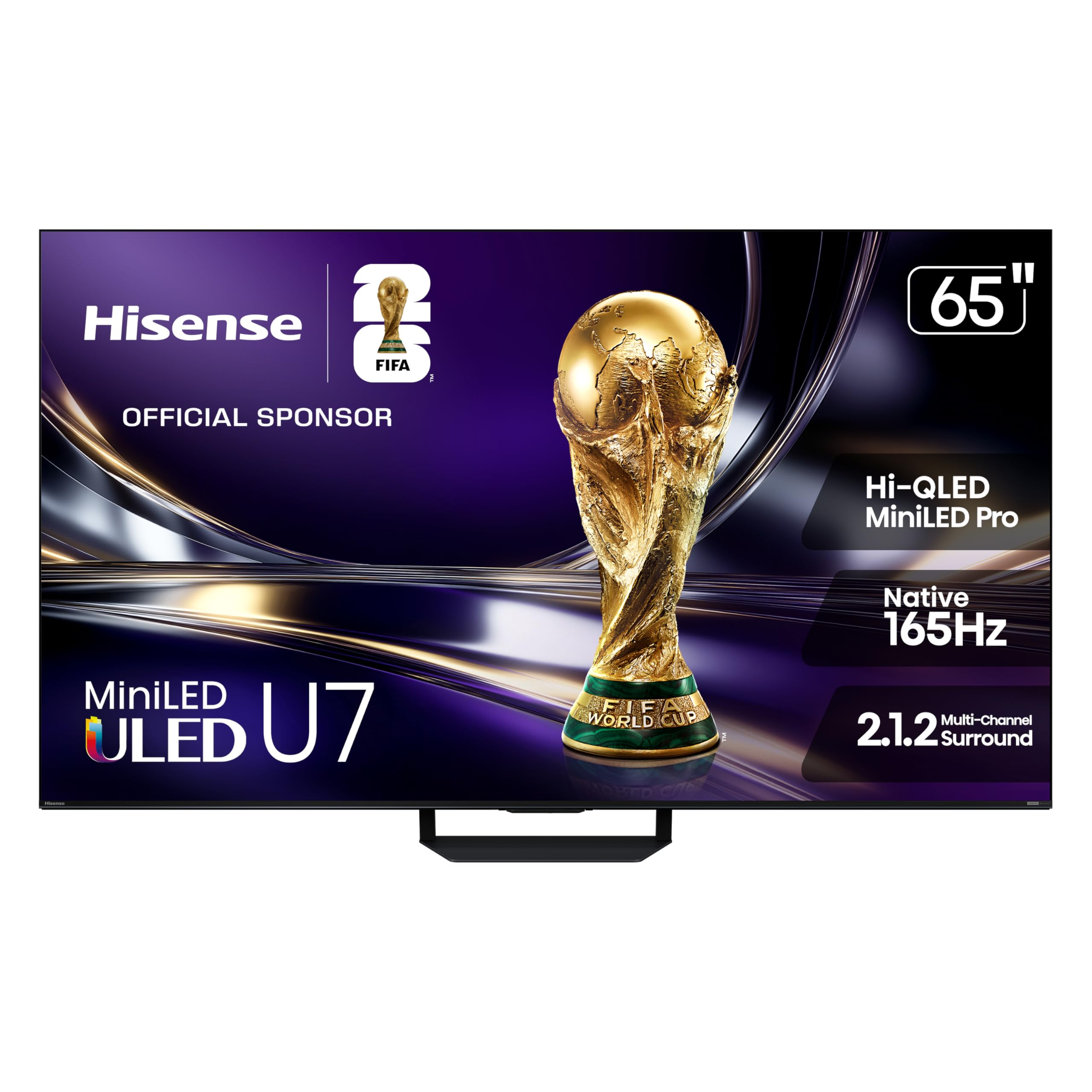
The Hisense U7 is the brightest sub-thousand-dollar Mini LED on this list, with up to 3000 local dimming zones and 3000 nits peak brightness. That brute-force light engine handles Dolby Vision in sunlit rooms without breaking a sweat — HDR specular highlights genuinely hurt your eyes in the best way. The native 165Hz refresh rate with VRR up to 330Hz is overkill for most content but ensures zero tearing in PC gaming.
Hi-QLED MiniLED Pro delivers Pantone-validated color accuracy, and the anti-reflection layer is genuine — glare from overhead lights is reduced significantly. The 2.1.2-channel audio has enough bass for casual viewing without a soundbar. Google TV is responsive, and the backlit remote is a welcome touch at this tier.
The processing chip can struggle with extremely low-bitrate streaming sources, introducing occasional noise. Viewing angles are decent but not OLED-wide — color shift is noticeable past 30 degrees off-center. Motion handling at 60Hz can show slight judder compared to the Sony BRAVIA 5.
Why it’s great
- Extreme brightness (3000 nits) for daylight HDR
- 3000 dimming zones for minimal blooming
- 165Hz native with VRR up to 330Hz for PC gaming
Good to know
- Viewing angles narrow with color shift past 30 degrees
- Processing can introduce noise on low-bitrate streams
8. TCL 65″ QM7K Series Mini LED QLED (65QM7K)
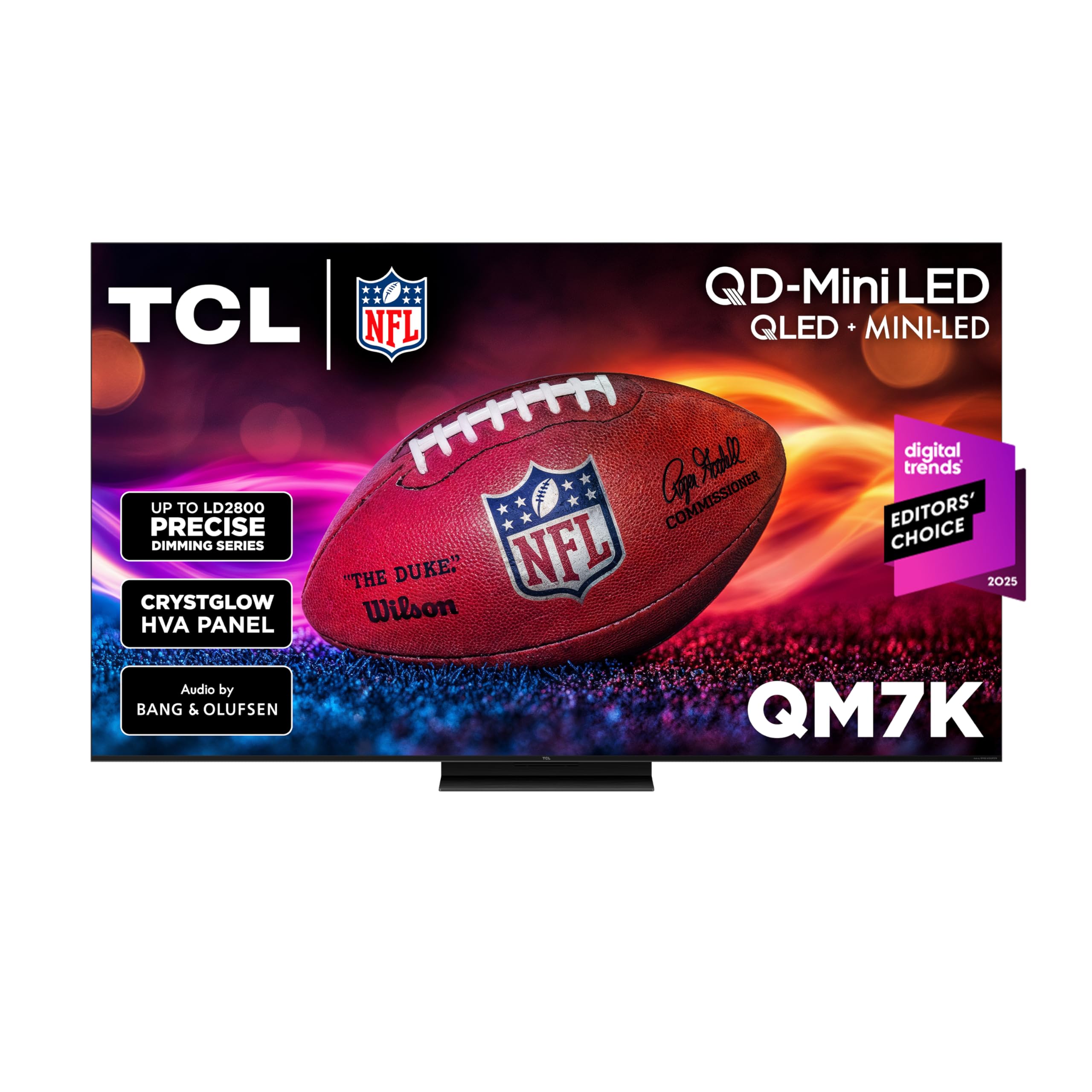
TCL’s QM7K combines QD-Mini LED with up to LD2500 precise dimming zones, delivering a black level that rivals inexpensive OLEDs while maintaining high brightness. The TCL Halo Control System with the high-contrast HVA panel minimizes blooming around subtitles and bright objects in dark scenes — the halo effect is present but very controlled. The native 144Hz panel with VRR supports both FreeSync Premium Pro and G-Sync compatible modes.
The CrystGlow HVA Panel’s anti-reflective treatment is effective in bright rooms, keeping image details crisp even with windows behind the viewer. Onkyo-tuned audio provides decent bass for a built-in system, though the hype around Bang & Olufsen tuning on the remote is overstated — a budget soundbar still outperforms it. Google TV with hands-free Alexa integration covers all streaming apps smoothly.
The remote feels cheap for a set at this level, with a plasticky build and no backlight. Some users have reported panel uniformity issues (DSE) on large uniform fields like football fields — this varies per unit. The stand is wide and requires a large table or stand surface.
Why it’s great
- LD2500 zones deliver deep black level for Mini LED
- Excellent anti-glare screen for bright rooms
- High HDR brightness with great contrast
Good to know
- Remote feels cheap and lacks backlight
- Panel uniformity varies — DSE possible on sports
9. Toshiba 65″ Z670R Mini-LED QLED (65Z670R)

Toshiba’s 2026 return to the Mini LED arena is anchored by the REGZA Engine ZRi Gen3, an AI processor fine-tuned in Japan that optimizes clarity, contrast, and audio in real-time. Dolby Vision IQ with the AI Light Sensor Pro automatically adjusts brightness and color balance to match room conditions — it reduces eye strain during evening sessions without washing out dark scenes. The native 144Hz panel with Game Mode Pro supports FreeSync Premium for tear-free gaming.
The Mini LED backlight with full-array local dimming delivers solid contrast, though zone count is lower than the TCL QM7K and Hisense U7 — blooming is visible in challenging night scenes. REGZA Power Audio Pro with a dedicated bass woofer produces richer low-end than most TVs in this price tier, and dialogue clarity via the dual clear direct speakers is notably good. Fire TV integration is responsive.
The viewing angle is typical for a VA-panel Mini LED — you lose contrast quickly when seated off-center. The TV’s overall brightness is adequate but doesn’t match the Hisense U7’s eye-searing peak. Some users report the need to adjust Dolby Vision settings per input to avoid overly dim shadows.
Why it’s great
- REGZA Engine ZRi delivers accurate, natural-looking picture
- Dedicated bass woofer for surprisingly good built-in sound
- Dolby Vision IQ with AI Light Sensor reduces eye strain
Good to know
- Zone count is lower — blooming visible in dark scenes
- Viewing angles are narrow with VA panel
10. iFFALCON 65″ 4K MiniLED (65U85)
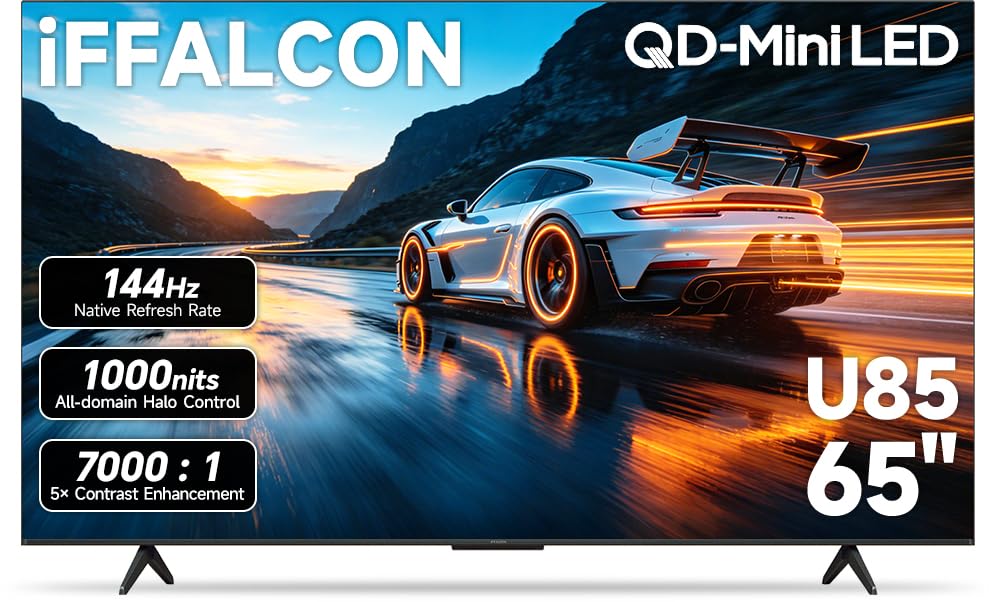
The iFFALCON 65U85 is the cheapest Mini LED in this roundup by a notable margin, but it does not cut the features that matter for Dolby Vision gaming. A native 144Hz panel with VRR up to 288Hz, FreeSync Premium Pro, and four HDMI 2.1 inputs means you can plug in a PS5, Xbox Series X, PC, and soundbar simultaneously without juggling cables. Dolby Vision Gaming mode activates with zero setup, and the 1000 nits peak brightness with a 7,000:1 contrast ratio brings Cyberpunk-style neon highlights to life without crushing shadows.
The 50W audio system with a dedicated 20W woofer and Dolby Atmos passthrough is functional for a bedroom or small living room, but dialogue can sound boxy at higher volumes. Google TV with far-field voice control and AirPlay 2 covers app streaming and casting. The built-in hotel mode with IP/IR control is a rare bonus for commercial or Airbnb installations.
Local dimming zones are limited compared to the TCL QM7K and Hisense U7 — dark scenes with bright subtitles show noticeable blooming. The panel is thicker than premium alternatives, and the plastic build feels budget. Motion handling at 60Hz is good but not as clean as the Sony BRAVIA 5.
Why it’s great
- Four HDMI 2.1 ports at entry-level pricing
- 144Hz VRR with FreeSync Premium Pro for console/PC gaming
- Dolby Vision Gaming with zero-config activation
Good to know
- Low zone count — blooming is visible in dark scenes
- Build feels budget with a thick bezel
11. Amazon Ember 65″ QLED Series with Fire TV
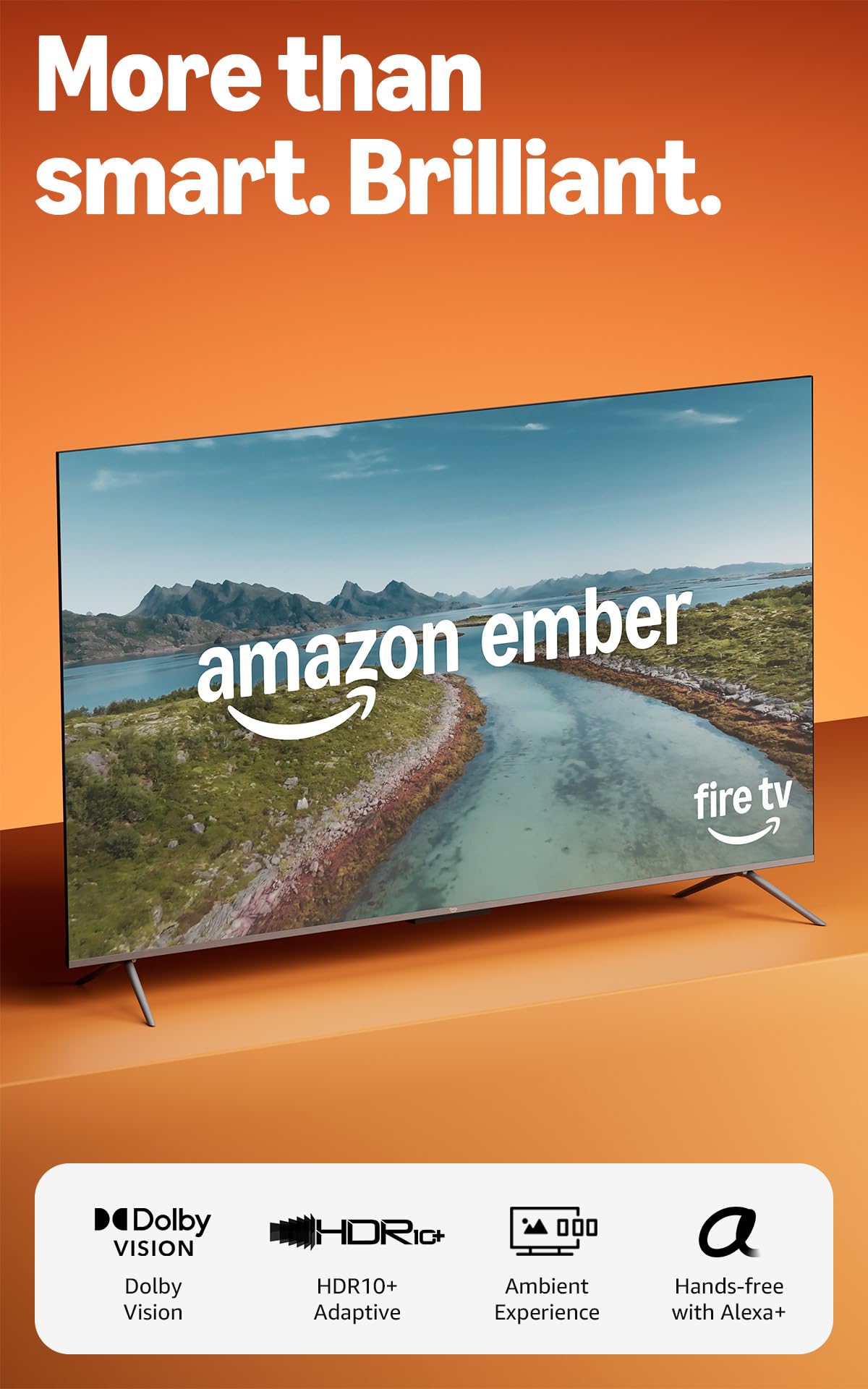
The Amazon Ember QLED is designed first as a smart home hub with a TV attached — the Omnisense technology wakes the display when you enter the room and shows art or your favorite channels instantly. Dolby Vision and HDR10+ Adaptive with full-array local dimming produce decent contrast for a QLED, but the zone count is low enough that blooming in letterbox bars is noticeable. The 4K QLED panel is bright enough for typical living rooms and works well with Fire TV’s content ecosystem.
Wi-Fi 6 and the quad-core processor make app loading fast, and Alexa+ with far-field microphones lets you control the TV, check sports scores, and manage smart home devices hands-free — even when the screen is off. The built-in Omnisense motion sensors are novel for a gallery-style idle screen. Four HDMI inputs with eARC support connect essential peripherals.
The Fire TV interface is aggressively ad-heavy — the home carousel pushes Prime Video rentals and sponsored content over your own apps. Some users report stutter or audio desync on certain Prime Video titles, and the UI can feel sluggish after extended use compared to Google TV. The refresh rate is limited to 60Hz, so console gamers who prioritize 120Hz should look elsewhere.
Why it’s great
- Deep Alexa integration with hands-free control even when idle
- Omnisense motion sensors for gallery-style art display
- Wi-Fi 6 for fast streaming and app loading
Good to know
- Fire TV interface is cluttered with ads
- 60Hz panel only — no 120Hz gaming support
FAQ
Is Dolby Vision better than HDR10+ for a 65-inch TV?
Can I get Dolby Vision gaming at 4K 120Hz on these TVs?
Does a higher refresh rate improve Dolby Vision movie watching?
Final Thoughts: The Verdict
For most users, the 65 inch tv with dolby vision winner is the Sony BRAVIA 5 (K-65XR50) because it combines Sony’s best-in-class processing, credible Mini LED contrast, and exclusive PS5 features into a cohesive package that handles both bright-room sports and dark-room movies equally well. If you want perfect black and infinite contrast, grab the LG G5 OLED evo — it’s the brightest OLED ever and makes Dolby Vision shine in any light. And for budget-conscious gamers who still want 144Hz with four HDMI 2.1 ports, nothing beats the iFFALCON 65U85.