
Our readers keep the lights on and the weekend projects moving. As an Amazon Associate, I earn from qualifying purchases.
A 7.1 soundbar promises true channel separation — discrete rear, front, and center speakers that wrap you in action. But many systems label themselves 7.1 while delivering muddied surrounds and weak bass. Finding the one that actually delivers on that promise takes more than reading the box.
I’m Rikta — the co-founder and writer behind FitlyFast. I’ve spent hundreds of hours analyzing wired and wireless channel configurations, DSP engines, and real driver layouts across the latest 7.1-class soundbars to separate marketing specs from measured performance.
Whether you game late into the night or want theater-level immersion without a receiver stack, this guide breaks down the hardware that matters most in a 7.1 soundbar system. I’ve focused on driver architecture, subwoofer extension, and connectivity standards that define real surround performance.
How To Choose The Best 7.1 Soundbar
A 7.1 soundbar isn’t just a longer bar. It relies on a specific driver count, strategic placement of surround modules, and a subwoofer that digs deep enough to make the low end tactile. Here are the three specifications that define whether a system will actually deliver discrete 7.1 performance.
Driver Count and Channel Realism
A 7.1 soundbar must physically produce seven independent audio channels plus the .1 subwoofer channel. Count the actual drivers — not marketing channel numbers. True 7.1 systems include two rear speakers (wired or wireless), front left/right, center, and side-firing or up-firing drivers. If the bar itself houses all drivers with no satellite units, you’re getting virtual surround, not discrete placement.
Subwoofer Low-Frequency Extension and Driver Size
Systems labeled 7.1 vary from a 5.25-inch subwoofer to a 10-inch driver. Low-frequency extension in hertz (Hz) tells you how deep the bass goes — 40Hz is adequate for rumbles, while 20Hz delivers tactile sub-bass you feel in your chest. A larger driver and lower Hz rating mean fuller, more immersive low-end without needing to max out volume for impact.
Connectivity and Wireless Stability
HDMI eARC is the baseline for passing Dolby Atmos TrueHD and DTS:X lossless audio. Check for 4K passthrough with HDR, and pay attention to wireless transmission — cheap 2.4GHz links can drop out. Premium systems use dual 5GHz bands or dedicated RF protocols for stable rear channel delivery. If you game, look for VRR and ALLM passthrough to avoid input lag.
Quick Comparison
On smaller screens, swipe sideways to see the full table.
| Model | Category | Best For | Key Spec | Amazon |
|---|---|---|---|---|
| ULTIMEA Skywave X70 | 7.1.4ch | Deep bass immersion | 10″ sub, 20Hz low freq | Amazon |
| TCL Q85H | 7.1.4ch | AI room optimization | Up-firing rear drivers | Amazon |
| JBL Bar 700MK2 | 7.1ch | Detachable surrounds | 10″ sub, detachable rears | Amazon |
| LG S90TR | 7.1.3ch | LG TV ecosystem | Center up-firing driver | Amazon |
| Samsung HW-Q900F | 7.1.2ch | Samsung Q-Symphony | 2 up-firing channels | Amazon |
| ULTIMEA Skywave X50 | 5.1.4ch | Wireless surround setup | 8″ sub, GaN amp | Amazon |
| LG S95TR | 9.1.5ch | Premium 3D spatial | Triple up-firing channels | Amazon |
| Sonos Arc Ultra | 9.1.4ch | Multi-room ecosystem | Sound Motion tech | Amazon |
| Hisense AX5140Q | 5.1.4ch | Budget Dolby Atmos | Up-firing speakers | Amazon |
| ULTIMEA Poseidon D80 | 7.1ch | Wired surround value | 4 wired surround speakers | Amazon |
| KEF XIO | 5.1.2ch | Audiophile music | 12 discrete amps | Amazon |
In‑Depth Reviews
1. ULTIMEA Skywave X70 7.1.4ch
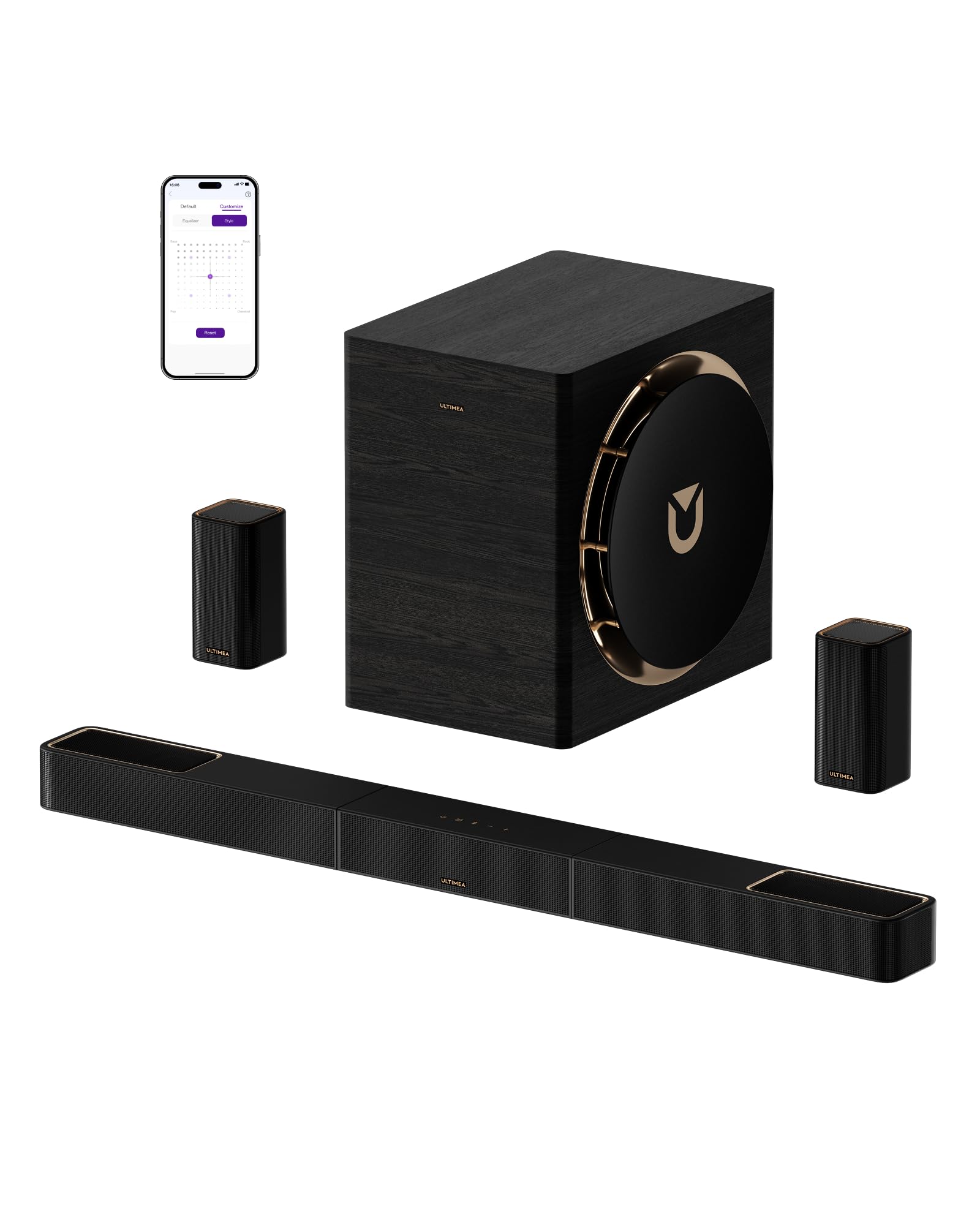
The ULTIMEA Skywave X70 delivers a 7.1.4 channel layout with a 10-inch wireless subwoofer that pushes low frequencies down to 20Hz, creating tactile bass you feel in the floorboards. The GaN amplifier provides 980W peak power with under 0.5% distortion, keeping dialogue and effects crisp even during loud action sequences. Rear surround speakers use dual 5GHz wireless transmission to avoid dropout, a common pain point in lesser systems.
Setup is straightforward via HDMI eARC, and the three-piece soundbar assembles into a single sleek unit with rose gold accents. The ULTIMEA app offers a 10-band EQ and 121 presets, giving you fine-grained control without a receiver. Owners report that the subwoofer alone transforms the room, with clean bass at moderate volumes and room-shaking power when pushed.
The only limitation is the lack of automatic room calibration — you’ll need to manually position the rear speakers for optimal imaging. Some users note the subwoofer placement heavily influences bass tightness, so experimenting with location is part of the setup process. For the price, this system competes with models costing significantly more.
Why it’s great
- 20Hz low-frequency extension for deep bass
- GaN amplifier with 980W peak power
- Dual 5GHz wireless rears with stable connection
Good to know
- No auto-room calibration
- Subwoofer placement critical for best sound
- Soundbar assembly in three pieces may be bulky
2. TCL Q85H 7.1.4 Surround Sound Bar

The TCL Q85H is a 7.1.4 channel system with upgraded rear speakers that include both front- and up-firing drivers. This design means effects specifically come from behind and above, not just the main bar. The 860W peak power and 6.5-inch wireless subwoofer deliver distortion-free sound at high volumes, making it capable of filling larger living rooms.
AI Sonic Optimization sets this system apart — it analyzes your room and seating position through the TCL app, adjusting sound balance automatically. This reduces the need to manually tweak for off-center seats. Dolby Atmos and DTS:X decoding ensure compatibility with modern streaming and Blu-ray content, and the system pairs seamlessly with TCL TVs via HDMI eARC.
Some buyers note the system struggles with non-Atmos content, where dialogue can feel quiet compared to loud effects. There is no individual channel volume adjustment, which limits fine-tuning if a rear speaker is too close or far. For a dedicated home theater setup, this remains one of the strongest solutions at its price tier.
Why it’s great
- Rear speakers with up-firing drivers
- AI Sonic room optimization
- High output power without distortion
Good to know
- No individual channel volume control
- Non-Atmos content may need EQ tuning
- Requires power outlet for rear speakers
3. JBL Bar 700MK2 7.1Ch

The JBL Bar 700MK2 uses detachable wireless surround speakers that lift off the main bar and charge internally, needing no external power outlet. This makes rear channel placement infinitely flexible — you can set them on a side table, behind a couch, or even in front with the soundbar in night mode. The 780W peak power and 10-inch wireless subwoofer anchor the low end with serious authority.
MultiBeam 3.0 technology widens the soundstage for listeners seated off-center, and PureVoice 2.0 dynamically adjusts dialogue volume so whispers remain audible without raising the master volume. Night mode mutes the soundbar and subwoofer entirely, allowing the detachable speakers to deliver intimate audio just for one or two people.
Owners report excellent sound quality but mention the surround speakers lack a bit of volume compared to wired alternatives. The app-based equalizer is necessary to reduce subwoofer bass, which can overwhelm at default settings. For apartments or rooms where permanent rear placement is impossible, this design solves a real space constraint.
Why it’s great
- Detachable surrounds need no outlet
- Night mode for solo listening
- PureVoice dialogue enhancement
Good to know
- Surround speakers could be louder
- Subwoofer may overpower out of box
- Requires app for full EQ control
4. LG S90TR 7.1.3-Channel

The LG S90TR features a 7.1.3 channel layout with a unique center up-firing speaker dedicated to dialogue clarity. This design prevents voices from being drowned out by background effects, a common issue with many surround bars. Wireless rear speakers connect without a receiver, and WOWCAST transmits Dolby Atmos signals wirelessly from LG TVs without an HDMI cable.
WOW Orchestra mode synchronizes the soundbar with LG TV speakers, producing a wider soundstage than the bar alone can achieve. Advanced Room Calibration uses a built-in microphone to measure dimensions and optimize timing and equalization. For gaming, VRR and ALLM passthrough support up to 120Hz, ensuring smooth audio sync.
Buyers note the system pairs best with LG OLED evo TVs for seamless control via one remote. The rear speakers are plug-and-play, but the subwoofer’s bass may fall short for those expecting deep rumble from a 10-inch unit. Overall, it is an exceptional match for LG owners wanting an upgrade without a complex receiver.
Why it’s great
- Center up-firing speaker for dialogue
- WOWCAST wireless Dolby Atmos
- 120Hz VRR passthrough for gaming
Good to know
- Best performance with LG TVs
- Subwoofer bass adequate not thundering
- Room calibration requires quiet environment
5. Samsung HW-Q900F 7.1.2ch
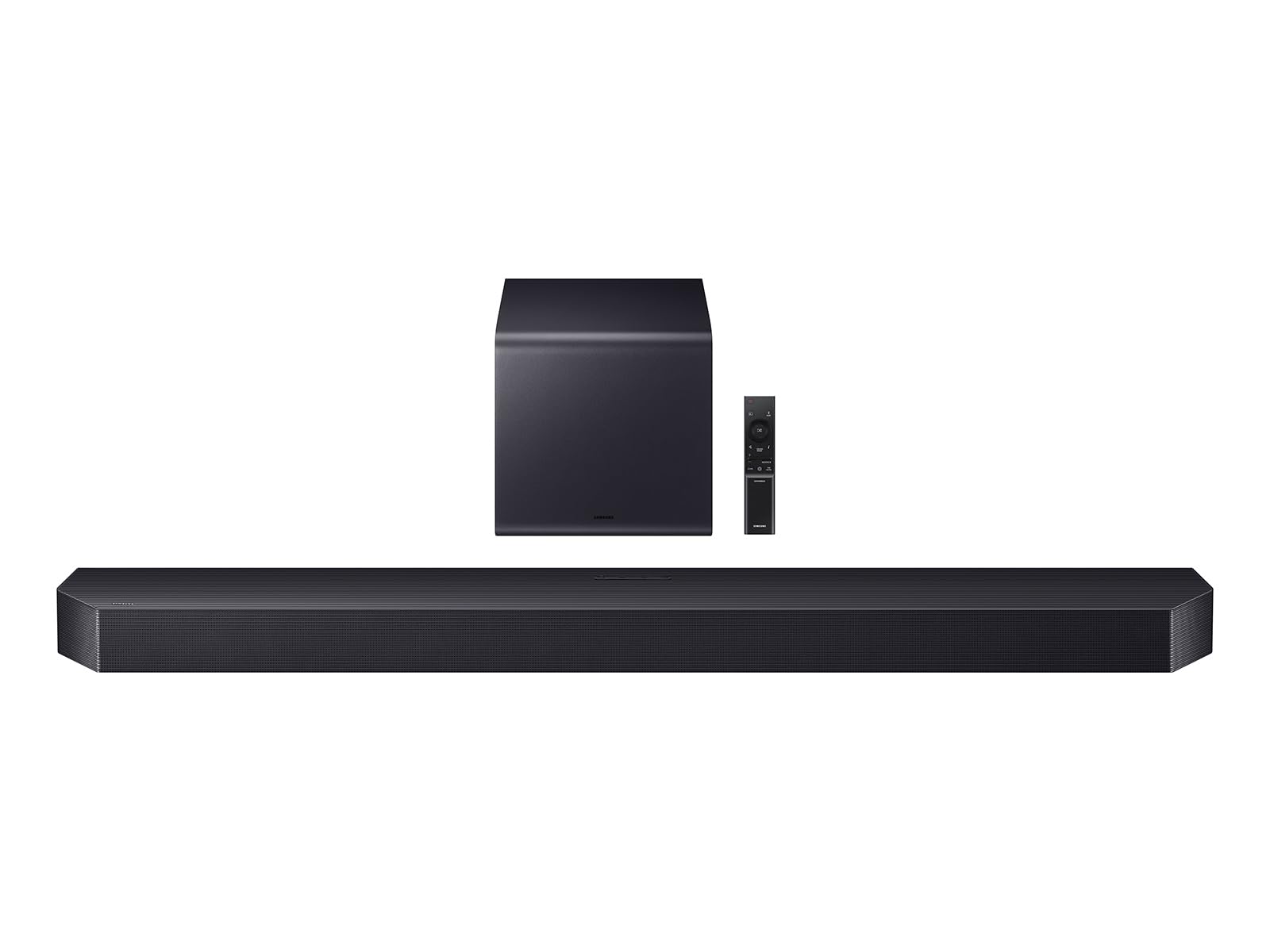
The Samsung HW-Q900F offers a 7.1.2 channel configuration with side, top, and wide-firing speakers. Q-Symphony lets compatible Samsung TVs use their built-in speakers simultaneously with the soundbar for a more robust soundfield. The soundbar uses a microphone to automatically calibrate audio to the room, optimizing bass and spatial imaging without manual adjustment.
Voice assistant support includes Alexa built-in, Google Cast, and Apple AirPlay 2, integrating the bar into a smart home ecosystem seamlessly. The 2025 model emphasizes wireless Dolby Atmos, allowing connection without an HDMI cable for compatible Samsung TVs. Owners report crisp highs and deep bass with easy integration into existing Samsung setups.
Music reproduction may disappoint compared to dedicated bookshelf speakers — some owners find the sound less balanced for high-resolution tracks. The soundbar is also noticeably tall at four inches, which may block a TV’s IR sensor if not wall-mounted. For movie and TV enthusiasts within the Samsung ecosystem, this is a capable choice.
Why it’s great
- Q-Symphony with Samsung TVs
- Automatic room calibration
- Alexa and AirPlay 2 built-in
Good to know
- Music sound quality may be lacking
- Tall profile can block TV sensor
- Premium price for ecosystem lock-in
6. ULTIMEA Skywave X50 5.1.4ch
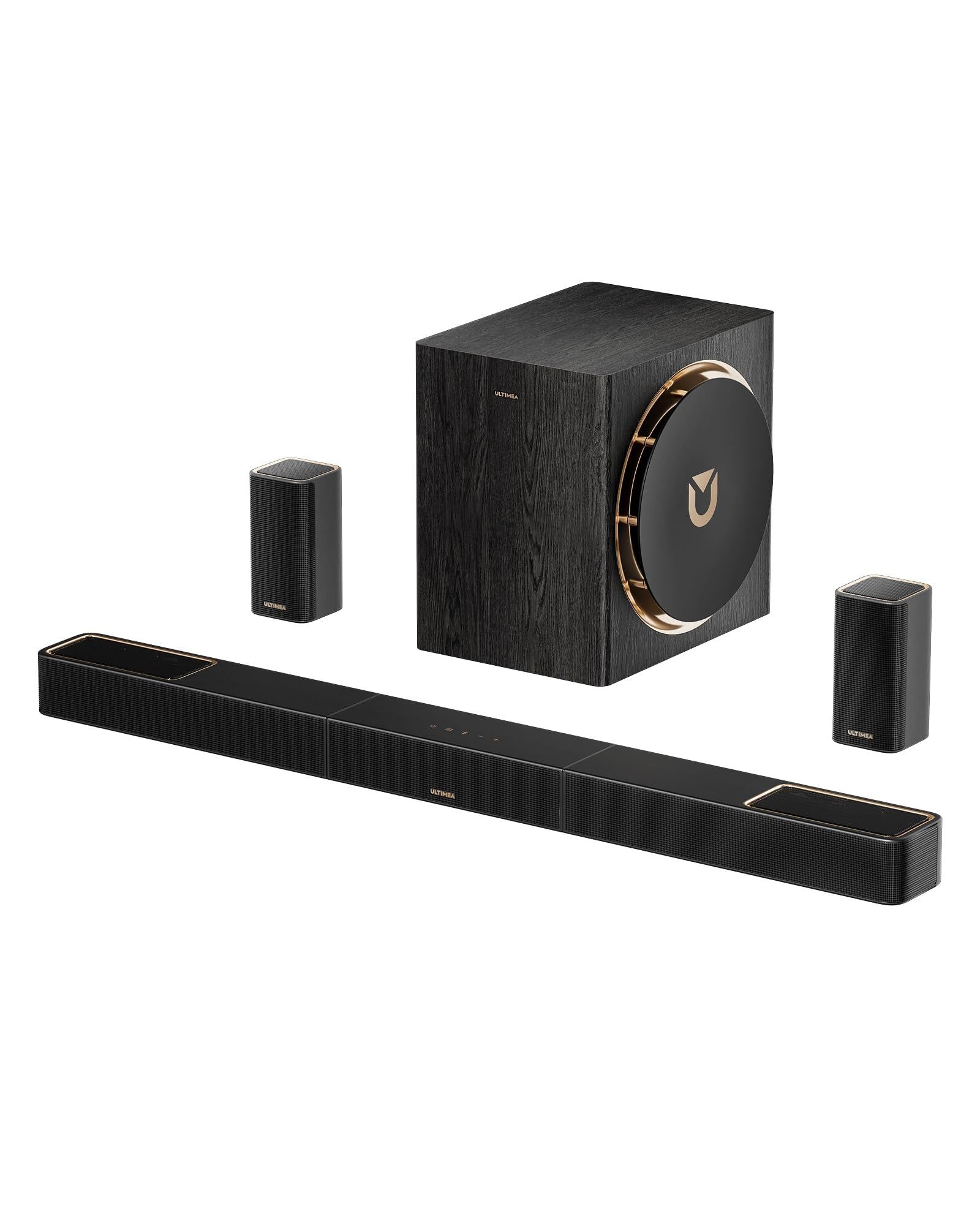
The ULTIMEA Skywave X50 is a 5.1.4 channel system with a 760W peak GaN amplifier and an 8-inch wireless subwoofer. Despite not being a true 7.1 configuration, it competes directly by using two wireless surround speakers with up-firing drivers to create convincing height effects. The dual 5GHz wireless transmission keeps rears drop-free in most home layouts.
Gravus Ultra-Linear Bass Technology in the subwoofer delivers clean low-end down to 28Hz — lower than many budget 7.1 bars manage. The NEURACORE multi-channel audio engine processes up to 17 channels with under 0.5% distortion, enabling precise object-based audio placement for Dolby Atmos. Setup via HDMI eARC is simple, and the app provides full control over sound profiles.
The surround speakers are subtle compared to more expensive systems, excelling with ambient foley and rain effects rather than aggressive directionality. Subwoofer bass can overpower dialogue at default settings, requiring the app’s equalizer to tame it. For the price, it delivers wireless height effects that beat many wired budget systems.
Why it’s great
- GaN amplifier with 760W peak power
- Subwoofer digs down to 28Hz
- Dual 5GHz wireless for stable surrounds
Good to know
- 5.1.4 not true 7.1 channel count
- Surround speakers subtle in loud scenes
- Bass may need EQ adjustment
7. LG S95TR 9.1.5-Channel

The LG S95TR is a 9.1.5 channel powerhouse with an industry-exclusive triple up-firing array — center, left, and right rear — creating overhead effects that rival dedicated ceiling speakers. The system includes true wireless rear speakers that connect without a receiver, and WOWCAST transmits lossless Dolby Atmos from an LG TV without a physical HDMI connection.
Advanced Room Calibration uses a built-in microphone to measure the dimensions of the room and detect rear speaker placement, then optimizes timing and equalization for your specific layout. WOW Orchestra mode blends the soundbar with LG TV speakers for a cohesive front soundstage. For gaming, 120Hz passthrough with VRR and ALLM ensures minimal lag.
Customers consistently praise the theater-like immersion but note that the rear speakers are larger than many expect. The soundbar’s processing can require fine-tuning out of the box — voices may initially sound washed out until the center channel is increased. For users willing to adjust, the S95TR delivers one of the most convincing object-based audio experiences available from a soundbar.
Why it’s great
- Triple up-firing for overhead effects
- WOWCAST wireless Dolby Atmos
- Automatic room calibration
Good to know
- Rear speakers larger than expected
- Needs EQ adjustment for dialogue clarity
- Premium investment for best performance
8. Sonos Arc Ultra 9.1.4ch

The Sonos Arc Ultra uses proprietary Sound Motion technology to create a 9.1.4 spatial audio experience from a single bar, though full immersion requires adding the Sub and Era 300 rear speakers. The AI-powered Speech Enhancement feature detects human voices in the mix and clarifies every word without affecting the soundstage, a major advantage for dialogue-heavy content.
Trueplay tuning uses the microphone on your iOS device to analyze room acoustics and adjust the frequency response. The system integrates with Sonos multi-room ecosystem, allowing you to group the bar with other Sonos speakers throughout your home. Control is available via the Sonos app, TV remote, touch controls, Sonos Voice Control, or Amazon Alexa.
The Arc Ultra performs best within the Sonos ecosystem, and achieving a true 7.1 layout requires additional components that significantly raise the total investment. Some users wish the bar alone produced more bass without the separate Sub. For those already invested in Sonos or wanting a seamless multi-room audio system, the Arc Ultra is the benchmark.
Why it’s great
- AI Speech Enhancement for clear dialogue
- Seamless multi-room Sonos integration
- Trueplay acoustic room tuning
Good to know
- Requires Sub and Era 300 for true surround
- Higher total cost for full setup
- Bass limited from bar alone
9. Hisense AX5140Q 5.1.4ch
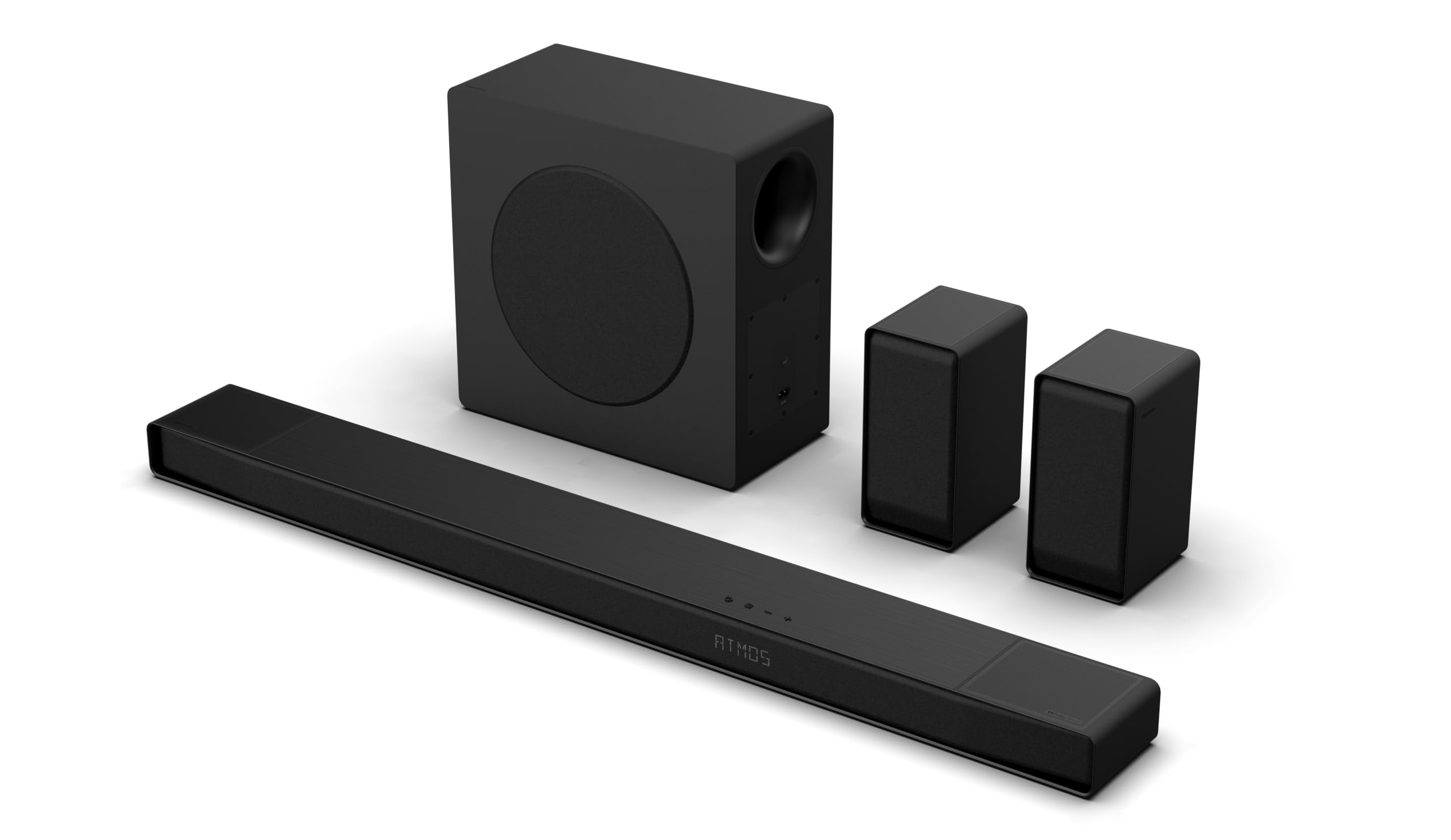
The Hisense AX5140Q is a 5.1.4 channel system that brings Dolby Atmos and DTS:X support to an entry-level price point. Six front-firing drivers, two up-firing speakers, and four surround speakers combine with a 6.5-inch wireless subwoofer to create a 3D soundstage. The 40Hz low-frequency extension provides adequate rumble for action scenes without overwhelming smaller rooms.
Seven quick-touch EQ modes (Movie, Music, Voice, Night, AI, Sport, Pro) allow instant tonal adjustments without diving into menus. HDMI eARC ensures single-cable connectivity with 4K HDR passthrough. The wireless subwoofer is compact enough to hide behind furniture, and the rear speakers add spatial depth for an immersive effect.
Some owners note that the up-firing speakers produce a height effect that is noticeable but not as powerful as premium systems. Rear speakers can feel underpowered in larger rooms, and Bluetooth audio occasionally garbles with certain iPhones. For a first-time surround buyer, this system offers strong value without requiring a significant commitment.
Why it’s great
- Dolby Atmos and DTS:X support
- Seven EQ presets for quick tuning
- Compact wireless subwoofer placement
Good to know
- Height effects weaker than premium bars
- Rear speakers lack power in large rooms
- Occasional Bluetooth audio glitches
10. ULTIMEA Poseidon D80 7.1Ch

The ULTIMEA Poseidon D80 is a 7.1 channel system with four wired surround speakers — two front and two rear — creating a dedicated 7.1 soundstage without wireless compression. The 6.5-inch wireless subwoofer provides the .1 channel with 40Hz extension, and the bar outputs 460W peak power. This configuration ensures that every channel is physically separate, which avoids the virtual processing many soundbars rely on.
Color-coded cables make identification straightforward during setup, and the system supports HDMI eARC for high-bitrate audio. The SurroundX System and 360° Aural Spatial Localization Technology work to position sound from every angle. The ULTIMEA app includes 121 expert EQ presets and a 10-band equalizer for granular sound shaping.
The system does not support DTS decoding, which limits compatibility with some older DVDs and Blu-rays. Some owners find the sound can feel hollow or flat before extensive EQ adjustment, and the remote requires line-of-sight. For those comfortable with cable management, the D80 offers a true seven-speaker layout at an aggressive price point.
Why it’s great
- True wired 7.1 with dedicated surrounds
- Color-coded cables for easy setup
- 121 EQ presets and 10-band equalizer
Good to know
- No DTS decoding support
- Sound may require EQ tuning out of box
- Remote needs clear line-of-sight
11. KEF XIO Dolby Atmos 5.1.2
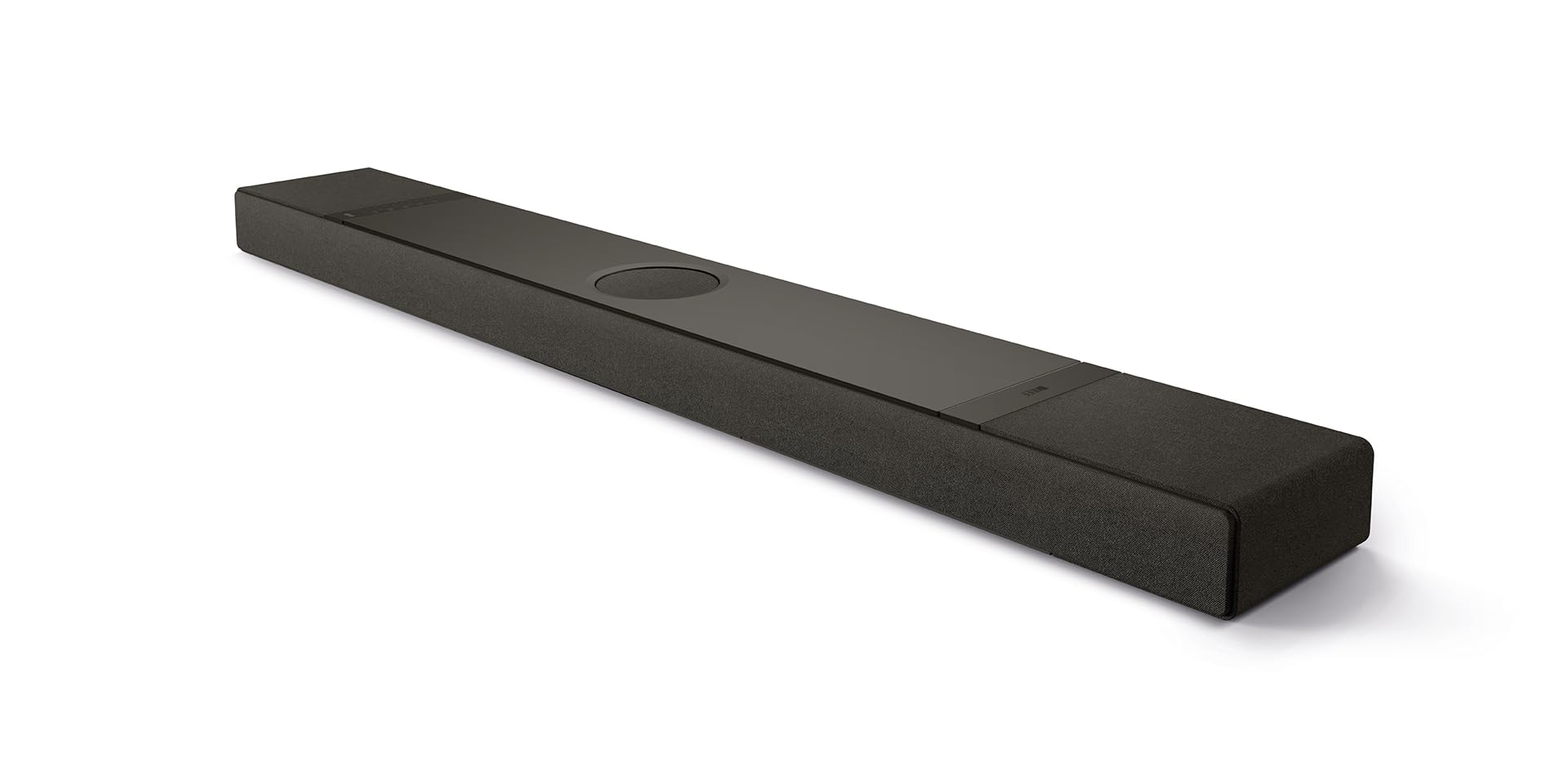
The KEF XIO is a 5.1.2 channel system built around 12 discrete amplifiers delivering 820W peak power into dedicated drivers. It is designed for audiophile-grade soundstaging, with a wide, natural soundfield that excels at music reproduction — a rarity among soundbars. The bar automatically senses whether it is placed on a credenza or wall-mounted and adjusts the speaker tuning accordingly.
Connectivity is comprehensive: HDMI eARC, Wi-Fi, Ethernet, Bluetooth 5.3, Apple AirPlay, Google Cast, and Spotify Connect. It supports Dolby Atmos, DTS:X, and up-mixes stereo content to spatial audio. The included remote and KEF Connect App provide access to Movie, Dialogue, and Night modes, plus a fully customizable equalizer.
The XIO produces impressive bass for a bar without a separate subwoofer, but serious home theater enthusiasts will want to pair it with an external sub for LFE-level impact. Some users have reported difficulty connecting the app after a factory reset. For music-first listeners who also want spatial audio for films, the KEF XIO is the most musically refined soundbar on this list.
Why it’s great
- 12 discrete amplifiers for precise channel control
- Excellent music reproduction and soundstaging
- Automatic placement sensing and tuning
Good to know
- Better with external sub for movie LFE
- App connectivity can be unreliable
- Higher investment for a 5.1.2 system
FAQ
Does a 7.1 soundbar need rear speakers to be real 7.1?
What does the third number in 7.1.4 mean for a soundbar?
Do I need HDMI eARC for a 7.1 soundbar?
Final Thoughts: The Verdict
For most users, the 7.1 soundbar winner is the ULTIMEA Skywave X70 because it combines a genuine 7.1.4 channel layout with a 10-inch subwoofer that reaches 20Hz, GaN amplification, and stable wireless rears — all without requiring a separate receiver. If you want flexible room placement with no rear speaker wires, grab the JBL Bar 700MK2. And for an audiophile musical experience that also handles spatial audio, nothing beats the KEF XIO.