
Our readers keep the lights on and the weekend projects moving. As an Amazon Associate, I earn from qualifying purchases.
A true 7.2 surround sound system separates a living room from a cinematic experience — it’s the difference between hearing a movie and feeling the floor shake during an explosion. But with HDMI 2.1 handshake issues, room calibration quirks, and power ratings that don’t tell the whole story, finding the right receiver or speaker bundle for your space requires cutting through marketing noise.
I’m Rikta — the co-founder and writer behind FitlyFast. I’ve spent years analyzing AV receiver specs, decoding customer feedback on HDMI chipset failures, and comparing room correction suites like YPAO, Audyssey, and Dirac Live to help you avoid the traps that frustrate home theater builders.
Whether you’re upgrading from a soundbar or building your first dedicated theater, this guide breaks down the key specs, real-world quirks, and top options to help you select the best 7.2 surround sound system for your room and budget without the guesswork.
How To Choose The Best 7.2 Surround Sound System
Building a 7.2 system requires matching a receiver’s processing and amplification to your speakers, room size, and content sources. Four key specs determine whether your setup delivers balanced, room-filling sound or leaves you chasing upgrades.
HDMI 2.1 and Video Passthrough
If you own a PlayStation 5, Xbox Series X, or a 4K120Hz TV, your receiver must feature certified HDMI 2.1 inputs with 40Gbps or 48Gbps bandwidth. Without it, you lose VRR (Variable Refresh Rate) and ALLM (Auto Low Latency Mode), causing screen tearing or input lag during fast-paced games. Models from 2021 and 2022 used early chipsets that could fail at 4K120Hz — newer revisions are more reliable.
Room Correction and Calibration Systems
Every receiver includes auto-calibration, but the quality varies wildly. YPAO (Yamaha) offers basic distance and EQ tuning. Audyssey MultEQ XT32 (Marantz, Denon) provides detailed multi-point correction for complex room shapes. Dirac Live (Onkyo TX-RZ70) goes further, using machine learning to optimize frequency response and impulse control across your entire listening area — a must for rooms with reflective surfaces or multiple seating rows.
Power Output and Amplifier Topology
Receiver wattage ratings are often measured at one channel driven (1ch) with 1kHz test tones, not all seven channels simultaneously. Look for FTC-rated power at 20Hz-20kHz with all channels driven for real-world headroom. Class A/B amps (Sony STR-AN1000) run warmer but often sound more musical; Class D amps (JBL MA7100HP) run cooler with higher efficiency but can sound less refined at low volumes.
Speaker Configuration and Impedance Handling
A true 7.2 system can drive 4-ohm speakers without overheating, which matters for high-end towers like Klipsch Reference or Polk ES series. Ensure the receiver’s impedance switch (often labeled “4 ohm” or “6 ohm”) matches your speakers. Bi-amping capability on some receivers lets you power a speaker’s tweeter and woofer separately, but note — bi-amping uses two amplifier channels, reducing your system from 7.1 to 5.1 in practice.
Quick Comparison
On smaller screens, swipe sideways to see the full table.
| Model | Category | Best For | Key Spec | Amazon |
|---|---|---|---|---|
| Pioneer VSX-935 | Mid-Range Receiver | Budget-minded Atmos upgrade | HDMI 2.1 8K, 7ch x 80W | Amazon |
| Yamaha YHT-5960U | Bundle System | All-in-one starter package | 5.1 bundle w/ 8″ sub, 80W/ch | Amazon |
| Yamaha RX-V6A | Mid-Range Receiver | MusicCast multi-room integration | 7ch x 100W, 8K/60B HDMI | Amazon |
| Onkyo TX-NR6100 | Mid-Range Receiver | THX Certified gaming/Atmos | 210W/ch dynamic, THX Select | Amazon |
| Sony STR-AN1000 | Mid-Range Receiver | 360 Spatial Sound Mapping | 7ch x 165W (6 ohm), 8K | Amazon |
| JBL MA7100HP | Mid-Range Receiver | Class D efficiency with 8K | 7ch x 125W, Class D, 8K | Amazon |
| Klipsch Reference 5.1 Atmos | Speaker Bundle | Complete Dolby Atmos speaker set | Tractrix horn, 12″ 400W sub | Amazon |
| Marantz Cinema 70S | Premium Slim Receiver | Compact design, HEOS multi-room | 7ch x 50W, slim chassis, 8K | Amazon |
| Sony STRAZ1000ES | Premium ES Receiver | High-end Sony ES series sound | 7ch x 100W (8 ohm), 8K, ES | Amazon |
| Onkyo TX-RZ70 | High-End Receiver | Dirac Live, 11ch upgradability | 11ch x 140W, Dirac, ESS Sabre | Amazon |
| Nakamichi Dragon 11.4.6 | Premium Soundbar System | Plug-and-play, massive bass | 11.4.6ch, 3000W peak, AMT | Amazon |
In‑Depth Reviews
1. Onkyo TX-RZ70
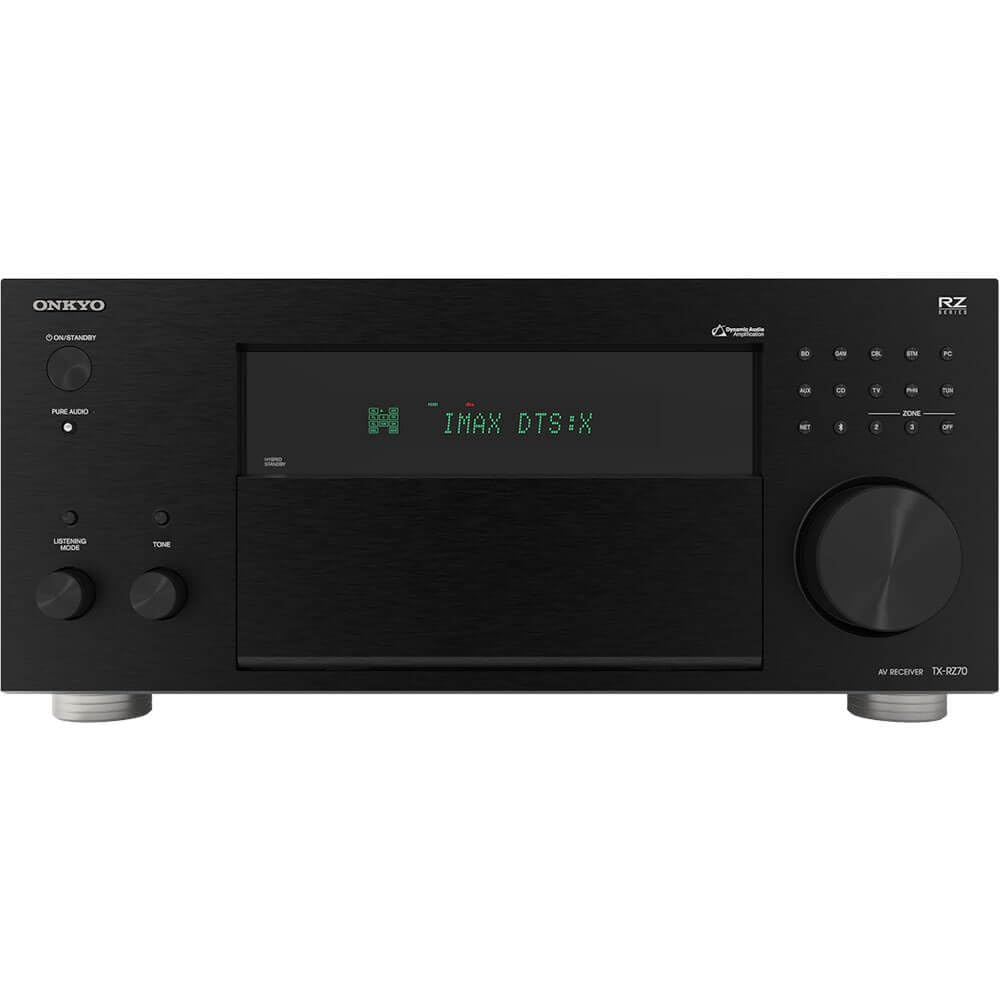
The Onkyo TX-RZ70 is a reference-grade 11.2-channel receiver that punches far above its price class, delivering 140 watts per channel with ESS Sabre DACs and Dirac Live room correction out of the box. In real-world testing, it drives 4-ohm Klipsch RF-7 III towers effortlessly, maintaining clean, dynamic sound without distortion even at high reference levels. The built-in Dirac Live Full Bandwidth uses machine learning to flatten frequency response and tighten bass across multiple seating positions — a feature typically reserved for receivers costing twice as much. THX Select certification ensures transparent signal integrity across all inputs, and the IMAX Enhanced mode stretches the aspect ratio for up to 26% more picture on your screen.
Gamers benefit from full HDMI 2.1 support with 4K120Hz passthrough, VRR, and ALLM, and the receiver handles DTS:X Pro and Auro-3D for 7.2.4 Atmos setups. The pre-outs let you integrate external amplifiers for the front channels if you ever outgrow the internal amps. The remote feels a bit cheap for this price tier, and the unit is exceptionally large (57.85 pounds) — you’ll need a dedicated AV cabinet. Zone2 control lacks on-screen volume feedback, a minor software miss. But for pure price-to-performance value, no other receiver under four grand matches the TX-RZ70’s combination of power, processing, and calibration sophistication.
Long-term reliability appears strong with zero HDMI handshake issues reported across firmware updates, and the ESS Sabre 32-bit DACs deliver audiophile-grade stereo performance for music streaming via Roon Ready. If you’re building a 7.2.4 Atmos system and want Dirac Live without spending on a separate MiniDSP or external calibration kit, this is the receiver to anchor your setup.
Why it’s great
- Rated 140W, tested at 170W per channel clean
- Dirac Live Full Bandwidth included, no extra cost
- ESS Sabre DACs for pristine stereo and multi-channel
- Runs cool even at high volume levels
- Pre-outs for easy future amp upgrades
Good to know
- Very large and heavy — needs a deep AV cabinet
- Remote feels budget-tier for this price
- Zone2 volume control lacks on-screen feedback
2. Sony STRAZ1000ES

The Sony STRAZ1000ES is the ES-series receiver for purists who want Sony’s legendary 360 Spatial Sound Mapping and a robust 7.2-channel platform with 100 watts per channel into 8 ohms. Its Digital Cinema Auto Calibration IX (DCAC IX) performs multi-point room correction with phase matching, and the 360SSM technology creates phantom height channels so effectively that a 5.1.2 setup with Dolby-enabled speakers sounds nearly identical to a 7.1.4 configuration. The receiver runs very hot, so you’ll want an AC Infinity Aircom T10 cooling fan above it — Sony’s ES line prioritizes sound quality over thermal efficiency. The backlit remote is a welcome premium touch missing from many competitors.
Video handling is excellent with 8K/60 and 4K/120 passthrough, Dolby Vision, HDR10, and IMAX Enhanced support. The on-screen graphical UI makes setup straightforward, and the web browser interface lets you tweak settings without the remote. Some users report that the auto-calibration overestimates subwoofer distance by about 12 feet, requiring manual measurement for proper phase alignment. There’s no HDR10+ support, which may matter if you own a Panasonic UB820 or Samsung TV that relies on dynamic metadata. The DAC section is revealing enough that poor-quality sources sound noticeably worse — this receiver rewards clean source material.
For dedicated home theater enthusiasts who want Sony’s proprietary spatial processing and the build quality of the ES line (including a thick front cover plate for a clean rack look), the STRAZ1000ES delivers a uniquely engaging surround experience. Pair it with Klipsch RP speakers for a dynamic combo, and plan for active cooling if your cabinet lacks ventilation.
Why it’s great
- 360 Spatial Sound Mapping creates convincing virtual height channels
- Backlit remote with clean, premium feel
- Works with Sonos for whole-home audio integration
- Web UI and app control for easy adjustments
Good to know
- Runs very hot — active cooling recommended
- No HDR10+ passthrough
- Auto-calibration may overestimate subwoofer distance
3. Marantz Cinema 70S

The Marantz Cinema 70S is a slim-line 7.2-channel receiver (just 4 inches tall) that fits into media consoles where full-size AV receivers won’t. It delivers 50 watts per channel — modest by high-end standards but sufficient for small to medium rooms with efficient speakers (90dB+ sensitivity). The built-in Audyssey MultEQ XT32 room correction is the same system used in Marantz’s flagship models, offering precise multi-point EQ adjustment for clear dialogue and balanced surrounds. Dolby Height Virtualization and DTS Virtual:X upmix legacy stereo or 5.1 content to 3D sound without needing physical height speakers. The HEOS platform lets you group this receiver with other Marantz/Denon devices for whole-home audio streaming via Spotify, TIDAL, and AirPlay 2.
HDMI connectivity includes three 8K/60 inputs and one 8K output, all supporting HDR10+, Dolby Vision, and Dynamic HDR. The phono input is a welcome addition for vinyl enthusiasts. The front panel display is small and lacks any detailed feedback — you’ll rely heavily on the on-screen menu. The remote is not backlit, and the network control app occasionally loses connection, requiring a reboot. The 50W rating means you can’t drive power-hungry 4-ohm speakers to reference levels in large rooms — plan accordingly. The build quality is excellent, with the classic Marantz porthole display adding visual flair to your rack.
For apartment dwellers, desktop audio setups, or anyone integrating a receiver into a sleek modern console, the Cinema 70S offers a rare blend of compact size and premium room correction. Pair it with bookshelf speakers or a 5.1.2 Atmos setup for a clean, capable system that doesn’t dominate your living space.
Why it’s great
- Ultra-slim chassis fits tight spaces
- Audyssey MultEQ XT32 calibration is top-tier
- Phono input for turntable integration
- HEOS multi-room streaming works seamlessly
Good to know
- 50W/ch limits speaker and room size choices
- Network app can lose connection sporadically
- Not backlit remote and minimal front display
4. Onkyo TX-NR6100
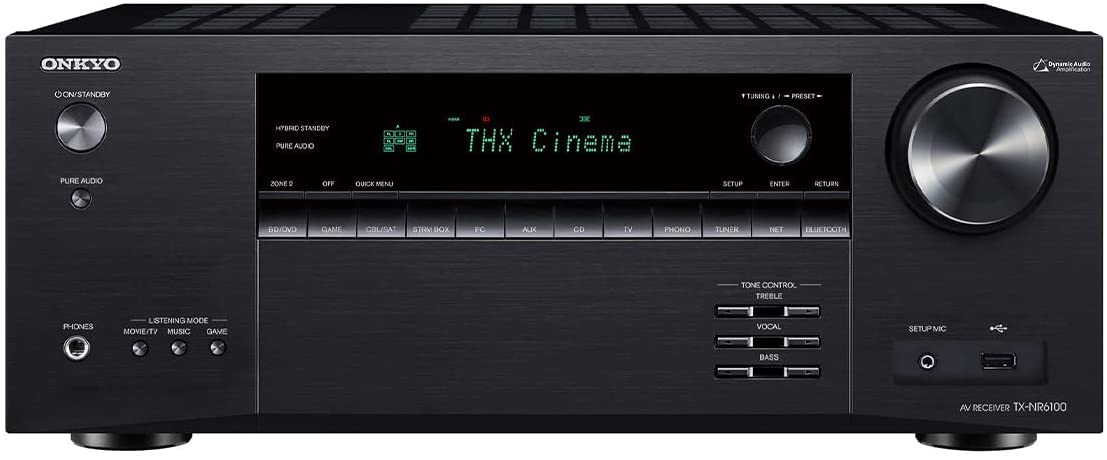
The Onkyo TX-NR6100 is a THX Select-certified 7.2-channel receiver designed for gamers and home theater fans who want full HDMI 2.1 bandwidth (40Gbps) for 4K120Hz with VRR. Its 210W/ch dynamic power rating (measured at 6 ohms, 1kHz, 1ch driven) provides generous headroom for transient peaks during action scenes, and the THX certification guarantees transparent audio reproduction across all channels. Dolby Atmos and DTS:X decoding is fully supported, and the AccuEQ room calibration with AccuReflex technology aligns timing between direct and reflected sound from Dolby Atmos speakers.
The eight HDMI inputs (three at 8K/60) give you plenty of ports for consoles, streaming boxes, and a PC. The non-backlit remote is the main ergonomic complaint — you’ll need to memorize button positions in a dark room. Bi-amping the front speakers uses two surround channels, reducing your 7.1 system to 5.1, so plan your speaker configuration carefully. Some early production units had HDMI 2.1 chipset issues (black screens at 4K120Hz), but later firmware and hardware revisions have resolved this. The fan noise is noticeable in very quiet scenes if the receiver is in an open rack.
For a mid-range receiver that punches above its weight with THX certification and robust gaming support, the TX-NR6100 is hard to beat. Pair it with Klipsch or JBL speakers for a dynamic 5.1.2 Atmos setup and take full advantage of the IMAX Enhanced mode for native Imax content.
Why it’s great
- THX Select certification for guaranteed performance
- Full 40Gbps HDMI 2.1 with VRR for gaming
- 260W dynamic power provides excellent headroom
- Eight HDMI inputs for multiple sources
Good to know
- Non-backlit remote is hard to use in the dark
- Bi-amping reduces system to 5.1
- Fan noise can be audible in quiet passages
5. Sony STR-AN1000

The Sony STR-AN1000 is a 7.2-channel receiver that brings Sony’s 360 Spatial Sound Mapping technology to the mid-range, creating phantom height and surround channels that make a 5.1.2 setup feel like a 7.1.4 system. Its 165W/ch rating (6 ohms, 1kHz, 1ch THD 0.9%) provides ample power for medium to large rooms, and the Digital Cinema Auto Calibration IX (DCAC IX) includes reflex optimization for Dolby Atmos-enabled speakers. The on-screen graphical setup guide walks you through speaker connection, calibration, and source assignment without needing to consult the manual.
The STR-AN1000 works with Sonos for whole-home audio, supports Bluetooth, Wi-Fi, Chromecast built-in, Spotify Connect, and Apple AirPlay 2. The six HDMI inputs (two outputs) include three 8K-capable ports, all with Dolby Vision, HDR10, and HLG support. A known quirk: the auto-calibration may add 12 feet to the subwoofer distance, requiring manual measurement with a tape measure for correct phase alignment. The front display is small and hard to read from a distance, so you’ll rely on the TV overlay for volume and input info. Some users report that Dolby Vision passthrough to Apple TV 4K can fail, outputting SDR instead — check your firmware version before buying if you use an Apple TV.
For a mid-range receiver with the best surround virtualization in its class and superb music playback (thanks to the 32-bit DAC), the STR-AN1000 is a strong choice for living room setups where you can’t install ceiling speakers. Pair it with two Sony SW3 subwoofers for smooth, omnidirectional bass that doesn’t localize to one corner.
Why it’s great
- 360 Spatial Sound Mapping creates convincing virtual Atmos
- Easy on-screen setup guide reduces frustration
- Works with Sonos for whole-home audio
- Dual subwoofer outputs for smoother bass
Good to know
- Auto-calibration may overestimate sub distance
- Dolby Vision pass-through issues with Apple TV
- Small, hard-to-read front display
6. JBL MA7100HP
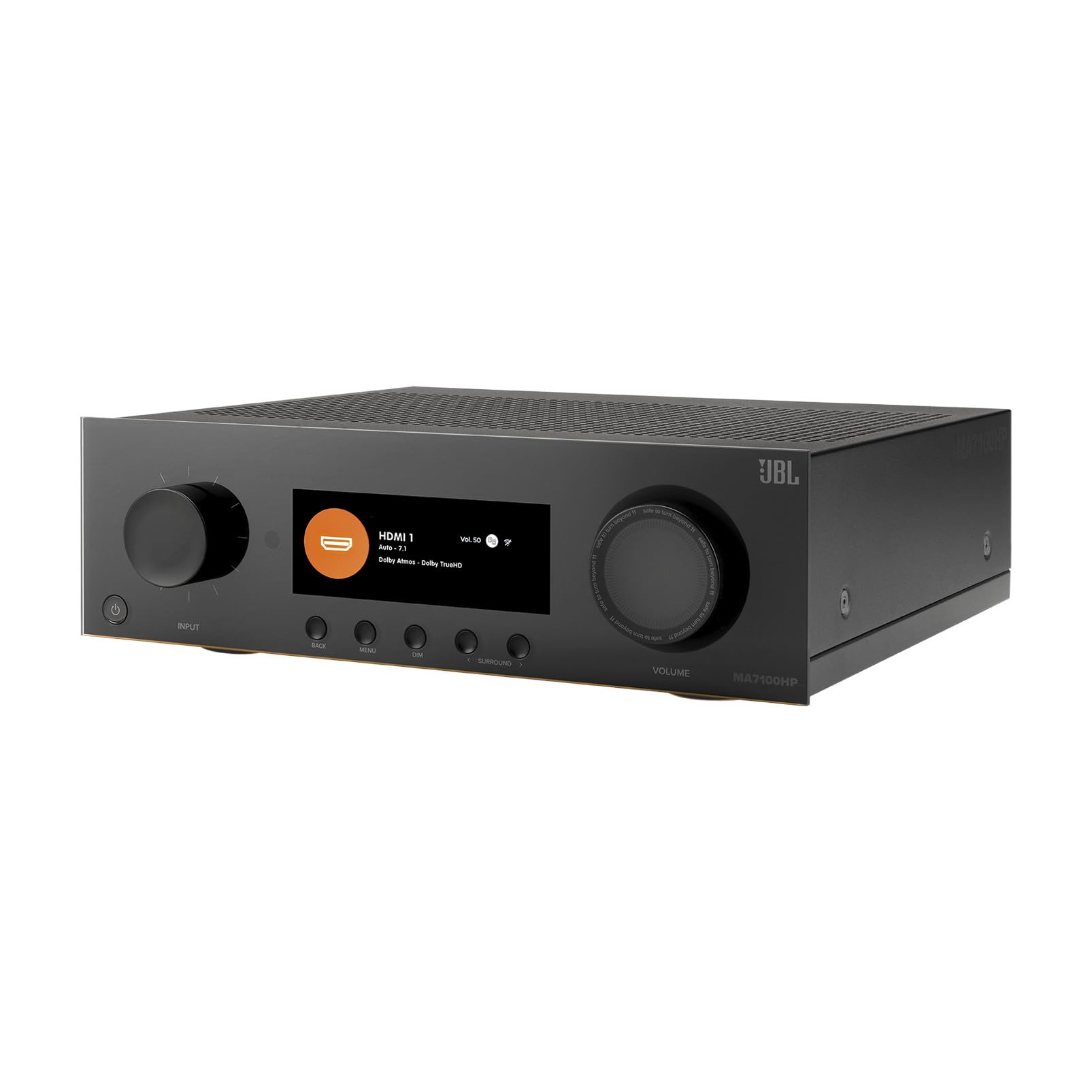
The JBL MA7100HP is a 7.2-channel receiver built around a low-noise Class D amplifier topology that delivers 125 watts per channel into 8 ohms with high efficiency and minimal heat. Its shallow chassis design makes it an excellent fit for media consoles where depth is limited. HDMI 2.1 connectivity supports 8K/60 and 4K/120 passthrough with Dolby Vision and HDR10+. The built-in music streaming supports Apple AirPlay 2, Google Chromecast, and Bluetooth, and the on-screen setup menu from the TV is responsive and easy to navigate.
The auto shut-off timer defaults to 20 minutes and must be manually changed — an annoyance if you want the receiver to stay on during long listening sessions. The remote is not backlit, which is a significant oversight for a receiver at this price point, and the front panel has a bright blue glow that can be distracting in a dark theater room. Some users report that the receiver fails to downmix DTS-HD Master Audio to 2.1 for stereo setups — if you run a 2.1 music system, this is a dealbreaker. JBL support acknowledges the issue and suggests a firmware fix, but no update has been released in over a year.
For a clean, powerful Class D receiver that drives 4-ohm speakers like Polk ES60 towers with ease and fits into tight cabinets, the MA7100HP delivers strong value. The lack of a backlit remote and DTS downmix limitation are real compromises, but if you’re building a 5.1.2 or 7.1 system with modern speakers, JBL’s efficient amplification and 8K support make it worth considering.
Why it’s great
- Efficient Class D amplifier runs cool
- Shallow chassis fits tight media consoles
- Full 8K/60 and 4K/120 HDMI support
- Drives 4-ohm towers without strain
Good to know
- Remote not backlit, hard to use in dark
- Cannot downmix DTS-HD MA to 2.1 for stereo setups
- Default 20-min auto shut-off is inconvenient
7. Yamaha RX-V6A

The Yamaha RX-V6A is a 7.2-channel receiver that has been a mid-range workhorse for years, delivering 100 watts per channel with YPAO R.S.C. (Reflected Sound Control) room correction that compensates for early reflections. It supports Dolby Atmos with Height Virtualization, DTS:X, and MusicCast multi-room streaming via Wi-Fi, Bluetooth, AirPlay 2, and Spotify Connect. The three 8K/60 HDMI inputs (plus four 4K inputs) cover current and future video needs, and the unit includes voice control with Alexa and Google Assistant. The build quality is solid, with banana plug-compatible speaker terminals that make multi-channel wiring clean.
The RX-V6A requires a firmware update out of the box to enable 8K passthrough and fix early HDMI 2.1 handshake issues — if you buy from a retailer with old stock, plan for a 30-minute setup before first use. The graphical user interface is basic, and the remote is not backlit. eARC works reliably with most modern TVs, though it won’t auto-turn-on with Sony TVs — you’ll need to power the receiver independently. The learning curve is steep for beginners, and the manual is dense; the MusicCast app can be frustrating to configure initially.
For a reliable, feature-packed receiver that pairs well with a variety of speaker brands (including 4-ohm loads), the RX-V6A is a safe bet for gamers and streamers. Its YPAO calibration is less precise than Audyssey or Dirac, but for living room setups with simple room shapes, it produces balanced, clear audio that satisfies most listeners.
Why it’s great
- MusicCast multi-room streaming is robust and stable
- YPAO R.S.C. compensates for room reflections
- Three dedicated 8K/60 HDMI inputs
- Handles 4-ohm speakers without issue
Good to know
- Firmware update required before first use
- Steep learning curve for setup
- eARC won’t auto-power-on with some TVs
8. Yamaha YHT-5960U Home Theater System

The Yamaha YHT-5960U is a complete 5.1-channel home theater bundle that includes the RX-V6A receiver (core of the system) plus four surround speakers, a center channel, and an 8-inch 50-watt powered subwoofer. This package is designed for first-time buyers who want a single-box solution with everything included — even pre-cut speaker wire matched to each channel’s length. The receiver supports 4K/120 and 8K/60 passthrough, Dolby Atmos (5.1.2 capable with additional ceiling speakers), YPAO room calibration, and MusicCast multi-room streaming. Setup is straightforward: color-coded speaker terminals and a quick-start guide get you running in under an hour.
The included speakers are entry-level: the subwoofer is underpowered for any room larger than 250 square feet, and the front left/right speakers sound thin compared to dedicated towers. Most owners end up upgrading the subwoofer to a 12-inch model within the first year, and the fronts to floorstanders for better soundstage depth and dynamics. The MusicCast app has a frustrating setup process that forces you to sign up for a Yamaha account. Reliability is a concern — some units fail within 12-18 months with buzzing or popping sounds, and warranty repairs can take two months. The 8-inch sub uses a 50W all-digital amp that runs out of headroom during action movies at moderate levels.
For a budget-conscious buyer who wants to get started with a name-brand 5.1 system and upgrade speakers later, the YHT-5960U provides a clean path into home theater. The receiver alone is worth the price, and the speakers serve as acceptable placeholders while you save for better components. Plan on replacing the subwoofer first — it’s the weakest link in the chain.
Why it’s great
- Complete 5.1 system with receiver, speakers, and wire
- RX-V6A receiver supports 8K/60 and Dolby Atmos
- Easy DIY installation with color-coded terminals
- MusicCast adds whole-home streaming potential
Good to know
- Included subwoofer is underpowered for larger rooms
- Front speakers lack bass extension and detail
- Reliability concerns with early units
- MusicCast app setup is frustrating
9. Pioneer VSX-935
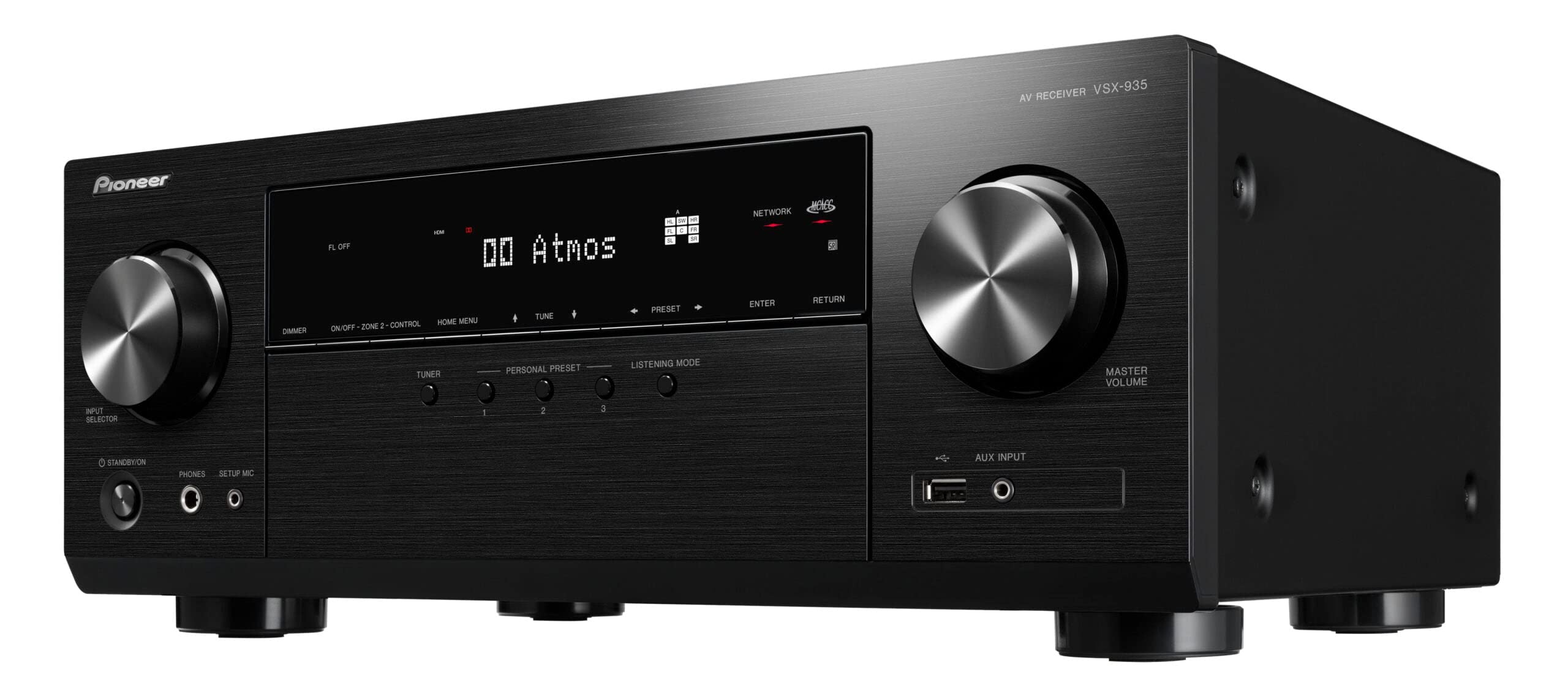
The Pioneer VSX-935 is a 7.2-channel receiver that brings Dolby Atmos Height Virtualization to the entry-level price bracket, creating a virtual surround and height effect from traditional speaker layouts without requiring overhead speakers. Its 80 watts per channel (rated 1kHz, 1ch driven) is adequate for small to medium rooms with efficient speakers (88dB+ sensitivity), and HDMI 2.1 support with 8K passthrough ensures compatibility with current gaming consoles. The dual-zone output lets you power a second pair of speakers in another room, and the clear front display with dimmer control is a thoughtful touch for dark theater rooms.
The VSX-935 does not include Wi-Fi — streaming requires Bluetooth or a wired Ethernet connection, which is a notable omission in 2024. The Bluetooth implementation is limited to two-way communication but is unreliable, buried in menus, and frequently drops connections. The on-screen interface looks dated, and the remote control lacks backlighting. Some units arrive with a dead display or no sound output on the first unit (often resolved by toggling the unused “Zone 2” mode). The automatic room calibration (MCACC) is basic compared to YPAO or Audyssey, producing acceptable but not refined results.
For a no-frills 7.2 receiver that lets you dip into Dolby Atmos without buying height speakers, the VSX-935 offers a functional entry point. Stick to wired Ethernet for streaming, plan for a possible unit exchange if you get a defective first sample, and consider upgrading to a mid-range model if you value wireless reliability and precise room correction.
Why it’s great
- Dolby Atmos Height Virtualization works without ceiling speakers
- HDMI 2.1 with 8K passthrough for future-proofing
- Dual-zone output for multi-room audio
- Clear front display with dimmer control
Good to know
- No built-in Wi-Fi — requires Ethernet for streaming
- Bluetooth is unreliable and menu-buried
- MCACC calibration is basic
- Intermittent quality control on first units
10. Klipsch Reference 5.1 Dolby Atmos Speaker System

The Klipsch Reference 5.1 Dolby Atmos system is a complete speaker package built around the R-625FA floorstanding towers with integrated up-firing elevation drivers for Dolby Atmos overhead effects. It includes the R-52C center channel for clear dialogue, R-41M bookshelf speakers for surrounds, and the R-12SW 12-inch powered subwoofer with a 400W peak amplifier. The Tractrix horn-loaded tweeters deliver the signature Klipsch sound — bright, dynamic, and high-efficiency (90-96dB sensitivity), meaning even a 75W receiver can drive them to reference levels without strain. The system covers a frequency range down to 45Hz from the towers alone, with the subwoofer extending to 28Hz for room-shaking bass.
The towers are 40 inches tall and weigh 50 pounds each — you’ll need floor space and sturdy legs. The supplied leg screws are weak (Klipsch includes poor-quality hardware), so budget for aftermarket spikes or isolation feet. The subwoofer’s 400W peak rating translates to about 100W RMS continuous, which is adequate for small to medium rooms (up to 300 sq ft) but will run out of headroom in larger spaces. The system ships in multiple boxes without notice — one box may arrive damaged with minor cosmetic issues. The Dolby Atmos up-firing effect works best with low, reflective ceilings (8-10 feet).
For a ready-to-go 5.1.2 Atmos speaker system that pairs perfectly with a mid-range receiver (Denon AVR-S760H or Sony STR-AN1000), the Klipsch Reference bundle provides excellent dynamics and presence for movies and music. Plan on replacing the subwoofer if your room exceeds 400 square feet, and consider upgrading the center channel to the RP-504C for even clearer dialogue.
Why it’s great
- Integrated up-firing Atmos drivers for overhead effects
- Tractrix horn tweeters deliver high sensitivity and dynamics
- 12-inch subwoofer provides impactful bass
- Complete 5.1 package with all speakers included
Good to know
- Supplied tower feet screws are low quality
- Subwoofer RMS power is limited for large rooms
- Ships in multiple boxes; packaging risks damage
11. Nakamichi Dragon 11.4.6 Surround System
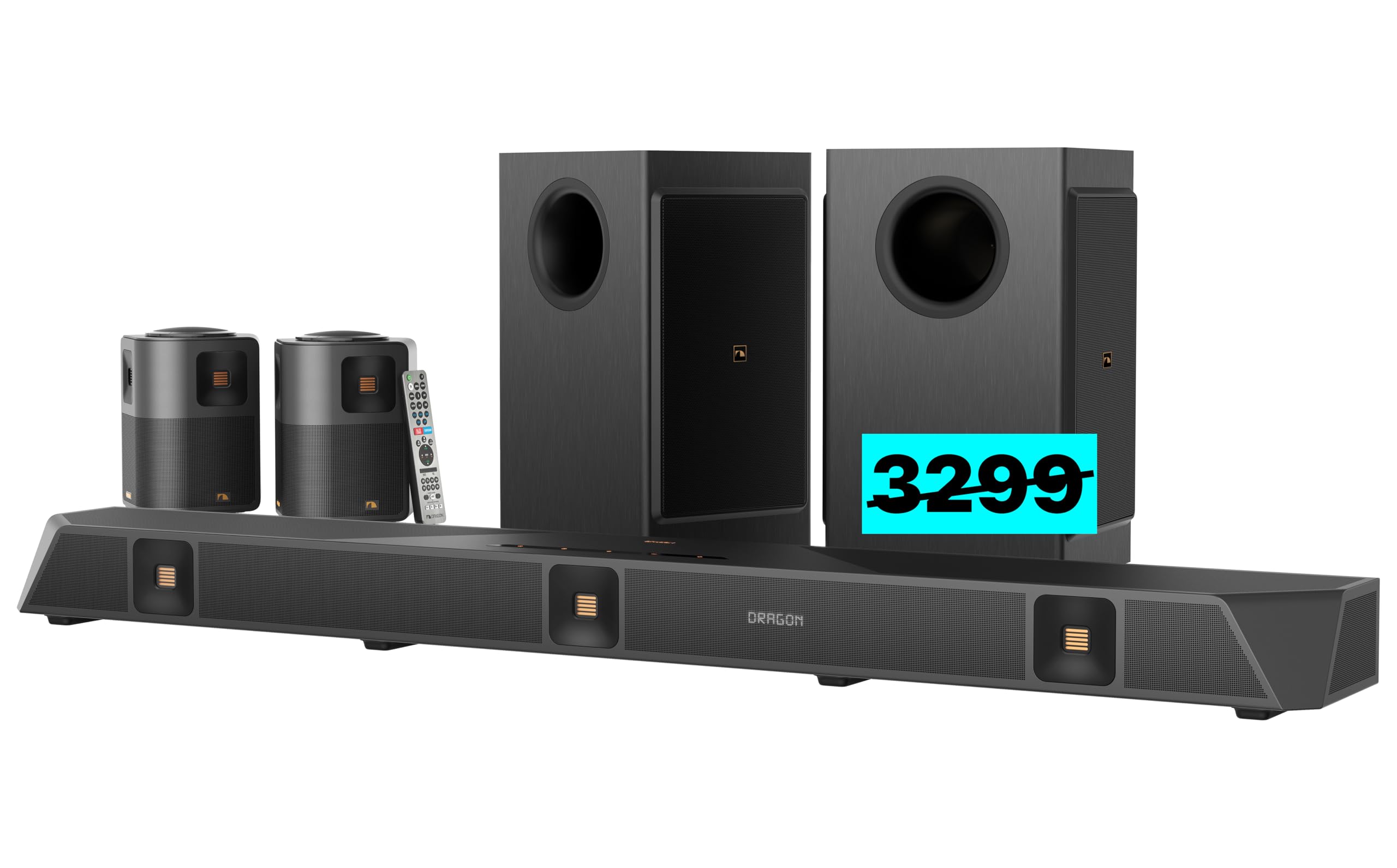
The Nakamichi Dragon 11.4.6 is an all-in-one, plug-and-play home theater system that delivers 11 discrete channels (including 6 dedicated height channels) through a soundbar-like main unit, two dual-opposing 8-inch subwoofers, and two Omni-Motion surround speakers. It bypasses traditional AV receiver complexity entirely — HDMI eARC connects to your TV, and the Pro-Cinema Engine handles Dolby Atmos (up to 24.1.10) and DTS:X Pro (up to 30.2) processing internally. The 58-inch-wide main unit houses 7 HiFi Air Motion Tweeters (AMTs) that preserve pristine high-frequency clarity even at reference volume levels, eliminating the harshness typical of dome tweeters at high output. The dual-opposing subwoofer design cancels cabinet vibration, delivering tight, clean bass down to 20Hz.
This is not a soundbar — the main unit alone weighs 32.2 pounds, each subwoofer weighs 34.4 pounds, and each surround speaker weighs 8.8 pounds. You need a large TV stand or wall mount for the main unit, and the subwoofers require floor space. The system ships in three boxes, and setup takes about 45 minutes (including firmware update via USB). The Omni-Motion surrounds project sound from both sides and above, creating the effect of six surround speakers. The PerfectHeight mechanism on the surrounds locks overhead effects to the sweet spot using an angled driver adjustment. Some users report auto-muting issues with Intel GPU drivers on PCs — using an Xbox One S or a dedicated media player avoids this. The system lacks analog RCA inputs, so vinyl enthusiasts will need an external phono preamp.
The Nakamichi Dragon is the best option for anyone who wants cinema-grade 3D sound without the complexity of a receiver, separate amplifiers, speaker wire runs, and calibration microphones. The 3000W peak output (with 11.4.6 channel processing) creates a truly enveloping surround field that outperforms many traditional 7.2 systems at its price. The only compromises are input flexibility and the inability to upgrade individual components — this is a closed ecosystem. For a dedicated theater room or large living room, the Dragon delivers visceral, reference-level sound with less hassle than any traditional setup.
Why it’s great
- True 11.4.6 processing with Dolby Atmos and DTS:X Pro
- AMT tweeters preserve clarity at high volumes
- Dual-opposing subs deliver clean, tight bass to 20Hz
- Plug-and-play setup with no receiver complexity
- Omni-Motion surrounds create convincing 3D soundstage
Good to know
- Large, heavy components require dedicated furniture
- No analog RCA inputs for turntables or legacy gear
- Auto-muting issues with certain PC GPU drivers
- Closed system — cannot upgrade individual components
FAQ
Can a 7.2 surround sound system work with a 5.1 speaker setup?
How do I prevent HDMI 2.1 handshake issues with my gaming console?
Final Thoughts: The Verdict
For most users, the best 7.2 surround sound system winner is the Onkyo TX-RZ70 because it combines Dirac Live Full Bandwidth room correction, ESS Sabre DACs, and 140W RMS per channel at a price that undercuts comparable receivers by thousands. If you want a compact, slim receiver with premium Audyssey calibration and HEOS multi-room streaming, grab the Marantz Cinema 70S. And for a plug-and-play system that delivers reference-level 3D sound without the complexity of a receiver, nothing beats the Nakamichi Dragon 11.4.6.