
Our readers keep the lights on and the weekend projects moving. As an Amazon Associate, I earn from qualifying purchases.
Waiting for the water to warm up while the kids are yelling from the bathroom isn’t a minor inconvenience—it’s a daily interruption that wears down your patience and your home’s energy budget. When your household demands simultaneous showers, laundry, and dishwashing without the dreaded temperature rollercoaster, a tankless solution stops being a luxury and starts being a necessity.
I’m Rikta — the founder and writer behind FitlyFast. I’ve spent the last several months analyzing the flow rates, BTU ratings, thermal efficiency, and real-world installation requirements of the most popular high-capacity tankless water heaters on the market to separate the real performers from the budget paperweights.
This guide breaks down the best options for replacing or upgrading to a high-capacity on-demand system, ensuring you pick the right unit for your family’s needs and your specific home setup when searching for your next 75 gallon water heater replacement.
How To Choose The Best 75 Gallon Water Heater
Replacing a massive storage tank with a tankless unit isn’t a direct swap. You need to match the unit’s capacity to your home’s peak demand, which is measured in gallons per minute (GPM), not storage gallons. A 75-gallon tank provides a reservoir, but a tankless unit must deliver the right flow rate *instantly*. Get this wrong, and you will be taking cold showers.
Flow Rate and BTU: The Real Performance Numbers
The two numbers that define a tankless heater’s ability to replace a 75-gallon tank are its flow rate (GPM) and its BTU input. A higher GPM means more fixtures can run simultaneously. For a large home, look for units offering 7.5 GPM or more. The BTU rating tells you how aggressively the unit can heat the water. A higher BTU (like 180,000 to 199,000) is essential for bringing cold incoming winter water up to shower temperature at a high flow rate. Skimping on BTU when you live in a colder climate is a classic mistake.
Condensing vs. Non-Condensing: Venting is the Dealbreaker
Condensing units use a secondary heat exchanger to capture exhaust heat, making them much more efficient (UEF over 0.90). The major practical difference is that they can vent using standard, less expensive PVC pipe, which is a massive advantage if you are retrofitting an existing home and don’t have a stainless steel chimney. Non-condensing units are simpler and often cheaper, but they require special Category III stainless steel venting, which adds cost and complexity to the installation. The choice here will determine your total project cost more than the price of the unit itself.
Gas Line and Electrical Requirements
Most high-output tankless water heaters require a 3/4-inch or even 1-inch natural gas or propane line to feed the burner. Your existing 1/2-inch gas line from a tank heater is almost certainly undersized. Factor in the cost of gas line upsizing when budgeting. Additionally, electronic ignition and the fan require a standard 120V electrical outlet, so a nearby plug is necessary. Ignoring these infrastructure needs is the number one reason installations stall.
Quick Comparison
On smaller screens, swipe sideways to see the full table.
| Model | Category | Best For | Key Spec | Amazon |
|---|---|---|---|---|
| A. O. Smith ATI-310CX3 | Mid-Range | Built-in Scale Prevention | 190,000 BTU / 8.0 GPM | Amazon |
| MIZUDO WCIU-HW199A1G-LP-M1n | Mid-Range | High Flow & WiFi Control | 199,000 BTU / 10.3 GPM | Amazon |
| Rheem RTG-95DVLN-3 | Premium | Proven Brand Reliability | 199,900 BTU / 9.5 GPM | Amazon |
| Rinnai RXP160iN | Premium | Smart Recirculation | 160,000 BTU / 9.0 GPM | Amazon |
| Westinghouse HW180A0G-NG | Mid-Range | WiFi Smart Home Integration | 180,000 BTU / 7.9 GPM | Amazon |
| Rinnai RUCS75iN | Premium | Contractor-Grade Build | 7.5 GPM (Condensing) | Amazon |
| Rinnai CX199iN | Premium | Max Capacity (11.1 GPM) | 199,000 BTU / 11.1 GPM | Amazon |
| FOGATTI Instagas 180S | Value | Outdoor Installation | 180,000 BTU / 8.1 GPM | Amazon |
| Rheem RTG-95DVLN-3 | Premium | High BTU Output | 199,900 BTU / 9.5 GPM | Amazon |
| Takagi T-H3J-DV-N | Premium | Ultra-Low NOx Emissions | 6.6 GPM (Condensing) | Amazon |
| ThermoMate RTC68iN | Mid-Range | High Efficiency Condensing | 163,000 BTU / 9.38 GPM | Amazon |
| Ranein Propane | Budget | Propane Fuel, Low Cost | 190,000 BTU / 8.5 GPM | Amazon |
| Stiebel Eltron Tempra 36 Plus | Mid-Range | Electric, Small Footprint | 36 kW / 1.5 GPM | Amazon |
In‑Depth Reviews
1. A. O. Smith ProLine XE ATI-310CX3
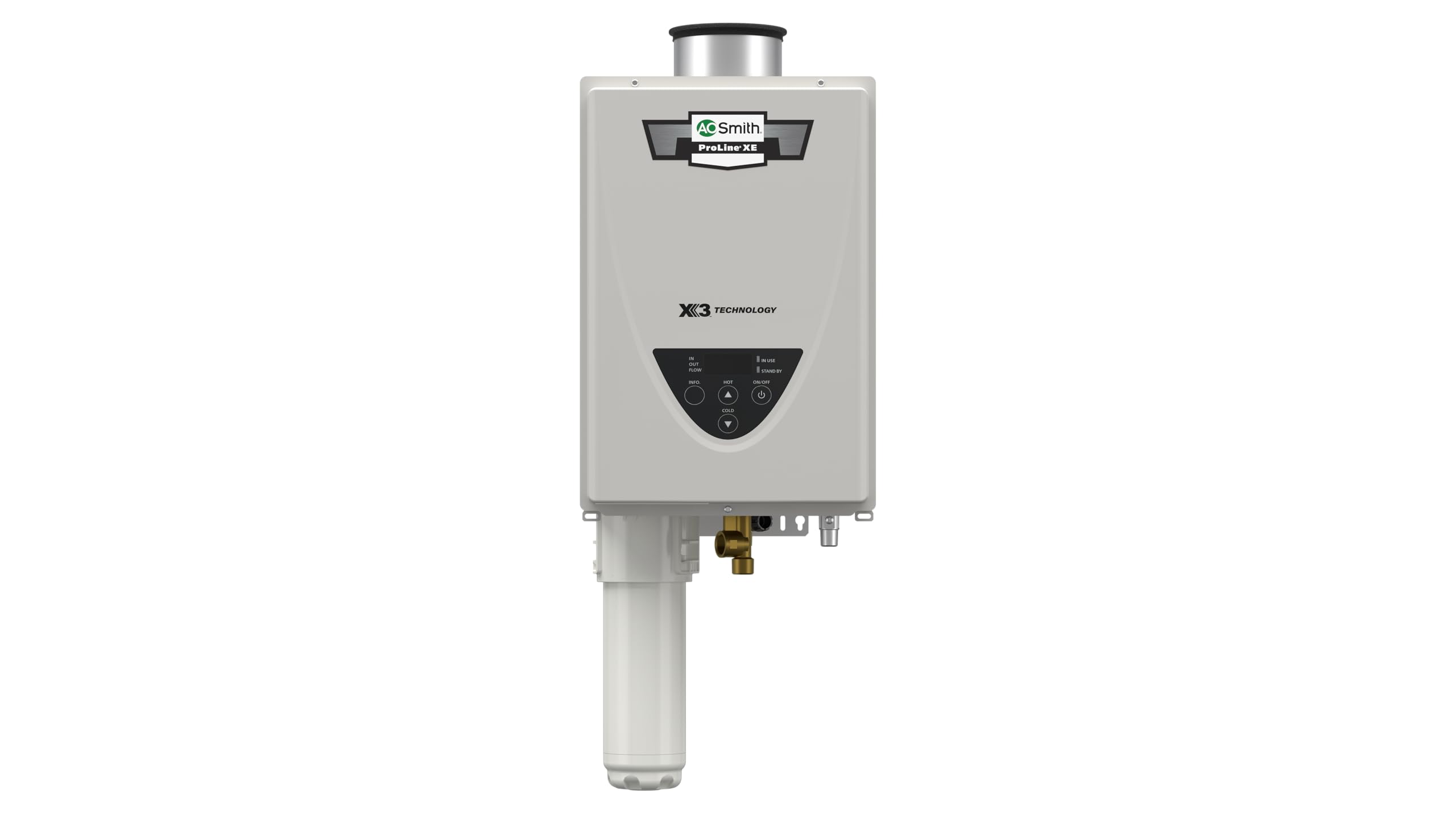
The A. O. Smith ProLine XE sets the standard for a mid-range unit that punches well above its weight, specifically because of its integrated X3 Scale Prevention Technology. This is a massive deal for anyone on municipal hard water, as it eliminates the need for annual descaling and external isolation valves—a recurring cost and hassle that most other units demand. The 190,000 BTU input and 8.0 GPM flow rate are perfectly balanced for a 3-4 bathroom home, offering enough thermal mass to keep showers hot even when the kitchen sink and washing machine are running.
The commercial-grade copper heat exchanger is a core differentiator here, providing 25 times better heat transfer than steel alternatives, which directly translates to faster heating and better energy efficiency (0.81 UEF). It’s also a non-condensing unit, which means it requires Category III stainless steel venting, a factor that simplifies the install for some while adding complexity for others. The included propane conversion kit adds significant flexibility for homes not on natural gas lines.
Build quality is exceptional, with a 15-year limited warranty on the heat exchanger reflecting A. O. Smith’s confidence. The trade-off is that it is a “professional installation recommended” unit due to the gas and venting requirements, which adds to the upfront cost. For a family that wants a reliable, low-maintenance workhorse with a trusted brand name, this is the benchmark.
Why it’s great
- Built-in X3 scale prevention eliminates descaling maintenance.
- Commercial-grade copper heat exchanger for superior thermal transfer.
- Includes propane conversion kit for fuel flexibility.
Good to know
- Non-condensing design requires stainless steel venting, not PVC.
- Professional installation is strongly advised due to gas line complexity.
2. MIZUDO WCIU-HW199A1G-LP-M1n
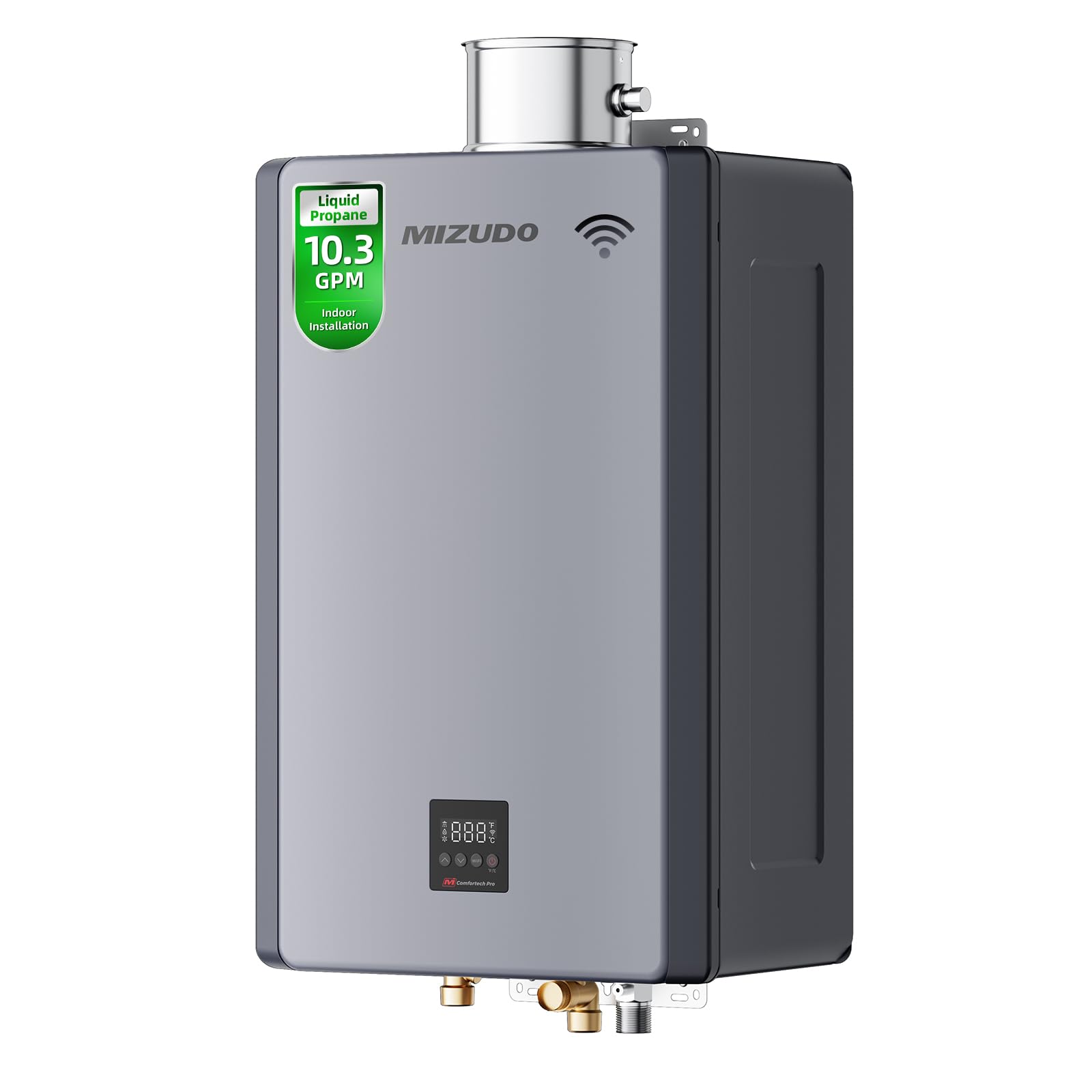
If your household runs multiple large tubs or you have a sprawling home with many bathrooms, the MIZUDO is a powerhouse that delivers the highest flow rate on this list at a mid-range price point. The 199,000 BTU burner is capable of 10.3 GPM, which is enough for five to seven fixtures at once, making it the true whole-home solution for a large family. The inclusion of WiFi and app control is a modern touch, allowing you to adjust temperature and monitor usage from your phone, which is a rarity at this price level.
This is a non-condensing indoor unit with a sealed direct vent system, meaning it draws combustion air from outside, which is safer and doesn’t compete with indoor air. The six-stage gas modulation technology is a key feature, designed to keep water temperature within ±1°F accuracy—a critical spec for preventing the “cold water sandwich” shock when a toilet is flushed mid-shower. The build feels solid at 55.5 pounds, indicating a robust heat exchanger.
The downsides are typical for a less established brand; some users noted the gas connection fitting wasn’t a standard 1/2 MIP, requiring a trip to the hardware store. Also, while it includes a 2-year full unit and 5-year heat exchanger warranty, long-term reliability data is thin compared to legacy brands. It is best for the owner who prioritizes raw capacity and smart features over brand history.
Why it’s great
- Class-leading 10.3 GPM flow for large, simultaneous usage.
- WiFi and app control for remote temperature and status monitoring.
- Six-stage gas modulation ensures precise ±1°F temperature stability.
Good to know
- Gas connection fitting size may require an adapter for standard hookups.
- Long-term reliability is less proven than established Japanese or American brands.
3. Rheem RTG-95DVLN-3
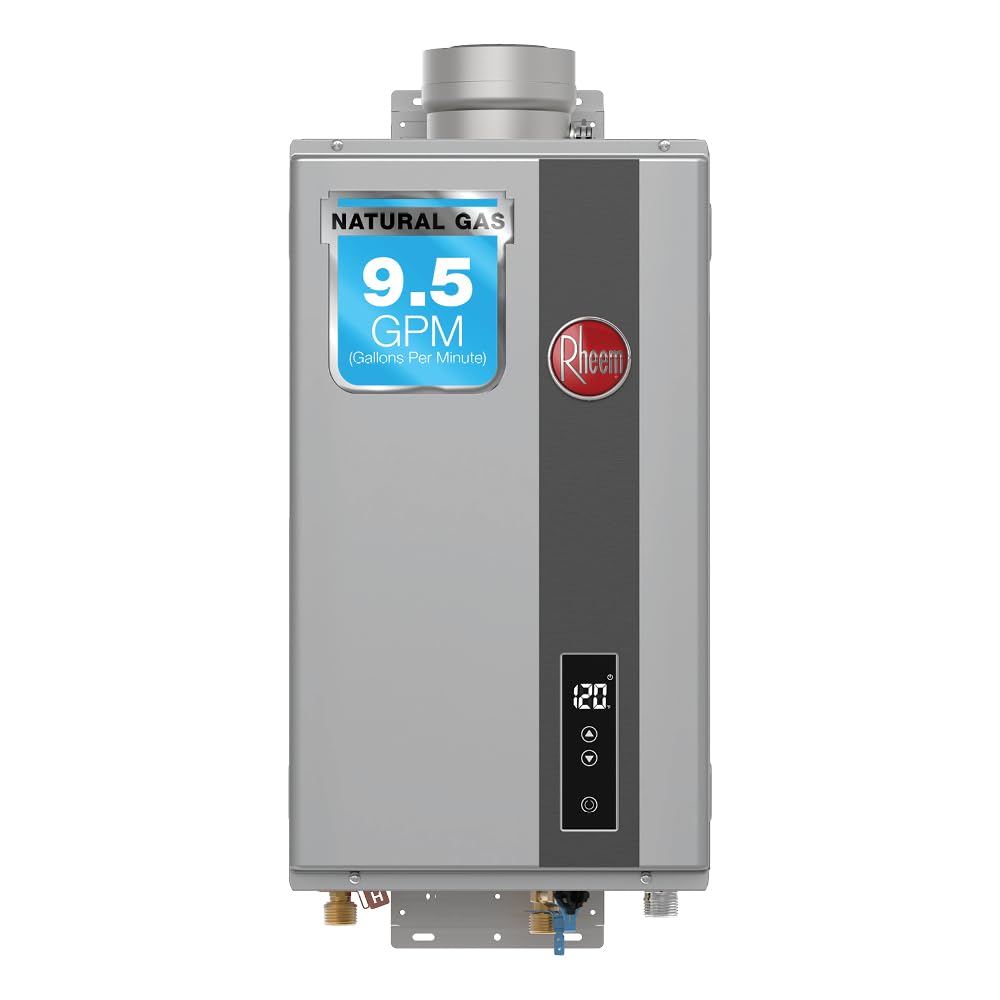
Rheem is a household name in water heating, and the RTG-95DVLN-3 is their high-output champion. With a massive 199,900 BTU input and a 9.5 GPM flow rate, it is designed to handle 2-3 bathroom homes with a very high demand. The “Hot-Start Programming” is a specific feature aimed at eliminating the initial cold burst you sometimes get between back-to-back showers, a subtle but important comfort enhancement for busy morning routines.
This is a non-condensing unit, so the venting rule applies—stainless steel is required. The efficiency rating of 0.82 UEF is respectable but not class-leading, a trade-off for the higher BTU output and simpler internal design. The unit is surprisingly compact for its capacity at 13.5 inches wide, making it easier to fit into existing mechanical closets. Rheem’s reputation for parts availability and technical support is a significant advantage for homeowners who want a trustworthy service network.
Some user reports note that the internal fan can be more audible than expected, and the unit requires a professional for gas and venting. The lack of scale prevention means you will need to plan for annual descaling if you have hard water, which is an ongoing maintenance cost to consider. It is the choice for the owner who trusts a major brand and needs high BTU power to overcome cold incoming water temperatures.
Why it’s great
- Highest BTU rating at 199,900 for excellent cold-weather performance.
- Hot-Start programming prevents cold water bursts between showers.
- Trusted brand with broad parts and service network availability.
Good to know
- Non-condensing design requires specialized stainless steel venting.
- No built-in scale prevention; requires regular descaling in hard water areas.
4. Rinnai RXP160iN

The Rinnai RXP160iN represents the pinnacle of convenience with its Smart-Circ intelligent recirculation pump built directly into the unit. This is not an add-on; it’s a fully integrated system that learns your family’s water usage patterns over time and pre-heats the water in the pipes right before you typically need it. The result is hot water at the tap in seconds, not minutes, saving a significant amount of wasted water over the lifespan of the heater. The UEF of 0.97 is outstanding, meaning nearly all the gas energy goes into heating the water.
As a condensing unit, it can vent using standard Schedule 40 PVC pipe, drastically simplifying a retrofit installation where you don’t have a metal chimney. It is also a “Versa Vent” unit that can be installed indoors or outdoors, offering maximum placement flexibility. The Smart Sense gas control allows it to run on either natural gas or propane without any hardware conversion kit. At 160,000 BTU and 9.0 GPM, it is powerful enough for most large homes, even if it doesn’t match the raw BTUs of the Rheem RTG.
The primary drawback is the ecosystem cost. Full WiFi control requires a separate Controlr module, which adds to the already premium price. The built-in recirculation, while brilliant, can cycle too frequently if not properly configured, potentially wasting energy. It requires professional setup to get the recirculation parameters right. This is the unit for the efficiency-conscious homeowner who wants the ultimate in convenience and is willing to pay for it.
Why it’s great
- Built-in Smart-Circ recirculation pump for near-instant hot water.
- 0.97 UEF efficiency rating reduces operational costs significantly.
- Versa Vent design for easy PVC venting or outdoor installation.
Good to know
- Premium price point; full WiFi features require a separate module.
- Recirculation pump settings are critical and may need professional tuning.
5. Westinghouse HW180A0G-NG
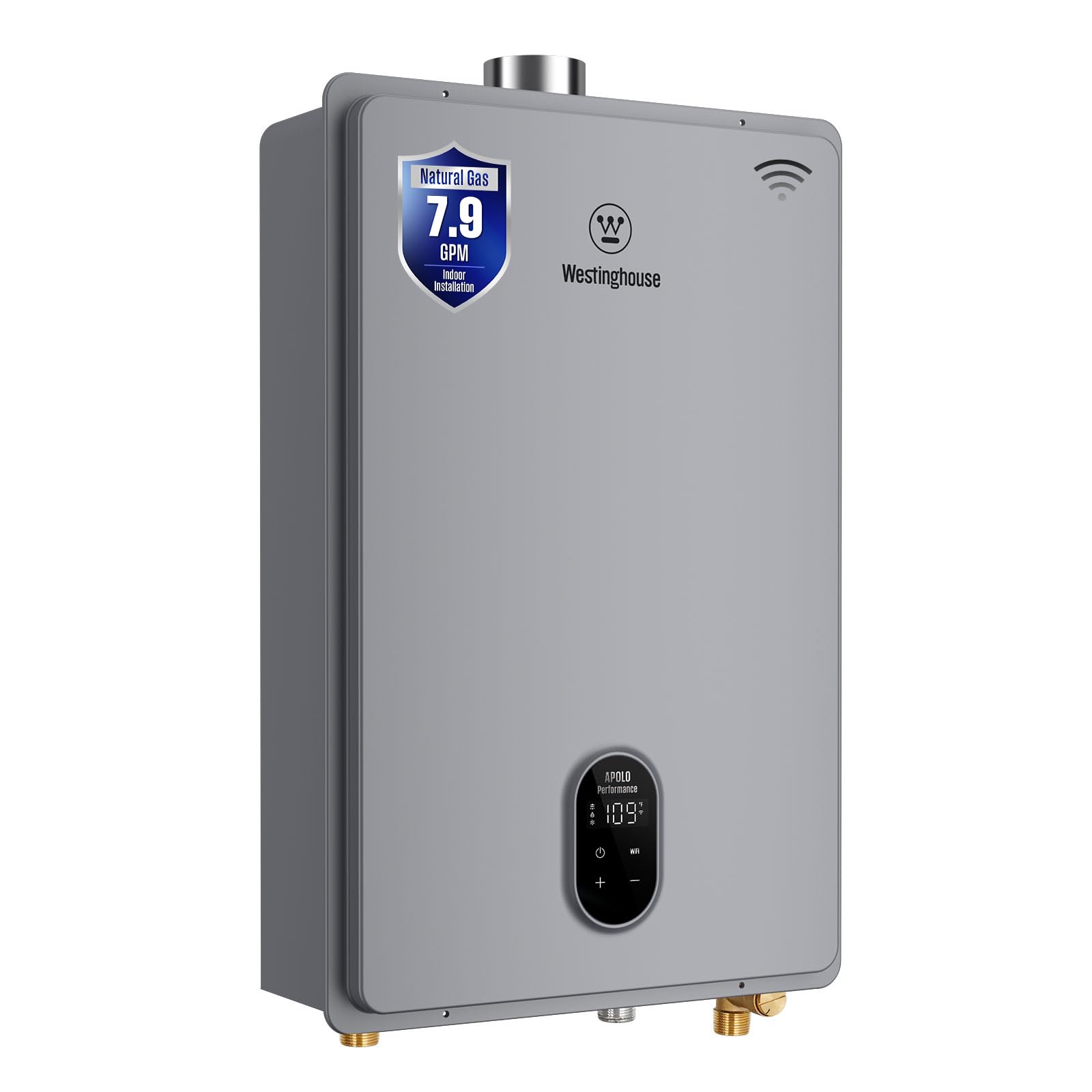
Westinghouse brings a competitive option to the table with a strong focus on smart home integration at a mid-range price. The standout feature here is the native WiFi App Control, which is more integrated than many competitors’ offerings. You can adjust the temperature, turn the unit on or off, and monitor the operating status directly from your smartphone without needing a separate hub or module. This makes it a fantastic choice for the tech-savvy homeowner who wants to manage their water heater like a smart thermostat.
The 180,000 BTU and 7.9 GPM flow rate support 3-5 fixtures simultaneously, which is adequate for a standard 3-4 bedroom home. The advanced self-modulating technology claims ±1°F temperature stability, which is a critical spec for preventing scalding or cold shocks. The unit is CSA certified and includes freeze protection, a variable-speed fan, and a durable copper heat exchanger, hitting all the essential reliability marks. The wall-mounted design is compact at 17.1 inches wide.
The venting and installation requirements are standard for a non-condensing gas unit, but the warranty and long-term support from Westinghouse are less established in the water heater space compared to Rheem or Rinnai. Some users reported minor delays in hot water reaching distant faucets, which is a general characteristic of non-recirculating systems. It is the best choice for someone who values seamless app control and a solid middle-ground performance for their smart home ecosystem.
Why it’s great
- Native WiFi app control for easy remote temperature and status monitoring.
- CSA certified with freeze protection for reliable indoor operation.
- Good balance of price and performance for 3-5 fixture homes.
Good to know
- Non-condensing design, requiring stainless steel venting materials.
- App ecosystem and long-term support are still being established.
6. Rinnai RUCS75iN

The Rinnai RUCS75iN is the no-frills, contractor-grade workhorse that is legendary for its reliability in the plumbing industry. This is a condensing unit, meaning it uses PVC for venting, which is a massive advantage for retrofits. It delivers a consistent 7.5 GPM, which is perfect for a 2-3 bathroom home or as a drop-in replacement for a smaller 50-75 gallon tank. The build quality is excellent at 63 pounds, reflecting a dense, well-made heat exchanger.
What makes this unit stand out is the warranty: 12 years on the heat exchanger, 5 years on parts, and 1 year on labor. This is a serious statement of durability from a premium brand. It’s also designed to serve up to 6 appliances at once. The trade-off for this reliability is that it lacks the modern conveniences of the RXP series. There is no internal recirculation pump, no WiFi, and temperature must be set via dip switches on the circuit board rather than a control panel.
This lack of features makes it a more straightforward and arguably more durable system with fewer components to fail. Professional installation is highly recommended, and the unit requires a dedicated condensate drain line. It is the choice for the homeowner who values mechanical reliability and low complexity over digital gadgets, and who wants a unit that a plumber will confidently install and service.
Why it’s great
- 12-year heat exchanger warranty, the best in its class for long-term peace of mind.
- Condensing design allows for cheaper and simpler PVC venting.
- Proven, contractor-grade reliability with a quiet operation.
Good to know
- No WiFi, no remote control, basic temperature adjustment via dip switches.
- Requires a professional installation to set up the condensate drain properly.
7. Rinnai CX199iN

The Rinnai CX199iN is a commercial-grade unit that serves as the ultimate solution for a very large residential home or a small commercial space. With a staggering 11.1 GPM flow rate and a 199,000 BTU input, it is the most powerful unit on our list by raw capacity. This is designed for mansions or homes where you might need to run 3-4 showers, a large whirlpool tub, and a dishwasher simultaneously without a whisper of a temperature drop.
Like the RXP series, it features condensing technology for high efficiency (97% thermal efficiency) and flexible PVC venting. It also includes the Smart Sense gas control for natural gas or propane flexibility. The “Smart Connect” allows you to set up and troubleshoot the unit via a smartphone app over Bluetooth and WiFi, giving it surprising digital sophistication for a commercial-class machine. The optional recirculation kit can be added for near-instant hot water.
The primary consideration is the gas line. You will almost certainly need a 1-inch gas line to feed this beast, which can be a major expense in a retrofit. The unit is also physically larger and heavier than residential models. It is overkill for an average 3-4 bedroom home. This is the specialist tool for the owner with a massive property and an insatiable demand for hot water, willing to invest in the infrastructure to support it.
Why it’s great
- Residential-leading 11.1 GPM flow for the largest households.
- Commercial-grade build with 97% condensing thermal efficiency.
- Smart Connect app for setup, monitoring, and troubleshooting.
Good to know
- Requires a 1-inch gas line, which often makes for an expensive retrofit.
- Overkill and oversized for standard 2-3 bathroom homes.
8. FOGATTI Instagas 180S
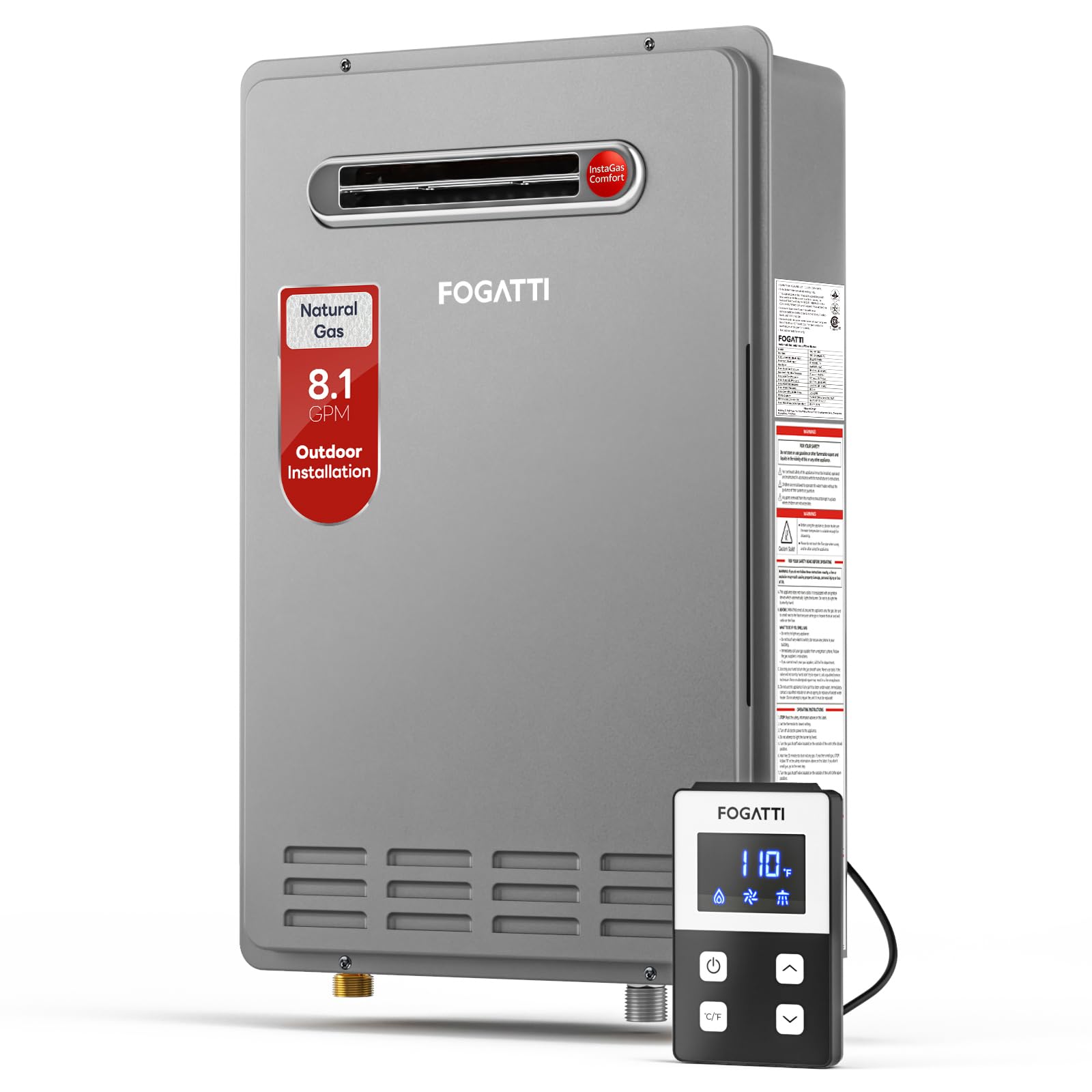
The FOGATTI Instagas 180S is purpose-built for outdoor installation, which is a huge advantage if you want to avoid venting complications entirely. It features a remote control panel that you can install indoors for convenient temperature setting without having to walk outside. The 180,000 BTU and 8.1 GPM output is a strong profile for a 3-5 outlet point home, and the 304 stainless steel burner and oxygen-free copper heat exchanger promise good corrosion resistance for outdoor elements.
A key safety feature is the bottom-mounted fan, which not only prevents smoke backflow but also allows the burner to perform more reliably in windy conditions. The water servo technology and four-stage combustion system work together to maintain temperature within ±1°F. The pricing is very competitive for a unit with this capacity from a brand that offers a 2-year whole unit and 5-year heat exchanger warranty. The compact dimensions (26.2 x 17.1 x 7.1 inches) are standard for tankless units.
The potential downsides are similar to other newer brands: some users reported ignition failures and inconsistent temperature control in cold weather, though the majority of reviews are positive. Being outdoor-only limits your placement options, and you must still factor in the cost of running a gas line and electrical supply to the external wall. It’s an excellent value pick for the specific scenario of an outdoor utility area.
Why it’s great
- Designed for outdoor installation, eliminating indoor venting costs.
- Includes a remote control panel for convenient indoor temperature adjustment.
- Stainless steel and copper construction for outdoor corrosion resistance.
Good to know
- Long-term reliability and customer support less established than leading brands.
- Some user reports of ignition issues in very cold weather.
9. Rheem Mid-Efficiency 7.0 GPM

This Rheem mid-efficiency unit is a solid, straightforward replacement for a smaller 50-75 gallon tank. At 7.0 GPM and 140,000 BTU, it is not the most powerful unit on the list, but it is more than sufficient for a 2-3 bathroom home that doesn’t have extreme simultaneous demand. The build quality is typical Rheem: reliable copper and stainless steel construction, and the EcoNet monitoring system provides a degree of smart functionality for basic diagnostics and energy tracking.
The key advantage here is the brand reputation and parts availability. Plumbers are very familiar with Rheem equipment, and finding service parts will be straightforward for years to come. The electronic ignition is rated for long life, and the unit is preset at 120°F from the factory for safety and efficiency. It is a non-condensing unit, so remember the stainless steel venting requirement.
The main trade-off is that the 7.0 GPM flow rate can feel undersized compared to larger competitors if you have a high-demand house. Some users also noted that it doesn’t include a remote thermostat, which is a minor convenience missing. It is a safe, predictable choice for the homeowner who wants a trouble-free install from a brand their plumber trusts, without needing the absolute highest capacity.
Why it’s great
- Established Rheem brand with excellent parts and service support.
- Reliable electronic ignition and durable copper/stainless build.
- EcoNet system offers basic smart monitoring for energy management.
Good to know
- 7.0 GPM may feel limited for large families with high simultaneous demand.
- No remote control included; temperature set at unit.
10. Takagi T-H3J-DV-N

The Takagi T-H3J-DV-N is a condensing high-efficiency unit that is a fantastic choice for a smaller home or for a homeowner in California or other regions with strict emissions standards. It is designed to satisfy the 2012 SCAQMD Rule 1146.2 for Ultra-Low NOx Emissions, making it one of the most environmentally responsible natural gas water heaters you can buy. The condensing design allows it to use PVC venting and achieve higher efficiency than older Takagi models.
With a 6.6 GPM flow rate, this is more of a direct replacement for a standard 40-50 gallon tank rather than a massive 75-gallon unit. It is optimized for 2-3 people and 2 bathrooms. The key differentiator here is the computerized safety features and the long-term reliability; many users report these units lasting over 15 years with proper maintenance. The warranty reflects this, with a strong heat exchanger coverage.
The downsides are the limited flow rate and the fact that it is a condensing unit, meaning it produces mildly acidic condensate that must be drained and neutralized. It is also a significant investment for a unit with a lower GPM. This heater is best for the environmentally conscious buyer who needs a reliable, clean-burning unit for a moderate-sized home and wants to minimize their carbon footprint.
Why it’s great
- Ultra-Low NOx emissions, compliant with strict California air quality rules.
- Condensing design for high efficiency and lower gas consumption.
- Excellent long-term reliability with a very low failure rate over decades.
Good to know
- 6.6 GPM flow rate is lower than most competitors on this list.
- Condensate neutralizer kit may be required to protect plumbing drains.
11. ThermoMate RTC68iN
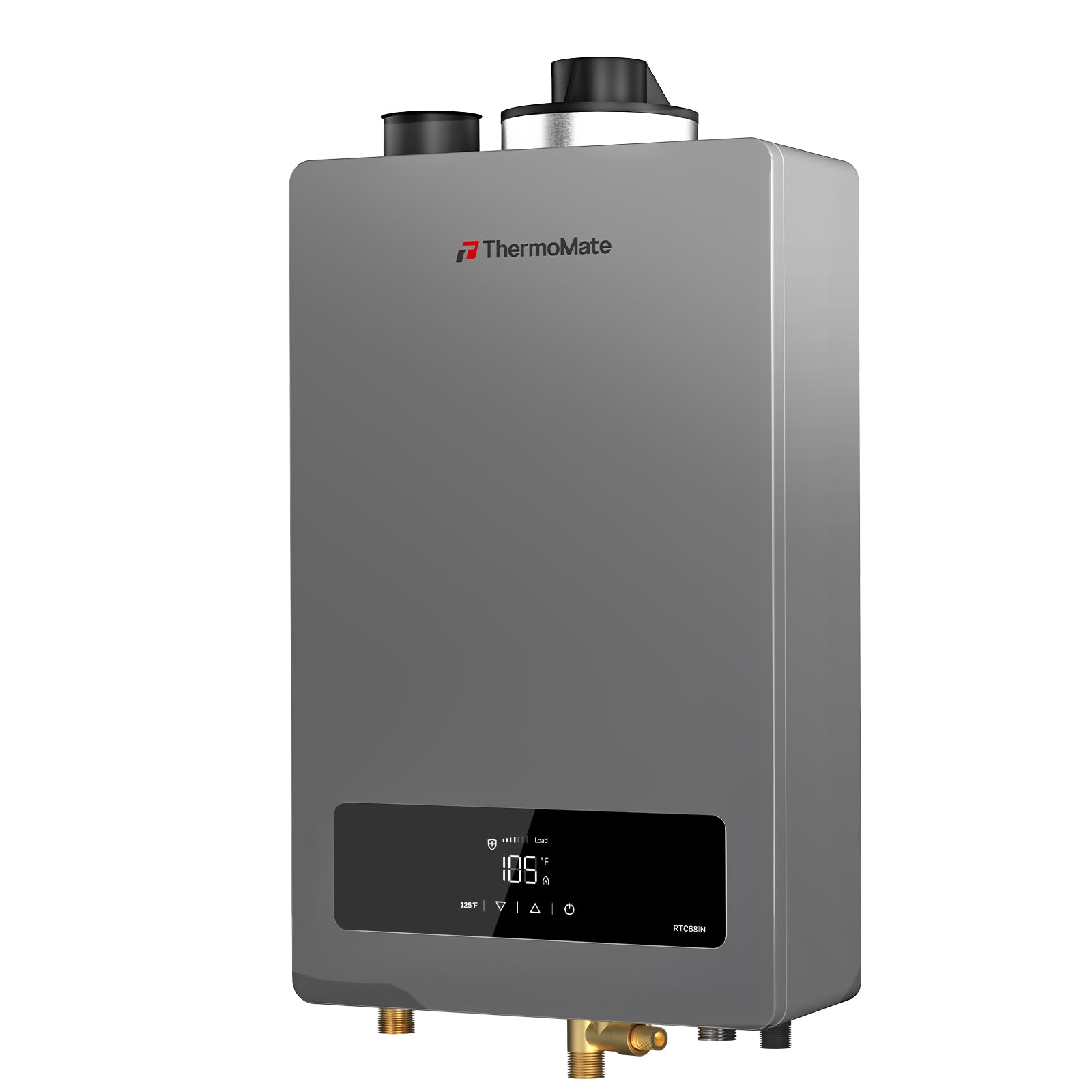
The ThermoMate RTC68iN is a condensing tankless water heater that packs an impressive 9.38 GPM capacity into a mid-range package, offering exceptional value for a high-efficiency unit. The 0.91 UEF rating is excellent, translating to an estimated 17% reduction in annual hot water costs compared to standard models. It uses a dual heat exchanger system—a stainless steel condensing unit paired with an oxygen-free copper one—to capture waste heat that traditional units simply vent out the flue.
A standout feature is the intelligent water mixing valve technology, which is designed to eliminate temperature fluctuation completely, providing zero cold water sandwich. The CSA certification and 8-point safety system including freeze protection down to 41°F gives it a solid safety profile. It is designed for indoor installation only and, as a condensing unit, requires a connection to a drain line to discharge the acidic condensate.
The trade-off for this advanced technology and capacity at a competitive price is the less established brand name. While the features are impressive, the track record and long-term support are unproven compared to Rinnai or Rheem. The condensate management is a non-negotiable installation detail. It is a strong choice for the owner who wants condensing efficiency and high flow without paying a premium brand price, but who is comfortable with a newer market entrant.
Why it’s great
- Condensing design with 0.91 UEF for significant energy savings.
- Dual stainless steel and copper heat exchangers for high durability.
- Intelligent mixing valve for zero temperature fluctuation during use.
Good to know
- Newer brand with a less proven long-term reliability record.
- Requires condensate drain and neutralizer kit installation.
12. Ranein Propane 8.5 GPM
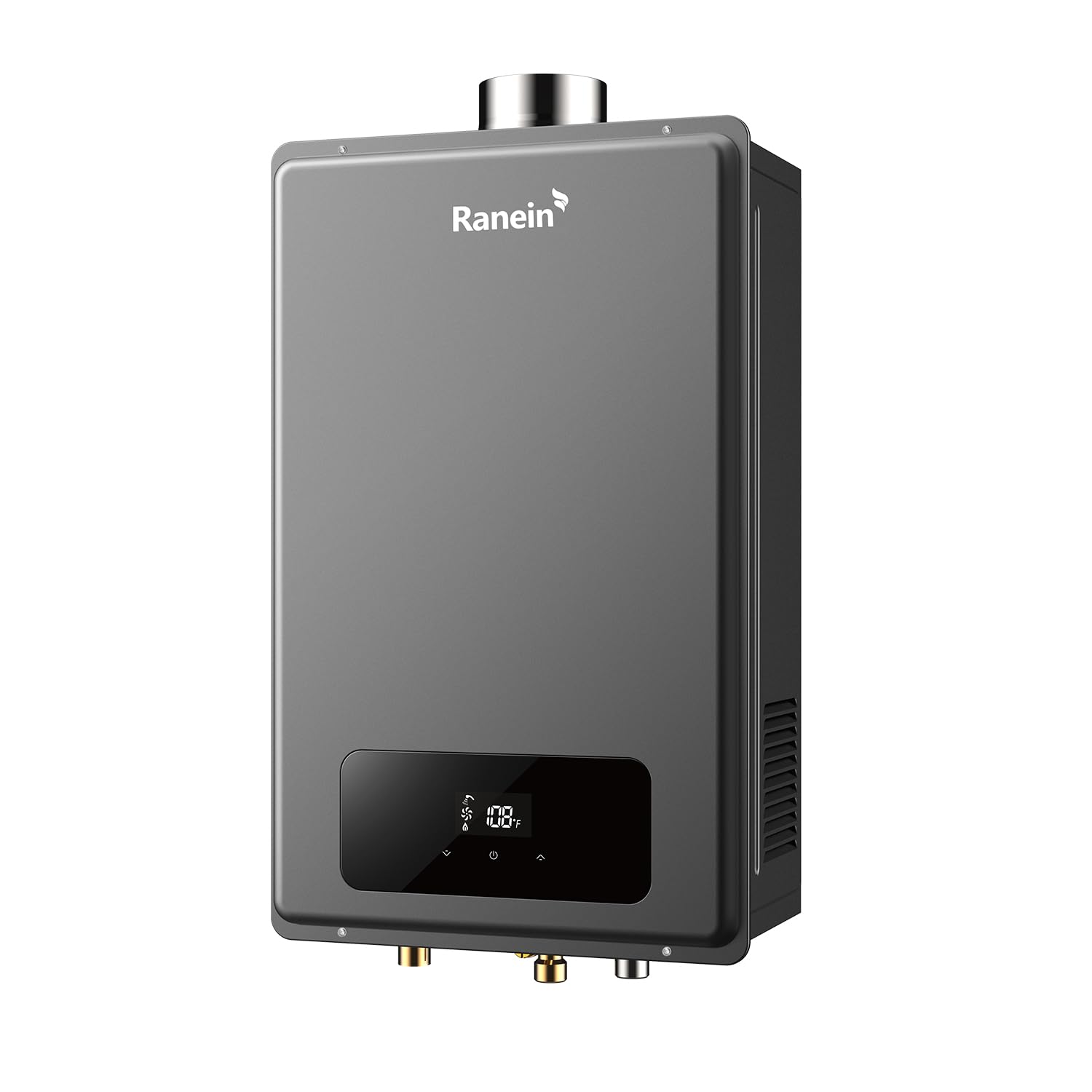
The Ranein Propane tankless water heater is the best option for those on a budget who need to replace a large tank with a high-flow propane unit. With 190,000 BTU and 8.5 GPM, the raw capacity numbers are excellent for a propane model, and it is designed to supply 4-6 outlet points. For a home using propane, this provides a very compelling cost-to-performance ratio, and the compact size (24.25 x 15.08 x 8.07 inches) makes it easy to mount in tight spaces.
A strong feature is the bottom-mounted fan with automatic speed adjustment to optimize combustion. This ensures the unit uses the propane efficiently and prevents wind from causing backdrafts or smoke. Customers have reported significant drops in fuel bills compared to older tank-style propane heaters, and the fast heating time is consistently praised. The 2-year manufacturer warranty provides the basic safety net for a less expensive unit.
The biggest risk with a budget unit is long-term reliability and customer support. Some users reported issues with the unit failing early and encountering poor customer service from Ranein. The unit is a non-condensing design and requires proper stainless steel venting. This is the value choice for a propane household where budget is the primary driving factor, accepting some risk on longevity in exchange for a huge upfront savings.
Why it’s great
- Excellent value for a high-BTU propane unit with 8.5 GPM capacity.
- Compact footprint saves space on wall mounting.
- Bottom fan design improves combustion efficiency and reduces backdraft risk.
Good to know
- Customer support reputation is a risk; some reports of poor service.
- Long-term reliability has not been proven over multiple years of use.
13. Stiebel Eltron Tempra 36 Plus
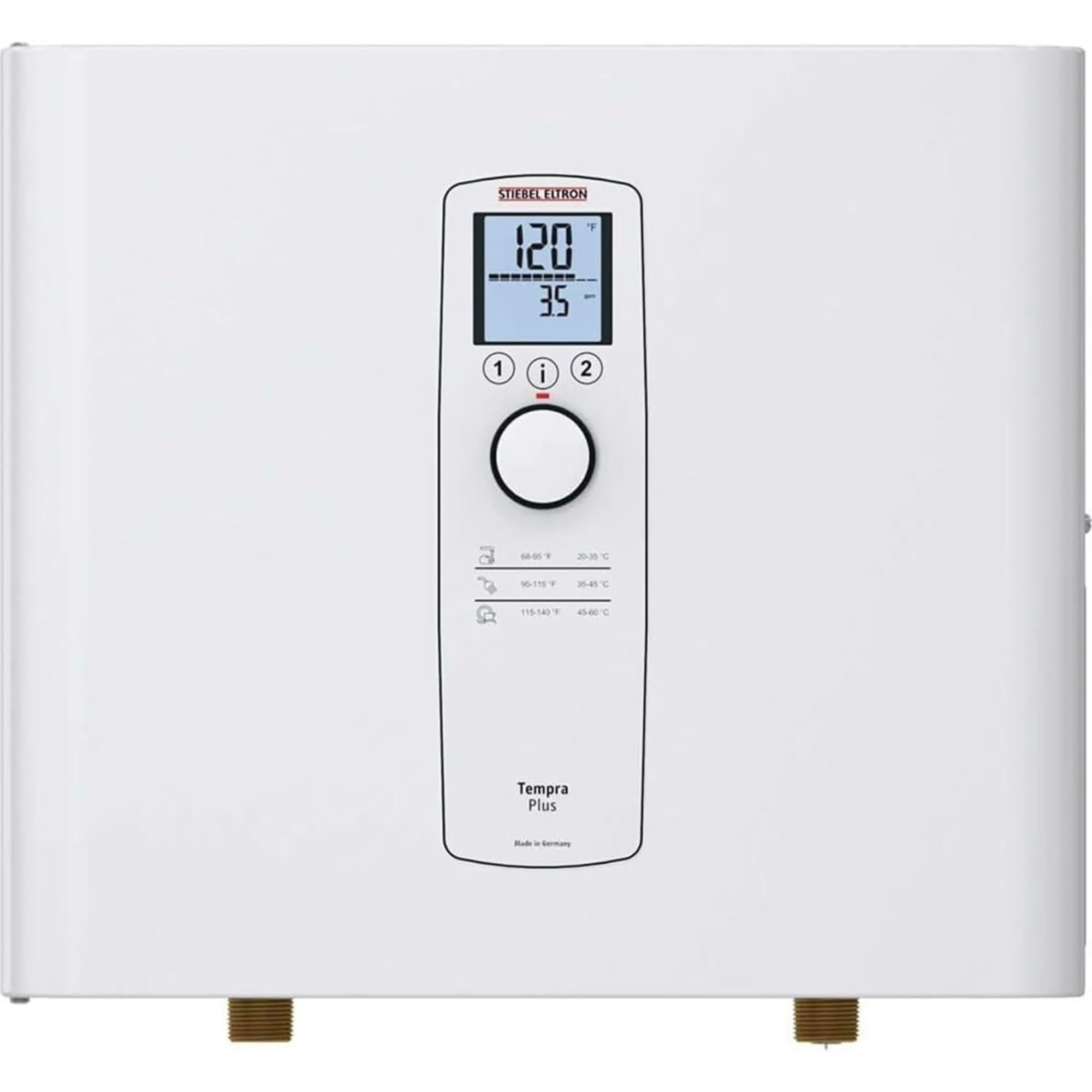
The Stiebel Eltron Tempra 36 Plus is the only electric unit on this list, and it serves a very specific purpose: homes where gas is not an option, or where the owner wants a perfectly silent, compact electric solution for a smaller hot water demand. It is important to be very clear about its capacity: this is a 36 kW unit that delivers only 1.5 GPM for a 77°F temperature rise. This is not a replacement for a 75-gallon gas tank. It is designed for a small apartment, a single bathroom, or a point-of-use application.
What makes the Tempra 36 exceptional is its build quality. Made in Germany, it features Stiebel Eltron’s exclusive Advanced Flow Control technology, which automatically modulates power to maintain the precise output temperature you set on the digital display. It is incredibly small at 16.63 x 14.5 inches and weighs only 19 pounds, making it extremely easy to mount. The lack of a gas line, venting, or pilot light simplifies installation dramatically, though it requires a massive electrical service—three 50-amp double-pole breakers.
The 1.5 GPM flow rate is the hard ceiling. You cannot run two showers simultaneously. Trying to do so will result in a lukewarm dribble. This unit is also notorious for causing high electric bills, as 36 kW is a massive electrical load. It is not a whole-house solution for a large family. It is the perfect drop-in replacement for a small electric tank, or for a dedicated application like a master bathroom or an in-law suite where you need endless, temperature-controlled hot water from a tiny, reliable electric box.
Why it’s great
- Exceptionally compact, silent, and simple to install without gas or venting.
- German-made build quality with digital temperature control precision.
- Self-modulating energy technology only uses power when water is flowing.
Good to know
- 1.5 GPM flow rate is far too low to replace a whole-house 75-gallon tank.
- Requires a massive electrical service: three 50-amp breakers (up to 150A total).
FAQ
Can a tankless water heater really replace my 75-gallon tank?
Do I need a bigger gas line for a 199,000 BTU tankless heater?
What does the condensation drain do on a condensing water heater?
Why does my tankless water heater take a few minutes to deliver hot water?
Final Thoughts: The Verdict
For most users looking to replace a large storage tank, the 75 gallon water heater champion is the A. O. Smith ProLine XE ATI-310CX3 because it offers the best balance of proven brand reliability, built-in scale prevention that eliminates maintenance, and a powerful 8.0 GPM flow rate for a large family. If you want the absolute maximum capacity and smart home controls, grab the MIZUDO WCIU-HW199A1G-LP-M1n. And for the homeowner who prioritizes near-instant hot water and the highest energy efficiency, nothing beats the Rinnai RXP160iN with its integrated recirculation pump.