
Our readers keep the lights on and the weekend projects moving. As an Amazon Associate, I earn from qualifying purchases.
A freezing garage turns any project into a battle. Whether you’re restoring a classic car, running a woodshop, or just trying to change your oil in January, the right heater transforms a bone-cold space into a productive zone. A 7500-watt hardwired electric heater, delivering roughly 25,000 BTUs, is the most popular solution for standard two- to three-car garages and workshops, offering a clean, vent-free alternative to propane or kerosene.
I’m Rikta — the co-founder and writer behind FitlyFast. I’ve spent countless hours dissecting the performance specs, installation requirements, safety certifications, and real-world user data of the top-selling garage heaters to build a guide that cuts through the marketing noise and gets you the heat you need.
If you want consistent, whole-room warmth without the fumes or the hassle of refueling, the right best 7500 watt garage heater will change how you use your workspace during the coldest months of the year.
How To Choose The Best 7500 Watt Garage Heater
Choosing a garage heater is not just about picking the highest wattage. The real-world performance depends on how the heat is generated, how it is distributed, and how well the unit matches your space, insulation, and electrical setup. Below are the critical factors that separate a heater that merely runs from one that truly warms.
Forced Air vs. Radiant Heat
Nearly all 7500-watt electric garage heaters use a fan-forced design. A heating element (usually a metal coil or a radiant element) gets hot, and a blower pushes air across it and into the room. This method circulates warm air throughout the entire space, making it ideal for general workshop heating. Radiant heaters, by contrast, warm objects and people directly without heating the air, which works well for spot heating but less so for warming a whole garage evenly. The forced-air approach is the standard for this category.
BTU Output and Heating Coverage
Wattage tells you the electrical draw, but BTU (British Thermal Units) tells you the actual heat output. A true 7500-watt heater running on 240V will produce roughly 25,500 BTUs. Manufacturers typically rate coverage between 700 and 1,250 square feet, but real-world performance depends heavily on ceiling height, insulation quality, and outside temperature. A well-insulated 2-car garage (roughly 500 sq ft) heats quickly, while a drafty, uninsulated 3-car space may require supplemental sources.
Installation and Electrical Requirements
These are hardwired units — they do not plug into a standard wall outlet. You will need a dedicated 240-volt circuit with a double-pole breaker rated between 30 and 40 amps, depending on the specific unit. Most manufacturers recommend 8 AWG copper wire for the connection. This is not a DIY job for most homeowners; hiring a licensed electrician is strongly advised to ensure compliance with the National Electrical Code and to avoid fire hazards.
Thermostat and Control Options
A built-in digital thermostat is a major convenience, allowing you to set a target temperature and let the heater cycle on and off automatically. Look for a range that starts around 45°F (for frost protection) and goes up to 85-95°F for comfortable working conditions. Many units include a remote control, which is especially useful for ceiling-mounted heaters you cannot reach easily. Timer functions (typically 1 to 12 hours) help manage energy consumption by running the heater only when needed.
Safety Certifications
Since you are hardwiring a high-powered appliance into your home’s electrical system, safety certifications are non-negotiable. Look for ETL, UL, or CSA listing marks. These indicate the unit has been tested for electrical and fire safety. Additional features like overheat auto-shutoff, tip-over switches (though less common in mounted units), and power indicator lights add another layer of protection.
Quick Comparison
On smaller screens, swipe sideways to see the full table.
| Model | Category | Best For | Key Spec | Amazon |
|---|---|---|---|---|
| DR. INFRARED HEATER DR-975 | Premium Electric | External thermostat control | UL/CUL listed, 5 louvers | Amazon |
| Comfort Zone CZ230ER | Mid-Range Electric | Ceiling mount, space saving | 25,600 BTU, 12-hr timer | Amazon |
| TEMPWARE 7500W | Value Electric | Budget-friendly performance | 25,590 BTU, 12-hr timer | Amazon |
| VEVOR 7500W | Value Electric | Multi-angle airflow | 25,600 BTU, 9-hr timer | Amazon |
| Riseon CZ231ER | Mid-Range Electric | ECO mode efficiency | 25,590 BTU, touch + remote | Amazon |
| Mr. Heater 80K BTU | Fuel-Powered | Max heat for large spaces | 80,000 BTU, kerosene/diesel | Amazon |
| DEWALT DXH75KT | Fuel-Powered | Rugged construction site use | 75,000 BTU, CSA certified | Amazon |
| ThermoMate 3000W | Specialty Infrared | Spot heating for patios | 3000W carbon fiber, IP54 | Amazon |
| KING KB2407-1-B2-ECO | Premium Electric | Long-term durability | 7500W, built-in fan delay | Amazon |
In‑Depth Reviews
1. DR. INFRARED HEATER DR-975

The DR-975 stands out for its professional-grade design and flexibility. It offers dual-power operation (4700W or 7500W) on a 240V circuit, allowing you to match heat output to the current conditions rather than always running at full blast. The five adjustable louvers provide precise directional airflow, which is critical when mounting the unit on a wall or ceiling and needing to direct heat down to your workspace rather than letting it pool at the ceiling.
What separates this unit from most competitors is its compatibility with an external wall thermostat. Many built-in digital thermostats suffer from inaccuracy because they measure the air temperature right at the heater, which is much hotter than the room. By wiring in a separate thermostat (sold separately), you get far more consistent temperature control. Users in cold climates like Minnesota and Montana report solid performance, with the heater cycling efficiently to maintain a comfortable workshop environment without excessive energy draw.
The trade-off is a slightly noisier fan compared to some premium units, and the installation is a bit more involved if you opt for the external thermostat. The unit is UL/CUL listed, which adds confidence for a hardwired installation. For the serious DIYer or professional who wants control and reliability, this is a standout option.
Why it’s great
- Dual wattage settings for flexible heat output
- Accepts external wall thermostat for accurate temperature control
- UL/CUL certified for safety
Good to know
- Fan is noticeable at higher speeds
- External thermostat required for optimal performance
- Requires 40A breaker and 8 AWG wire
2. Comfort Zone CZ230ER

The Comfort Zone CZ230ER is a customer favorite for good reason. This forced-air ceiling-mount heater is built with heavy-gauge steel and a robust coil heating element, delivering a strong 25,600 BTUs. The space-saving design is perfect for crowded garages and workshops where floor space is at a premium. Its adjustable louvers and variable mounting angle allow you to dial in the airflow direction, combating the common issue of hot air stratifying near the ceiling.
User reports consistently praise its performance in standard two-car garages. One reviewer noted it heated a 24×36 insulated pole barn from frigid outdoor temps to a comfortable 62°F without issue. The digital thermostat (range of 45°F to 95°F) and the included remote control make operation simple from across the room. The 12-hour programmable timer is a welcome feature for scheduling heat before you head out to the workshop, saving energy by not running all day.
The primary drawbacks are the internal thermostat’s tendency to be slightly inaccurate (a common issue across this category) and the lack of a power-loss memory — if the power flickers, the unit resets and needs to be manually turned back on. It requires a 31.25-amp circuit, so a 40-amp breaker and 8 AWG wire are necessary. For the price, this is a well-balanced, reliable unit that gets the job done.
Why it’s great
- Compact ceiling mount frees up floor space
- Powerful 25,600 BTU output heats quickly
- Easy-to-use remote and 12-hour timer
Good to know
- Internal thermostat can be inaccurate
- No power-loss memory mode
- Requires professional hardwired installation
3. TEMPWARE 7500W
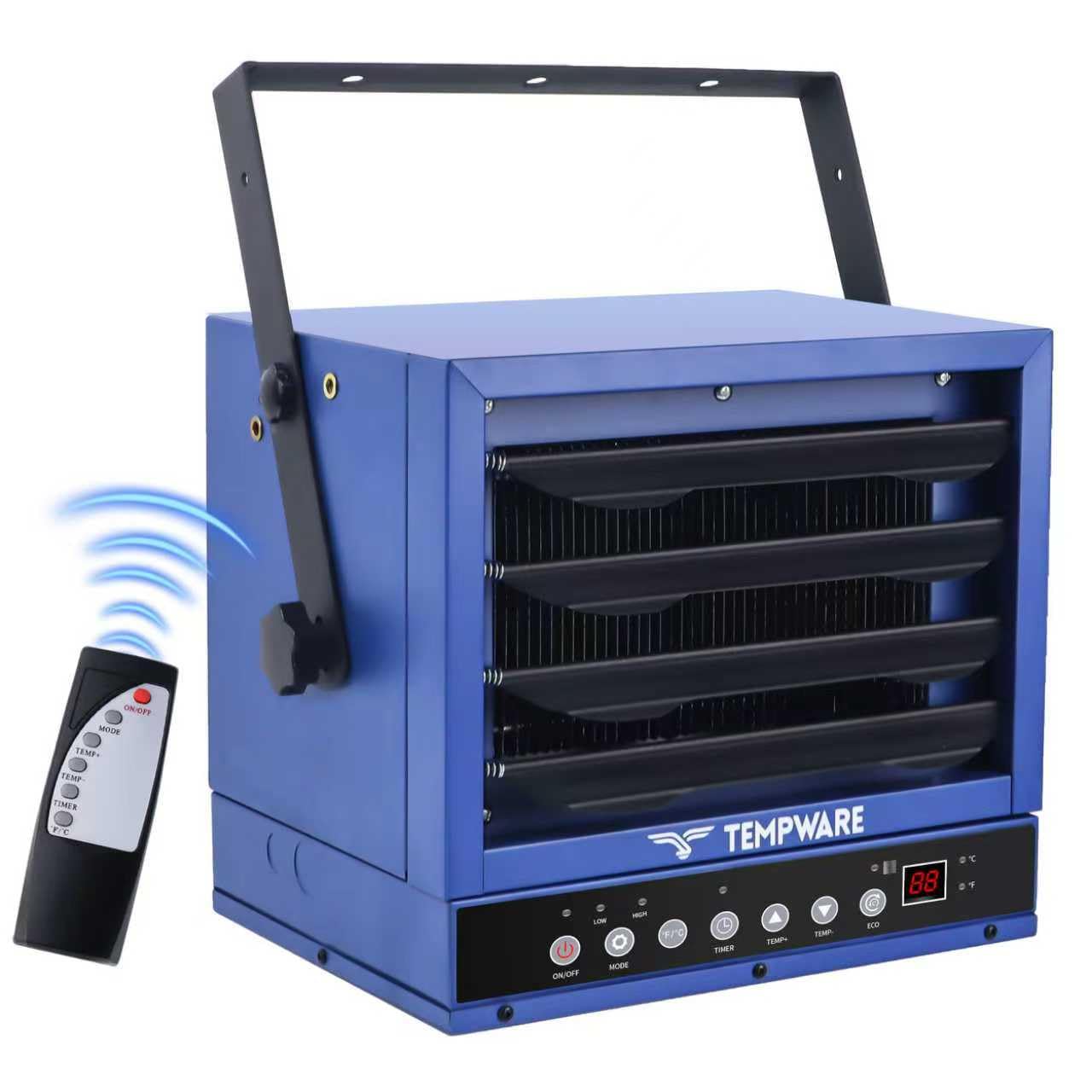
The TEMPWARE unit is a strong entry-level option that delivers the necessary heat without a high upfront cost. It pushes a genuine 25,590 BTUs and is rated to cover up to 1,250 square feet, making it suitable for most residential garages. The digital thermostat spans from 45°F to 95°F, and the 12-hour timer adds a layer of energy management. The blue steel housing is sturdy and ETL certified, giving peace of mind for a hardwired appliance.
User feedback is largely positive, especially from those in the Midwest who needed a reliable heat source for working on cars during winter. The unit includes a full-function remote, which is essential when the heater is mounted high on a ceiling. The adjustable louvers help direct the warm air down to floor level, which is one of the biggest challenges with ceiling-mounted forced-air heaters.
The main concern raised by users is the lack of responsive customer support from the manufacturer. Some users also noted the lowest thermostat setting of 45°F might not be low enough for simple frost protection if you just want to keep pipes from freezing. A few reviews mention the heat tends to stratify near the ceiling in uninsulated garages, leaving the floor cold. Despite these caveats, for the price, it offers solid performance and a good feature set.
Why it’s great
- Strong BTU output for the price point
- ETL certified with overheat protection
- Includes remote and 12-hour timer
Good to know
- Customer support is reportedly poor
- Heat stratification can be an issue in uninsulated spaces
- Lowest temp setting may not be low enough for all frost protection needs
4. VEVOR 7500W

VEVOR brings a well-constructed, fan-forced heater to the table with a focus on durability and precise airflow. The housing is made from SPCC cold-rolled steel, which resists deformation over time better than thinner sheet metal. It offers 25,600 BTUs and coverage rated at 732 square feet, which is a more conservative and perhaps more realistic number than some competitors’ claims. The unit supports both wall and ceiling mounting with multi-angle adjustment.
A standout feature is the precise temperature control, which users report maintains within a tight 2°F window around the set point. The remote control and 9-hour timer add convenience. It is ETL listed and includes overheat auto shut-off. Several users with uninsulated 700 sq ft garages reported the heater kept them comfortable even when outdoor temperatures dropped, and they appreciated the relatively quiet fan operation compared to older units.
The main downside is the 9-hour timer is shorter than the 12-hour timers found on some competitors. Also, like many in this category, it requires a 32-amp circuit, which means a 40-amp breaker and professional wiring. A handful of users reported that the remote control feels somewhat basic. Overall, it is a solid mid-range option with a quality build.
Why it’s great
- Durable cold-rolled steel construction
- Tight temperature control around set point
- Quiet fan operation
Good to know
- Shorter 9-hour timer limit
- Remote control feels basic
- Requires professional installation with 40A breaker
5. Riseon CZ231ER
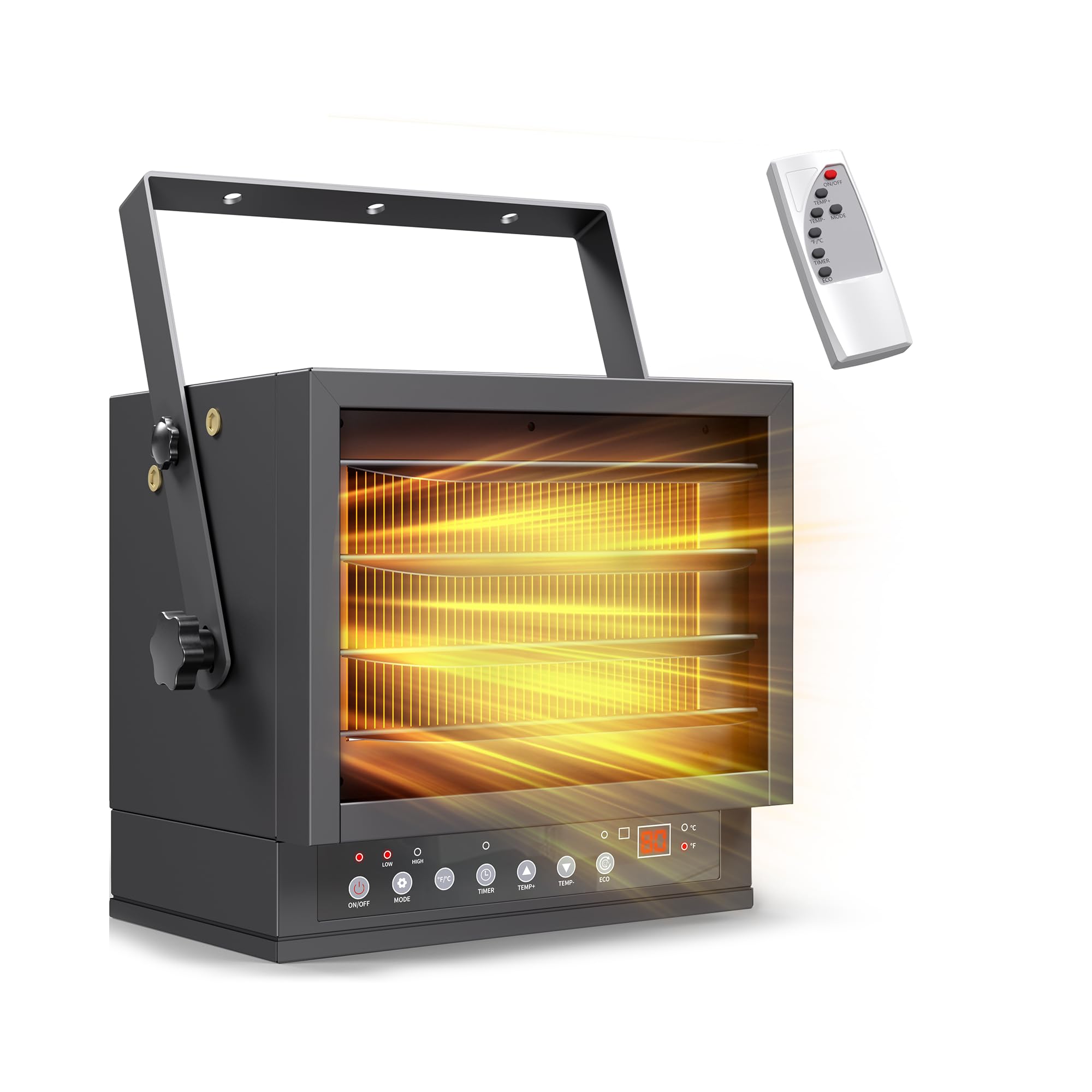
The Riseon CZ231ER aims to bring smart energy management to the garage heating category. Beyond the standard 7500W/6250W settings and 25,590 BTU output, this unit features an ECO mode that uses a precision temperature sensor to automatically adjust power consumption based on the environment. The combination of an LED touch screen on the unit and a full-function remote gives you dual control options, which is handy when the heater is mounted high.
The black steel housing is robust, and the unit is ETL certified. The adjustable louvers and multi-angle mounting bracket allow for targeted heat direction, improving efficiency. Users with larger shops up to 1,500 square feet reported that this heater provided enough supplemental heat to reduce reliance on mini-split systems. The fast heating time and convenient remote operation were frequently praised.
The downside is some quality control variance. One user reported a defective unit where the fan speed control was non-functional and the thermostat did not properly cycle off, causing the temperature to overshoot significantly. The ECO mode on that particular unit was also ineffective. This suggests that while the design is promising, buying from a seller with a good return policy is wise. For most users, however, it works as advertised and provides good value.
Why it’s great
- ECO mode for energy-efficient operation
- Dual touch screen and remote control
- ETL certified with overheat protection
Good to know
- Some quality control reports of defective units
- ECO mode performance may vary
- Hardwired installation required
6. Mr. Heater 80,000 BTU

The Mr. Heater forced-air kerosene/diesel heater is a different beast entirely from the electric units above. It produces 80,000 BTUs — roughly three times the heat of a 7500W electric heater — and can warm up to 2,000 square feet. This is the right tool for uninsulated construction sites, large barns, or workshops where electric service is insufficient or unavailable. It runs on kerosene or diesel (No. 1 and No. 2 fuel oil) and features a built-in thermostat, LED troubleshooting diagnostics, and a photo cell flame sensor for safety.
Users report that it heats a two-stall garage from below freezing to t-shirt temperatures in under 20 minutes. The outer housing stays cool to the touch during operation, which is a key safety feature. The unit is heavy (33 lbs) and designed to sit on a pedestal, not mount on a wall. It requires a well-ventilated space because it consumes oxygen and produces combustion byproducts — never use it in a sealed or living space.
Downsides include the noise level (these forced-air fuel heaters are loud) and the need to source, store, and handle fuel. One user noted the heat projection only travels about 5 feet before rising, so direct airflow placement matters. Another reported the pressure gauge was missing from the box. For raw heat output in massive, cold spaces where ventilation is available, this is a powerhouse.
Why it’s great
- Massive 80,000 BTU output for large spaces
- Runs on affordable kerosene or diesel
- Built-in diagnostics and safety features
Good to know
- Requires ventilation — never use in a sealed space
- Very loud during operation
- Requires fuel storage and handling
7. DEWALT DXH75KT
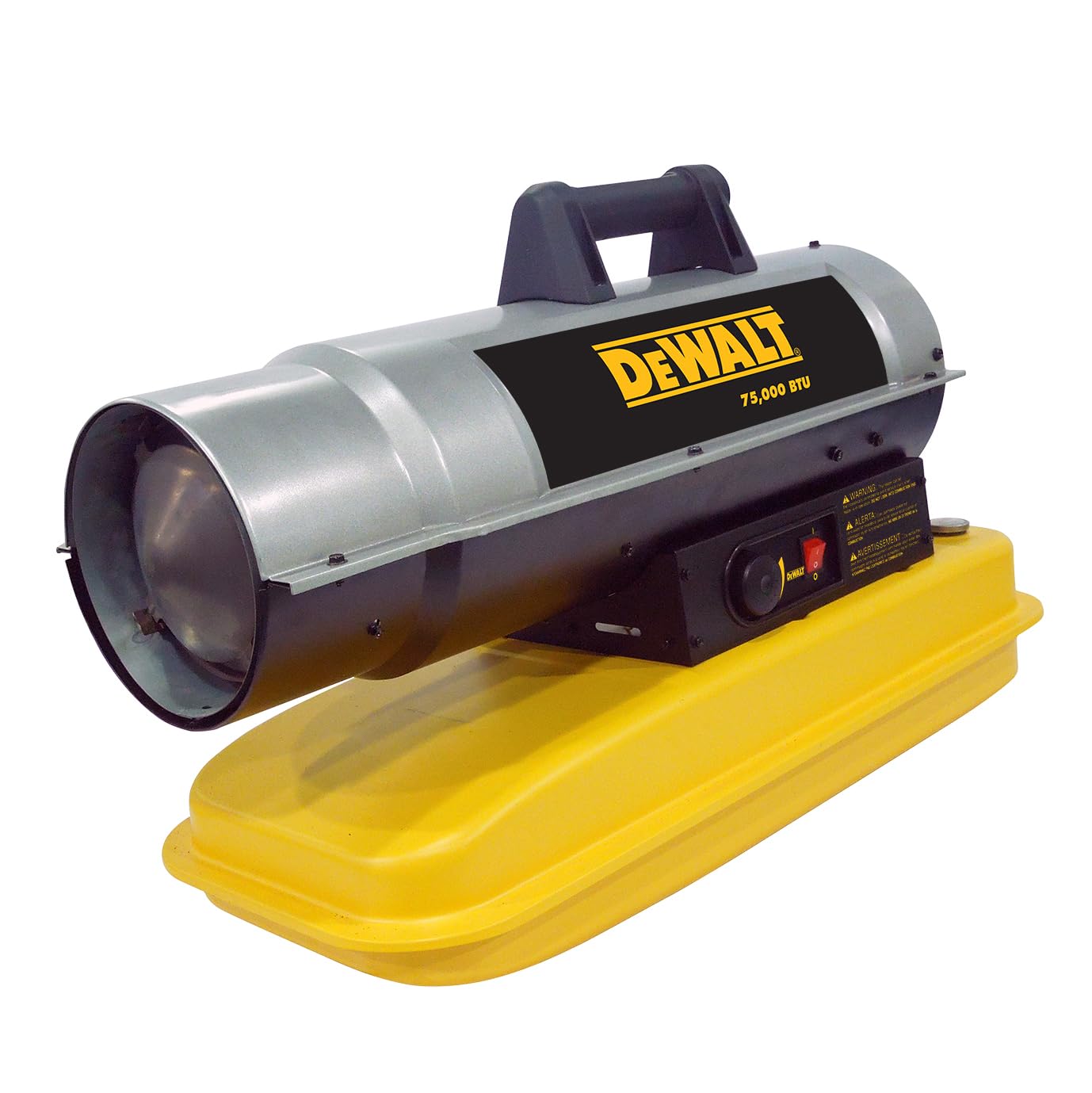
The DEWALT DXH75KT is a 75,000 BTU forced-air kerosene heater built for rough job site conditions. It is CSA certified and designed for well-ventilated spaces like workshops, barns, and construction sites. The recessed controls protect the switches from damage when the unit is bumped or moved. It burns kerosene or diesel and provides 8-10 hours of runtime on a full tank, depending on the throttle setting.
Users consistently praise its build quality and reliability. One user who works in the Northeast reported it kept a 28×30 ft block garage warm throughout winter, while another noted it outperformed other 75k BTU units in terms of blower force. The assembly is minimal — just attach the handle — and the ignition is reportedly instant and reliable. The yellow steel housing is durable, though the paint on the fuel tank can scratch easily.
The primary concern is longer-term reliability. One user reported a motor locking up after eight tanks of fuel, though two other units from the same owner remained reliable. This suggests some variability in motor longevity. Also, it is a fuel-powered unit, so ventilation is mandatory, and the noise level is comparable to other forced-air kerosene heaters. For a durable, no-nonsense heat source for temporary or high-airflow spaces, the DEWALT name carries weight.
Why it’s great
- Rugged build quality suited for job sites
- Strong blower for effective heat distribution
- Easy setup and reliable ignition
Good to know
- Ventilation required — not for sealed spaces
- Some reports of motor failure after heavy use
- Paint on fuel tank scratches easily
8. ThermoMate 3000W Infrared
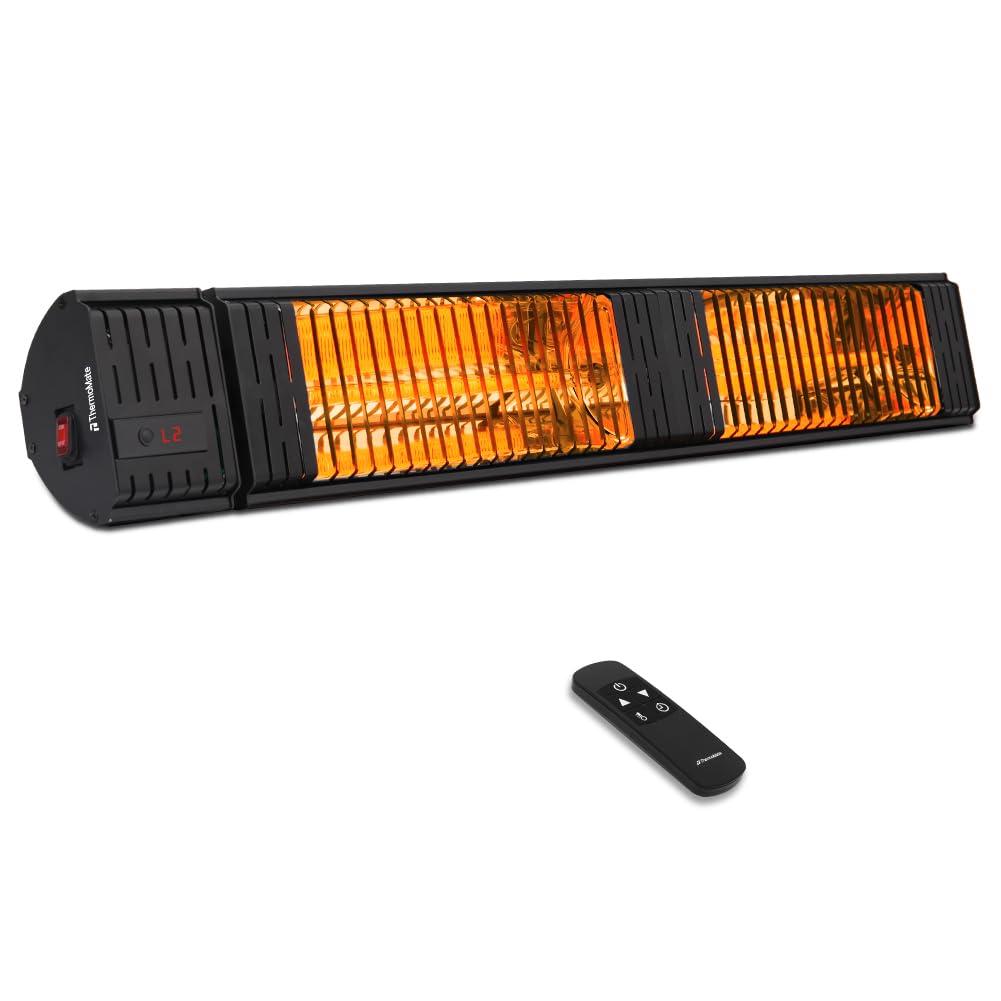
The ThermoMate 3000W is not a 7500W garage heater; it is a specialty infrared heater that serves a different purpose entirely. Using a carbon fiber heating tube, it delivers instant radiant heat that warms people and objects directly rather than the air. This makes it ideal for spot heating on patios, decks, or in a specific corner of a garage where you are working. It is rated for 120 square feet of coverage and is IP54 rated for weather resistance, allowing outdoor use.
The design is sleek and wall-mountable, taking up minimal space. It runs on 240V and is hardwired, but at 3000W, it draws only 12.5 amps compared to the 31+ amps of a 7500W unit. The remote control offers 24-hour timer functionality and switching between 1500W and 3000W modes. Users with covered patios love the instant warmth it provides in 40°F weather, and one creative user used it to maintain a tolerable area for outdoor cats during winter.
The critical limitation is its coverage area — 120 sq ft is tiny compared to a 7500W forced-air unit. It will not warm a whole garage. Some users reported that the heat output felt low when mounted at the recommended height, and the customer support hours are limited. It is a niche product for targeted heating, not a replacement for a whole-space garage heater.
Why it’s great
- Instant radiant heat unaffected by wind
- Weather-resistant (IP54) for outdoor patio use
- Low 12.5A draw works with smaller circuits
Good to know
- Only 120 sq ft coverage — not for whole garages
- Heat output can feel low with high mounting
- Limited customer support availability
9. KING KB2407-1-B2-ECO

The KING KB2407-1-B2-ECO is the heavy-duty, premium-end electric garage heater. It is a tank at 33.5 pounds, built with commercial-grade components designed for long-term use. The 7500W output is paired with a built-in fan delay that continues to run after the heating element shuts off, dissipating residual heat and improving the lifespan of the internal components. It also features a summer fan-only mode, so you can circulate air without heat.
The universal wall/ceiling mounting bracket is included, making installation straightforward for a professional. Users report it can heat a three-car garage to a comfortable temperature within 30 minutes, even in cold climates. The remote control allows for full operation, and the thermostat range is suitable for both frost protection and active working conditions. The gray finish is unobtrusive and professional-looking.
The main issue is the price, which is significantly higher than other 7500W electric units. Additionally, there have been some reports of reliability problems, with one user’s unit developing an internal thermostat issue after just a few days of use, and another user’s unit failing after three years. The return policy is also tight at 30 days, which is a concern given the investment. For those who prioritize build heft and brand reputation and are willing to pay for it, this is the premium choice, but the value proposition is harder to justify given the reliability concerns.
Why it’s great
- Commercial-grade build quality and weight
- Fan delay extends component life
- Summer fan-only mode adds year-round utility
Good to know
- Significant price premium over competitors
- Some reliability concerns reported
- 30-day return window is short for this price tier
FAQ
Can a 7500 watt garage heater run on a 30 amp breaker?
Do I need to ventilate my garage with an electric heater?
Why does my garage heater feel like it is not heating the floor?
Final Thoughts: The Verdict
For most users, the best 7500 watt garage heater winner is the Comfort Zone CZ230ER because it delivers dependable heat output, a space-saving ceiling mount, and a user-friendly remote and timer at a reasonable price. If you want professional-grade control with an external thermostat for precise temperature management, grab the DR. INFRARED HEATER DR-975. And for huge, uninsulated spaces where electrical service is limited, nothing beats the raw power of the Mr. Heater 80,000 BTU.