
Our readers keep the lights on and the weekend projects moving. As an Amazon Associate, I earn from qualifying purchases.
Moving from a 61-key to a 76-key keyboard is the single most practical upgrade a learner can make. That extra octave and a half means you stop bumping into the highest and lowest notes of standard piano repertoire — pieces that demand a full left-hand bass line or a soaring right-hand melody suddenly fit without compromise. You get the breadth of an 88-key instrument without committing to the weight, cost, or floor space a full-size digital piano demands.
I’m Rikta — the co-founder and writer behind FitlyFast. I spend my weeks analyzing the interplay between key action weight, sound engine sampling, and polyphony counts across hundreds of portable keyboards and digital pianos to separate the gear that actually supports musical growth from the toys that merely light up.
This guide dissects the nine most compelling options on the market right now — from lightweight touch-sensitive portables to fully weighted hammer-action sets — so you can confidently choose the 76 key keyboard that matches your skill level and long-term goals.
How To Choose The Best 76 Key Keyboard
A 76-key board lives in a specific niche — wider than a starter keyboard, narrower than a full upright. The right choice depends on how much key resistance you want, what sounds you need, and where you plan to play. Here is what to look for.
Key Action: Touch Sensitivity vs. Weighted Feel
Touch-sensitive keys register volume based on how hard you press, but they spring back quickly with little resistance. Graded Soft Touch (GST) — found on the Yamaha NP32 — adds gentle weighting that is heavier in the bass and lighter in the treble, mimicking an acoustic piano without the full mechanical heft. Fully weighted, hammer-action keys use physical hammers to recreate the resistance of a real piano; they build finger strength but add significant weight to the instrument. Beginners on a budget can start with touch-sensitive, but serious learners should aim for graded or weighted action.
Sound Engine, Polyphony, and Timbres
A stereo-sampled grand piano sound from a reputable manufacturer (Yamaha’s AWM Stereo Sampling, for example) delivers far more realistic tone than generic samples. Polyphony — the number of notes that can ring simultaneously — matters for sustained passages and pedal-heavy playing. 32-note polyphony is the bare minimum; 64-note or higher avoids dropped notes during complex pieces. Timbres (instrument voices) and rhythms are useful for exploration, but prioritize sound quality and polyphony above sheer quantity.
Portability, Connectivity, and Build
If you carry the keyboard to lessons or gigs, battery-powered capability and weight under 12 pounds are major advantages. Full-size weighted boards often exceed 30 pounds with stands and require a dedicated spot. USB-MIDI connectivity lets you connect to apps for learning and recording — look for MIDI over USB for the broadest compatibility. Headphone jacks (preferably 1/4-inch for better audio quality) allow silent practice. Check the included accessories: a music rest and power adapter are essential; benches and pedal units add value but vary in quality.
Quick Comparison
On smaller screens, swipe sideways to see the full table.
| Model | Category | Best For | Key Spec | Amazon |
|---|---|---|---|---|
| Yamaha YPT-W320 | Portable Keyboard | Beginners wanting touch sensitivity + learning tools | 76 touch-sensitive keys, 6.35mm jack | Amazon |
| Yamaha NP32 | Graded Soft Touch | Portable practice with weighted-like feel | Graded Soft Touch, 64-note polyphony | Amazon |
| The ONE Smart Keyboard COLOR | LED Learning | Gamified learning for absolute beginners | 61 keys, LED guidance, Bluetooth app | Amazon |
| UISCOM Digital Piano | Full-Size Set | Budget 88-key set with stand and pedal | 88 semi-weighted keys, triple pedal | Amazon |
| Liquid Stands Stand & Bench Set | Stand Accessory | Sturdy support for any keyboard | Adjustable Z-style, 250-lb capacity | Amazon |
| UMOMO 88 Key Hammer Action | Weighted Action | Acoustic piano feel on a budget | Progressive hammer action, bench included | Amazon |
| WENCAI Sub Brown | Upright Style | Home décor + velocity-sensitive learning | Velocity-sensitive keys, French DREAM sound | Amazon |
| WENCAI Fully Weighted Black | Hammer Action | Realistic weighted feel for serious practice | Fully weighted hammer action, metal pedals | Amazon |
| Best Choice Products 88-Key Set | Complete Package | All-in-one set with triple pedal unit | 88 fully weighted keys, U-stand included | Amazon |
In‑Depth Reviews
1. Yamaha YPT-W320 76 Touch Sensitive Key Portable Keyboard

The Yamaha YPT-W320 hits the exact note most learners need: 76 full-size touch-sensitive keys that respond to playing dynamics, wrapped in a lightweight 11.4-pound body. The extended range over a 61-key board lets you tackle pieces that span the standard grand piano compass without constantly running out of room at either end — a real limitation that stalls progress. Yamaha’s AWM stereo sampling delivers the brand’s signature warm grand piano tone, and the Smart Chord feature lets beginners produce full chord voicings with a single finger, which keeps practice sessions rewarding.
The built-in Keys to Success lesson system and Touch Tutor teach hand placement and volume control stepwise, making this one of the most pedagogically complete portable keyboards at its tier. The 6.35mm headphone jack is the full-size you want for better audio impedance, and the power adapter and music rest come in the box — no hidden extras. The 45.2-inch length fits comfortably on a standard stand or tabletop, and the black chassis looks clean in any room.
Polyphony isn’t stated officially by Yamaha for this model, but based on the previous generation expect roughly 32 notes, which is sufficient for early-intermediate play but may cut off notes in dense pedal-heavy passages. There is no onboard recording or MIDI-over-USB port, so connecting to apps requires the traditional MIDI jack solution. Still, for a student who needs responsive keys, guided lessons, and the full 76-key span, the YPT-W320 is the most balanced choice available right now.
Why it’s great
- 76 touch-sensitive keys in a portable 11.4-pound frame
- Smart Chord and Keys to Success make learning intuitive
- Authentic AWM stereo-sampled grand piano tone
- Full-size 6.35mm headphone jack for quiet practice
Good to know
- Polyphony may be limited to 32 notes
- No USB-MIDI port for app integration
- Touch sensitivity levels cannot be adjusted
2. Yamaha NP32 76-Key Lightweight Portable Keyboard

The Yamaha NP32 Piaggero series is built for the player who needs the closest thing to weighted action without lugging a 30-pound slab. Its Graded Soft Touch (GST) mechanism uses progressive weighting — heavier in the low end, lighter in the upper octaves — to simulate an acoustic piano’s response while keeping the overall keyboard at just over 19 pounds. The 64-note polyphony is double that of the YPT-W320, meaning sustained passages with the pedal down won’t drop notes mid-phrase. The Advanced Wave Memory stereo sampling captures the resonance of a grand piano across the full 76-key range, producing a tone that sounds convincing through the built-in stereo speakers.
The NP32 runs on six AA batteries, delivering genuine portability for outdoor gigs or rehearsals where power outlets are scarce. The USB-to-Host port connects directly to iOS devices and computers for use with educational apps like Yamaha’s own controller software, which adds a graphic interface for sound selection and metronome settings. The 1/4-inch headphone jack is the professional standard, and the included music rest is simple but effective.
The 76-key layout on the NP32 is notably offset — middle C is not centered, which some players find awkward when sitting squarely in front of the keyboard. The onboard sounds, while excellent for a portable, do not rival high-end VST pianos in tonal depth. The speakers, though loud, lack the low-end warmth of larger cabinet designs. For the gigging musician or the committed student who practices in multiple rooms, the NP32’s combination of graded feel, 64-voice polyphony, and battery power is unmatched at this tier.
Why it’s great
- Graded Soft Touch simulates weighted piano feel
- 64-note polyphony handles complex passages cleanly
- Battery-powered with USB-to-Host for app connection
- Excellent stereo-sampled grand piano sound
Good to know
- Middle C is not centered, which can feel awkward
- Speakers lack deep low-end resonance
- Keys are slightly smaller than standard width
3. The ONE Smart Keyboard COLOR 61 Keys

The ONE Smart Keyboard COLOR uses built-in red LED lights above each key to guide finger placement in real time, paired with an app that contains over 4,000 sheet music titles and 100 instructional videos. This is the most effective gamified learning tool in the list — the lights eliminate the guesswork of reading standard notation while you build muscle memory, and the app tracks your progress song by song. The 61 full-sized keys are velocity-sensitive, so pressing harder actually changes the volume, which is a step above basic on/off keybeds found on ultra-budget boards.
The sound engine offers 256 timbres including grand piano, guitar, marimba, and ukulele, sampled from a real concert grand. The 64-note polyphony is generous for a keyboard in this price band, and the two 3-watt speakers produce enough volume for a living room. Bluetooth connectivity pairs with iOS and Android devices for app control, and the keyboard also works as a MIDI controller via USB. The lightweight 7.7-pound design runs on either the included power supply or four AA batteries, delivering up to 6 hours of portable play.
The app’s full feature set (including lighted key integration) is only available on iOS; Android users get a more basic experience without the LED guidance. The plastic chassis feels light and somewhat hollow, and the keys lack the subtle resistance of a graded action. For absolute beginners — especially kids or adults with zero musical background — the ONE COLOR is a powerful motivational tool that makes daily practice genuinely fun.
Why it’s great
- LED lights above keys enable self-guided learning
- 256 instrument timbres with 64-note polyphony
- Runs on batteries for 6 hours of portable play
- Bluetooth app integration with thousands of songs
Good to know
- 61 keys limit advanced repertoire range
- Full LED features require iOS device
- Keys are not graded or weighted
4. UISCOM Digital Piano Keyboard for Beginners
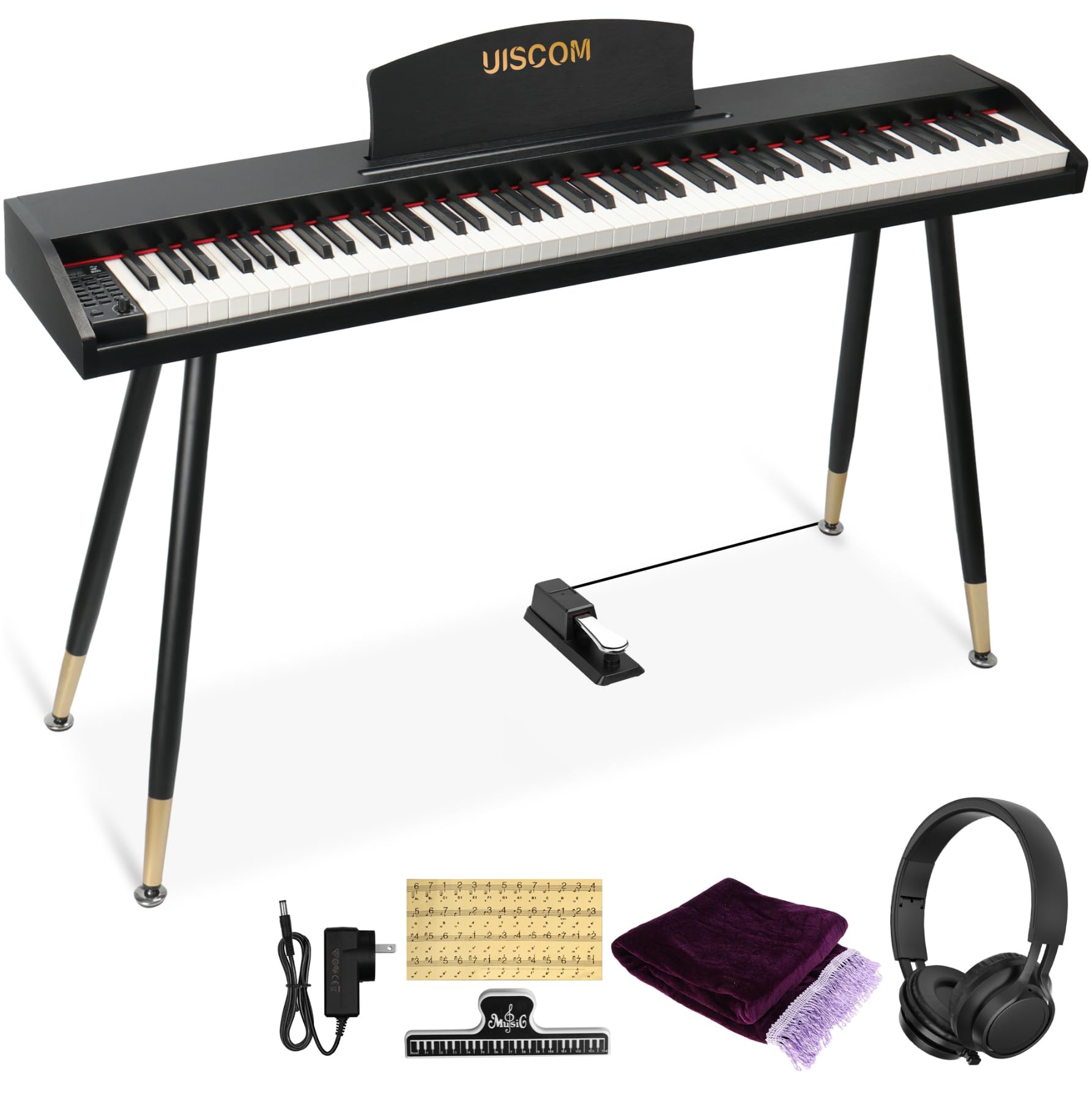
The UISCOM 88-key set is built for the budget-conscious learner who wants the full keyboard breadth without the mechanical complexity of a weighted action. The semi-weighted keys offer a middle ground — quicker return and lighter touch than fully weighted boards, which helps beginners build finger speed without the initial resistance that can discourage early practice. The package includes a triple pedal unit, headphones, music stand, key stickers, and a piano cover, so everything needed to start is in the box. The wood grain finish and eco-friendly materials give it a furniture-grade look that blends into a home environment.
The sound library is large: 600 tones, 800 rhythms, and 80 demo songs. The built-in metronome, split keyboard, layering, transposition, and recording functions provide genuine practice and composition tools at this price point. The MIDI-USB connection works with apps like POP Piano and Perfect Piano for guided lessons, and the Bluetooth speaker function means the keyboard doubles as a sound system for backing tracks. The wood brown aesthetic with metal legs is surprisingly elegant for the price.
The semi-weighted keys lack the nuanced dynamic range of a full hammer action — playing softly produces a consistent volume rather than a true pianissimo, and the default piano timbre can sound thin and abrasive compared to Yamaha or Roland samples. The music stand is too small to hold standard sheet music books securely, and the pedal unit’s soft pedal only reduces volume without changing the timbre. Intermediate players will quickly outgrow the sound engine, but for a beginner who wants an all-in-one 88-key setup without a large investment, the UISCOM delivers functional breadth.
Why it’s great
- Complete set with triple pedal, headphones, and cover
- 600 tones, 800 rhythms for creative exploration
- Bluetooth speaker function for backing tracks
- Attractive wood grain finish with metal stand
Good to know
- Semi-weighted keys lack full dynamic expression
- Default piano timbre can sound thin
- Music stand is too small for standard books
5. Liquid Stands Piano Keyboard Stand and Bench Set

The Liquid Stands set is not a keyboard itself but the support system that keeps your 76-key or larger instrument stable at the correct playing height. The Z-style frame offers significantly more stability than the common X-style stands, which tend to wobble during dynamic play. The width adjusts to fit anything from a compact 54-key board up to a full 88-key slab, and the height adjusts to accommodate both seated and standing positions — a critical feature for growing children or players who switch between playing styles. The 250-pound load capacity means even the heaviest weighted digital piano sits securely.
The included bench is adjustable-height with a padded seat, and the set weighs only 9 pounds for the stand, making it genuinely easy to transport between gigs or store when not in use. The anchoring straps and anti-skid foam pads prevent the keyboard from sliding during play, and the headphone hook keeps cables organized. Assembly requires no tools and takes under 15 minutes, which is a welcome contrast to furniture-style stands that need an hour of bolt-tightening.
The bench, while stable and comfortable for short sessions, lacks back support and the cushioning is on the firm side — players who practice for an hour or more may want a separate piano bench with more padding. The stand’s folded footprint is still fairly large for carrying, and the stainless steel finish shows fingerprints readily. If your current keyboard sits on a wobbly X-stand or a too-low desk, this set solves the ergonomic problem directly.
Why it’s great
- Z-style frame is far more stable than X-style stands
- Adjustable height and width fit any keyboard size
- 250-pound load capacity for heavy digital pianos
- Includes bench, straps, foam pads, and headphone hook
Good to know
- Bench cushion is firm and has no back support
- Folded size is still somewhat bulky to carry
- Stainless steel finish shows fingerprints easily
6. UMOMO 88 Key Progressive Hammer Action Digital Piano
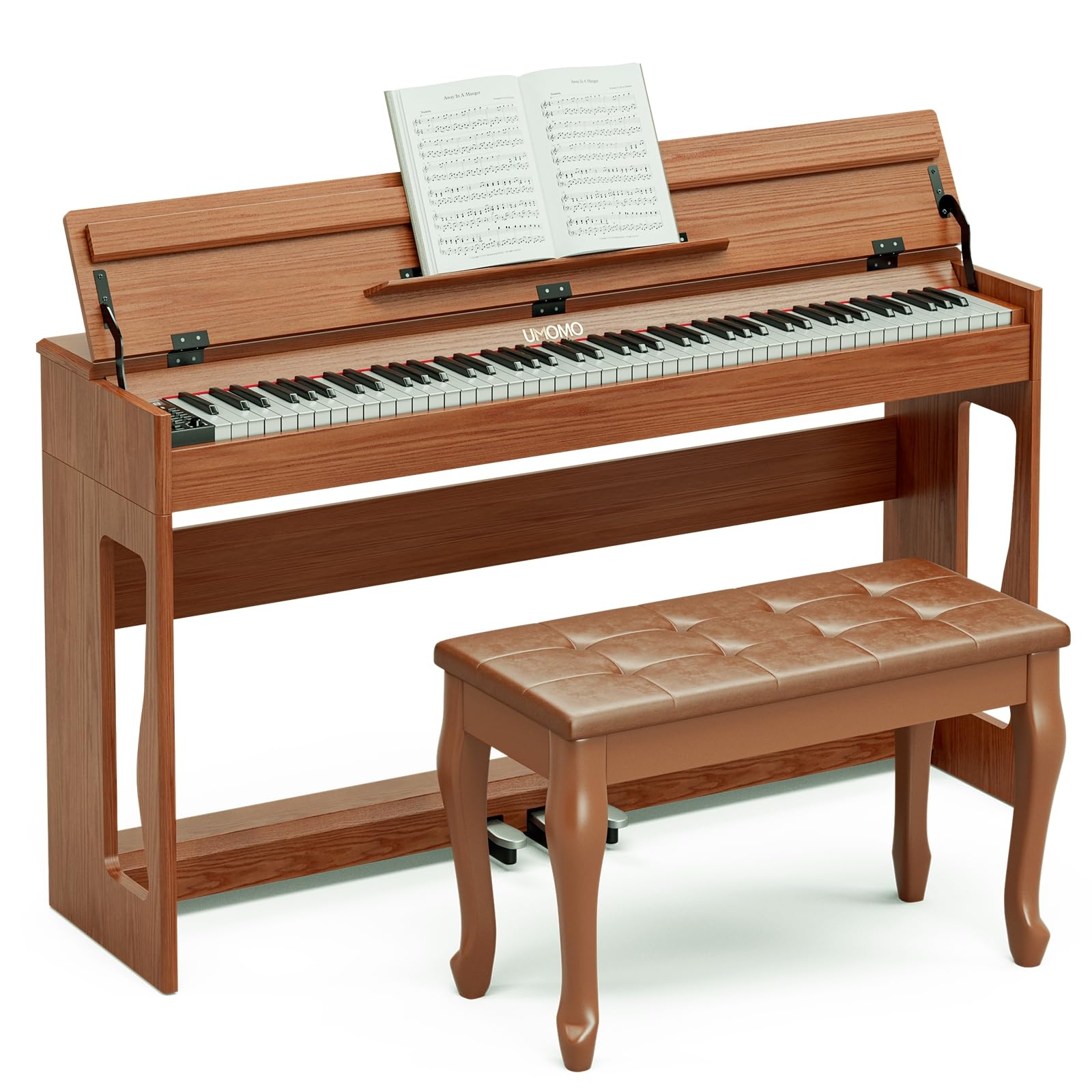
The UMOMO UMP-718 brings genuine progressive hammer action — where the lower keys are heavier than the upper keys — to a price point that typically offers only semi-weighted or synth-action keybeds. This graduated touch is the same principle found in acoustic grand pianos, and it trains the fingers to apply appropriate force across the register. The 88 full-size keys are weighted, so the down-weight resistance is consistent enough that players can transition to an acoustic upright without feeling a drastic difference. The wood-brown cabinet with a furniture stand presents as a proper home piano rather than a piece of gear.
The duet bench is a thoughtful inclusion for teaching studios or parent-child practice sessions, and the USB-MIDI port connects to any standard learning app. The onboard sounds are adequate for practice, with a decent grand piano sample and a handful of additional voices. The headphone jack (3.5mm) sits underneath the keyboard, keeping the top surface clean but making it awkward to access while the keyboard is against a wall. The stand bolts together solidly, and the finish is described as high-quality and beautiful in nearly every user report.
The built-in speakers are the weak link — multiple owners note that the sound quality falls short of even a budget Yamaha, with distortion creeping in past halfway volume. The volume inconsistency across the dynamic range means that very soft playing may not produce the quietest tones, and very loud playing can cause cabinet buzz. The user manual is sparse, and the key feel, while weighted, does not have the nuanced escapement feel of premium brands. Still, for a player who wants the tactile discipline of hammer-action keys at an approachable price, the UMOMO delivers that core requirement effectively.
Why it’s great
- Genuine progressive hammer action for proper technique
- Duet bench included for two-player practice
- Beautiful wood-brown cabinet with furniture stand
- USB-MIDI for app and computer connection
Good to know
- Built-in speakers distort at higher volume
- Dynamic response can be inconsistent across key range
- Headphone jack placement is hard to reach
7. WENCAI 88 Key Velocity-Sensitive Electric Piano (Sub Brown)

The WENCAI BL-8817 in Sub Brown is designed as a furniture-grade instrument that doubles as a desk surface when not in use — the integrated dust cover stores flat on top, creating a usable shelf. The 88 velocity-sensitive keys respond to playing force, allowing expressive dynamics from pianissimo to fortissimo. The French DREAM sound source is a legitimate step up from generic sample-based engines, providing a rich grand piano resonance that responds to key velocity with appropriate tonal shift. The sound is warm and full-bodied through the dual stereo speakers, and the 128-timbre, 100-rhythm library gives a beginner plenty of territory to explore.
MIDI-over-USB works with standard music apps for self-study, and the three-pedal unit includes soft, sostenuto, and sustain functions — unusual at this price for a furniture-style piano. The 30-day return policy and one-year warranty provide reassurance for a first-time buyer. Assembly requires two people due to the weight (roughly 73 pounds), but once assembled the unit feels solid and does not wobble during play. The wooden upright form factor fits seamlessly into a living room or study without looking like electronic equipment.
The keys are velocity-sensitive but not fully weighted — they spring back quickly and lack the hammer-action resistance that builds finger strength over time. The glossy finish on the Sub Brown model shows dust and fingerprints quickly, and the control panel buttons feel slightly recessed and difficult to operate by touch alone. The maximum polyphony is not listed, but user reports suggest it sits around 32-48 notes, which may limit sustained chord work. For the player who values aesthetics and needs a first instrument that does not scream “beginner gear,” the WENCAI Sub Brown is visually and acoustically satisfying.
Why it’s great
- French DREAM sound source produces warm grand piano tone
- Furniture-style cabinet doubles as a desk surface
- Triple pedal unit with soft, sostenuto, and sustain
- MIDI-USB compatibility for learning apps
Good to know
- Velocity-sensitive, not fully weighted keys
- Polyphony likely limited to 32-48 notes
- Glossy finish needs frequent cleaning
8. WENCAI 88 Key Fully Weighted Digital Piano (Black)
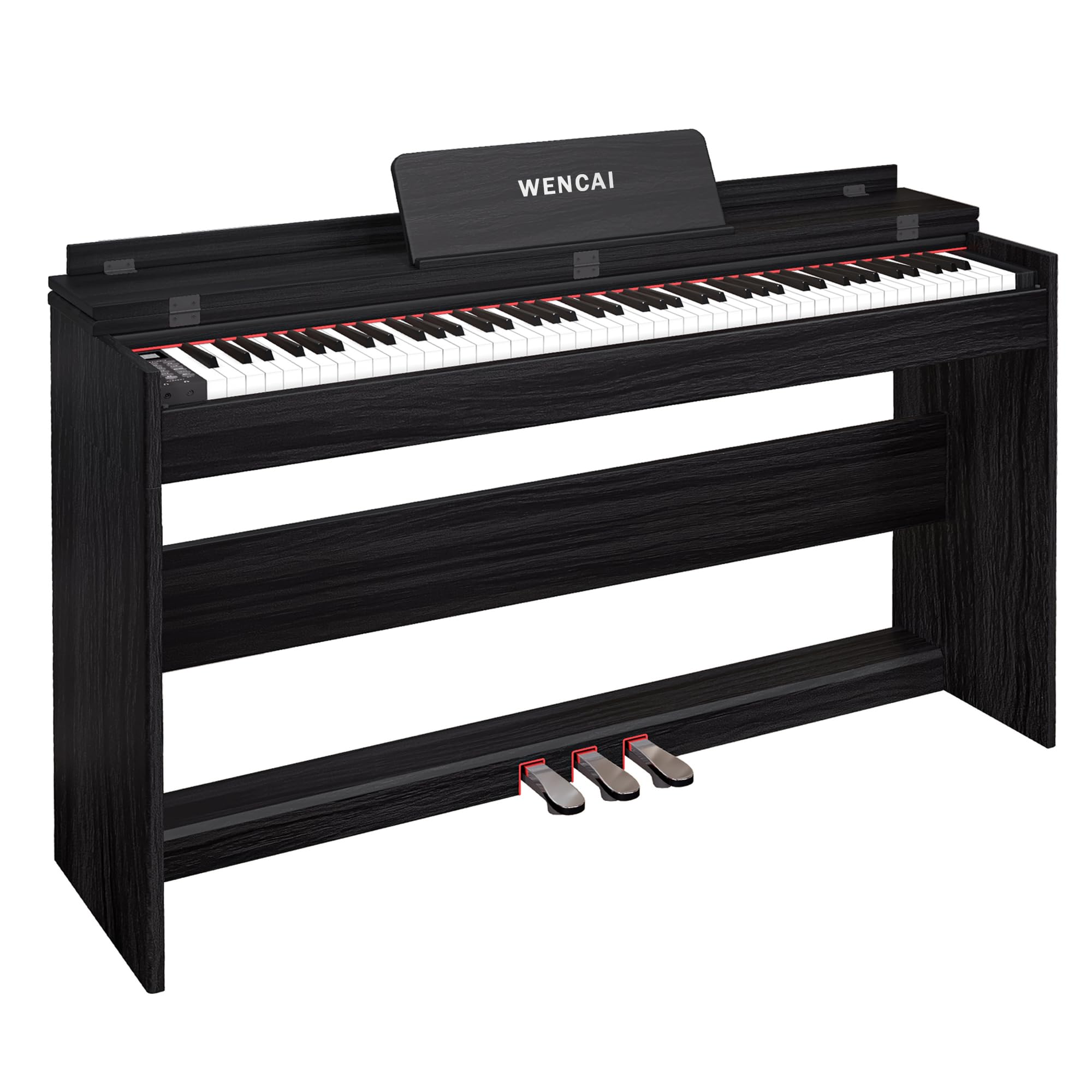
The WENCAI BL-8812 is the fully weighted sibling of the Sub Brown model, and it addresses the main criticism of its counterpart: the keys now feature progressive hammer action with real physical weight. Each of the 88 keys has an individual hammer mechanism, creating the heavier bass and lighter treble feel of an acoustic upright. The resistance builds finger strength and teaches proper articulation — the key return speed is slower than synth-action, which forces deliberate finger motion. The French digital chip and dual high-power stereo speakers deliver a full-bodied piano tone that fills a medium-sized room without distorting at reasonable volumes.
The 128 timbres, 100 rhythms, and 88 demo songs provide a generous palette for exploration, and the metal pedal unit (soft, sostenuto, sustain) connects to the bottom of the piano body for a clean installation. The USB-MIDI port works with Windows, macOS, and Linux, making it compatible with any major DAW or educational app. The magnetic music stand is a quality-of-life improvement over clip-on stands, staying secure during vigorous play. The black finish is classic and matches most home décors without drawing attention.
Assembly is heavy work — the unit weighs roughly 73 pounds and requires two people to lift and align. The pedal sockets are located on the bottom of the piano body, which means you must route the cable before placing the piano against the wall, or it becomes awkward to plug in. The touch sensitivity can be adjusted, but the default setting may feel too heavy for some beginners, and the lack of an adjustable key weight setting is a minor omission. For a student who wants to develop proper piano technique without spending four figures, the WENCAI BL-8812 provides the essential weighted experience in a home-friendly package.
Why it’s great
- Fully weighted progressive hammer action for real piano feel
- Metal pedal unit with soft, sostenuto, and sustain
- French digital chip produces rich, loud sound
- USB-MIDI works with Windows, macOS, and Linux
Good to know
- Very heavy — requires two people for assembly
- Pedal sockets on bottom are hard to access after placement
- Default touch sensitivity may feel too heavy for beginners
9. Best Choice Products 88-Key Weighted Full Size Digital Piano Set

Best Choice Products positions this 88-key set as a complete package for players who want everything in one shipment: a fully weighted hammer-action keyboard, a U-stand, a three-pedal unit (soft, selective sustain, full sustain), a padded stool, a music stand, and a keyboard cover. The weighted keys respond to playing force with real resistance, and the 140 timbres, 128 rhythms, and 100 demo songs give a beginner ample sonic variety. The two headphone jacks allow teacher-student shared listening — a practical feature for lessons that cheaper sets omit entirely.
The triple pedal unit is a genuine advantage over single-sustain pedal sets, enabling proper piano footwork from day one. The MIDI-over-USB connectivity opens the door to recording software and learning apps, and the U-stand is sturdier than the typical X-stand, reducing lateral wobble during dynamic playing. The keyboard dimensions (52 inches wide) match a standard upright footprint, and the 56-pound total weight includes the stand, making it feasible to move room to room with two people.
The stand has a known design issue — the keyboard platform tilts backward slightly, which some users correct by shimming the front bolts with washers or coins. The included stool is functional but basic, with limited padding and a 220-pound weight capacity that may not suit all users. The default piano sound, while decent for the price, does not match the tonal depth of Yamaha’s AWM sampling or the French DREAM engine in the WENCAI units. For a family buying a first digital piano that includes every accessory needed to start playing immediately, this set delivers exceptional breadth despite some fit-and-finish compromises.
Why it’s great
- Complete set with weighted keys, stand, stool, and pedals
- Three-pedal unit for proper piano footwork
- Two headphone jacks for shared listening
- 140 timbres and 128 rhythms for sonic variety
Good to know
- Keyboard platform may tilt backward; needs shimming
- Included stool is basic with 220-lb limit
- Default piano sound lacks depth of premium engines
FAQ
Is 76 keys enough for learning piano properly?
What is the difference between Graded Soft Touch and fully weighted keys?
Can I use a 76-key keyboard with learning apps like Simply Piano or Flowkey?
How many timbres and rhythms do I actually need?
Final Thoughts: The Verdict
For most users, the 76 key keyboard winner is the Yamaha YPT-W320 because it combines touch-sensitive 76-key range, Yamaha’s excellent grand piano sound, and built-in lesson tools in a lightweight 11.4-pound package at a reasonable investment. If you want graded key resistance and 64-note polyphony for more advanced playing, grab the Yamaha NP32. And for a learner who needs gamified LED guidance to build daily practice habits, nothing beats the The ONE Smart Keyboard COLOR.