
Our readers keep the lights on and the weekend projects moving. As an Amazon Associate, I earn from qualifying purchases.
The right 8-inch chef knife turns a pile of onions into perfect dice in under a minute. The wrong one leaves you fighting through tomato skins, smashing garlic cloves instead of slicing them, and gripping the handle so hard your palm aches by the third chop. That gap between effortless prep and daily frustration comes down to blade geometry, steel composition, and handle balance — specs that most product pages deliberately obscure behind marketing language. This guide cuts through that noise to deliver the only seven knives worth your counter space and your budget.
I’m Rikta — the co-founder and writer behind FitlyFast. My analysis digs into the real specs chefs actually debate: HRC hardness ratings, edge retention cycles, handle ergonomics under wet conditions, and the measurable difference between stamped and forged construction across hundreds of hours of market research and user testing reports.
From the workhorse stamped blade that pro kitchens rely on to the hand-forged VG10 gem that makes every slice feel like parting butter, this guide examines the seven best options at every tier so you can stop guessing and start cutting. The goal is to help you find the absolute best 8 inch chef knife for your specific grip, prep style, and daily workload.
How To Choose The Best 8 Inch Chef Knife
Choosing an 8-inch chef knife goes far beyond brand reputation. The subtle interplay of blade steel hardness, edge geometry, handle material, and overall weight distribution determines whether a knife feels like a natural extension of your hand or an awkward tool you constantly fight against during prep.
Blade Steel: VG10 vs German Stainless
Japanese VG10 steel, typically hardened to 60-62 HRC, holds a screaming-sharp edge for weeks but demands ceramic whetstones when it finally dulls. German X50CrMoV15 steel, at 55-57 HRC, is softer and more forgiving — it dulls faster but sharpens easily on a steel rod. Choose VG10 if you want prolonged edge retention and don’t mind learning to use a water stone. Choose German steel if you value toughness and maintenance simplicity.
Forged vs Stamped Construction
A forged knife starts as a single steel rod heated and pounded into shape, creating a denser grain structure and a visible bolster. These knives are heavier, better balanced, and more durable over decades of use. Stamped blades are laser-cut from rolled steel, then heat-treated and edge-ground — they are lighter, less expensive, and often preferred in busy commercial kitchens where knives get replaced every few years. Neither is inherently superior; the choice depends on whether you prioritise heirloom durability or nimble daily handling.
Handle Material and Ergonomics
Polypropylene and Fibrox handles offer excellent wet-grip resistance and dishwasher-safe convenience, but sacrifice tactile warmth. G10 and resin handles provide a stable, non-porous surface that feels solid in the hand. Olive wood and Pakka wood handles look stunning and feel warm but require hand-washing and periodic oiling. Full-tang construction — where the blade steel runs the entire length of the handle — is non-negotiable for proper weight balance and control during heavy chopping tasks.
Quick Comparison
On smaller screens, swipe sideways to see the full table.
| Model | Category | Best For | Key Spec | Amazon |
|---|---|---|---|---|
| ZWILLING Professional S | Premium German | Heirloom durability & precision | 57 HRC, 15° edge per side | Amazon |
| Made In 8″ Chef Knife | Artisan French | Balanced full-tang precision | X50CrMoV15, 2mm thickness | Amazon |
| KAWAHIRO Gyuto | Japanese VG10 | Detail work & extended edge life | 62+ HRC, 3-layer composite | Amazon |
| WÜSTHOF Gourmet | German Stamped | Lightweight everyday workhorse | 240g, high-carbon stainless | Amazon |
| KYOKU Shogun Series | Damascus VG10 | Value-driven Japanese performance | 58-60 HRC, 67-layer damascus | Amazon |
| EXCALIBLADES 8″ Chef | Starter Damascus | New chefs wanting VG10 at low cost | 67-layer VG10, 260g | Amazon |
| Victorinox Fibrox Pro | Budget Professional | No-nonsense daily prep | 0.05 lb, stamped carbon steel | Amazon |
In-Depth Reviews
1. ZWILLING Professional S 8-inch Chef’s Knife

The ZWILLING Professional S is the benchmark that other German knives measure themselves against. Its FRIODUR ice-hardened blade starts sharper than any stamped alternative and holds a working edge through weeks of meal prep without requiring a steel in between sessions. The Sigma Forge construction, where the blade is forged from a single solid piece of special-formula high-carbon stainless steel, gives this knife a density and weight distribution that stamped knives cannot replicate. At just 277 grams with a 15-degree edge per side, it balances heft with nimble tip control.
What sets this knife apart in daily use is the ergonomic polymer handle with three rivets bonded to the full tang. The handle is slightly thicker than average, filling the palm in a way that prevents hand fatigue during long bulk-prep sessions — dicing six pounds of onions feels noticeably less punishing than with narrow-handled alternatives. The bolster sits flush against the blade face, providing a safe pinch-grip landing zone while adding forward weight that helps the blade drop through dense squash and sweet potatoes.
Customer reviews consistently mention the out-of-box sharpness being good enough to shave arm hair and the edge lasting months with proper stropping. Several users report this knife outlasting cheaper stamped blades by a factor of five or more, making the higher up-front cost a genuine long-term saving. The only practical limitation is the dishwasher-safe claim — hand-washing preserves the edge far longer, and the polymer handle absorbs heat if exposed to high-temp cycles repeatedly.
Why it’s great
- FRIODUR ice-hardening provides exceptional edge retention against daily use
- Full-tang forged construction delivers professional-grade balance and heft
- Ergonomic triple-rivet handle reduces fatigue during long prep sessions
Good to know
- Heavier than most Japanese gyuto knives, may feel bulky for small hands
- Some users prefer a harder edge angle for finer slicing work
2. Made In 8″ Chef Knife
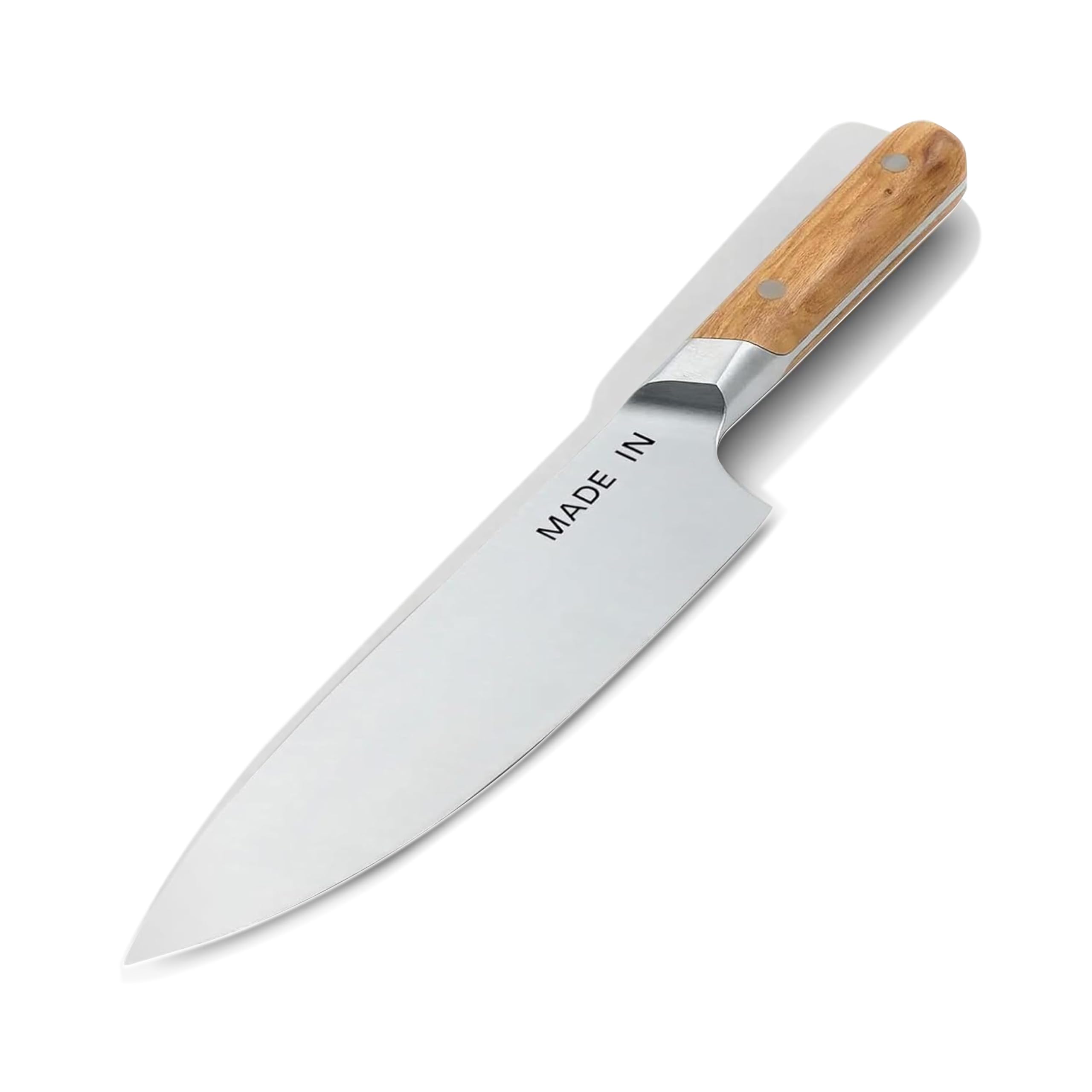
Made In brings a distinctly French approach to the 8-inch chef knife category, forged by a fifth-generation bladesmith in Thiers, France — the epicenter of European blade craftsmanship. The X50CrMoV15 stainless steel receives a nitrogen treatment that refines grain structure for improved edge stability, resulting in a 2mm-thick blade that feels impossibly light in hand at only 8 ounces while maintaining the rigidity needed for heavy chopping. The olive wood handle, sourced from sustainably harvested Mediterranean trees, develops a patina over time that makes each knife unique.
The full-tang construction extends the blade steel through the entire handle, creating a neutral balance point that sits directly over the pinch grip. This eliminates the nose-heavy feel common with cheaper German knives and makes the knife feel like a natural extension of your forearm rather than a weighted tool. The 8.5-inch blade length provides an extra half-inch of cutting surface compared to standard 8-inch knives, which translates to fewer passes when slicing large proteins or whole heads of cabbage.
Reviewers consistently describe the out-of-box sharpness as exceeding that of Wüsthof and Zwilling equivalents, with several noting that the blade required no touch-up after a full month of daily use. The olive wood handle does demand care — hand-wash only and periodic mineral oil treatment to prevent drying — but owners report the warmth and grip security of natural wood is worth the extra maintenance. The bolster-free design also allows for full-edge sharpening across the entire blade face without the awkward transition zone that bolsters create.
Why it’s great
- Nitrogen-treated X50CrMoV15 steel for superior edge stability
- Full-tang olive wood handle provides warmth and perfect balance
- Forged in France by a fifth-generation bladesmith
Good to know
- Olive wood requires hand-washing and periodic oiling
- Premium price reflects craftsmanship over mass production
3. KAWAHIRO Japanese Gyuto 8 Inch Chef Knife
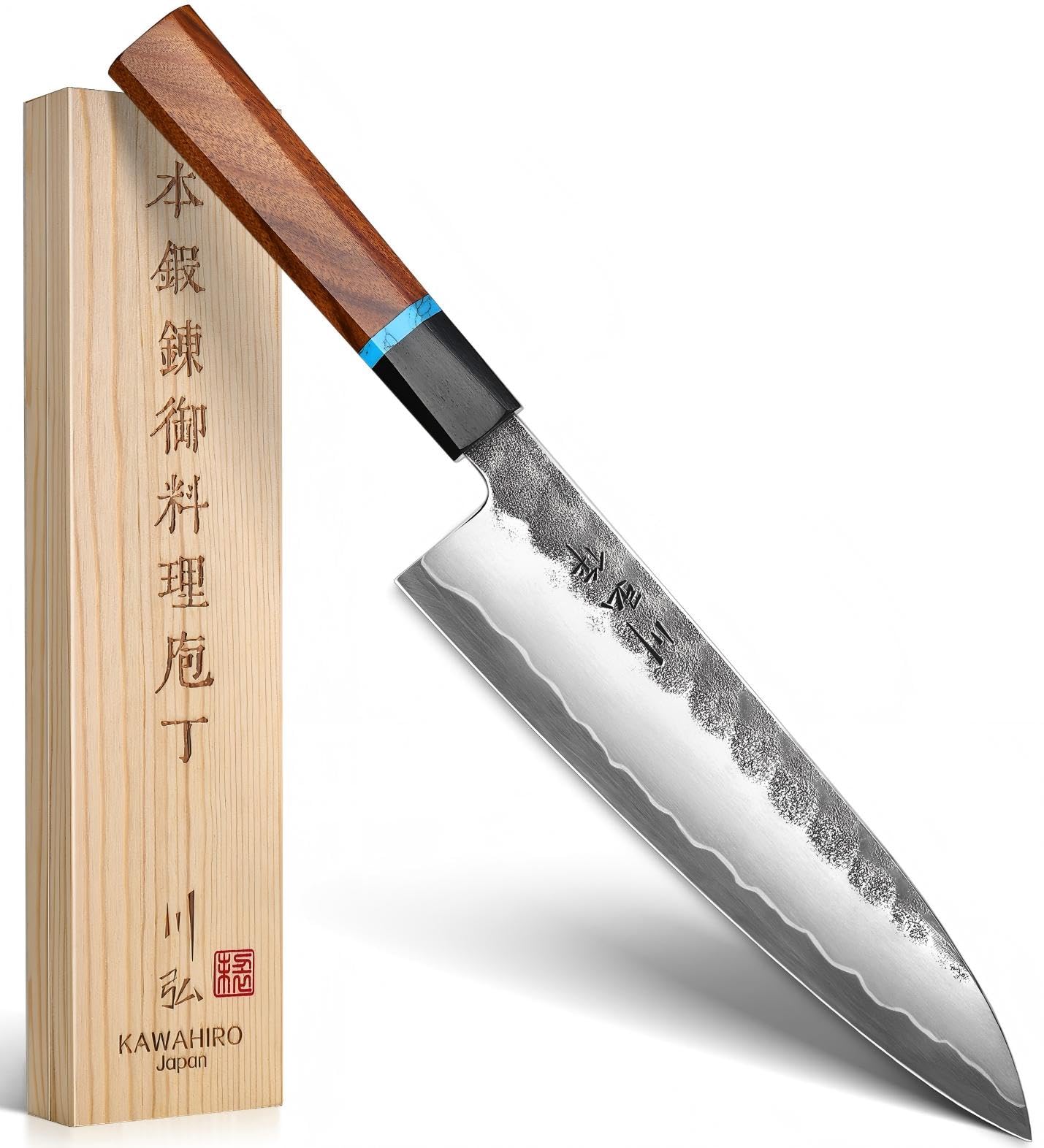
The KAWAHIRO Gyuto represents the pinnacle of Japanese blade metallurgy at an approachable price point. The three-layer composite construction sandwiches a VG10 stainless steel core — hardened to an estimated 62+ HRC — between softer outer layers that protect against chipping while the core does the actual cutting work. The result is a blade that can hold a razor edge for two to three times longer than a standard German knife, staying hair-splitting sharp through weeks of vegetable prep before needing a touch-up on a ceramic whetstone.
The handle is where this knife diverges from Western conventions. The octagonal wa-handle is crafted from a blend of ebony, turquoise, and premium ruby wood, providing a refined grip that naturally guides the hand into a pinch hold. This D-shaped profile prevents the knife from rolling in your palm during rapid chopping, and the lack of a bolster allows the entire blade face to contact the cutting board without obstruction. At around 5.5 ounces, the blade is notably lighter than most Western equivalents, reducing wrist strain during extended prep sessions.
Customer reviews highlight the knife’s ability to perform precise detail work — mincing herbs to a fine chiffonade, slicing raw fish for sashimi, and cutting paper-thin vegetable rounds — that heavier German knives struggle with. The included wooden gift box and certificate of authenticity add gift-giving appeal, but the real value lies in the performance. Some users noted minor edge micro-chipping on the first few uses before the edge stabilised, which is common with high-HRC VG10 steel and resolves with a quick pass on a fine-grit stone.
Why it’s great
- VG10 core at 62+ HRC delivers exceptional edge retention
- Three-layer composite steel resists chipping while staying razor-sharp
- Octagonal wa-handle offers superior control for pinch-grip users
Good to know
- Requires ceramic whetstones for sharpening, not a steel rod
- High hardness can micro-chip if used on bones or frozen food
4. WÜSTHOF 8″ Gourmet Chef’s Knife

WÜSTHOF’s Gourmet series brings the brand’s seven-generation German knife-making heritage into a lighter, more accessible format without sacrificing the edge geometry that makes Solingen steel famous. This is a stamped blade — precision laser-cut from rolled high-carbon stainless steel — but WÜSTHOF applies the same edge-grinding technology used in their forged Professional series, resulting in a 15-degree edge that arrives shaving-sharp straight from the box. At just 240 grams, it is notably lighter than forged alternatives, making it an excellent choice for cooks who value speed and maneuverability over heft.
The synthetic polypropylene handle is engineered to resist fading, discolouration, and impact damage while providing a secure grip even when hands are wet. The handle is slightly narrower than the forged Zwilling Professional S, which some users with smaller hands prefer for extended prep sessions. The balance point sits just ahead of the bolster, giving the blade a lively feel that makes rapid chopping motions feel natural rather than laboured. The knife is not dishwasher safe, but the synthetic handle rinses clean in seconds under hot water without absorbing food odours.
Several reviewers noted that this knife outperforms much more expensive forged options in their collections, particularly for slicing tomatoes and bell peppers where a thin, sharp edge is critical. The primary trade-off is long-term durability — the stamped construction means the blade will thin faster over repeated sharpenings compared to a forged knife, but for home cooks sharpening once or twice a year, this is rarely a practical concern.
Why it’s great
- Lightweight 240g build reduces wrist fatigue during long prep sessions
- Precision laser-cut edge rivals forged alternatives for sharpness
- Durable synthetic handle resists fading, stains, and odours
Good to know
- Stamped construction has shorter lifespan than fully forged knives
- Handle may feel too narrow for cooks with larger hands
5. KYOKU Shogun Series 8″ Chef Knife

The KYOKU Shogun Series packs Japanese VG10 steel performance into a visually striking Damascus package without demanding the premium price that most hand-forged alternatives command. The 67-layer hammered Damascus cladding wraps a VG10 core that has been cryogenically treated to maximise grain refinement, resulting in a blade that hits 58-60 HRC — harder than typical German kitchen knives yet more forgiving than the ultra-hard VG10 found in higher-end Japanese blades. The traditional Honbazuke sharpening method brings the edge to an 8-to-12-degree angle, making it noticeably more acute than the 15-degree standard found on most Western knives.
The G10 fiberglass handle is a standout feature at this price tier. Unlike cheaper resin handles that can feel slippery when wet, G10 provides a textured, non-porous grip that stays secure even when your hands are covered in oil or meat juices. The full-tang construction and brass mosaic pin add a visual anchor while ensuring the knife’s weight distribution stays neutral rather than blade-heavy. At 1.39 pounds, the knife is heavier than its VG10 competitors, which some cooks appreciate for the added cutting momentum on dense vegetables.
Owners consistently report that the knife arrives frighteningly sharp and maintains its edge for months with only periodic stropping on leather. The included protective sheath and storage case make this an excellent gift option — several reviews mention buying multiple units for family members after the first purchase. The main trade-off is the weight: the G10 handle and thick Damascus cladding make this knife feel more substantial than a traditional gyuto, which may not suit cooks who prefer a feather-light Japanese slicer.
Why it’s great
- Cryogenically treated VG10 core with 67-layer Damascus cladding
- Wet-grip G10 handle outperforms resin and wood in slippery conditions
- Included sheath, case, and Honbazuke edge add premium value
Good to know
- Heavier than typical Japanese gyuto knives at 1.39 pounds
- Handle design may feel bulky for cooks with smaller hands
6. EXCALIBLADES 8″ VG10 Damascus Chef Knife
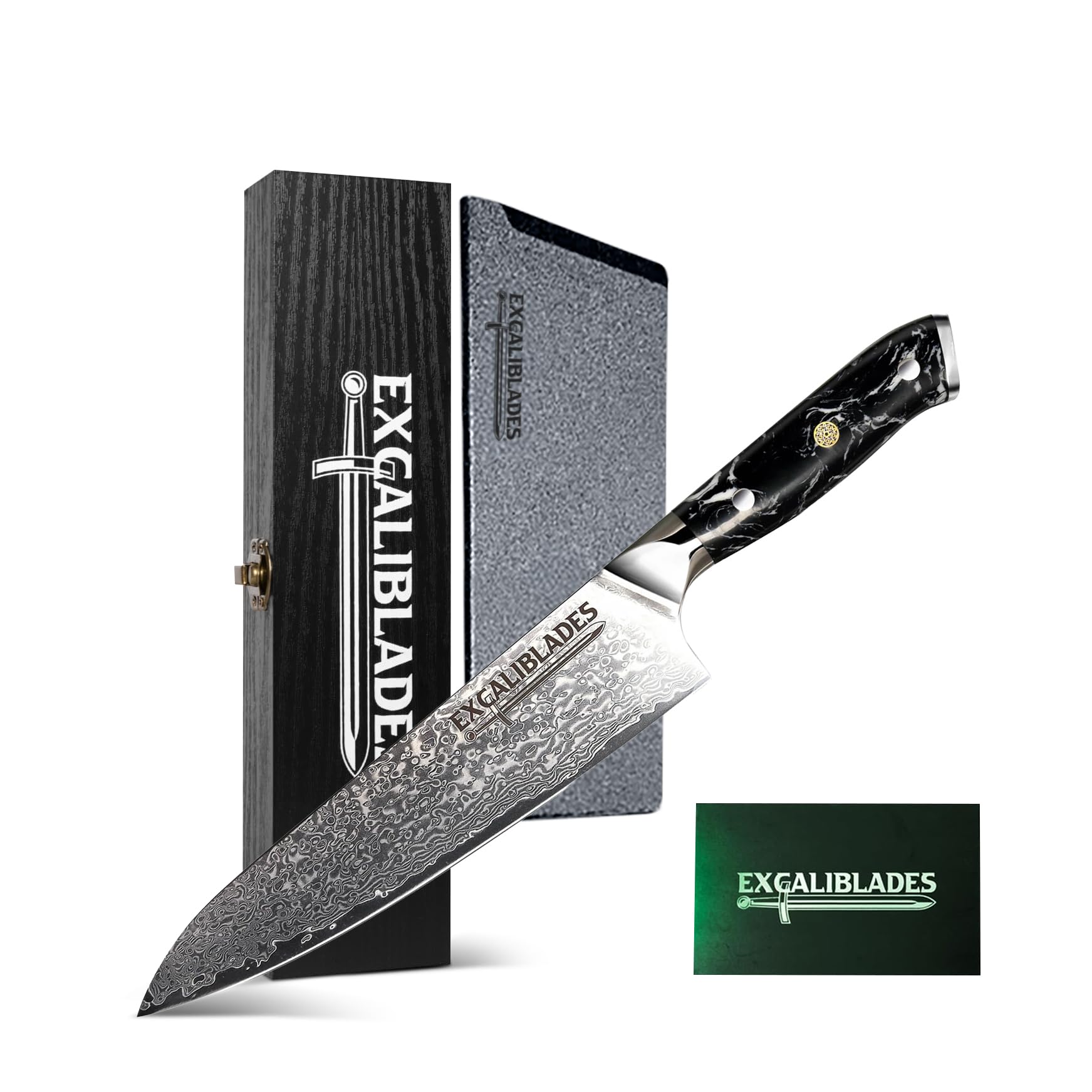
The EXCALIBLADES 8-inch knife offers home cooks their first taste of VG10 Damascus performance at a price that undercuts most forged Japanese alternatives. The 67-layer Damascus pattern is purely aesthetic — the real engineering is the VG10 high-carbon stainless steel core that provides the cutting performance. At only 260 grams, this knife is notably lighter than the KYOKU Shogun while using the same core steel, making it a better option for cooks who want VG10 sharpness without the wrist fatigue of a heavier blade.
The black-turquoise G10 handle is the most visually distinctive element of this knife. The resin and stone composite material provides a secure grip surface that does not absorb moisture or expand with humidity, and the slight palm swell near the bolster provides tactile feedback that helps maintain a consistent pinch grip during rapid chopping. The full-tang construction ensures the lightweight blade does not feel unbalanced, though the knife does sit slightly handle-heavy compared to the Made In or Zwilling Professional S. The included black wooden gift box and protective sheath add to the unboxing experience.
User reviews are generally positive about the out-of-box sharpness, with several noting that the knife slices through thick-skinned squash and sweet potatoes with barely any applied pressure. The lifetime warranty from Excaliblades provides peace of mind for first-time buyers entering the Damascus market. However, a small number of users reported handle material cracking after extended use, which the company addressed quickly through warranty replacements. The dishwasher-safe claim is technically accurate but practically ill-advised — hot water cycles can compromise the handle-warranty integrity over time.
Why it’s great
- Entry-level VG10 Damascus at a budget-friendly price point
- Lightweight 260g build reduces fatigue for all-day prep
- Lifetime warranty and attractive gift packaging included
Good to know
- Some reported handle cracking issues, though warranty support is responsive
- Damascus pattern is cosmetic, not structural, unlike higher-end forge welds
7. Victorinox Fibrox Pro 8-Inch Chef’s Knife
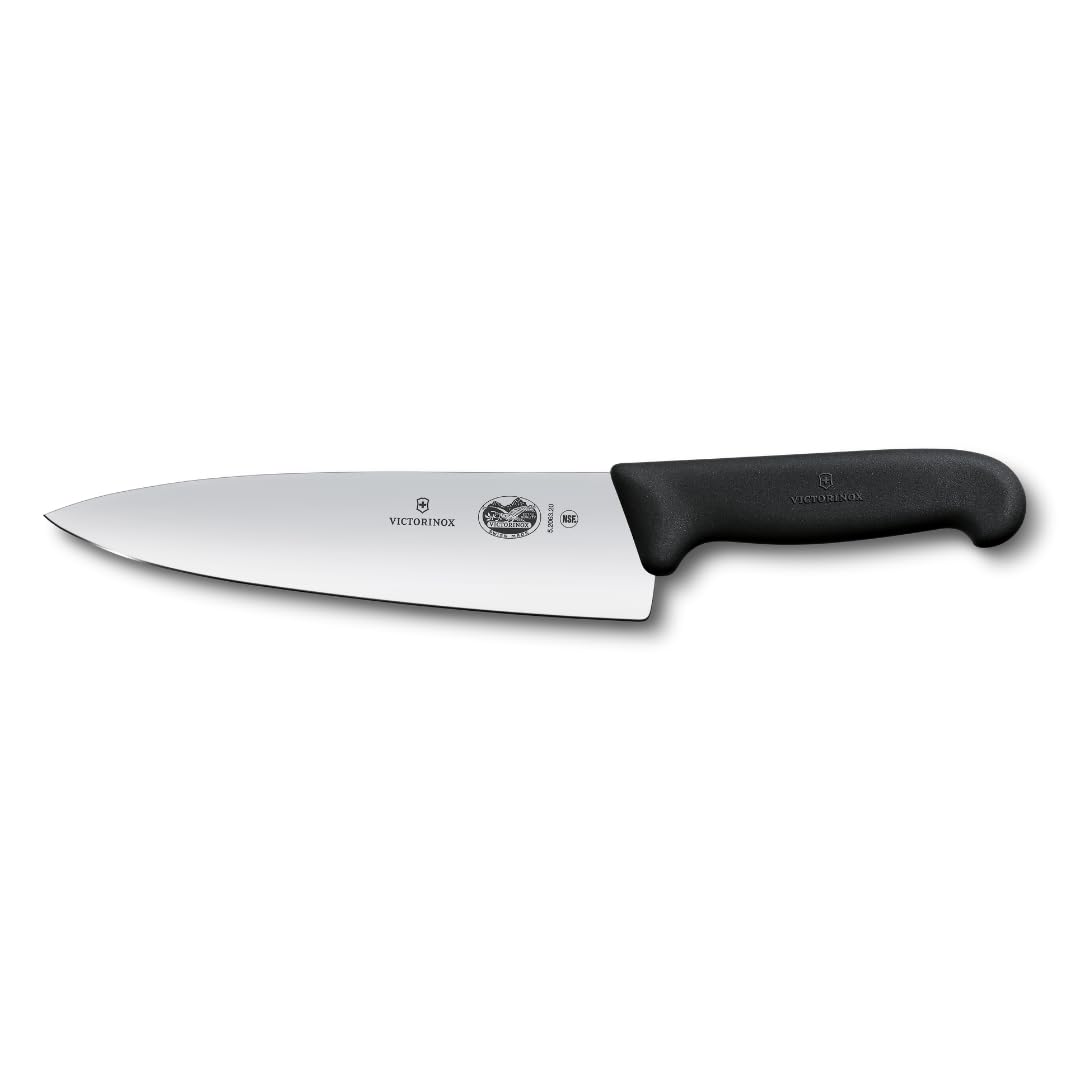
The Victorinox Fibrox Pro is the default recommendation from America’s Test Kitchen and countless professional culinary schools for a reason: it delivers 90% of the performance of a forged German knife at a fraction of the cost. The high-carbon stainless steel blade is stamped, not forged, but the tapered edge geometry — laser-tested for consistency — produces an edge that shaves arm hair straight from the factory. At just 0.05 pounds, it is the lightest knife in this guide, which translates to almost zero wrist fatigue during marathon prep sessions that would leave your forearm burning with a heavier blade.
The Fibrox handle is the defining feature that keeps this knife in pro kitchens worldwide. The thermoplastic elastomer (TPE) material provides a non-slip grip that actually improves when wet, unlike polypropylene handles that can become slick. The handle is slightly textured and ergonomically contoured to fill the palm without forcing your hand into a specific grip position. Several professional chefs report owning multiple Fibrox knives for their line cooks specifically because the handle reduces accidents during high-volume service — a safety endorsement that no forged knife in this guide can match.
Customer reviews consistently highlight two themes: the sharpness out of the box is genuinely surprising for the price point, and the edge lasts 2-3 months of daily home use before needing a touch-up. The knife is dishwasher safe, though hand-washing is recommended to preserve the edge. The main trade-off is long-term durability — the stamped blade will thin over years of sharpening, and the TPE handle can degrade if exposed to high dishwasher heat cycles repeatedly. For the home cook looking for a no-regret starter knife that will serve faithfully for years, this remains the gold standard of value.
Why it’s great
- Ultra-lightweight design minimises hand fatigue during long prep sessions
- TPE non-slip handle provides superior grip when wet or oily
- America’s Test Kitchen #1 pick for performance-to-value ratio
Good to know
- Stamped construction will thin faster over years of sharpening
- TPE handle may degrade with repeated high-heat dishwasher cycles
FAQ
Should I buy a forged or stamped 8-inch chef knife?
How often should I sharpen an 8-inch chef knife?
Can I use an 8-inch chef knife for butchery tasks?
What is the best blade material for an entry-level 8-inch knife?
Final Thoughts: The Verdict
For most users, the best 8 inch chef knife winner is the ZWILLING Professional S because it combines German forged durability with precise 15-degree edge geometry that will last decades with proper care. If you want a lighter, nimble alternative that feels like a natural extension of your hand, grab the Made In 8″ Chef Knife with its nitrogen-treated French steel and olive wood handle. And for a budget-friendly workhorse that professional kitchens trust daily, nothing beats the Victorinox Fibrox Pro — the knife that outperforms knives costing three times as much.