
Our readers keep the lights on and the weekend projects moving. As an Amazon Associate, I earn from qualifying purchases.
You are not buying a toy keyboard. You are investing in a tool that will either train your fingers correctly or ingrain bad habits you will have to unlearn later. The difference between an 88 key keyboard that frustrates you and one that makes you want to practice every day comes down to a single decision: how the keys feel under your hands. For a beginner, a keyboard with unweighted, springy keys teaches you nothing about real piano technique, while a fully weighted or hammer-action keyboard builds the proper finger strength and control you need from day one.
I’m Rikta — the co-founder and writer behind FitlyFast. I’ve spent hundreds of hours analyzing the technical specifications, customer feedback, and market positioning of digital pianos to identify which models genuinely deliver for first-time players.
This guide breaks down the specific models that offer real weighted action, quality sound engines, and the connectivity features that support your learning journey, helping you confidently choose the best 88 key keyboard for beginners for your space, budget, and musical goals.
How To Choose The Best 88 Key Keyboard For Beginners
Every beginner faces the same trap: buying a keyboard that looks like a piano but feels like a toy. Your first 88 key keyboard must prioritize touch sensitivity and weighted feel above all else, because those features directly determine whether you build proper technique or develop a heavy-handed playing style that limits you later. Here is exactly what matters.
Weighted vs Semi-Weighted vs Unweighted Keys
Unweighted keys are plastic bars on springs — they offer zero resistance and teach you nothing about controlling dynamics. Semi-weighted keys add a small metal weight for slight resistance but still lack the heft of an acoustic piano. Fully weighted keys use internal weights to simulate the resistance of a real piano hammer mechanism, and graded hammer action goes a step further by making the low keys heavier than the high keys, exactly like an acoustic grand piano. For beginners, anything less than fully weighted is a compromise on technique.
Polyphony — Why 128 Notes Matter
Polyphony is the number of notes a keyboard can produce simultaneously. A 64-note polyphony limit means that when you hold the sustain pedal and play a chord, older notes will drop out, cutting off the sound. With 128-note polyphony, complex passages with sustained chords play back cleanly without any dropped notes. This is one spec where you cannot afford to cut corners, because it directly affects the realism of your playing experience.
Sound Engine and Built-In Voices
The sound engine is the internal computer that generates the piano tone. Higher-end models use sample-based sound engines that record real acoustic pianos, while budget-tier options use basic synthesis. Look for models that include at least one high-quality grand piano voice alongside additional instrument voices for variety. A good sound engine with reverb effects creates a more immersive practice experience and keeps you engaged longer.
Connectivity for Learning Apps
USB-MIDI connectivity lets you connect your keyboard to a computer, tablet, or smartphone for use with interactive learning apps like Simply Piano, Flowkey, or Yousician. This feature turns your keyboard into a practice tool that listens to your playing and provides real-time feedback. Without USB-MIDI, you are limited to standalone practice, which slows down your progress significantly.
Quick Comparison
On smaller screens, swipe sideways to see the full table.
| Model | Category | Best For | Key Spec | Amazon |
|---|---|---|---|---|
| Yamaha P71 | Digital Piano | Acoustic feel on a budget | 25 lbs weight, graded weighted action | Amazon |
| MOSEN MDP-110 | Home Upright | Upright piano feel with desk mode | 380 voices, 128-note polyphony | Amazon |
| Donner OURA DDP-60 | Slim Cabinet | Minimalist design with great touch | 4 velocity curves, 8 reverb effects | Amazon |
| Donner DEP-20 | Portable Console | Heavy hammer action on a budget | 25W amplifiers, backlit LCD screen | Amazon |
| KUMENG Weighted Digital Piano | Desk Convertible | Compact desktop setup with weighted keys | 800 tones, 128 polyphony | Amazon |
| WENCAI BL-8818 | Upright Style | French sound engine, elegant cabinet | French DREAM sound source | Amazon |
| M-AUDIO Keystation 88 MK3 | MIDI Controller | Computer-based music production | Semi-weighted keys, pitch/mod wheels | Amazon |
In‑Depth Reviews
1. YAMAHA P71 88-Key Weighted Action Digital Piano

The Yamaha P71 is the benchmark entry-level digital piano for a reason: its graded weighted action keys accurately replicate the heavier bass keys and lighter treble keys of an acoustic piano. Yamaha’s sound engine delivers a rich grand piano voice with full dynamic range, and Dual Mode lets you layer piano with strings for a fuller practice sound. Professional musicians who have owned the P71 for years consistently report that it remains reliable through daily use and even live gigs — a durability test that budget-tier keyboards rarely survive.
The control panel is refreshingly simple: one-button operation means you spend time playing, not scrolling through menus. The 10 built-in voices are limited compared to competitors, but the grand piano voice is excellent, and that is the one you will use 95% of the time as a beginner. USB connectivity works seamlessly with iOS and Android learning apps, turning the P71 into an interactive practice tool.
At 25 pounds, the P71 is lightweight enough for a single person to move between rooms, and its compact dimensions fit easily into a corner of a bedroom or living room. The included sustain pedal is basic and tends to slide on hardwood floors, but this is a minor inconvenience that an aftermarket pedal solves for a small additional investment.
Why it’s great
- Graded weighted action feels nearly identical to an acoustic piano
- Yamaha reliability proven over years of daily use and gigging
- Lightweight and portable at 25 pounds
- Simple one-button operation for distraction-free practice
Good to know
- Only 10 built-in voices — less variety than budget competitors
- Basic sustain pedal slides easily; upgrade recommended
- Down-firing speakers limit high-frequency clarity at low volumes
2. MOSEN 88 Key Digital Piano Fully Weighted with Graded Hammer Action (MDP-110)
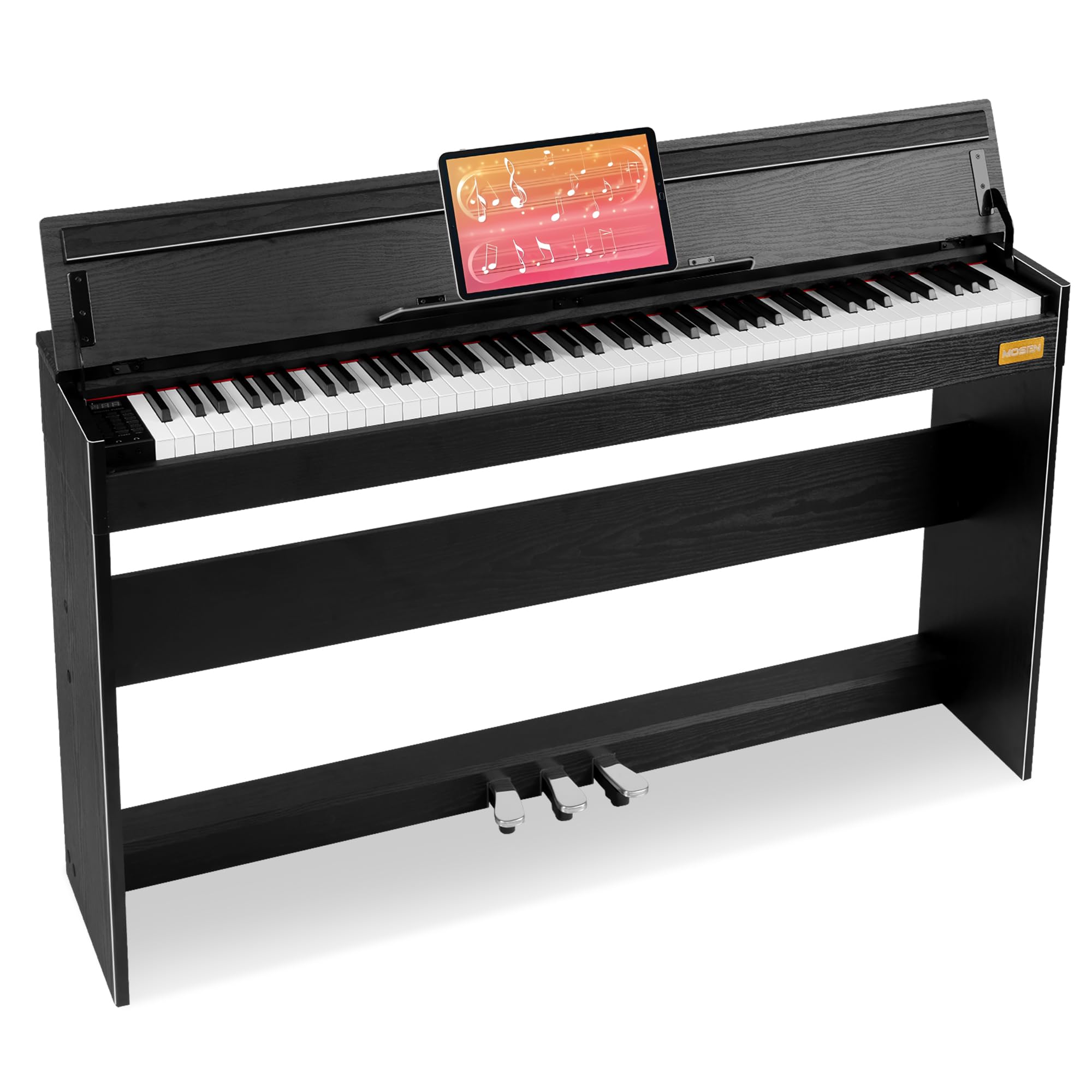
The MOSEN MDP-110 solves the common problem of where to put a piano in a small home. Its sturdy wooden stand and integrated dust cover create a piece of furniture that doubles as a flat desk surface when closed — ideal for apartments, dorm rooms, or home offices where every square foot counts. The graded hammer action keys provide the tactile resistance that beginners need to develop proper finger strength, and the dual German sound engine delivers 128-note polyphony with clean sustain.
With 380 voices, 128 rhythms, and an LCD control panel, the MDP-110 offers far more variety than the Yamaha P71. Beginners exploring different genres can switch from grand piano to electric organ to strings without needing external software. USB-MIDI connectivity supports interactive learning apps, and the dual headphone jacks allow quiet practice for two players or teacher-student sessions.
Assembly takes about an hour with one person, and the included hardware is complete with no missing parts. Some users report minor cosmetic scratches from shipping, but the design and build quality generally impress for the price tier. The lacquered finish looks significantly more expensive than it is, making this a strong option for those who want a home instrument that also serves as decor.
Why it’s great
- Furniture-style cabinet with dust cover doubles as a desk
- Graded hammer action for proper finger technique development
- 380 voices and 128 rhythms for genre exploration
- Dual headphone jacks for quiet practice
Good to know
- Shipping damage reported due to pallet strap tightness
- Assembly takes about 60 minutes
- Heavier and less portable than slab-style digital pianos
3. Donner OURA DDP-60 88 Key Digital Piano

The Donner OURA DDP-60 prioritizes visual elegance without sacrificing playability. Its slim light oak cabinet looks more like a piece of Scandinavian furniture than a digital piano, and the three-pedal unit provides the full sostenuto and soft pedal experience that most budget keyboards omit. The 88 velocity-sensitive keys offer four selectable touch curves, letting beginners choose between a lighter or heavier feel depending on their hand strength and preference.
The DDP-60 includes 128 tones, 83 rhythms, and 8 reverb effects, giving new players enough variety to stay engaged during practice sessions. Dual Mode allows two people to play on the same keyboard range, which is useful for teacher-student lessons or parent-child duets. The three headphone jacks (two under the cabinet and one at the back) support private practice for multiple users.
Sound quality is decent through the built-in speakers but noticeably improves with studio headphones, where the velocity sensitivity reveals more dynamic nuance. The lightweight cabinet design makes single-person assembly feasible, though the unit has some weight to it. A minor clicking sound from the key mechanism has been noted by some users but does not affect playability.
Why it’s great
- Slim, minimalist cabinet blends with home decor
- Triple pedal unit included for full expressive control
- Four selectable velocity curves for personalized feel
- Three headphone jacks for quiet multi-user practice
Good to know
- Built-in speakers are mediocre; headphones improve sound
- Minor key clicking reported by some users
- Not ideal for recording or live performance use
4. Donner DEP-20 Beginner Digital Piano 88 Key Full Size Weighted Keyboard

The Donner DEP-20 is the budget king of fully weighted hammer-action keyboards. Its 88 graded hammer action keys are the main selling point at this price tier, and multiple professional musicians confirm that the key action feels similar to an acoustic piano, with good velocity control across piano to fortissimo dynamics. The 128-note polyphony ensures that complex sustained passages play back without dropped notes, a critical feature for students learning to use the sustain pedal effectively.
With 238 tones and a backlit LCD screen, the DEP-20 offers more sonic variety than most competitors at the same price. The dual 25W amplifiers provide room-filling sound that is louder than typical built-in speakers. USB-MIDI connectivity works with learning apps, and the recording mode lets students play back their practice sessions for self-evaluation.
The main drawbacks are navigational: selecting sounds requires scrolling through hundreds of options without a number pad shortcut, and the double voice layer is locked at a fixed 50/50 blend. The built-in sound quality is standard MIDI-level, and experienced players recommend using the DEP-20 with an external sample library for better tone. However, as a starting instrument for learning proper technique, this is an exceptional value.
Why it’s great
- Graded hammer action rivals keyboards costing twice as much
- 128-note polyphony for clean sustained passages
- Dual 25W amplifiers for loud, clear practice sound
- Backlit LCD screen displays chords and notation
Good to know
- No number pad for quick sound selection
- Built-in sound quality is standard MIDI; best with USB sample library
- Heavy and bulky — not truly portable
5. KUMENG 88 Key Weighted Keyboard Full-Size Desk Progressive Hammer-Action Electric Piano
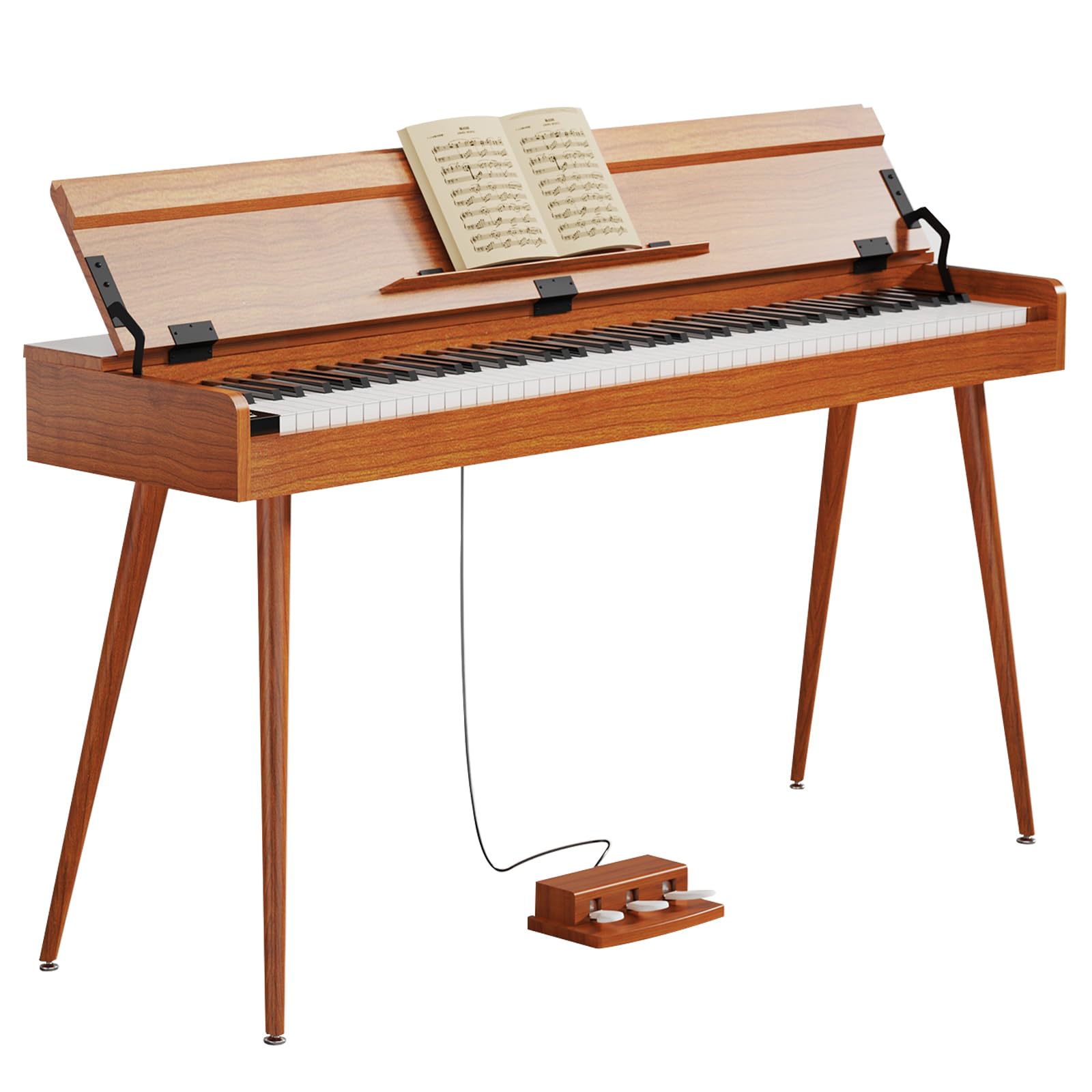
The KUMENG 88 Key Weighted Keyboard offers a unique form factor that targets beginners with limited space. The piano includes portable detachable legs and a high-quality wooden cabinet with a flip key cover, and the entire unit converts from a full-size hammer-action digital piano into a spacious work desk. This 2-in-1 design is perfect for dorm rooms, home offices, or apartments where a permanent piano setup is impractical.
The progressive hammer-action keys provide the graded resistance that builds proper finger strength, and the 128-note polyphony handles complex passages without note dropout. With 800 tones and a multi-function control panel, beginners have access to an enormous variety of sounds, and the split keyboard function allows two different instruments to be played simultaneously on the left and right sides. USB-MIDI connectivity integrates with learning apps, and the headphone jack enables silent practice.
Some users note that the manual lacks detail on USB and power connector specifics, and the headphone output quality has been criticized for noise and buzzing at higher volumes. The triple pedal unit works well for basic sustain control, though advanced players may find the pedal action less refined than standalone units. Assembly is straightforward, and the clean brown cabinet finish looks attractive in a home setting.
Why it’s great
- 2-in-1 design converts to a work desk when not in use
- Progressive hammer-action keys for proper finger development
- 800 tones provide massive sonic variety
- Split keyboard function for dual-instrument play
Good to know
- Headphone output has noise and buzzing issues
- Manual lacks detail on connector specifications
- Not suitable for live performance or recording
6. WENCAI 88 Key Electric Piano Velocity-Sensitive Keyboard BL-8818

The WENCAI BL-8818 distinguishes itself from the crowded field by using the French DREAM sound source, which reproduces the resonant tones of a grand piano with noticeable warmth and depth. The velocity-sensitive 88 keys respond to touch dynamics across a wide range, from whisper-quiet melodies to loud, emphatic chords. The sturdy wooden stand with an integrated dust cover provides a classic upright piano aesthetic, and the cover doubles as a desk surface when closed.
USB-MIDI connectivity is compatible with Windows, macOS, and Linux operating systems, and the piano works with popular learning apps for self-directed practice. The PES-certified power supply meets safety standards, and the included sustain pedal provides basic control. The piano supports headphone connection via a 3.5mm jack for silent practice, which is essential for apartment living.
Assembly is time-consuming but manageable with two people, as the unit weighs over 33 kilograms. The build quality is solid, with a lacquered finish that looks more expensive than the price suggests. Some users have noted that the piano is heavy enough that placement should be carefully considered before assembly. The sound quality through external speakers or headphones is notably better than the built-in speakers, which are adequate for practice but not performance-level.
Why it’s great
- French DREAM sound source delivers rich, warm grand piano tones
- Wooden stand with dust cover doubles as a desk surface
- Wide multi-OS compatibility for learning apps
- PES-certified power supply ensures electrical safety
Good to know
- Heavy at over 33 kg — requires two people for assembly
- Built-in speakers are adequate but not powerful
- Assembly takes significant time and effort
7. M-AUDIO Keystation 88 MK3 88 Key Semi Weighted MIDI Keyboard Controller
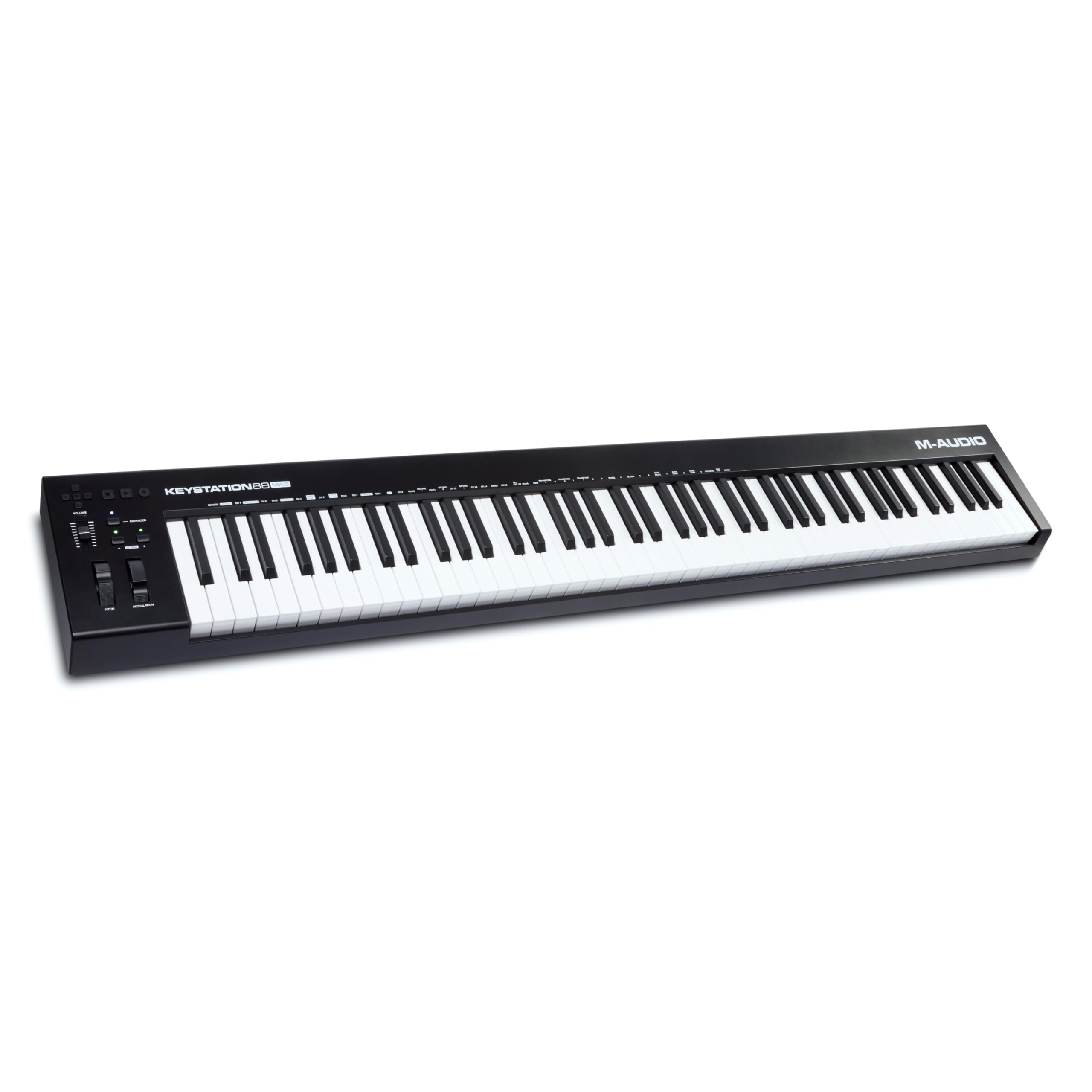
The M-AUDIO Keystation 88 MK3 is not a self-contained digital piano — it is a MIDI controller that produces no sound on its own and requires connection to a computer, tablet, or smartphone running virtual instrument software. This makes it fundamentally different from the other keyboards on this list. Its 88 semi-weighted keys offer more resistance than unweighted controllers but significantly less than fully weighted hammer-action keyboards. For a beginner whose primary goal is learning to play piano, this is a compromise that will not build proper finger technique.
Where the Keystation excels is in music production and software control. The pitch wheel, modulation wheel, volume fader, and transport buttons provide direct hands-on control over DAW parameters. The slimline design fits easily on any desk, and USB plug-and-play connectivity works with Mac, PC, and iOS devices without drivers or external power. Bundled software includes Ableton Live Lite, MPC Beats, Mini Grand, and several other production tools.
Some users report significant setup difficulties on Windows, requiring MIDI-OX workarounds to establish reliable connection. The keys are quiet enough for apartment use but lack the weighted feel that beginners need. This keyboard is ideal for an aspiring music producer who also wants a basic piano-style controller, but it is not a substitute for a weighted-action digital piano for a beginner focused on piano technique.
Why it’s great
- Plays well with Logic Pro and other major DAWs out of the box
- Slim, lightweight design fits any desk or studio setup
- Bundled with professional music production software
- USB powered — no separate power supply needed
Good to know
- Semi-weighted keys lack the resistance needed for piano technique
- Windows setup can be problematic; may require MIDI-OX workaround
- Produces no sound without a computer or tablet connected
FAQ
Can I use a 88 key keyboard for learning apps like Simply Piano?
Is a semi-weighted keyboard okay for a beginner pianist?
Do I need a triple pedal unit as a beginner?
How much space do I need for a full 88 key keyboard?
Should I buy a keyboard with built-in speakers or use studio monitors?
Final Thoughts: The Verdict
For most users, the 88 key keyboard for beginners winner is the Yamaha P71 because its graded weighted action and Yamaha reliability give you a proper acoustic-piano feel at a price that leaves room for a quality sustain pedal upgrade. If you want a furniture-style instrument that doubles as a desk and offers more voice variety, grab the MOSEN MDP-110. And for the best value hammer-action keyboard under the premium tier, nothing beats the Donner DEP-20.