
Our readers keep the lights on and the weekend projects moving. As an Amazon Associate, I earn from qualifying purchases.
Specs are compiled from manufacturer listings and verified buyer reviews and can change over time — please confirm the key details on the product page before buying.
Finding an 88 key keyboard that feels like a real grand piano is the difference between training your hands properly and picking up habits you will have to unlearn later. This guide walks through seven weighted-key models, from mid-range to premium, comparing their internal hammer action, sound engines (the computer chip that creates the piano tone), and connectivity so you can match one to your skill level and home setup.
I’m Rikta — the founder and writer behind FitlyFast. This guide is built by comparing the manufacturers’ published specifications and the patterns across verified customer reviews, so you get each pick’s real strengths and trade-offs instead of marketing spin.
Whether you are a beginner learning scales or an experienced player upgrading from a keyboard with light spring-loaded keys, the best 88 key keyboard earns its place with graded hammer action (keys that are heavier in the low notes and lighter in the high notes, just like an acoustic piano), enough polyphony (the number of notes it can play at the same time) for complex passages without cutting notes short, and the right ports for apps and recording.
Quick Picks
- Roland FP-30X — Premium Pick
- Yamaha P225 — Portable Performer
- Yamaha DGX-670B — Band-in-a-Box
- Donner DDP-300 — Graded Action Champ
- Donner DDP-90 Pro — Compact Upright
- HEXANT 88-Key Weighted Digital Piano — Sound Library King
- Ktaxon GPP-203 Digital Piano — Budget Weighted Entry
How To Choose The Best 88 Key Keyboard
An 88 key keyboard is a long-term investment in your playing, and picking the wrong one can hold you back. Here are the specs (technical details) that separate a practice tool from a toy.
Weighted vs. Semi-Weighted vs. Unweighted Keys
Weighted keys simulate the resistance of an acoustic piano’s hammer mechanism. Graded hammer action — heavier in the low notes, lighter in the high notes — is the gold standard for building proper technique. Semi-weighted keys offer some resistance but lack the graduated feel that trains your dynamics (control over loud and soft playing). Unweighted spring keys, common on cheap keyboards, teach a light touch that will not transfer to a real piano. If you ever plan to play an acoustic instrument, choose fully weighted or graded hammer action.
Polyphony — How Many Notes at Once
Polyphony is the number of notes a keyboard can produce simultaneously (at the same time). For simple beginner pieces, 64 notes is adequate. But once you play with the sustain pedal held down, layer two voices (instrument sounds), or use the onboard accompaniment rhythms (built-in backing bands), you can hit the ceiling fast. A 128-note polyphony count, versus 64-note polyphony, gives you breathing room for complex classical passages and multi-voice arrangements without notes dropping out mid-measure (in the middle of a bar of music).
Sound Engine and Voices
The sound engine (the digital brain that creates the piano tone) determines how realistic your piano sounds. The best keyboards sample actual grand pianos — Yamaha uses its CFX Concert Grand, Roland uses its SuperNATURAL engine. More voices give you variety, but quality matters more than quantity. A keyboard with 10 well-sampled piano voices can sound richer than one with 600 generic tones. Pay attention to whether the keyboard includes stereo sustain samples (recordings of the strings vibrating in stereo) and sympathetic resonance (which mimics the way an acoustic piano’s strings vibrate together).
Connectivity and App Support
Bluetooth MIDI (a wireless standard for sending music data) lets you connect wirelessly to piano apps like Simply Piano or GarageBand. USB-MIDI serves the same purpose with a cable. If you plan to record or use software instruments, look for a keyboard that works as a MIDI controller (a device that sends note and control data to a computer). Headphone jacks are essential for quiet practice — two jacks are a bonus for teacher-student duets. Audio outputs let you connect to an external speaker or PA system for performances.
Quick Comparison
| Model | Best For | Key Action | Polyphony | Weight | Amazon |
|---|---|---|---|---|---|
| Roland FP-30X | Premium feel & sound | PHA-4 Standard | — | 32.7 lbs | Amazon |
| Yamaha P225 | Portable realism | Graded Hammer Compact (GHC) | — | 25.4 lbs | Amazon |
| Yamaha DGX-670B | Built-in band accompaniment | Graded Hammer Standard (GHS) | — | 47 lbs | Amazon |
| Donner DDP-300 | Realistic graded action | Graded Hammer Action | 128 | 96.6 lbs (43.8 kg) | Amazon |
| Donner DDP-90 Pro | Compact weighted design | Hammer Action Weighted | 128 | 74.96 lbs | Amazon |
| HEXANT Semi-Weighted | Value & sound variety | Semi-Weighted | 64 | 66 lbs | Amazon |
| Ktaxon GPP-203 | Budget weighted action | Weighted Action | 64 | — | Amazon |
In‑Depth Reviews
1. Roland FP-30X

The portable slab that delivers a concert-grand touch in a 32.7-pound frame.
Touch is everything on an 88 key keyboard, and the Roland FP-30X uses the PHA-4 Standard keyboard — an action (internal mechanism) with an authentic ivory-like feel and escapement (a subtle click that mimics the mechanism of a grand piano). So you get resistance and feedback that trains your fingers the same way an acoustic instrument does. The SuperNATURAL sound engine (the digital brain that creates the tone) gives you rich expression across the full dynamic range (from very soft to very loud), from the softest pianissimo to a powerful fortissimo, all through a 22-watt built-in stereo speaker system that fills a room without external amplification. This makes the FP-30X more expressive in its touch than the Yamaha P225, which uses a Graded Hammer Compact action that reviewers describe as lighter and quieter but less acoustically authentic.
Bluetooth audio and MIDI (wireless connections for sound and music data) mean you can stream music from your phone to play along, or connect wirelessly to Roland’s Piano Partner 2 app for voice selection and metronome control. Buyers report the key bed feels heavier than some Kawai acoustic pianos, which serious players appreciate for building strength, but note that the bottom-facing speakers sound noticeably better through headphones. The slim profile at 11.2 inches deep and 6 inches tall makes it easy to tuck into a corner or carry to a gig.
Decisive touch advantage: The PHA-4 action is closer to a real acoustic piano than any other portable in this roundup, and the SuperNATURAL engine gives you expressive dynamics that cheaper keyboards smooth over.
One honest caveat: The onboard speakers face downward, so the sound is much richer through headphones or external monitors, which adds cost if you need room-filling volume for performance.
Who reaches for this: The player who will not compromise on touch feel — pianists upgrading from a basic weighted board or an adult learner who wants one keyboard that trains their hands properly from day one.
Look elsewhere if: You need an all-in-one furniture cabinet with built-in stand and triple pedals, since the FP-30X is a portable slab and those accessories cost extra.
2. Yamaha P225

A featherlight 25.4-pound keyboard that carries the sound of Yamaha’s flagship CFX concert grand.
At just 25.4 pounds, the Yamaha P225 is the lightest fully weighted 88 key keyboard in this lineup — but it does not skimp on feel. Its Graded Hammer Compact (GHC) action (an internal mechanism that is quieter and more compact than older designs) provides heavier resistance in the low keys and lighter touch in the high keys, matching the physics of an acoustic grand. Owners mention this action is noticeably quieter than the older GHS (Graded Hammer Standard) mechanism, which matters if you practice in a shared space. It feels lighter overall than the Roland FP-30X, which some buyers prefer for travel.
The Pure CFX sound engine (the digital brain that creates the tone) samples Yamaha’s flagship CFX Full Concert Grand, complete with Virtual Resonance Modeling (VRM Lite, a digital simulation of sympathetic string vibrations) that recreates the way an acoustic piano’s strings vibrate together. You get 24 instrument Voices, dual 3.5mm headphone jacks for silent duet practice, and Bluetooth audio for playing along with tracks from your phone. Unlike the stripped-down sustain pedal that ships with some rivals, the included FC5 pedal gives you basic half-damper control (partial sustain for more expressive playing).
Customers note the realistic tone and responsive weighted keys inspire daily practice, and the compact 52.2-inch width fits well in tight apartments. The P225 is also slim enough at 5 inches tall to slide under a bed for storage — a rare trick for a fully weighted board.
Why it wins for travel
- At 25.4 pounds versus the Roland FP-30X at 32.7 pounds, it is dramatically easier to carry to lessons or gigs
- The GHC action is quieter than Yamaha’s older GHS, so late-night practice disturbs fewer housemates
- Full-duplex USB audio lets you record with backing tracks directly to your computer without extra gear (additional equipment)
Where it cuts corners
- Only 24 voices — limited compared to the 630 on the DGX-670B, so you are mostly getting piano sounds
- The included FC5 sustain pedal is functional but basic; serious players will want a separate stand and triple pedal unit
Ideal for the moving musician: If you need one keyboard that sounds like a concert grand yet fits in a car trunk, the P225 is the lightest path to authentic acoustic feel.
Skip it for: Anyone who wants a furniture-style console with a built-in stand, extensive non-piano voices, or automatic accompaniment features.
3. Yamaha DGX-670B
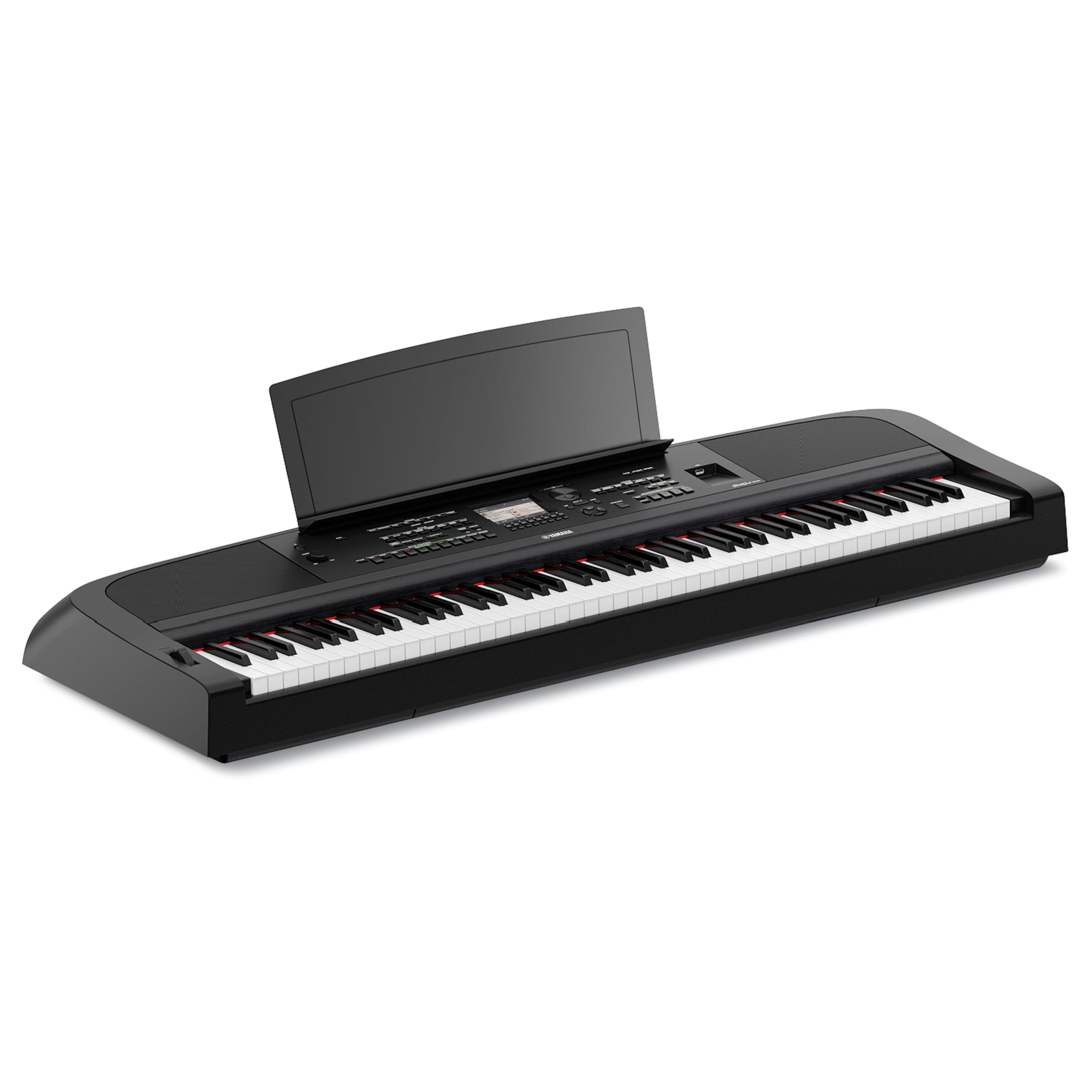
An 88 key workstation that wraps a weighted keyboard inside a full arranger (a built-in automatic backup band system) with 263 automatic band styles.
Most weighted keyboards give you a piano and a few extra voices. The Yamaha DGX-670B gives you an entire backing band. It packs 630 instrument Voices — from pianos and strings to synthesized sounds — and 263 Automatic Accompaniment Styles (pre-programmed backing rhythms and harmonies) spanning rock, R&B, dance, and jazz. The Adapted Style feature shifts between main variations based on how hard you play and how many notes you hit, so the accompaniment responds to your intensity like a live band following your lead.
Under the hood is the Graded Hammer Standard (GHS) weighted action (an internal hammer mechanism) and CFX Stereo Sampling from Yamaha’s flagship concert grand, giving you the same core piano authenticity as the P225 but loaded into a much larger feature set. The sturdy music rest holds thick sheet music books, and the large LCD screen makes navigating all those voices and styles manageable. Reviewers point out the sound quality is professional-grade through a PA system and the 47-pound cabinet feels solid.
The catch is the keybed: several reviewers point out that it uses double sensors rather than the triple sensors found on higher-end Yamaha models, which means rapid note repetition may not register as consistently. And at 47 pounds and 55 inches long, this is not a keyboard you casually toss in a car.
Standout feature for performers: The 263 auto-accompaniment styles turn solo practice into a live band experience, which keeps beginners engaged and gives experienced players a creative sketchpad.
The keybed reality: The double-sensor GHS action differs from the P225’s GHC action in fast repeated notes, so advanced classical pianists may feel the limitation.
Who it fits perfectly: The hobbyist who wants to feel like they are playing in a band — singer-songwriters, church musicians, and anyone who gets bored with straight piano practice.
Not ideal for: The purist classical pianist who needs the fastest key repetition and the most nuanced graded action; the P225 or FP-30X better serve that touch.
4. Donner DDP-300

A furniture-style upright with true graded hammer action (heavier bass keys and lighter treble keys like an acoustic grand) and a 128-note polyphony ceiling that rivals premium boards.
The Donner DDP-300 is the only keyboard in this mid-range tier that combines graded hammer action with 128-note polyphony (the number of notes it can play at the same time). That polyphony count is 128, while the Ktaxon and HEXANT offer 64 each, so you can hold the sustain pedal through complex chord progressions without notes cutting out. This is a clear advantage over those 64-note boards during fast classical runs. Four adjustable touch curves (settings that change how hard you must press to play loudly) let you tailor the key resistance from light to heavy, which helps beginners who struggle with finger strength or advanced players who want a specific feel.
Sound comes from 10 HD timbres (high-definition instrument sounds) sampled from top grand pianos, delivered through a stereo system with dual tweeters and a subwoofer for warm 3D surround. The partition mode splits the keyboard into two equal-pitch sections, making teacher-student duets straightforward. Bluetooth audio and MIDI (wireless connections for sound and music data), plus dual 6.35mm headphone jacks, mean you can practice silently with a teacher or connect wirelessly to apps.
Buyers rave about the action and tone — several compare it favorably to higher-priced Yamaha and Roland models — but some report occasional sticky keys under heavy force and a wobbly volume dial. At 96.6 pounds, this is the heaviest keyboard in the roundup by a wide margin, so set it up in its permanent spot.
Polyphony leader among mid-range options: With 128 notes, the DDP-300 holds up through fast classical trills and sustained pedal work where 64-note boards drop notes.
Where it struggles: Weighing 96.6 pounds versus the Roland FP-30X at 32.7 pounds, it is much less convenient to move, and build quality reports include occasional sticky keys that require customer service attention.
Perfect for the budget-conscious classical student: If you need graded hammer action and high polyphony in a furniture-style cabinet without spending premium money, the DDP-300 delivers where cheaper options fall short.
Avoid it for: Anyone who needs to move the keyboard regularly or wants the highest build consistency — the Roland and Yamaha cabinets are more durable for daily heavy use.
5. Donner DDP-90 Pro
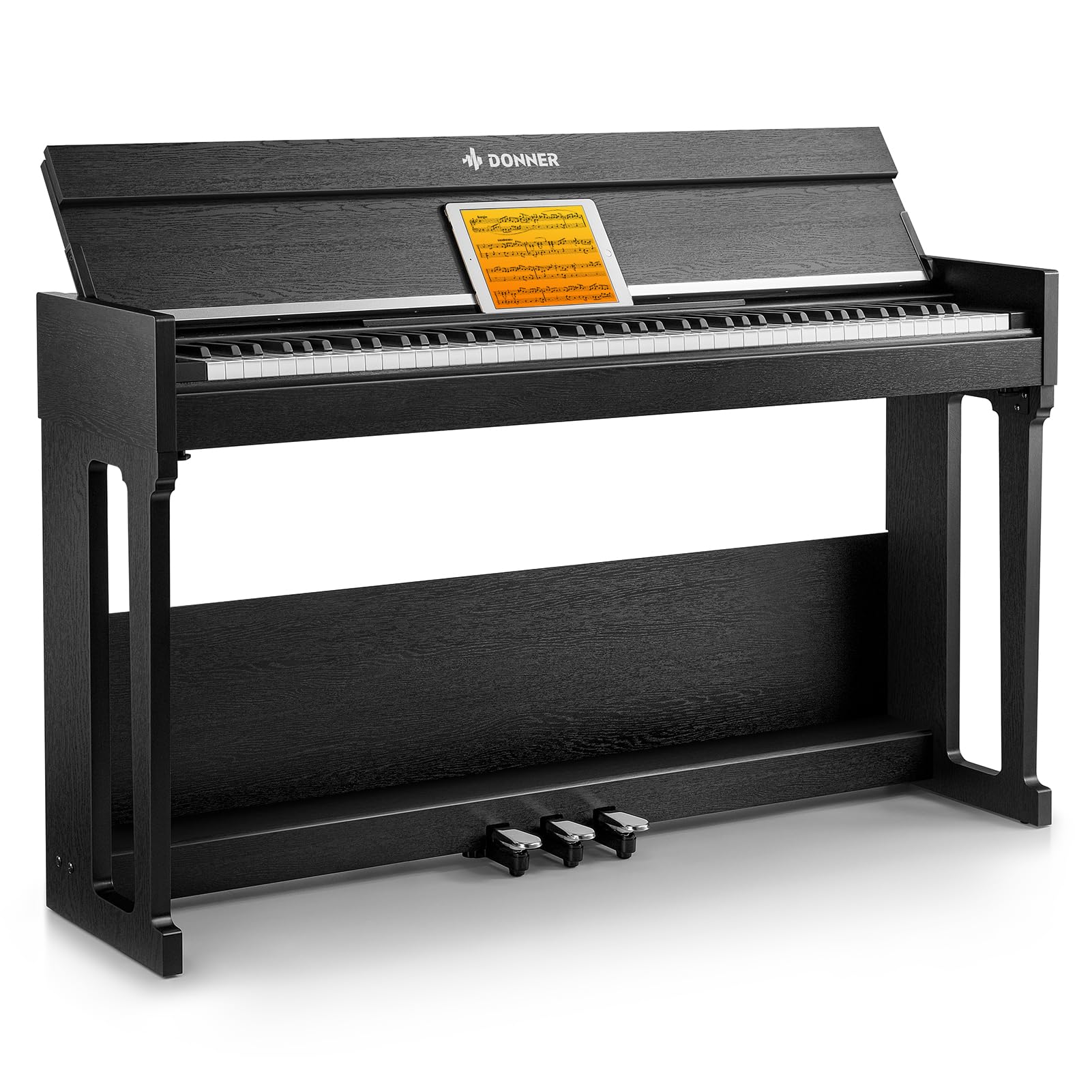
A space-saving weighted upright with the same 128-note polyphony as premium boards but at a mid-range price.
The Donner DDP-90 Pro matches the DDP-300’s 128-note polyphony ceiling in a more compact cabinet at 54 inches wide and 13.8 inches deep. So you get the same headroom for sustained, complex pieces as the bigger DDP-300 but in a smaller footprint. The hammer action weighted keys (keys with a mechanical hammer inside) have an ivory-feel texture and respond to dynamics, letting you play soft and loud passages with control. The updated version gives you 238 tones, 200 rhythms, and 100 built-in songs — a big jump from the original model’s smaller library.
The standout physical feature is the slow-close flip cover, which protects the keys from dust and prevents slammed fingers — a meaningful detail for families with young children. Shoppers say the 88 weighted keys feel realistic, the triple metal pedal system works well, and the smooth connection to PC, tablet, and phone via USB MIDI (a cable connection for music data) makes it easy to use with learning apps like Simply Piano. The 2 headphone jacks (6.35mm) allow teacher and student to practice together silently.
At 74.96 pounds versus the HEXANT at 66 pounds, the DDP-90 Pro is less convenient to reposition, though buyers report the assembly instructions can be confusing with preinstalled screws and misaligned holes. A couple of reviewers mention the sustain pedal feels weaker than expected, and some find the highest register a little thin.
What makes it family-friendly
- 128-note polyphony matches the DDP-300, while the Ktaxon and HEXANT boards offer 64-note polyphony
- Slow-close flip cover is a child-safety feature absent from most competitors in this price tier
- 238 tones and 200 rhythms give beginners variety without needing external sound modules
Assembly and feel trade-offs
- At 74.96 pounds versus the HEXANT at 66 pounds, it is not ideal for frequent repositioning
- Some owners mention the included sustain pedal lacks the resistance needed for expressive half-pedaling (partial sustain control)
Best suited for: The family buyer who needs a weighted-action keyboard that fits in a smaller living space, with child-friendly features and enough polyphony to grow with a beginner’s skills.
Not for the picky pianist: If you need the most nuanced touch action or a heavy-duty sustain pedal, the DDP-300 offers better graded hammer feel and the FP-30X delivers a superior overall action.
6. HEXANT 88-Key Weighted Digital Piano

Semi-weighted keys with a massive 600+ sound library that one buyer called “insane” for the price.
The HEXANT puts quantity before every other spec: 480 tones plus 128 standard GM tones gives you over 600 sounds in total, backed by 200 preset rhythms and 80 demo songs. So you get instant access to a huge variety of instrument sounds and backing beats. The progressive semi-weighted keyboard uses velocity sensitivity (the harder you press, the louder the sound) and adjustable touch response, so you can set how hard you have to press to produce a loud sound. That makes it more expressive than a basic spring-action keyboard, though the feel is less realistic than the fully graded hammer action on the Donner DDP-300.
A 2×25-watt amplifier system (two speakers with 25 watts each) drives the built-in speakers louder than most competitors at this price — useful for small gatherings or practice in a living room without external speakers. The backlit LCD screen shows your sound selections clearly, and the double keyboard split function lets two people play different instrument sounds on the same 88-key board. The package includes a matching piano bench, which neither the Ktaxon nor the Donner models offer at this tier.
Buyers praise the variety — one called out “over 600 sounds; which is insane” — and note the assembly is straightforward. At 66 pounds and 53.5 inches wide, versus the Donner DDP-90 Pro at 74.96 pounds, it is more manageable for a one-time setup. But the semi-weighted action and 64-note polyphony mean advanced classical pieces with sustained pedal may trigger note dropouts.
Biggest sonic playground: With over 600 sounds packed into a semi-weighted cabinet that includes a bench, the HEXANT is the best value for anyone who wants to explore every instrument type without spending extra.
The trade-off that matters: Semi-weighted keys and 64-note polyphony cap its usefulness for serious classical training, so it is a learning instrument rather than a long-term professional tool.
Who will love it: A beginner or hobbyist who wants maximum sound variety, built-in rhythms, and a complete package with bench — perfect for exploring different musical styles without buying extra gear.
Not right for: Anyone who plans to transition to acoustic piano and needs to build proper finger strength with fully graded hammer action.
7. Ktaxon GPP-203 Digital Piano

A fully weighted 88-key board with dual Bluetooth connectivity at a price that undercuts everything else.
The Ktaxon GPP-203 proves you do not have to spend premium money to get weighted keys and Bluetooth. Its weighted action simulates the hammer mechanism of a real grand piano, giving you a heavier feel than semi-weighted alternatives. Dual Bluetooth — separate channels for audio streaming and MIDI data (music note information) — means you can play along with tracks from your phone while using a piano app simultaneously, a feature usually reserved for more expensive boards like the Roland FP-30X.
The sound comes from a “dream sound source” (the brand’s naming for its sound engine) with 64-note polyphony, 128 timbres (instrument sounds), and 128 rhythms, delivered through dual 10-watt stereo speakers. The three-pedal unit gives you soft, sustain, and sostenuto control (holding specific notes while leaving others unaffected) — rare at this price point, where most budget boards include a single sustain pedal. The split function turns the keyboard into two 44-key pianos for duet play, and the touch/transpose controls make it easier for beginners to shift keys without learning new fingerings.
Buyers consistently praise the weighted keys as feeling “like real piano” with a good sound suitable for home practice. They note the assembly is easy despite minimal instructions, and the included dust cover and note stickers are thoughtful extras. At just over, the bench is not included, and the 64-note polyphony limits complex pieces — but as an entry point to weighted keys, it is tough to top.
The smart entry point: For a beginner who knows they want weighted keys but is not ready to invest in a premium instrument, the Ktaxon delivers the essential feature — real hammer feel — plus dual Bluetooth that many intermediate boards lack.
Where it shows its price: 64-note polyphony will drop notes during fast classical passages with sustained pedal, and the onboard speakers top out at 10 watts each, so larger rooms may need external amplification.
Reach for this if: Your budget is tight but you refuse to learn on spring-action keys — the Ktaxon gives you the weighted feel that builds proper technique without the premium price tag.
Look elsewhere if: You need a long-term instrument for serious classical study; the 64-note polyphony and basic sound engine will feel limiting within a year of consistent practice.
Understanding the Specs
Graded Hammer Action
This is the most important spec on an 88 key keyboard. Graded hammer action means the keys in the lower register feel heavier and the keys in the upper register feel lighter — exactly like an acoustic piano. Without it, you are playing a uniform spring or weight system that does not train your fingers to control dynamics (loud and soft playing) across the keyboard. The Roland FP-30X uses PHA-4 Standard with escapement (a subtle click that mimics the mechanism of a grand piano), which feels closest to a real piano. The Yamaha P225 uses Graded Hammer Compact (GHC), which is both quieter and more compact than older systems. The Donner DDP-300 uses true graded hammer action that adjusts weight from bass to treble. The HEXANT uses semi-weighted keys, which offer resistance but not the graduated feel that builds proper technique for acoustic piano transfer.
Polyphony — Why It Matters
Polyphony is the number of notes a keyboard can produce at the same time. When you play a chord, hold the sustain pedal, add a second voice layer, and the built-in rhythm track plays, every note counts against the polyphony budget (the limit of notes the keyboard can handle). A 64-note polyphony board — like the Ktaxon and HEXANT — can drop or cut off notes in complex classical passages or layered arrangements. A 128-note board — like the Donner DDP-300 and DDP-90 Pro, versus 64-note boards like the Ktaxon and HEXANT — gives you headroom (extra capacity) to play fast, sustained pieces without notes cutting out mid-measure (in the middle of a bar of music). For serious piano study, 128 polyphony is the safer investment because it will not limit you as your repertoire grows.
FAQ
What is the difference between weighted keys and semi-weighted keys?
How much polyphony do I need for piano lessons?
Will an 88 key keyboard fit in a small apartment?
Can I use an 88 key keyboard with piano learning apps?
Is a sustain pedal included with these keyboards?
What does “touch response” or “touch curve” mean?
Can I record my playing on these keyboards?
Do I need a separate stand for a portable 88 key keyboard?
Which 88 key keyboard has the best sound quality?
What is the difference between 64-note and 128-note polyphony in practice?
Final Thoughts: The Verdict
For most buyers, the best 88 key keyboard winner is the Roland FP-30X because its PHA-4 Standard keyboard delivers the most authentic acoustic touch and the SuperNATURAL sound engine gives you expressive dynamics that no other portable in this class matches. If you want a lightweight board that sounds like a concert grand and travels easily, grab the Yamaha P225. And for a furniture-style upright with true graded hammer action and high polyphony at a mid-range price, the Donner DDP-300 gives you the best value for serious practice without reaching premium pricing.
How We Picked
We do not accept paid placement. Every pick is matched to a real buyer and a real use-case; we do not hands-on test units.
Sources & Methodology
Specifications: manufacturer listings and product documentation. Review insights: verified customer reviews, as of July 2026. Pricing: not shown on this page (it changes often); check the current price via the retailer link.
As an Amazon Associate, FitlyFast earns from qualifying purchases. This does not affect which products we feature.