
Our readers keep the lights on and the weekend projects moving. As an Amazon Associate, I earn from qualifying purchases.
An 88-key MIDI controller is the backbone of a serious home studio or stage rig, but the gap between a springy synth-action keybed and a true graded hammer-action can be the difference between inspired takes and a frustrating playing session. Weighted keys, aftertouch sensitivity, and seamless DAW integration separate controllers that feel like a real piano from those that feel like a toy.
I’m Rikta — the co-founder and writer behind FitlyFast. My work focuses on analyzing digital instrument specifications, keybed technologies, and connectivity protocols to identify the controllers that genuinely serve composers, producers, and performing musicians across all skill levels.
This guide breaks down the essential specs and real-world performance of the best 88 key midi controller options available today, covering hammer-action keybeds, pad controllers, software bundles, and DAW compatibility to help you find the right match for your workflow.
How To Choose The Best 88 Key MIDI Controller
Finding the right 88-key controller is about matching the keybed feel to your primary genre, the control surface to your DAW workflow, and the build quality to your gigging or studio needs. Below are the three critical areas to evaluate before making a purchase.
Keybed Action Types: Hammer vs. Semi-Weighted
The most important spec is the type of key action. Graded hammer action replicates the heavier bass keys and lighter treble keys of an acoustic grand piano — essential for pianists playing virtual pianos. Semi-weighted or unweighted synth action is preferred for organ, synth leads, or quick repeated notes where lighter resistance helps. If your primary focus is realistic piano performance, skip controllers that only offer spring-loaded keys.
Control Surface and DAW Integration
Beyond the keys, a controller’s faders, knobs, pads, and transport controls define how deeply you can interact with your software. Look for auto-mapping support for your DAW (Ableton Live, Logic Pro, Cubase, Pro Tools), MIDI CC assignability, and NKS support if you use Native Instruments instruments. Drum pads with velocity sensitivity and note repeat are key for beat production without a separate pad controller.
Connectivity and Portability
USB-C or USB-B for computer connection is standard, but 5-pin MIDI ports allow you to control hardware synthesizers and modules without a computer. Bluetooth MIDI is valuable for wireless connection to tablets or laptops on stage. For gigging, weight and footprint matter — some premium controllers weigh over 30 pounds, while portable options are under 15 pounds. Check whether the unit is bus-powered or requires an external power adapter.
Quick Comparison
On smaller screens, swipe sideways to see the full table.
| Model | Category | Best For | Key Spec | Amazon |
|---|---|---|---|---|
| M-AUDIO Hammer 88 Pro | Premium MIDI Controller | Studio production & DAW control | Graded hammer action with aftertouch | Amazon |
| Casio Privia PX-S3100 | Premium Digital Piano | Stage performance & piano practice | 700 tones, Bluetooth audio/MIDI | Amazon |
| Native Instruments S88 MK3 | Premium Controller | Native Instruments workflow | Fatar keybed, polyphonic aftertouch | Amazon |
| Roland JUNO-D8 | Premium Synthesizer | Live bands & gigging musicians | ZEN-Core engine, 3800+ sounds | Amazon |
| Roland GO:PIANO88PX | Mid-Range Portable | Portable practice & learning | 12.8 lbs, battery-powered | Amazon |
| Roland E-X50 | Mid-Range Arranger | Entertainment & auto-accompaniment | 700+ tones, mic input with effects | Amazon |
| UISCOM 88 Key Weighted | Value Digital Piano | Space-saving home practice | Triple pedals, desk/vanity design | Amazon |
| STRICH SDP-120 | Value Digital Piano | Budget-friendly piano practice | 2x15W speakers, wireless MIDI | Amazon |
| Ktaxon 88-Key Weighted | Value Digital Piano | Entry-level weighted keys | Double Bluetooth, 3-pedal unit | Amazon |
In‑Depth Reviews
1. M-AUDIO Hammer 88 Pro

The M-AUDIO Hammer 88 Pro delivers a studio-grade experience with its graded hammer action keybed that feels remarkably close to an acoustic grand piano. The velocity-sensitive keys with aftertouch give you nuanced control over virtual instrument dynamics, making it a powerful tool for both piano performances and expressive synth programming.
Beyond the keybed, the controller packs 16 RGB-backlit drum pads with note repeat, eight assignable knobs, nine faders, and Smart Chord/Scale modes that streamline production workflows. NKS integration allows direct control over Native Instruments instruments without mouse-clicking, and the included software bundle (MPC Beats, Ableton Live Lite, and AIR Music Tech instruments) provides a complete production starting point.
Build quality is solid overall, though some users have reported LCD screen burn-in and firmware issues over extended use. The graded hammer action and assignable controls make it a compelling centerpiece for a DAW-based studio, especially if you produce across multiple genres and need a controller that handles both piano parts and beat production.
Why it’s great
- Graded hammer action with aftertouch for realistic piano feel
- Extensive control surface with faders, knobs, and drum pads
- NKS integration and comprehensive software bundle
Good to know
- Keybed consistency can vary; some units need velocity calibration
- LCD screen has durability concerns per long-term reviews
- Heavy unit, less portable for frequent gigging
2. Casio Privia PX-S3100

The Casio Privia PX-S3100 stands out as a performance powerhouse, combining an award-winning slim design with a massive sound library of 700 tones and 200 rhythms. Its weighted keys feature a textured ebony/ivory feel that provides a realistic touch for classical and contemporary playing, while Duet Mode splits the keyboard for teacher-student lessons or layered performances.
Connectivity is a strong point — the included WU-BT10 Bluetooth adapter enables wireless MIDI and audio streaming to apps and devices without needing extra power. The stereo speaker system with Hall Simulation and Surround effects produces an immersive sound that fills rooms, while dual headphone jacks allow quiet practice. The illuminated touch controls and gloss black finish give it a modern aesthetic suitable for home or stage.
Some users note that the grand piano sound could be louder for a more dramatic feel, and the interface requires some learning to access deeper functions. The key feel sits in a balanced middle ground — not too heavy for synth players nor too light for pianists — making it a versatile choice for those who need onboard sounds alongside MIDI capabilities.
Why it’s great
- Ultra-slim, elegant design with textured weighted keys
- Vast tone library and built-in rhythms for instant playability
- Bluetooth audio/MIDI included, no extra adapter purchase
Good to know
- Onboard speakers lack deep bass at high volumes
- Touch sensor controls can be finicky during fast changes
- Higher price point for a controller-focused setup
3. Native Instruments S88 MK3

The Native Instruments S88 MK3 is built for deep integration with the Komplete ecosystem, featuring a Fatar TP/80SK keybed that offers 88 semi-weighted keys with polyphonic aftertouch. Unlike standard aftertouch, polyphonic aftertouch lets you apply pressure per key, enabling expressive techniques like independent vibrato or filter modulation across multiple notes simultaneously — a game-changer for cinematic scoring and advanced synth work.
The high-resolution full-color screen provides intuitive browsing of sounds, effects, and mixing parameters directly from the keyboard, reducing mouse dependency. The included Komplete 14 Select bundle gives you a solid starting library of instruments and effects. The chassis mixes metal and glass elements for a premium build feel that matches its price point.
Setup requires a bit more effort than plug-and-play controllers — firmware updates and power requirements (20W USB-C PSU for standalone mode) need attention. Additionally, the semi-weighted action, while premium, is lighter than the fully graded hammer action some pianists prefer. For users deeply invested in Native Instruments software, however, the S88 MK3 offers an unmatched level of workflow speed.
Why it’s great
- Polyphonic aftertouch for nuanced, per-key expressiveness
- Deep NKS integration with high-resolution screen
- Premium build quality with metal and glass elements
Good to know
- Semi-weighted keys, not graded hammer action
- Complex initial setup and firmware update process
- Requires external PSU for standalone mode; high price
4. Roland JUNO-D8

The Roland JUNO-D8 is a gig-ready synthesizer that pairs an 88-note weighted hammer-action keybed with Roland’s flagship ZEN-Core engine, delivering over 3800 sounds ranging from acoustic grand pianos to cutting-edge synth patches. Its USB-C audio/MIDI interface supports mobile battery power, making it a practical choice for live performances where you might run from a power bank.
The PHA-4 keyboard action provides one of the most realistic weighted feels in this price bracket, making it ideal for keyboardists who want seamless transitions between piano and synth sounds. The sample import function lets you bring in custom WAV files, and Roland Cloud expansions add flexibility over time. Intuitive performance tools like scene memories and real-time control knobs help you adapt to setlist changes quickly.
While the sound engine is deep, the control interface has a steeper learning curve compared to more streamlined controllers. The unit is also relatively heavy at around 32 pounds, which matters if you transport it frequently. For experienced players who need both a premium weighted feel and a massive sound library for stage, the JUNO-D8 delivers serious value.
Why it’s great
- ZEN-Core engine with massive professional sound library
- Excellent PHA-4 hammer action, one of the best weighted feels
- USB-C powered operation for mobile setups
Good to know
- Interface UX can be non-intuitive for new users
- Heavy at 32 lbs; less portable than slim alternatives
- Higher price tier, requires serious commitment
5. Roland GO:PIANO88PX
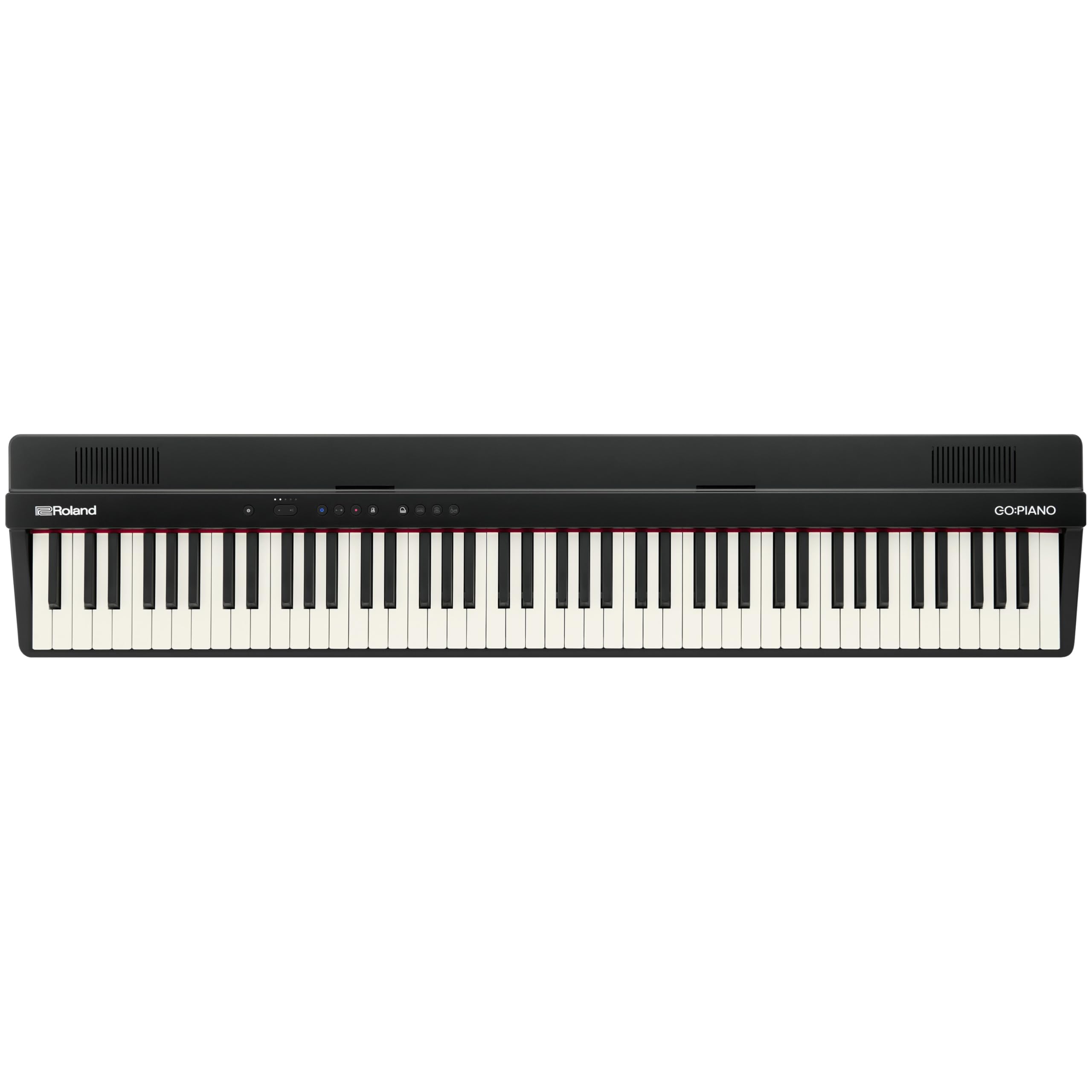
The Roland GO:PIANO88PX redefines portable 88-key performance at just 12.8 pounds, easily the lightest fully weighted option on this list. It runs on AA batteries or the included AC adapter, freeing you from power outlet dependency for outdoor practice, lessons, or coffee shop sessions. Despite the featherweight build, it delivers the signature Roland sound quality with a pleasant piano tone and a 128-note polyphony engine.
Bluetooth audio and MIDI connectivity allow wireless streaming of backing tracks and connection to the Roland Piano App for learning games and remote control. The simple button interface keeps distractions minimal, making it ideal for focused practice. The smooth, unweighted touch response (despite the marketing) is lighter than graded hammer action, but it offers good responsiveness for weighted-feel expectations.
The unit lacks professional PA output — the headphone output doubles as the sound output, requiring an adapter for stage use. It’s built for home practice and travel, not for loud band environments. For students, traveling musicians, or anyone who needs a truly grab-and-go 88-key experience, this is the clear winner.
Why it’s great
- Incredibly lightweight at 12.8 lbs, easy to carry anywhere
- Battery-powered operation for untethered practice
- Great Roland piano sound with Bluetooth and app support
Good to know
- Touch is smooth/semi-weighted, not graded hammer action
- Sound output via headphone jack requires adapter for PA systems
- Limited to home-use sound levels, not stage-ready
6. Roland E-X50

The Roland E-X50 is an arranger keyboard built around entertainment and ease of use, offering nearly 700 tones, 300 auto-accompaniment styles, and a mic input with effects for singing along. Its onboard stereo speaker system with independent woofers and tweeters delivers big, powerful sound that fills a living room or small venue — great for casual performances and family music sessions.
Bluetooth audio streaming lets you play along with tracks from your phone, and the recording feature captures both keyboard and arranger performances. The auto-accompaniment function responds to left-hand fingering, creating full backing arrangements that make a single player sound like a band. This feature is particularly valuable for solo performers and hobbyists who want rich, layered sound without a backing track.
While the MIDI features are less deep than dedicated controllers — it’s not primarily designed for studio production — the sound library and arranger capabilities make it a versatile instrument. Some users note the menu system takes adjusting to, and the build quality is decent but not rugged for heavy touring. It occupies a unique space as a keyboard that prioritizes onboard playability over DAW control.
Why it’s great
- Massive auto-accompaniment library for solo performances
- Powerful stereo speakers with separate woofers/tweeters
- Mic input with effects for singing and playing
Good to know
- MIDI control features are limited compared to dedicated controllers
- Menu navigation can be slow for quick sound changes
- Quality control issues reported with packaging and accessories
7. UISCOM 88 Key Weighted Digital Piano

The UISCOM 88 Key Weighted Digital Piano stands out with its unique wooden desk design that transforms the unit from a keyboard into a functional vanity or workspace. This is a smart solution for musicians with limited floor space — when you’re not playing, it serves as a regular desk without screaming “keyboard” in your living decor. The progressive hammer-action keys provide a reasonably authentic weighted feel for practice.
Sound comes from the French Dream5704 sound chip, offering eight tones and 40 demo songs that cover the basics for learning and casual play. The triple pedals (soft, sostenuto, sustain) add useful expressive control for classical pieces. MIDI functionality via USB allows connection to computer-based learning software and DAWs, and dual headphone jacks enable silent practice for two players or teacher-student setups.
The key action is less weighted than more expensive models — some users find it slightly light — but it remains acceptable for beginners and casual use. The assembly requires two people due to the desk’s weight and size. At this price point, it delivers a clever design compromise that prioritizes space efficiency and aesthetics over concert-grade key action.
Why it’s great
- Innovative desk/vanity design saves valuable floor space
- Triple pedal unit included for expressive playing
- Good sound chip with multiple tones and MIDI connectivity
Good to know
- Key action lighter than graded hammer action on premium models
- Assembly is awkward and requires two people
- Best for beginners/casual use, not demanding pianists
8. STRICH SDP-120

The STRICH SDP-120 punches well above its price segment by delivering a fully weighted keyboard design that simulates the tactile response of an acoustic grand piano. The 2x15W built-in speakers are powerful for a home setup, and the 128-voice polyphony with 128 tones, 200 rhythms, and 110 demo songs gives beginners plenty of material to explore without needing external software.
Wireless MIDI connectivity via Bluetooth is a rare feature at this price level, allowing cable-free connection to smartphones, tablets, and computers for music apps and recording. The intuitive LCD display and sustain pedal included in the box mean you can start playing right away with no extra purchases. Users consistently praise the key action as feeling surprisingly close to more expensive models from established brands.
The internal speakers sound noticeably better through headphones than through the built-in drivers — the speakers lack the richness of premium systems. The power switch is awkwardly placed behind the music stand, and the manual is sparse on detailed functions like tone layering. But as a budget entry point into weighted 88-key playing, the value proposition is exceptional.
Why it’s great
- Fully weighted keys rival much more expensive models
- Wireless MIDI and sustain pedal included
- Powerful 2x15W speakers for a home environment
Good to know
- Onboard speakers lack richness; headphones sound better
- Power switch placement is inconvenient
- Manual lacks detailed instructions for advanced features
9. Ktaxon 88-Key Weighted Digital Piano

The Ktaxon 88-Key Weighted Digital Piano offers a compelling package for budget-conscious learners, featuring a three-pedal unit (soft, sustain, sostenuto) and double Bluetooth connectivity for both audio streaming and MIDI transmission. The weighted keys simulate a hammer mechanism for a more realistic touch than basic spring-loaded keyboards, making it a solid learning tool for beginners tackling piano technique.
The built-in dual 10W stereo speakers provide decent sound for home practice, and the 128 timbres, 128 rhythms, and 20 demo songs give variety for exploring different musical styles. The split/touch function divides the keyboard into two 44-key zones for duet playing, and the recording feature helps track practice progress or capture performance ideas.
External speaker and headphone outputs have been reported by some users to produce a hissing noise with certain devices, limiting the reliability of auxiliary connections. The included stand and bench are functional but not premium-grade. For the price, the Ktaxon delivers weighted keys and a full pedal set that make it a worthy consideration for absolute beginners who want to start with proper technique without a large investment.
Why it’s great
- Full three-pedal unit included for expressive control
- Double Bluetooth for audio and MIDI wireless use
- Split keyboard for duet practice and versatile play
Good to know
- Auxiliary outputs may produce hissing with some devices
- Stand and bench are functional but feel budget-tier
- Speaker volume limited for larger rooms
FAQ
What is the difference between grad hammer action and synth action keys?
Can I use an 88-key MIDI controller without a computer?
Does aftertouch matter for piano playing or only for synth?
Final Thoughts: The Verdict
For most users, the best 88 key midi controller winner is the M-AUDIO Hammer 88 Pro because it combines graded hammer action with a deep control surface and NKS integration at a premium price that justifies its feature set for both piano and production work. If you want ultra-portability for travel and practice, grab the Roland GO:PIANO88PX. And for Native Instruments workflow where polyphonic aftertouch transforms your sound design, nothing beats the Native Instruments S88 MK3.