
Our readers keep the lights on and the weekend projects moving. As an Amazon Associate, I earn from qualifying purchases.
Every beginner piano player hits the same wall: a keyboard that feels like a toy under your fingers. Light, springy keys won’t build the finger strength or muscle memory you need to transition to an acoustic piano. That is why finding true hammer-action or fully weighted keys in an affordable 88-key package is the single most important decision a new player makes—and why most entry-level options fall short.
I’m Rikta — the co-founder and writer behind FitlyFast. I’ve spent years analyzing digital piano mechanisms, key action grading descriptions, and user longevity data to separate real weighted keyboards from gimmicks.
This buying guide cuts through the marketing to give you practical, research-backed advice on selecting the best 88 key weighted keyboard for beginners that will keep you playing for years without feeling the need to upgrade immediately.
How To Choose The Best 88 Key Weighted Keyboard For Beginners
Choosing your first weighted keyboard can feel overwhelming. Between graded hammer action and semi-weighted designs, the specifications matter more than brand names. Focus on three things: the actual key mechanism, the sound engine’s polyphony, and the connectivity options that let you grow as a player.
Key Action: Graded Hammer vs. Semi-Weighted
Graded hammer action means the bass keys are heavier and the treble keys are lighter—replicating an acoustic grand piano. Semi-weighted keys have a uniform resistance. For a beginner, graded hammer action (often called “progressive hammer action”) builds proper technique from day one. Avoid keyboards that only say “touch sensitive” without describing the action mechanism.
Polyphony: How Many Notes Can Play Simultaneously
Polyphony is the number of notes a keyboard can produce at once. Cheap keyboards often have 32 or 48-note polyphony, which cuts off notes when using the sustain pedal. Look for 64-note polyphony as a minimum. 128-note polyphony is ideal for beginners because you never have to think about dropped notes during practice.
Connectivity: USB-MIDI and Headphone Jacks
Modern learning apps (Simply Piano, Yousician) require USB-MIDI connectivity. A keyboard with USB-MIDI can connect to a tablet or phone for interactive lessons. Also check for at least one headphone jack—preferably a standard 6.35mm (1/4 inch) or 3.5mm—so you can practice silently without disturbing others.
Quick Comparison
On smaller screens, swipe sideways to see the full table.
| Model | Category | Best For | Key Spec | Amazon |
|---|---|---|---|---|
| Yamaha P71 | Premium | Authentic piano feel on a budget | Graded hammer action, 10 Voices | Amazon |
| Donner DDP-90 Pro | Premium | Feature-rich home practice | Hammer action, 238 tones, flip cover | Amazon |
| Yamaha Weighted Action 88-Key | Premium | Portable, slim grand-piano feel | Weighted action, compact 24.5 lbs | Amazon |
| Best Choice Products 88-Key Set | Mid-Range | Complete beginner set with accessories | Hammer-action weighted keys, 140 timbres | Amazon |
| Donner DDP-60 | Mid-Range | Minimalist design with dual player mode | Velocity-sensitive keys, 128 polyphony | Amazon |
| STRICH SDP-300W | Mid-Range | Wood-grain aesthetic with wireless MIDI | Hammer action, simulated ivory keys | Amazon |
| UMOMO UMP-718 | Mid-Range | Graded hammer action with duet bench | Progressive hammer action, brown finish | Amazon |
| STRICH SDP-120 | Value | Budget-friendly weighted feel | Fully-weighted keys, 128 polyphony | Amazon |
| HEXANT Semi-Weighted Piano | Value | Budget upright-style with bench | Semi-weighted progressive keys, 480 tones | Amazon |
In-Depth Reviews
1. Yamaha P71 88-Key Weighted Action Digital Piano

The Yamaha P71 is the digital piano that piano teachers recommend most often for a reason. Its graded hammer action (GHS) gives you heavier keys in the lower register and lighter keys in the upper register—exactly how an acoustic grand responds. At 25 pounds, it’s light enough to move to a lesson or gig, yet the key mechanism feels substantial. The included sustain pedal is basic but functional, and many users upgrade it after a few months.
The sound engine samples Yamaha’s CFIIIS grand piano, and the built-in 6W + 6W speakers produce a clear, resonant tone that fills a bedroom or practice room. With only 10 voices, you don’t get hundreds of effects, but that simplicity keeps focus on practice. USB-MIDI connectivity works flawlessly with apps like Simply Piano and Flowkey, making it an excellent choice for beginners who want interactive lessons.
Dual Mode lets you layer two voices (piano and strings, for example) for a richer soundscape during performance. The unit’s down-firing speakers mean the sound bounces off the floor, so placing it on a solid stand is important for clarity. Overall, the P71 delivers the most authentic acoustic feel in a portable package at this price point.
Why it’s great
- Graded hammer action mimics acoustic piano touch.
- Lightweight (25 lbs) for easy transport.
- USB-MIDI works with all major learning apps.
Good to know
- Only 10 voices; no rhythm or accompaniment features.
- Basic sustain pedal slides on smooth floors.
- Speakers are down-firing, requiring a solid stand for best sound.
2. Donner DDP-90 Pro Digital Piano
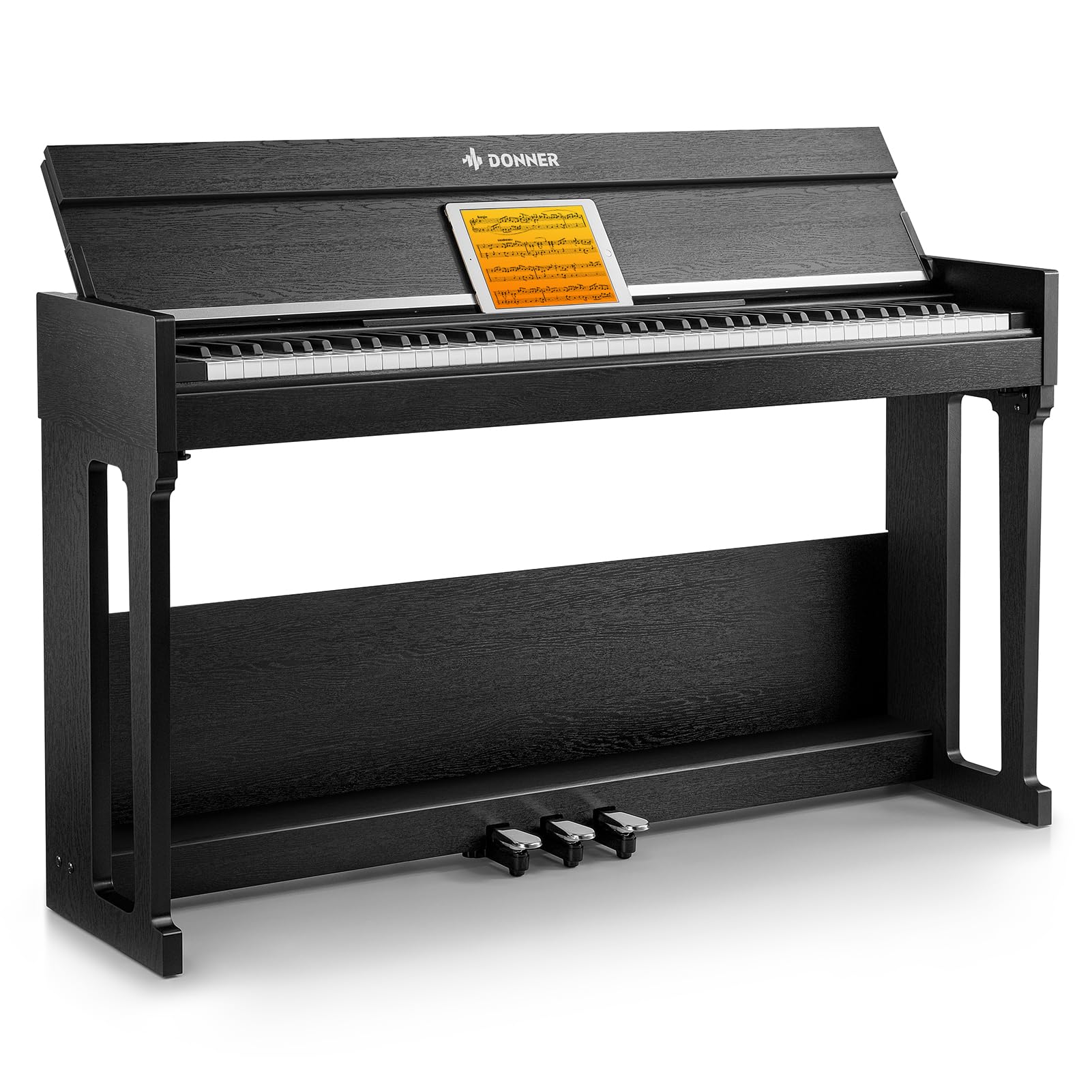
The Donner DDP-90 Pro is a serious step up in features while keeping the weighted key feel that beginners need. Its hammer-action keys have an ivory-feel texture that prevents slipping during long practice sessions. The included metal triple-pedal system (soft, sostenuto, sustain) gives you fine control over expression, something rarely seen at this level. The slow-close flip cover protects the keys and adds a premium feel to any room.
With 238 tones, 200 rhythms, and 128-note polyphony, this piano gives you plenty of room to experiment without hitting technical limits. The sound samples come from real acoustic grand pianos, offering dynamic and realistic timbre. 128-note polyphony ensures that even complex passages with heavy sustain pedal use will not cut off notes, a critical feature for advancing players.
Connectivity is comprehensive: USB-MIDI for apps, a USB-A port for playing MP3s from a flash drive, audio input/output jacks, and two headphone jacks for silent practice duets. Weighing 75 pounds, this is a heavy home piece intended for a dedicated spot. Setup is straightforward, but you’ll want a second person for assembly. The DDP-90 Pro grows with your skills better than most keyboards in this tier.
Why it’s great
- Metal triple-pedal system with soft, sostenuto, sustain.
- 238 tones and 128-note polyphony for advanced practice.
- Slow-close flip cover protects keys and looks elegant.
Good to know
- Very heavy at 75 pounds; not easily portable.
- Some units have sticky key issues reported by a few buyers.
- Assembly can be tricky due to pre-installed screws.
3. Yamaha Weighted Action 88-Key Digital Piano

This Yamaha model delivers the same graded weighted action as the P71 in an even slimmer package—just 10.55 inches deep and 24.47 pounds. The slim design fits neatly into small apartments, dorm rooms, or tight corners without compromising key feel. The weighted action replicates the resistance of an acoustic piano, helping beginners develop proper finger strength from their first lesson. The single-button control interface keeps distractions minimal.
Audio quality comes from digitally sampled Yamaha grand piano tones. Ten voices (grand piano, electric piano, organ, harpsichord, vibraphone, strings, and more) cover a variety of musical styles without overwhelming a beginner. Sound Boost technology makes the speakers louder and fuller, compensating for the compact cabinet. The included music rest, sustain footswitch, and AC adapter get you playing immediately without extra purchases.
USB-MIDI connectivity links to computers and mobile devices for lesson apps. The headphone jack (6.35mm) is conveniently located, allowing silent practice. Many users comment how closely the touch and response match a high-end acoustic piano. The pedal, however, is a basic footswitch that slides on hardwood floors; upgrading to a sturdier pedal is a common recommendation. For pure playability in a portable frame, this Yamaha is hard to beat.
Why it’s great
- Ultra-compact design (10.5″ deep) fits small spaces.
- Graded weighted action feels like a real piano.
- Sound Boost enhances speaker output for richer tone.
Good to know
- Only 10 voices; no rhythm/accompaniment features.
- Basic sustain pedal may need upgrading.
- No built-in stand or bench included.
4. Best Choice Products 88-Key Weighted Full Size Digital Piano Set

Best Choice Products offers a full beginner bundle that includes the keyboard, a U-stand, adjustable stool, three-pedal unit, and a keyboard cover. For a family buying their first digital piano, this package removes the hassle of sourcing accessories separately. The 88 fully weighted keys are hammer-action and velocity-sensitive, giving you realistic resistance that builds finger strength. The triple-pedal unit includes soft, selective sustain, and sustain pedals for nuanced control.
Sound versatility is a strong point: 140 timbres, 128 rhythms, and 100 demo songs give beginners a huge library to explore. The dual headphone jacks allow teacher-student silent practice, which is valuable for lessons at home. MIDI/USB outputs make it compatible with learning apps and recording software. The keyboard measures 52 inches wide, fitting standard living room spaces.
Build quality receives mixed feedback—the stand and stool have been described as wobbly by some users, and the piano’s top can slope backward depending on assembly. A simple tip from experienced owners: adding a small spacer in the assembly holes can level the keys. Sound quality is good for the price but not as refined as premium options. For a complete, budget-conscious starter package, this set covers all the bases.
Why it’s great
- All-in-one bundle with stand, stool, pedals, cover.
- Hammer-action weighted keys feel realistic.
- Dual headphone jacks for shared silent practice.
Good to know
- Stand and stool can feel unstable.
- Keyboard top may slope backward; alignment needed.
- Sound quality is decent but not premium.
5. Donner OURA DDP-60 Digital Piano

The Donner DDP-60 is a visually striking digital piano with a slim, light oak cabinet that blends into modern home decor. Its full-size velocity-sensitive keyboard offers four adjustable touch curves, allowing you to set the key response to your playing style. This is not a graded hammer action, but the velocity sensitivity gives good dynamic control for a beginner. 128-note polyphony ensures that complex chords with sustain never clip notes.
It features 128 tones, 83 rhythms, 47 demo songs, and 8 reverb effects—enough variety to keep practice engaging. The dual mode splits the keyboard into two equal ranges, making it ideal for teacher-student lessons or parent-child duets. Triple headphone jacks (two 6.35mm and one that doubles as an AUX input) provide flexible connection options, though most beginners will use one at a time.
Assembly takes under an hour, and the keyboard is relatively movable at a moderate weight. Users praise the clean aesthetic and the crisp sound quality, especially when paired with studio headphones. The built-in speakers are adequate for home practice but not powerful enough for performances. For a beginner who values style and simplicity, the DDP-60 offers an attractive entry point with room to grow.
Why it’s great
- Beautiful slim design in light oak wood finish.
- Dual mode splits keyboard for teacher-student use.
- 128-note polyphony handles demanding pieces.
Good to know
- Not graded hammer action; lighter key feel.
- Built-in speakers are mediocre; headphones recommended.
- Some users report key clicking sounds with nails.
6. STRICH SDP-300W Digital Piano
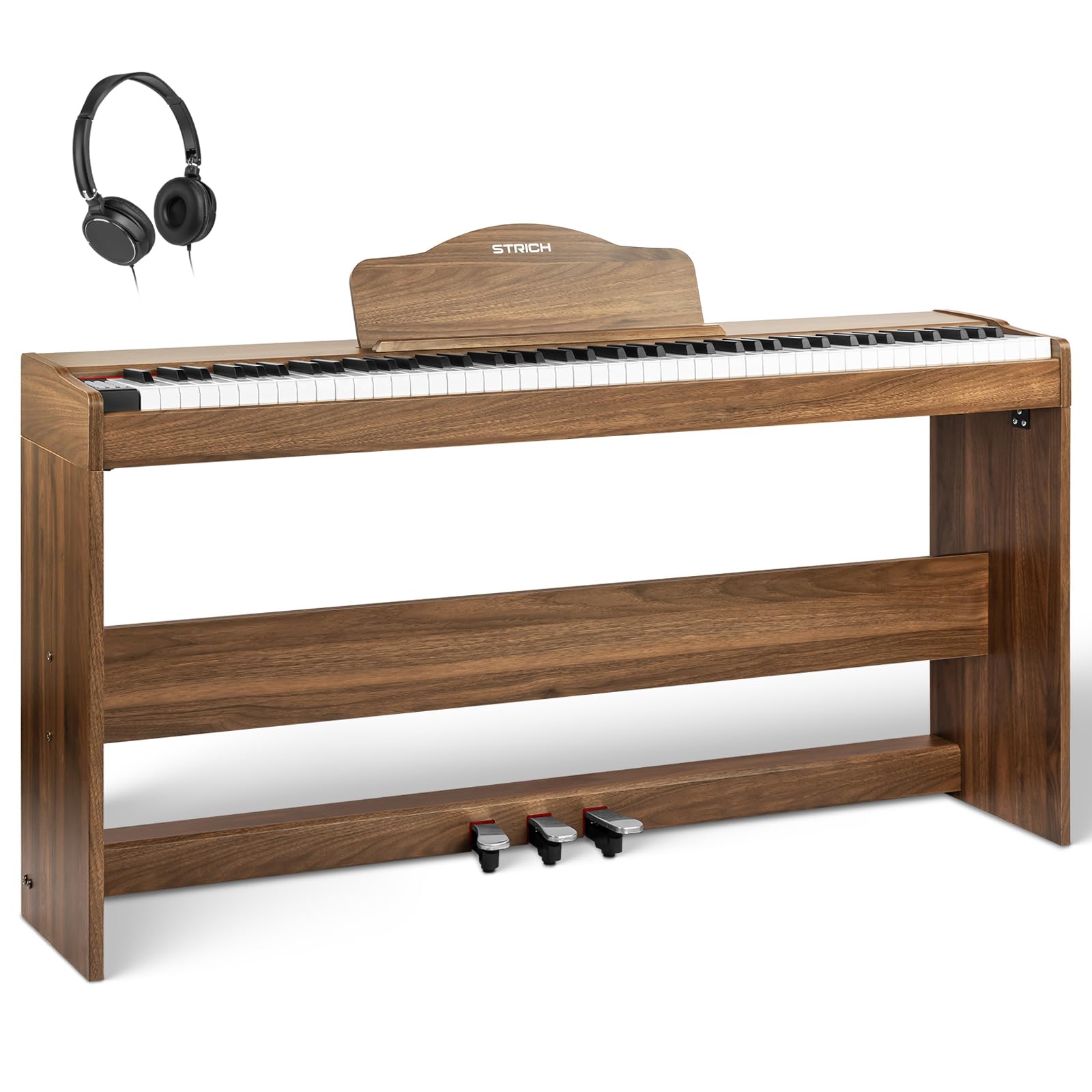
The STRICH SDP-300W stands out with its walnut wood-grain finish that looks like vintage furniture rather than a black plastic keyboard. The hammer-action keys have simulated ivory texture for a comfortable, non-slip touch during long practice sessions. 128 preset timbres, 200 drum rhythms, and 128-note max polyphony give a versatile sonic palette. The 20W speakers produce plenty of volume for a living room.
Wireless MIDI connectivity is a standout feature—you can connect to teaching apps on your iPad or phone without USB cables. The dual-keyboard function splits the range for two players. The audio input port lets you play backing tracks from your phone through the piano’s speakers. Assembly takes about 15 minutes, and the furniture stand feels sturdy and substantial. The adapter is a standard 5.5mm x 2.2mm DC connector with 100-240V input range.
Sound quality is described as authentic and enjoyable, though the volume range for accents is narrower than high-end models. The power switch and cables on the back prevent flush wall placement. Some users experienced AC power adapter failures within the first week, so testing immediately upon arrival is recommended. Overall, for a beginner who wants the look of a home furniture piece with modern connectivity, the SDP-300W is a compelling choice.
Why it’s great
- Beautiful walnut wood-grain finish.
- Wireless MIDI for app connectivity.
- Hammer action keys with simulated ivory texture.
Good to know
- Narrower dynamic volume range than premium models.
- Some early adapter failures reported.
- Cables in back prevent flush wall placement.
7. UMOMO 88 Key Progressive Hammer Action Digital Piano
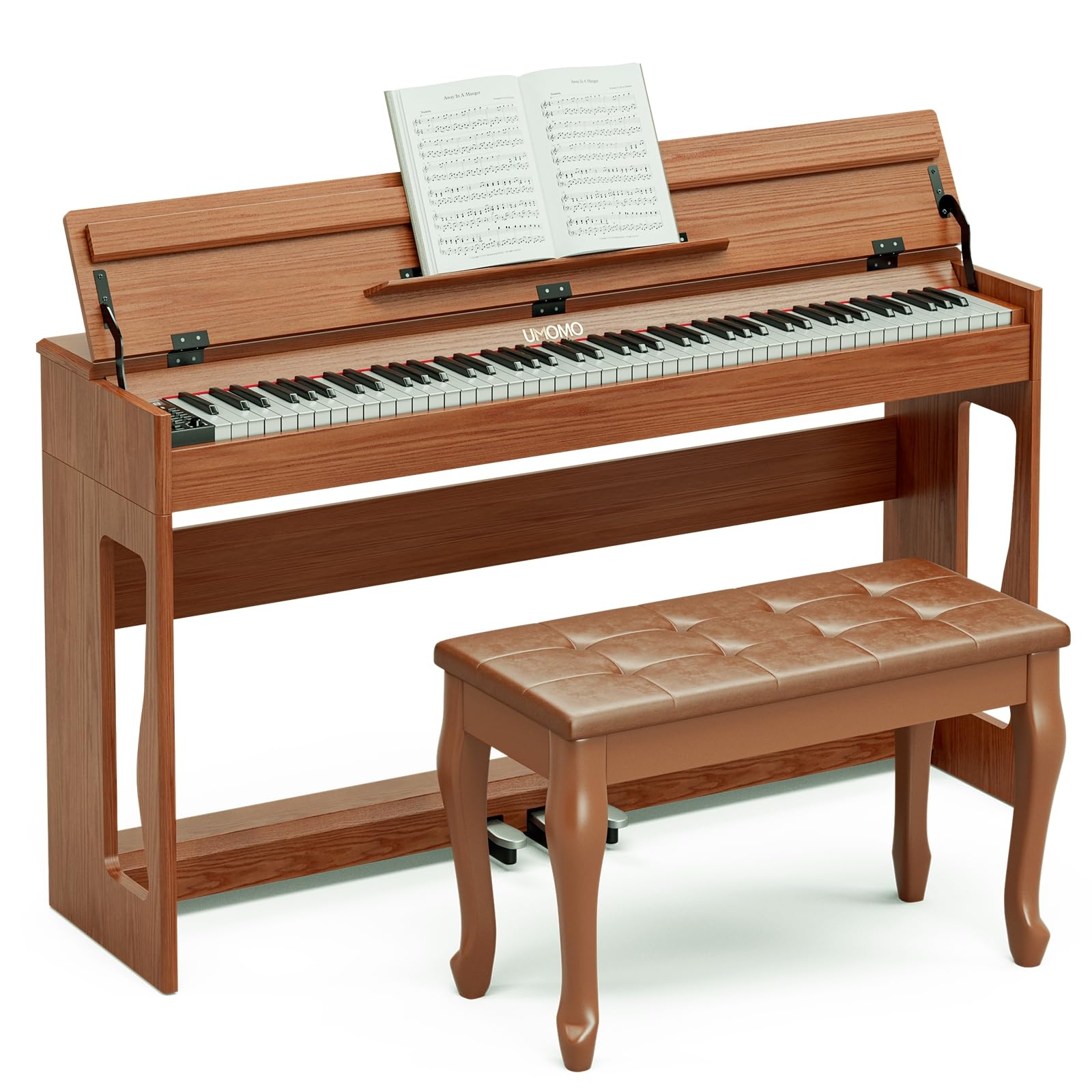
The UMOMO UMP-718 focuses on the quality of its key action above all else. With genuine progressive hammer action, the bass keys are heavier and the treble keys lighter, exactly replicating an acoustic grand piano’s mechanics. This is the ideal mechanic for a beginner who intends to eventually play on an acoustic upright. The brown wood cabinet with a furniture stand gives it a classic, non-electronic appearance. A duet bench is included, allowing two people to sit comfortably side by side.
Sound-wise, the internal speakers deliver a warm piano tone, though several reviews note that the default piano sound is only satisfactory compared to entry-level Yamahas. The headphone jack is located underneath the piano, which can be awkward to access. User guides could be clearer, and assembling the heavy unit requires two people. The packaging and finish are excellent, with a flawless walnut veneer that arrives in good condition.
The UMOMO excels where it matters most: building proper finger technique. The graded touch is the most important feature for a beginner, and this keyboard delivers it convincingly. Volume inconsistency between soft and hard playing is noticeable, and distortion occurs above halfway on the volume dial. For a beginner who prioritizes authentic key feel over sound polish, the UMOMO offers outstanding value.
Why it’s great
- True progressive hammer action for technique development.
- Includes duet bench for two players.
- Beautiful brown wood cabinet with furniture stand.
Good to know
- Default piano sound is mediocre.
- Headphone jack is hard to access underneath.
- Volume distortion above halfway.
8. STRICH SDP-120 88 Keys Weighted Keyboard

The STRICH SDP-120 proves that a fully weighted keyboard doesn’t have to be expensive. Its fully-weighted key mechanism simulates the tactile response of a grand piano, providing an authentic playing experience for a fraction of the cost. The 128-note polyphony and 128 tones/200 rhythms give beginners plenty of creative room. The 2x15W speakers produce clear sound that fills a medium-sized room, outperforming many budget competitors in volume.
Connectivity is a strong suit: built-in wireless MIDI, along with USB, MIDI, and audio inputs, allow flexible setup. You can connect to teaching apps wirelessly or plug in headphones for silent practice. The sustain pedal included is a standard unit, and the keyboard arrives with reinforced packaging to avoid damage. As a standalone unit (no stand or bench included), it’s lightweight at 9.3 kg (20.5 lbs), making it easy to place on any existing desk or table.
Reviewers note that the key action is lighter than Yamaha or Roland models under budget tier, which some beginners prefer for reduced finger fatigue. The sound quality is described as excellent for the price, though the LCD display and interface could be clearer for layering tones. The power switch behind the music stand is slightly inconvenient. Overall, the SDP-120 delivers genuine weighted feel at the lowest entry point, perfect for testing commitment to piano before spending more.
Why it’s great
- Fully-weighted keys at a very accessible price.
- Wireless MIDI for app connectivity.
- Lightweight (20.5 lbs) and easy to move.
Good to know
- Key action is lighter than premium brands.
- Power switch location is inconvenient.
- No stand or bench included.
9. HEXANT 88-Key Semi-Weighted Digital Piano

The HEXANT upright-style digital piano is designed as a complete package from the start. It includes the piano itself, a matching bench, a three-pedal unit (sustain, soft, sostenuto), and all necessary accessories. The progressive, semi-weighted keys are velocity-sensitive and offer adjustable touch response. While semi-weighted keys do not have the graded resistance of hammer action, they provide a noticeable step up from unweighted keyboards and are easier for very young beginners with less finger strength.
Sound capabilities are impressive for the price: 480 tones, 200 rhythms, 80 demo songs, and 64-note polyphony. The backlit LCD screen clearly displays sound volume, tone selection, and recording controls. The double keyboard split function allows two different sounds on each half, useful for duet play. With 2x25W amplifiers, this piano can fill a living room without distortion. The bench is comfortable and stable.
Assembly takes about 30 minutes with two people. The cabinet is available in black or white wood color, fitting home decor styles. Some users note that the overall sound is good but not as rich as acoustic pianos, which is expected at this level. The semi-weighted keys are not for purists needing an acoustic feel, but for a budget-friendly, all-in-one beginner solution with a pedal system and bench, the HEXANT delivers solid value right out of the box.
Why it’s great
- Complete bundle with bench and 3-pedal unit.
- 480 tones and 200 rhythms for variety.
- 2x25W speakers produce loud, clear sound.
Good to know
- Semi-weighted keys, not graded hammer action.
- 64-note polyphony may limit complex playing.
- Sound is decent but not as refined as premium models.
FAQ
Is a semi-weighted keyboard enough for a beginner?
What is the minimum polyphony recommended for a beginner?
Do I need a triple pedal system as a beginner?
Final Thoughts: The Verdict
For most users, the best 88 key weighted keyboard for beginners winner is the Yamaha P71 because its graded hammer action and trusted build quality provide the closest acoustic experience at a price that won’t break your budget. If you want a feature-packed home piano with 238 tones and a triple pedal system, grab the Donner DDP-90 Pro. And for the absolute cheapest entry point with fully weighted keys and wireless MIDI, nothing beats the STRICH SDP-120.