
Our readers keep the lights on and the weekend projects moving. As an Amazon Associate, I earn from qualifying purchases.
An 88-key weighted keyboard is not a starter toy. It’s a tool that, from the first note, trains your fingers to respect the resistance of an acoustic grand. The difference between a passable synth-action board and a proper hammer-action instrument shows up the moment you try to control dynamics — that soft pianissimo or a sudden fortissimo. Get the action wrong, and your practice becomes a constant fight against a keyboard that can’t deliver what your ears demand.
I’m Rikta — the founder and writer behind FitlyFast. I spend my time cross-referencing digital piano hammer mechanisms, polyphony counts, and speaker configurations so you don’t have to guess which model delivers a true acoustic feel without the maintenance.
After matching dozens of specifications against real playing demands, I’ve narrowed the field to a definitive lineup. Here is my curated selection of the best 88 key weighted keyboard options that actually replicate the touch and tone of a real piano.
How To Choose The Best 88 Key Weighted Keyboard
An 88-key weighted keyboard is a long-term investment. Choosing based on looks or brand name alone leads to disappointment. Focus on the action, the sound engine, and the connectivity that matches your practice or performance goals.
Graded Hammer Action Is Non-Negotiable
A true weighted keyboard uses graded hammer action. Heavier in the lower register, lighter in the treble, just like an acoustic grand. Models that offer only a uniform weight across all keys miss the point. Look for at least three levels of touch sensitivity so your playing dynamics are accurately captured.
Polyphony and Sound Engine Depth
Polyphony determines how many notes can ring simultaneously before the oldest one cuts off. For fast classical passages or pieces that rely on the sustain pedal, 128-note polyphony is the baseline. Entry-level 64-note chips drop notes when you play layered chords with pedal, which destroys the illusion of a real piano.
Speaker System and Headphone Output
If you plan to play without headphones, built-in speakers need enough wattage to fill a room without distortion. A 10W-per-channel system is acceptable for a bedroom, but a 20W or higher system gives you room to shape your tone. Headphone jacks should be accessible and offer a natural stereo image without artificial reverb.
Quick Comparison
On smaller screens, swipe sideways to see the full table.
| Model | Category | Best For | Key Spec | Amazon |
|---|---|---|---|---|
| Roland FP-30X | Portable Premium | Authentic touch & tone | PHA-4 Standard keyboard | Amazon |
| Casio Privia PX-870 | Console Premium | Powerful built-in speakers | 40W 4-speaker system | Amazon |
| Yamaha YDP184 | Console Flagship | Concert grand realism | GH3 action with VRM | Amazon |
| Yamaha YDP105 | Console Entry | Complete console package | GHS action + bench | Amazon |
| Donner DDP-300 | Mid-Range Premium | Rich 3D surround sound | Dual tweeter + subwoofer | Amazon |
| Donner DDP-90 Pro | Compact Mid-Range | Space-saving with slow-close cover | 238 tones / 200 rhythms | Amazon |
| Best Choice Products 88-Key | Full Set Mid-Range | All-in-one bundle | Includes U-stand + stool | Amazon |
| STRICH SDP-300W | Stylish Mid-Range | Vintage wood-grain design | 25Wx2 speakers | Amazon |
| AODSK B-83S | Value Mid-Range | Beginners with course access | 30-day beginner course | Amazon |
| UMOMO UMP-718 | Budget Friendly | Full-size with bench | 10-grade hammer action | Amazon |
| Ktaxon 88-Key Digital Piano | Entry Level | Lowest-cost weighted option | Dual Bluetooth included | Amazon |
In‑Depth Reviews
1. Roland FP-30X

The Roland FP-30X strikes the hardest balance between portability, authentic key feel, and acoustic tone. Its PHA-4 Standard keyboard uses graded hammer action with escapement — the subtle click you feel on a grand piano when a jack escapes the hammer butt. The SuperNATURAL sound engine produces dynamic layers from pianissimo to fortissimo without that digital staircase effect common in lower-end sound chips.
At 32.7 pounds, this is a slab you can move easily between rooms or take to a lesson. The built-in 22-watt stereo speaker system delivers room-filling sound for its size, but the true magic happens through headphones where the acoustic detail becomes crystal clear. Bluetooth audio and MIDI support connect to apps like Roland’s Piano Partner 2 for selection control and metronome functions.
Some players note the key bed is slightly heavier than certain Kawai or Yamaha actions, which can be a positive for building finger strength. The bottom-facing speakers can sound muffled on soft surfaces, so a stand is recommended. The included DP-2 pedal switch is basic — serious players will want the optional RPU-3 triple pedal unit for full damper, sostenuto, and soft control.
Why it’s great
- PHA-4 action with escapement feels remarkably close to a grand piano
- SuperNATURAL engine provides seamless dynamic expression
- Lightweight slab design and Bluetooth connectivity
Good to know
- Built-in speakers face downward, best on a proper stand
- Included single pedal switch is basic
- Key bed noise can be audible during quiet playing
2. Casio Privia PX-870
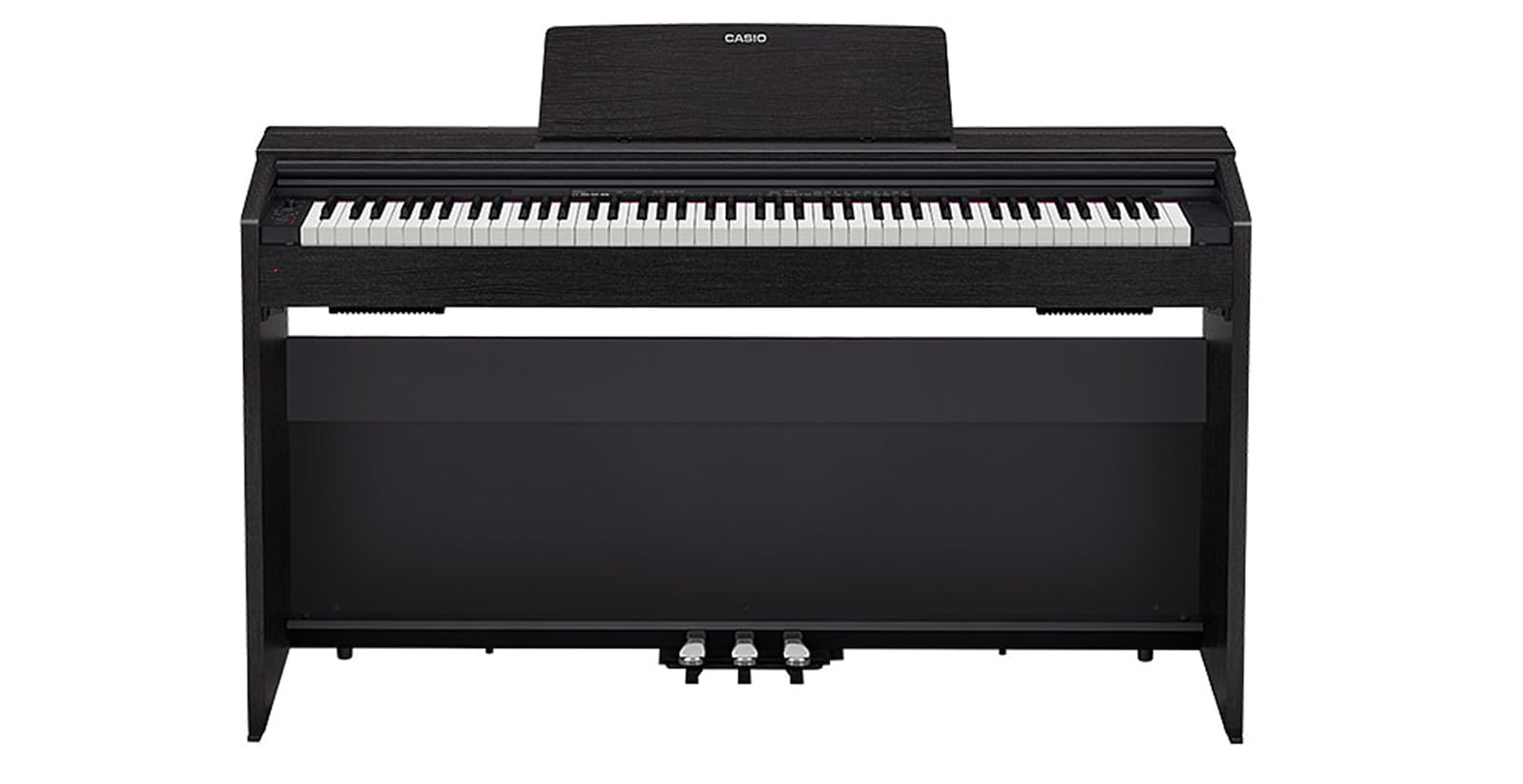
The Casio Privia PX-870 is a console digital piano that refuses to compromise on its speaker system. The 40-watt, 4-speaker Sound Projection system is unheard of at this level — two full-range drivers firing upward and two downward to create a sound field that genuinely fills a living room. The Tri-Sensor II Scaled Hammer Action keyboard uses three sensors to detect key velocity with higher accuracy than dual-sensor systems, which matters for rapid repeated notes.
The AiR (Acoustic and Intelligent Resonator) sound source models damper resonance, string resonance, and key-off simulation. You hear the subtle ring of undamped strings when you hold the sustain pedal, and the faint mechanical noise of key release. The built-in sliding key cover protects the keys and gives the unit a furniture-grade appearance without an external dust cover.
Duet Mode splits the keyboard into two identical pitch ranges, making it easy for teacher and student to play together. Dual headphone jacks support the same setup for silent lessons. The USB-MIDI connectivity is class-compliant, so no driver installation is needed on Mac or Windows. The cabinet is fiberboard rather than solid wood, which keeps the weight at 75.6 pounds but means the finish can chip if handled roughly during assembly.
Why it’s great
- 40W 4-speaker system provides immersive, room-filling sound
- Tri-Sensor II action offers fast, accurate key tracking
- AiR sound engine with damper and string resonance modeling
Good to know
- Cabinet is fiberboard, not solid wood
- Assembly instructions are limited; use video guides
- Rear ports can be inconvenient for wall placement
3. Yamaha YDP184 Console Digital Piano

The Yamaha YDP184 is the console flagship for a reason. Its Graded Hammer 3 (GH3) action features synthetic ivory key tops that absorb moisture and prevent slipping during long practice sessions. The CFX Premium Grand Piano voice samples Yamaha’s flagship concert grand, captured over multiple dynamic layers to create a sound that breathes. Virtual Resonance Modeling (VRM) calculates sympathetic string vibrations in real time based on key position and pedal depth, adding complexity that lower-tier digital pianos simply cannot match.
The full dot LCD display gives you smooth navigation across sounds, recorder functions, and system settings without squinting at tiny LEDs. The half-damper pedal control allows the same nuanced sustain you get on a grand piano — press partially for a subtle blur, full for a complete wash. With 128-note polyphony, even complex Romantic-era pieces with heavy pedal usage will not drop a single note.
This unit is heavy at 123 pounds, and you will need a second person for setup. The included padded bench is well-built and matches the dark rosewood finish, but the overall footprint is substantial. If you have limited floor space, the console cabinet may dominate a small room. Yamaha’s Smart Pianist app works with the YDP184 for additional voice editing and sheet music display, but the connection is wired USB only — there is no Bluetooth built in.
Why it’s great
- GH3 action with synthetic ivory key tops for grip and feel
- CFX sound engine with Virtual Resonance Modeling
- Full LCD display and half-damper pedal control
Good to know
- Very heavy; requires two people to assemble and move
- No Bluetooth audio/MIDI — wired USB only
- Large console footprint
4. Yamaha YDP105
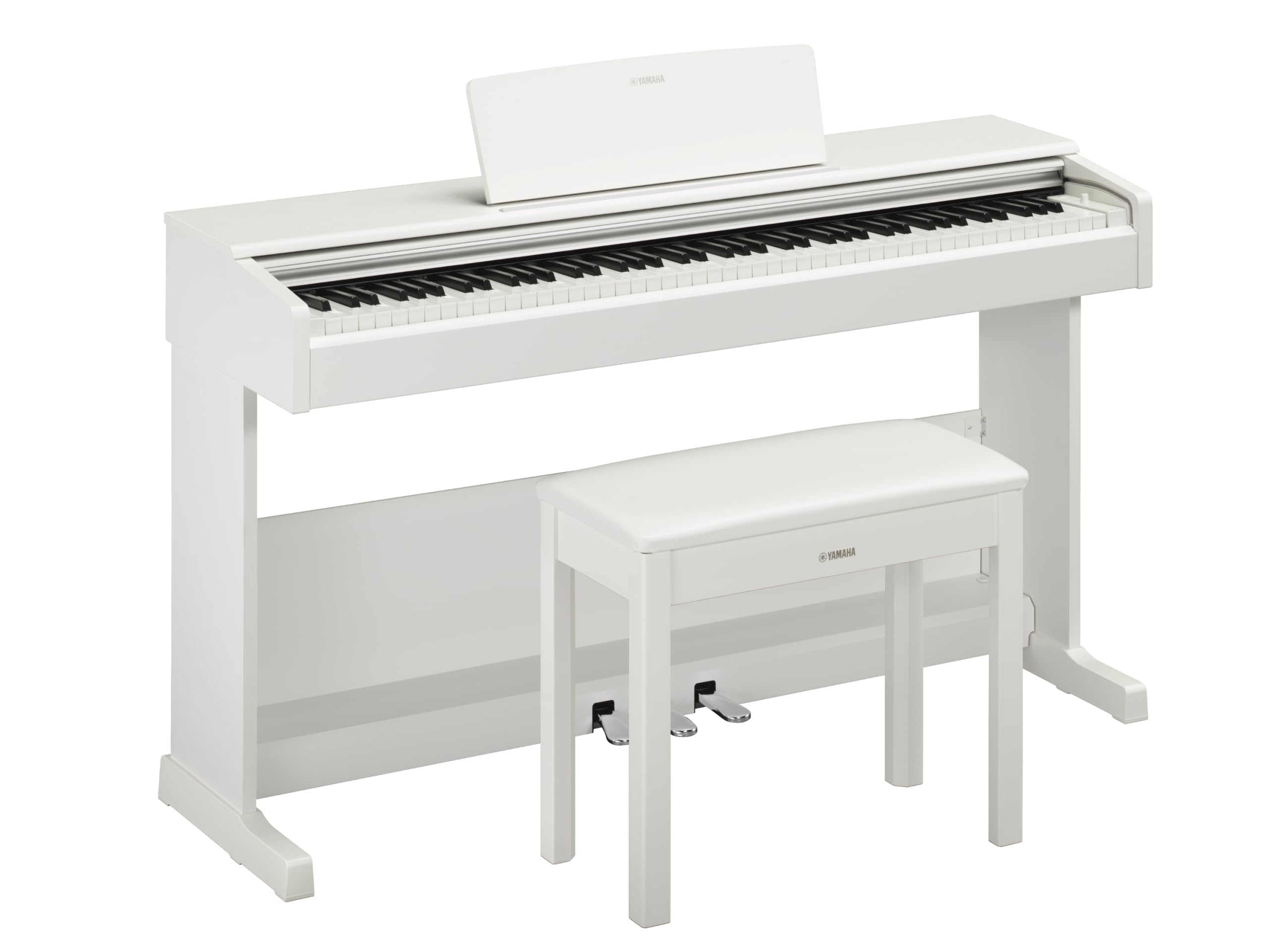
The Yamaha YDP105 is the entry point into Yamaha’s Arius console line, and it delivers exactly what someone moving from a portable keyboard to a furniture-grade instrument needs. The Graded Hammer Standard (GHS) action is lighter than Yamaha’s GH3 but still provides the heavier bass and lighter treble split that defines weighted feel. Grand Piano Voice samples from Yamaha’s concert grands, giving you a warm, rich foundation tone that works for classical, pop, and jazz.
A padded bench is included in the box — plus a full three-pedal unit with damper, sostenuto, and soft pedals mounted into the console frame. The dual 3.5mm headphone jacks allow a teacher and student to practice together silently. The white finish with wood grain is a stylish option that brightens a room compared to the standard black glossy units.
The GHS action is not as refined as the GH3 on the YDP184 — rapid key repetition can feel slightly sluggish, and the key tops are standard plastic rather than synthetic ivory. At 82.7 pounds it is still a furniture piece that needs two people to move. The 10 voice demo songs and 10 preset songs are limited, so you will want to supplement with external sheet music or app-based learning.
Why it’s great
- Complete console package with bench and triple pedals
- GHS weighted action true to Yamaha standards
- Dual headphone jacks for teacher/student practice
Good to know
- GHS action is less responsive than GH3 for fast passages
- Only 10 onboard voices
- Heavy at 82.7 pounds
5. Donner DDP-300

The Donner DDP-300 stands out for its unusual speaker architecture. Instead of one or two full-range drivers, it uses dual tweeters and a dedicated subwoofer to produce warm 3D surround sound with rich bass and clear treble. That alone makes it a compelling choice for players who want an immersive audio experience without external monitors. The graded hammer action keyboard features four selectable touch curves, so you can tailor the resistance to your playing style — from light to heavy.
Bluetooth connectivity is built into this model, supporting both audio streaming and MIDI data transfer. The partition mode splits the keyboard into two equal-pitch sections, which works well for one-on-one teaching. The dark rose finish is elegant, though some buyers note the color leans closer to black than the deep cherry red shown in marketing images.
A few user reports mention sticky keys on certain units, though Donner’s customer service is described as responsive. The volume dial has a wobbly feel that does not inspire long-term confidence. No bench is included, which is a notable omission at this price point. The pedal cord also uses a non-standard connector that may require a replacement unit if it arrives damaged.
Why it’s great
- 3D sound system with tweeter and subwoofer
- Four selectable touch curves
- Built-in Bluetooth audio and MIDI
Good to know
- Some reports of sticky keys
- Bench not included
- Volume build quality feels average
6. Donner DDP-90 Pro
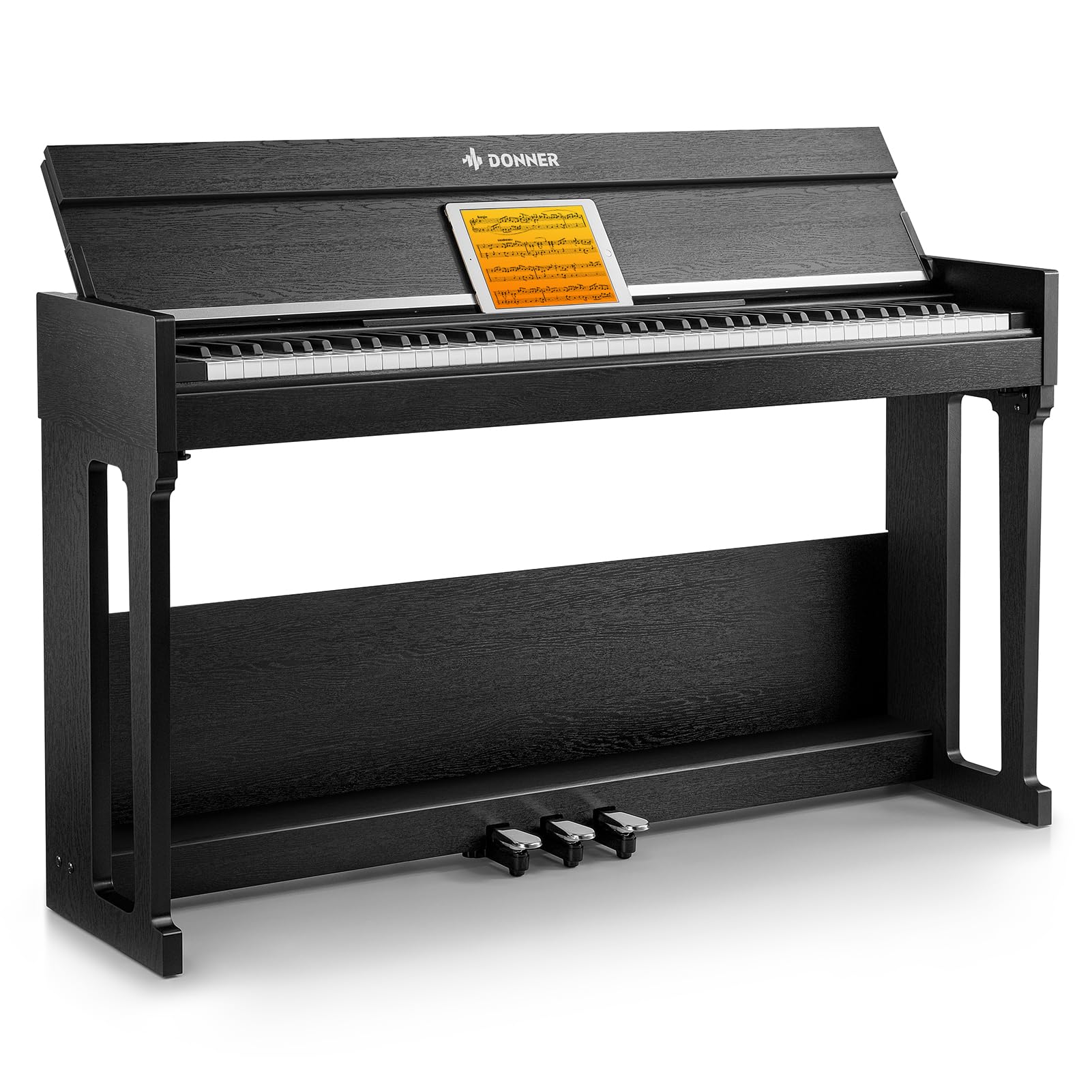
The Donner DDP-90 Pro is designed for players who need a full weighted action in a smaller footprint. The cabinet is noticeably thinner than a traditional console, so it fits in apartments or dens without dominating the room, yet it still includes a professional metal triple-pedal system. The hammer-action weighted keys have an ivory-feel texture that provides a subtle grip, and the 128-note polyphony supports fast trills without note dropout.
With 238 tones, 200 rhythms, and 100 demo songs, the DDP-90 Pro is one of the most feature-packed models in the mid-range bracket. The slow-closing key cover is a thoughtful touch that prevents slamming on fingers. USB-MIDI connectivity works with any teaching app on PC, tablet, or smartphone, and the built-in amplifier handles audio from a U-disk or external input.
The sustain pedal action is weaker than more expensive consoles; the spring resistance is lighter and the half-damper control is not as nuanced. Some users report a single key that sticks or produces a different volume, though this seems to be a unit-to-unit variance. The headphone jack is located underneath the piano, which makes plugging and unplugging annoying if the unit is against a wall.
Why it’s great
- Compact design for small rooms without sacrificing weighted keys
- Massive library of 238 tones and 200 rhythms
- Slow-closing key cover for safety
Good to know
- Sustain pedal lacks half-damper refinement
- Headphone jack underneath is inconvenient
- Occasional key consistency issues
7. Best Choice Products 88-Key Weighted Set

This is a bundle-first keyboard. Best Choice Products packages the weighted keyboard with a U-stand, a three-pedal unit, a stool, a keyboard cover, a music stand, and two headphone jacks. For someone starting from zero who wants everything in one box, that convenience is hard to argue with. The hammer-action keys offer a reasonable approximation of acoustic resistance for the price tier.
You get 140 timbres, 128 rhythms, and 100 demo songs, which gives a beginner endless sonic variety to explore. The triple pedal unit includes soft, selective sustain, and full sustain pedals. The media compatibility via MIDI/USB outputs means you can connect to learning apps and record performances.
The included stool and U-stand are the weakest elements of this bundle. The stool has a 220-pound weight capacity but the padding is thin and the legs feel flimsy. The stand slants toward the back, which some users fix by inserting coins into the support holes during assembly. The sound quality is serviceable but does not match the depth of dedicated console units — the built-in speakers lack bass and can sound tinny at higher volumes.
Why it’s great
- Complete bundle includes stand, stool, pedals, cover
- 140 timbres and 128 rhythms for creative variety
- Hammer-action keys at an accessible price
Good to know
- Stool and stand are low quality
- Sound quality lacks bass depth
- Some units arrive with a slanted stand issue
8. STRICH SDP-300W

The STRICH SDP-300W goes for a specific look: black wood-grain cabinet that reads as a vintage furniture piece rather than a black plastic slab. The hammer-action keys have a simulated ivory texture that feels slightly more textured than standard smooth plastic keys. The 25W x 2 speaker system is powerful for a mid-range unit and produces clear sound across the register without breaking up at higher volumes.
With 128 preset timbres, 200 drum rhythms, and 128-note max polyphony, the SDP-300W covers the bases for exploration beyond straight piano. The auto chord function helps beginners by playing full chords from simplified fingerings. Wireless and USB-MIDI connectivity let you connect to teaching apps without fumbling with cables.
The power button is located on the back of the unit, which is a minor inconvenience if the piano is pushed against a wall. The Audio-in port is useful for playing along with backing tracks, but some users report the piano slides slightly during vigorous playing, so you may want to place it on a rug or use non-slip pads. The dynamic range on the speakers is decent but does not match the projection of the Casio PX-870 or the Yamaha YDP105.
Why it’s great
- Vintage wood-grain finish stands out visually
- 25W x 2 speakers deliver solid room-filling sound
- 128 timbres and wireless connectivity
Good to know
- Power button located on the back
- Can slide during heavy playing without grip pads
- Lower dynamic range than higher-end consoles
9. AODSK B-83S
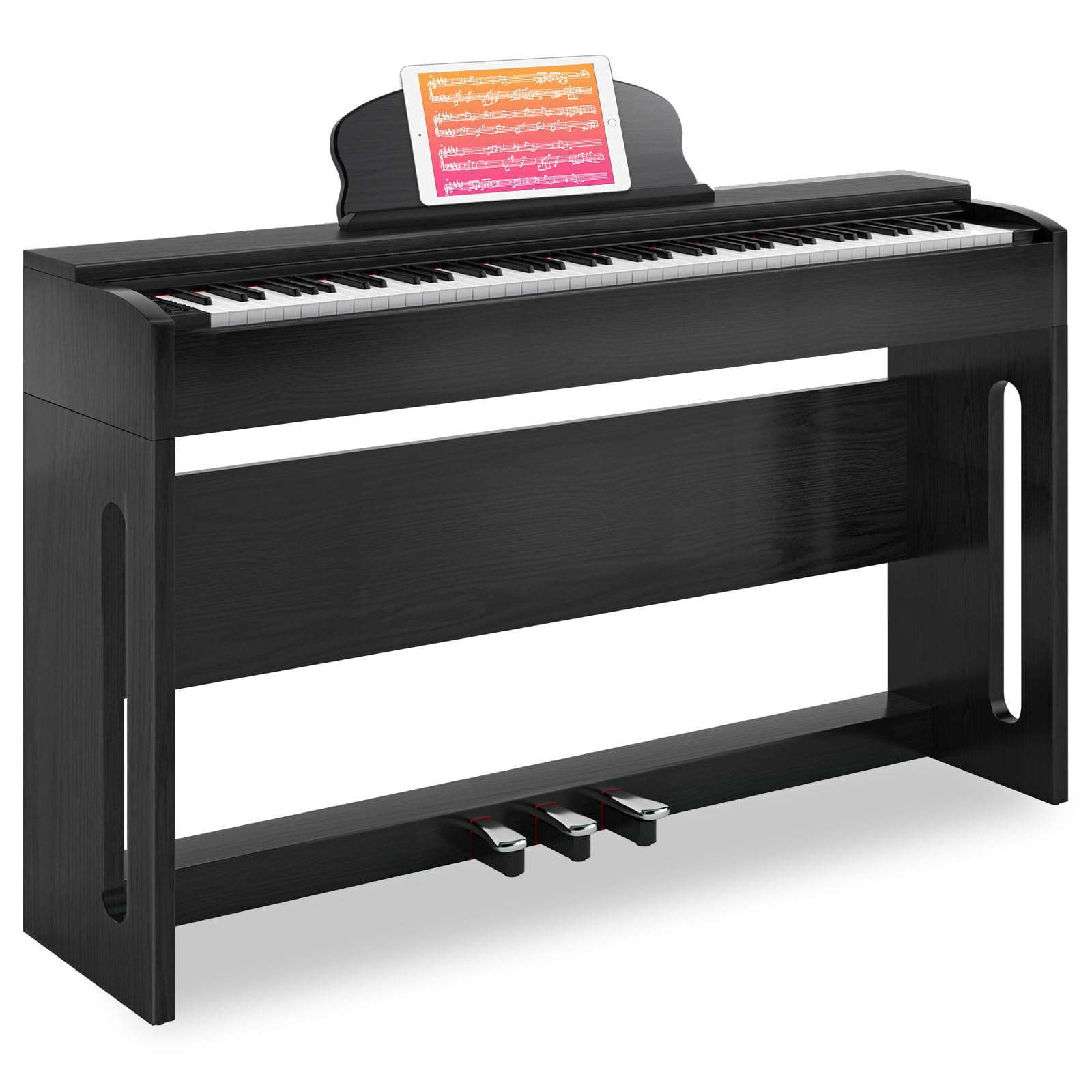
The AODSK B-83S is built with a specific audience in mind: absolute beginners who want a weighted keyboard that comes with structured learning support. The unit offers a 30-day beginner course via contact with the seller, plus 128 tones and 88 demo songs. The fully weighted 88-key action provides the graded resistance needed to develop proper finger control from day one.
The furniture stand and triple pedals (soft, sustain, sostenuto) are included in the box, so you do not need to hunt for accessories. The headphone jack supports up to two headphones simultaneously, which makes silent duet practice possible without an external splitter. The 128-note polyphony handles moderate pedal usage without cutting notes.
Assembly is the main pain point here. Multiple reviewers describe the instructions as unclear, and the build process requires your own screwdriver. The key action is lighter than higher-priced consoles, so experienced players may find it less satisfying for fast dynamic pieces. The default piano sound is fine for practice but lacks the harmonic richness of Roland’s SuperNATURAL or Casio’s AiR sound engines.
Why it’s great
- 30-day beginner course included for learning support
- Furniture stand and triple pedals in the box
- Dual headphone jacks for quiet duet practice
Good to know
- Assembly instructions are poor
- Key action is lighter than premium models
- Default piano tone lacks harmonic depth
10. UMOMO UMP-718
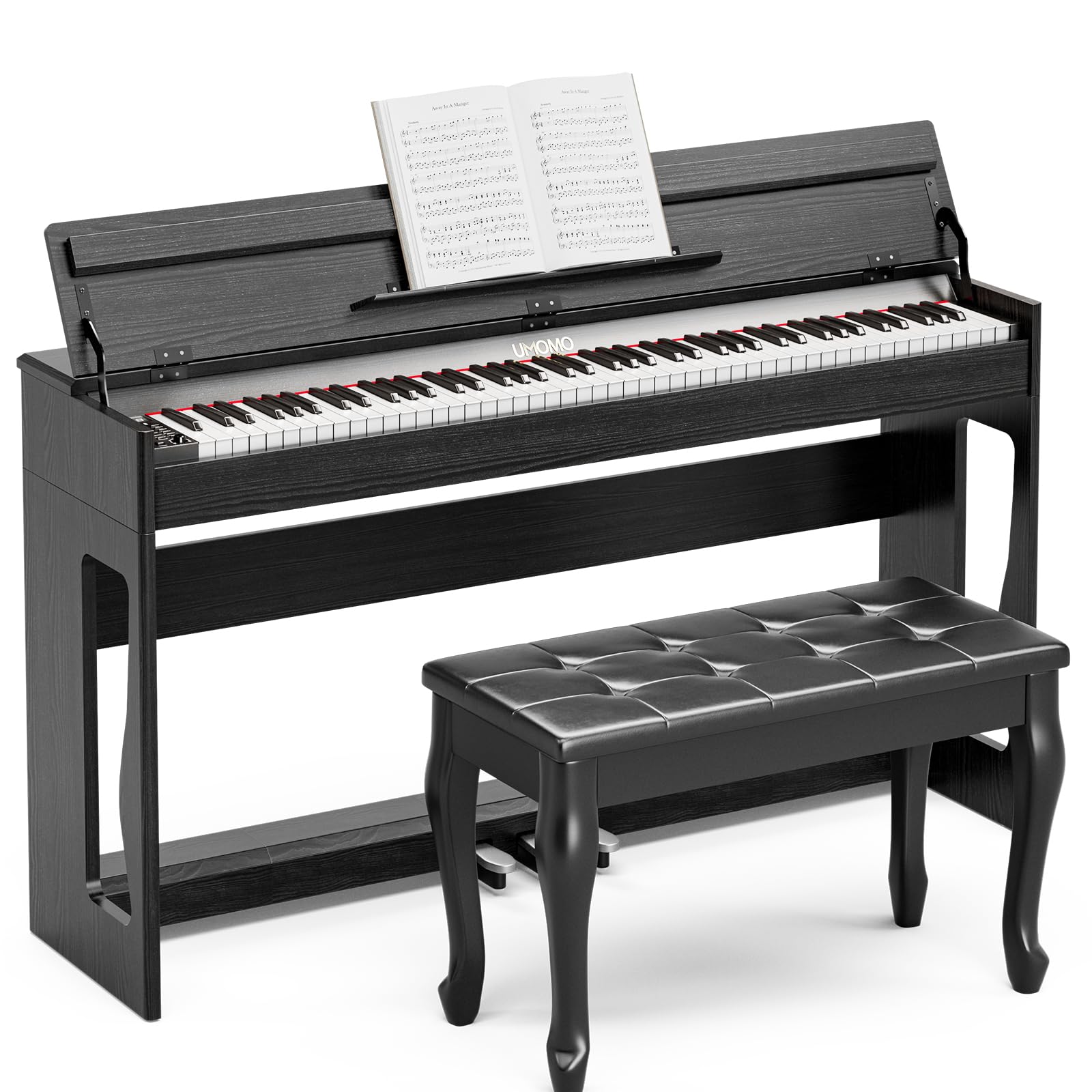
The UMOMO UMP-718 enters the conversation for players on a tight budget who refuse to sacrifice weighted action. It features 88 fully weighted hammer action keys with a 10-grade resistance curve — heavier in the bass, lighter in the treble. The sound engine offers 128 tones, 128 rhythms, and 80 demo songs with 128-note polyphony, which is above average for its tier.
The cabinet is finished in a painted black that looks clean, and the included bench is described as stable. The three-pedal unit provides soft, damper, and sustain functions. USB-MIDI connectivity allows you to use music production software for arrangement and composition. The 45-kilogram weight means the unit stays planted during playing but requires two people for assembly and relocation.
The built-in speakers are the most common complaint. Users describe the sound as decent for the price but lacking the clarity of a mid-range Yamaha or Casio. The headphone jack is located underneath the piano, which is awkward to access daily. Volume consistency between the lowest and highest keys is slightly off, and the default piano sound is mediocre — serviceable for practice but not inspiring for performance.
Why it’s great
- 10-grade hammer action provides proper graded resistance
- Included bench and triple pedal unit
- 128-note polyphony for sustained play
Good to know
- Built-in speakers lack clarity and depth
- Headphone jack under the unit is inconvenient
- Volume consistency is not uniform across the register
11. Ktaxon 88-Key Digital Piano

The Ktaxon 88-Key Digital Piano is the cheapest fully-weighted board in this lineup, and it earns its spot by proving that an entry-level price does not have to mean synth-action keys. The simulated heavy hammering mechanism provides a rebound that mimics an upright piano, and the double Bluetooth support (audio and MIDI) is rare at this level. The 64-note polyphony is the biggest limitation here — it is half of what most competitors offer.
The three-pedal unit includes soft, sustain, and sostenuto functions, and the included dustproof cloth, headphones, music stand, and piano sticker bundle covers everything a beginner needs to start immediately. The split function divides the keyboard into two 44-key zones for duet play. The 10W stereo speakers are fine for bedroom practice but distort at higher volume levels.
External speakers plus headphones produce audible hiss, which ruins the experience if you try to use powered monitors or an amp. The keys feel smooth rather than textured, so your fingers can slide during long sessions. The build quality on the stand is acceptable for stationary use, but the unit will not survive repeated moves. This is strictly a stationary first instrument for someone testing whether they want to commit to piano.
Why it’s great
- Full weighted action at the lowest entry cost
- Dual Bluetooth for audio and MIDI connection
- Complete bundle with pedals, cover, and headphones
Good to know
- 64-note polyphony cuts notes during heavy pedal use
- Speaker hiss when using external audio devices
- Smooth key surface lacks grip for sweaty fingers
FAQ
Can beginners start on a graded hammer action keyboard or should they use semi-weighted keys first?
What does 128-note polyphony actually mean for my playing?
Do I need a three-pedal unit or is a single sustain pedal enough?
Final Thoughts: The Verdict
For most users, the best 88 key weighted keyboard winner is the Roland FP-30X because it combines authentic PHA-4 action, a premium sound engine, and genuine portability in one package. If you want powerful built-in speakers and a furniture-grade console, grab the Casio Privia PX-870. And for the ultimate concert grand simulation in a home console, nothing beats the Yamaha YDP184.