
Our readers keep the lights on and the weekend projects moving. As an Amazon Associate, I earn from qualifying purchases.
Shooting in 8K isn’t just about resolution—it’s about the freedom to reframe, the ability to pull a crisp still from a moving subject, and the confidence that your footage will remain sharp as display technology advances. But raw 8K data streams push camera processors and cooling systems to their absolute limits, separating genuinely capable bodies from overheated marketing claims.
I’m Rikta — the co-founder and writer behind FitlyFast. I’ve spent years analyzing the sensor readout speeds, codec efficiency, and thermal management architectures that define whether an 8K camera is a reliable production tool or a spec-sheet liability.
After digging through real-world stress tests, recording limits, and codec depth, I’ve assembled the definitive list of the best 8k video camera options that balance resolution, dynamic range, and practical usability for serious shooters.
How To Choose The Best 8K Video Camera
Choosing an 8K camera is a decision about your entire production pipeline. The body is only the start—you need to consider the codec ecosystem, storage throughput, and whether the sensor can maintain that resolution without losing dynamic range. Here’s exactly what separates a workhorse from a marketing bullet point.
Understand the sensor architecture
A stacked CMOS sensor with a separate DRAM layer reads data much faster than a traditional CMOS sensor. This speeds up rolling shutter and reduces jello effect when panning. For 8K, you want a stacked or BSI stacked sensor. The Canon EOS R5 C and Nikon Z 8 use this architecture to deliver high frame rates without the lag that plagues older sensors.
Check the recording limits—not the spec sheet, the real-world behavior
Many cameras can *start* recording 8K, but thermal throttling stops them cold. Look for an active cooling fan (like the R5 C’s built-in fan or the FX3’s internal fan) if you need long takes. Passive heat sinks work for shorter clips, but in warm environments, they top out quickly. The Panasonic Lumix S1RII and Nikon Z 8 both have fanless designs that still manage 8K for reasonable durations, but your mileage depends heavily on ambient temperature.
Evaluate codec and bit depth
8K generates mountains of data. Internal 10-bit recording is the bare minimum for color grading. ProRes RAW, N-RAW, and Cinema RAW Light give you more flexibility in post, but they demand fast CFexpress Type B or SSD storage. If you prefer external recorders, check that the HDMI output carries a clean 8K signal without downsampling. Every camera on this list records internally or externally in at least 10-bit depth.
Quick Comparison
On smaller screens, swipe sideways to see the full table.
| Model | Category | Best For | Key Spec | Amazon |
|---|---|---|---|---|
| Canon EOS R5 C | Cinema Hybrid | 8K/60p long takes | Active internal fan, 8K/60p RAW | Amazon |
| Nikon Z 8 | Hybrid Pro | 8K/60p N-RAW | 45.7MP stacked, 8K/60p internal | Amazon |
| Sony FX3 (bundle) | Cinema Line | Low-light 4K (8K-ready workflow) | ISO 409600, internal fan, XLR handle | Amazon |
| Canon EOS R5 | Full-Frame | Hybrid stills/8K video | 45MP stacked sensor, 8K RAW | Amazon |
| Sony a7R V | High-Resolution | 61MP stills + 8K 24p | 61MP, AI AF, 8K 24p | Amazon |
| Panasonic Lumix S1RII | Mirrorless Hybrid | 8K + burst shooting 40fps | 44.3MP, 8K internal, phase hybrid AF | Amazon |
| Blackmagic Pocket 6K | Cinema Pocket | 6K RAW (8K workflow prep) | Super35, 6K/50fps RAW, SSD recording | Amazon |
In‑Depth Reviews
1. Canon EOS R5 C

The EOS R5 C solves the single biggest pain point of the original R5: overheating. Canon installed an internal cooling fan directly into the body, allowing uninterrupted 8K/60p internal RAW recording. That fan isn’t a gimmick—it vents heat during long interviews, event coverage, and live-streaming sessions. The 45MP full-frame stacked sensor delivers the same superb dual-pixel AF and 12-bit Cinema RAW Light that cinema shooters need for heavy color grading. You get broadcast-grade MXF XF-AVC files alongside MP4 for quick-turnaround work.
The body stays compact relative to dedicated cinema rigs, but the fan does add bulk. Battery life is average, and many pros pair it with a V-Mount battery plate for all-day shoots. The mini-HDMI port demands a cable clamp to avoid accidental disconnects. Despite those quirks, the R5 C is the only hybrid body under three thousand that offers active cooling with 8K/60p RAW—making it the most versatile single-camera solution for a mixed stills-and-video production schedule.
For indie filmmakers running interviews, B-roll, and gimbal work, this camera replaces a two-camera setup. The RF mount also adapts well to EF glass, extending your lens options without sacrificing AF speed. If you need one body that can film a documentary by day and shoot a portrait session by evening, the R5 C is the most complete package available.
Why it’s great
- Active fan enables continuous 8K/60p internal RAW recording
- Dual Pixel AF with subject tracking is fast and reliable
- Cinema RAW Light provides excellent flexibility for grading
Good to know
- No built-in IBIS; designed for gimbal or tripod use
- Battery life is short; external V-Mount recommended
- mini-HDMI port requires a clamp for secure rigging
2. Nikon Z 8

Nikon’s Z 8 packs the Z 9’s stacked 45.7MP sensor into a body that’s about 30% lighter, making it a strong candidate for travel-heavy hybrid shooters. The EXPEED 7 processor powers internal 8K/60p in 12-bit N-RAW or ProRes RAW, and the bit rates are high enough to retain every highlight and shadow detail. Nikon’s deep-learning AF is its most advanced yet, detecting people, animals, birds, cars, and trains—even in very low light down to -9 EV. The shutterless design means no blackout during high-speed bursts up to 120fps JPEG or 20fps RAW.
Heat management is achieved through a passive heat sink rather than an active fan, so in hot climates (above 30°C), recording times are limited. Users report that CFexpress Type B cards can also heat up, but selecting low-voltage cards and enabling auto-power-off helps. The single CFexpress Type B slot plus a UHS-II SD slot is a minor compromise for redundancy. Video autofocus has improved with firmware updates, but it still trails Canon’s Dual Pixel AF in tracking speed during fast irregular motion.
For photographers who also shoot 8K video, the Z 8 is a spectacular stills camera with full-frame resolution and dynamic range that rivals medium format. The N-RAW files are remarkably efficient in post, reducing storage overhead compared to uncompressed RAW. The four-axis tilting screen and weather-sealed magnesium alloy body make it reliable in harsh field conditions. It’s the best all-around option for Nikon loyalists who need 8K without jumping to the Z 9’s bulk.
Why it’s great
- Stacked 45.7MP sensor with fast readout and low rolling shutter
- Internal 8K/60p N-RAW and ProRes RAW recording
- Deep-learning AF with excellent subject detection range
Good to know
- No active fan; heat limits recording time in warm environments
- Single CFexpress Type B slot is restrictive for backup
- Video AF occasional hesitation with very fast, erratic subjects
3. Sony FX3 (bundle)

The Sony FX3 is built for video-first shooters who need absolute reliability in long-form recording. Its 10.2MP full-frame sensor may not hit 8K resolution internally, but it records oversampled 4K from a 6K readout and outputs 16-bit RAW via HDMI—making it a powerful piece of an 8K workflow when paired with an external recorder. The internal fan keeps the sensor cool during hours of continuous recording, which is why this camera is a favorite for documentary, event, and interview shoots.
This bundle includes the 24-70mm f/2.8 GM II lens, a 128GB memory card, ND filter kit, and a shoulder bag—a solid starting kit for professionals. The FX3’s top handle with built-in XLR inputs delivers professional audio capture directly into the camera, eliminating the need for a separate recorder. The 15+ stops of dynamic range and dual base ISO (800 and 12,800) give it exceptional low-light performance without significant noise, even at very high sensitivity.
The tradeoff is that you don’t get internal 8K recording. You also lose the high-resolution stills capability—12MP is fine for social media but won’t replace a dedicated stills camera. For filmmakers who prioritize audio, ergonomics, and run-and-gun reliability, the FX3 is a purpose-built cinema tool that leads its class. If your project demands 8K final output, this camera feeds into that pipeline externally.
Why it’s great
- Active cooling for unlimited recording times
- Built-in XLR handle with professional audio inputs
- Excellent low-light performance with dual native ISO
Good to know
- No internal 8K recording; relies on external recorder
- 12MP sensor is limiting for high-res stills
- Bundle price is premium
4. Canon EOS R5

The Canon EOS R5 was the first mirrorless camera to deliver internal 8K RAW recording in a compact full-frame body. Its 45MP stacked CMOS sensor, paired with the DIGIC X processor, provides exceptional still-image quality at 20fps electronic shutter and phase-detection autofocus that covers the entire frame. For hybrid shooters, this is a camera that excels equally at high-res stills and 8K video—provided you manage its thermal limits. Early overheating concerns were mitigated by firmware updates that improved recording time, but it still doesn’t match the R5 C’s active cooling in hot environments.
The Eye Control AF feature is unique to Canon—you select focus points simply by looking through the viewfinder. It works well for fast-moving subjects like birds and sports. The 5-axis IBIS is effective enough to shoot handheld in low light at ISO 100, which is rare for such a high-resolution sensor. Battery life is about 650 shots per charge, which is fair for a mirrorless body of this class. The 8K video quality, oversampled to 4K, provides stunning sharpness and detail even when downscaled for delivery.
For photographers who occasionally shoot 8K video, the EOS R5 is an incredible value. It delivers 45MP stills with dynamic range that rivals medium format, plus 8K/30p RAW internal recording for short clips. The main limitation is heat: you can get 20-30 minutes of 8K in a cool studio, but direct sunlight or a warm room will reduce that. If your work is mostly stills with occasional high-resolution video, this is the most cost-effective hybrid body on the market.
Why it’s great
- 45MP stacked sensor with excellent dynamic range
- 8K RAW internal recording and Eye Control AF
- 5-axis IBIS effective for handheld stills and video
Good to know
- Thermal limits restrict 8K recording in warm environments
- Battery life is shorter than competition
- mini-HDMI port, no full-size HDMI
5. Sony a7R V

The Sony a7R V is built around a 61MP full-frame back-illuminated Exmor R sensor, making it the highest-resolution full-frame body on this list. For video, it records 8K/24p in Super 35 mode, using a crop from the sensor that still delivers excellent detail. The dedicated AI processing unit powers Real-Time Recognition AF, accurately tracking human eyes, animal eyes, birds, cars, and planes with precision that’s noticeably improved over the a7R IV. The BIONZ XR engine delivers 8x faster processing, enabling 10fps continuous shooting with full AF tracking.
The a7R V is a photographer’s camera first, with video added as a valuable secondary feature. The 8K clip is limited to 24p and Super 35 crop, so you lose the wide-angle look unless you use ultra-wide lenses. The rolling shutter is present in 8K mode, making fast pans and gimbal work less forgiving than on stacked-sensor cameras. But for studio shoots, interviews, or landscape video, the 61MP stills are exceptional and the 8K video is perfectly usable. The dual CFexpress Type A/SD slots give flexible storage options.
The articulating LCD, improved menu system, and larger grip make it a comfortable camera for all-day shooting. Battery life has improved over the a7R IV, though 8K recording still drains faster than 4K. If your primary income is high-resolution stills (portraits, weddings, commercial) and you occasionally need 8K video, the a7R V delivers the best resolution-to-dollar ratio in Sony’s lineup. It’s not a cinema body, but it’s a world-class stills camera with 8K capability.
Why it’s great
- 61MP sensor provides extraordinary still-image detail
- AI AF with excellent subject tracking reliability
- Improved menu and ergonomics over previous a7R models
Good to know
- 8K limited to 24p in Super 35 crop
- Rolling shutter visible in 8K mode during fast pans
- Not ideal for dedicated video production
6. Panasonic Lumix S1RII

Panasonic’s Lumix S1RII is the company’s first camera to offer internal 8K video recording, paired with a 44.3MP full-frame sensor and a phase hybrid AF system that uses AI for human recognition. It shoots 8K in a variety of frame rates and can capture 40fps burst shooting with continuous AF—impressive specs for a body that’s aimed at both photographers and videographers. The color science leans warm and natural, giving footage a distinct look that many users prefer for portraits and landscape work.
AFC 40 burst shooting is genuinely useful for sports and wildlife, maintaining resolution while tracking fast subjects. The Lumix Camera Flow app offers remote control and file transfer, which is convenient for tethered shoots. However, some users report that the camera can overheat when recording 8K for extended periods, shutting down after two minutes in hot conditions. The AF peaking feature has also received criticism for being less precise than competitors, making manual focus verification more difficult.
The S1RII lacks a large native lens ecosystem compared to Canon and Sony, and third-party support is still maturing. The body is solidly built with weather sealing, but the menu system can be complex for new users. If you’re already invested in Panasonic glass and want to shoot 8K with a hybrid body that also does high-speed burst photography, the S1RII is a capable choice. Just be prepared to manage its thermal limits and accept a smaller lens library.
Why it’s great
- First Panasonic with internal 8K recording
- 40fps burst with continuous AF for action
- Natural color science with wide dynamic range log
Good to know
- Overheating in 8K video mode in warm environments
- AF peaking less precise than Sony or Canon
- Limited native RF lens ecosystem currently
7. Blackmagic Design Pocket Cinema Camera 6K
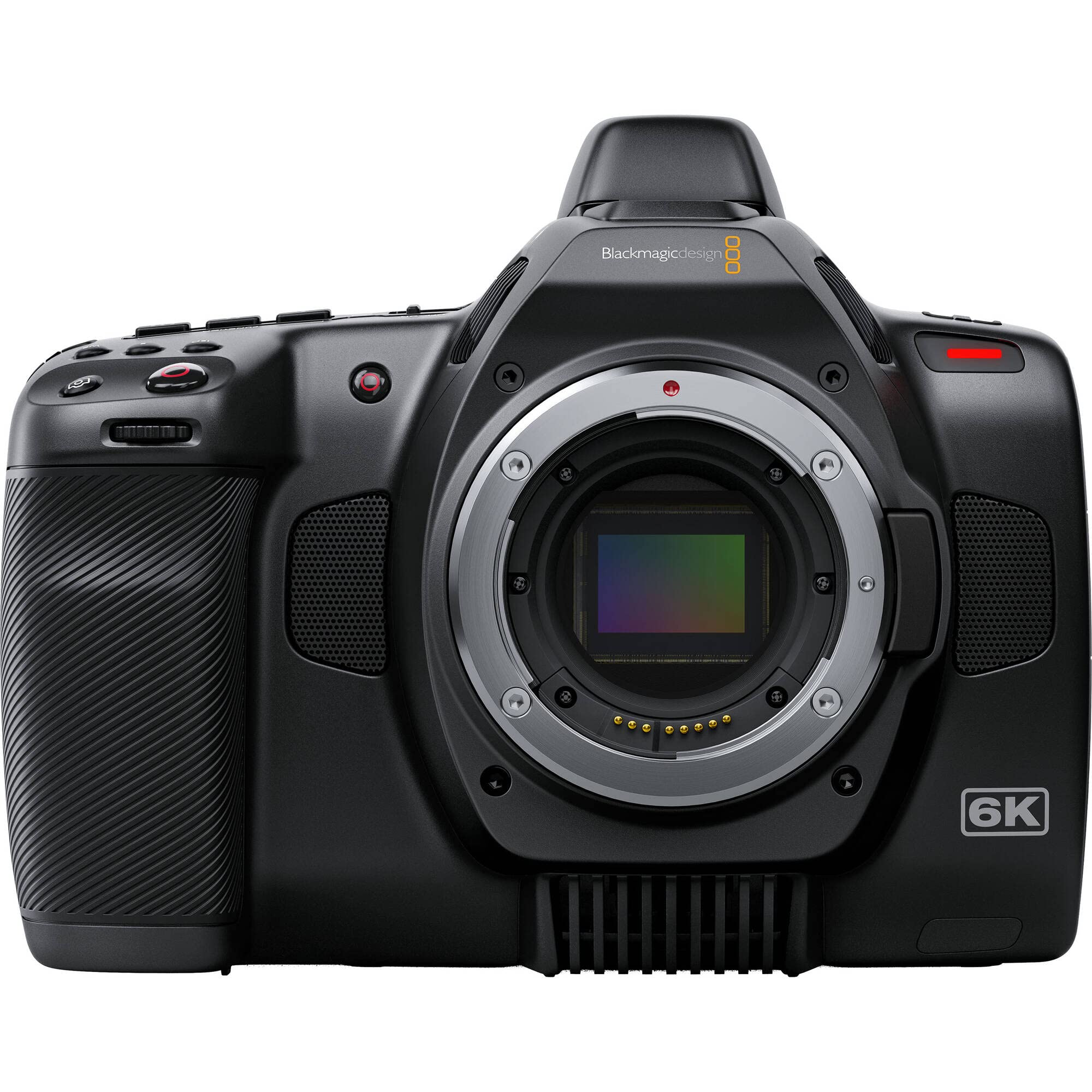
The Blackmagic Pocket Cinema Camera 6K uses a Super35 sensor with an EF lens mount, recording up to 6K/50fps in Blackmagic RAW. While it doesn’t reach 8K resolution, it’s included here for filmmakers who want a RAW cinema workflow that can be finished at 8K through upscaling or compositing. The 13 stops of dynamic range and 6K oversampling provide excellent latitude for color grading, with an image that rivals cameras costing much more. The included DaVinci Resolve Studio license (worth several hundred dollars) is a significant bonus for post-production.
The camera’s form factor is compact and DSLR-like, making it easy to rig on a gimbal or take on location. The 5-inch touchscreen is bright enough for studio work but can be misleading in direct sunlight—most professionals use an external monitor. The EF lens mount is a huge advantage because you can adapt almost any vintage or modern lens, and the mechanical shutter keeps rolling shutter to a minimum. Blackmagic RAW files are relatively efficient for their quality, reducing storage demands compared to uncompressed RAW from larger cinema cams.
Autofocus is contrast-detection only, which is unreliable for moving subjects; this camera demands manual focus discipline. Battery life is poor, with the included NP-F550 lasting about 45 minutes, so external battery power is standard. The 6K Pocket is not an 8K camera, but its RAW workflow, color science, and low price make it an ideal B-cam or entry into high-quality cinema production. If your output target is 4K finishing or you’re learning RAW workflows, it’s the most affordable way to get a professional-grade image pipeline.
Why it’s great
- Blackmagic RAW with excellent dynamic range and color
- EF lens mount compatible with many adapted lenses
- Includes DaVinci Resolve Studio for editing and grading
Good to know
- No 8K resolution; capped at 6K internal
- Contrast-detect AF is slow and unreliable
- Short battery life; external power recommended
FAQ
Can a full-frame 8K camera overheat in real-world use?
What memory card speed do I need for 8K recording?
Is 8K video essential if my final output is 4K?
Final Thoughts: The Verdict
For most users, the best 8k video camera winner is the Canon EOS R5 C because it combines active cooling, cinema-grade 8K/60p RAW, and hybrid stills capability in a single body. If you want unmatched stills resolution, grab the Sony a7R V. And for Nikon loyalists needing 8K with N-RAW quality and a lighter body, nothing beats the Nikon Z 8.