
Our readers keep the lights on and the weekend projects moving. As an Amazon Associate, I earn from qualifying purchases.
An 8x binocular hits the sweet spot between raw power and practical usability. You get enough magnification to see feather details on a warbler or the stitching on a sail at the regatta, yet the image stays steady enough for handheld use. The real challenge isn’t the magnification — it’s choosing between lens coatings, prism quality, and chassis toughness without blowing your budget on specs you don’t need.
I’m Rikta — the co-founder and writer behind FitlyFast. My work focuses on dissecting optical benchmarks like twilight factor, exit-pupil diameter, and dielectric coating efficiency to separate genuine performance gains from marketing gravity.
Whether you’re glassing a ridgeline at dawn or scanning the third row at a concert, the optimal pair of 8x binoculars delivers sharp contrast, a wide enough field to track movement, and a waterproof seal that weather can’t compromise.
How To Choose The Best 8x Binoculars
Picking the right pair means understanding the optical chain — from the objective lens to your retina. The three pillars are light transmission, resolution, and ergonomic fit. Ignore one, and the other two won’t save you.
Lens Coatings and Prism Quality
A “fully multi-coated” designation means every air-to-glass surface has anti-reflective layers, boosting light throughput. BaK-4 prisms (vs. BK-7) yield a round exit pupil with no dark edges. This combination directly determines how bright the view looks at dawn and dusk.
Objective Lens Size and Exit Pupil
The second number (the objective diameter in mm) controls light gathering. An 8×42 produces a 5.25mm exit pupil, which matches your fully dilated pupil in low light. The bigger that exit pupil, the more comfortable the image is in dim conditions, especially if your hands shake slightly.
Physical Build and Field of View
Rubber armoring, nitrogen purging, and a wide field of view (360+ feet at 1,000 yards) make an 8x pair effective for tracking birds or game. Check the close-focus distance too — some models focus as near as 8.2 feet, which matters for butterfly or dragonfly observation.
Quick Comparison
On smaller screens, swipe sideways to see the full table.
| Model | Category | Best For | Key Spec | Amazon |
|---|---|---|---|---|
| ZEISS Terra ED | Premium | All-Weather Clarity | 88% Light Transmission | Amazon |
| Nikon Monarch M5 | Mid-Range | Low-Light Viewing | 19.5mm Eye Relief | Amazon |
| Vortex Diamondback HD | Mid-Range | Lifetime Warranty | 393 ft Field of View | Amazon |
| Celestron Nature DX ED | Mid-Range | ED Glass on a Budget | ED Objective Lenses | Amazon |
| Steiner Military-Marine | Tactical | Shock Absorption | Sports-Auto-Focus | Amazon |
| Nocs Provisions Field Issue | Compact | Travel Friendliness | 387 ft Field of View | Amazon |
| Nikon Travelite EX | Compact | Ultra-Portability | 8×25 Compact Design | Amazon |
In‑Depth Reviews
1. ZEISS Terra ED 8×42

The ZEISS Terra ED hits 88% light transmission thanks to hydrophobic multi-coated optics and Schmidt-Pechan ED glass that kills chromatic aberration before it starts. The 375-foot field of view at 1,000 yards gives you enough width to track fast-moving birds without constant panning.
Its fiberglass-reinforced chassis is lightweight yet nearly indestructible, and the large focus wheel falls right under your index finger for rapid adjustments. The 18mm of eye relief makes it comfortable for eyeglass wearers, while the hydrophobic coating sheds rain instantly.
At this price point, you’re paying for Zeiss’s proprietary anti-reflective coatings and a near-seamless color rendition that cheaper bins can’t match. The hard case and neoprene strap are quality touches that protect your investment.
Why it’s great
- Hydrophobic multi-layer coating for all-weather use
- 88% light transmission delivers bright images in twilight
- ED glass virtually eliminates color fringing
Good to know
- Premium pricing reflects the German engineering pedigree
- Manufacturing is overseas despite the Zeiss brand heritage
2. Nikon Monarch M5 8×42
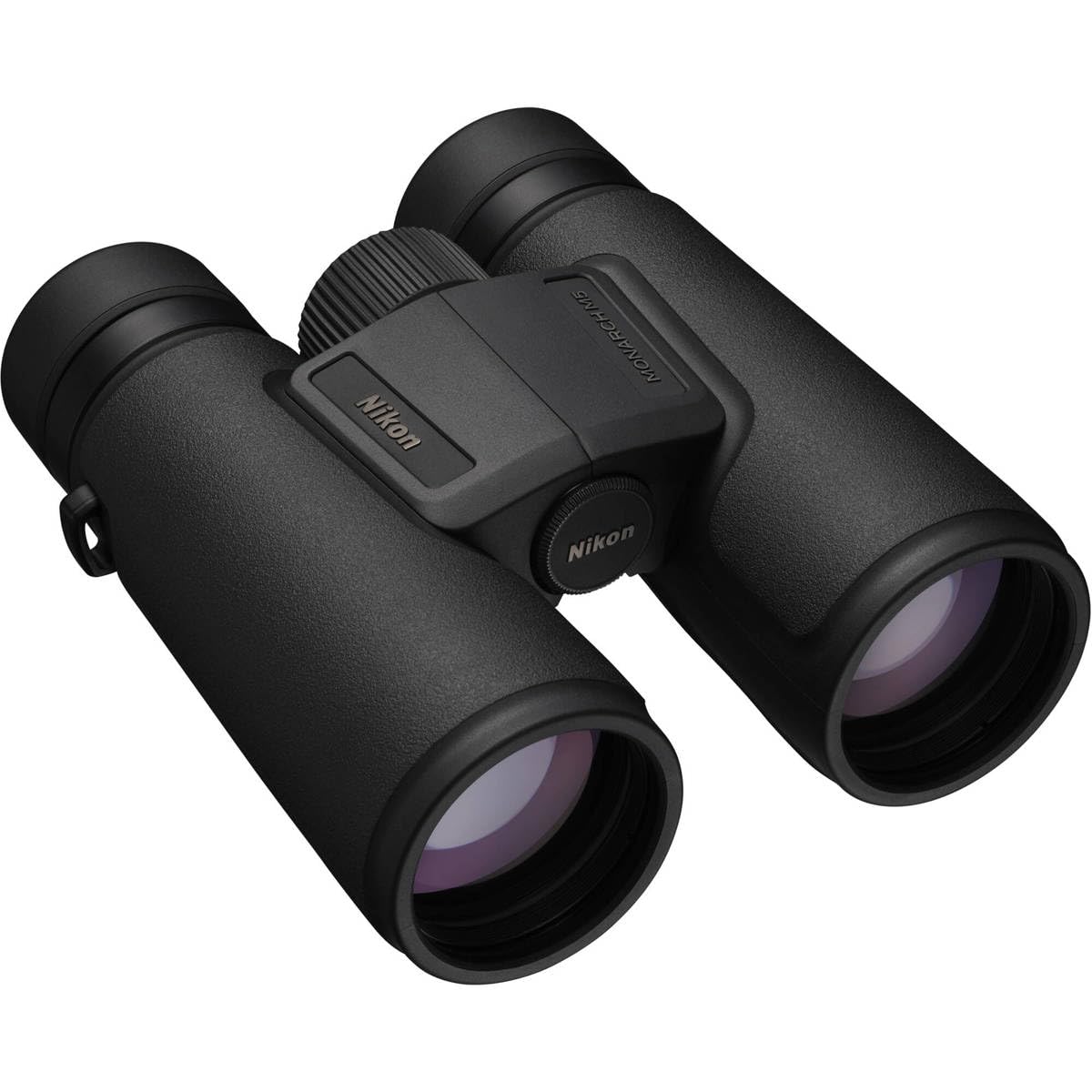
The Nikon Monarch M5 combines ED glass with dielectric high-reflective prism coatings to produce bright, true-color images even in shaded forest or dusk light. The 5.3mm exit pupil matches your eye’s maximum dilation, so you don’t sacrifice brightness when scanning at dawn.
With a close-focus capability of 8.2 feet, you can examine a butterfly on a flower or a warbler in a low branch without backing up. The large center focus knob is smooth and precise, and the 19.5mm of eye relief is generous for glasses users.
This model’s field of view (335 feet at 1,000 yards) is narrower than some competitors, but the edge-to-edge sharpness is exceptional. The rubber-armored body seals against water and fog with nitrogen purging, making it a reliable daily driver for birders and hikers.
Why it’s great
- ED glass with dielectric coatings for vivid low-light performance
- Excellent 19.5mm eye relief
- Close focus at 8.2 feet for detailed nature study
Good to know
- Field of view is narrower than some 8×42 rivals
- Heavier than compact options at over 24 ounces
3. Vortex Diamondback HD 8×42

The Vortex Diamondback HD uses select glass elements in an HD optical system to cut chromatic aberration while delivering crisp resolution and color accuracy. The 393-foot field of view at 1,000 yards is generous for tracking in open terrain.
Fully multi-coated lenses and dielectric prism coatings boost light transmission, while Armortek exterior coatings protect lenses from scratches and oil. The rubber armor provides a secure, non-slip grip, and the adjustable eyecups twist up for glasses wearers.
The real differentiator is Vortex’s VIP unconditional lifetime warranty — a fully transferable promise to repair or replace if damaged. The included GlassPak harness distributes weight across your shoulders, making long glassing sessions comfortable.
Why it’s great
- VIP lifetime warranty covers any damage
- Argon purging and O-ring seals for true fogproof performance
- Wide 393-foot field of view
Good to know
- Slightly heavier than other 8×42 options in the same class
- Eyecup mechanism can feel stiff initially
4. Celestron Nature DX ED 8×42

The Celestron Nature DX ED brings extra-low dispersion glass to a price point where ED optics are usually reserved for more expensive models. Chromatic aberration — that purple-green fringing at high-contrast edges — is dramatically reduced, giving you razor-sharp views.
The 42mm objectives couple with phase-coated BaK-4 prisms to maximize light transmission, which is especially noticeable in low-light conditions like dawn or dusk birding. The rubber-armored polycarbonate housing is durable and waterproof with nitrogen purging to prevent fogging.
At 17.8mm of eye relief, it’s comfortable for extended use, and the center focus knob operates smoothly. It also includes tripod adapter threads for stable viewing sessions. For the price, the optical clarity punches well above its weight.
Why it’s great
- ED glass at a budget-friendly entry point
- Phase-coated BaK-4 prisms for bright, sharp images
- Lightweight and tripod-adaptable
Good to know
- Focus wheel is slower than premium competitors
- Shallow depth of field relative to more expensive bins
5. Steiner Military-Marine 8×30

The Steiner Military-Marine uses Sports-Auto-Focus technology that locks each eyepiece to your vision and keeps everything sharp from 20 yards to infinity. You never chase focus on moving targets — a real advantage when tracking game or scanning open water.
The floating prism system absorbs severe shock, so drops won’t knock optics out of alignment. The Makrolon polycarbonate housing and NBR Long Life rubber armoring resist oil and petroleum, making this a favorite for rugged environments. At 17.1 ounces, it’s relatively light for its durability.
The 8×30 configuration offers a slightly smaller objective lens than the 42mm standard, which trades some low-light performance for a more compact carry. The field of view is 362 feet, and the Steiner Heritage Warranty is transferable for life.
Why it’s great
- Sports-Auto-Focus eliminates constant refocusing
- Floating prism system withstands hard impacts
- Chemical-resistant rubber armoring
Good to know
- 30mm objectives limit low-light brightness vs 42mm
- Rear lens caps can be less secure out of the box
6. Nocs Provisions Field Issue 8×32

The Nocs Provisions Field Issue is a mid-sized 8×32 that weighs only 16.7 ounces, making it an ideal travel companion for hiking, backpacking, and international trips. The Swiss-designed BaK-4 prism and fully multi-coated optics produce a bright, wide 387-foot field of view.
The oversized focus wheel allows precise adjustments from 9.3 feet to infinity, and the multi-stop twist-up eyecups accommodate both eyeglass wearers and bare eyes. The IPX7 rating means it can be submerged in three feet of water for 30 minutes without failure.
Its rugged wave-grip design ensures a secure hold even in wet conditions, and the “No-Matter-What” lifetime warranty backs your purchase. The only trade-off is a slightly less premium case and strap compared to higher-end models, but the optics are the priority.
Why it’s great
- IPX7 waterproof rating for serious weather protection
- Lightweight at 16.7 ounces for all-day carry
- Ergonomic wave-grip design for wet hands
Good to know
- Accessories (case, strap) feel lower quality than optics
- 32mm objectives gather less light than 42mm models
7. Nikon Travelite EX 8×25

The Nikon Travelite EX is the pocket-friendly entry point at 8×25, designed for travelers who prioritize weight and packability. The multilayer-coated optics and aspherical eyepiece lenses deliver sharp, true-color images with minimal distortion despite the small objective size.
It’s nitrogen-purged and O-ring sealed for waterproof performance up to 2 meters for 5 minutes and fully fogproof. The turn-and-slide eyecups and click-type diopter adjustment make it easy to customize, even for eyeglass wearers. The field of view is 47.5 degrees.
This model shines in daylight conditions — the 25mm objectives simply can’t gather enough light for serious low-light birding. But for a compact travel binocular that fits in a jacket pocket and delivers clear, steady images, it’s a reliable choice.
Why it’s great
- Extremely compact and lightweight for easy packing
- Waterproof and fogproof for all-weather travel
- Sharp, true-color images for daylight use
Good to know
- 25mm objective limits low-light performance
- Plastic enclosure feels less premium than metal builds
FAQ
Why choose 8x magnification over 10x for birding?
What does fully multi coated mean on binoculars?
Is ED glass worth the extra investment?
Final Thoughts: The Verdict
For most users, the best 8x binoculars winner is the Nikon Monarch M5 8×42 because it combines ED glass, dielectric coatings, and comfortable ergonomics at a mid-range price point that doesn’t skimp on optical quality. If you want a wider field of view and a lifetime warranty, grab the Vortex Diamondback HD 8×42. And for premium all-weather clarity with Zeiss coatings, nothing beats the ZEISS Terra ED 8×42.