
That sinking feeling when your solar pathway lights flicker out by 10 PM or never fully recover after a cloudy week—the culprit is almost always a tired or mismatched NiMH cell. Alkaline batteries don’t belong here, and even rechargeable cells vary wildly in how they handle the daily trickle-charge cycle a solar fixture demands.
I’m Rikta — the co-founder and writer behind FitlyFast. I’ve spent years analyzing battery chemistry and real-world discharge data for outdoor lighting systems, so I know exactly which specs separate a cell that lasts three seasons from one that dies before the first frost.
Whether you’re restoring a set of garden path lights or wiring a string of decorative lanterns, choosing the right aa batteries for solar lights comes down to understanding capacity, cycle life, and low-self-discharge chemistry — not just grabbing the cheapest pack on the shelf.
How To Choose The Best AA Batteries For Solar Lights
Solar lights charge their internal batteries during the day using a small solar panel, then drain that stored energy to power LEDs at night. The battery must tolerate daily micro-charging, occasional overcharge on long sunny days, and deep discharge during overcast weeks. Here are the key factors that determine whether a cell thrives or fails in this environment.
Match the Capacity (mAh) to Your Light’s Solar Panel
A 2000mAh NiMH cell sounds powerful, but if your solar light’s tiny panel can only replenish 600mAh on a good day, the battery will never reach full charge. This leads to premature failure from chronic undercharging. For small pathway lights and string lights, a 700mAh to 1000mAh cell is ideal. For larger lanterns or security lights with bigger solar panels, a 1500mAh to 2000mAh cell works better.
Prioritize Low Self-Discharge (LSD) Chemistry
Standard NiMH cells lose charge even when sitting idle, which is a problem for seasonal lights that get stored over winter. LSD NiMH cells (often labeled “pre-charged” or “ready to use”) retain 70–80% of their capacity after one to three years of storage. This means your lights will fire up faster each spring without needing a full recharge cycle first.
Cycle Life Determines Long-Term Value
Each charge/discharge cycle gradually degrades a battery’s internal chemistry. Budget NiMH cells might last 500 cycles, while premium cells like Eneloop are rated for 2100 cycles. Since a solar light cycles once per day, 500 cycles equals roughly 1.4 years, whereas 2100 cycles delivers over 5.7 years of daily use. The cycle rating directly translates to how frequently you’ll repurchase batteries.
Quick Comparison
On smaller screens, swipe sideways to see the full table.
| Model | Category | Best For | Key Spec | Amazon |
|---|---|---|---|---|
| Eneloop Panasonic Pro | Premium | Highest cycle life & low self-discharge | 2100 cycles, 2000mAh, 70% retention after 10 years | Amazon |
| Amazon Basics 16-Pack | Mid-Range | High capacity for larger solar lights | 2000mAh, 1000 cycles, 80% capacity after 2 years | Amazon |
| Tenergy Solla | Mid-Range | Anti-leak design for outdoor durability | 1000mAh, 2000 cycles, UL Certified | Amazon |
| Kruta Rechargeable | Mid-Range | High cycle count at mid capacity | 1000mAh, 1200 cycles, pre-charged 40% | Amazon |
| GENYESTAR 1500mAh | Value | Extended runtime for higher-drain lights | 1500mAh, 1000 cycles, operates -4°F to 140°F | Amazon |
| Hronn 700mAh | Budget | Low power path & string lights | 700mAh, 500 cycles, 80% retention after 3 years | Amazon |
| Howardly 900mAh | Budget | Simple replacement for old solar cells | 900mAh, 900 cycles, pre-charged 30-50% | Amazon |
In‑Depth Reviews
1. Eneloop Panasonic BK-3MCCA8BA

The Eneloop is the benchmark that all other NiMH rechargeables are measured against. With a rated capacity of 2000mAh (typical 2100mAh) and an extraordinary 2100-cycle lifespan, these cells are built for the long haul. Independent testing confirms they consistently deliver 95-100% of rated capacity with internal resistance around 170 mΩ, meaning minimal energy loss as heat during the trickle-charge from a solar panel.
The low self-discharge chemistry retains 70% of charge after 10 years of storage, so if you stash your solar lights in the shed over winter, the Eneloops will be ready to work without a full recharge come spring. They operate reliably down to -4°F, which is crucial for fixtures that stay in the ground through freezing temperatures. Users report first-gen packs still going strong after four-plus years in daily use.
The 8-pack configuration is tight—you’ll need multiple packs for a larger installation. Physical dimensions are standard, so they fit snugly into most solar light casings without the bulging issues seen in some budget options. For pure reliability and long-term economy, these cells justify their higher upfront cost through drastically reduced replacement frequency.
Why it’s great
- 2100 recharge cycles translate to over 5.7 years of daily use
- Low self-discharge retains charge through long storage periods
- Consistent capacity and discharge curve across all cells
Good to know
- Higher upfront cost per battery compared to value packs
- 8-pack requires purchasing multiples for large solar arrays
2. Amazon Basics 16-Pack Rechargeable AA

The Amazon Basics 2000mAh NiMH cells sit at an excellent intersection of high capacity and affordable price. Independent capacity testing shows these cells deliver 1890-1920 mAh out of the box (around 95% of the 2000mAh rating), and after a few activation cycles they often exceed the rated spec, averaging 2130 mAh. The low self-discharge formulation retains 80% capacity after two years, which is sufficient for the seasonal storage needs of most solar light owners.
The 16-pack is a practical bundle for anyone with a large solar installation. With a 1000-cycle lifespan, each cell will last roughly 2.7 years of daily solar cycling, which is respectable for the price point. Users note the batteries are approximately 1mm thicker than standard alkaline cells—this can cause a tight fit in some fairy light casings, so check the physical clearance of your fixtures before committing.
These cells perform well in medium-drain solar lights like pathway markers and decorative string lights, providing enough capacity to run from dusk until dawn in moderate configurations. They are not the best choice for extremely cold climates—some users report reduced performance below 10°F—but for general seasonal use, they are a reliable workhorse.
Why it’s great
- High 2000mAh capacity at a budget-friendly price per cell
- 16-pack covers large solar installations in one purchase
- Proven low self-discharge performance in independent tests
Good to know
- Cells are slightly thicker than standard, causing fit issues in some fixtures
- Performance drops significantly in sub-freezing temperatures
3. Tenergy Solla Rechargeable NiMH AA

The Tenergy Solla is purpose-engineered for solar lighting in a way few other batteries are. Its “Solar PRO” technology addresses the two biggest killers of solar light batteries: overcharging from excessive summer sun and over-discharging from extended periods of cloud cover. The anti-leak design uses a special formula that resists the internal pressure buildup that often causes standard NiMH cells to bulge or burst in outdoor temperature swings.
At 1000mAh, the capacity is modest—intentionally so, since most small solar panels cannot fully replenish a higher-capacity cell during a single day’s sunlight. The 2000-cycle rating means these cells will survive over 5.4 years of daily use, dramatically outlasting the typical 1-2 year lifespan of generic NiMH cells. The UL certification adds a layer of safety assurance that is rare in the battery space.
Users report these batteries lasting 2-3 years even in demanding applications, and the positive terminal is tall enough to make reliable contact in a wide variety of light fixtures. The 12-pack is a balanced size for most residential installations. These are not the highest-capacity option, but for the specific abuse pattern of solar lights—daily trickle charging, temperature extremes, occasional full discharge—they are arguably the most tuned choice.
Why it’s great
- Anti-leak formulation handles overcharge from long sunny days
- 2000 cycles for over 5 years of daily use
- UL Certified for safety and environmental compliance
Good to know
- 1000mAh capacity may be too low for larger solar fixtures
- Not compatible with LiFePO4-based solar systems
4. Kruta Rechargeable AA Solar Battery
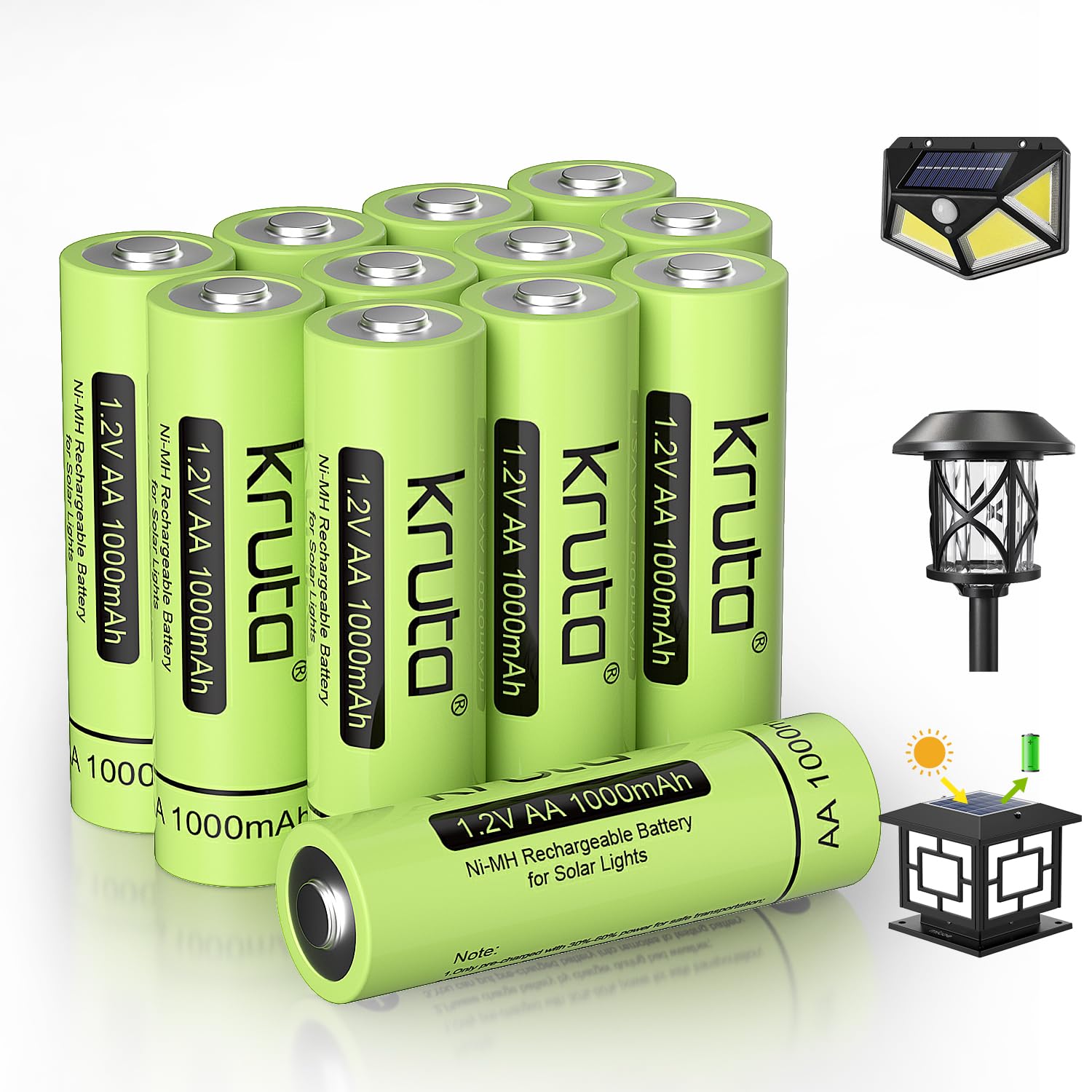
The Kruta rechargeable AA batteries offer 1000mAh capacity with a 1200-cycle lifespan, which is above average for mid-range cells. The batteries are pre-charged to 40% for safe shipping, so a full charge cycle is recommended before first use. Users report that after the initial charge, these cells deliver around 8 hours of runtime in typical solar garden lights, which covers the average overnight period during summer months.
The 1.2V NiMH chemistry is a direct drop-in replacement for the standard 1.5V alkaline cells that many solar lights ship with. The low self-discharge formulation keeps the cells usable for the full solar season, and the 12-pack provides enough cells to cover a typical yard installation. Several reviewers note these cells have improved the brightness of their solar lights compared to the original batteries that came with the fixtures.
One point of note: the advertised capacity is 1000mAh, but some specifications list a 600mAh rating on the technical sheet, so there is some ambiguity about the exact capacity. User experiences suggest the cells perform consistently at the lower end of the 1000mAh range, which is still sufficient for small pathway lights and string lights. They are a solid mid-range pick for users who want a simple, reliable replacement.
Why it’s great
- 1200 cycles deliver over 3 years of daily use
- Compatible with both solar charging and standard NiMH chargers
- 12-pack covers a full garden installation in one box
Good to know
- Actual capacity may be closer to 600mAh than advertised 1000mAh
- Fully pre-charged cells require a full charge cycle before use
5. GENYESTAR AA Rechargeable NIMH 1500mAh

The GENYESTAR 1500mAh NiMH cells are a strong choice for solar lights with larger panels that can replenish the extra capacity. The higher mAh rating translates to longer runtime after sunset, which is beneficial for security lights or motion-sensor fixtures that need to stay active throughout the night. The batteries are rated to operate in temperatures from -4°F to 140°F, making them suitable for harsh outdoor environments including snowy winters and blistering summers.
These cells support 1000 charge/discharge cycles, which is roughly 2.7 years of daily solar cycling. Independent testing has shown the actual capacity to be closer to 1250mAh rather than the advertised 1500mAh, so buyers should set expectations accordingly. Still, even at 1250mAh, they offer 25% more runtime than a standard 1000mAh cell, which is meaningful for applications where every extra hour of light counts.
The 8-pack format is economical but may require multiple purchases for larger installations. Users report these batteries restore dim or non-working solar lights to like-new performance, and the low self-discharge formulation means they retain 80% capacity after 3 years of storage. For the price point, they offer a good balance of capacity and cycle life, provided the fixture’s solar panel can actually charge them fully each day.
Why it’s great
- 1500mAh rated capacity for extended nighttime runtime
- Wide temperature tolerance from -4°F to 140°F
- Low self-discharge retains 80% capacity after 3 years
Good to know
- Actual measured capacity is closer to 1250mAh
- 8-pack may not cover a full yard installation
6. Hronn 700mAh NiMH Rechargeable AA
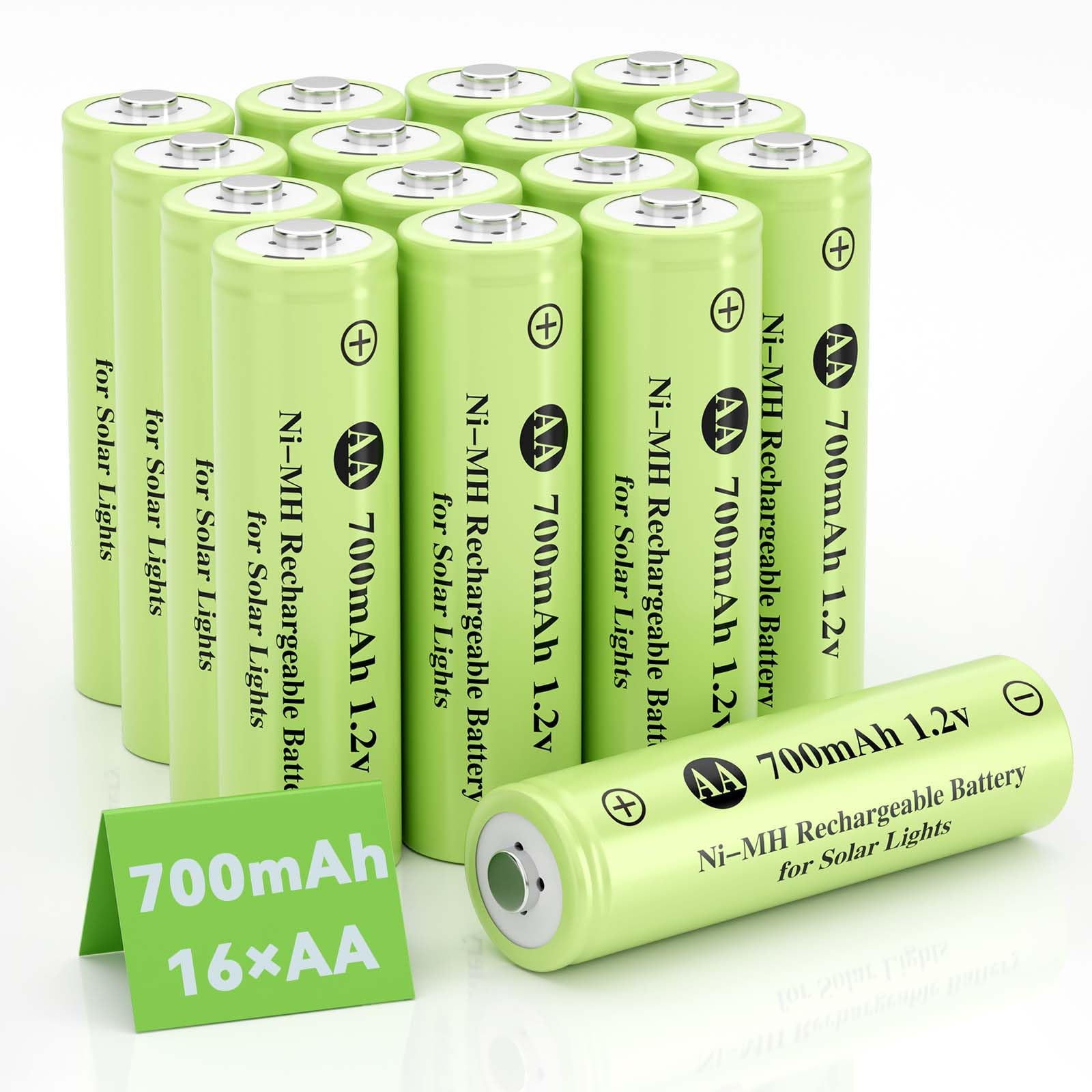
The Hronn 700mAh NiMH cells are the low-capacity specialist in this lineup, purpose-built for small solar lights with tiny solar panels that cannot efficiently charge larger batteries. The 700mAh rating is deliberately conservative—it matches the charging output of typical pathway and string light panels, ensuring the battery reaches a full charge each day rather than cycling in a half-charged state that accelerates degradation.
The 16-pack provides excellent value for users with many small solar fixtures, such as stepping stone lights, tiki torches, or fairy light strings. With 500 recharge cycles, each cell will last about 1.4 years of daily use, which is reasonable for this price tier. The low self-discharge formulation retains 80% capacity after 3 years of storage, making them suitable for seasonal use where lights are stored in the off-season.
User feedback confirms these batteries work well in low-power applications, with lights staying on from sunset until 2:30 AM in one verified report. The 700mAh capacity is roughly one-third of a premium 2000mAh cell, so they are not suitable for larger fixtures or lights that need all-night operation. For the specific use case of budget-friendly, low-consumption solar lights, they are a perfectly matched solution.
Why it’s great
- 16-pack provides extensive coverage for small solar fixtures
- 700mAh capacity matches the daily charge from small solar panels
- Retains 80% capacity after 3 years of storage
Good to know
- 700mAh capacity is too low for larger or security lights
- Only 500 cycles compared to premium options with 2000+
7. Howardly 900mAh Rechargeable AA

The Howardly 900mAh NiMH cells are an entry-level option that gets the job done for basic solar light replacement. The 900mAh capacity is in the sweet spot for many medium-sized solar fixtures, providing enough runtime to cover most of the evening without exceeding what a typical solar panel can replenish. With 900 recharge cycles, these cells will last roughly 2.5 years of daily use, which is decent for the price tier.
The 12-pack format is practical for users who need to replace batteries in multiple fixtures at once. The batteries support both solar charging and standard NiMH charger top-ups, so you can boost them during extended cloudy periods. Users in the Northeast report these cells hold a charge from 9:30 PM to 6 AM in winter conditions, which is a solid performance for a 900mAh cell.
The main trade-off is the lack of specialized anti-leak or temperature-hardening features found in more expensive options. They are pre-charged to 30-50% for shipping safety and require a full charge before first use. One user noted that at the same price point, the 900mAh pack represents less value per cell compared to higher-capacity options. For simple, no-fuss replacement, they are a functional choice.
Why it’s great
- 900mAh provides balanced runtime for medium solar fixtures
- 12-pack covers multiple lights in a single purchase
- 900 cycles offer 2.5 years of daily use
Good to know
- Lacks specialized weather-hardening for extreme climates
- Value per cell is lower than higher-capacity options at similar price
FAQ
Can I use regular alkaline AA batteries in my solar lights?
Should I choose 700mAh or 2000mAh NiMH batteries for my solar lights?
Why do my solar light batteries only last one year?
Final Thoughts: The Verdict
For most users, the aa batteries for solar lights winner is the Eneloop Panasonic BK-3MCCA8BA because its 2100-cycle lifespan and exceptional low self-discharge make it the most reliable option over the long term. If you want the best balance of capacity and value per cell, grab the Amazon Basics 16-Pack for its 2000mAh rating and affordable price. And for solar-specific features like anti-leak protection and optimized charging for the daily solar cycle, nothing beats the Tenergy Solla.