
Our readers keep the lights on and the weekend projects moving. As an Amazon Associate, I earn from qualifying purchases.
Solar lights depend on one critical component: the battery. When the sun goes down, your 1.2V NiMH cell determines whether your pathway stays lit or your garden goes dark. A standard alkaline battery in a solar fixture will fail fast, unable to handle the daily charge-and-drain cycle that solar exposure demands. You need a battery engineered for deep cycling, low self-discharge, and reliable performance across seasons.
I’m Rikta — the co-founder and writer behind FitlyFast. I’ve spent countless hours analyzing NiMH chemistry, discharge curves, and cycle life data to build this guide around the specs that keep solar lights burning bright from dusk to dawn.
If you’re searching for the most reliable aa rechargeable batteries for solar lights, this guide breaks down capacity, cycle counts, and self-discharge rates so you can make a confident purchase.
How To Choose The Best AA Rechargeable Batteries For Solar Lights
Selecting the right cell for your solar fixtures isn’t about grabbing the highest mAh number. Solar lights operate on a unique cycle: a slow trickle charge during daylight, followed by a steady drain through the night. The battery must tolerate partial charging, repeated deep cycling, and temperature swings. Here are the critical specs to weigh.
Capacity (mAh) vs. Solar Light Draw
A solar light’s LED typically draws between 50 and 150 mA per hour. A battery rated at 1000 mAh will theoretically run a 100 mA light for about 10 hours. But real-world solar charging is rarely perfect. Cloudy days, shaded panels, and winter light all reduce charge. Higher capacity cells (2000 mAh+) help buffer against these inconsistent charging conditions, keeping your lights on longer after short winter days.
Low Self-Discharge (LSD) Technology
Not all NiMH batteries hold their charge equally when sitting idle. Standard NiMH cells can lose up to 1% of their charge per day. LSD NiMH batteries, however, retain 70–85% of their capacity after a full year on the shelf. For solar lights that get packed away during winter months, LSD tech means you can pull them out next spring with most of the charge intact, avoiding a frustrating full recharge cycle.
Cycle Life and Charging Habits
Every rechargeable battery has a finite number of charge-discharge cycles before its capacity degrades. Solar lights in sunny climates can cycle every single day, meaning a battery rated for 500 cycles will last about 1.4 years in daily use. A battery rated for 1200 cycles stretches that to over three years. Consider your local sunshine hours: high-cycle cells are worth the extra investment for year-round, full-sun installations.
Quick Comparison
On smaller screens, swipe sideways to see the full table.
| Model | Category | Best For | Key Spec | Amazon |
|---|---|---|---|---|
| Panasonic eneloop pro | Premium | High-drain solar & extreme temps | 2500 mAh min / 85% charge after 1 year | Amazon |
| Amazon Basics 2400 mAh | Mid-Range | High-capacity continuous drain | 2400 mAh / 400 cycles | Amazon |
| Granicell 2800 mAh | Premium Value | Long seasonal storage (3 years) | 2800 mAh / 1300 cycles / 80% after 3 years | Amazon |
| WENJOOP 2800 mAh | Mid-Range | High-cycle daily solar use | 2800 mAh / 1200 cycles | Amazon |
| Amazon Basics 2000 mAh | Value | Everyday household & solar | 2000 mAh / 1000 cycles / 80% after 2 years | Amazon |
| Kruta 1000 mAh | Entry-Level | Low-drain solar & budget multi-pack | 1000 mAh / 1200 cycles | Amazon |
| Howardly 900 mAh | Entry-Level | Basic solar path lights | 900 mAh / 12-pack value | Amazon |
In‑Depth Reviews
1. Panasonic eneloop pro AA 4-Pack

The eneloop pro is the gold standard for any device that demands sustained high power. At a minimum of 2500 mAh per cell, this battery delivers roughly 20% more runtime than the standard eneloop, making it ideal for solar lights that need to stay bright through long winter nights. The proprietary LSD technology retains up to 85% of its charge after a full year of storage, so lights pulled from the shed after months of darkness will still fire up reliably.
Panasonic builds these cells in Japan with tight manufacturing tolerances. Users report no leakage, consistent discharge curves, and reliable performance in extreme temperatures down to -4°F, a standout spec for solar lights in freezing climates. Each cell is pre-charged using solar power at the factory, aligning perfectly with the eco-friendly goal of your solar setup. The 500-cycle rating is lower than some competitors, but the capacity retention and build quality justify the premium for high-drain applications.
For solar lights with larger gardens or path lights that run long hours, the eneloop pro is hard to beat. The trade-off is simple: you get top-tier capacity and reliability but pay more and replace packs more often than high-cycle alternatives. Still, for critical lights where failure is not an option, these cells earn their spot.
Why it’s great
- Industry-leading capacity retention after 1 year of storage
- Proven reliability in extreme cold down to -4°F
- Japanese manufacturing ensures consistent performance cell-to-cell
Good to know
- Only 500 recharge cycles compared to 1200+ from competitors
- 4-pack limits quantity for multi-light installations
- Premium pricing per cell
2. Amazon Basics 2400 mAh 12-Pack

Amazon Basics takes its high-capacity lineup seriously with this 2400 mAh AA. Designed for continuous-drain devices, these cells deliver a measured average of around 2555 mAh in third-party testing, slightly exceeding the stated spec. For solar lights that run 8–10 hours nightly, this capacity provides a solid buffer during periods of weak solar charging. The low self-discharge technology retains 50% capacity after one year, which is adequate for seasonal storage but not as strong as premium LSD offerings.
These batteries are pre-charged and ready to go. The 12-pack size is a practical sweet spot for homeowners with a dozen or more solar path lights. Users note that the cells are slightly thicker than standard alkaline batteries, which can cause fit issues in about 25% of tight battery compartments — a known quirk with some NiMH cells that meet IEC standards. The 400-cycle rating is lower than average, so in daily solar cycling, expect replacement after roughly 13 months.
If you are looking for a high-capacity workhorse pack at a reasonable per-cell cost, this Amazon Basics option is a strong mid-range contender. Just be mindful of the shorter cycle life and potential fitment issues with tight compartments. For solar fixtures with generous battery slots, these cells provide excellent runtime.
Why it’s great
- Real-world capacity often exceeds 2500 mAh in testing
- 12-pack offers excellent value for multi-light setups
- Low self-discharge suitable for seasonal storage
Good to know
- 400 cycles is less durable than high-cycle alternatives
- Slightly larger size may not fit tight compartments
- Shorter runtime per charge compared to premium brands
3. Granicell 2800 mAh 16-Pack
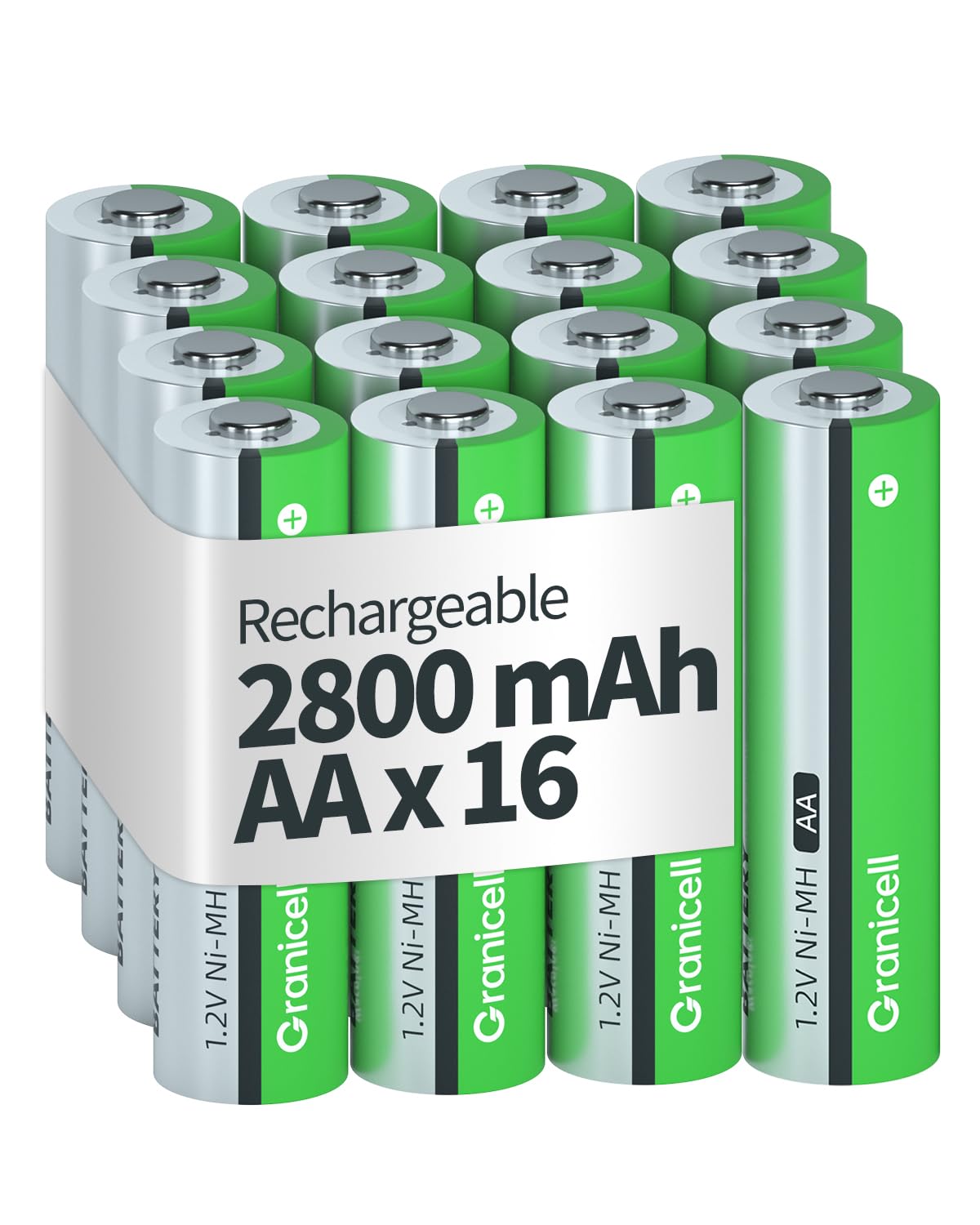
Granicell targets the intersection of high capacity, ultra-long cycle life, and long-term storage. Each cell delivers 2800 mAh, tying for the highest capacity in this roundup, and withstands up to 1300 recharge cycles. For solar lights that cycle daily in a sunny climate, that translates to over three and a half years of service before noticeable degradation — an exceptional lifespan for the price. The LSD technology is equally impressive, retaining 80% of its charge after three years of non-use.
Safety is another focus: these cells pass six professional safety tests, using advanced electrolytes to improve stability. They arrive pre-charged using solar energy at the factory, reinforcing the eco-friendly theme. The 16-pack format gives you enough cells to refresh two dozen lights or keep spares ready for rotation. Initial user reports are positive, citing long life and strong power delivery comparable to name brands at a lower cost.
The main caveat is that Granicell is a less established brand than Panasonic or Amazon Basics. Long-term reliability data is still accumulating in the user community. However, if the specs hold true, this pack offers the best balance of capacity, cycle life, and per-cell value for dedicated solar installations.
Why it’s great
- 1300 cycle rating is outstanding for daily solar use
- 80% capacity retention after 3 years of storage
- 16-pack provides excellent per-cell value
Good to know
- Less proven brand with limited long-term user data
- Some units may be confused with lithium types in packaging
- Pre-charge level may require topping off before first use
4. WENJOOP 2800 mAh 12-Pack
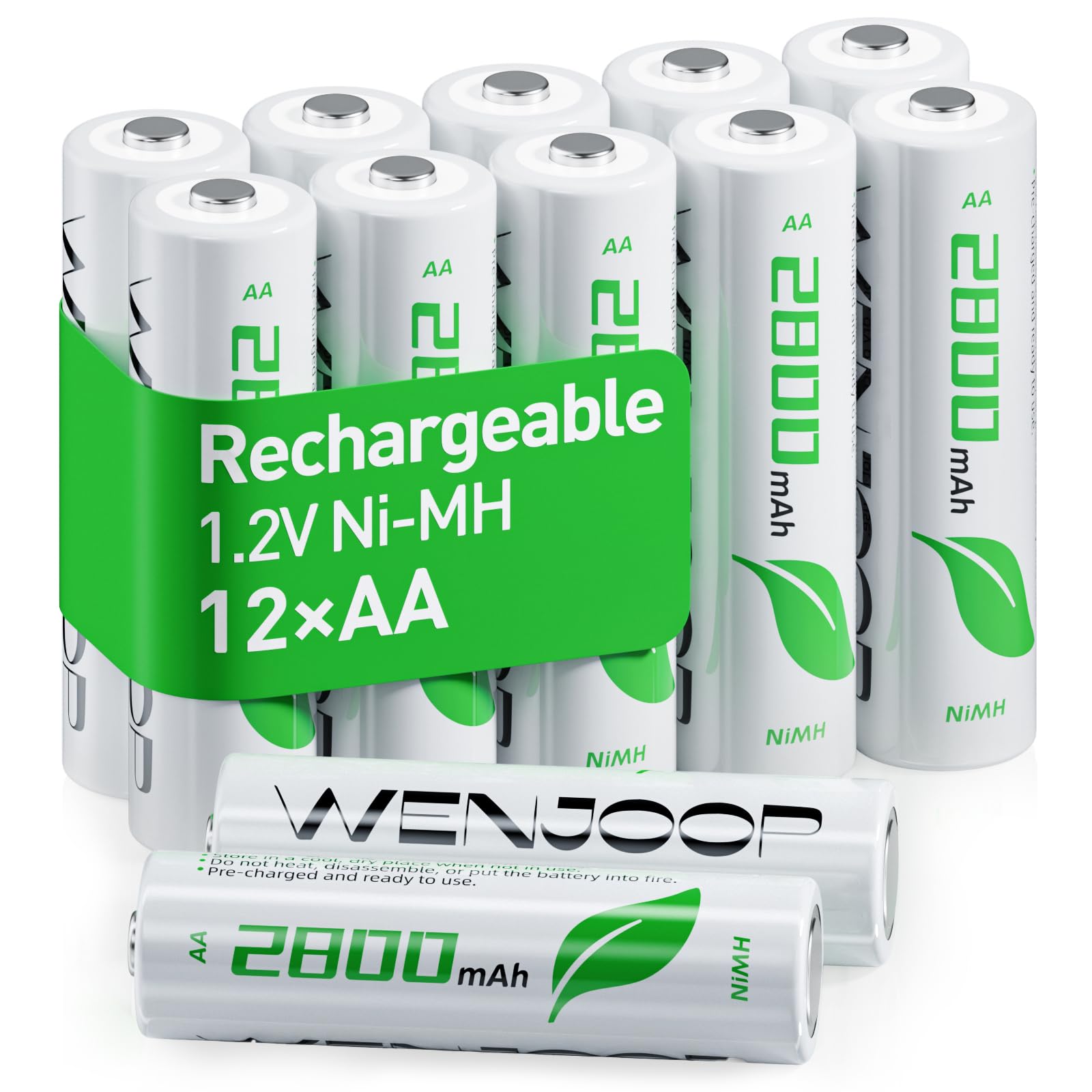
WENJOOP brings a 2800 mAh capacity paired with a 1200-cycle rating, putting it in the same high-value territory as Granicell. The leak-resistant design and no-memory-effect chemistry make it a dependable choice for continuous solar cycling. Users report that these cells survive an entire solar season without capacity degradation, even in harsh sun-exposed environments. In hot climates, the tough outer casing helps prevent the batteries from fusing together, a common issue with some NiMH cells stored in direct heat.
The 12-pack is conveniently sized for a medium solar setup. The cells come pre-charged (partially for shipping safety) and work with most NiMH-specific chargers. Customers note that they recharge fully in about 1.5 hours with a quality charger. In timer-controlled flameless candles, these cells lasted six weeks of 8-hour daily cycles before needing a recharge — a solid real-world validation of the high-capacity spec.
The warranty (30-day money-back with 2-year coverage) adds confidence for a brand that is still building its reputation. For solar lights that demand high capacity and long cycle life without the premium price of the eneloop pro, the WENJOOP 2800 is a smart mid-range play.
Why it’s great
- High 2800 mAh capacity with 1200 recharge cycles
- Leak-resistant design tested in hot outdoor conditions
- 2-year warranty adds buyer protection
Good to know
- May require paper separators to prevent sticking in heat
- Some units arrived with partial charge only
- Brand is less established for long-term reliability
5. Amazon Basics 2000 mAh 16-Pack

The standard Amazon Basics 2000 mAh AA is a workhorse for general use. While not as capacity-rich as the 2400 mAh sibling, this cell compensates with a higher cycle life of 1000 recharges and superior LSD retention: 80% capacity after two years. For solar lights that don’t demand massive overnight runtime, this balance of capacity and longevity makes it an excellent value. The 16-pack provides enough cells for multiple fixtures and household devices.
Third-party testing confirms that these cells often exceed their rated capacity, averaging around 2130 mAh after activation cycles. The discharge profile is consistent, which matters for solar lights that use simple voltage regulation — a flat discharge means the LED stays bright longer before dimming. Users note that the cells hold their charge well during storage, though some report that a full pre-charge is recommended before first use for best results.
The main weakness for solar-specific use is the lower 2000 mAh capacity. On very short winter days with minimal sun, these cells may not hold enough juice to run lights through a full night. But for moderate climates and well-positioned solar panels, this pack delivers dependable performance at a per-cell cost that is hard to beat.
Why it’s great
- 1000 cycle rating with proven performance
- 80% capacity retention after 2 years is excellent for storage
- 16-pack at a very competitive cost per cell
Good to know
- 2000 mAh may be insufficient for long winter nights
- Some cells may arrive with lower charge levels
- Not ideal for high-drain solar fixtures with large LEDs
6. Kruta 1000 mAh 12-Pack
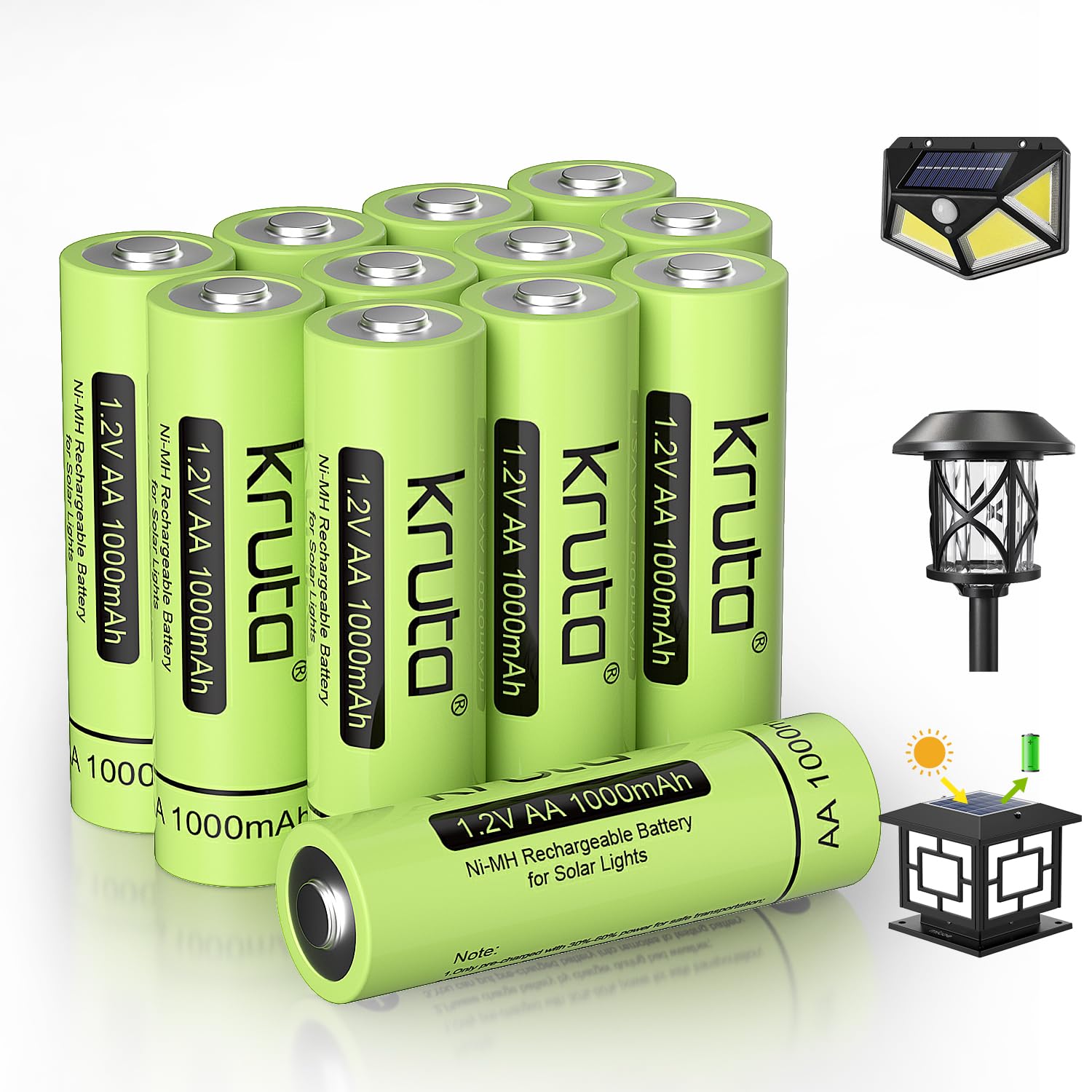
Kruta offers a budget-friendly entry point for solar batteries. At 1000 mAh, these cells are best suited for low-drain solar lights, such as small path lights or accent markers that only need a few hours of glow. The 1200-cycle rating is competitive with premium batteries, so even at this low capacity, the long-term value improves. Users report that these cells revived non-functioning solar devices, often outperforming the original batteries that came with the lights.
The 12-pack provides plenty of units for refreshing an entire set of lights. Kruta pre-charges these cells to 40% for shipping safety, so a full charge before first use is essential. The NiMH chemistry handles the daily charge-discharge cycle well, and users note that the batteries hold a charge through the night in their solar fixtures. One reviewer even mentioned that after replacement, their solar lights were brighter than with the original batteries.
The trade-off is clear: lower capacity means shorter runtime per cycle. On overcast days or during winter, these cells may run out of power before dawn. They are best deployed in lights that don’t need to shine all night or as a cost-effective way to bring old, non-functioning lights back to life. For the price, the reliability per cycle is solid.
Why it’s great
- 1200 cycles provide excellent long-term durability
- 12-pack is ideal for refreshing multiple lights at once
- Users report brighter performance than stock batteries
Good to know
- 1000 mAh may not run lights through full winter nights
- Pre-charge is only 40% — needs full charge before use
- Not suitable for high-drain solar fixtures
7. Howardly 900 mAh 12-Pack

Howardly rounds out the list with a simple, no-frills 900 mAh NiMH battery. This is a pure entry-level option for basic solar path lights that don’t demand high performance. The 12-pack provides a generous quantity to replace old or dead cells in a full set of garden lights. Users report that these batteries work well in older solar pathway lights, charging and holding charge reliably through the night, with lights remaining bright from 9:30 PM to 6 AM before dawn.
The 900-cycle rating is decent for the price point, though not as robust as the 1200+ cycle competitors. The cells are pre-charged to 30–50% for shipping. They support dual charging methods: directly from the solar panel in the light, or via a dedicated NiMH charger for cloudy periods. The brand is less known, but the value proposition is clear: a large number of cells at a low per-unit cost.
The main limitation is the low capacity. In larger solar lights with multiple LEDs or in locations with limited sunlight, these cells may struggle to maintain illumination through a full night. For budget-conscious buyers with basic solar lights that only need a few hours of evening light, the Howardly 900 mAh pack is a functional, cost-effective solution.
Why it’s great
- Very low cost per battery for budget-focused buyers
- 12-pack covers a full set of basic path lights
- Works reliably in older solar lights
Good to know
- 900 mAh limits overnight runtime in larger lights
- Only 900 cycles — shorter lifespan than higher-cycle options
- Brand is less established for long-term support
FAQ
Can I use regular alkaline AA batteries in solar lights?
Why do my solar lights dim after only a few hours with new batteries?
How many cycles should a good solar light battery have?
Final Thoughts: The Verdict
For most users, the aa rechargeable batteries for solar lights winner is the Panasonic eneloop pro because it delivers industry-leading capacity retention, proven reliability in extreme cold, and consistent high-discharge performance that keeps solar lights burning all night. If you want the best capacity-to-cycle-life value for multi-light setups, grab the Granicell 2800 mAh 16-Pack. And for a budget-friendly refresh of basic path lights, nothing beats the Kruta 1000 mAh 12-Pack.