
Our readers keep the lights on and the weekend projects moving. As an Amazon Associate, I earn from qualifying purchases.
The constant hunt for fresh alkaline AAs stops here. Whether your TV remote dies mid-scene or your kid’s toy train stalls on the living room rug, the answer is a set of quality NiMH cells that pay for themselves after a few charge cycles. The right pack eliminates drawer clutter, landfill waste, and the nagging feeling that you’re throwing money into the trash.
I’m Rikta — the founder and writer behind FitlyFast. I’ve spent years analyzing battery chemistry specs, sorting through capacity claims, and stress-testing self-discharge rates so you don’t have to guess which rechargeables actually deliver on their promises.
This guide breaks down the real-world performance, cycle life, and voltage stability of today’s top contenders to help you find the best aa rechargeable batteries for your remotes, controllers, and high-drain gear.
How To Choose The Best AA Rechargeable Batteries
Not all NiMH cells behave alike. Capacity, self-discharge rate, and internal resistance vary widely across brands, and the wrong pick can leave you swapping cells more often than you’d like. Focus on four factors to match the pack to your devices.
Capacity (mAh) vs. Device Drain
Higher mAh numbers look better on the box, but they don’t always translate to longer runtime in every device. High-drain gadgets like camera flashes and gaming controllers benefit from cells above 2,400 mAh, while low-drain items like wall clocks run fine on standard 2,000 mAh cells. Oversizing can sometimes cause fit issues in tight compartments due to slightly thicker casings.
Low Self-Discharge (LSD) Technology
Standard NiMH cells lose 10-15% of their charge within the first 24 hours. LSD cells, often labeled “pre-charged,” retain 70-85% after one year of storage. If you plan to stash spares for emergencies or rotate between devices, prioritize packs that specify LSD chemistry. The absence of that label is a red flag for long-term usability.
Cycle Life Ratings
Manufacturers quote anywhere from 400 to 2,100 recharge cycles. The higher number applies under ideal conditions — moderate discharge depths, proper charging, and stable temperatures. Real-world cycle life is often 60-80% of the advertised number. Premium cells with thicker electrode plates tend to survive more cycles before capacity drops noticeably.
Physical Fit and Build Quality
NiMH cells are fractionally thicker than alkaline AAs due to IEC standards. Some budget packs run slightly oversize, which can jam in tight battery compartments found in some remotes, string lights, and compact toys. A steel shell with corrosion resistance adds safety against leaks and punctures, especially in devices left unattended for months.
Quick Comparison
On smaller screens, swipe sideways to see the full table.
| Model | Category | Best For | Key Spec | Amazon |
|---|---|---|---|---|
| Panasonic Eneloop 10-Pack | Premium | Ultimate cycle life & storage | 2,100 cycles / 70% charge after 10 years | Amazon |
| NICEBATT 16-Pack | Mid-Range | High-volume household replacement | 2,800 mAh / 1,200 cycles | Amazon |
| WENJOOP 12-Pack | Mid-Range | Solar light & outdoor use | 2,800 mAh / -40°F to 140°F range | Amazon |
| Amazon Basics High-Capacity 8-Pack | Mid-Range | High-drain controllers & toys | 2,400 mAh / 400 cycles | Amazon |
| Amazon Basics 12-Pack | Budget | Low-drain remotes & clocks | 2,000 mAh / 1,000 cycles | Amazon |
| Mupoer 12-Pack | Budget | Eco-friendly daily drivers | 2,800 mAh / 85% retention after 3 years | Amazon |
| Deleepow 8-Pack | Budget | High-capacity at entry-level price | 3,300 mAh / 1,200 cycles | Amazon |
In‑Depth Reviews
1. Panasonic Eneloop 10-Pack (BK-3MCCA10FA)

The Eneloop is the benchmark that other rechargeable AAs are measured against. Rated for 2,100 cycles and pre-charged via solar power at the factory, these cells retain up to 70% of their charge after a decade of storage — a real advantage for emergency kits and seldom-used devices. The typical capacity of 2,100 mAh may look modest next to budget 3,000 mAh claims, but the voltage stability under load is noticeably better, keeping camera flashes recycling quickly and controllers responsive until the very last minute.
Build quality is consistent across every cell in the pack. The steel casing is dimensionally precise, so you won’t encounter the 1 mm oversize issue that plagues cheaper NiMH cells in tight compartments. Multiple reviewers report using the same Eneloop set for five years or longer without noticing meaningful capacity degradation. The leak-resistant construction adds peace of mind for devices stored away for months.
The upfront investment is higher than any other pack on this list, but the total cost of ownership over a decade is lower. If you charge and reuse a set weekly, the per-cycle cost drops to fractions of a cent. Pair them with a smart charger that monitors individual channels to maximize the 2,100-cycle potential.
Why it’s great
- Industry-leading 2,100 recharge cycles
- Retains 70% charge after 10 years of storage
- Consistent voltage output under high-drain loads
- Precise dimensions fit all battery compartments
Good to know
- Premium price per cell compared to budget packs
- 2,100 mAh capacity lower than some budget 2,800-3,300 mAh claims
- Requires a quality NiMH smart charger for best results
2. NICEBATT Rechargeable AA 16-Pack
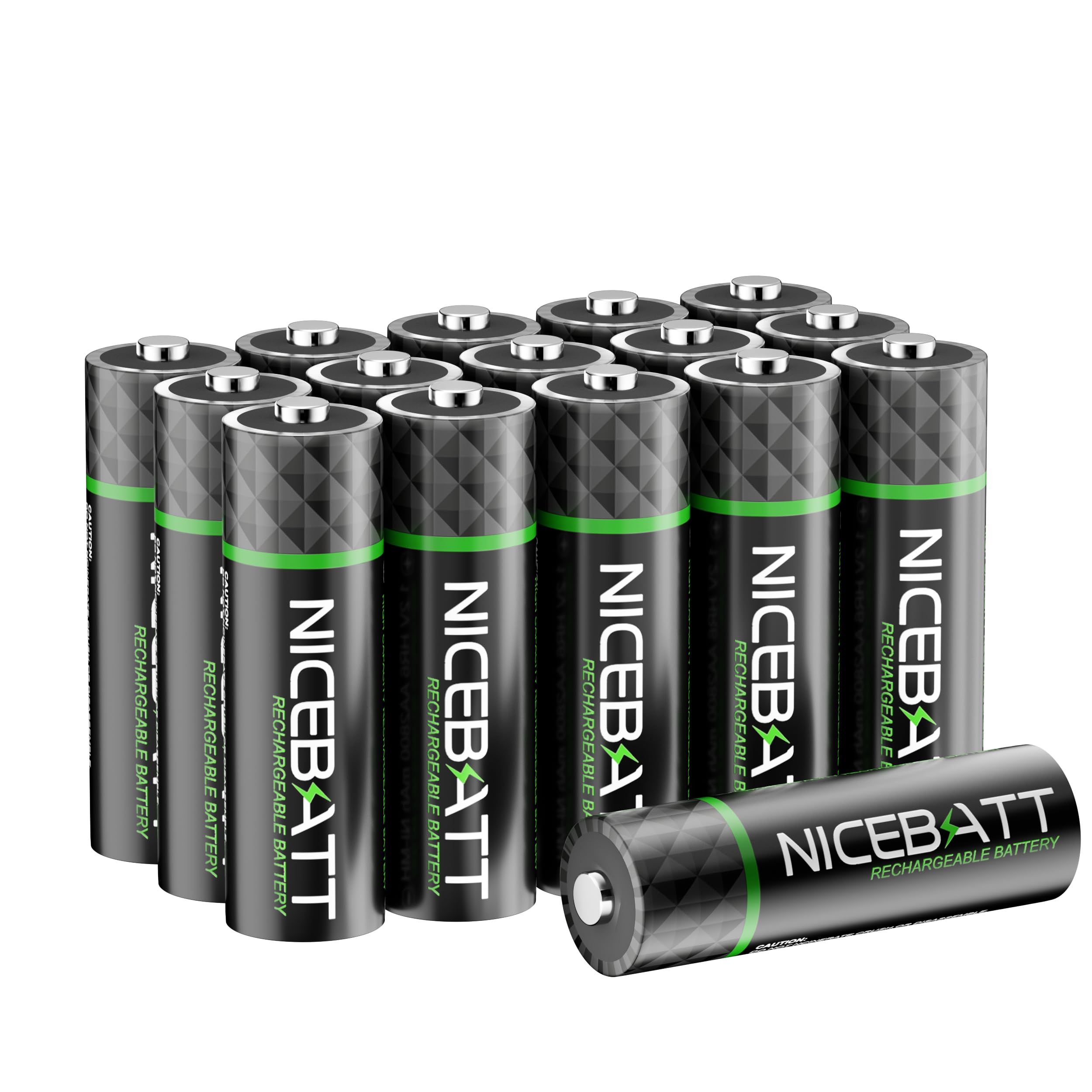
The NICEBATT 16-pack delivers the highest cell count at a mid-range price point, making it the most economical option for households that need to replace every alkaline in the house at once. Each cell is rated for 2,800 mAh and 1,200 cycles, with a claimed 80% charge retention after two years of storage. Independent testing of new cells showed actual capacity between 2,350-2,400 mAh at a 500 mA load, which is solid for the price tier but falls short of the printed number.
Build consistency is generally good, with close voltage matching across the pack. One reviewer noted that charge levels upon arrival varied between 65-80%, so a full initial charge cycle is essential before relying on them. The cells handle moderate-drain devices like TV remotes, wall clocks, and kids’ toys without issue. For high-drain applications like camera flashes or VR controllers, the voltage sag is more noticeable than on premium Eneloop cells.
The 16-count format is ideal for families stocking multiple devices simultaneously. At roughly half the per-cell cost of the Eneloop, the NICEBATT pack makes sense if you prioritize upfront savings over ultimate cycle life. Pair with a smart charger that has independent channels to monitor each cell’s health over time.
Why it’s great
- 16 cells cover an entire household at once
- Low per-cell cost compared to premium brands
- Rated for 1,200 recharge cycles with decent retention
- Steel casing with leak resistance
Good to know
- Actual capacity tested below 2,800 mAh at higher drain rates
- Charge levels vary upon arrival
- Voltage sag more noticeable in high-drain gear
3. WENJOOP Rechargeable AA 12-Pack
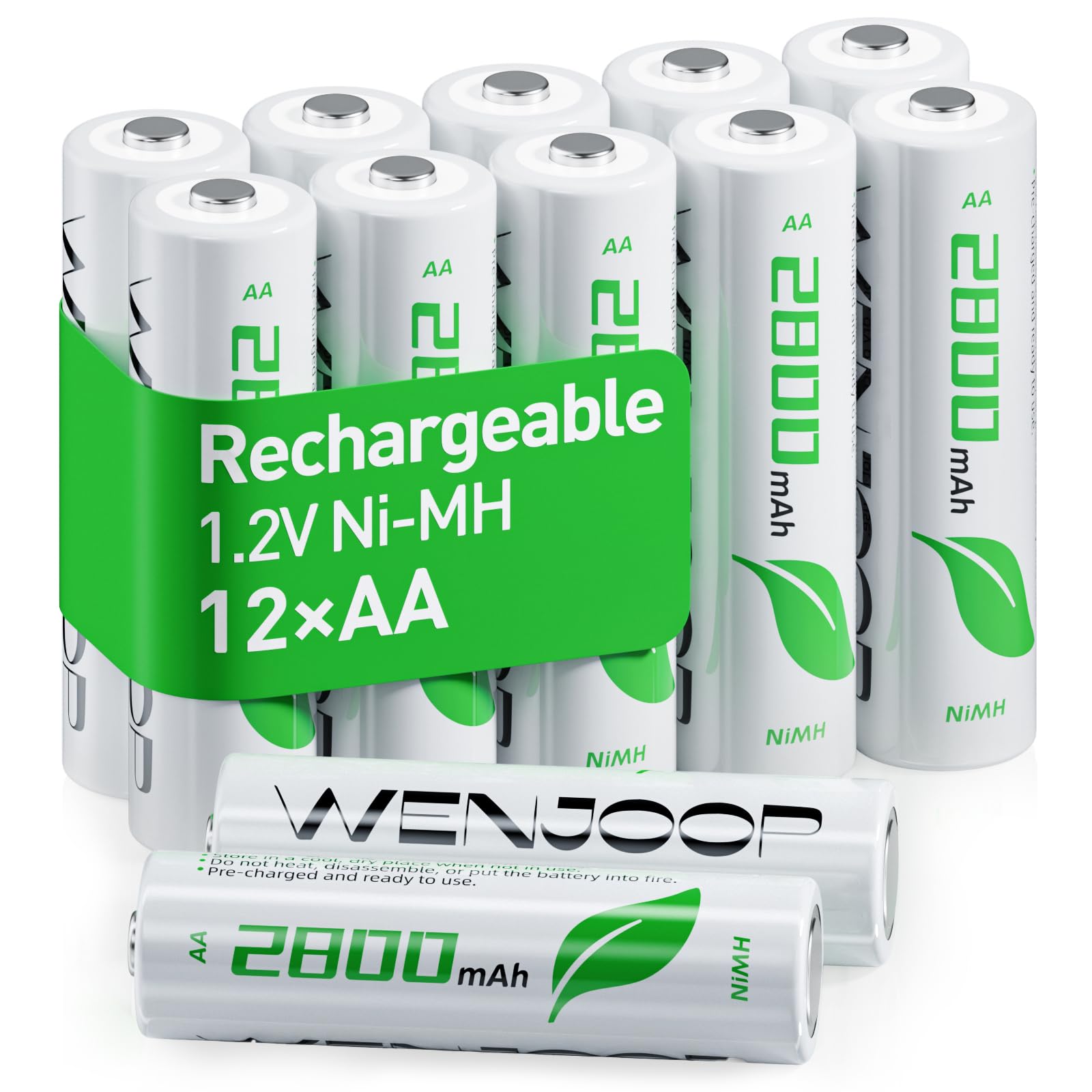
The WENJOOP pack distinguishes itself with an unusually wide operating temperature range of -40°F to 140°F, which makes it a strong candidate for outdoor solar lights, weather sensors, and garage door openers that face seasonal extremes. Each cell carries a 2,800 mAh rating and is advertised to retain 85% of its charge after three years in storage. Users report that these batteries last roughly three summers in outdoor solar lights before capacity drops noticeably.
The cells arrive partially pre-charged and reach full capacity in about 90 minutes with a compatible NiMH charger. Several reviewers noted that the diameter is slightly wider than standard alkaline cells, which can cause a snug fit in some devices but generally does not prevent insertion. A leak-proof design and built-in overcharge protection add to the safety profile for unattended devices.
The 12-pack format works well for households that mix indoor and outdoor devices. For the price tier, the combination of high capacity, wide temperature tolerance, and three-year charge retention is competitive. Just be aware that the 2,800 mAh figure is optimistic; real-world endurance in high-drain indoor devices falls closer to what you’d expect from a good 2,400 mAh cell.
Why it’s great
- Exceptional temperature range for outdoor use
- 85% charge retention after three years claimed
- Leak-proof and overcharge protection built in
- 12-pack covers most household needs
Good to know
- Slightly wider diameter may fit tightly in some compartments
- Capacity rating optimistic compared to real-world tests
- Full charge cycle recommended before first use
4. Amazon Basics High-Capacity 8-Pack (2,400 mAh)

Amazon’s high-capacity variant bumps the standard 2,000 mAh to 2,400 mAh without moving far from the budget-friendly price point. Independent tests show many cells actually exceed the rating, averaging around 2,555 mAh with tight quality control. The trade-off is a lower cycle life rating of 400 recharges — far below the 1,000 or 2,100 cycles of competitors. For households that rotate through a handful of devices and charge infrequently, this limitation rarely matters. For daily high-drain use, the cells will wear out faster.
The low self-discharge performance is decent but not class-leading: about 85% charge retention after five months of storage, per one detailed test. The cells are slightly fatter than standard alkaline AAs, so check fit in tight compartments before committing. Build quality varies between manufacturing origins — units from Japan tend to show tighter consistency than those from China, though both generally perform well within spec.
This pack excels in game controllers, digital cameras, and other high-drain devices where the extra capacity translates directly to longer runtime between charges. At roughly one-third the cost of premium cells per unit, the value proposition is strong for users who don’t need decade-long storage or ultra-high cycle counts. Use a smart NiMH charger to avoid shortening the already limited 400-cycle lifespan.
Why it’s great
- Exceeds rated 2,400 mAh capacity in real testing
- Strong value for high-drain devices like controllers
- Decent low self-discharge retention over months
- Pre-charged and ready out of the box
Good to know
- Only rated for 400 cycles, half of many competitors
- Slightly fatter than standard cells, fit issues possible
- Quality consistency depends on manufacturing origin
5. Amazon Basics 12-Pack (2,000 mAh)

The standard Amazon Basics 2,000 mAh pack is the volume leader for a reason: it delivers consistent NiMH performance at a price that makes disposable alkaline look foolish. Rated for 1,000 recharge cycles and low self-discharge that retains 80% capacity after two years, this 12-pack covers most low- to moderate-drain devices without breaking the bank. Independent tests confirmed cells averaging 1,890-1,920 mAh out of the box, with activation cycles boosting them past the 2,000 mAh mark.
Reviewers consistently note the value proposition, but the one recurring complaint is dimensional. The cells are roughly 1 mm thicker than standard Duracell alkalines, which can cause fit problems in tight compartments like some fairy light strings and compact remotes. Beyond that, the performance is reliable: consistent voltage, no overheating during charging, and a solid 24 hours of continuous runtime in ambient lighting applications.
The 12-pack is the best entry point for anyone switching from disposables for the first time. The lower capacity compared to high-end cells is less noticeable in clocks, remotes, and basic toys, where the 2,000 mAh rating easily delivers weeks of use. Pair with a charger that uses independent channel monitoring to avoid the rapid charge errors that sometimes appear with thicker budget cells.
Why it’s great
- Excellent price-per-cell for a 12-pack
- Rated for 1,000 cycles with solid retention
- Pre-charged and ready to use immediately
- Consistent performance across all 12 cells
Good to know
- About 1 mm thicker than standard alkalines
- 2,000 mAh capacity limits high-drain runtime
- Some cells may require activation cycles to reach full capacity
6. Mupoer Rechargeable AA 12-Pack
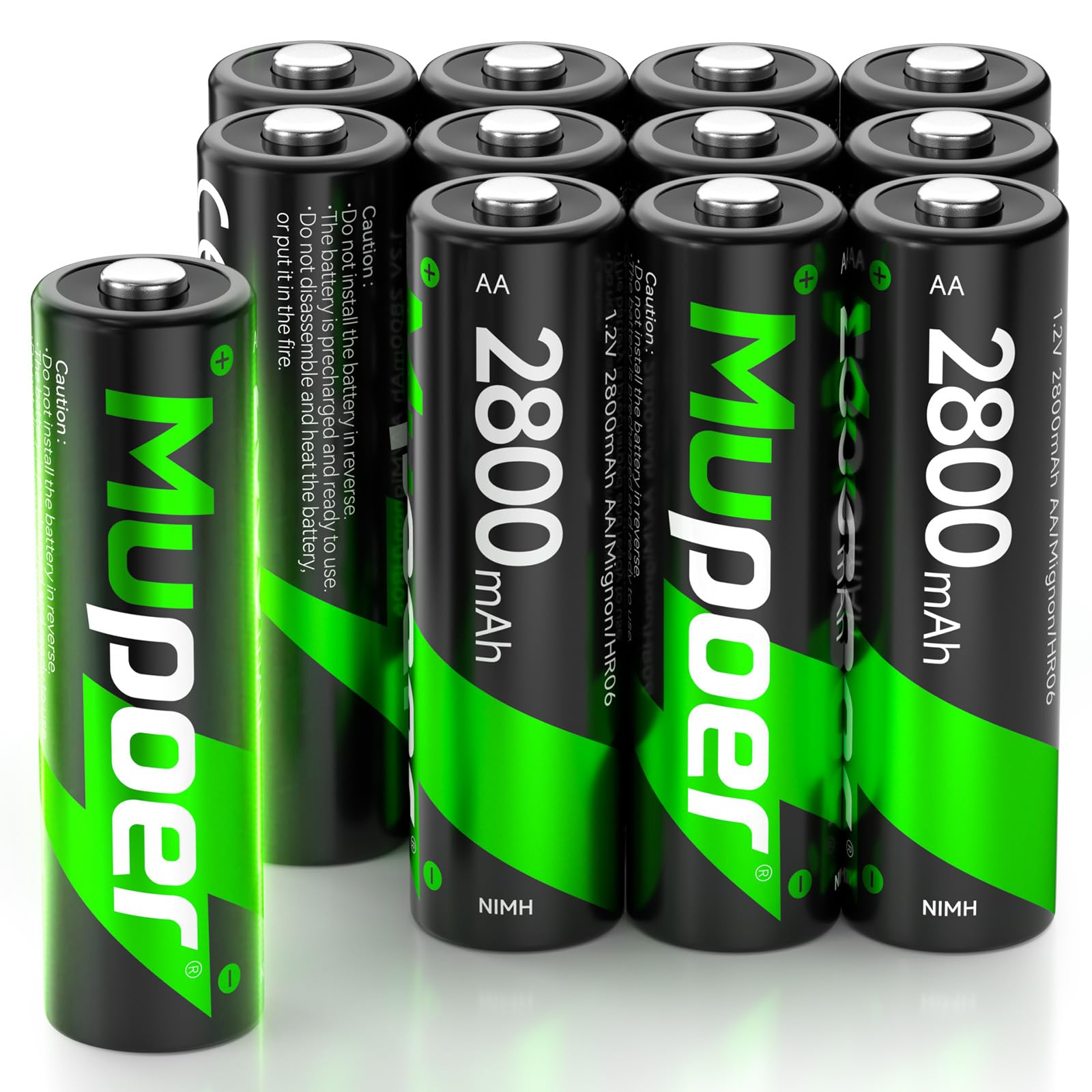
The Mupoer 12-pack offers a competitive 2,800 mAh capacity with a 1,200-cycle rating and claims of 85% charge retention after three years of storage. The cells use NiMH chemistry that is free of mercury, cadmium, and lead, appealing to environmentally conscious users. The DBCK steel shell provides corrosion resistance and high density for safety against leaks and extreme temperatures.
Initial testing shows cells arriving at roughly 42% charge (1,200-1,300 mAh), requiring a 20-30 minute top-off before first use. Reviewers report runtime comparable to Eneloop in daily devices like electric toothbrushes and trimmers, which is impressive for the price tier. The cells come in four-count clam-shell packs, making organization easier than loose-packs that jumble in a drawer.
One-year warranty coverage adds a layer of protection, though the build quality seems solid based on early feedback. The 2,800 mAh rating is likely optimistic at higher drain rates, but for mixed household use — remotes, clocks, toys, and moderate-drain electronics — these cells perform reliably. The low internal resistance helps them deliver steady power without excessive voltage sag during use.
Why it’s great
- Heavy-metal-free chemistry for eco-friendly disposal
- DBCK steel shell with corrosion resistance
- Runtime comparable to premium cells in moderate-drain devices
- Comes in organized four-count clam-shell packs
Good to know
- Needs initial top-off charge before first real use
- 2,800 mAh rating may not hold at high drain rates
- Long-term cycle life unverified beyond early reviews
7. Deleepow AA Rechargeable 8-Pack (3,300 mAh)

The Deleepow 8-pack makes the boldest capacity claim on this list at 3,300 mAh, paired with a 1,200-cycle rating and built-in overcharge/over-discharge protection. The smart chip design theoretically allows safe charging beyond 24 hours, which is reassuring for forgetful users. The low internal resistance construction aims to support high-drain devices like digital cameras and flash units.
User experiences are sharply divided. Several reviewers report excellent runtime in moderate-drain devices and appreciate the low entry price. However, a significant number of users report that the cells drain rapidly — needing a charge every two days in some devices — and that charger compatibility can be finicky, with some NiMH-specific chargers flashing error codes when these cells are inserted. The 3,300 mAh rating appears to be a peak theoretical number rather than a sustained output under load.
The 8-pack is best suited for users who need a low-cost trial run into rechargeable NiMH and have a tolerant charger. For critical devices or daily high-drain use, the inconsistency makes these a riskier choice than the Amazon Basics or Mupoer packs at similar price points. If you do buy them, run at least two full charge/discharge cycles to stabilize the cells before depending on them.
Why it’s great
- Highest mAh claim of any pack on this list
- Overcharge/over-discharge protection chip
- Low entry price for 8 cells
Good to know
- Inconsistent user reports on actual runtime
- Charger compatibility issues reported with some NiMH chargers
- 3,300 mAh rating does not reflect real-world sustained capacity
FAQ
Can I use NiMH rechargeable AA batteries in any device that takes AA alkalines?
Why do my rechargeable AA batteries die faster than disposables?
What does “pre-charged” mean for rechargeable AA batteries?
Do I need a special charger for NiMH AA rechargeable batteries?
Final Thoughts: The Verdict
For most users, the best aa rechargeable batteries winner is the Panasonic Eneloop 10-Pack because it delivers unmatched 2,100-cycle longevity, decade-long charge retention, and consistent voltage that outperforms every competitor in high-drain devices. If you want the highest cell count without breaking your budget, grab the NICEBATT 16-Pack. And for outdoor solar lights and extreme-temperature installations, nothing beats the WENJOOP 12-Pack.