
Our readers keep the lights on and the weekend projects moving. As an Amazon Associate, I earn from qualifying purchases.
Every household drawer holds a graveyard of dead alkalines—remotes that won’t click, toys that won’t buzz, and flashlights that won’t shine. A capable charger changes that entirely, turning disposable drain into a reusable ecosystem that pays for itself within months. But not all charging bays treat your cells equally, and the wrong unit can actually shorten battery life through constant overcharging pulses.
I’m Rikta — the co-founder and writer behind FitlyFast. For this guide, I spent weeks breaking down charge algorithms, bay independence, and real-world cycle counts across the most popular AAA battery charger bundles on the market, cross-referencing technical specs against verified user reports to separate genuine value from marketing hype.
If you’re still burning cash on single-use cells, switching to a dependable aaa battery charger eliminates that recurring expense while keeping your favorite gadgets powered on your terms, not the store’s.
How To Choose The Best AAA Battery Charger
The ideal charger goes beyond just filling cells—it protects them. The three factors below separate a smart investment from a slot that slowly cooks your batteries.
Independent Charging Bays
Cheaper chargers wire cells in series, meaning one weak battery stops the entire row from reaching full charge. Independent bays—often found on mid-range and premium units—monitor each cell separately. This ensures a mixed set of AA and AAA, partially drained and fresh batteries all finish correctly without one dragging the others down.
Charge Current and Speed
Charge rate is measured in milliamps (mA). A fast rate—around 600 mA or higher—fills a standard AAA in under two hours but generates more heat. Slower trickle charging at 200 mA is gentler on the cells and can extend total cycle count. The right choice depends on whether you need quick turnaround for daily-use devices or prefer overnight conditioning for occasional spares.
Low Self-Discharge (LSD) Compatibility
LSD batteries retain 80% of their charge after one to three years of idle storage. Not all chargers handle them optimally—some overcharge them or fail to detect the fully charged state. A smart charger that uses negative delta voltage cutoff detects the voltage peak of LSD cells and stops charging immediately, preventing the heat buildup that robs these batteries of their long-term capacity.
Quick Comparison
On smaller screens, swipe sideways to see the full table.
| Model | Category | Best For | Key Spec | Amazon |
|---|---|---|---|---|
| Imuto Rechargeable Lithium Set | Lithium | High-drain devices & travel | 1600 cycle count | Amazon |
| Panasonic eneloop BQ-CC63SBA | NiMH | Eneloop battery care | 5-hour charge time | Amazon |
| Panasonic BQ-CC65AKBBA | NiMH | Enthusiasts & data tracking | LCD voltage display | Amazon |
| POWEROWL 16 Bay Charger | NiMH/NiCD | High-volume battery households | 16 independent slots | Amazon |
| Amazon Basics 8-Bay Bundle | NiMH | Budget-conscious bulk charging | 16 cells included | Amazon |
| BEVIGOR 8 Bay Bundle | NiMH | Entry-level charging kit | 1500 cycle design | Amazon |
| HiQuick 8-Bay Bundle | NiMH | Fast home charging | 2-hour AAA charge | Amazon |
In‑Depth Reviews
1. Imuto Rechargeable Lithium Set (4 AAA + 4 AA)

The Imuto set breaks from the NiMH norm by using lithium-ion chemistry with an integrated charging case. Each AAA delivers 1300 mWh with a steady 1.5 V output until fully depleted—unlike NiMH, which gradually drops voltage and can cause low-battery warnings in devices like shavers and cameras that expect a constant 1.5 V.
The charger case doubles as a storage box, keeping all eight cells organized during travel. Charging completes in roughly two hours via USB-C for the entire set, and the lithium chemistry supports up to 1600 recharge cycles before noticeable capacity fade. The 1.5V constant output keeps high-drain gear like VR controllers and door locks running at full power longer.
One AAA battery in the initial batch showed early failure after about five cycles, but the warranty service reportedly replaced it without hassle. The lithium cells are slightly heavier than NiMH equivalents, so weight-sensitive devices may feel the difference. If you prioritize stable voltage output and ultra-long cycle life, this is the closest you get to permanent batteries.
Why it’s great
- Constant 1.5 V output keeps high-drain devices running at peak
- 1600-cycle lithium chemistry outlasts typical NiMH cells
- Integrated storage case doubles as a travel-friendly charger
Good to know
- One battery from the sample failed early; warranty support responded
- Lithium cells are slightly heavier than standard NiMH
2. Panasonic eneloop BQ-CC63SBA 8-Position Charger
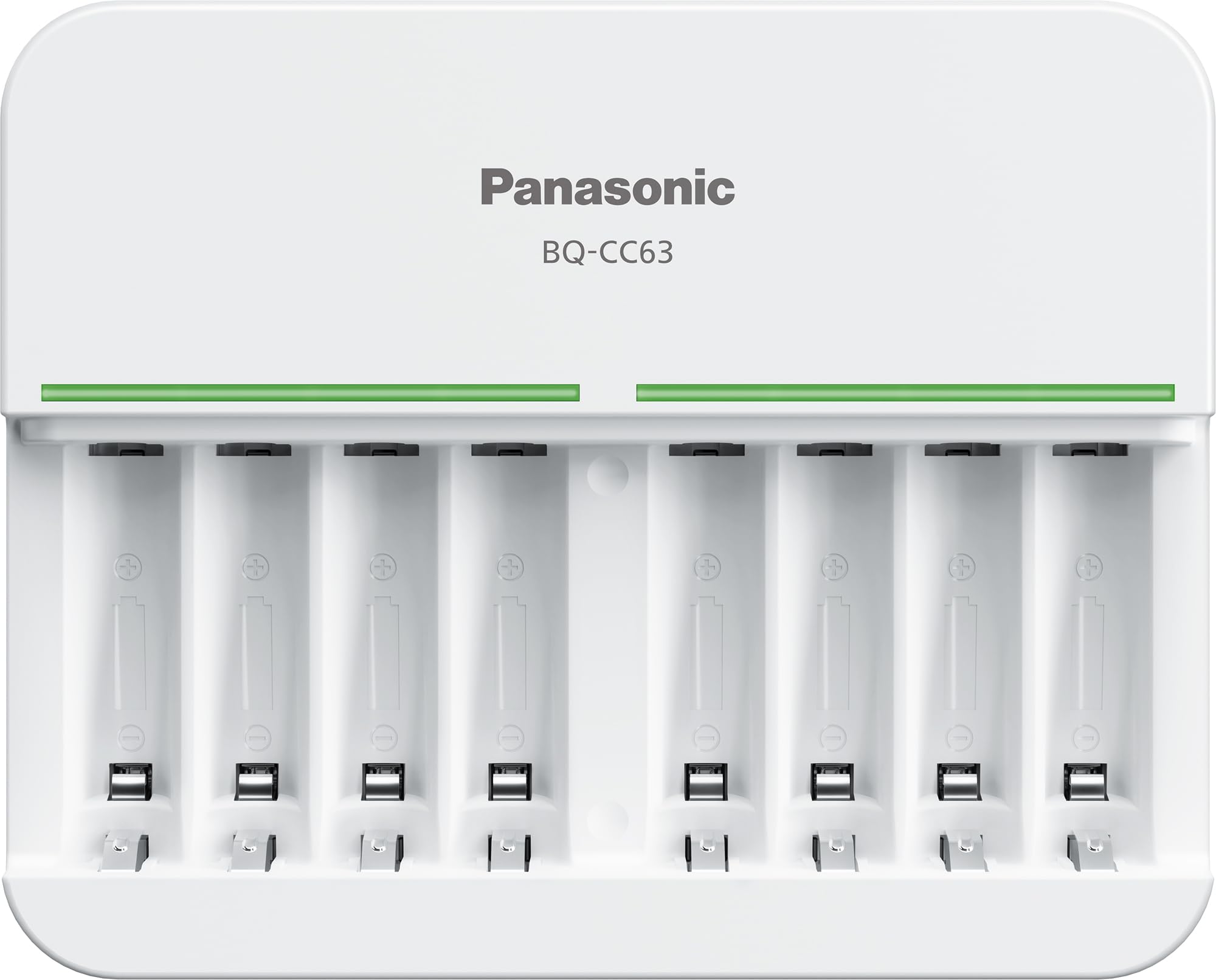
The BQ-CC63SBA is Panasonic’s eight-bay charger designed specifically for eneloop and eneloop Pro NiMH cells. It uses individual slot detection with a –ΔV cutoff algorithm, which stops charging the instant each battery reaches peak voltage—preventing the heat and overcharging that slowly kills standard NiMH cells over repeated cycles.
Charge times are competitive at five hours for a full set of eight AA eneloops or three hours for AAA cells. The six-foot AC power cord offers flexible placement, and each of the eight green LEDs provides clear per-bay status. Users note the charger runs cool even during bulk sessions, a sign that the current control is precise.
The main trade-off is that this unit charges eneloops exclusively—non-eneloop NiMH batteries may not reach the same termination accuracy. Also, the LEDs only show on/off charging status rather than intermediate charge levels, so you won’t see percentage progress. For those who already own eneloops, this is the most maintenance-friendly way to keep them running for thousands of cycles.
Why it’s great
- –ΔV cutoff prevents heat damage on premium eneloop cells
- Eight independent slots with individual green status LEDs
- Runs cool even during full-bay charging sessions
Good to know
- Optimized for eneloop cells; other NiMH brands may not terminate as accurately
- LEDs indicate only on/off, not intermediate charge levels
3. Panasonic BQ-CC65AKBBA eneloop Pro 4-Bay Charger

The BQ-CC65AKBBA is a four-bay charger with an LCD panel that displays real-time battery voltage, charge/discharge time, and mAh discharge capacity per slot. This data feedback lets you track whether a cell is degrading or just temporarily out of balance—something no simple LED indicator can offer.
It charges two eneloop Pro AA cells in just two hours and includes a refresh/discharge mode that can revive older batteries that have developed voltage depression. The integrated USB-A output port (5V/1A) lets you charge a phone or earbuds while the charger is plugged in, turning it into a small desktop power station.
At four bays, capacity is limited compared to eight- or sixteen-slot units, so high-volume users may need multiple charge sessions. The USB port is a useful bonus but not a replacement for a dedicated power bank. For enthusiasts who want to monitor cell health and recover fading batteries, this charger delivers laboratory-level insight without needing a multimeter.
Why it’s great
- LCD displays per-slot voltage, charge time, and mAh discharge data
- Refresh mode can restore older NiMH cells with voltage depression
- Includes USB-A output for charging mobile devices
Good to know
- Only four bays limit high-volume simultaneous charging
- Higher price point reflects the advanced monitoring features
4. POWEROWL 16 Bay AA AAA Battery Charger

The POWEROWL 16 Bay Charger is a circular unit that handles up to sixteen AA or AAA NiMH or NiCD cells simultaneously. Each slot has its own independent charging circuit with three ventilation holes directly beneath the cell to keep heat from building up during extended sessions.
It uses a four-stage charging cycle—pre-charge, fast charge, float charge, and trickle charge—with red and green LEDs indicating status per slot. When the charger detects a faulty or non-rechargeable battery, the corresponding indicator flashes. This troubleshooting feature acts as a built-in battery tester, instantly flagging dead cells without extra gear.
The downside is the charge rate: 200 mA per slot, which is intentionally slow to protect cell health. A full eight-bay charge can take up to ten hours. It’s not the choice for overnight quick-turn needs, but for households with a large inventory of batteries—flashlights, toys, clocks—this unit provides gentle, high-capacity maintenance that extends overall pack life.
Why it’s great
- Sixteen independent slots with individual ventilation cooling
- Four-stage charge cycle prevents overcharging and extends battery health
- Fault detection works as a built-in battery tester
Good to know
- 200 mA per slot is slow—full charge takes up to 10 hours
- No capacity readout or charge-level LCD
5. Amazon Basics 8-Bay NiMH Battery Charger with 16 Cells
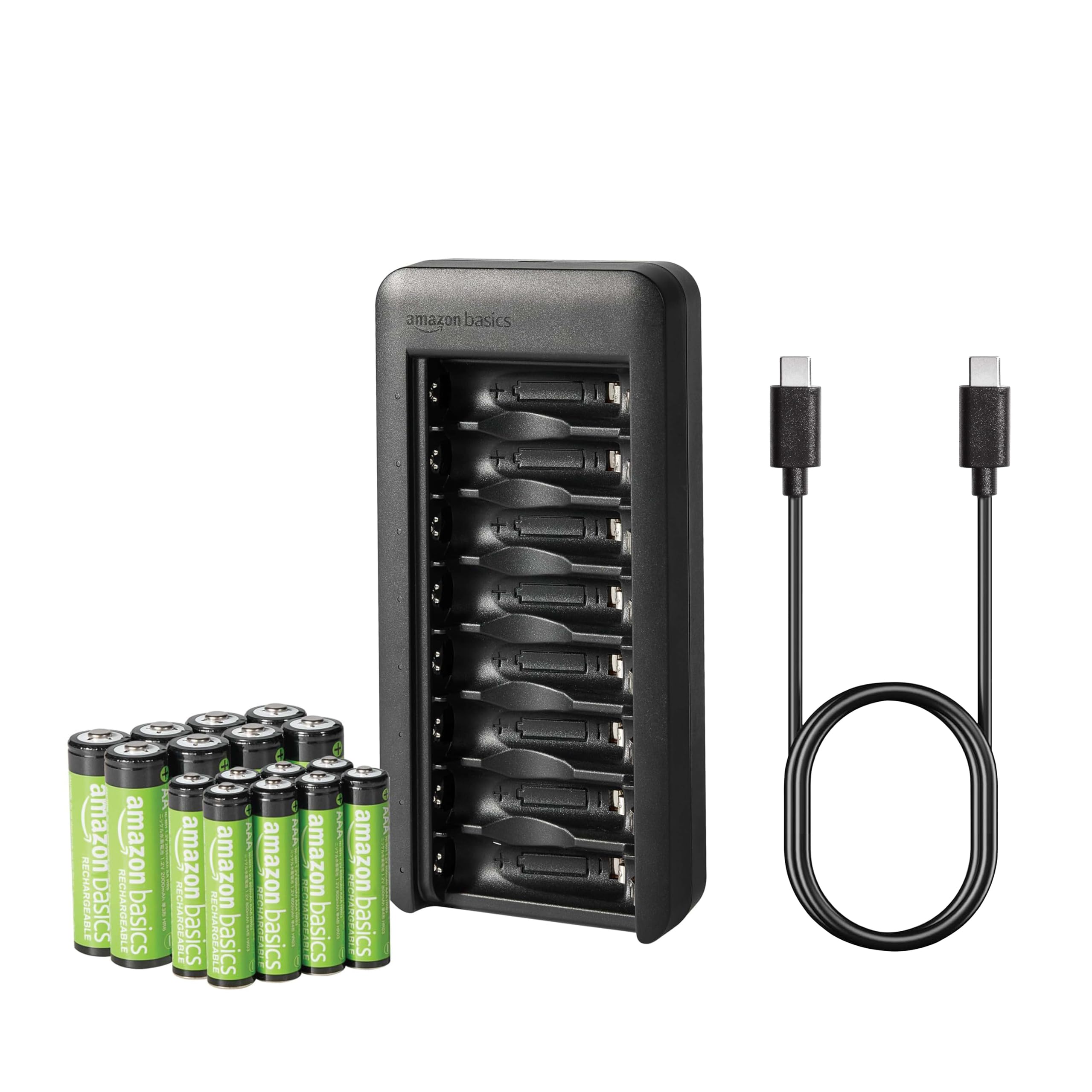
Amazon Basics offers a straightforward NiMH solution: an eight-bay charger paired with eight AA 2000 mAh and eight AAA 800 mAh cells—sixteen batteries total. The charger uses independent bays and provides four LED blink patterns: slow blinking for charging, solid white for full, fast blinking for error detection, and a power-on sequence check.
The batteries use low self-discharge technology, retaining 80% capacity after twelve months of storage. The charger input is USB-C, though the package does not include a power adapter, so you need a standard 5V USB block or laptop port. Build quality is consistent with Amazon Basics products—solid plastic housing with no sharp edges.
A few users report that the charger occasionally triggers the fast-blink error when charging more than two AA batteries simultaneously, though swapping slots often resolves it. The ten-hour charge time for eight AA cells is slower than premium competitors, but considering you get sixteen usable batteries in the box, the per-cell cost is among the lowest available.
Why it’s great
- Sixteen NiMH cells included provide immediate high-capacity inventory
- USB-C input works with common chargers and laptop ports
- Independent bays with clear LED status feedback
Good to know
- Charger may show error lights when charging more than two AA cells at once
- No AC adapter included; requires a USB power source
6. BEVIGOR 8 Bay Smart Charger with 4 AA + 4 AAA
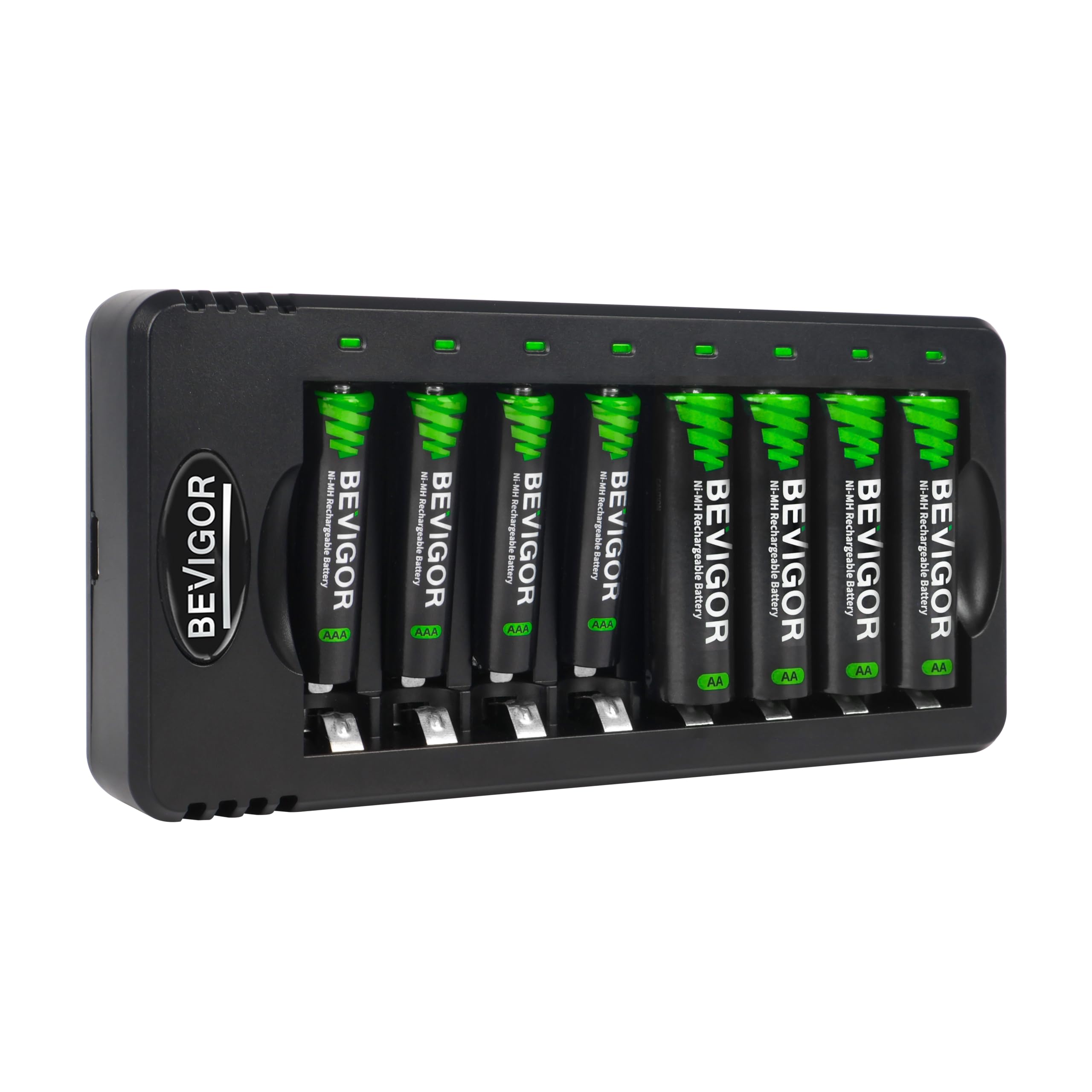
The BEVIGOR kit combines an eight-bay NiMH charger with four AA 2800 mAh and four AAA 1100 mAh batteries—enough to cover most household remotes and toys right out of the box. The charger uses trickle charge mode to maintain long-term battery health, automatically shifting to a low-current top-up once each cell is full.
Low self-discharge design means the included batteries retain 80% capacity after three years of storage, and each cell is rated for up to 1500 recharge cycles. The unit supports mixed NiMH and NiCD AA/AAA sizes with eight isolated circuits, so you can charge a single AAA without needing to fill all eight slots. A red/green per-bay LED indicates charging versus full status.
The four-hour charge time for the full set is acceptable for an entry-level bundle, though the included USB-C cable for power input leaves you to supply your own 5V adapter. Users consistently report the batteries last more than three weeks in moderate-drain devices before needing a recharge, making this a reliable starter kit for those new to rechargeable systems.
Why it’s great
- Trickle charge mode extends battery life over repeated cycles
- Batteries retain 80% capacity after three years of idle storage
- Eight isolated bays allow charging a single cell
Good to know
- No AC adapter included; uses USB-C cable only
- Battery life is adequate but not class-leading for high-drain use
7. HiQuick 8-Bay Charger with 4 AA + 4 AAA

The HiQuick 8-bay charger uses pulse current charging technology designed to eliminate the shunting effect that slows down conventional chargers. The result is a full charge for eight AAA 1100 mAh batteries in just two hours, and a full set of AA 2800 mAh cells in 4.5 hours. An integrated LCD screen shows the charging progress, providing more feedback than simple blinking LEDs.
The included NiMH batteries are rated for 1200 recharge cycles with low self-discharge performance that keeps 80% capacity after 36 months of non-use. The charger accepts both Micro USB and USB-C input cables, adding flexibility if you have a preferred cable type. Microcomputer control technology guards against overcharge, over-current, over-voltage, overheat, and short circuit conditions.
The AA cells from this set have a slightly larger diameter than standard, which can cause tight fits in cylindrical battery compartments—the label may peel or jam when forced. One user reported two dead charger slots after a power surge event, though the batteries themselves continued to hold charge fine. For fast turnaround on high-volume charging, the HiQuick is one of the quickest budget-friendly options available.
Why it’s great
- Pulse current charges eight AAA cells in only two hours
- LCD screen provides clear charging status feedback
- Accepts both Micro USB and USB-C input for cable flexibility
Good to know
- AA batteries have slightly larger diameter, may stick in tight compartments
- Two slots failed after a power surge in one reported case
FAQ
Can I charge NiMH and NiCD batteries in the same charger?
How many recharge cycles can I expect from an AAA battery?
Is it safe to leave batteries in the charger after they are full?
Final Thoughts: The Verdict
For most users, the aaa battery charger winner is the Imuto Rechargeable Lithium Set because its constant 1.5 V output and 1600-cycle lithium chemistry eliminates the voltage sag that frustrates owners of high-drain toys and kitchen gadgets. If you want precise battery health tracking with refresh capability, grab the Panasonic BQ-CC65AKBBA. And for the sheer need to manage a household with dozens of battery-powered devices, nothing beats the massive capacity of the POWEROWL 16 Bay Charger.