
Our readers keep the lights on and the weekend projects moving. As an Amazon Associate, I earn from qualifying purchases.
You are tired of buying packs of single-use AAA batteries every few months for your TV remotes, kids’ toys, and flashlights — and you are ready for a rechargeable solution that actually saves you money without the frustration of cells that die too quickly or refuse to hold a charge. The best AAA rechargeable batteries balance three things: how many times you can recharge them (the cycle count), how much power they hold (the milliamp-hour or mAh rating), and how well they keep that charge when sitting in a drawer for months (low self-discharge).
I’m Rikta — the co-founder and writer behind FitlyFast. This guide is built by comparing the manufacturers’ published specifications and the patterns across verified customer reviews, so you get each pick’s real strengths and trade-offs instead of marketing spin.
Whether you need a bulk pack for high-drain devices like digital cameras or a premium set for everyday household electronics, this guide to aaa rechargeable batteries cuts through the spec-sheet noise to show you which packs are actually worth your money.
How To Choose The Best AAA Rechargeable Batteries
The two most important numbers on any rechargeable battery pack are the capacity (measured in milliamp-hours or mAh, which tells you how long the battery runs on a single charge) and the cycle count (how many times you can recharge it before it stops holding a useful amount of power). A high capacity is great for devices that drain quickly, but a high cycle count is what actually saves you money over years of use — paying slightly more for a battery rated for 2100 cycles beats buying a cheaper 500-cycle pack four times over.
Low Self-Discharge (LSD) — the “shelf life” factor
Standard rechargeable batteries lose their charge in weeks just sitting idle. LSD batteries (like Panasonic Eneloop and Amazon Basics) are engineered differently — they keep 70% to 80% of their charge even after two to three years in a drawer. This matters when you grab a battery for a remote control or a smoke alarm that you rarely touch; with LSD cells, you do not have to recharge them before every use.
Voltage compatibility — 1.2V NiMH vs 1.5V lithium
Most AAA rechargeable batteries are nickel-metal hydride (NiMH) and output a steady 1.2 volts, while standard alkaline disposables deliver 1.5 volts. Some devices (like certain clocks, cameras, or motorized toys) can act sluggish or show a “low battery” warning early with 1.2V cells. If that happens, you may want lithium-ion rechargeables (like the Paleblue) that maintain a constant 1.5V throughout their discharge — but those come with their own quirks, like cutting off power without warning when depleted.
Internal resistance — the hidden performance killer
Internal resistance (measured in milliohms or mΩ) is the battery’s internal friction that wastes energy as heat. A lower number (under 200 mΩ) means the battery delivers power more efficiently, especially in high-drain devices like digital camera flashes or motorized toys. Higher internal resistance causes voltage to sag under load, making devices turn off sooner than the battery’s mAh rating would suggest. Eneloop cells typically measure around 180 mΩ, while budget cells can spike much higher.
Charger compatibility and care
Most NiMH batteries work with any standard NiMH smart charger (a charger that monitors each cell individually and stops charging when full). Avoid “dumb” timer-based chargers — they can overcharge and damage cells. If you buy a USB-rechargeable lithium pack like the Paleblue, you skip the external charger entirely because the charging circuit is built into each battery.
Quick Comparison
On smaller screens, swipe sideways to see the full table.
| Model | Category | Best For | Key Spec | Amazon |
|---|---|---|---|---|
| Eneloop (6-pack) | Premium NiMH | Long-term value | 2100 cycles, 800mAh min | Amazon |
| Eneloop (8-pack) | Premium NiMH | High consistency | 2100 cycles, 800mAh min | Amazon |
| EBL Gold Pro | High Capacity | Extended runtime | 1100mAh, 1.2V NiMH | Amazon |
| Amazon Basics | Budget Bulk | High volume use | 24-pack, 850mAh | Amazon |
| Granicell | Value Bulk | Low-drain devices | 24-pack, 1100mAh | Amazon |
| POWEROWL | Mid-Range | Medium-drain gadgets | 24-pack, 1000mAh | Amazon |
| Paleblue | Lithium USB | No charger needed | USB-C recharge, 1.5V | Amazon |
In‑Depth Reviews
1. Eneloop Panasonic BK-4MCCA6BA AAA (6-Pack)

The 2100-cycle rating dwarfs almost every competitor — that is 4.2 times more recharges than the Amazon Basics pack, which means you may never need to buy AAA batteries again for the next decade. These are for anyone who wants maximum long-term savings from a single purchase and refuses to compromise on reliability.
Each cell delivers 800mAh minimum (850mAh typical), and thanks to low self-discharge technology they hold 70% of their charge after 10 years sitting unused — so a remote that you grab once a year works on the first press. Buyers report these are “the best batteries you can buy,” with one person calling them a “third pack; replaces all traditional batteries.” They work in extreme cold down to -4°F, making them the most versatile pick in this group.
The honest limit is the higher upfront cost per battery versus bulk competitors, and at only 6 batteries per pack you may need multiple orders to outfit a large household. Verdict: if you can afford the initial investment, this is the single best pack of AAA rechargeables money can buy.
Why it’s great
- Rechargeable up to 2100 times — the highest cycle count in this guide
- Pre-charged with solar power at the factory, ready to use immediately
- Retains 70% charge after 10 years of storage
- Works reliably in extreme cold down to -4°F
Good to know
- Only 6 batteries per pack; larger households may need to buy multiple
- Higher initial cost per battery than budget bulk options
2. Eneloop Panasonic BK-4MCCA8BA AAA (8-Pack)

The 8-pack Eneloop delivers the same 2100-cycle endurance and 800mAh minimum capacity as the 6-pack, giving you two extra batteries for a very small increase in price — so if you are deciding between the two Eneloop options, the 8-pack beats the 6-pack on value by offering roughly 33% more batteries for only a few dollars more. The catch is that you get the same per-cell performance, so the choice comes down to how many AAA batteries you need right now.
Where this pack really shines is in consistency between cells — something that matters if you use multiple batteries in a device like a camera flash or a toy that needs balanced power. One reviewer who capacity-tested all 8 cells reported they “exceeded 750mAh (762-778mAh), high consistency,” meaning you will not get one cell that drains faster than the rest. For devices where mismatched cells cause early shutdowns, this is a notable practical advantage over budget packs that can have one weak outlier.
If you already own Eneloop batteries and want to expand your collection, or if you need exactly 8 fresh cells for a set of gadgets that run simultaneously, this is the version to pick over the 6-pack.
Where it shines
- Exceptional cycle-to-cycle consistency — all cells test close to advertised capacity
- Same 2100-cycle and low self-discharge specs as the 6-pack
- Pre-charged and ready for immediate use
Worth noting
- Per-cell cost is slightly higher than the 6-pack per battery
- Only an extra 2 batteries over the 6-pack for a bigger price jump
3. EBL Gold Pro AAA Rechargeable Batteries (16-Pack)
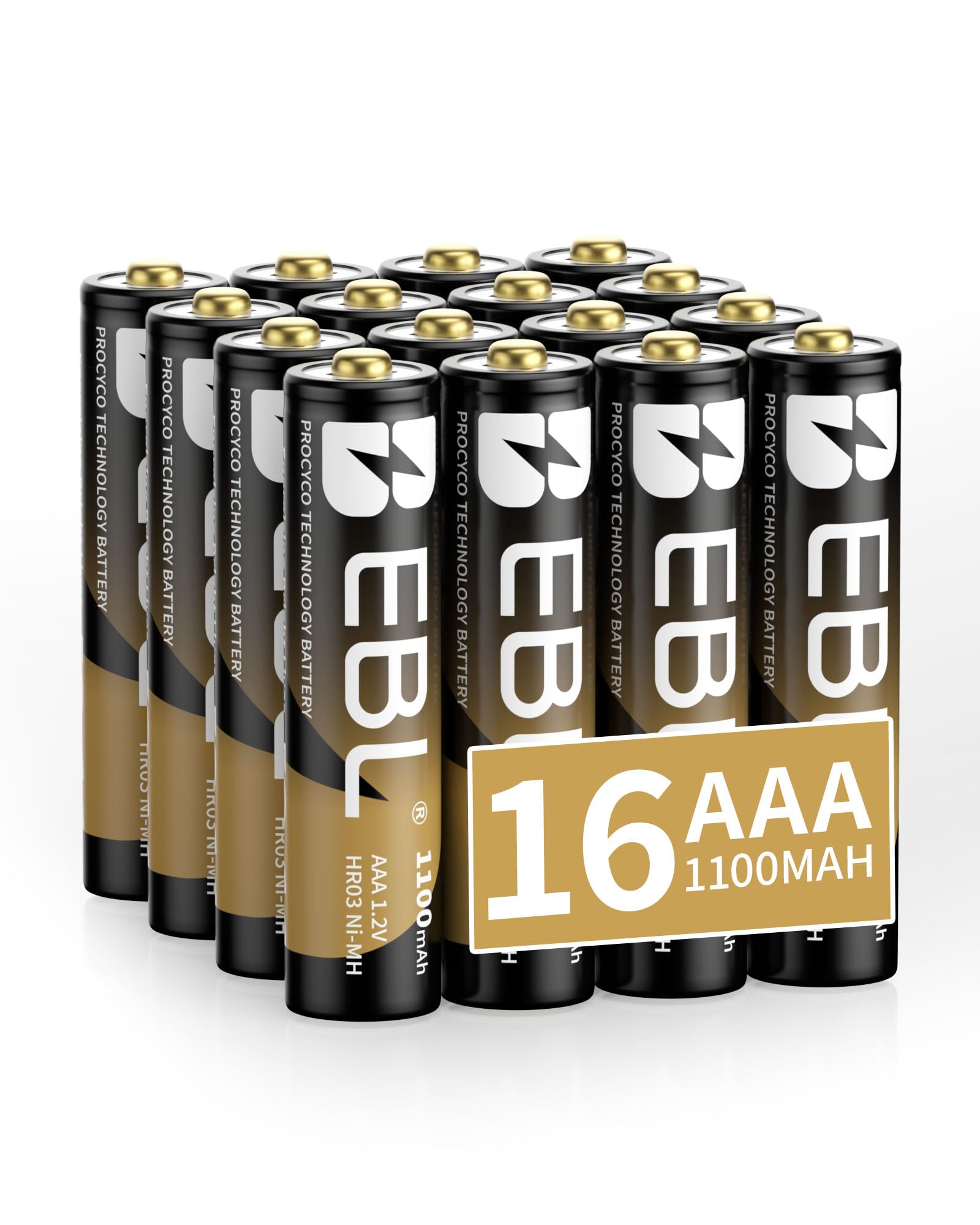
Picture this: you’re replacing the batteries in a fleet of kid’s toys, wireless mouses, and LED lanterns all at once, and you want each device to run as long as possible before the next swap. The EBL Gold Pro gives you 1100mAh of capacity — that is roughly 38% more runtime per charge than the Eneloop’s 800mAh, which means your kid’s toy car or your LED flashlight runs noticeably longer between charges. The 16-pack size also fills a medium gap between Eneloop’s 8 and the 24-packs from Amazon Basics and Granicell.
EBL claims a low-self-discharge design that maintains over 90% capacity after 3 years, and the batteries come pre-charged to about 15-20% (enough for immediate use in low-drain devices, but you will want a full charge cycle before heavy use). The company uses what they call “ProCyco technology” — really just a well-optimized NiMH chemistry — and backs it with a one-year warranty. Buyers who have used EBL for years say these are “good rechargeables” that work well in “kids toys and remote controls.”
The standout spec here is the pure mAh number: at 1100mAh, this pack leads the premium NiMH field on raw capacity, giving you the longest single-charge runtime among the standard-type cells in this guide.
What stands out
- 1100mAh capacity provides the longest runtime among standard NiMH picks here
- 16-pack strikes a practical balance between quantity and per-cell cost
- Low self-discharge holds over 90% after 3 years, according to the brand
The trade-offs
- Only pre-charged to 15-20% — needs a full charge cycle before heavy use
- Some owners mention inconsistent customer service experiences
4. Amazon Basics 24-Pack AAA Rechargeable Batteries

The single number that matters most in this category is the per-battery cost, and the Amazon Basics 24-pack scores as hard to beat with 24 cells. Each cell is rated at 850mAh with a 500-cycle lifespan, and while that cycle count is 4.2 times lower than the Eneloop’s 2100, it still means 500 full recharges per battery before noticeable degradation.
The real-world capacity actually exceeds the rating — one reviewer measured “average capacity 1,079 mAh (exceeds rated 850 mAh)” with an average internal resistance of 193 mΩ, which is decent for a budget cell. That means in low- to medium-drain devices, these batteries will perform closer to 1000mAh-rated competitors. The downside you accept is the lower 500-cycle count and the higher likelihood of one or two weak cells in a 24-pack — same reviewer noted “one weak outlier.”
For price-to-performance, this 24-pack is the clear winner if you need lots of batteries right now for remotes, clocks, and flashlights and do not care about hitting 2000+ charge cycles, making for a strong price-to-value read.
The upsides
- 24-pack delivers the best per-battery cost in this guide
- Actual measured capacity often exceeds the 850mAh rating
- Low self-discharge retains 80% capacity after 24 months
Keep in mind
- Only rated for 500 recharges — 4.2x fewer cycles than Eneloop
- Some packs include one or two weak outlier cells
5. Granicell AAA Rechargeable Batteries (24-Pack)
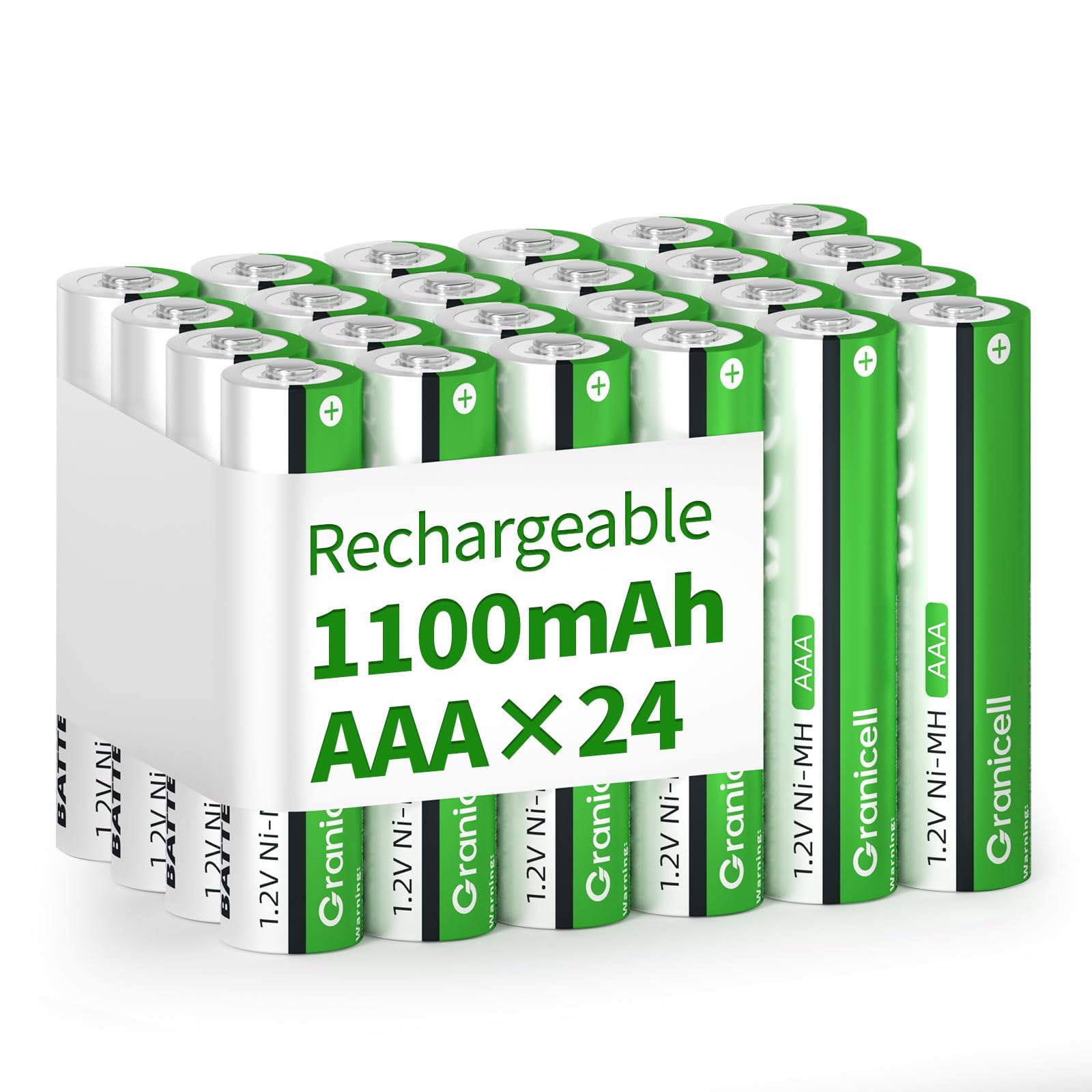
The Granicell 24-pack delivers 1100mAh per cell — the same high capacity as the EBL — but adds 1300 recharge cycles (2.6 times more than Amazon Basics’ 500) and comes as a 24-pack. That combination makes it a compelling middle-ground option if you want more capacity than Eneloop offers but still want a large bulk pack.
What you give up is consistency — these are a lesser-known brand, and while many customers note they work “just as good as the name brand batteries” with zero issues, a small number of customers have received packs where cells would not hold a charge at all (though the company appears responsive to replacement requests). One buyer put them through a “durability test: several hours continuous in bright CREE LED flashlight” and they passed, which suggests the core chemistry is solid for a budget price.
This is the exact pack for a household that burns through batteries by the dozen — say, for solar garden lights or a large collection of battery-powered toys — where the combination of high capacity and high count beats the premium brands on value-per-watt-hour.
Why we’d pick it
- 1100mAh capacity combined with a 24-pack gives the most total power per purchase
- 1300-cycle rating is 2.6x higher than Amazon Basics
- Low self-discharge retains 80% capacity after 3 years, per the brand
A few caveats
- Brand quality control varies — some reviewers point out defective cells
- Not as rigorously tested by independent reviewers as Eneloop
6. POWEROWL AAA Rechargeable Batteries (24-Pack)

The POWEROWL 24-pack is perfect for families or high-volume households who want to cover every device in one order without spending top dollar, thanks to its 1000mAh capacity (25% more than Eneloop), 1200 recharge cycles (2.4x more than Amazon Basics), and a 24-pack count that supplies a whole house. That spec sheet looks great on paper, and for many buyers these have worked well for years — one happy customer reported that “rechargeable batteries eliminate constant buying” and that they charge “in 1-2 hours.”
The trade-off is that a vocal minority of buyers experience the opposite: batteries that lose their charge in under a week on the shelf, or voltage that “crashes under load” after minutes of use. The reviewer who called them “GARBAGE” noted that cells “will not hold a full charge more than 1 week on shelf,” which is a serious failure of low-self-discharge design. This split in experiences suggests quality control varies between production batches.
If you are willing to take a gamble on a budget-friendly 24-pack with above-average specs, POWEROWL can work out — but the risk of getting a dud batch is higher here than with more established brands, something to weigh if you need absolute reliability.
Strong points
- 1000mAh capacity and 1200 cycles offer a good balance for the price
- 24-pack covers every device in a large household
- Many users report reliable performance in toys and remotes
Before you buy
- Quality control inconsistency — some batches fail to hold charge
- Voltage sag under high load reported by some users
7. Paleblue USB Rechargeable AAA Lithium Batteries (4-Pack)

The Paleblue is the most expensive option in this guide by a wide margin, but it also delivers a fundamentally different value proposition: you never need to buy a separate charger. While every other battery here requires a dedicated NiMH charger, the Paleblue’s built-in USB-C port lets you plug each cell directly into a cable — a convenience that justifies the premium for users who prioritize simplicity over upfront cost.
What that money actually gets you is a modern, leak-proof design (lithium-ion batteries do not corrode like NiMH or alkaline) and a steady 1.5V output throughout the entire discharge cycle — meaning your gadgets get consistent power until the battery suddenly stops. Buyers love that they “recharge quickly and last” and find the “compact cord so much more portable than the bigger plastic recharger units.” One limitation is that with only 600mAh capacity, these have roughly 25% less runtime than an 800mAh Eneloop, and the sudden shutdown (rather than gradual dimming) can catch you off guard in devices that need a low-battery warning.
The one clear reason to choose Paleblue over everything else: you hate external battery chargers and want the absolute simplest, fastest recharging system available.
What we like
- Built-in USB-C port means no separate charger needed
- Full charge in under 1 hour — 12x faster than standard NiMH
- Steady 1.5V output and no risk of corrosive leakage
The downsides
- Only 600mAh capacity — noticeably shorter runtime than NiMH options
- Abrupt power cutoff with no low-battery warning
- Only 4 batteries per pack — the smallest quantity in this guide
Understanding the Specs
Capacity (mAh)
This number — milliamp-hours — is the fuel tank. A 1100mAh battery delivers power for roughly 37% longer between charges than an 800mAh battery in the same device. Higher is better for runtime, but very high capacity in AAA cells (over 1100mAh) can sometimes mean shorter overall lifespan if the chemistry is pushed too hard.
Cycle Count
This tells you how many times you can fully recharge the battery before its capacity drops significantly (usually to about 70% of new). A 2100-cycle battery like the Eneloop will outlast a 500-cycle battery by about 4 times — the higher the number, the more years you get before replacement.
Low Self-Discharge (LSD)
Standard rechargeable batteries lose 1-2% of their charge per day sitting idle. LSD batteries are formulated to lose only about 0.1-0.3% per day — so after a year in a drawer, they still have 70-80% of their charge left. If your batteries sit for months between uses (remotes, emergency flashlights), LSD is essential.
Internal Resistance (mΩ)
Measured in milliohms, this is the battery’s internal electrical friction. A lower number (under 200 mΩ) means more of the stored energy reaches your device instead of turning into heat. Higher internal resistance (over 300 mΩ) causes voltage to sag under load — a camera flash may not fire even though the battery still shows charge on a tester.
Voltage (1.2V vs 1.5V)
Most NiMH rechargeables output 1.2 volts, while standard alkaline batteries output 1.5 volts. Some devices (e.g., certain wall clocks, wireless mice, or older toys) are designed for 1.5V and may show “low battery” early with 1.2V cells. Lithium-ion rechargeables like the Paleblue maintain 1.5V throughout but cost more and offer less capacity.
Pre-Charged vs. Ready-to-Cycle
“Pre-charged” means the batteries come with a partial charge from the factory and can be used immediately. Some budget options arrive with only 15-20% charge and need a full charge-discharge cycle or two to reach peak performance — something to account for if you need them for an urgent use right out of the box.
FAQ
Can I mix rechargeable AAA batteries with regular alkaline batteries in the same device?
Why do my rechargeable AAA batteries not last as long in a remote control as disposables?
How many times can I actually recharge an AAA battery before it dies?
Are AAA rechargeable batteries safe to leave in devices for months?
What charger should I use for NiMH AAA batteries?
Final Thoughts: The Verdict
When it comes down to it, the aaa rechargeable batteries winner is the Eneloop 6-pack because its 2100-cycle lifespan, reliable 800mAh capacity, and proven track record of consistency make it the single best long-term investment in this category. If you want maximum capacity per charge for high-drain devices, grab the EBL Gold Pro 16-pack. And for the simplest charging experience — no separate charger needed at all — the standout is the Paleblue USB-C 4-pack.