
Our readers keep the lights on and the weekend projects moving. As an Amazon Associate, I earn from qualifying purchases.
Specs are compiled from manufacturer listings and verified buyer reviews and can change over time — please confirm the key details on the product page before buying.
Printing with ABS is a battle against two things: a room-temperature draft and a cooling plastic that wants to shrink. An enclosed machine that keeps the chamber hot is not a luxury — it is the single hardware requirement that separates a successful ABS part from a curled-up mess on the build plate. This guide walks you through the best enclosed options, from value-minded workhorses to industrial-capacity beasts, all capable of handling ABS filament reliably.
I’m Rikta — the founder and writer behind FitlyFast. This guide is built by comparing the manufacturers’ published specifications and the patterns across verified customer reviews, so you get each pick’s real strengths and trade-offs instead of marketing spin.
To print tough, heat-resistant parts that stay flat on the plate, you need an abs 3d printer with a fully enclosed chamber, a heated bed, and a hotend (the nozzle assembly that melts the filament) that can handle the higher extrusion temperatures without clogging.
Quick Picks
- Bambu Lab P1S — Best Overall
- Anycubic Kobra S1 Combo — Best Value
- QIDI Q1 Pro — Compact Speedster
- Creality K2 Pro Combo — Large Format
- QIDI Max4 Combo — Oversize Beast
How To Choose The Best ABS 3D Printer
Picking an ABS printer depends on three connected specs: a sealed heated chamber, a hotend that can reach around 350°C, and a heated bed. A printer without all three cannot print ABS reliably — the plastic will warp mid-print, and the part will lift off the plate.
The Enclosed Chamber is Everything
ABS shrinks as it cools. If a draft of room-temperature air hits one side of your print, that side contracts faster, and the corners curl up. A fully enclosed printer traps the heat around the plastic, keeping the temperature even across the whole part. Look for a model marketed as “fully enclosed” — not one where you have to buy a separate acrylic tent or print a plastic door yourself.
Hotend Temperature and Heated Bed
ABS extrudes best at a nozzle temperature around 250°C to 270°C, so a hotend rated for 300°C or more gives you safe headroom. The bed should hit 100°C or higher so the first few layers stay stuck. A heated chamber — a separate element that warms the air inside the box — reduces warping even further and helps with tall, thin parts that otherwise want to peel off.
Build Volume and Your Projects
Think about the biggest single part you will ever print. A small printer with a 256mm³ build volume covers most hobby projects and functional brackets. If you plan to print full-size helmet halves or large industrial prototypes, jump to a model with a 300mm³ or larger build area so you are not splitting every model into glued sections.
Quick Comparison
| Model | Best For | Build Volume (mm) | Max Speed | Item Weight | Amazon |
|---|---|---|---|---|---|
| Bambu Lab P1S | Best Overall ABS workhorse | 260 x 260 x 260 | 500mm/s | 38.9 lb | Amazon |
| Anycubic Kobra S1 Combo | Multi-color ABS prints | — | 600mm/s | 54.9 lb | Amazon |
| QIDI Q1 Pro | Fast ABS in a compact footprint | 245 x 245 x 240 | 600mm/s | 43.9 lb | Amazon |
| Creality K2 Pro Combo | Large-format ABS prototyping | 300 x 300 x 300 | 600mm/s | 61.6 lb | Amazon |
| QIDI Max4 Combo | Oversize ABS and engineering-grade parts | 390 x 390 x 340 | 800mm/s | 120 lb | Amazon |
In-Depth Reviews
1. Bambu Lab P1S

A fully enclosed workhorse that does not force you to choose between speed and quality.
The P1S gives you a 260mm³ build volume inside a sealed metal box, so you can close the top lid and front door and print ABS without worrying about drafts. Bambu Lab rates it at 500mm/s printing speed with 20,000 mm/s² acceleration — buyers report it took them “less than half an hour” from unboxing to first print. The CoreXY motion system keeps the print head stable at those speeds, producing sharp details even in tall ABS models that would wobble on a bedslinger.
One reviewer noted that the printer handles ABS “with little to no effort,” though they advise closing both lid and door for ABS and opening them for PLA to avoid heat creep. The P1S supports up to 16 colors when connected to an AMS unit, and the Bambu Studio software makes slicing straightforward. The self-leveling bed and filament-runout sensor mean you can start a multi-hour ABS print and walk away. Unlike the heavier (54.9-pound) Anycubic Kobra S1, this printer weighs 38.9 pounds, so it is more manageable to lift onto a table.
What makes it a top pick
- Fully enclosed body — critical for consistent ABS chamber temperature
- Auto bed leveling before every print removes first-layer guesswork
- Filament-runout detection pauses the job so you can reload and resume
One honest limitation
- Struggles with flexible TPU filament; better suited to rigid materials like ABS and PLA
- Multi-color printing requires a separate AMS unit that you must buy and connect
Your best bet for ABS: if you want a printer that runs PLA and ABS equally well from the start, with a fast setup and reliable results — this is the one to buy.
Only skip it if: you need a huge 300mm+ build volume and are willing to pay more for the extra capacity.
2. Anycubic Kobra S1 Combo

A CoreXY speedster that adds multi-color ABS and active filament drying in the same box.
Anycubic packs a built-in filament dryer, a fully enclosed body, and a 4-color printing system into one machine rated at 600mm/s. The Kobra S1 Combo lets you dry ABS spools inside the ACE Pro unit before they feed into the hotend, which cuts down on the bubbles and layer-separation problems that wet ABS causes. The enclosed chamber maintains a stable temperature for materials like ABS, and one-click auto-leveling plus vibration compensation mean you do not spend time dialing in z-offset.
Owners mention that the machine has run for “almost 2,000 hrs and have 0 issues so far!!” — speaking to the reliability of the CoreXY structure (a belt-driven motion system) and the direct-drive extruder (which pushes filament directly into the hotend). The printer weighs 54.9 pounds, so it is noticeably heavier than the 38.9-pound Bambu Lab P1S. Some users had early trouble with the ACE Pro locking filaments at first use; the manual does not flag the routing issue, so if you buy this model, feed each filament one at a time the first time through.
Biggest strengths
- Built-in active filament drying prevents moisture-related failures during long prints
- 600mm/s top speed outpaces the 500mm/s Bambu Lab P1S for time-sensitive jobs
- Multi-color ABS printing with up to 8 colors using two ACE Pro units
Watch out for
- ACE Pro loading mechanism can lock if you load multiple filaments simultaneously
- Still a newer model — the community support ecosystem is smaller than Bambu’s
Best for color experiments: if you want multi-material ABS prints and the built-in dryer gives you confidence on humid days, this is a strong mid-range choice.
Reconsider if: you prefer a more mature software ecosystem or if early-adopter issues on the filament system sound frustrating.
3. QIDI Q1 Pro

The small-footprint printer that actively heats its chamber to keep ABS corners flat.
The Q1 Pro is one of the few printers at this price that actively heats the air inside the enclosure to 60°C (140°F) rather than just trapping ambient heat. That stable chamber temperature makes a measurable difference on ABS parts that tend to warp — reviewers report printing ASA without adhesive and without any corner lifting. The printer hits 600mm/s and 20,000 mm/s² acceleration, and one buyer mentioned that they were “from unboxing to printing in just 10 minutes” as a plug-and-play experience.
The hotend reaches 350°C, so it can handle carbon-fiber-filled filaments in addition to ABS. A 1080P HD camera lets you monitor the print remotely, and the Klipper-based firmware is fully open-source if you like to tinker. The build volume is a relatively compact 245mm³, smaller than the 260mm³ P1S, so it will not fit large helmet halves. Users also point out that the exhaust fan lacks a carbon filter, so you should run it in a ventilated area or print your own filter box from the wiki.
Why it stands out
- Active heated chamber with a controlled 60°C (140°F) maximum temperature
- 350°C bimetal nozzle allows printing carbon-fiber and glass-fiber filaments
- Open-source Klipper firmware plus 32GB internal storage
Trade-offs
- No built-in carbon air filter for ABS fumes — requires a DIY solution or a well-ventilated room
- Side spool mount is flimsy; many users replace it with an external filament holder
Choose this if: you want the most capable compact ABS printer with an actively heated chamber and open-source freedom in a small desk footprint.
Look elsewhere for: large-format projects or if you absolutely need an integrated air filter without any manual upgrades.
4. Creality K2 Pro Combo
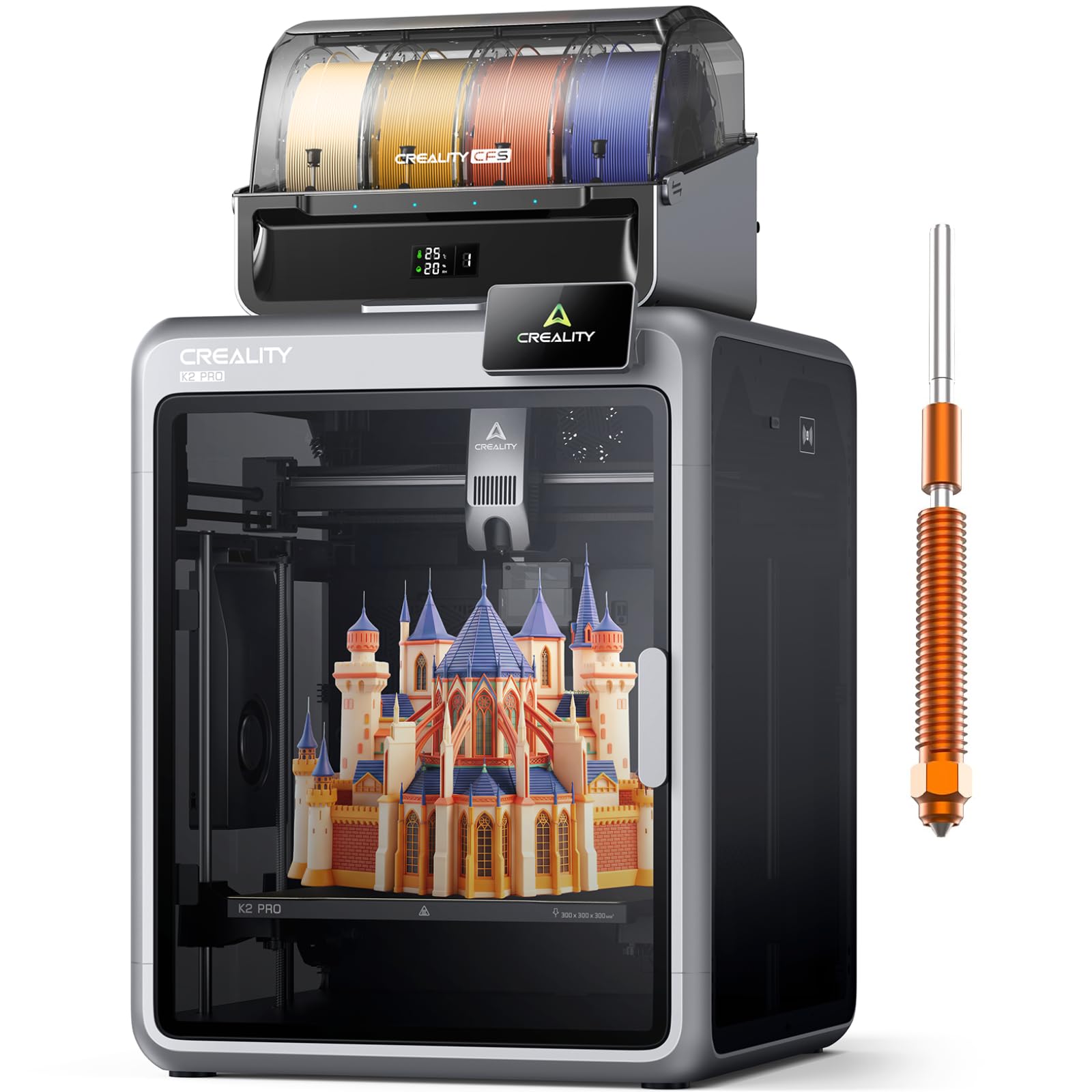
A 300mm³ build bay with active chamber heating and dual AI cameras that watch every layer.
The K2 Pro Combo handles large ABS prototypes in one shot — the 300mm³ build volume compared to the QIDI Q1 Pro’s 245mm³ build volume. It maintains a chamber temperature up to 60°C to prevent corner warping on ASA, ABS, and even PPA-CF. Creality pairs this with a 600mm/s speed and a 20,000 mm/s² acceleration system driven by FOC step-servo motors and linear rails, so the print head stays precise even at those speeds.
Two AI cameras handle print monitoring: a chamber camera for 24-hour watch and a nozzle camera that auto-tunes the flow rate in real time. The CFS system allows up to 16 colors with auto filament identification. One long-time owner says the printer has been running “at least one print every single day since I got it” — a sign of durability. The downsides: a few users report the software is still maturing, with occasional sync issues between the printer and the slicing programs, and the machine weighs 61.6 pounds, so it is not easy to relocate.
Strengths
- A full 300mm³ build volume for large ABS parts that smaller machines cannot fit
- Active chamber heating up to 60°C prevents curling on engineering materials
- Dual AI cameras for failure detection and automatic flow rate tuning
Caveats
- Software setup can be challenging for beginners — several workarounds are needed
- Heavy (61.6 lb); requires a sturdy table and two people to lift into place
Perfect for professionals: if you routinely print large ABS or PPA-CF parts and want a single machine that does not force you to split models across multiple plates.
Pass if: you are new to 3D printing — the K2 Pro rewards experience and troubleshooting patience.
5. QIDI Max4 Combo
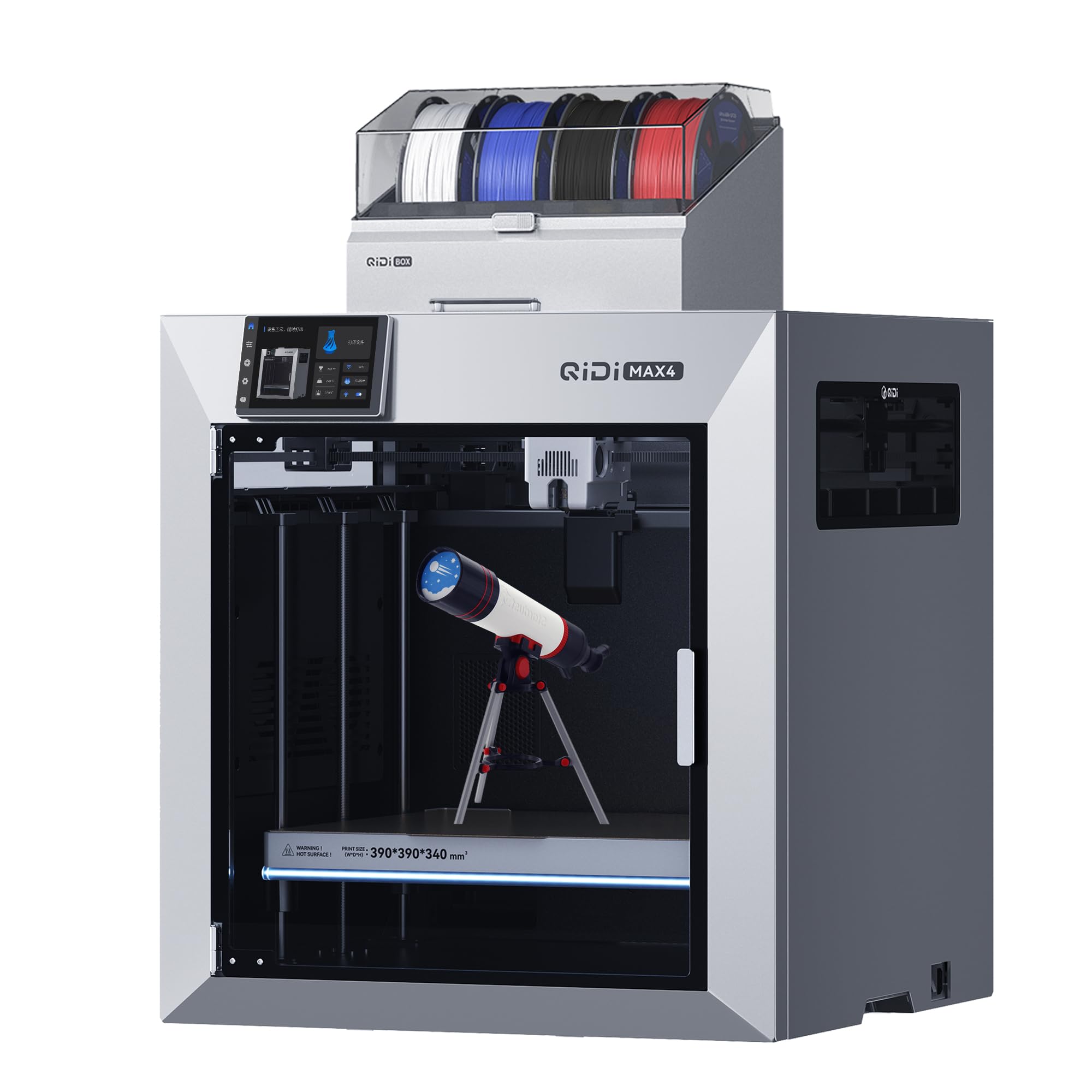
An industrial-scale chamber that prints entire helmet shells and mechanical parts in one go.
The Max4 Combo gives you a 390mm³ build volume — compared to the Creality K2 Pro’s 300mm³ build volume. It hits a top speed of 800mm/s with 30,000 mm/s² acceleration thanks to closed-loop motors on the X and Y axes, which help keep accuracy high even when the print head is moving large distances. The chamber heats to 65°C, a touch warmer than the K2 Pro’s 60°C, and supports industrial-grade materials like ABS-CF, PC, and PPS-CF straight from the start.
Customers note “700+ hours with minimal issues” and praise the “outstanding print quality” on engineering filaments like PPA-CF and ABS-CF. The QIDI BOX add-on open up 16-color multi-material printing. The machine weighs 120 pounds and measures 28 inches on every side, so it requires permanent floor space. A few reviewers point out a lengthy pre-print calibration process and a high prime purge during color changes, but those are compromises that come with professional-grade features.
What makes it unique
- 390mm³ build volume — the largest in this list, for industrial-sized parts
- 65°C actively heated chamber and hardened steel nozzle for carbon-fiber materials
- Closed-loop motors on X/Y axes maintain precision at 800mm/s
Consider before buying
- 120 pounds — you will not move it once it is set up; plan your workspace
- Pre-print calibration takes noticeably longer than smaller printers
- High filament waste during multi-color purge cycles
The go-to for large engineering prints: if you need a single 390mm³ part in ABS-CF or PPA-CF and you have the space and budget, the Max4 Combo is the right tool.
Overkill if: most of your projects fit inside a 256mm³ cubic space — the weight and footprint do not make sense for occasional small parts.
Understanding the Specs
Heated Chamber vs Enclosed Body
An “enclosed” printer just has walls and a door that block drafts. A printer with a “heated chamber” has an active heating element that warms the air inside to a set temperature, like 60°C or 65°C. The difference matters for ABS: trapped ambient heat from the bed alone might keep the chamber at 35°C on a cold day, while an actively heated chamber stays at 60°C. That extra 25°C reduces internal stress in your ABS part and keeps tall thin walls from curling off the plate.
All-Metal Hotend and Nozzle Temp
Standard PTFE-lined hotends start to degrade above about 260°C. ABS often prints at 250°C to 270°C, which can damage a PTFE liner over time and cause clogs. An all-metal hotend (or bimetal nozzle) moves the heat-break zone so the plastic stays solid higher up in the nozzle. Look for a printer with a rated max temperature of 300°C or 350°C — that means you can print ABS all day without worrying about melting the liner.
FAQ
Can I print ABS on an open-frame printer without an enclosure?
What temperature should the bed be for ABS?
Do I need a heated chamber or is an enclosed body enough?
Why does ABS produce fumes and do I need ventilation?
What is the difference between a Bowden and a direct-drive extruder for ABS?
Can the Bambu Lab P1S print ABS right from the start?
Is a 600mm/s printer actually useful for ABS?
Does the Anycubic Kobra S1 Combo support ABS in its multi-color system?
Final Thoughts: The Verdict
If you want one dependable pick, the abs 3d printer winner is the Bambu Lab P1S because it combines a fully enclosed chamber, a 500mm/s print speed, and a proven ecosystem that produces reliable ABS parts with minimal effort. If you want multi-color ABS and a built-in filament dryer, grab the Anycubic Kobra S1 Combo. And for large-scale engineering-grade projects, the QIDI Max4 Combo delivers a 390mm³ build volume that fits oversize prototype parts without splitting.
How We Picked
We do not accept paid placement. Every pick is matched to a real buyer and a real use-case; we do not hands-on test units.
Sources & Methodology
Specifications: manufacturer listings and product documentation. Review insights: verified customer reviews, as of July 2026. Pricing: not shown on this page (it changes often); check the current price via the retailer link.
As an Amazon Associate, FitlyFast earns from qualifying purchases. This does not affect which products we feature.