
Our readers keep the lights on and the weekend projects moving. As an Amazon Associate, I earn from qualifying purchases.
Specs are compiled from manufacturer listings and verified buyer reviews and can change over time — please confirm the key details on the product page before buying.
Your camper feels like an oven the second the summer sun hits it. Pick the wrong AC and you either drain your battery all night or end up stuck at a full-hookup park. The best choice depends on your battery setup, the size of your space, and how often you camp off-grid. For most buyers, the Gidrox 10000 BTU wins because it heats and cools from a 12V battery bank, includes a whisper-quiet 40dB sleep mode, and has app control — all in one rooftop unit.
I’m Rikta — the founder and writer behind FitlyFast. This guide is built by comparing the manufacturers’ published specifications and the patterns across verified customer reviews, so you get each pick’s real strengths and trade-offs instead of marketing spin.
Whether you drive a van, a trailer, or a truck camper, the right ac for camper balances your battery setup, your space size, and your budget without forcing you to camp exclusively at full-hookup sites.
Quick Picks
- Gidrox 10000 BTU 12V DC RV Air Conditioner with Heater — Best Overall
- Treeligo 10000 BTU 12V DC Rooftop RV Air Conditioner — Top Value
- OutEquip Summit 2 12V 10000 BTU Rooftop AC with Heat Pump — DIY Favorite
- RecPro RV Air Conditioner 13.5K Ducted or Non-Ducted — Quiet Shore-Power King
- OutEquip 10K BTU 12V RV Rooftop Air Conditioner with Heater (Black) — Ultra-Compact 12V
- Coleman-Mach 48204-069 Mach 15 Plus, 15,000 BTU A/C — High-BTU Workhorse
- TOSOT 16000 BTU GO Cool RV Air Conditioner with Heat Pump — Premium All-in-One
How To Choose The Best AC For Camper
Start with one big question: do you camp with shore power most of the time, or do you spend nights off the grid on your batteries? Your answer decides whether a 120V unit or a 12V DC unit makes sense. If you plan to boondock (camp without hookups), a 12V rooftop unit with an inverter compressor is your best bet because it sips power from your battery bank without needing a generator. If you always have shore power, a traditional 120V RV AC is simpler and often cheaper per BTU.
BTU Ratings and Your Camper Size
BTU (British Thermal Unit) measures raw cooling power — the amount of heat the AC removes per hour. A 10,000 BTU unit works well for smaller vans and campers up to about 20 feet. Bigger trailers and motorhomes benefit from 13,500 or 15,000 BTU units. The catch: more BTUs usually draw more power, so a larger unit can drain a battery bank faster. Match the BTU to your space rather than buying the biggest number.
12V DC vs 120V AC Power
A 12V DC camper AC runs directly off your house battery without an inverter, which avoids the 10-15% efficiency loss that happens when you convert DC to AC and back. That matters a lot when you are counting every amp-hour (a unit of battery capacity). A 120V AC unit needs shore power or a generator, but some models can be paired with a soft-start device (a gadget that reduces the startup power surge) to run from a smaller portable generator.
Inverter Compressor Technology
An inverter compressor varies its speed to maintain temperature rather than cycling on and off at full blast. This saves battery power and keeps the noise down. Units with inverter tech, like the Treeligo and Gidrox picks below, adjust automatically so you are not hammering your battery every time the compressor kicks in.
Quick Comparison
| Model | Best For | BTU | Power Source | Weight | Amazon |
|---|---|---|---|---|---|
| Gidrox 10000 BTU | All-season comfort + App control | 10,000 | 12V DC | 52 lbs | Amazon |
| Treeligo 10000 BTU | Budget-friendly off-grid cooling | 10,000 | 12V DC | 40 lbs | Amazon |
| OutEquip Summit 2 (w/ Heater) | DIY van builds & solar setups | 10,000 | 12V/24V/48V DC | 43 lbs | Amazon |
| RecPro 13.5K | Quiet 120V for shore power | 13,500 | 110-120V AC | — | Amazon |
| OutEquip 10K (Black) | Sleek low-profile on tight roof | 10,000 | 12V DC | ~45 lbs | Amazon |
| Coleman-Mach 15 Plus | High-BTU replacement unit | 15,000 | 120V AC | — | Amazon |
| TOSOT 16000 GO Cool | Year-round heat pump + WiFi | 16,000 | 120V AC | — | Amazon |
In-Depth Reviews
1. Gidrox 10000 BTU 12V DC RV Air Conditioner with Heater
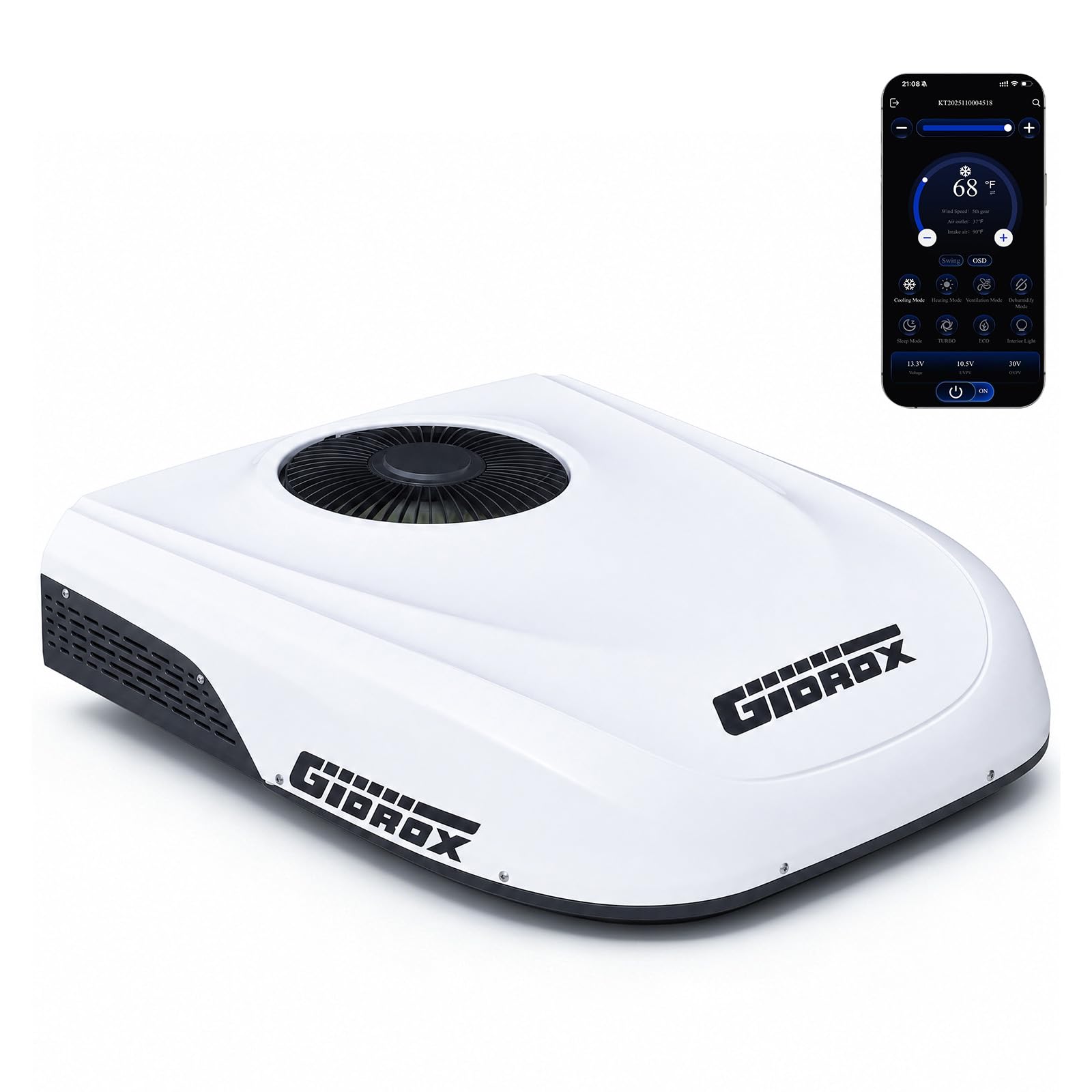
The year-round companion that heats and cools from your battery bank.
This unit does something most 12V camper ACs do not: it packs a PTC heater (a positive temperature coefficient ceramic element that self-regulates heat, giving you instant warmth below freezing) alongside the cooling, so you get warmth on chilly mornings without firing up your propane furnace. On the cooling side, it runs directly off 12V DC with an average tested power draw of roughly 350W overnight in 30°C (86°F) ambient conditions, according to the manufacturer. Pair that with a 400Ah battery and buyers report it handles all-night use comfortably.
It is quiet too: in Sleep mode the brushless fan drops to 40dB — that is a library-quiet hum. That is noticeably quieter than the Treeligo unit’s 50dB. The trade-off is weight: at 52 pounds it is 30% heavier than the Treeligo 10000 BTU’s 40 pounds, which matters if you are lifting solo onto a van roof. The app control (Bluetooth) gives you temperature, timer, and °C/°F switching from your phone. One reviewer noted they “dropped circuit board during install; Gidrox sent free replacement, paid return shipping,” which says a lot about the company’s support. The Gidrox also draws 2930 Watts annually versus the Treeligo’s 800 Watts — that is a 3.7x gap — but that annual figure reflects a different measurement standard, not necessarily real-world battery drain. It fits a standard 14×14-inch roof cutout and comes with a 19.7-foot power cable.
Why It Leads
- Integrated PTC heater for year-round use, no furnace needed.
- Sleep mode at 40dB is whisper-quiet — quieter than the Treeligo’s 50dB.
- Three control methods: app, remote, and physical panel.
The Trade-Offs
- 52 lbs is noticeably heavier than many 12V rivals (like the Treeligo at 40 lbs).
- Some buyers found the bolts too short for thicker roofs and needed longer 8mm all-thread.
- Premium price reflects the heater and app features.
The all-seasons pick: For anyone who wants cooling plus the ability to knock off the morning chill without propane, this is the most complete 12V rooftop option in this lineup.
The catch to know: If you have a very thick roof over 3.5 inches, plan to buy longer threaded rods before you start installing.
2. Treeligo 10000 BTU 12V DC Rooftop RV Air Conditioner
The lightweight, low-profile entry point for 12V battery-powered cooling.
At 40 pounds and only 5.5 inches tall, the Treeligo is built for vans and campers where roof space and weight matter. It uses an inverter compressor (a variable-speed motor that adjusts its power draw instead of slamming on and off) and delivers 10,000 BTU with the outlet temperature dropping as low as 43°F (6.2°C). The compressor is quieter than a standard RV AC at 50dB, and it comes with a 5-meter power cord to reach most battery banks. One buyer mentioned, “Installed it, its pretty straight forward. It works no problem with my 12v 300 ah battery,” which gives a solid real-world reference for battery pairing. The electric swing air outlet (a motorized vent that moves left and right) spreads air evenly across the camper, so you are not freezing in one seat and sweating in another.
The big differentiator here is price: it sits squarely in the budget-friendly tier for a 12V inverter unit, which makes it a smart entry point if you are building a DIY camper and watching costs. The main trade-off is that it lacks a built-in heater — the Gidrox above costs more but includes that function. Also, the annual energy consumption spec is 800 Watts, which is a 3.7x gap in the label’s favor versus the Gidrox’s 2930 Watts, though that number likely reflects different testing conditions rather than your actual night-to-night battery drain. The compatible roof cutout is 13.8-14.6 inches long and 9.8-10.6 inches wide — check your roof dimensions before ordering.
Why It Wins on Value
- Weighs only 40 lbs — 12 lbs less than the Gidrox — for easier solo roof installation.
- Ultra-slim 5.5-inch profile keeps your roof sleek and reduces wind drag.
- Inverter compressor and electric swing louvers provide even, efficient cooling.
The Limits You Should Know
- No integrated heater — you will need a separate source for cold mornings.
- 50dB is quiet but the Gidrox’s Sleep mode (40dB) is noticeably quieter.
- Some owners mention bolt-hole alignment issues during installation.
Best budget-friendly 12V starter: If you are on a tighter budget and your camper stays in warm climates, the Treeligo delivers 10,000 BTU of battery-friendly cooling at a lower cost than nearly any competitor.
Who should skip it: Anyone who needs heating and does not want to carry a separate propane or electric heater.
3. OutEquip Summit 2 12V 10000 BTU Rooftop AC with Heat Pump
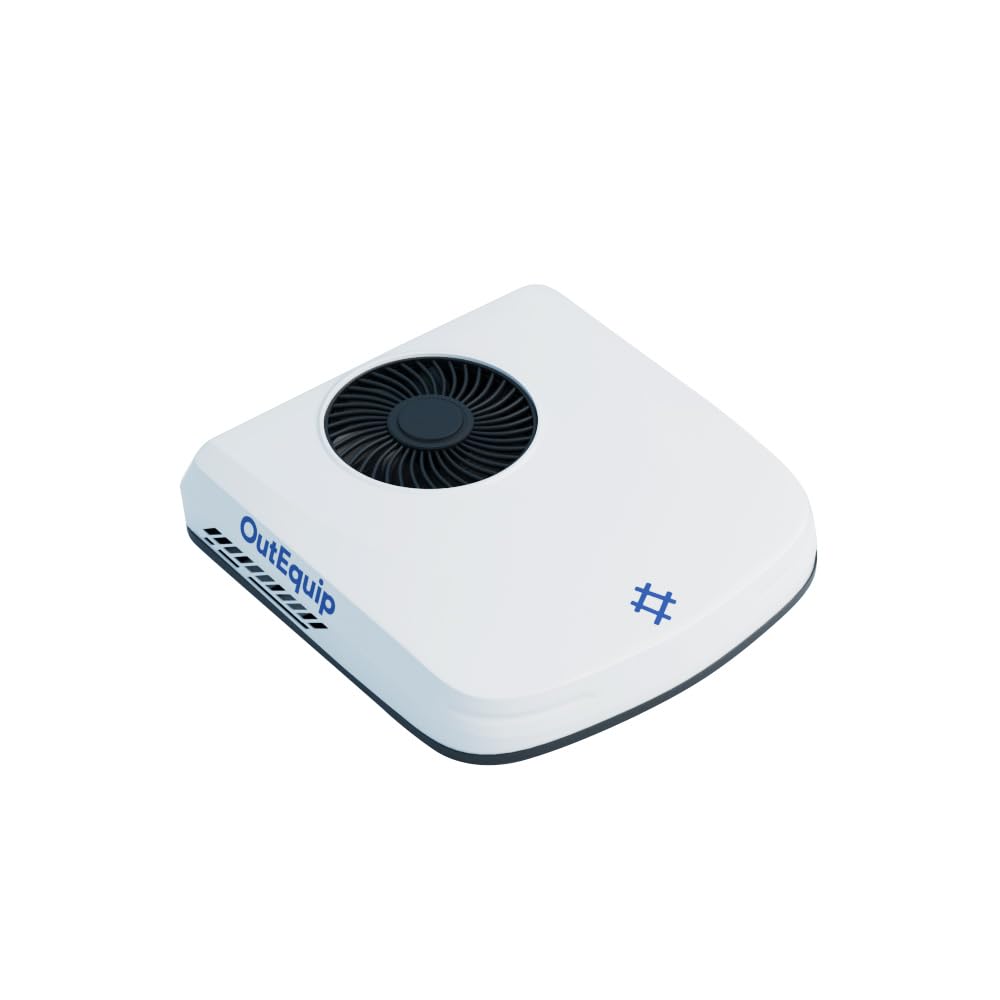
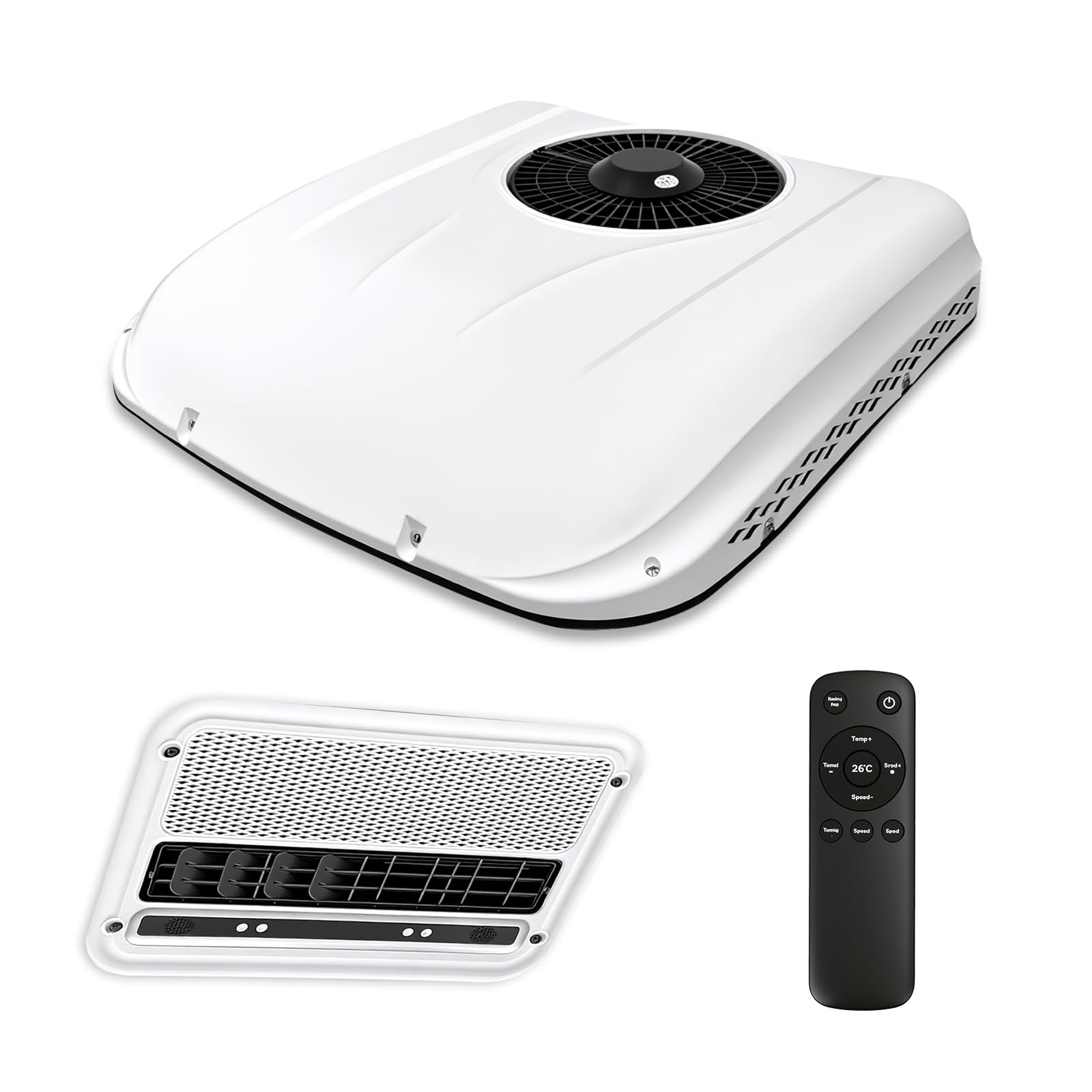
The DIY camper’s secret weapon that sips from a wide range of battery voltages.
This unit stands out because it accepts 12V, 24V, or 48V DC — which means if you built a high-voltage battery bank (common in larger solar setups), you can run it without a voltage converter. The cooling is 10,000 BTU with a 4,500 BTU PTC heater for mild chilly mornings (not arctic camping, as one buyer cautioned). It weighs 43 pounds and sits just over 6 inches tall, so it is low-profile on the roof. One buyer wrote, “I finally pulled the pull the trigger and bought the OutEquipPro Summit 2 Rooftop AC with heat pump for my DIY camper van,” and reported a 4-hour DIY install, from cutting the roof opening to wiring. The installer note is helpful: the minimum roof cutout is 14.1 inches by 10.3 inches, not the standard 14×14, so measure carefully before cutting.
Buyers praise its variable-speed compressor (an inverter) that draws about 16 amps on Eco mode, which lets it run all night on a 600Ah battery bank with 2,200 watts of solar. Annual energy consumption is 960 Watts, making it more efficient than traditional 120V units. The heat pump is supplementary, not a primary heat source in sub-freezing temps, as the data itself notes. The included remote control gives you Eco, Sleep, and Turbo modes. The main frustration in reviews is the fragile lid connectors — one buyer described it as “nearly impossible to remove the lid without breaking at least one of them” — so take extra care during ceiling panel access.
Why Builders Love It
- Runs on 12V, 24V, or 48V DC — rare flexibility for custom electrical setups.
- Lightweight at 43 lbs and low-profile (just over 6 in) for a clean roof.
- Customers note excellent support from OutEquip when voltage mix-ups happened.
The Installation Reality
- Lid connectors are fragile and easily break during first removal.
- Heat pump is only for mild chill — not for extreme cold.
- Roof cutout is an odd size (14.1 x 10.3 in), so verify before cutting.
For the off-grid builder: If you have a high-voltage battery bank and want a versatile 12V/24V/48V unit with a heat pump, this is the most future-proof pick in the list.
The install warning: Treat the interior lid connectors as fragile — they break easily, so be ready with replacement clips or adhesive.
4. RecPro RV Air Conditioner 13.5K Ducted or Non-Ducted

The quietest 120V replacement that fits ducted and non-ducted systems alike.
If you always have shore power and want a straightforward replacement for your worn-out rooftop AC, the RecPro 13.5K runs on standard 110-120V AC and is built to be quiet — just 59.7 dB, which reviewers point out is about 20 dB quieter than the Furrion it replaced. That is a significant drop in noise — so you can sleep through the cooling cycle. It draws low amps for its size, so it can share a 30-amp pedestal with your other appliances. The annual energy consumption is 5,694 Kilowatt Hours Per Year, which is higher than the 12V units, but on shore power that matters less.
The unit is compatible with both ducted and non-ducted setups, and shoppers say a straightforward install in about an hour or two. The included remote and touchscreen LED panel let you switch between Cool, Dry, Fan, Sleep, and Timer modes. The catch: reviews in humid regions like Florida strongly warn that this unit acts as a “humidity generator” — when the compressor cycles off, the fan keeps blowing and re-evaporates moisture back into your camper. Buyers in arid climates love it; those in the Southeast should look elsewhere. The ETL safety certification and Energy Star rating are pluses, but the humid-region complaint is a hard, honest limit.
What Makes It Stand Out
- Quieter than Furrion by about 20 dB, according to owners.
- Ducted or non-ducted flexibility — works with most RV roof systems.
- Low amp draw makes it generator-friendly (reported to work with a 2,200W gen + SoftStart).
Where It Falls Short
- Major humidity issue in coastal climates — the fan re-circulates moisture.
- Remote requires direct line-of-sight (no Wi-Fi or app control).
- No built-in heat pump.
Best for dry-climate shore-power campers: If you park in arid regions or the desert, the RecPro’s quiet operation and dual-duct compatibility are tough to top at this price.
Not for the South: If you camp in humid areas like the Gulf coast or Florida, the moisture re-evaporation issue is a dealbreaker.
5. OutEquip 10K BTU 12V RV Rooftop Air Conditioner with Heater (Black)
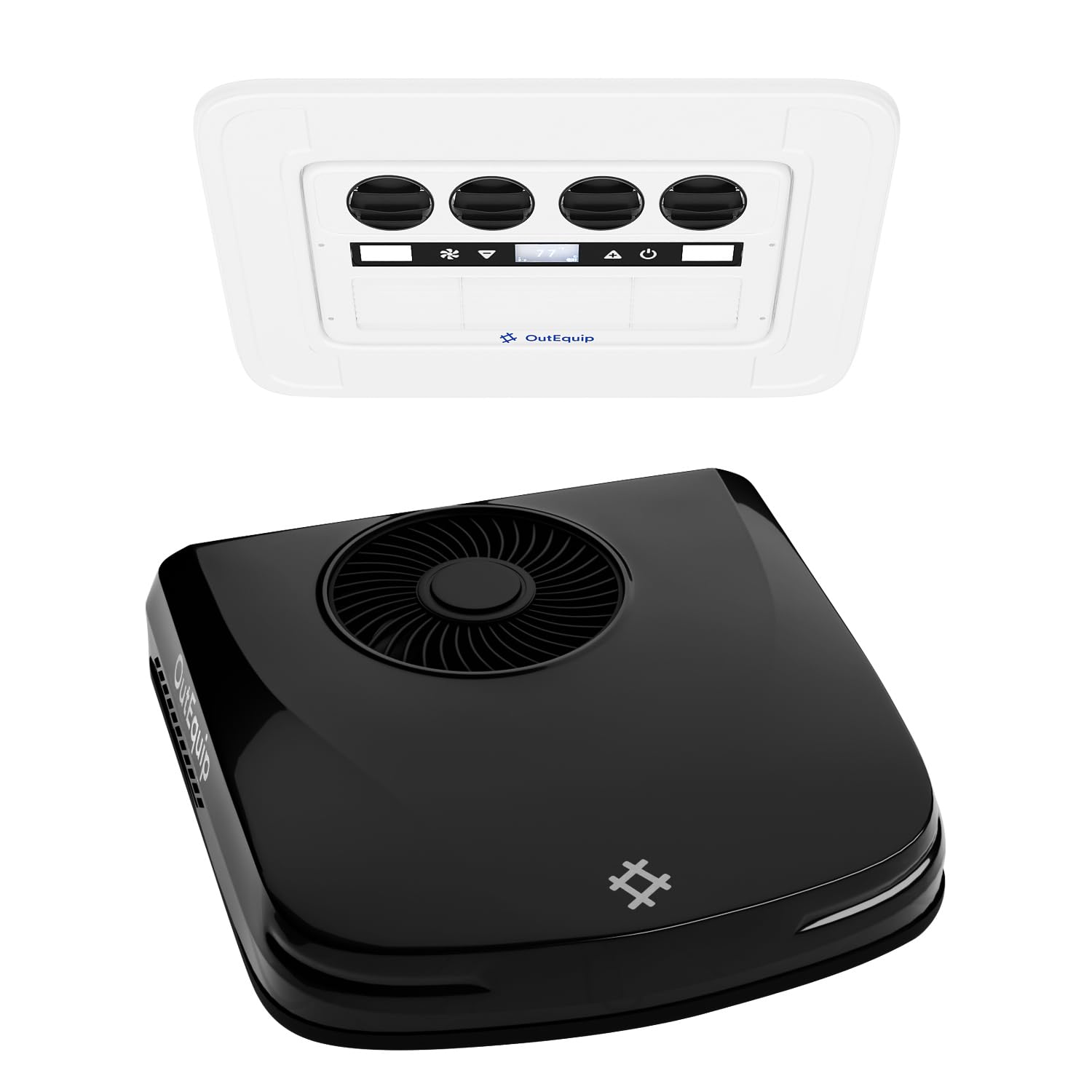
A sleek black unit that stays below a roof rack and cools your camper while you drive.
This OutEquip 10K unit wears a black housing, which helps it blend into darker roof designs and sits low enough to fit under a roof rack — a big deal for vans that carry gear up top. It weighs about 45 pounds and draws 960 Watts annually. The dual brushless copper motor fans and anti-vibration mounts keep the noise low enough for sleeping, and buyers in Arizona heat report it “keeps up with AZ heat” and “cools quickly.” One owner uses it “best for keeping dog cool in truck topper,” which is a specific use-case that shows its flexibility. It offers Eco, Sleep, and Turbo modes, and a remote control with digital temperature display.
Like the other OutEquip unit, this one includes a heater, though buyers report it is “noisy” for heating and “not useful” for serious cold — it is a supplementary heat source, not a furnace replacement. The remote beeps (which some users find annoying) and the unit lacks Bluetooth, so you cannot monitor temperatures while driving. The real differentiator here is appearance and clearance: if your camper has a low roof or a rack, the black low-profile design fits where a taller white unit would not. The downside is that the included hardware brackets may be too short for very thick roof structures, so check your roof thickness before you commit.
Why It Fits Tight Spaces
- Sleek black low-profile housing clears roof racks and looks minimal.
- Lightweight at ~45 lbs and easy solo installation.
- Dual brushless copper fans and anti-vibration mounts for quiet sleep.
The Noise Caveats
- Heater is noisy when running — fine for warmth, not for silence.
- No Bluetooth or app, so you cannot check temperature from the cab.
- Some owners mention the bracket bolts are too short for thicker roofs.
For the van-lifer with a roof rack: If your camper has low clearance or you carry a kayak/solar rack up top, this black low-profile unit fits where taller ACs cannot.
Skip if you want smart features: The lack of Wi-Fi or Bluetooth means you rely entirely on the remote or panel.
6. Coleman-Mach 48204-069 Mach 15 Plus, 15,000 BTU A/C

The brute-force 15,000-BTU swap for big RVs that stay on shore power.
The Coleman-Mach 15 Plus is a pure 120V AC rooftop unit (no 12V battery option) designed to cool big spaces — think 30-40 foot fifth wheels and Class A motorhomes. At 15,000 BTU, it outpaces most competitors in raw cooling, and it uses the newer Puron refrigerant (also called R-410A). One buyer, a former HVAC tech, measured a 30°F differential between suction and discharge lines — which is excellent performance for an RV AC — and reported it kept a 40-foot rig with three slide-outs at 75°F in 90°F weather after four hours. That kind of real-world data shows its capabilities for large, poorly-insulated campers. It includes a wood skid for shipping protection and is a stand-alone unit.
The catch that pops up in buyer reviews is that the unit ships without a control module (the part with the freeze sensor that tells the AC when to cycle) — you must buy the control box separately if yours is old or missing. Some buyers also noted the outer casing arrived damaged from shipping, though the unit still operated fine. It is not a 12V unit, so it cannot run off your battery bank without a heavy inverter. If you are replacing an old Coleman unit, the install is straightforward plug-and-play with basic tools — one buyer did it in about an hour with a helper. The lack of a heat pump is also something to note: cooling only.
The Big Cooling Advantage
- 15,000 BTU provides serious cooling for large RVs, outperforming smaller 13.5K units.
- Plug-and-play replacement for most Coleman rooftop openings.
- Customers note excellent temperature differentials (30°F drop) in hot weather.
What You Need to Know
- Requires a separate control module (not included) to operate.
- 120V only — no battery-powered off-grid use without a large inverter.
- No heat pump or built-in heater.
For the big-rig owner with shore power: If you have a large fifth wheel or a Class A and only camp with hookups, the 15,000 BTU Coleman is among the most proven, powerful drop-in replacements on the market.
The gotcha: Order the control module at the same time, or you will have a non-functioning unit sitting on your roof.
7. TOSOT 16000 BTU GO Cool RV Air Conditioner with Heat Pump

The WiFi-ready powerhouse that heats, cools, and stays whisper-quiet.
The TOSOT GO Cool is the most feature-dense unit in this list: 16,000 BTU cooling, a 12,500 BTU heat pump for electric warmth, WiFi control via the Gree+ app, and a rated noise level of 43dB — which the brand says is 32% quieter than standard RV ACs. It operates in ambient temperatures from 23°F to 115°F, making it genuinely all-season. One owner reported it “keeps 23ft trailer at 70°F in 105°F heat” and called it a direct replacement for a failed Dometic 13.5K unit. It also uses only about 800 watts on high cooling, which is remarkably efficient for its BTU class. The heat pump is great for shoulder-season camping (spring and fall) when you do not want to run your propane furnace just to take the chill off. ETL certified for safety.
The install is designed for standard 14.25 x 14.25-inch roof openings, and it ships in two packages. The main downside: reviewers point out Amazon often delivers only one of the two packages, or the box arrives damaged. One review explicitly says, “Would buy from Tosotdirect instead” to avoid shipping hassles. The indoor mounting screws are reportedly difficult to align, and the vents have poor airflow control. The remote is generic with unclear labels. Still, for someone with a midsize camper (16-24 feet) who wants the highest BTU capacity plus WiFi and a heat pump in one package, the TOSOT is a compelling single-box solution. No battery-powered 12V option here though — this is strictly 120V AC shore power.
What Makes It Premium
- 16,000 BTU cooling + 12,500 BTU heat pump for year-round use.
- WiFi via Gree+ app for smartphone temperature control.
- 43dB is genuinely quiet — quieter than a normal conversation.
Where It Stumbles
- Ships in two packages — Amazon delivery frequently mishandles this.
- No 12V DC option; requires shore power or a generator.
- Indoor panel screws are hard to align, and the remote has confusing buttons.
For the tech-ready camper owner: If your goal is max BTU and WiFi control for a medium-sized travel trailer or Class C, the TOSOT GO Cool delivers the highest cooling capacity and the lowest noise in one package.
Who should avoid it: Off-grid boondockers — this unit will drain a battery fast. Stick with a 12V DC unit for solar/battery setups.
Understanding the Specs
BTU — What It Actually Means for Your Camper
BTU (British Thermal Unit) measures how much heat the AC can remove per hour. A 10,000 BTU unit typically handles vans and small campers up to about 20 feet. A 13,500 BTU unit handles larger trailers and motorhomes. A 15,000 or 16,000 BTU unit is for big rigs or poorly insulated campers. More BTU drains more power, so for battery-powered setups, 10,000 BTU is usually the balance for all-night cooling without killing your bank.
12V DC vs 120V AC — Which Power Source Do You Need?
12V DC units run directly off your camper’s house battery — no inverter needed, no conversion losses. This is the best choice for boondocking and off-grid solar setups. 120V AC units are more powerful and cheaper per BTU, but they need shore power or a generator to run. If you mostly camp at full-hookup RV parks, a 120V unit is simpler and gives you more BTU for your money. If you like to dry camp in the woods, a 12V inverter unit is the only real option.
Inverter Compressor — The Battery-Saver Everyone Talks About
An inverter compressor (also called a variable-speed compressor) adjusts its motor speed to match the cooling demand, rather than cycling on and off at full power. This makes the unit quieter, maintains a more stable temperature (no hot/cold swings), and draws less power overall. It is the single biggest feature that separates a good battery-powered AC from a power-hungry one. All the 12V DC units on this list use inverter compressors, which is why they can run all night on a battery bank.
Noise Level (dB) — How Quiet is Quiet?
Decibels (dB) measure sound pressure. A normal conversation is about 60 dB. A library is about 40 dB. An RV AC at 50-55 dB is quiet enough for most people to sleep through. Units at 40-43 dB, like the Gidrox and TOSOT, are genuinely whisper-quiet — you will hear the fan but not the compressor cycling. If you are a light sleeper or have kids who wake easily, look for a unit rated at 50 dB or lower, and consider the Sleep mode that some models offer.
FAQ
Will a 12V DC rooftop AC work with my existing battery setup?
Can I install a rooftop AC myself, or do I need a professional?
What roof cutout size do I need for a standard RV AC?
How long can a 10,000 BTU 12V AC run on a single battery charge?
Is a heat pump worth the extra cost on a camper AC?
What is the difference between an inverter AC and a non-inverter AC?
Can I run a 120V camper AC off a portable generator?
Why does my RV AC seem to re-circulate humidity instead of removing it?
What gauge wire do I need to connect a 12V DC roof AC to my battery?
How do I protect my RV AC from lightning strikes and power surges?
Final Thoughts: The Verdict
For most campers who want one AC that does everything — cooling, heating, and all-night off-grid battery compatibility — the winner for the ac for camper category is the Gidrox 10000 BTU because it combines a PTC heater, 40dB sleep mode, and app control in a single 12V rooftop package. If you boondock on a tighter budget and do not need heating, grab the Treeligo 10000 BTU for its lightweight 40-pound build and inverter efficiency. And if you have a large RV with shore power and want maximum cold air, the standout is the raw 16,000-BTU capacity and WiFi convenience of the TOSOT GO Cool.
How We Picked
We do not accept paid placement. Every pick is matched to a real buyer and a real use-case; we do not hands-on test units.
Sources & Methodology
Specifications: manufacturer listings and product documentation. Review insights: verified customer reviews, as of July 2026. Pricing: not shown on this page (it changes often); check the current price via the retailer link.
As an Amazon Associate, FitlyFast earns from qualifying purchases. This does not affect which products we feature.