
Our readers keep the lights on and the weekend projects moving. As an Amazon Associate, I earn from qualifying purchases.
Camping in the summer heat is miserable without a way to cool your tent or RV after the sun goes down. A dedicated AC for camping needs to balance real cooling power with energy efficiency, portability, and the ability to run on battery or a small generator—without keeping you awake all night.
I’m Rikta — the co-founder and writer behind FitlyFast. I’ve spent countless hours analyzing the specs, customer feedback, and real-world performance of portable and rooftop AC units designed for outdoor use to separate the effective ones from the power hogs.
Whether you need a rugged, battery-compatible rooftop unit for your van or a compact tent AC that quietly keeps a small space cool through the night, this guide helps you find the right ac for camping.
How To Choose The Best AC For Camping
Camping ACs are not the same as home window units. The biggest challenge is getting enough cooling without overwhelming your power source—your generator, solar setup, or battery bank. You also need a unit that can handle dust, vibration, and temperature swings. Here are the specs that matter most.
Cooling Power vs. Power Draw
BTU rating tells you how much heat the AC can remove, but the real story is how many watts it pulls to do so. A 10,000 BTU unit that draws 1,400W will drain a small portable power station fast. Look for units with inverter compressors, which use less power to maintain temperature and are significantly quieter. For most campers, a unit between 5,000 and 8,000 BTU with a draw under 600W hits the sweet spot for tents and small RVs.
Portable vs. Rooftop vs. Battery-Powered
Portable units are flexible—you can use them in a tent, truck, or small room. However, the single-hose models are less efficient because they create negative pressure, pulling hot air in from outside. Dual-hose portables or rooftop units are more efficient. Rooftop ACs are the best choice for an RV or van because they free up floor space and distribute cool air from above. Battery-powered units like the EcoFlow Wave 3 add the huge benefit of cordless operation, but come at a premium cost.
Noise Level for Sleep
Nothing ruins a good night’s sleep in the wilderness like a loud compressor kicking on every 15 minutes. Check the decibel rating—anything under 50 dB is considered quiet enough for sleeping. Inverter models run the compressor at variable speeds, avoiding the sudden loud start that non-inverter units make.
Quick Comparison
On smaller screens, swipe sideways to see the full table.
| Model | Category | Best For | Key Spec | Amazon |
|---|---|---|---|---|
| EF ECOFLOW WAVE 3 | Battery-Powered Portable | True cordless freedom | 6100 BTU / 1800W | Amazon |
| Cybertake S2 Pro | Dual-Power Portable | Versatile power options | 5100 BTU / 40 dB | Amazon |
| Outequip 12V Rooftop | Rooftop RV AC | Class B van conversion | 10000 BTU / 20A ECO | Amazon |
| Countrymod 12V Rooftop | Rooftop RV AC | Ultra-low power draw | 10000 BTU / 0.3 kWh | Amazon |
| Outequip w/ Heater | Rooftop RV AC | Cooling + warmth | 10000 BTU / 4500 BTU heat | Amazon |
| BAYKUL 6800 BTU | Dual-Hose Portable | Cooling & heating | 6800 BTU / 550W | Amazon |
| OUTOHOME 5200 BTU | Compact Dual-Hose | Fast tent cooling | 5200 BTU / 400W | Amazon |
| Antarctic Star 10K BTU | Portable Single-Hose | Garage or campsite | 10000 BTU / 600W | Amazon |
| Antarctic Star 8K BTU | Portable Single-Hose | Small room or tent | 8000 BTU / 770W | Amazon |
In‑Depth Reviews
1. EF ECOFLOW WAVE 3 Portable Air Conditioner

The EcoFlow Wave 3 is the only unit in this list that can run for up to 8 hours cordlessly using its optional 1024Wh battery pack. That is a game-changer for tent camping and vanlife where generator noise is not welcome. It delivers 6100 BTU of cooling and 6800 BTU of heating, enough to change the temperature in a medium tent by 15°F in 15 minutes.
The unit is compact at 20 inches and weighs roughly 40 pounds, but the built-in handle makes it manageable. It also recharges from AC in about 75 minutes or can be topped off via solar. The R290 refrigerant is more eco-friendly than traditional options, though it is flammable so you must handle it with care. The companion app gives you remote control over modes, timers, and power monitoring.
Some units have arrived with a non-functional fan (error 38), and EcoFlow’s warranty support outside the US is minimal. Also, there is no window kit included—buyers must DIY an exhaust seal. For anyone who values silence and true cordless operation, though, the Wave 3 is the premium pick.
Why it’s great
- Cordless operation for up to 8 hours with battery pack.
- Fast 15-minute cool-down and app control.
- Quiet sleep mode at 44 dB.
Good to know
- No window kit or exhaust adapter included.
- Warranty support outside the US requires self-funded shipping.
- Price includes AC unit only; the battery is sold separately.
2. Cybertake S2 Pro Portable Camping Air Conditioner
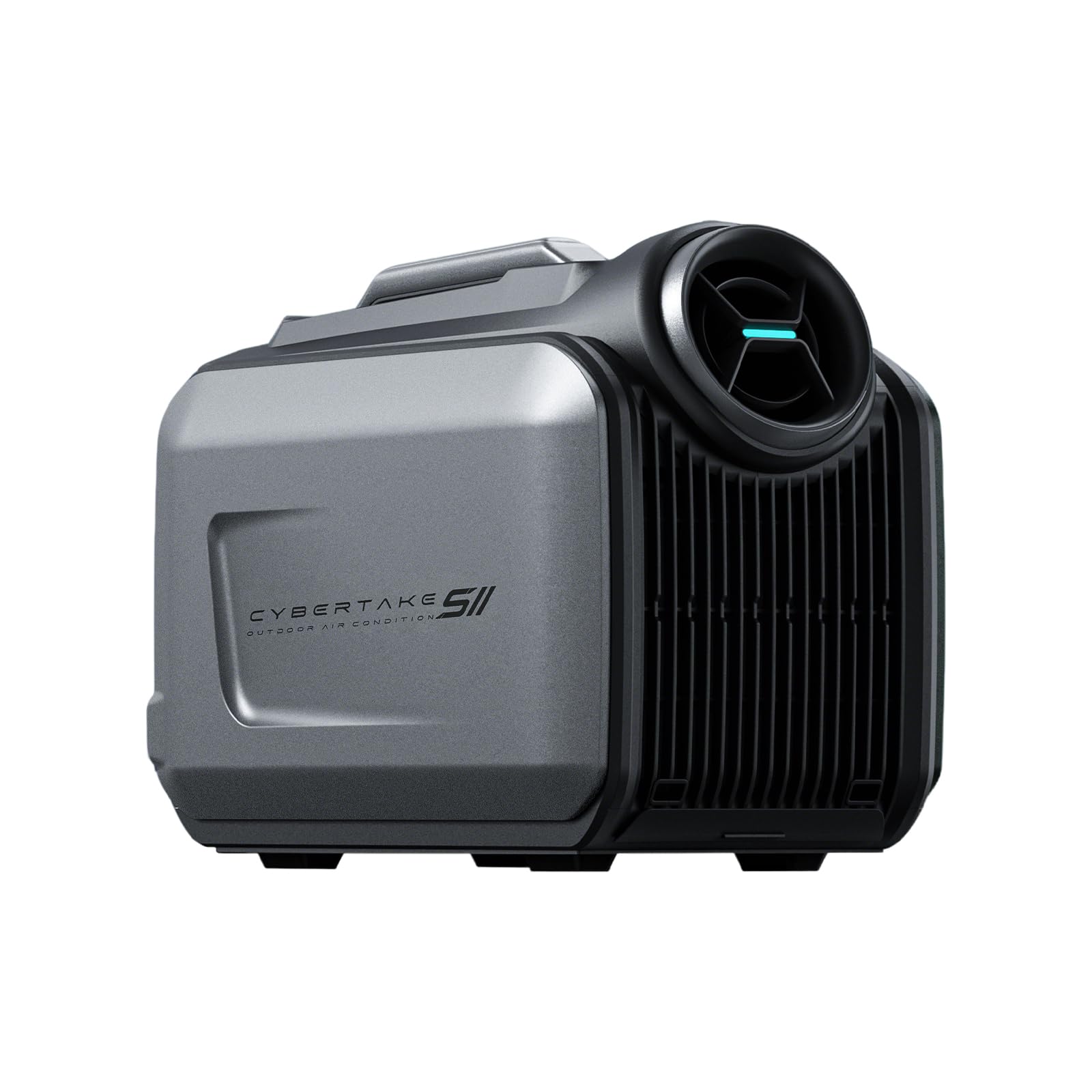
The Cybertake S2 Pro solves the power flexibility problem better than most. It accepts 12V/24V DC from a vehicle battery, 100-240V AC from a wall outlet, or 48V DC from a portable power station. That means you can run it in your truck, your tent, or your RV without worrying about finding the right plug. It delivers 5100 BTU of cooling and 6100 BTU of heating for spaces up to 130 square feet.
Noise is impressively low at 40 dB, comparable to a quiet library. The dual-hose design is much more efficient than single-hose portables, and the auto-swing louvers distribute air evenly. The IPX4 water-resistant shell is a welcome bonus for outdoor use, repelling splashes and rain. Setup is fast—plug in the hoses, set the exhaust, and you are cool in under a minute.
The included 4-inch hose adapter has been reported to blow off the rear plate under high fan speeds, requiring a third-party clamp. Also, the optional remote is expensive for what it is. For campers who need a unit that works with multiple power sources without a separate inverter, the S2 Pro is a solid choice.
Why it’s great
- Runs on 12V, 24V, 48V, or 120V AC power.
- Very quiet at 40 dB in sleep mode.
- Dual-hose design with IPX4 weather resistance.
Good to know
- Hose adapter may blow off without reinforcement.
- Optional remote is costly.
- Cools only up to 130 sq. ft.
3. Outequip 12V 10000 BTU Rooftop AC (w/out Heater)
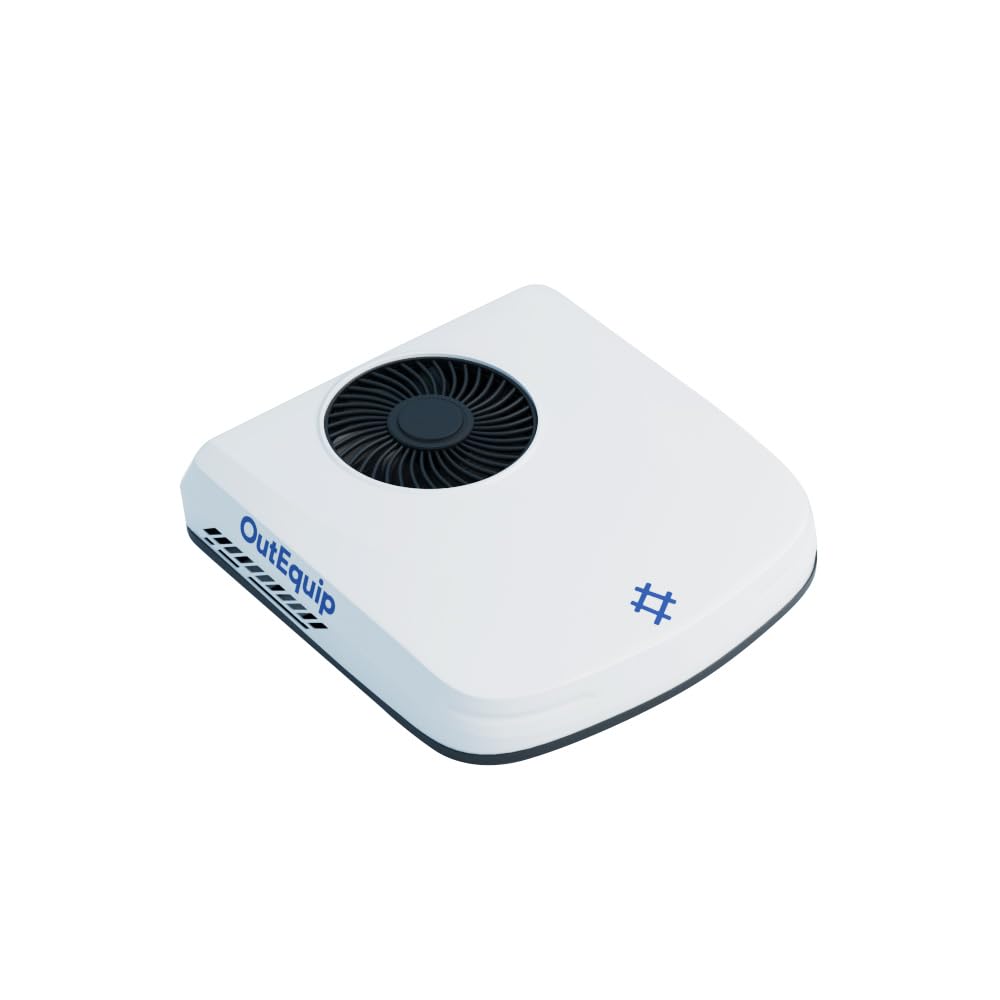
Van conversion owners often struggle to find a quiet, low-profile AC that actually cools. The Outequip 12V rooftop unit is only about 6 inches tall, fitting under tight clearance roofs like the Promaster. It delivers a genuine 10,000 BTU of cooling, handling 105°F Phoenix heat while holding the van at 80°F on a moderate 21A draw on ECO mode.
The inverter compressor runs smoothly and the brushless DC motor keeps noise to a whisper—one reviewer measured 54 dB on high. At 45 pounds, it is lighter than many traditional rooftop units, making solo installation feasible. It fits standard 14×14-inch roof vents, and the included remote gives you access to ECO, sleep, and turbo modes.
Installation instructions are sparse, and the screws can be difficult to remove if the gasket seals tight. Some users reported a 1/4-inch tilt issue if the roof is not perfectly level. Also, this version does not include a heater, making it a pure cooling solution. For Class B van owners who need a compact, efficient 12V AC, this one is hard to beat.
Why it’s great
- Low-profile design fits tight van roofs.
- Very efficient on ECO mode (~20-21A).
- Lightweight at 45 lbs for solo install.
Good to know
- No heater included.
- Install instructions are lacking detail.
- Requires careful sealing to prevent water ingress.
4. Countrymod 12V 10000 BTU RV Air Conditioner
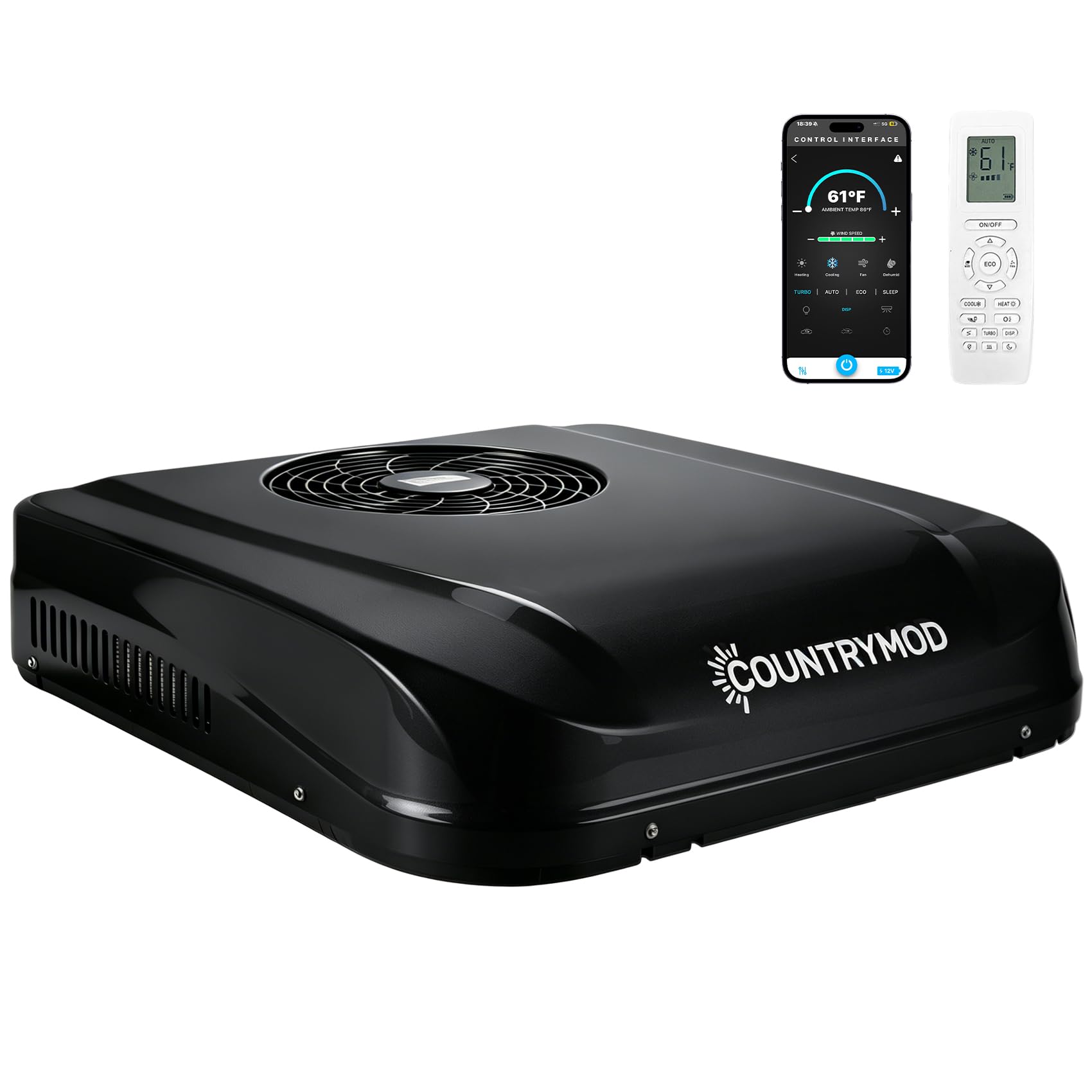
If you are willing to watch a YouTube video for installation, the Countrymod 12V rooftop AC delivers incredible energy efficiency for the price. Consuming only 0.3 kWh per hour (about 260W in ECO mode), it is five times more efficient than standard 120V rooftop units. This means a 480Ah battery bank can run it all night without a generator.
The noise level in sleep mode is around 44 dB—nearly silent. The low-profile design fits a standard 14×14-inch vent and the inverter compressor varies speed instead of cycling on/off, which maintains a steady temperature. The unit articulates air vents well, distributing cool air evenly through the RV. Customer service has been praised for quick responses.
Thicker RV roofs require longer metric bolts (8mm x 160mm) which are not included. The corner bracket may break at low torque if over-tightened. Also, the inner ducts may need gap sealing with insulation. Despite these installation quirks, the performance and efficiency make it one of the best value 12V rooftop units.
Why it’s great
- Extremely low power draw (260W ECO).
- Quiet sleep mode at 44 dB.
- Excellent customer service and support.
Good to know
- Thick roofs require longer bolts (not included).
- Corner bracket fragile at 4.5 lb-ft torque.
- Inner ducts may need gap sealing.
5. Outequip 12V 10000 BTU Rooftop AC (w/ Heater)
This is essentially the same Outequip rooftop unit as product 3 but with a built-in 4500 BTU PTC heater. The cooling side is identical—10,000 BTU with a variable-speed inverter compressor that draws only 200-300W in ECO mode. The heat pump works well for taking the chill off a cold morning, though it is not enough for extreme cold weather camping.
The unit is designed for mobile applications like vans, campervans, and tractors. It weighs about 43 pounds, about half the weight of a traditional Dometic unit, and its low-profile design allows more rooftop solar. Many reviewers report a 40 dB noise level on ECO, making it easy to sleep through. The remote control offers easy access to turbo, eco, and sleep modes.
The lid screws are difficult to remove for installation, and the plastic connectors on the wire harness are fragile and can break. Some users also noted that the heat pump is delayed by up to 10 minutes before blowing warm air. For van owners who want both cooling and supplementary heat in a single rooftop package, this is a compelling option.
Why it’s great
- Cooling and heating in one low-profile unit.
- Lightweight at 43 lbs, easy to install solo.
- Quiet at 40 dB on ECO mode.
Good to know
- Heat pump has a 10-minute delay on startup.
- Lid screws are hard to remove, fragile connectors.
- Heater is not enough for sub-freezing conditions.
6. BAYKUL 6800/7500 BTU Portable Camping Air Conditioner
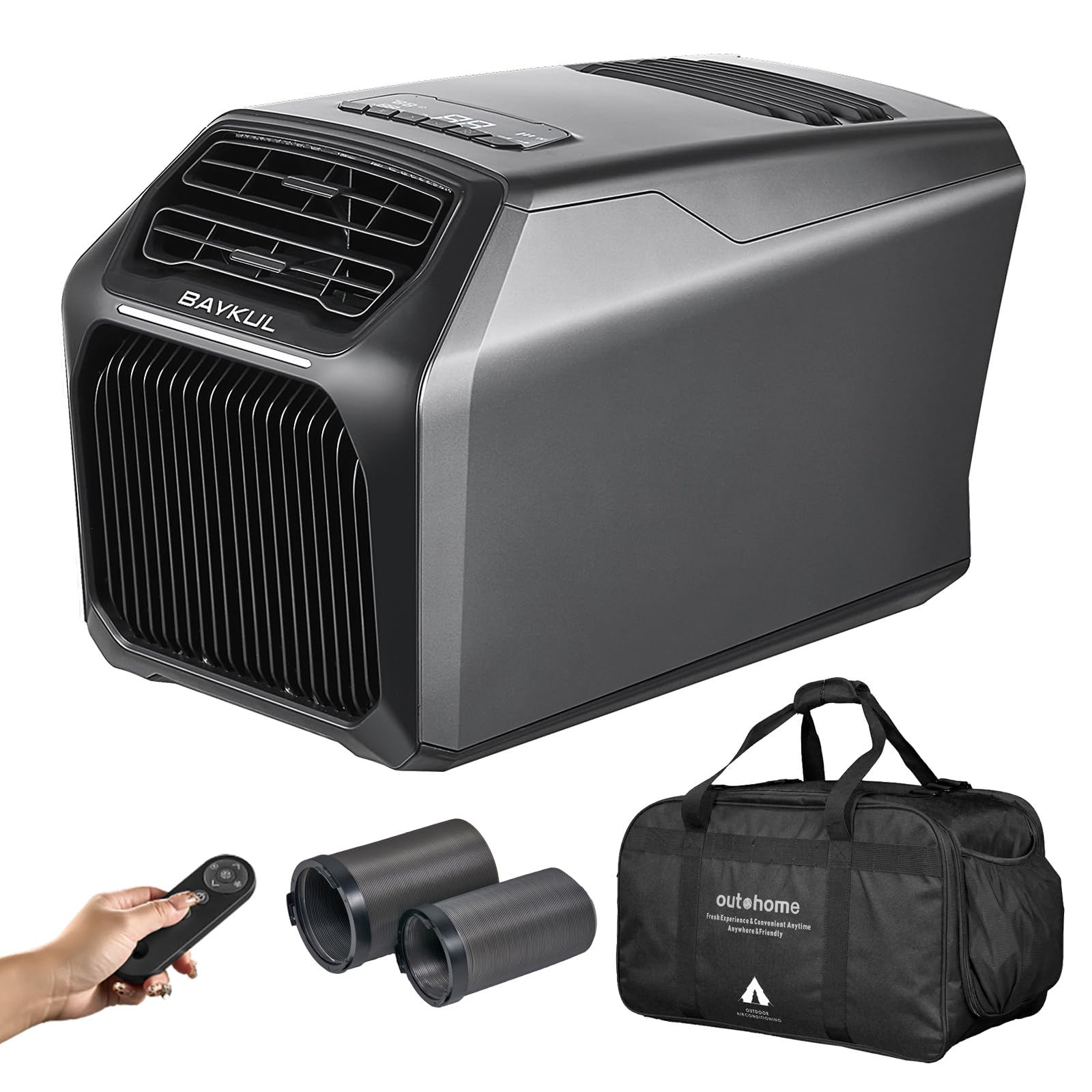
The BAYKUL is a 6-in-1 portable unit that includes a heat pump, making it useful for all four seasons. It delivers 6800 BTU of cooling and 7500 BTU of heating, consuming an average of 550W. This is efficient enough to run on a small inverter generator without stumbling. The compact size is just 30 pounds, and it comes with a carry bag for easy transport.
The dual-hose design (exhaust and intake) means it does not create negative pressure in your tent or RV, which is a major advantage over single-hose units. The RF remote can control the unit even through walls, and the LCD display shows the temperature. At 46 dB, it is quiet enough for sleeping, but not library-quiet.
A significant minority of users report units that run hot and fail to cool effectively, with one HVAC engineer stating the unit got dangerously hot. The warranty support seems inconsistent. Also, the unit is slightly bulky for a carry-on bag despite being relatively light. For campers with a generator who need a dual-hose unit with a heater, this is a capable option if you get a good unit.
Why it’s great
- Dual-hose design is more efficient than single-hose.
- Includes both cooling and heating functions.
- Compact at 30 lbs with a carry bag.
Good to know
- Some units may run hot or fail to cool.
- Warranty support is inconsistent.
- Slightly bulky despite lightweight claim.
7. OUTOHOME 5200 BTU Portable Tent Air Conditioner
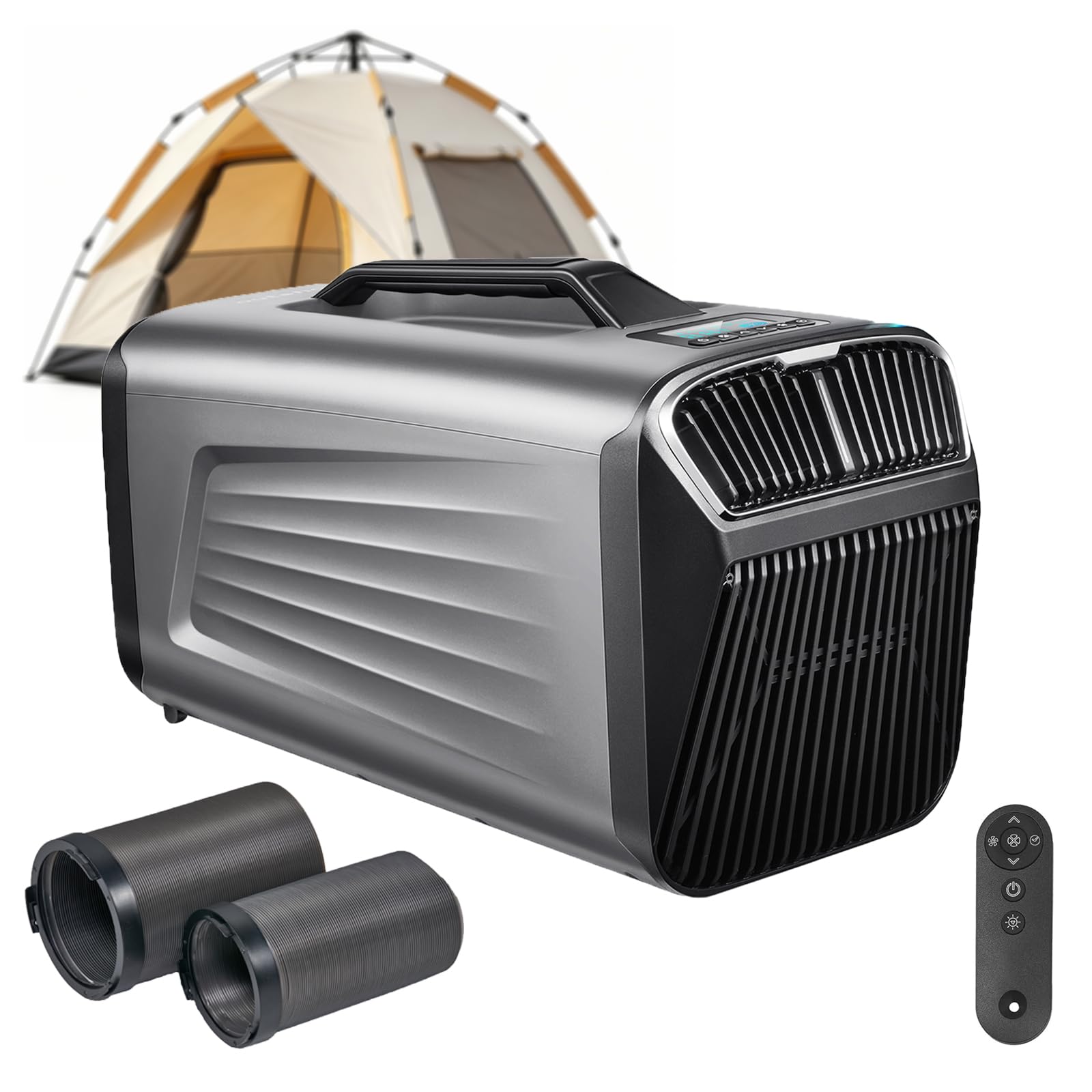
If your primary camping setup is a tent and you have access to shore power or a generator, the OUTOHOME is one of the most efficient options at just 400W consumption. The 5200 BTU cooling capacity can drop the temperature by 18°F in five minutes, according to the manufacturer. The dual-hose design means the hot air from the compressor is vented outside separately, which reduces the load on the tent.
The unit is reasonably compact at 22 x 11 x 14 inches and weighs under 32 pounds. The built-in handle makes it easy to carry from the car to the campsite. The noise level in sleep mode is rated at 46-50 dB, and most reviewers agree the compressor is nearly silent—only the fan is audible. The drainage-free operation works well in humidity below 70%.
A few units have arrived defective, with one user reporting that the unit blows warm air after only one minute of runtime. Also, the display defaults to Celsius and the Fahrenheit setting resets each time the unit is powered off. For campers who need a fast-cooling, low-power AC for a tent, this is a strong mid-range contender.
Why it’s great
- Very low power draw at 400W.
- Dual-hose design improves efficiency.
- Fast cooling with quiet compressor.
Good to know
- Some units may be defective from the factory.
- Display resets to Celsius on power cycle.
- Not fully drainage-free in high humidity.
8. Antarctic Star 10000 BTU Portable Air Conditioner
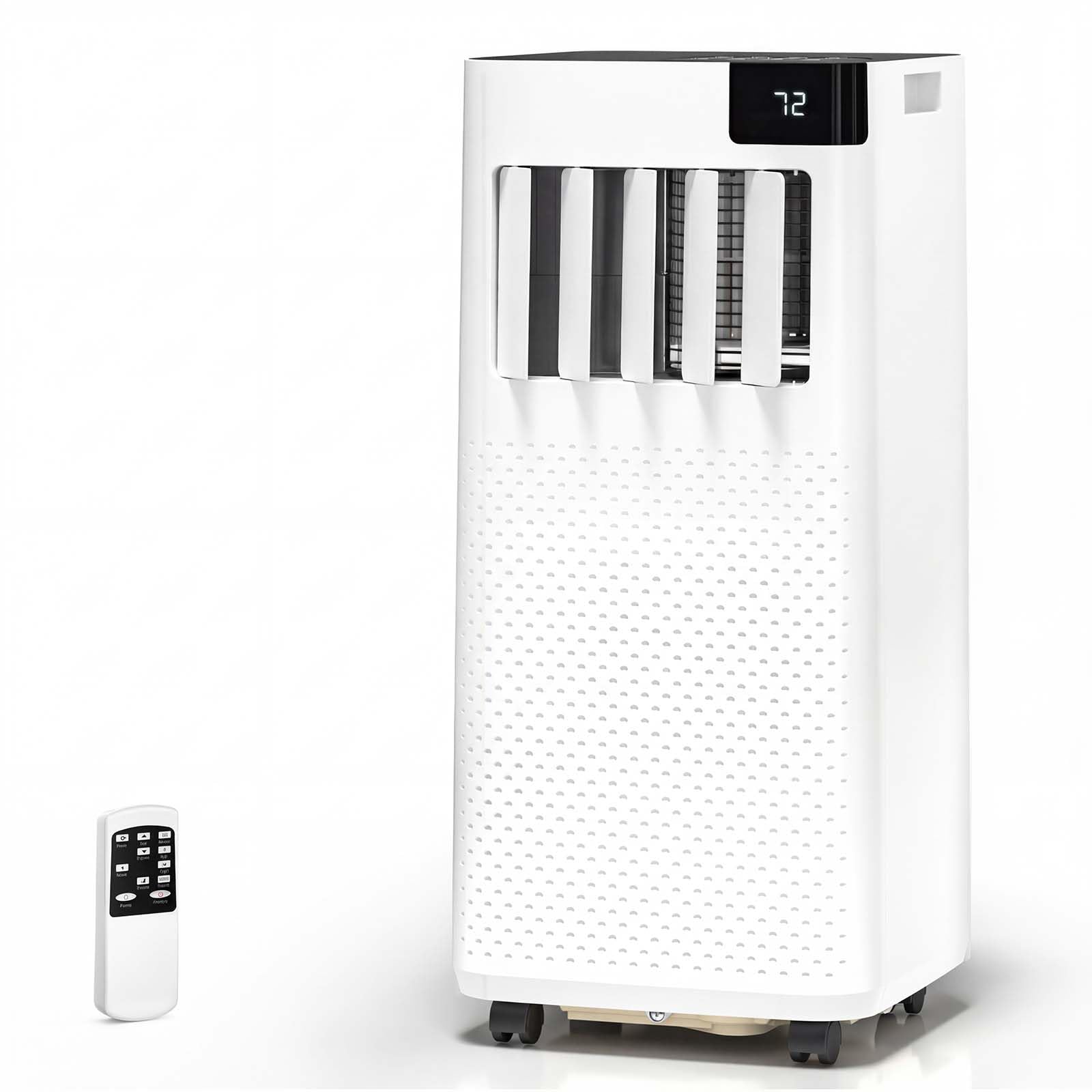
The Antarctic Star 10,000 BTU portable is a classic single-hose unit that is best suited for a campsite with a large tent or a pop-up shelter where you have reliable 120V power. For its price, it delivers genuine cooling for up to 450 square feet, but the single-hose design pulls air from the room, creating negative pressure that draws hot air in from outside. This means it runs less efficiently than a dual-hose unit.
It includes a remote control, 24-hour timer, and auto-swing louvers to distribute air. The self-evaporating system reduces the need to dump a water bucket in most conditions. The caster wheels make it easy to roll, but at 45 pounds, you are not going to carry it far from the car. Installation is straightforward with the included window kit.
The buttons are unresponsive and the fan mode is noisy and inefficient. The non-inverter compressor dims lights on startup and is loud enough to be disruptive. For the price, it is a decent entry-level unit for occasional campsite use, but it is not ideal for a tent or for those who are sensitive to noise.
Why it’s great
- Low entry price for 10,000 BTU output.
- Self-evaporating system, minimal water draining.
- Includes remote and 24-hour timer.
Good to know
- Single-hose design is less efficient.
- Noisy compressor and fan mode.
- Heavy at 45 lbs and bulky for camping.
9. Antarctic Star 8000 BTU Portable Air Conditioner
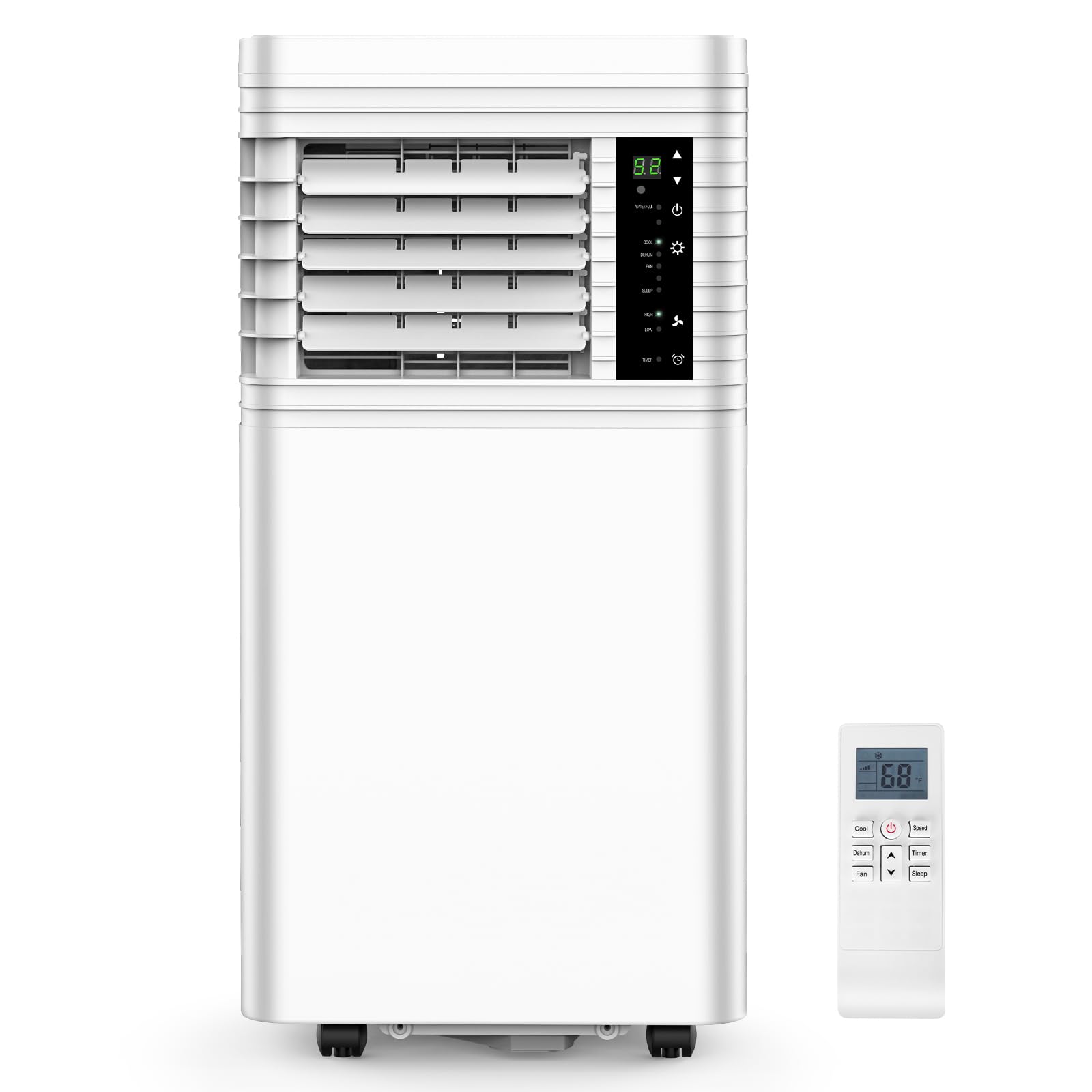
The smaller 8,000 BTU version of the Antarctic Star is slightly more efficient than its 10K sibling, using around 770W of power. It is designed to cool up to 350 square feet, which is a better match for a small room, camper, or a large tent. The included sleep mode automatically adjusts the temperature over 8 hours, which is great for overnight use.
The unit works with both vertical and horizontal sliding windows, giving you more installation flexibility. The washable filter slides out easily for cleaning, and the remote control makes it convenient to change settings without getting up. Some users report that the hose does not fit securely on the exhaust, which reduces cooling efficiency.
The compressor is non-inverter, so it cycles on and off loudly, and the temperature control swings a few degrees above and below the set point. The fan mode is also inefficient, running both fans constantly. For the price, it is a functional unit for occasional campsite cooling, but for regular camping trips, a dual-hose or inverter-based unit will serve you better.
Why it’s great
- Affordable entry-level 8,000 BTU cooling.
- Sleep mode for overnight comfort.
- Works with vertical and horizontal windows.
Good to know
- Hose connection may be loose, reducing efficiency.
- Non-inverter compressor is loud.
- Temperature swings several degrees from set point.
FAQ
What size AC do I need for a tent?
Can I run a camping AC on a portable power station?
Are single-hose ACs good for camping?
Final Thoughts: The Verdict
For most users, the ac for camping winner is the EF ECOFLOW WAVE 3 because it offers true cordless freedom and app control, making it the gold standard for modern campers who value silence and convenience. If you want a dual-hose portable that is extremely efficient on power, grab the OUTOHOME 5200 BTU. And for a permanent low-profile 12V solution in a van or RV, nothing beats the Outequip 12V Rooftop AC for its combination of efficiency, low noise, and build quality.