
Our readers keep the lights on and the weekend projects moving. As an Amazon Associate, I earn from qualifying purchases.
An enclosed trailer without climate control is a metal oven in summer and a damp cooler in spring. Whether you’re hauling horses, converting a cargo hauler into a camper, or running a mobile food truck, the wrong AC unit leaves you sweating through 100-degree afternoons or battling condensation on your equipment. The solution isn’t a window shaker wedged into a plywood cutout — it’s a properly rated system designed for the confined, uninsulated reality of a trailer.
I’m Rikta — the founder and writer behind FitlyFast. I’ve spent years analyzing trailer HVAC hardware, from rooftop RV units to ductless mini-splits, tracking BTU ratings, SEER2 efficiency, inverter compressor performance, and real-world customer durability across portable, split, and rooftop form factors.
This guide breaks down the eleven best options for trailer cooling, comparing installation type, noise levels, and cooling capacity so you can match the right system to your trailer size and power setup. The goal is simple: find the ac for enclosed trailer that keeps you comfortable without wasting money on gear that can’t handle the job.
How To Choose The Best AC For Enclosed Trailer
Trailer AC selection isn’t the same as picking a unit for a house. Enclosed trailers lack the insulation value of residential walls, have limited rooftop access, and often run on 15-amp or 30-amp shore power. Three factors decide whether a unit works or fails.
Match BTU to Trailer Volume, Not Square Footage
Most trailer ACs are rated for square footage, but trailers have lower floor-to-ceiling ratios and thin metal skins that radiate heat. A 12,000 BTU unit that handles 450 square feet in a house might struggle in a 250-square-foot enclosed trailer baking in direct sun. For a cargo trailer, estimate 20–25 BTUs per cubic foot, not per square foot. A 16-foot tandem-axle trailer needs at least 13,500 BTUs; a 28-foot hauler demands 15,000 BTUs or more.
Pick the Right Form Factor for Your Roof and Power
Three installation types dominate this category. Rooftop units (like the Dometic FreshJet 3 or Coleman-Mach 15) bolt through a standard 14×14-inch vent opening, require no interior floor space, and are the default for RV-style trailers. Mini-split systems (like the Mountman or DELLA Vario) split the compressor and evaporator, keeping the noisy hardware outside while the indoor unit mounts on a wall; they require a line-set pass-through and a dedicated breaker. Portable units (like the DREO 515S) sit on the floor and vent through a window or wall panel — they’re the easiest to install but sacrifice floor space and efficiency in a small trailer.
Prioritize Inverter Compressors and SEER2 Ratings
A standard AC compressor cycles on and off at full power, drawing a heavy inrush current that can trip a 15-amp breaker. An inverter compressor ramps up and down, drawing less startup current and maintaining a consistent temperature with less noise. Look for SEER2 ratings above 18 for any mini-split or rooftop unit you plan to run off a generator or solar setup. Higher SEER2 directly translates to lower sustained amp draw — critical when your trailer’s electrical system is limited.
Quick Comparison
On smaller screens, swipe sideways to see the full table.
| Model | Category | Best For | Key Spec | Amazon |
|---|---|---|---|---|
| Mountman 12000 BTU | Mini-Split | Mid-size trailers with 110V outlet | 19 SEER2, 26dB sleep mode | Amazon |
| ROVSUN 9000 BTU | Mini-Split | Small campers & utility trailers | 19 SEER, 28-42dB operation | Amazon |
| DREO 515S Portable | Portable | Rental trailers & temporary setups | 8000 BTU SACC, 45dB noise | Amazon |
| DELLA Vario 12000 BTU | Mini-Split | Garage & shop trailers | 23 SEER2, 28dB quiet rating | Amazon |
| Dometic FreshJet 3 13.5K | Rooftop | RV trailer replacement, quiet upgraded | 21 SEER, 4dB quieter than Brisk II | Amazon |
| Coleman-Mach 15 Plus 15K | Rooftop | Large travel trailers, Texas heat | 15000 BTU, Puron refrigerant | Amazon |
| TOSOT 16000 BTU RV | Rooftop | Class B/C vans, 24ft trailers | 43dB, heat pump, WiFi | Amazon |
| Furrion Chill Cube 18K | Rooftop | Large fifth wheels, solar/RV parks | Variable speed, ~850W draw, 72.4 lbs | Amazon |
| Coleman-Mach 15 Upper 15K | Rooftop | 32-foot Class A motorhome | 80+ lbs, scroll compressor | Amazon |
| RecPro 15K Ducted/Non-Ducted | Rooftop | Swing-season camping, heat pump need | 55.4dB quiet, low amp draw | Amazon |
| Dometic Brisk II 15K | Rooftop | 1980s-2000s RV trailer replacement | 15000 BTU, non-ducted ADB required | Amazon |
In‑Depth Reviews
1. Mountman 12000 BTU Mini Split AC/Heating System
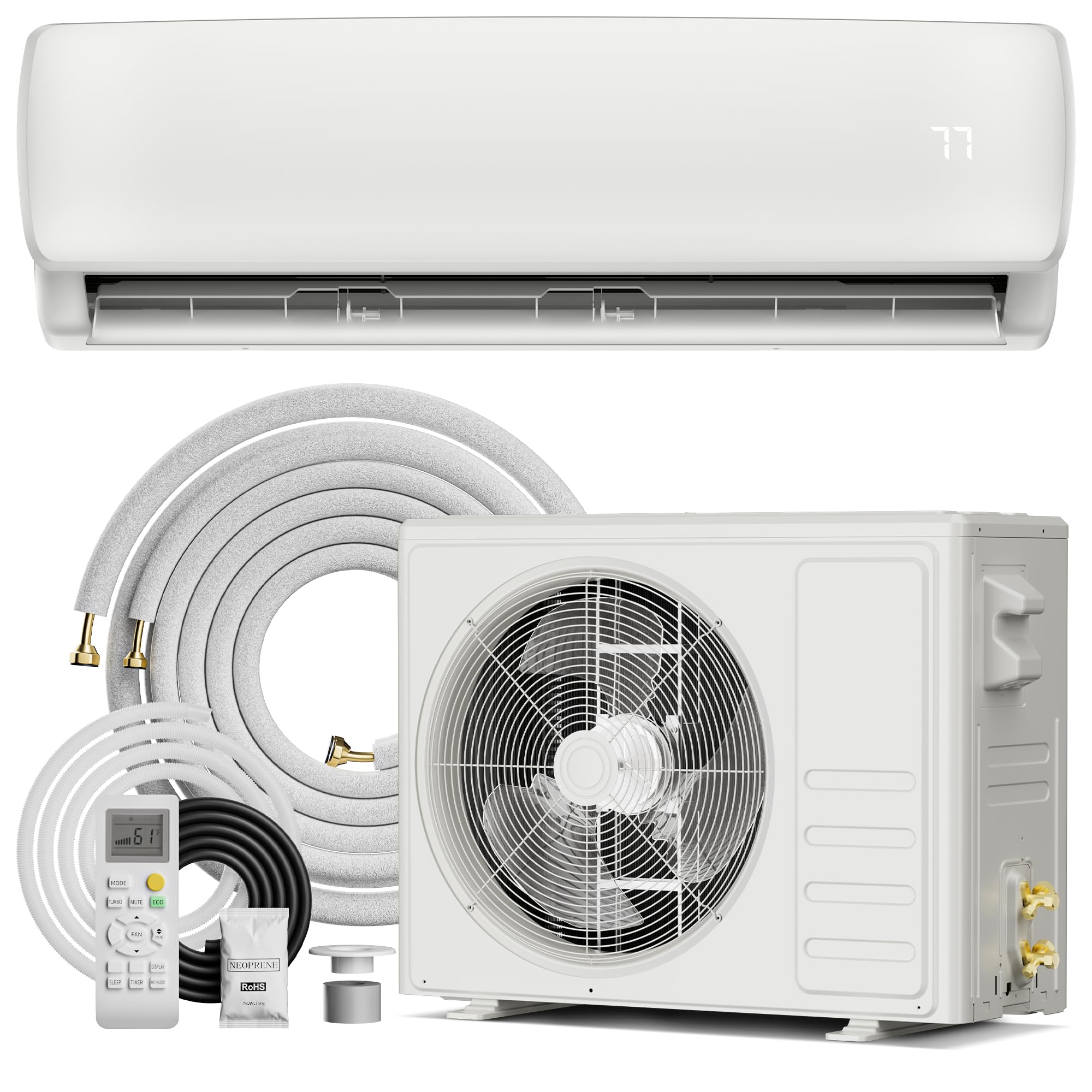
The Mountman hits a rare sweet spot for enclosed trailers: enough BTU capacity (12,000) to cool a 7×16 cargo hauler or small food truck, but running on standard 110/120V power so you don’t need a dedicated 220V line. Its inverter compressor at 19 SEER2 pulls roughly 12 amps during peak demand and can drop to 10% output when the temperature differential is small, which matters when your trailer is connected to a 15-amp shoreline.
The indoor unit is whisper-quiet at 26dB in sleep mode — a meaningful spec for overnight rest in a camper conversion. The included installation kit covers standard line-set runs, and the manual provides clear guidance for a DIY vertical mount. Several verified purchasers reported successful self-installation using a vacuum pump and YouTube tutorials, which is rare for a mini-split in this price tier.
One trade-off: the copper lines are on the shorter side, so you’ll need to mount the condenser close to the evaporator. For a trailer, that’s usually fine since you can position the outdoor unit on a hitch-mounted bracket or under the trailer frame. The pre-charged R32 refrigerant removes the need for professional charging, and the four-in-one modes (cool, heat, dry, fan) deliver year-round utility.
Why it’s great
- 19 SEER2 inverter reduces amp draw on limited trailer circuits.
- Ultra-quiet 26dB sleep mode won’t disturb overnight rest.
- Pre-charged R32 with DIY-friendly installation kit.
- Heat pump provides supplemental warmth in shoulder seasons.
Good to know
- Line-set is short; plan for close condenser placement.
- Instructions are dense; a video walkthrough helps first-timers.
2. ROVSUN 9000 BTU Mini Split AC/Heating System

For small enclosed trailers — think 6×12 utility conversions or teardrop-style campers — the ROVSUN 9000 BTU unit offers a lower entry point without stepping down to a flimsy window unit. It covers up to 450 square feet, which translates comfortably to about 200-250 square feet of uninsulated trailer space when accounting for solar gain through metal walls.
The 19 SEER inverter keeps current draw under 7.5 amps on a 110V circuit, meaning you can run a small fridge and lights on the same 15-amp breaker without tripping. The four-way swing function distributes airflow evenly, and at 28-42dB, it’s quieter than a typical RV rooftop unit by a wide margin. Verified customers note that professional installation is recommended for vacuuming the line-set, but experienced DIYers with basic HVAC tools report success.
Long-term reliability is the main question. One reviewer reported a failed evaporator coil after a year, though the replacement unit has been solid. This is a pattern across budget mini-splits — the ROVSUN delivers strong upfront performance, but the scroll compressor and electronics may not match the lifespan of a premium Dometic or Furrion. For a weekend hauler or seasonal use, it’s a legit value play.
Why it’s great
- Under 7.5A draw works on a standard 15A trailer circuit.
- 4-way swing prevents stagnant hot spots in tight layouts.
- Includes heat pump for cold mornings without propane.
Good to know
- Some units have developed evaporator coil leaks within 1-2 years.
- DIY installation requires a vacuum pump and gauges.
3. DREO Portable Air Conditioner 515S
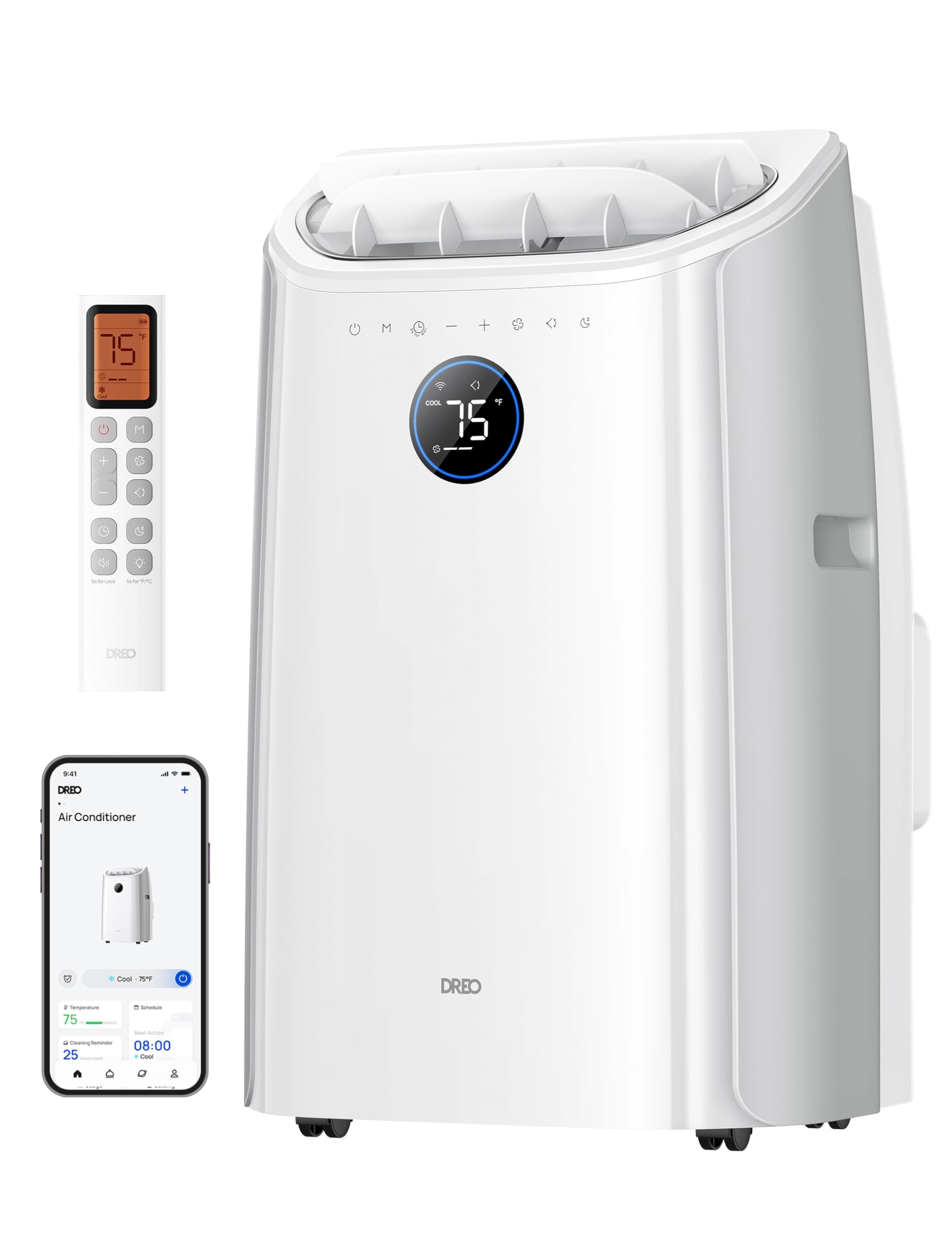
Not every trailer has a roof vent or the structural strength to support a 70-pound rooftop unit. The DREO 515S solves that by sitting on the floor and venting through a window or a simple wall panel cutout. It’s rated at 12,000 BTU ASHRAE (8,000 BTU SACC), which is enough for a 10-14 foot enclosed trailer or a small cargo hauler used for weekend camping.
Where this unit separates from other portable ACs is its drainage-free system. DREO’s patented algorithm and internal pump evaporate condensation automatically in environments up to 90% humidity. No buckets, no drain hose routing — you set it up and forget it. The 45dB noise rating is audibly quieter than traditional portables, and the app-based controls (Google Home, Alexa, Siri) make it easy to pre-cool the trailer before you arrive.
The downsides are inherent to the portable form factor. It occupies floor space, the exhaust hose introduces some heat back into the trailer, and the SACC rating is lower than the ASHRAE number suggests. For a temporary or rental trailer where you can’t cut a roof hole, it’s a practical solution. For permanent installation, a mini-split or rooftop unit will outperform it on efficiency and cooling depth.
Why it’s great
- True self-evaporating system eliminates manual draining.
- Smart home integration for remote pre-cooling.
- Zero roof modifications needed for installation.
Good to know
- SACC rating (8000 BTU) is honest; don’t expect 12K performance.
- Exhaust hose takes up vent space and reduces net efficiency.
4. DELLA Vario Series 12000 BTU Mini Split

The DELLA Vario series runs on 208-230V, which makes it a better fit for trailers with a dedicated 30-amp RV hookup or a permanent shop setup rather than a single 110V outlet. At 23 SEER2, it’s among the most efficient mini-splits in this price range, and the inverter compressor maintains consistent temperature without the abrupt cycling that stresses generator circuits.
Coverage is rated for 550 square feet, which translates to a 20-24 foot enclosed trailer with moderate insulation. The “I Feel” sensor is a smart feature — the remote control senses the temperature at your location and adjusts the unit accordingly, preventing the thermostat from being fooled by a cool wall corner while you’re roasting on the other side of the trailer. The included 16.4-foot installation kit with standard 1/4 and 3/8-inch copper lines is generous for a trailer install where the condenser can sit 10-15 feet away.
Reliability feedback is mixed. Some owners report units running strong for years with no issues, while a minority experienced Freon leaks in the indoor evaporator after about two years. This unit requires professional installation for line-set vacuuming — skipping that step voids performance guarantees. For the SEER2 and smart features, it’s a strong mid-range option if you can handle the 230V requirement.
Why it’s great
- 23 SEER2 delivers excellent energy efficiency for 230V setups.
- “I Feel” remote sensor prevents uneven cooling in long trailers.
- Full 16.4ft installation kit included with standard line sizes.
Good to know
- Requires 208-230V power; not compatible with standard 110V outlets.
- Some units have developed Freon leaks in the indoor coil after 2 years.
5. Dometic FreshJet 3 Series 13.5K BTU

The FreshJet 3 is the upgrade path for anyone currently running a Dometic Brisk II or Penguin and tired of the noise. It’s 4dB quieter than competitive rooftop units, and at 21 SEER, it’s significantly more efficient than older rooftop designs that hover around 9-10 EER. The 13,500 BTU output is sufficient for a 20-24 foot travel trailer, especially when combined with the higher airflow design that moves more cubic feet per minute across the coil.
Installation is backwards-compatible with existing Dometic and competitor air distribution boxes, meaning you can swap the old unit without replacing the ceiling assembly. It’s also 14% lighter than the Brisk II, which reduces roof strain on aluminum-framed trailers. Verified owners report startup draw around 2,000 watts with continuous draw settling at 1,600-1,700 watts and fan-only operation at 450 watts — numbers that work on a 30-amp hookup with some headroom for other appliances.
The main concern is packaging durability during shipping. Multiple reviews document cracked mounting tabs or damaged shrouds on arrival. Dometic’s customer service has issued partial refunds or replacements in most cases, but it’s an extra hassle. For campground use where quiet operation matters, the FreshJet 3 justifies its premium over standard rooftop units.
Why it’s great
- 21 SEER drastically cuts power draw vs older rooftop ACs.
- 14% lighter than Brisk II for safer roof installation.
- Backwards-compatible with existing Dometic ceiling boxes.
Good to know
- Frequent shipping damage reports; inspect thoroughly on arrival.
- Requires separate control box if replacing a non-Dometic unit.
6. Coleman-Mach 48204-069 Mach 15 Plus

When your trailer is parked in direct Texas sun or desert heat, you need 15,000 nominal BTUs and a compressor that can maintain a 30-degree differential. The Coleman-Mach 15 Plus delivers exactly that. One verified owner reported suction line temperatures of 45°F with a 75°F return — a 30°F split — in a 40-foot RV with three slide-outs, maintaining 75°F interior when the outside hit 90°F.
The Mach 15 Plus uses Puron refrigerant (R-410A), which operates at higher pressures than R-22 and provides better heat transfer. The black exterior shroud absorbs less reflected glare than white units on dark-roofed trailers. It includes a wood skid for shipping protection, though some recent shipments have swapped to thick cardboard to reduce weight. The medium-profile design minimizes wind resistance when traveling.
One critical note: the upper unit ships without a control box. If your existing control box is damaged or missing, you must order the 08-0080 lower assembly separately. Several negative experiences stem from buyers not realizing the control module is separate. For a pure drop-in replacement on an existing Mach-series trailer, it’s a powerful upgrade. For a new install, budget for the full kit.
Why it’s great
- Proven 30°F Delta-T performance in extreme heat conditions.
- Puron refrigerant handles high ambient temperatures better than older blends.
- Black shroud reduces visual glare on dark RV roofs.
Good to know
- Control box and mounting hardware sold separately.
- Unit is heavy (80+ lbs); two-person roof install recommended.
7. TOSOT 16000 BTU RV Air Conditioner

The TOSOT is a non-ducted rooftop unit designed to fit a standard 14.25 x 14.25-inch vent opening, making it a direct replacement for most RV-style trailer roofs. At 16,000 BTUs with a 12,500 BTU heat pump, it’s one of the highest-capacity drop-in units in this category, capable of cooling a 24-foot enclosed cargo trailer or Class C motorhome even in 105°F ambient conditions.
The 43dB noise rating is audibly quieter than traditional Dometic or Coleman rooftop units, and the Gree+ app integration lets you adjust temperature, fan speed, and mode from inside the trailer without reaching up to a ceiling panel. The heat pump provides supplemental electric heat down to 23°F, which eliminates the need to run a propane furnace for mild spring and fall camping. Owners report a 2-hour installation time with basic tools, and the complete hardware kit includes everything except a separate control box.
The biggest risk is long-term parts support. TOSOT is a subsidiary of Gree, a major global manufacturer, but their RV-specific product line has less aftermarket presence than Dometic or Coleman. One reviewer’s unit developed a rooftop seal leak after a year, and customer service offered only a replacement unit at full price. For the BTU output and features, it’s a compelling option if you accept the lower service network.
Why it’s great
- 16K BTU on a standard 14×14 roof vent opening is class-leading.
- WiFi app control with Gree+ for remote pre-cooling.
- Heat pump works down to 23°F for four-season utility.
Good to know
- Aftermarket parts and service support are limited.
- Some units develop seal leaks; warranty responsiveness is inconsistent.
8. Furrion Chill Cube 18k BTU Variable Speed

The Furrion Chill Cube represents a step change in rooftop AC technology for trailers. Its variable-speed compressor doesn’t cycle on and off like traditional units — it modulates continuously, drawing about 850 watts once the setpoint is reached. That’s roughly half the sustained draw of a fixed-speed 15K rooftop unit, making it viable for solar-powered trailers and generator runs with limited capacity.
The 18,000 BTU output is enough for a 35-foot fifth wheel or a large enclosed car hauler. At 72.4 pounds, it’s about 10% lighter than comparable units, and the aerodynamic rooftop profile reduces drag while driving. The R32 refrigerant is more environmentally friendly than R-410A and allows for a smaller condenser coil, which contributes to the weight savings. Owners report it cools a 37-foot trailer with a single unit — something that usually requires two 15K rooftop ACs.
The unit ships as an AC-only assembly. You must purchase the air distribution box (ADB) separately for either ducted or non-ducted installation. Some users report that the compressor at certain ramp-up frequencies creates a vibration resonance that transmits through the trailer roof. For most installations, it’s barely noticeable, but in lightweight aluminum trailers, the sound can be more pronounced. If you want inverter-level efficiency in a rooftop form factor, the Chill Cube is the current benchmark.
Why it’s great
- Variable-speed compressor draws ~850W sustained — ideal for solar.
- 18K BTU handles large trailers that normally need two AC units.
- Lightweight 72.4 lb design with R32 refrigerant.
Good to know
- Air distribution box must be purchased separately.
- Compressor vibration can resonate in thin aluminum roof panels.
9. Coleman-Mach 15 Upper Unit 48204C966

This is the upper unit only for the Coleman-Mach 15 series, meant for owners who already have the lower control box and mounting frame from a previous Mach 3 or Mach 8 installation. It delivers 15,000 BTUs with a scroll compressor — a design inherently quieter and more durable than reciprocating compressors found in budget rooftop units.
The external shroud measures 13.8 x 26.1 x 38 inches and sits taller than older Mach 3 models, so check your interior ceiling clearance before ordering. Verified owners on Class A motorhomes report cooling from 80°F to 64°F in 30-45 minutes even in South Florida summer conditions. The pre-installed foam gasket with crush indicators ensures a watertight seal without additional tape or caulk.
The critical detail: this is the upper assembly only. No control box, no mounting hardware, no return air grille. You must verify your existing lower unit is functional. Several negative reviews stem from buyers who installed the upper unit only to discover their control module was incompatible. For a direct swap on an existing Mach-series trailer, it’s a straightforward upgrade. For a new build, you need the full 08-0080 kit.
Why it’s great
- Scroll compressor runs quieter and lasts longer than reciprocating types.
- Pre-installed crush-indicator gasket for foolproof roof sealing.
- Proven 15K cooling even in extreme Southern humidity/heat.
Good to know
- Upper unit only — requires separate control box purchase.
- 80+ lbs; roof lifting requires two people or a strap system.
10. RecPro 15K Ducted or Non-Ducted

RecPro’s 15K unit is designed for flexibility — one SKU works for both ducted and non-ducted trailer installations by swapping the ceiling assembly. That matters if you have a pre-ducted fifth wheel or a cargo trailer where you want to run ceiling vents. The built-in heat pump provides electric heating down to moderate low temps, and the total amp draw is low enough to run alongside a refrigerator and converter on a standard 30-amp circuit.
The noise level is rated at 55.4dB, which is comparable to light rainfall and quieter than the typical rooftop units. Owners upgrading from Dometic units consistently report a noticeable reduction in low-frequency drone. The UV-resistant plastic shroud and aerodynamic profile reduce wind noise while driving, and the sleeved pipes prevent vibration wear on the copper lines — a detail many budget units skip.
Some owners report the sound level is closer to 55-65dB in practice, especially on high fan. The fan runs continuously in most modes, which some users find noticeable after years of cycling units. The Australian manufacturer has responsive customer service, but replacement parts are not as widely available as Dometic or Coleman components. For the heat pump and ducting flexibility at a mid-range price point, it’s a solid contender.
Why it’s great
- Compatible with both ducted and non-ducted ceiling assemblies.
- Heat pump reduces propane use in spring and fall.
- UV-resistant shroud and sleeved pipes improve longevity.
Good to know
- Fan runs continuously; may be noticeable for light sleepers.
- Aftermarket parts availability lags behind Dometic/Coleman.
11. Dometic Brisk II 15K BTU

The Dometic Brisk II is the industry standard for RV trailer rooftop AC — it’s been on thousands of travel trailers from the factory for the past two decades. The 15,000 BTU version cools a 28-32 foot trailer effectively, and the non-ducted design works with a separate air distribution box (ADB) or a standard ceiling vent shroud. It’s not the quietest or most efficient unit on this list, but it’s the most widely available and easiest to find replacement parts for.
Installation is straightforward on trailers with an existing 14×14-inch roof opening. The unit ships with the foam gasket pre-attached, and wiring is standard black/white/ground. Owners in 100°F+ climates report that it keeps their trailers comfortable, especially when paired with a secondary unit in long fifth wheels. The 1,500-1,800 watt draw works on 30-amp shore power with a reasonable load budget.
The trade-offs are the same as any fixed-speed rooftop AC: it cycles loudly, has a distinct compressor start-up sound, and draws roughly double the inrush current of an inverter unit. Several owners noted that the plastic vent levers are fragile and break during the first season. For an exact OEM replacement on a trailer that already has a Dometic roof system, it’s the most predictable choice. For a new build where you control the entire spec, the FreshJet or Chill Cube offers better efficiency and lower noise.
Why it’s great
- Widest parts availability and simplest service path.
- Proven cooling in extreme heat for standard RV layouts.
- Direct bolt-in replacement for thousands of existing trailers.
Good to know
- No inverter — loud cycling and high inrush current.
- Plastic vent levers prone to breaking within a season.
- Control box and ADB sold separately for non-ducted installs.
FAQ
How many BTUs do I need for a 20-foot enclosed trailer?
Can I install a mini-split on a trailer without cutting a roof hole?
Will a portable air conditioner work in a cargo trailer?
Do I need a 30-amp or 50-amp hookup for trailer AC?
Can I run trailer AC off a generator or solar?
Final Thoughts: The Verdict
For most enclosed trailer owners, the ac for enclosed trailer winner is the Mountman 12000 BTU Mini Split because it combines 19 SEER2 inverter efficiency, 110V power compatibility, a functional heat pump, and ultra-quiet 26dB operation in a package that fits small to mid-size trailers without requiring a roof cutout or a 30-amp dedicated circuit. If you want to avoid any floor-space intrusion and need cooling for a larger 28-35 foot hauler, the Furrion Chill Cube 18K offers variable-speed rooftop performance that halves your power draw compared to traditional units. And for a rental, temporary, or low-budget trailer setup where you can’t modify the roof or walls, the DREO 515S portable delivers solid drainage-free cooling with smart controls and zero permanent installation.