
Our readers keep the lights on and the weekend projects moving. As an Amazon Associate, I earn from qualifying purchases.
A slow refrigerant leak is the silent killer of AC efficiency. You notice warmer airflow, rising electric bills, and frequent compressor cycles, but the source remains hidden inside a coil or buried in a line set. Chasing that invisible hiss with soapy water and a flashlight wastes hours of troubleshooting time. The right electronic sniffer turns a frustrating guessing game into a quick, precise pinpoint operation.
I’m Rikta — the co-founder and writer behind FitlyFast. I have spent countless hours combing through field tests, customer reliability reports, and spec sheets from HVAC professionals who depend on these tools daily to separate repeatable performers from single-use gimmicks.
For homeowners and pros alike, the search for an accurate tool narrows down to the best ac leak detector that balances sensitivity, sensor longevity, and real-world convenience without breaking the bank.
How To Choose The Best AC Leak Detector
Refrigerant leaks hide in the most inconvenient places — under insulation, inside microchannel coils, or behind a brazed joint. Choosing the wrong sniffer means you miss the leak entirely or chase ghost readings all afternoon. Focus on three critical factors that separate a useful tool from a frustrating toy.
Sensor Technology — Heated Diode, Infrared, or Corona
Heated diode sensors deliver the best balance of sensitivity and response time for modern refrigerants like R-410A and R-32. They detect leaks as small as 0.03 oz/yr without the drift issues common in corona discharge units. Infrared sensors offer excellent specificity with less false alarming from ambient contaminants, but they cost more. Stick with heated diode for general HVAC work and upgrade to infrared only if you need long-term stability in high-contamination environments.
Sensitivity Rating Measured in Ounces per Year
Manufacturers express sensitivity as the smallest leak a detector can reliably identify in ounces per year. A rating of 0.14 oz/yr catches most serviceable leaks. For micro leak detection — the kind that loses a few pounds of refrigerant over six months — look for 0.10 oz/yr or tighter. Anything above 0.5 oz/yr misses the slow weepers that drive up utility bills.
Battery Life and Probe Reach
An electronic sniffer is useless when the battery dies mid-sweep. Rechargeable lithium-ion packs with USB-C charging eliminate disposable battery waste and keep you running through a full service day. Probe length matters more than you expect — an 18-inch flexible gooseneck reaches behind line sets and into tight condenser compartments where rigid tips cannot fit.
Quick Comparison
On smaller screens, swipe sideways to see the full table.
| Model | Category | Best For | Key Spec | Amazon |
|---|---|---|---|---|
| Fieldpiece DR58 | Premium | Pro-grade micro leaks | 0.03 oz/yr sensitivity | Amazon |
| Elitech ILD-200 | Premium | Long-life IR sensor | Infrared, 0.14 oz/yr | Amazon |
| Aprvtio ALD-200 | Mid-Range | A2L / A3 refrigerant support | Heated diode, 0.14 oz/yr | Amazon |
| SENSYX SFD200 | Mid-Range | Rechargeable cordless use | IR sensor, 5.5″ display | Amazon |
| Elitech CPU-1G | Value | Budget-friendly entry | Corona, 0.11 oz/yr | Amazon |
| Leak Saver Direct Inject | Sealant | DIY repair solution | Sealer + dye + moisture remover | Amazon |
| UEi CD100A | Specialty | Combustible gas & refrigerant | 18″ flexible gooseneck | Amazon |
In-Depth Reviews
1. Fieldpiece DR58 Heated Diode

The Fieldpiece DR58 is the benchmark for professional leak detection with a heated diode sensor that sniffs out leaks smaller than 0.03 oz/yr — twenty times more sensitive than a soap bubble test. It handles all HFC, CFC, HCFC, and HFO blends including the newer A2L refrigerants, making it future-proof for evolving HVAC standards. The backlit LCD screen displays leak intensity numerically, and an LED tip combined with an audible beep gives you three simultaneous cues to zero in on the exact source.
The 17-inch flexible probe slips behind compressor shrouds and into tight evaporator cabinets without disassembly. A rechargeable USB battery delivers up to 18 hours of run time, which covers two full service days on a single charge. Replacement filter tips extend sensor life, and the IP54 rating protects against moisture and oil exposure common in commercial refrigeration environments.
HVAC technicians report that this unit detected micro leaks on outdoor units with light wind present, something cheaper sniffers failed to register. The only caveat is that extreme sensitivity can trigger false positives near dryer sheets or strong soap fragrances, but proper calibration in clean air resolves that quickly. For a technician who cannot afford to miss a single seep, the DR58 is the definitive choice.
Why it’s great
- Industry-leading <0.03 oz/yr sensitivity catches ultra-slow weeps
- IP54 rated against moisture and oil ingress
- Long 17-inch flexible probe reaches confined spaces
- USB rechargeable with 18-hour battery capacity
Good to know
- Premium price positions it for professional use
- May false alarm near strong ambient odors if not calibrated
2. Elitech ILD-200 Infrared Sensor Leak Detector

The Elitech ILD-200 shifts from heated diode to infrared sensor technology, which provides superior resistance to contamination drift and a manufacturer-claimed sensor lifespan of ten years. Infrared detection is inherently more specific to halogenated gas molecules, so it ignores many of the ambient vapor false triggers that plague corona and heated diode units. Sensitivity reaches 0.14 oz/yr with three adjustable levels — High, Medium, and Low — giving you control over the detection radius as you close in on the leak.
A 2.8-inch large color screen displays a peak hold reading that graphically shows the concentration gradient, so you can watch the number climb as the probe approaches the breach. The included hard carry case protects the unit during transport between job sites. It detects all common refrigerants including R-22, R-410A, R-134A, R-404A, R-600a, and R-1234yf blends, making it suitable for both residential AC and automotive systems.
Field reports confirm it found propane fireplace leaks in addition to HVAC refrigerant slow leaks, proving its versatility beyond strictly AC work. The trade-off is a slightly slower response time compared to heated diode sensors when sweeping quickly across a large coil. For a technician who wants a durable, low-maintenance sniffer that stays calibrated longer between zero adjustments, the ILD-200 is a strong pick.
Why it’s great
- Infrared sensor resists contamination drift better than heated diode
- 10-year expected sensor lifespan reduces replacement costs
- Large color peak-display screen shows concentration levels
- Detects all halogenated and hydrocarbon refrigerants
Good to know
- Response speed is slightly slower than heated diode designs
- Premium tier price may exceed DIY budgets
3. Aprvtio ALD-200 3-in-1 Heated Diode Detector
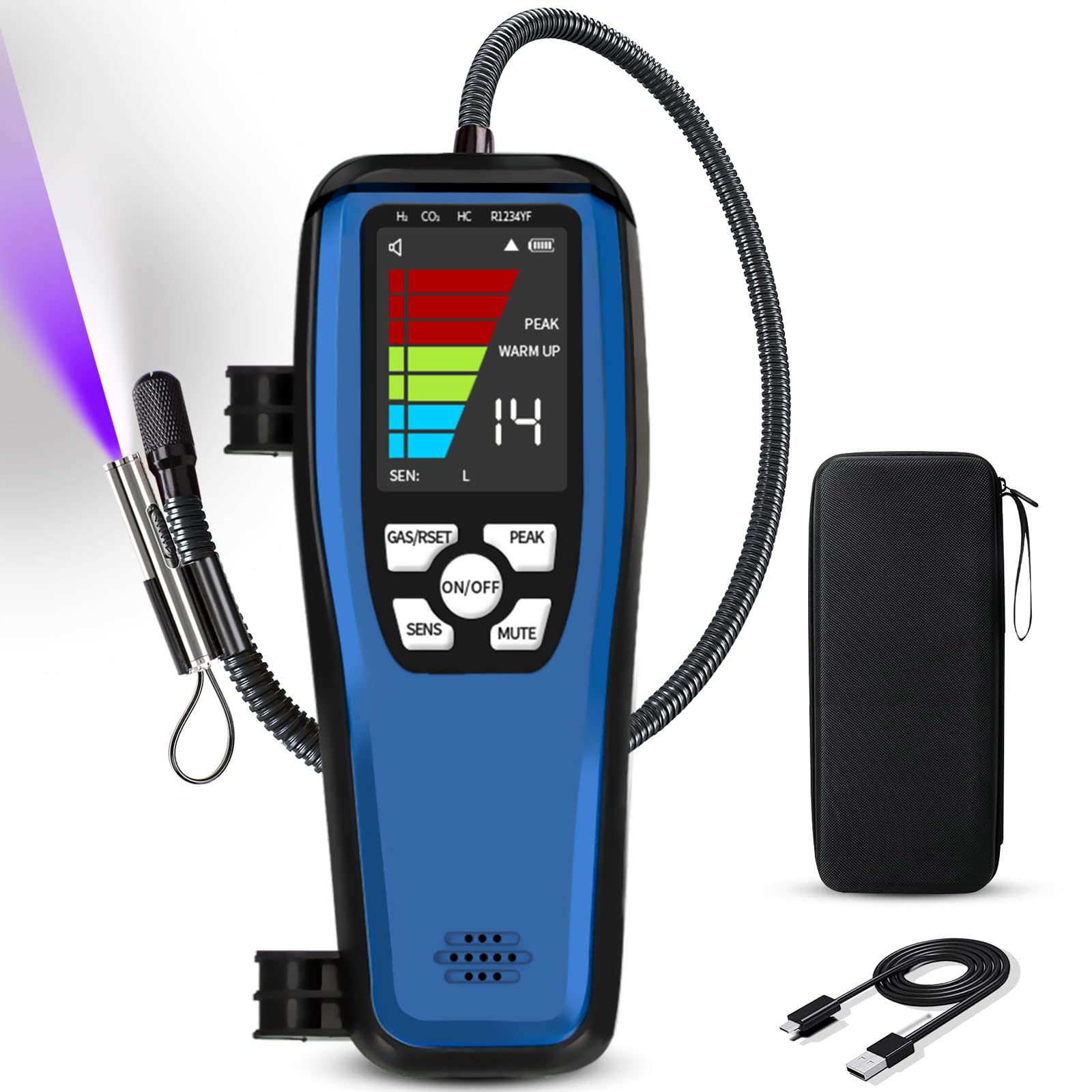
The Aprvtio ALD-200 bridges the gap between pro-level performance and enthusiast pricing with a next-generation heated diode sensor that supports A1, A2L, and A3 flammability class refrigerants. That means it works with R-410A, R-32, R-454B, and even hydrocarbon refrigerants like R-290 and R-600a — a feature set typically reserved for units costing twice as much. Sensitivity tops out at 0.14 oz/yr, which picks up micro leaks that dye tests and bubble solutions routinely miss.
A 2.8-inch TFT color display shows concentration levels with a user-selectable Peak Mode that locks onto the maximum reading as you sweep. The smart Reset Function recalibrates the sensor on demand to suppress false alarms caused by residual refrigerant in the air. The housing is oil-resistant and impact-resistant, built to survive drops from ladders and rough tool bag treatment.
Users consistently praise its ability to locate R-410A evaporator coil leaks that professional mechanics with higher-end gear could not find. Battery life is adequate for a full day of service, though some users note the charge depletes faster than premium competitors. For the technician or serious DIYer who needs A2L compatibility today without paying flagship prices, the ALD-200 is the sweet spot.
Why it’s great
- True 3-in-1 A1 / A2L / A3 refrigerant support
- Peak Mode and Reset Function reduce false alarming
- Oil-resistant housing withstands job-site abuse
- Mid-range price for near-pro spec
Good to know
- Battery life is shorter than some premium competitors
- Sensor tip may require periodic cleaning for consistent readings
4. SENSYX SFD200 Rechargeable Refrigerant Detector
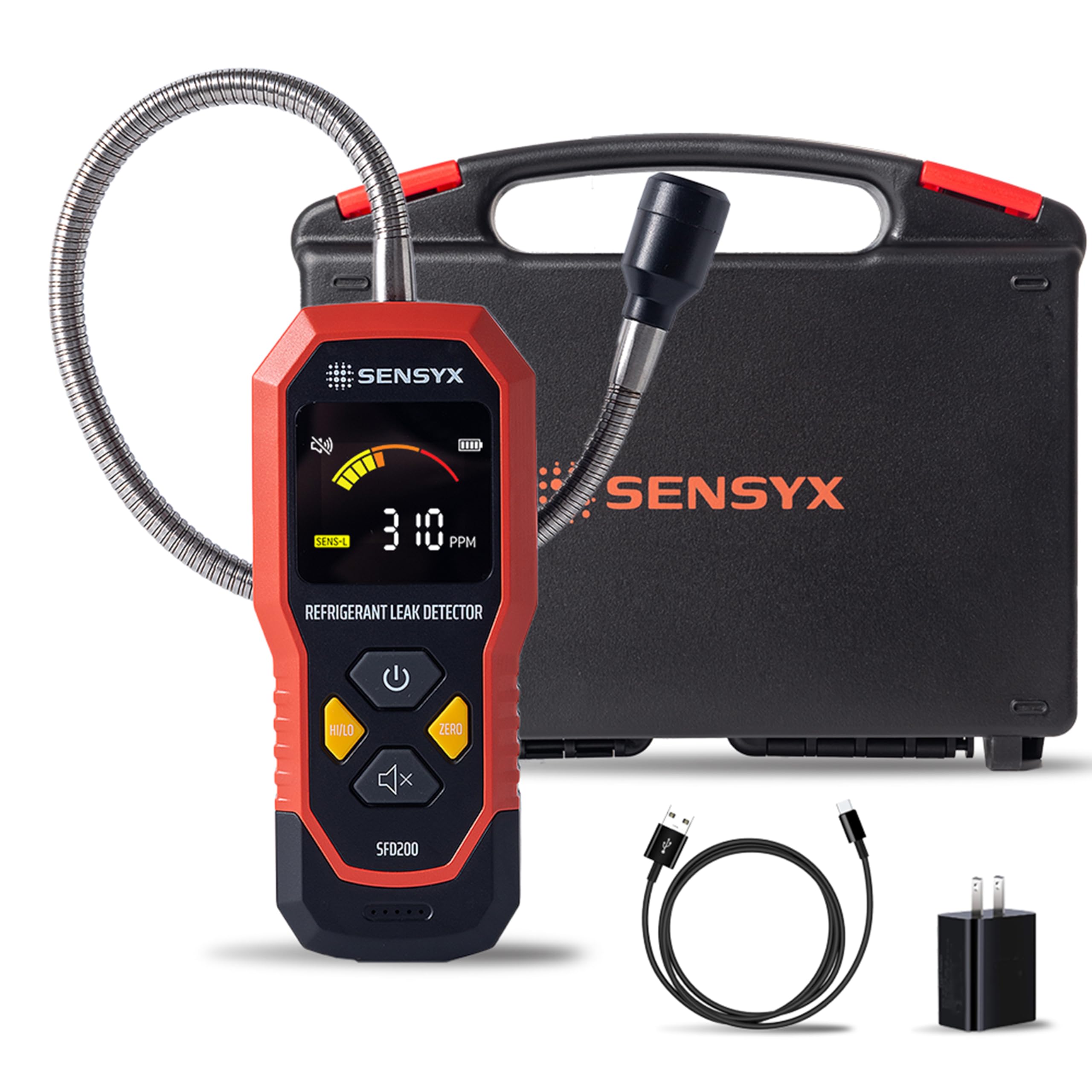
The SENSYX SFD200 delivers a modern cordless experience with a built-in rechargeable lithium battery charged via USB-C, eliminating the need for disposable alkaline cells. It uses a Japanese-made heat dioxide semiconductor sensor that can detect an extensive list of halogen refrigerants including R-410A, R-134A, R-404A, R-32, and the HFO class like R-1234yf. The large color LCD screen provides a clear level display so you can see leak intensity without squinting into dark attics or basements.
Adjustable sensitivity with High and Low levels lets you start with a broad sweep and tighten the resolution as you approach the suspected area. The audible alarm increases tick rate as concentration rises, and the mute button silences the beeper when working in noise-sensitive environments. The unit is UL1484 certified for safety standards, which adds an extra layer of reliability validation.
HVAC technicians report finding R-410A leaks and even natural gas line leaks within the first week of ownership, confirming the sensor’s versatility. The main drawback reported is that the sensor must be turned on and zeroed in clean outdoor air — powering up inside a refrigerant-saturated area results in a constant false alarm. For the DIY user who wants a ready-to-go tool without buying batteries, the SFD200 is a convenient option.
Why it’s great
- USB-C rechargeable battery eliminates disposable cell cost
- Japanese heat dioxide sensor offers broad refrigerant compatibility
- Large color screen with clear leak level display
- UL1484 certified for safety compliance
Good to know
- Must be zeroed in clean air to avoid false positives
- Probe could be longer for deep reach into equipment
5. Elitech CPU-1G Corona Discharge Sniffer

The Elitech CPU-1G uses a traditional corona discharge sensor that has been a staple in the HVAC industry for years, offering a proven detection mechanism at a budget-friendly price point. It offers seven adjustable sensitivity settings with a maximum rating of 0.11 oz/yr, which competes favorably with many mid-range options for leak finding capability. The 14-inch stainless steel flexible probe comes with two alternative sensor tips, and a modular sensor design makes replacement straightforward when the element eventually wears out.
Response time is rated at three seconds, with a warm-up period of six seconds — fast enough to sweep a condenser coil efficiently. It runs on two included C alkaline batteries, which are not rechargeable but provide long shelf life for occasional use. The unit detects all halogenated gases including R-22, R-410A, R-134A, R-404A, and all HFC, CFC, and HCFC blends.
Long-time HVAC technicians praise the CPU-1G for finding leaks through walls and insulation, earning confidence in its diagnostic reliability over many years of use. The main limitations are the audible-only alarm (no visual screen) and the bulkier form factor compared to modern slim detectors. For the homeowner who only needs to confirm a leak a few times per season, the CPU-1G provides reliable detection at an approachable price.
Why it’s great
- Proven corona sensor with 0.11 oz/yr sensitivity
- Seven adjustable sensitivity levels for precise tuning
- Modular sensor design for easy maintenance
- Includes two C batteries and spare sensor tips
Good to know
- No visual display — audio-only leak indication
- Alkaline batteries not rechargeable
6. Leak Saver Direct Inject 3-in-1 Sealant

The Leak Saver Direct Inject is not a sniffer — it is a chemical solution designed to seal refrigerant leaks permanently from the inside out. The 3-in-1 formulation combines a polymer-free organosilane sealant with a moisture remover and UV dye, giving you a complete system treatment in a single injection. The sealant reacts with air and moisture at the leak site to form a permanent plug without clogging TXVs, capillary tubes, or manifold gauges.
Compatibility spans all refrigerants except ammonia, including R-410A, R-22, R-134A, R-1234yf, R-404A, and hydrocarbon refrigerants like R-290. It works on central air conditioners, ductless mini-splits, automotive AC, heat pumps, and commercial refrigeration up to 5 tons. Over 4 million units sold since 2015 give it a strong track record in the market.
Users report sealing slow leaks that professional diagnostics could not locate, with some systems holding charge for months after treatment. The UV dye helps locate larger breaches if you choose to chase them separately. The main risk is that sealants only work on leaks where the full refrigerant charge is not lost within seven days — a catastrophic blowout still requires mechanical repair. For a slow weep that defies all detection methods, the Direct Inject is a sensible trial before expensive coil replacement.
Why it’s great
- Polymer-free organosilane formula won’t clog system components
- 3-in-1 includes sealant, moisture remover, and UV dye
- Compatible with all refrigerants except ammonia
- Proven track record with millions of units sold
Good to know
- Only effective for slow leaks with charge retention over 7 days
- Not a replacement for mechanical repair on large breaches
7. UEi CD100A Combustible Gas Leak Detector

The UEi CD100A is a combustion gas detector that doubles as a practical refrigerant sniffer — a dual-use tool that covers both natural gas lines and AC systems. It detects acetone, ammonia, butane, methane, natural gas, LPG, and jet fuel beyond standard refrigerants, making it a versatile companion for any HVAC tech’s tool bag. The 18-inch flexible gooseneck probe reaches deep into furnace compartments and behind gas appliances without disassembly.
Operation is straightforward: turn on the unit in clean air for a 10-second warm-up, then sweep the probe tip near suspected leaks. The tick rate increases audibly as gas concentration rises, and a tip light illuminates dark areas around condensers and gas valves. The battery delivers approximately 15 hours of continuous run time on two C cells, which covers multiple service calls.
HVAC professionals note that the CD100A is extremely sensitive — so sensitive that it will detect the outgassing from your hand, breath, and some plastics, which can confuse new users. Seasoned techs appreciate that it does not auto-zero, allowing them to observe baseline drift and interpret readings manually. The gooseneck is somewhat delicate, so careful storage in the included case is important. For someone who wants one tool for both gas line safety checks and refrigerant leak hunting, the CD100A earns its spot.
Why it’s great
- Detects combustible gases plus halogen refrigerants
- 18-inch flexible gooseneck reaches tight spaces
- Tip light illuminates dark work areas
- No auto-zero allows manual baseline interpretation
Good to know
- Extreme sensitivity triggers on hand outgassing and breath
- Gooseneck probe requires careful handling during storage
FAQ
Can an AC leak detector distinguish between refrigerant and combustible gas?
Do HVAC sealants like Leak Saver really work without clogging the system?
Why does my leak detector beep constantly even when no leak is present?
Can I use an AC refrigerant detector on automotive air conditioning systems?
Final Thoughts: The Verdict
For most users, the ac leak detector winner is the Fieldpiece DR58 because its sub-0.03 oz/yr sensitivity and IP54 durability set the standard for finding the toughest micro leaks without chasing false signals. If you want A2L refrigerant compatibility at a mid-range price, grab the Aprvtio ALD-200. And for the DIY homeowner balancing budget and reliability, nothing beats the Elitech CPU-1G for dependable spot checks without breaking the bank.