
Our readers keep the lights on and the weekend projects moving. As an Amazon Associate, I earn from qualifying purchases.
Acacia wood consistently ranks as one of the hardest domestic hardwoods available for kitchen tools, but its high density requires precise milling to prevent cracking. A genuinely well-made board from this material delivers a cutting surface that resists deep gouging while remaining forgiving enough to keep your chef’s knife edges sharp for weeks between honing sessions.
I’m Rikta — the co-founder and writer behind FitlyFast. I’ve spent hundreds of hours analyzing the grain density, moisture-locking treatments, and edge-grain versus end-grain construction of dozens of acacia boards to separate marketing fluff from legitimate durability.
After reviewing manufacturing processes and real-world user feedback, this guide details the key specs that define a long-lasting acacia cutting board — from thickness and moisture content to juice groove depth and grain orientation.
How To Choose The Best Acacia Cutting Boards
Acacia is roughly 30 percent harder than black walnut and more water-resistant than bamboo, but its density introduces challenges. Porous grain can trap moisture if the board lacks proper sealing, and thin boards under one inch tend to cup or warp when exposed to humidity swings on a kitchen counter. Prioritize thickness, grain orientation, and initial oil treatment to avoid disappointment after a few months of daily use.
Thickness and Weight Stability
Boards measuring 1.2 inches or thicker resist the thermal and moisture expansion that causes thinner slabs to bend. Heavier boards also stay put during chopping without needing rubber feet, though some users prefer lighter boards for frequent washing. For heavy-duty butchery or daily meal prep, the added stability of a 1.5-inch slab justifies the extra weight.
Grain Construction: End-Grain vs Edge-Grain
End-grain boards — where the wood fibers run perpendicular to the surface — allow the knife edge to slide between fibers rather than cutting across them. This self-healing property reduces visible cut marks and keeps blades sharper longer. Edge-grain construction is more budget-friendly and easier to manufacture, but it will show knife scars more readily over time. For serious cooks, end-grain acacia is worth the premium.
Factory Oil Treatment and Maintenance
A board shipped with food-grade mineral oil or coconut oil already absorbed into the fibers is ready for immediate use. Boards that arrive dry require a full soak before the first chop to prevent the wood from drawing moisture out of whatever you cut. Re-oiling every three to four weeks — or whenever water stops beading on the surface — maintains the board’s moisture barrier and prevents bacterial absorption into the grain.
Quick Comparison
On smaller screens, swipe sideways to see the full table.
| Model | Category | Best For | Key Spec | Amazon |
|---|---|---|---|---|
| BABILONIA 19.7×12.2 | Premium Edge-Grain | Daily prep with included slide plate | 1.6-inch thickness, includes oil | Amazon |
| Cookaholic End-Grain | Premium End-Grain | Self-healing surface, knife preservation | 1.5-inch thickness, 9.1 lbs | Amazon |
| Lelwoy Set of 4 | Mid-Range Set | Multiple board sizes for food separation | 3-layer moisture lock, 13% moisture | Amazon |
| GAOMON 24×18 | Mid-Range XL | Stove cover, large batch prepping | 24×18 inch surface area | Amazon |
| Caperci 24×16 | Mid-Range Large | Heavy-duty carving and chopping | 30-year-old high-density acacia | Amazon |
| FANICHI 20×15 | Mid-Range Thick | Butcher block use, dual-sided design | 1.5-inch thickness, cracker holder | Amazon |
| Socisen 24×18 Bamboo | Budget-Friendly XL | Large surface on a budget, non-slip feet | 5-layer bamboo construction | Amazon |
In‑Depth Reviews
1. BABILONIA 19.7×12.2 Inch Acacia Cutting Board
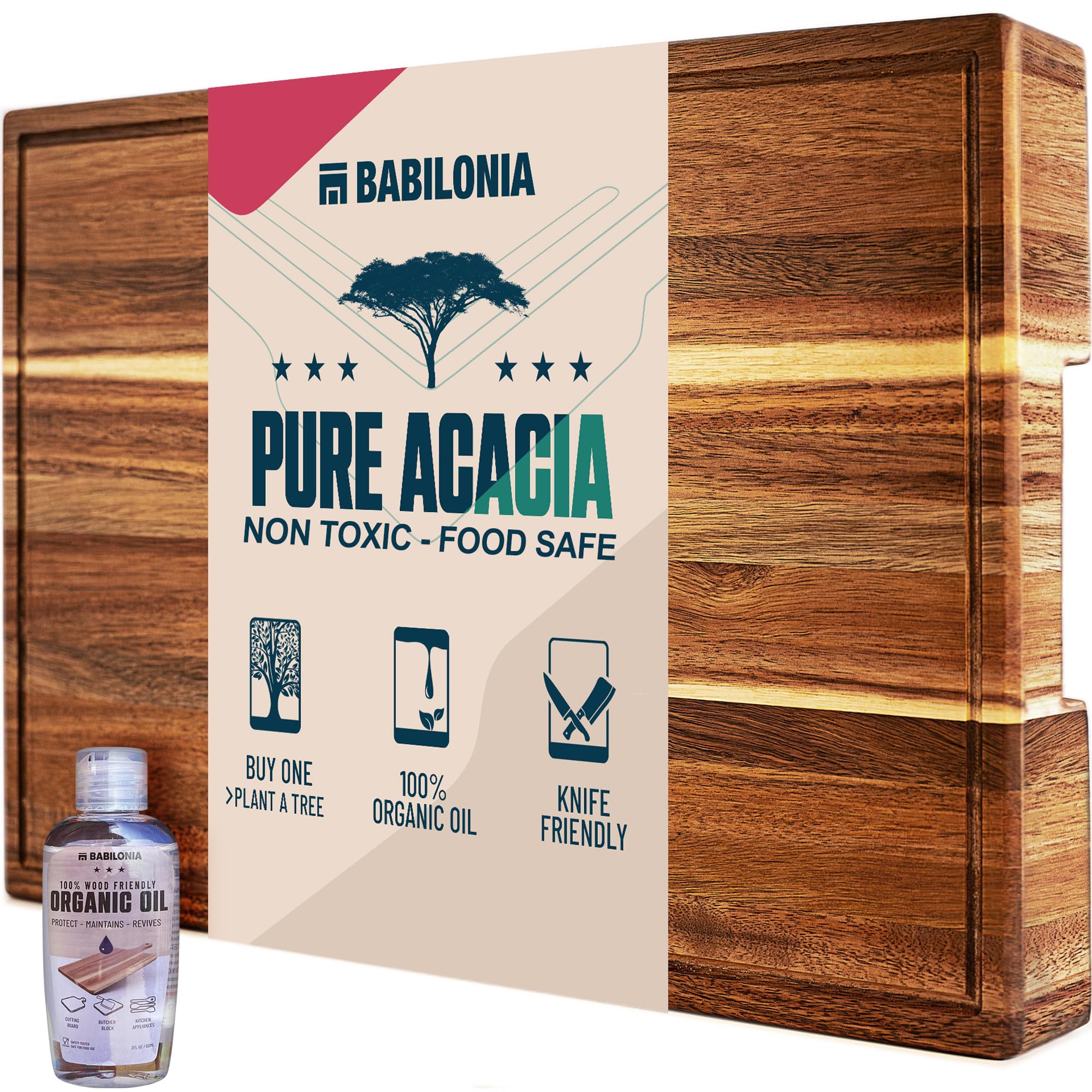
This board’s 1.6-inch thickness provides a level of stability that makes heavy chopping feel planted. The edge-grain construction is knife-friendly, and several users reported using it six times a week for months with only one oiling session and no visible warping. Its most distinctive feature — a small slide plate that lets you push chopped ingredients directly into a bowl — eliminates the awkward lifted-board shuffle that every cook knows.
The factory pre-oiling with a free bottle of organic oil included means you can wash it and start cutting immediately. The hidden handle keeps the design clean when used as a serving tray for charcuterie, and the natural acacia grain varies from board to board, giving each unit a unique look. A few users noted that the included plate is somewhat small, but for transferring prepped vegetables or minced garlic, it works surprisingly well.
At roughly 1.6 inches, this board is thicker than most edge-grain options in its price tier, which directly translates to a lower risk of cupping over time. The 19.7-by-12.2-inch size is practical for a standard kitchen island without overwhelming the sink. For anyone who preps dinner daily and wants a board that arrives ready to use with a built-in workflow upgrade, this is the most complete package.
Why it’s great
- Exceptional 1.6-inch thickness for warp resistance
- Slide plate and oil included, ready immediately
- Knife-friendly edge grain reduces blade wear
Good to know
- Slide plate is small, not ideal for large batches
- Edge-grain will show cut marks over time
2. Cookaholic End-Grain Acacia Cutting Board

The end-grain construction is the headline feature here — wood fibers oriented vertically allow knife edges to slip between them rather than being blunted by cross-grain cutting. After months of daily use, several buyers reported that knife marks are barely visible, confirming the self-healing claim. At 20 by 15 inches and 9.1 pounds, this board stays planted on the counter without any non-slip pad.
The factory curing with coconut oil gives the wood a pleasant natural aroma and eliminates the need for an initial oil soak. One side features a deep juice groove for carving meats, while the flat reverse side works well for pizza or pastry. A small number of users experienced splitting after a year, suggesting that even thick end-grain boards require regular re-oiling in dry climates to maintain fiber cohesion.
The checkered end-grain pattern adds visual depth that makes this board suitable for table-side serving. For cooks who prioritize blade longevity and want a board that looks as good after two years as it did on day one, the end-grain architecture delivers real mechanical benefits that edge-grain boards can’t match. Just commit to a monthly oiling routine.
Why it’s great
- End-grain self-healing reduces visible cut marks
- Heavy 9.1-pound weight stays stable during chopping
- Deep juice groove on one side, flat on the other
Good to know
- Some units developed cracks after a year without oiling
- Premium price tier for an acacia board
3. Lelwoy Acacia Wood Cutting Board Set of 4

The Lelwoy set includes four boards — two at 17 by 12 inches, plus 12-by-9 and 12-by-8 options — making it the most practical solution for cooks who want separate boards for meat, vegetables, fruit, and bread without buying individual slabs. The three-layer moisture locking technology holds the wood at a consistent 13 percent moisture content, which directly addresses the drying-and-cracking problem that plagues bamboo boards.
Users who switched from bamboo specifically called out the absence of mold after months of daily use, a direct result of acacia’s natural water resistance combined with the factory moisture seal. The hidden handles on each board allow the larger sizes to double as serving trays, and the juice groove on the front face catches runoff from slicing tomatoes or carving roast chicken.
The 1-inch thickness is adequate for most home cooking, though heavy butchers might want something thicker for pounding cutlets. Each board arrived pre-oiled and ready to use after a quick rinse. For households that prepare different food groups in the same session, having four dedicated surfaces at one price point reduces cross-contamination risk without occupying separate cabinets.
Why it’s great
- Four boards for dedicated food group separation
- Moisture lock prevents cracking and mold
- Hidden handles on larger boards for serving
Good to know
- 1-inch thickness may feel thin for heavy chopping
- Edge-grain will show knife marks with time
4. GAOMON 24×18 Inch Acacia Cutting Board

At 24 by 18 inches, this board is proportioned to sit directly over a standard gas or electric stovetop, instantly converting burner space into a prep station. Multiple users confirmed that it fits their range perfectly, making it ideal for kitchens where counter real estate is tight. Despite the large surface area, the board remains relatively lightweight compared to end-grain slabs of similar dimensions.
The 1.2-inch thickness provides enough rigidity for kneading dough and rolling out pastries without flexing. The recessed handholds on two sides allow easy lifting and transport, and the juice groove along the perimeter contains runoff from carving large roasts or the Thanksgiving turkey. A few users noted that cut marks appear quickly, which is typical for edge-grain acacia at this price point.
The board’s reversible design means one side can stay pristine for serving charcuterie while the other takes the daily abuse of chopping. The warm wood grain pattern varies between units, giving each board a distinct look. For households that need a massive work surface without dedicating permanent counter space, this stovetop-compatible size is the most functional option in its tier.
Why it’s great
- Fits over stovetop for extra prep space
- Large 24×18 surface handles whole turkeys
- Reversible with juice groove and flat side
Good to know
- Edge-grain shows cut marks quickly
- Not thick enough for heavy-duty butchery
5. Caperci 24×16 Inch Acacia Cutting Board

Caperci uses 30-year-old high-density acacia, which results in a tighter grain pattern and greater resistance to deep scoring than boards made from younger, softer acacia. The 24-by-16-inch dimensions offer substantial cutting area without the full 18-inch width that can make washing in a standard sink difficult. The board underwent multiple mechanical sanding and hand-polishing passes, yielding a burr-free surface that feels smooth to the touch.
The juice groove is carved deep enough to hold the runoff from a large roast, and the built-in handles on both sides make it easy to carry from counter to table for serving. A few users found the board too large for their cabinets and needed to plane it down, so measuring your storage space is wise. The 1-inch thickness is adequate but not overbuilt — it won’t stand up to repeated mallet-driven butchering without flexing.
One user reported returning the board because of its sheer size, which underscores that this is a serious slab meant for cooks with room to spare. For anyone regularly preparing large batches of vegetables, carving whole briskets, or making fresh pasta dough, the extra surface area combined with the harder grain makes this a durable mid-range choice. Season with mineral oil before first use for best results.
Why it’s great
- High-density acacia from 30-year-old trees
- Deep juice groove captures heavy runoff
- Built-in handles for easy serving transport
Good to know
- 1-inch thickness may flex under heavy impacts
- Large size requires dedicated storage space
6. FANICHI 20x15x1.5 Inch Acacia Cutting Board
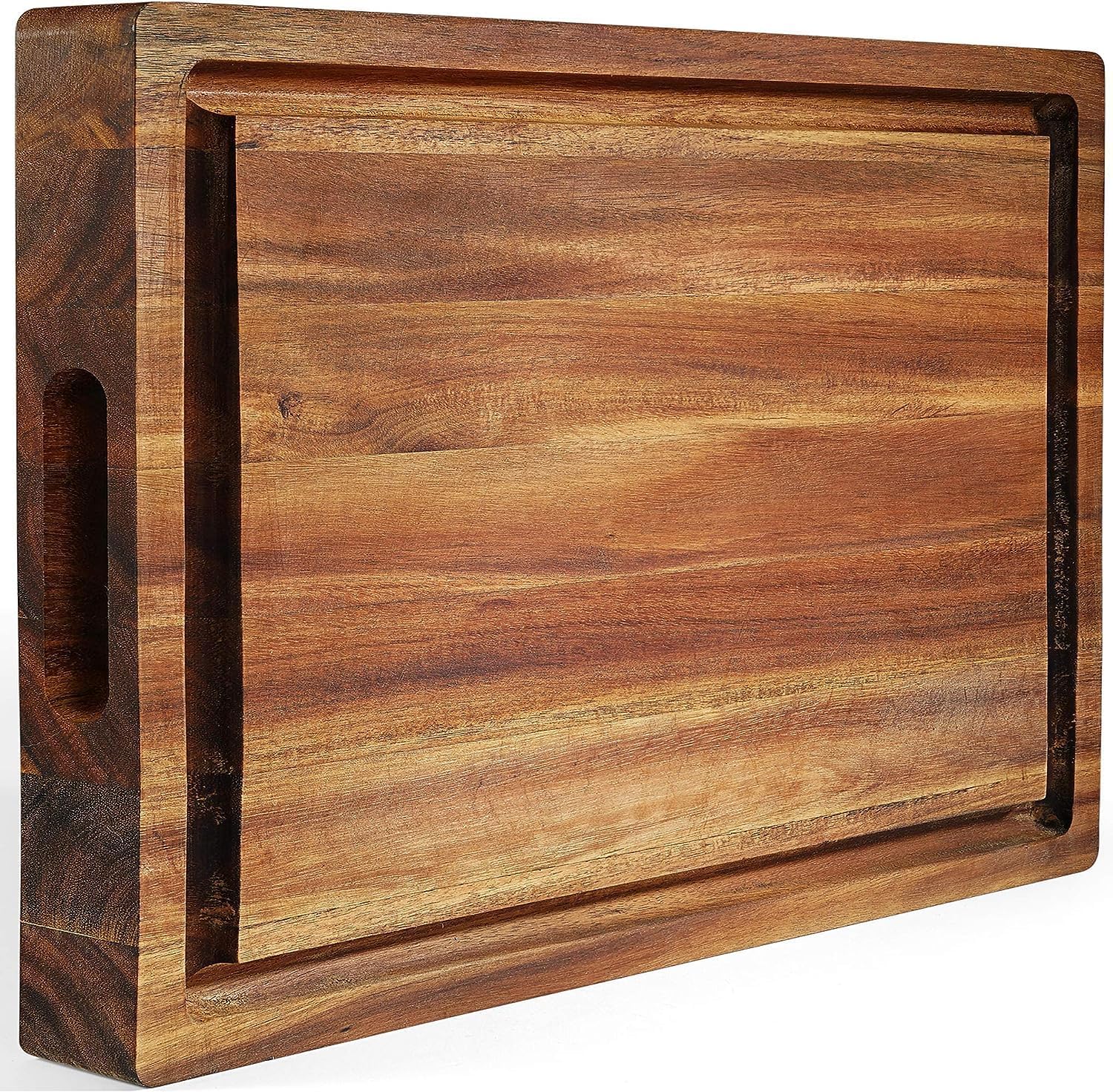
The FANICHI board’s 1.5-inch thickness places it in the heavy-duty category, and the 20-by-15-inch footprint is large enough for substantial prep without being unwieldy. The front side features an expertly carved juice groove, while the reverse side includes a long holder designed for slicing bread and cheese. Multiple users described the board as “beyond expectations” for its craftsmanship and the way the acacia grain catches light.
The board arrived pre-oiled with a natural finish, and several reviewers noted that a round of re-oiling made the surface effectively waterproof — water beaded rather than soaking in, which is the correct indicator of a well-sealed board. The inner cutout handles make gripping and moving the board easy even with wet hands. One caution repeated by users: do not put this board in a dishwasher, as the heat and moisture will crack it.
A few owners reported that the board’s slick surface required a towel underneath to prevent sliding during heavy chopping, and one noted slight instability when cutting near the edges due to thickness unevenness. For those who want a thick slab that can double as a butcher block and a serving board, the dual-sided design with the cracker groove adds versatility not found on standard flat boards.
Why it’s great
- Substantial 1.5-inch thickness resists warping
- Dual-sided with cracker/bread holder on reverse
- Pre-oiled and ready to use out of the box
Good to know
- Slick surface may need towel underneath for stability
- Not dishwasher safe — hand wash only
7. Socisen 24×18 Inch Bamboo Cutting Board
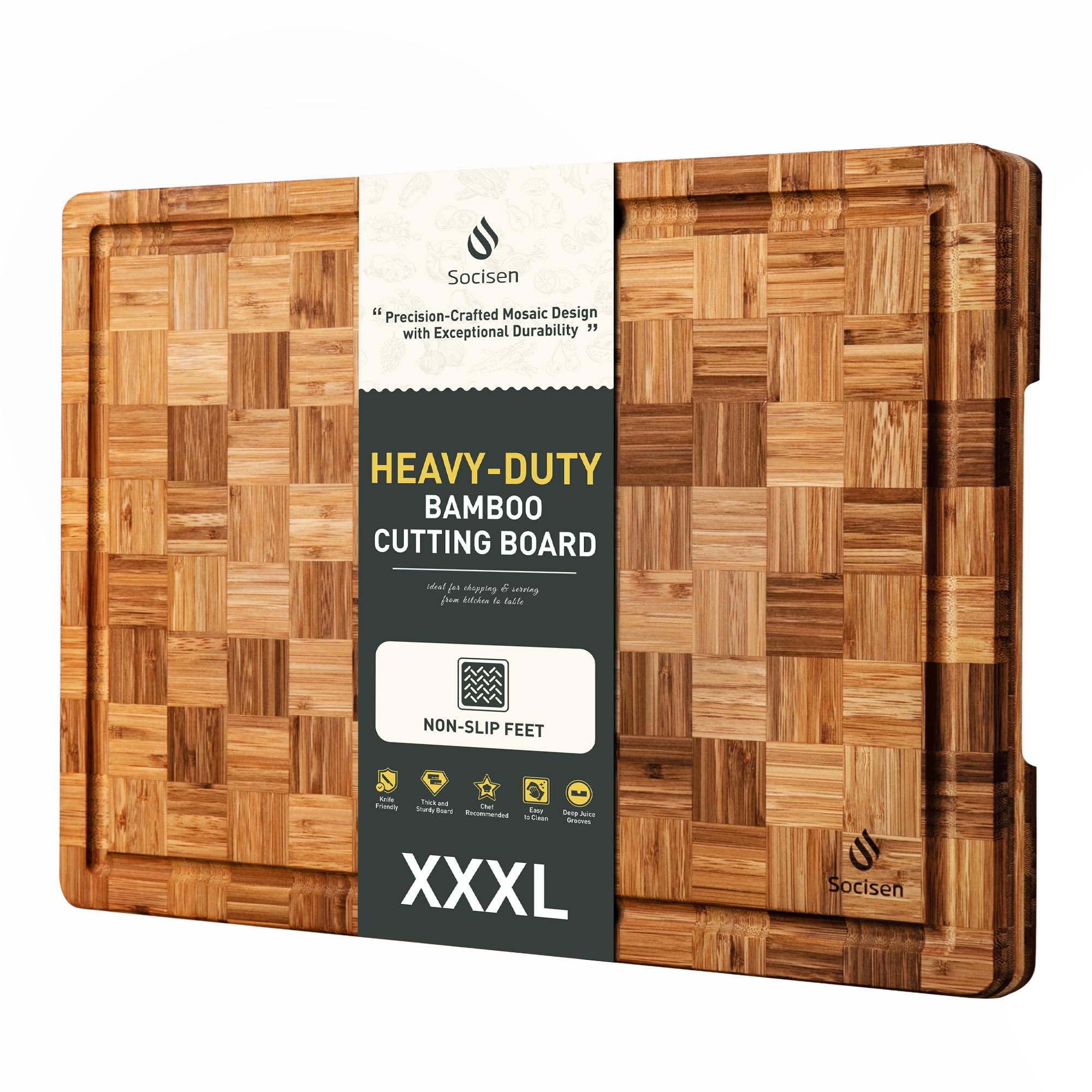
While this board is made from bamboo rather than solid acacia, its 5-layer laminated construction and massive 24-by-18-inch footprint make it a legitimate alternative for shoppers who need a huge prep surface at a budget-friendly price point. The bamboo fibers are denser than many softwoods, and the non-slip rubber feet keep the board planted firmly during chopping — a feature absent from many solid wood boards.
Users praised the board’s solid feel and the way it handled daily use without staining, even from beets. The FSC-certified bamboo is more sustainable than many tropical hardwoods, and the 5-layer splicing technique resists the warping that thin single-piece boards suffer. A few reviewers noted that the juice groove overflowed when resting medium-rare steaks, so the groove depth is shallower than on dedicated carving boards.
The three included handle cutouts make carrying this large board manageable, and the natural bamboo grain provides a clean aesthetic that blends with most kitchen decors. For cooks who want an extra-large surface for rolling dough or prepping large batches without paying a premium for solid acacia, this bamboo board delivers similar functionality at a significantly lower entry point.
Why it’s great
- Massive 24×18 surface for big prep jobs
- Non-slip rubber feet keep board stable
- FSC-certified sustainable bamboo construction
Good to know
- Bamboo is harder than acacia, dulling knives faster
- Juice groove is relatively shallow
FAQ
How often should I oil my acacia cutting board?
Why does my acacia board show cut marks after the first use?
Can I put an acacia cutting board in the dishwasher?
Final Thoughts: The Verdict
For most users, the acacia cutting board winner is the BABILONIA 19.7×12.2 Inch Board because its 1.6-inch thickness and included slide plate provide the best balance of stability, convenience, and ready-to-use value. If you want end-grain self-healing properties that keep knife marks invisible, grab the Cookaholic End-Grain Board. And for households that need multiple dedicated cutting surfaces, nothing beats the Lelwoy Set of 4 for its moisture-locking technology and food-group separation.