
Our readers keep the lights on and the weekend projects moving. As an Amazon Associate, I earn from qualifying purchases.
The moment a baby pulls up to stand, the world changes — and so does your need for gear that supports wobbling weight shifts and sudden, determined lunges. An activity walker is not a passive seat or a rolling entertainment pod; it’s a stability tool that should engage a child’s developing motor cortex, not substitute for their muscle work. The wrong one teaches poor gait mechanics or frustrates with flimsy steering. The right one becomes a trusted partner in those first 100 steps.
I’m Rikta — the co-founder and writer behind FitlyFast. I’ve spent hours analyzing the structural engineering, wheel resistance, and interactive engagement science behind the top baby walkers to separate the genuinely supportive from the merely colorful.
Whether you’re buying for a 9-month-old who is cruising furniture or an enthusiastic toddler who wants to push everything in sight, this guide cuts through the marketing noise to help you find the best activity walker for your child’s specific developmental stage.
How To Choose The Best Activity Walker
Choosing an activity walker isn’t about picking the one with the most buttons or the brightest lights. It’s about matching a child’s gross motor development stage to the right structural support. A 7-month-old needs a seated walker with stable leg positioning; a 12-month-old cruising along furniture needs a push walker with measured resistance. Here are three filters to apply before you add to cart.
Wheel Resistance and Surface Grip
The most overlooked spec is how the wheels behave on different flooring. On hardwood or tile, a walker without resistance clickers or non-slip rear wheels can shoot out from under a baby, causing falls and fear. Look for models that specify wheel resistance mechanisms — either adjustable speed control on rear wheels or friction-based wheel stoppers. For carpeted homes, smoother-rolling but weighted bases perform better without getting stuck.
Handle Height Range and Frame Geometry
A walker with a single fixed handle height forces a baby to lean forward or hunch, which can delay proper gait development. The best activity walkers offer at least three handle height positions — measured from floor to grip — to accommodate growth from early pull-to-stand at 9 months through confident walking at 18 months. Frame width also matters: a base that’s too narrow tips sideways when a child pushes at an angle; look for a wide triangular or rectangular base with a low center of gravity.
Interactive Depth vs. Sensory Overload
Many walkers bombard a baby with flashing lights and loud sounds that create passive entertainment, not active learning. Quality activity centers incorporate cause-effect mechanisms — shape sorting, gear turning, phone handsets that require button pressing — that build fine motor skills and problem-solving. Prioritize walkers where the play panel can be detached for floor play, extending the utility well beyond the walking phase.
Quick Comparison
On smaller screens, swipe sideways to see the full table.
| Model | Category | Best For | Key Spec | Amazon |
|---|---|---|---|---|
| Skip Hop Farmstand | Convertible Push Walker | Versatile long-term play value | 3 handle heights, 2 speed controls | Amazon |
| PULA Baby Push Walker | Indoor/Outdoor Wagon | All-terrain stability | EVA wheels, 2-in-1 wagon design | Amazon |
| 5-in-1 Foldable Baby Walker | Seated/Activity Combo | Multi-mode support (bouncer, rocker, walker) | 3 height positions, 5 modes | Amazon |
| Ingenuity Step & Sprout | Seated + Push Walker | Smooth transition from seated to push mode | 3 modes, foldable for travel | Amazon |
| Radio Flyer Scan & Sort Cart | Interactive Shopping Cart | Pretend-play engagement | 3 handle heights, shape sorting | Amazon |
| 3-in-1 Sit to Stand Walker | Budget All-in-One | Drawing board + activity center value | Speed adjustment, drawing board | Amazon |
| VTech Sit-to-Stand Learning Walker | Classic Sit-to-Stand | Entry-level affordability with solid features | 2-speed control, 5 piano keys | Amazon |
In‑Depth Reviews
1. Skip Hop Baby Walker Farmstand
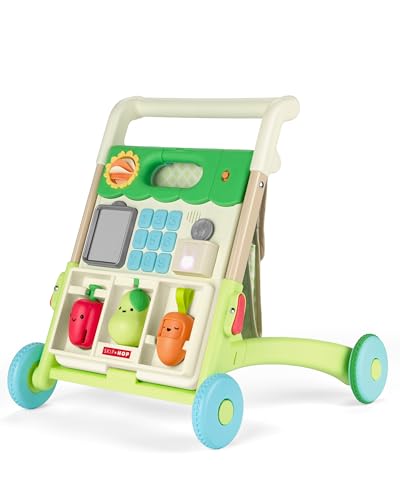
The Skip Hop Farmstand sets a new benchmark for what a convertible activity walker should achieve. Its five distinct play modes — sit, cruise, push cart, stroller, and pretend-play — mean this single piece of gear maintains relevance from a 6-month-old learning trunk control all the way through a 5-year-old running a mock farmers market. The three handle height settings (18.3, 20.1, and 21.9 inches) accommodate substantial growth without forcing a hunched posture.
The interactive panel is unusually deep: a numbered keypad, light-up coin box with ka-ching sound, sunflower spinner, musical mirror scale, and removable jingle bell pepper and rattle pear. These aren’t just sensory novelties — the cause-effect relationships (turn the gear, hear a sound; press the keypad, see a light sequence) build genuine problem-solving loops. The detachable panel doubles as a floor easel or toddler activity station, extending utility far beyond the walking phase.
Non-skid rear wheels and a two-position speed control switch give parents granular control over how fast the walker rolls — critical for hardwood-floor homes where momentum builds quickly. The farmstand aesthetic coordinates with Skip Hop’s broader collection, and the overall build quality justifies the mid-range price point. The only concession is that the music can feel repetitive to adults, but a volume control mitigates the annoyance.
Why it’s great
- Five modes cover 6 months to 5 years of play
- Three adjustable handle heights for proper gait alignment
- Non-skid wheels and speed control for safety
- Detachable play panel with 50+ cause-effect activities
Good to know
- Music can be annoying at full volume
- Price is higher than basic sit-to-stand models
- Phone attachment can be easily lost off the panel
2. PULA Baby Push Walker with Wheels
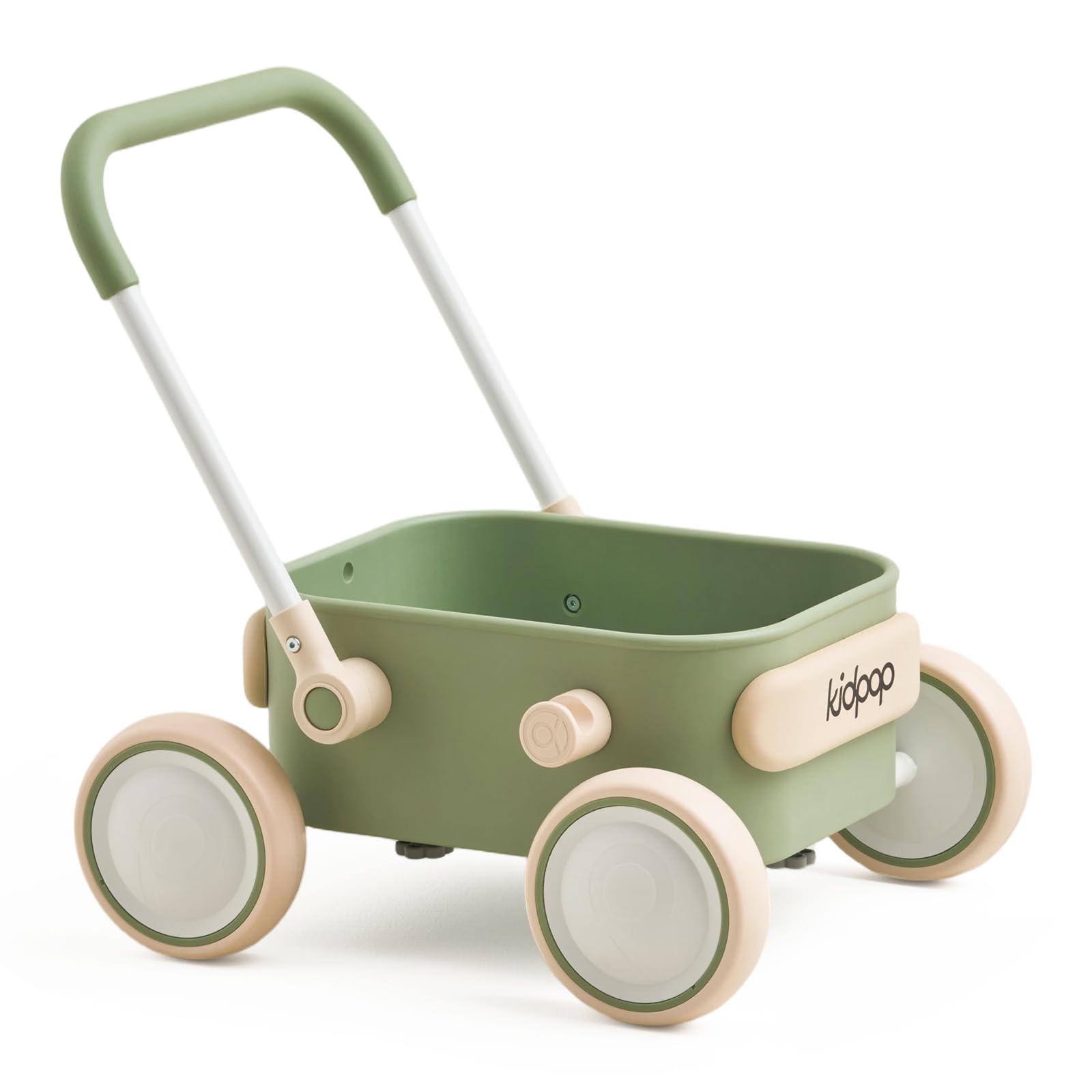
The PULA walker is the only model in this roundup that genuinely works on grass, gravel, and indoor tile with equal stability. Its EVA wheels absorb shock quietly while maintaining a low center of gravity that makes tip-overs virtually impossible — a design that earned the 2023 German iF Award. The food-grade PP material hopper can carry toys or snacks, and the wide enclosed wheel design prevents pinched fingers better than open-spoke alternatives.
This is a 2-in-1 product: it functions as a push walker for first steps and a pull wagon for confident toddlers. The non-slip handlebar is comfortable for small hands but thick enough to provide solid grip during early standing. At nearly 10 pounds, it’s heavy enough to feel substantial but light enough for a parent to carry up a flight of stairs. The one-click folding mechanism collapses the cart in under 60 seconds, making it genuinely portable.
Where it falls short is interactive engagement — there is no light-up dashboard, sound board, or detachable activity panel. This is purely a walking device, not an entertainment center. That’s a feature for parents who want pure walking practice without sensory overload, but a limitation for those who want all-in-one stop-and-play. The metal-and-rubber build means it will outlast most plastic-heavy alternatives by years.
Why it’s great
- EVA wheels roll smoothly on grass, gravel, and tile
- Low center of gravity prevents tipping
- 2-in-1 walker and pull wagon for longer use
- One-click folding for easy portability
Good to know
- No interactive toys or sound activities included
- Higher price for a non-electronic walker
- Not suitable for babies who need seated support
3. 5-in-1 Foldable Baby Walker (Purple)
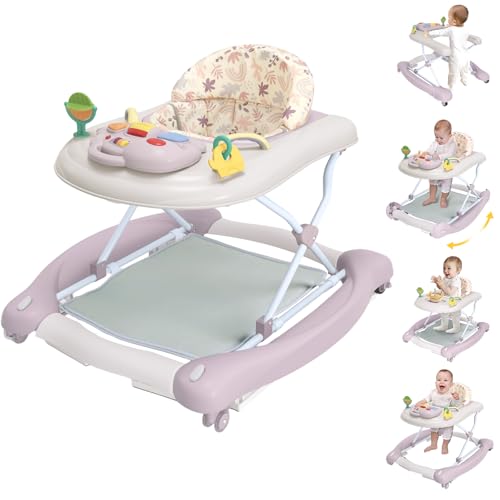
This walker attempts to be every piece of baby gear a living room needs — and largely succeeds. Its five modes include seated walker, bouncer combo, rocker, feeding table, and push walker, covering the 6-to-18-month window comprehensively. The three height adjustments are designed to keep a child’s legs at a natural angle during standing, which reduces the risk of developing an O-leg gait common in poorly fitted walkers.
The activity panel packs musical toys, shape recognition cutouts, colorful rotatable gears, and rattles that hit the major sensory development milestones. The silicone non-slip mat on the base prevents the entire structure from sliding on hard floors, and the triangular chassis with enlarged base provides a wide support footprint. The whole unit folds flat in seconds for storage under a crib or sofa — a critical feature for smaller homes.
The single notable downside is battery reliability: multiple user reports describe the battery compartment heating up or failing to make contact, effectively disabling the toy panel. This appears to be a manufacturing consistency issue rather than a design flaw, but it’s worth checking immediately upon arrival. When fully functional, this walker delivers more value per dollar than any standalone seated walker on the market.
Why it’s great
- Five modes (walker, bouncer, rocker, table, push) cover six months
- Three height adjustments prevent poor leg alignment
- Triangular base and silicone mat for floor stability
- Folds flat for easy storage and travel
Good to know
- Battery-powered toy panel has intermittent connection issues
- Battery compartment may overheat in some units
- Seat cushion is comfortable but not machine-washable
4. Ingenuity Step & Sprout 3-in-1 Walker
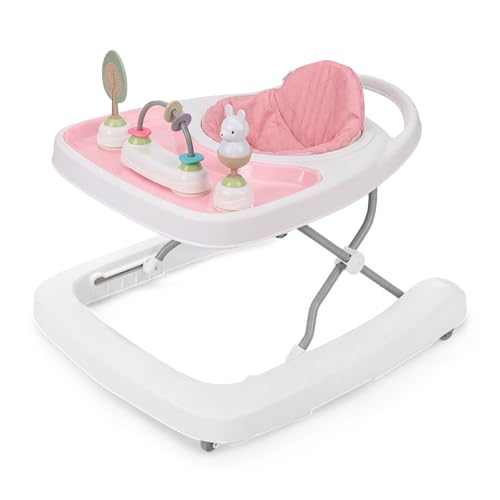
Ingenuity’s Step & Sprout solves the most common real-world complaint about activity walkers: they take up too much floor space. This 3-in-1 folds flat with a simple latch mechanism and includes carry handles, making it the only travel-friendly option in the premium tier. It converts from a seated activity walker (6-12 months) into a push-behind walker (12-24+ months), with the same frame serving both modes.
The nature-inspired toy set includes a tree, flower, and leaf that attach via suction cups to the removable tray. Parents report that the suction cups don’t hold as securely as they’d like — toddlers can pop them off with a swipe — but the toys themselves are simple and engaging without being overstimulating. The three adjustable height positions are easy to change without tools, and the ultra-plush seat pad unsnaps for machine washing, which is a hygiene necessity for this age group.
On hardwood and laminate, the wheels glide smoothly with decent resistance; on thick carpet, the walker struggles to roll and may frustrate a beginner walker. The frame is narrow enough to fit through standard doorways, which is a practical detail for teaching walking across rooms. The neutral pink-and-green colorway works for any gender and matches the brand’s Spring & Sprout jumper line for cross-product coordination.
Why it’s great
- Folds flat with carrying handles for travel
- Converts from seated walker to push-behind mode
- Machine-washable seat pad for easy cleaning
- Fits through standard doorways easily
Good to know
- Suction-cup toys pop off tray frequently
- Wheels don’t roll well on thick carpet
- Seat could be taller for longer-legged babies
5. Radio Flyer Scan & Sort Shopping Cart
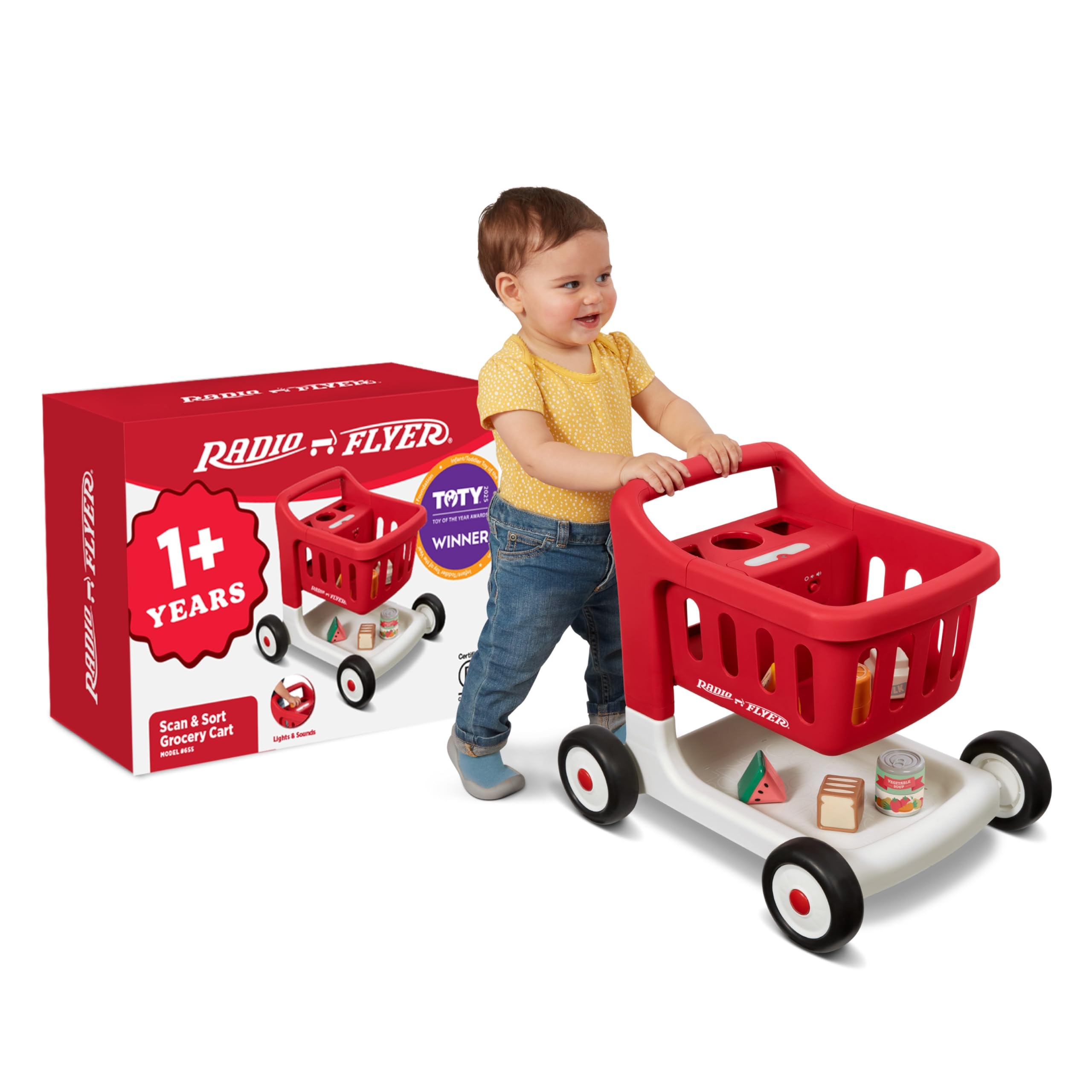
Radio Flyer brings its century-old metal-cart heritage to the activity walker category with a design that prioritizes durability and imaginary play. The Scan & Sort is a red shopping cart with a working barcode scanner that activates lights, music, and sound effects when a child scans any of the six included play food pieces — or any other toy with a barcode, a detail that extends the play value considerably.
The three adjustable handle heights span from typical push-walker height for a 12-month-old up to comfortable strolling height for a 3-year-old. The safety resistance clickers in the rear wheels provide audible feedback and physical resistance that slows the cart down on hard floors, mimicking the resistance babies need to build walking confidence. The shape-sorting cutouts on the cart top integrate a fine-motor task into the gross-motor activity, which is a smart dual-development approach.
The metal frame and plastic interior make this significantly more durable than all-plastic alternatives — it survived daily use by one reviewer’s toddler through age 3 and was still functional for younger siblings. The weight distribution is balanced enough that even a novice walker won’t tip it over when pulling up. The one real gap is the lack of a locking wheel option; on non-carpet floors, the cart can roll away slightly faster than a brand-new walker can manage.
Why it’s great
- Interactive scanner engages kids in pretend-play for hours
- Three handle heights accommodate growth through age 3
- Metal frame construction is more durable than plastic alternatives
- Shape-sorting cutouts add fine-motor practice
Good to know
- Wheels cannot be locked, may roll fast on hardwood
- Not suitable for seated use — push-only design
- Batteries required for scanner/music features
6. 3-in-1 Baby Walker Activity Center with Drawing Board
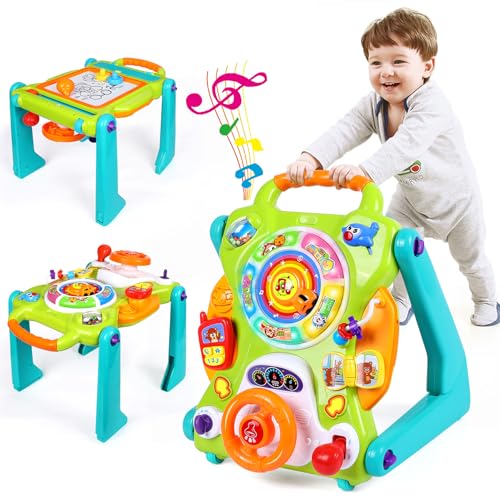
This 3-in-1 walker differentiates itself from the field with an unexpected feature: a built-in magnetic drawing board on the back of the activity panel. The set includes a magnetic pen and four cartoon stamps, turning the walker into an art station once a child outgrows the walking phase. It’s a simple, screen-free creativity tool that keeps the walker relevant well past age 2.
The front activity panel packs simulated driving features — engine switch, lever, airplane, rotated rattle, spinning beads — alongside a phone handset and colorful LED lights. Two volume levels ensure the sounds aren’t obnoxious for adult ears. The legs detach easily, converting the walker into a stationary activity table, and the triangular base with wide leg spread prevents tipping even when a child pulls up aggressively.
At the lower end of the price scale, this walker achieves an impressive feature-to-dollar ratio. The ABS plastic build is safe and durable enough for daily use, though it won’t survive the abuse a metal-frame walker like the Radio Flyer will. Speed adjustment on the rear wheels gives parents control over pace, and the 9-to-36-month age range means this walker serves most of a child’s early development window. The biggest trade-off: the drawing board surface shows scratches over time and the magnetic pen is small enough to lose.
Why it’s great
- Magnetic drawing board adds creative play beyond walking
- Detachable legs convert to stationary activity table
- Fast/slow speed adjustment for parent control
- Wide triangular base prevents tipping
Good to know
- Drawing board surface scratches with heavy use
- Magnetic pen is small and easy to misplace
- ABS plastic frame less durable than metal options
7. VTech Sit-to-Stand Learning Walker

VTech’s sit-to-stand walker has been a bestseller for years because it nails the fundamentals without overcomplicating them. The detachable activity panel contains five piano keys, a telephone handset, three shape sorters, light-up buttons, and colorful spinning rollers — a focused set of cause-effect toys that teach letters, numbers, and music without overwhelming a baby’s developing sensory system.
The two-speed control switch on the rear wheels is the standout safety feature at this price tier: it lets a parent set a slower speed for early standers and a faster speed for confident walkers. The wheel stopper prevents the walker from sliding forward when a baby pulls up, which is the exact moment most walker falls occur. The panel attaches securely for walking mode but detaches for floor play, giving this walker a second life as a stationary activity center.
The plastic construction is light (under 5 pounds), which makes it easy to move around the house but also means it can tip if a child leans heavily on one side. The 35-pound weight limit is generous for the category, and the 90-day manufacturer warranty provides reasonable coverage. For families on a tight budget who still want a developmentally sound walker with proven durability across multiple children, this remains the gold standard of entry-level value.
Why it’s great
- Two-speed control switch for safe speed management
- Wheel stopper prevents slides during pull-up
- Detachable panel works as floor activity center
- Proven durability across multiple children
Good to know
- Light frame can tip with aggressive leaning
- 90-day warranty is shorter than premium models
- Plastic construction less durable than metal frames
FAQ
What is the ideal age range for an activity walker?
Do activity walkers delay walking milestones?
Are sit-to-stand walkers better than seated walkers?
How do I clean an activity walker properly?
Final Thoughts: The Verdict
For most users, the activity walker winner is the Skip Hop Farmstand because its five-play-mode design, three adjustable handle heights, and 50+ cause-effect activities deliver the best combination of developmental value and long-term use from 6 months to 5 years. If you need an all-terrain walker that transitions from indoor tile to outdoor grass, grab the PULA Baby Push Walker. And for families on a budget who still want a proven, durable sit-to-stand walker with speed control, nothing beats the VTech Sit-to-Stand Learning Walker.