
Our readers keep the lights on and the weekend projects moving. As an Amazon Associate, I earn from qualifying purchases.
Specs are compiled from manufacturer listings and verified buyer reviews and can change over time — please confirm the key details on the product page before buying.
When ALS makes everyday tasks like eating, standing, or speaking feel like a fight, the right piece of adaptive equipment can return a small piece of independence and a whole lot of dignity. This guide looks at six carefully selected tools that tackle the most common daily challenges—from shaky hands at mealtime to safe transfers between chair and bed—so you can find the match that fits your current needs and abilities.
I’m Rikta — the founder and writer behind FitlyFast. This guide is built by comparing the manufacturers’ published specifications and the patterns across verified customer reviews, so you get each pick’s real strengths and trade-offs instead of marketing spin.
Whether you are a caregiver setting up a home or a person living with ALS researching options, this breakdown of adaptive equipment for als patients covers weighted utensils, a no-spill bowl, a simple communication device, a patient lift sling, a portable seat lift, and a standing transfer aid.
Quick Picks
- Adaptive Utensils, Weighted Utensils for Hand Tremors — Best Overall
- Solid Full-Body Patient Lift Sling – 600 lb Capacity (Large) — Pro Grade
- Etac Turner PRO Patient Transfer Aid – 440 lbs Capacity — Space Saver
- Modaliv Adaptive Silicone Scooper Bowl with Suction Base — Best Value
- Seat Boost Lift Assist Cushion — Smart Design
- Tiny Talker Too – Special Supplies AAC Communication Device — Budget Champion
How To Choose The Best Adaptive Equipment For ALS Patients
ALS affects everyone differently, so the gear that helps one person might not help another. The key is matching the equipment to the person’s current stage — fine motor control, leg strength, balance, and communication ability change over time. Focus on tools that solve one specific problem at a time: holding a fork, getting out of a chair, or signaling a need.
Prioritize weight and grip for eating tools
If hand tremors or weak grip make self-feeding hard, look for utensils that are weighted (measured in ounces) and have built-up handles or a universal cuff (a strap that wraps around your palm to hold the utensil if you cannot grip). A heavier utensil can dampen tremors, and a bendable neck lets you adjust the angle as range of motion changes.
Check transfer equipment for caregiver safety
Equipment like a patient lift sling or a standing transfer aid is for both the user and the caregiver. A sling with a 600 lb weight capacity and a full-body design supports safe transfers, while a standing aid requires the user to have some leg and arm strength. Never buy a transfer device that requires more physical ability than the user has — it becomes a hazard instead of a help.
Match communication tools to current speech ability
A simple button-based AAC (augmentative and alternative communication) device works for basic wants and needs, but if the user has limited fine motor control, check the button size and the pressure needed to activate it. A device that fits in a pocket is useful for portability, but the sound quality and recording length matter for the listener to understand.
Quick Comparison
| Model | Best For | Weight/Size | Key Feature | Capacity | Amazon |
|---|---|---|---|---|---|
| Weighted Utensil Set (10 Pcs) | Self-feeding with tremors | 1.85 lbs set | 4.0 oz weighted | 10-piece set | Amazon |
| Modaliv Adaptive Silicone Bowl | One-handed scooping | 2.1 lbs | Suction base | 16 oz (estimated) | Amazon |
| Tiny Talker Too AAC Device | Basic non-verbal communication | 2.4 oz | 12 buttons, recordable | Up to 2 seconds per button | Amazon |
| Solid Full-Body Patient Lift Sling | Transfers with a lift | Large size (up to 600 lbs) | Full head-to-thigh support | 600 lb bariatric | Amazon |
| Seat Boost Lift Assist Cushion | Getting up from a chair | 8.5 lbs | Non-electric gas spring (a sealed cylinder of compressed gas and fluid that provides lift) | 220 lbs | Amazon |
| Etac Turner PRO Standing Aid | Standing pivot transfers | 17.6 lbs | Rotating base | 440 lbs | Amazon |
In‑Depth Reviews
1. Adaptive Utensils, Weighted Utensils for Hand Tremors, Parkinsons Utensils (10 Pcs)

A 10-piece eating set that uses weight and bendable angles to put shaky hands back in control.
Each piece of silverware is 4.0 ounces — noticeably heavier than standard utensils — which dampens hand tremors (tiny shaking movements) as you bring food to your mouth, helping keep bites on the fork and off the table. The fork and spoon necks bend a full 180 degrees, so you can twist them to whatever angle feels natural, whether you are eating with your left hand, right hand, or needing a different approach as your grip changes over time. An elastic universal cuff with velcro wraps around your palm, a strap that measures 5.0 inches, so even someone with little or no hand strength can hold the utensil securely. Buyers report that the bendable angle adjusts as Parkinson’s progresses and that the weighted design reduces shaking effectively.
The set covers you for every meal: a rocker knife that owners mention is sharp enough to cut meat, a dinner fork, a fruit fork, a dinner spoon, a soup spoon, and a tea spoon. All pieces are dishwasher safe, and a cleaning brush is included specifically for the handle grooves. Unlike the Modaliv bowl which stays put with suction, this set goes mobile — the back of the included apron doubles as a travel roll bag.
What stands out
- 4.0-ounce weight actively reduces tremor amplitude during eating
- 180-degree bend suits both handedness and changing posture
- 10-piece coverage from soup spoon to steak knife
- Universal cuff (5.0-inch strap) works for very weak grip
The trade-offs
- Textured handles are wide and won’t fit standard silverware drawer slots
- Some users find the appearance less attractive despite function
Reach for this if: hand tremors or weak grip make self-feeding difficult — the weighted design and universal cuff together cover a wide range of grip strength.
Look elsewhere if: you need just a single fork or spoon, or if drawer storage is your main priority.
2. Solid Full-Body Patient Lift Sling – 600 lb Capacity (Large)
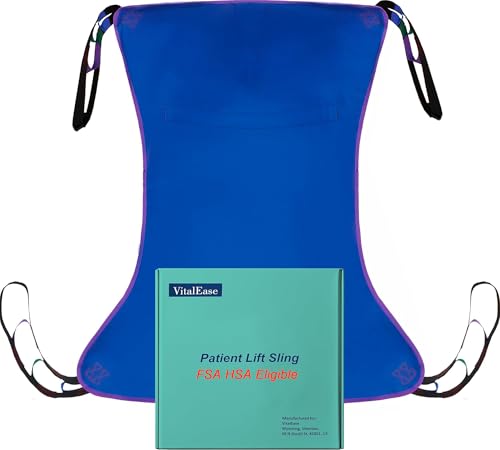
A heavy-duty sling built for daily transfers, with full head-to-thigh coverage and a 600 lb safety margin.
When a loved one can no longer stand or bear weight, transferring them between bed, wheelchair, and chair becomes the most physically demanding part of care. This sling supports the entire body — from head and neck through back, hips, and thighs — distributing weight evenly so no single pressure point causes discomfort. The reinforced multi-point loop attachments fit standard 4-point and 6-point spreader bars on Hoyer, Invacare, Drive, and similar lifts, meaning it works with the equipment most home-care setups already use. Buyers confirm it fits a Hoyer lift and that the stiffer material offers better hip and sacrum support than mesh versions.
Made from tear- and stretch-resistant polyester, it withstands multiple transfers per day and survives high-temperature washing cycles (60–80°C) without losing strength. Unlike the Etac Turner PRO, which requires standing ability, this sling is for fully dependent transfers. It comes in color-coded sizes (Green for Large), and all sizes hold up to 600 lbs. Note: this is a solid sling with no toileting opening, so plan for a separate toileting sling if needed.
Reasons to buy
- Full head and neck support for users with no head control
- 600 lb bariatric capacity covers nearly all body sizes
- Compatible with most popular lift brands including Hoyer and Invacare
- Machine-washable without losing shape or strength
Reasons to consider
- Solid construction means no toileting opening — requires a separate sling for bathroom transfers
- Requires a mechanical lift and at least one trained caregiver to operate
Best suited for: families or professionals needing a durable, full-support sling for a person with limited or no head control who requires a mechanical lift for all transfers.
Not for: users who can still stand or bear weight — a standing transfer aid fits that scenario better.
3. Etac Turner PRO Patient Transfer Aid – 440 lbs Capacity
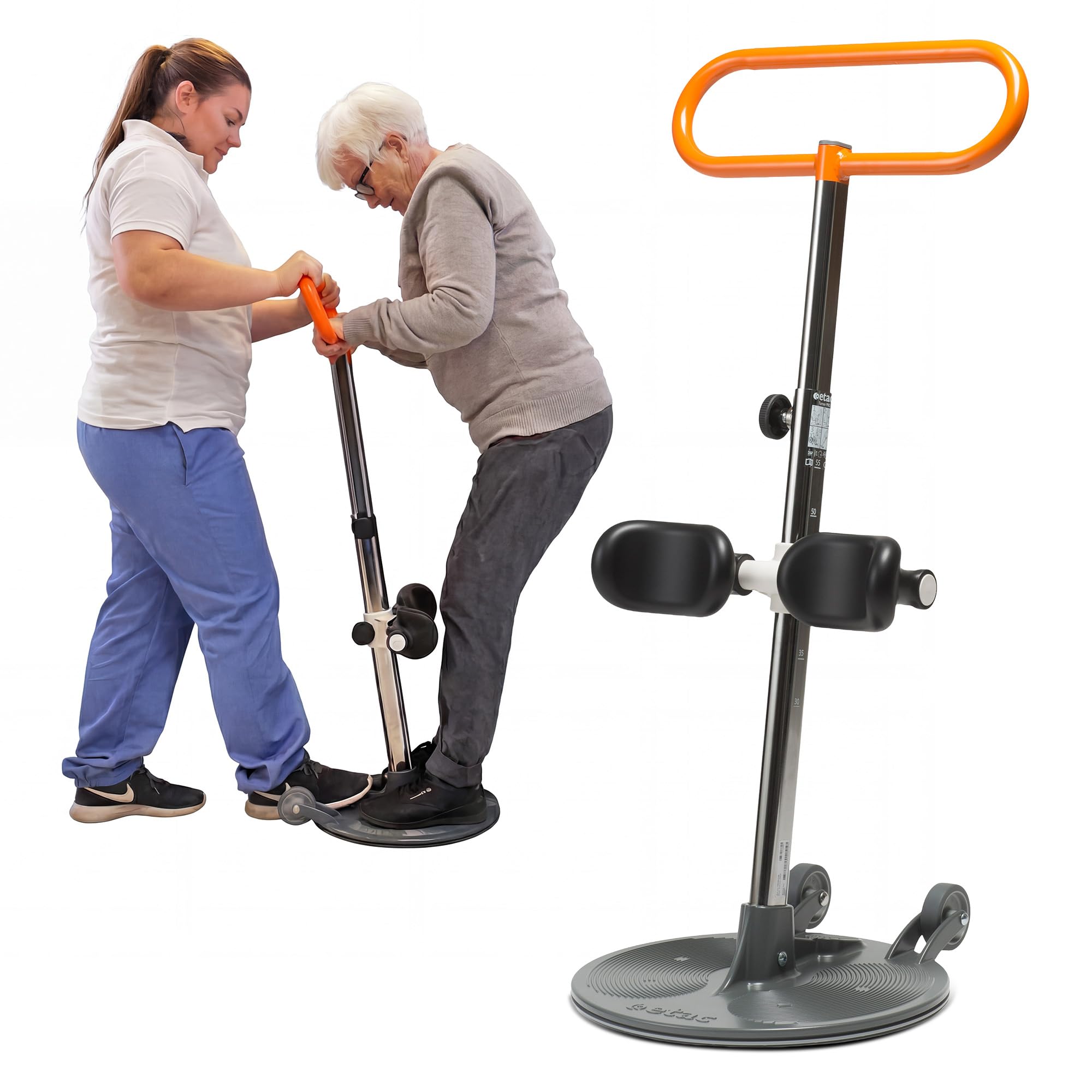
A compact standing pivot aid that replaces a two-person armpit lift with a simple stand-turn-sit motion.
This device sits in a different lane than the full-body sling above: it is designed for someone who still has enough leg and upper body strength to stand, pivot, and hold onto a handle for 15-30 seconds. The user places their feet on the anti-slip base plate, grabs the ergonomic handle, and pulls themselves to a standing position while padded knee supports provide lateral stability. The caregiver then guides the turning motion — no lifting required. One reviewer, a registered nurse of 34 years, calls it a transformation from a two-person armpit lift to an easy stand-turn-sit. Another caregiver reports that their 88-year-old mother with dementia learned the simple 5-10 second sequence immediately without fear.
At 17.6 pounds with dimensions of 29.5 x 20 x 5.6 inches, it is light and compact enough to fit in tight home spaces and on various flooring types. The rotating platform swivels smoothly, and the soft angled leg pads adjust in height for a customized fit. Unlike the Seat Boost cushion which lifts you from a seated position, this Turner PRO transfers you from one seat to another entirely. The catch is that it absolutely requires the user to have the grip strength to pull up and the balance to stand briefly — if those abilities change, the device becomes unusable.
What works
- Eliminates caregiver back strain — no lifting required, just guidance
- Quick 5-10 second transfer sequence even for users with dementia
- Sturdy 440 lb load capacity handles larger users
- Fits through narrow doorways and tight spaces
What to watch
- User must have arm strength to pull up and stand for 15-30 seconds
- Some customers note the knee stabilizer can flip unexpectedly and the handle height adjuster may slip
Ideal for: a caregiver and user pair where the user can still stand briefly and has decent grip strength — it saves your back and preserves the user’s dignity.
Avoid if: the user cannot bear weight or follow simple verbal instructions to pull up and hold on.
4. Modaliv Adaptive Silicone Scooper Bowl with Suction Base – Sage Green
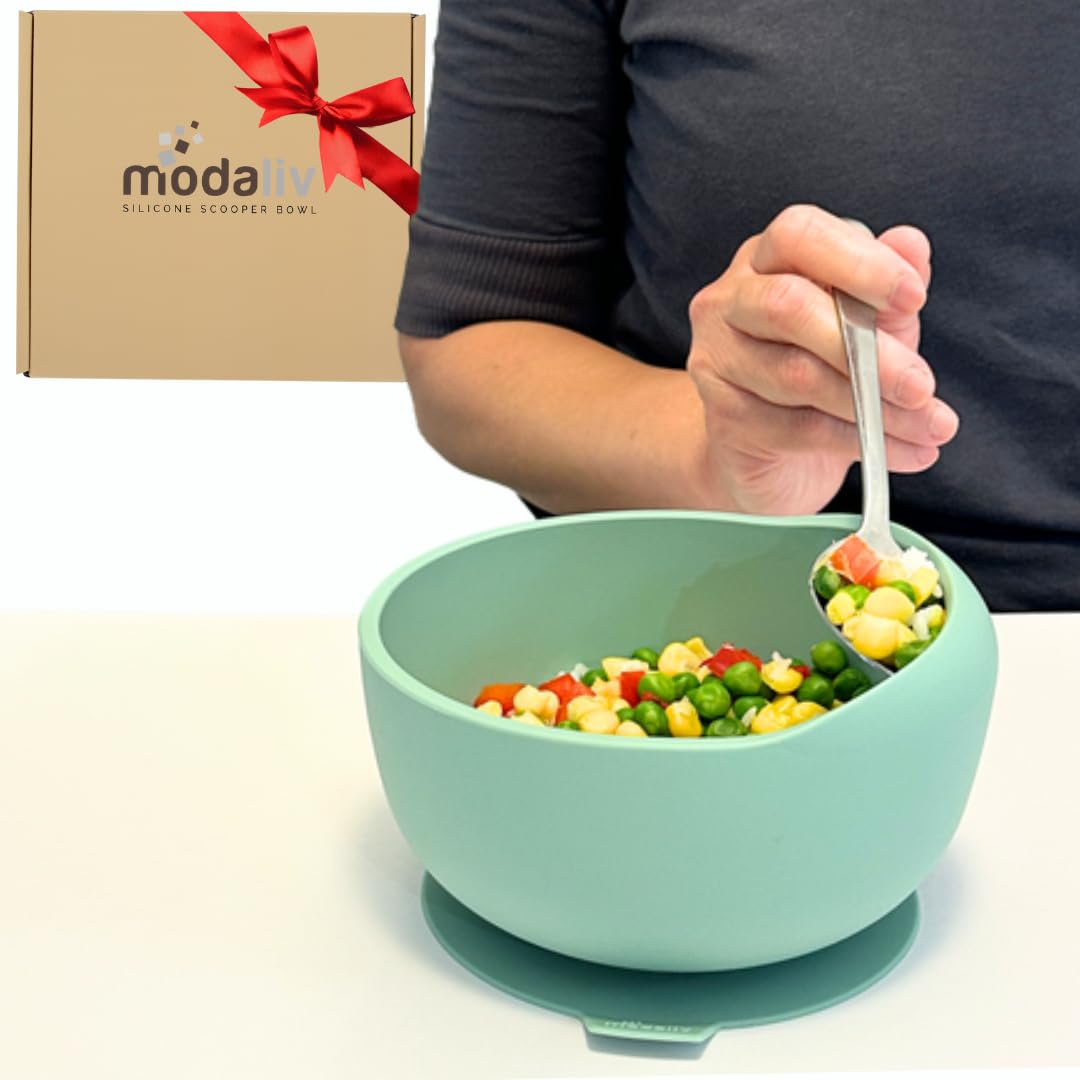
A silicone bowl that sticks to the table so you can scoop food one-handed without chasing it around.
among the most frustrating mealtime problems for someone with limited mobility is a bowl that slides away with every spoonful. This bowl solves it with a strong suction base that grips tables, trays, and even lap surfaces — reviewers point out it stays securely in place even when used on a lap in a recliner. The raised curved lip on one side acts as a scooping edge, guiding food onto the utensil without needing the other hand to hold the bowl steady. Bite by bite, that means less frustration and more independence for someone with Parkinson’s, stroke recovery needs, or ALS.
It is made from BPA-free silicone that is both microwave safe and dishwasher safe, so heating leftovers takes no extra steps. At 2.1 pounds, the bowl itself has enough heft to stay put even without the suction engaged. One caregiver of a 97-year-old mom calls it a godsend because it worked equally well on a front-facing table, in a wheelchair, and on a lap in a recliner. The Modaliv bowl handles liquids well too, making it useful for soups without the splash risk of lighter bowls. Compared to the weighted utensil set above, this bowl handles the other half of the equation — keeping the food container stable while the utensil does the work.
Why it works
- Suction base eliminates sliding on tables, trays, and laps
- Raised curved lip funnels food onto the spoon or fork
- BPA-free silicone is microwave and dishwasher safe
- Deep curved interior lets you scoop efficiently with one hand
One limitation
- Single bowl — you might want two for alternating meals and cleaning
- Suction may weaken on heavily textured or uneven surfaces
Perfect for: anyone who struggles to keep a bowl steady while eating one-handed — especially useful for soup, cereal, or any semi-liquid meal.
skip it if: you already have a plate guard or prefer divided plates to bowls.
5. Seat Boost Lift Assist Cushion – Portable, Non-Electric, Supports up to 220 lbs

A non-electric cushion that uses a gas spring (a sealed cylinder of compressed gas and fluid) to nudge you upward as you start to stand.
If you have the leg strength to stand but need an extra push to get started, this cushion sits on your chair and does exactly that — no batteries, no plugging in, no charging. It works through a hydropneumatic gas spring that releases and gently lifts as you begin to stand, helping you rise from a low seat without a struggle. The device measures 20 inches by 17 inches, weighs 8.5 pounds, and adjusts to your weight so the lift force is appropriate for your body. It is designed for ALS, Parkinson’s, arthritis, post-surgery recovery, and anyone who struggles to rise from a seated position. Reviewers report that it makes getting up a breeze after back surgery and that it is less bulky and far less expensive than a full lift chair.
The cushion is portable enough to take to restaurants, theaters, church, or a family visit. It stays firmly in place and does not push you forward, which is a common complaint with cheaper spring-loaded cushions. That said, the manufacturer is direct: this is NOT a comfort product — the firm memory foam is there for function, not for sitting for long periods. Some shoppers say the fabric cover shreds within a couple of months, and the weight setting mechanism inside has sharp edges. Unlike the Etac Turner PRO which moves you between seats, the Seat Boost only helps you get off the one you are sitting in.
What we like
- Self-powered gas spring means zero reliance on electricity or batteries
- Light at 8.5 lbs and portable enough for dining out or travel
- Gently lifts only when you start to stand, no forward push
What to know
- Firm memory foam is not made for long sitting comfort
- Some users report the cover starts shredding within months
- Weight adjustment area has sharp edges; read the directions carefully
Grab this for: someone who can stand but needs a mechanical assist to start the motion — ideal for home chair, restaurant seat, or car seat.
Pass if: the person cannot bear weight on their legs at all, or if cushion comfort for extended sitting matters equally.
6. Tiny Talker Too – Special Supplies AAC Communication Device for Non-Verbal (12 Button)

A pocket-sized speech device with 12 recordable buttons that gives a non-verbal person a way to be heard.
For someone with ALS who has lost the ability to speak clearly, an AAC device can mean the difference between expressing a need and being ignored. The Tiny Talker Too is a simple, inexpensive entry into that world. It has 12 large 3/4-inch buttons that are soft to the touch and easy to press for someone with fine motor delays. Record your own voice — up to 2 seconds per button — by sliding the switch to record mode and speaking clearly. Press a button, and the device speaks for the user. It runs on two small batteries (no charger needed) and measures 6 inches by 3 inches by 0.5 inches, small enough to slip into a pocket.
Reviewers, including special education teachers and speech therapists, call it a good low-cost AAC device for introducing speech. They recommend recording in a quiet room for the clearest audio, and note that you can record over the phrases repeatedly as needs change. One parent of a non-verbal child reports it is easy to use and with practice gives her daughter a way to express wants and needs. On the downside, the sound quality is not great, the included paper labels are not very durable, and a small number of users report that after weeks of heavy use a button may short-circuit. The device at 2.4 ounces is dramatically lighter than the 1.85-pound utensil set, making it truly portable, but the trade-off in build quality shows at this entry-level price.
Strengths
- Inexpensive alternative to devices costing hundreds — makes AAC accessible
- Portable at 2.4 oz and 6 x 3 x 0.5 inches — fits in a pocket
- Record your own voice for personalized, familiar communication
- Large 3/4-inch soft buttons suit limited fine motor control
Weaknesses
- Mediocre sound quality — best recorded in quiet room with clear speech
- Included label stickers are not great; users printed their own
- Buttons may short-circuit after extended heavy use; chewing may be a factor
Use this for: an affordable, portable option to introduce communication when speech is lost — ideal for caregivers to keep one at home and one in a bag.
Move up if: you need sturdy build quality for heavy daily use, better audio, or more than 12 buttons for longer phrases.
Understanding the Specs
Weight (Ounces & Pounds)
The weight of a utensil or device matters because it either helps or hinders. A 4.0-ounce utensil is heavy enough to dampen hand tremors — the extra mass introduces inertia that smooths out small involuntary movements. A patient lift sling at 600 lbs is about capacity for the person using it, not its own weight, telling you the maximum user size it can safely hold. A cushion at 8.5 lbs is the device weight, telling you how portable it feels to carry to a restaurant or car.
Load Capacity (Pounds)
For transfer equipment like a sling or a standing aid, the load capacity is the maximum user weight the device is rated to hold safely. The solid body sling is rated for 600 lbs, while the Etac Turner holds 441 lbs. Always pick a device with a capacity higher than the user’s actual body weight — that safety margin is important for daily use. For a seat lift cushion, the 220 lb limit is lower, so check the user’s weight against that number before buying.
Number of Buttons / Recording Time (AAC Devices)
An AAC device with 12 buttons and 2 seconds per button gives the user 12 distinct messages of up to two words each (“I need water”, “I need help”). More buttons mean more vocabulary, but smaller buttons can be harder to press for someone with limited finger control. For basic wants and needs — hungry, thirsty, bathroom, help, pain — 12 buttons is a solid start. Longer recording time is helpful if you want full phrases rather than short commands.
FAQ
What adaptive equipment is most useful for early-stage ALS?
Will a weighted utensil work for both left and right handed use?
Can the Adaptive Silicone Bowl be used in the microwave?
What is the difference between a full-body sling and a standing transfer aid?
Is the Etac Turner PRO difficult to learn for a caregiver?
How does the Seat Boost cushion lift without electricity?
Can the Tiny Talker Too be used for someone with low vision?
How do I clean the patient lift sling?
Which size patient lift sling should I choose?
Are these adaptive equipment items HSA or FSA eligible?
Final Thoughts: The Verdict
Across the board, the winning pick among the adaptive equipment for als patients is the Weighted Utensil Set (10 piece) because it restores an essential daily activity — eating independently — with a thoughtful combination of weight, bendable angles, and grip support. If you need safe transfers for a person who cannot stand, grab the Solid Full-Body Patient Lift Sling. And for a caregiver whose loved one can still stand but needs help rising and turning, the Etac Turner PRO offers the best balance of safety, compactness, and back-saving design.
How We Picked
We do not accept paid placement. Every pick is matched to a real buyer and a real use-case; we do not hands-on test units.
Sources & Methodology
Specifications: manufacturer listings and product documentation. Review insights: verified customer reviews, as of July 2026. Pricing: not shown on this page (it changes often); check the current price via the retailer link.
As an Amazon Associate, FitlyFast earns from qualifying purchases. This does not affect which products we feature.