
Our readers keep the lights on and the weekend projects moving. As an Amazon Associate, I earn from qualifying purchases.
Bonding carbon fiber requires an adhesive that can match its remarkable stiffness-to-weight ratio without introducing stress points that cause delamination or shear failure. This isn’t about grabbing the nearest tube of super glue — you need a formula engineered for low-surface-energy materials and high-load transfer.
I’m Rikta — the co-founder and writer behind FitlyFast. I’ve spent years analyzing adhesive chemistries and how they perform under real-world loads on composites, metals, and marine-grade substrates.
If you need a trustworthy bond that won’t crack under vibration or temperature shifts, this guide to the best adhesive for carbon fiber will help you sort through epoxy, urethane, and cyanoacrylate options based on actual performance specs.
How To Choose The Best Adhesive For Carbon Fiber
Carbon fiber panels and tubes have a non-porous, resin-rich surface that many general-purpose glues cannot wet properly. You need an adhesive that forms a chemical bond rather than relying on mechanical grip alone. Below are the critical factors to weigh.
Epoxy vs. Urethane vs. Cyanoacrylate
Epoxies offer the highest shear strength and environmental resistance, making them the dominant choice for structural carbon-fiber-to-metal or carbon-fiber-to-composite bonds. Urethanes provide superior impact resistance and flexibility, ideal for applications subject to vibration. Cyanoacrylates (super glues) set fastest but are brittle and best for non-load-bearing cosmetic touch-ups or small repairs where strength matters less than speed.
Working Time and Cure Schedule
A fast-setting adhesive (1 to 5 minutes) works for small parts you can clamp immediately, but larger assemblies or those requiring precise alignment demand at least 20 minutes of open time. Slower-curing epoxies also penetrate better into carbon fiber weave layers, increasing bond surface area.
Gap-Filling and Viscosity
Thickened epoxy pastes fill voids between uneven carbon fiber surfaces and won’t sag on vertical repairs. Thin, low-viscosity adhesives wick into hairline cracks but provide little structural reinforcement. Choose based on whether you are bonding flat panels, filling pinholes, or assembling tubular joints.
Quick Comparison
On smaller screens, swipe sideways to see the full table.
| Model | Category | Best For | Key Spec | Amazon |
|---|---|---|---|---|
| 3M DP420 | Epoxy | Structural carbon-to-metal | Shear strength 4,000+ psi | Amazon |
| TotalBoat Thixo | Epoxy | Vertical/surface repairs | 50-minute working time | Amazon |
| 3M DP100 Plus | Epoxy | Thermal cycling bonds | UL 94 HB certified | Amazon |
| WEST SYSTEM G/flex | Epoxy | Wet/underwater repairs | Waterproof to 2-day cure | Amazon |
| Starbond 5 Minute Epoxy | Epoxy | General composite bonding | Shear strength 2,600 lb | Amazon |
| Norton Speedgrip | Urethane | Fast-cycle production work | 1.5-minute working time | Amazon |
| Titebond Instant Bond | CA Glue | Cosmetic gap-fill touch-ups | Jet black finish | Amazon |
In‑Depth Reviews
1. 3M Scotch-Weld DP420

The 3M DP420 is a two-part epoxy structural adhesive delivering exceptional shear strength over 4,000 psi alongside high impact and fatigue resistance. Its formulation is specifically engineered for bonding composites, metals, and ceramics under demanding loads. The black pigmentation is a bonus for visual alignment on dark carbon fiber surfaces.
Users report successful long-term bonding of aluminum inserts into carbon fiber tubing subjected to daily abuse over months. The 20-minute working time allows careful positioning before the structural cure begins. Full cure at 24 hours at 73°F delivers a bond that can exceed the strength of the surrounding composite material.
It requires a manual or pneumatic dispensing gun for the duo-pak cartridge, adding an upfront tooling cost. The 50 ml size is sufficient for multiple small repairs but runs out fast on larger panel bonds. Industrial-grade only; not sold for consumer use, so check your state regulations.
Why it’s great
- Ultra-high shear strength for structural carbon fiber assemblies
- Black color blends into carbon weave for clean aesthetics
- Fatigue-resistant formula survives vibration cycles
Good to know
- Requires a separate dispensing gun and mixing nozzles
- Limited 50 ml cartridge size for larger jobs
- Not labeled for consumer sale in some regions
2. TotalBoat Thixo

TotalBoat Thixo is a pre-thickened, no-drip epoxy adhesive formulated for overhead and vertical applications where sag resistance is critical. The two-part cartridge and static mixing tip deliver a perfect 2:1 ratio without manual measurement — a major convenience for one-handed repairs on boat hulls, carbon fiber panels, and structural joints.
The thixotropic consistency stays put on vertical surfaces yet still wets out fiberglass and carbon fabric layers when used as a bonding paste. With a 50-minute working time followed by a 30-minute gel phase, you have room to clamp, shim, and adjust before the chemical reaction locks the joint. Full mechanical cure in 24 hours.
The 185 ml cartridge is smaller than a standard 300 ml tube from many competitors, so the cost per use is notably higher. The thick formula requires significant hand pressure on a standard caulk gun, and the mixing tips can clog if you pause mid-application for longer than a few minutes.
Why it’s great
- Non-sag formula ideal for vertical carbon fiber repairs
- Generous 50-minute working time for complex setups
- 100% waterproof once fully cured
Good to know
- Smaller cartridge volume than standard tubes
- High viscosity makes caulk gun operation tiring
- Mixing tips may clog during intermittent use
3. 3M Scotch-Weld DP100 Plus
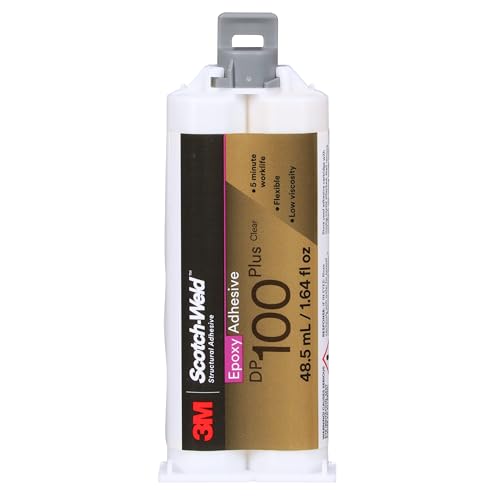
3M DP100 Plus is a clear, fast-handling epoxy designed for thermal cycling resistance across industries from transportation to sporting goods. It bonds firmly to metals, ceramics, glass, and many plastics, making it a versatile choice when the carbon fiber assembly must endure alternating heat and cold without bond degradation.
The 2–5 minute open working time allows quick positioning before a one-hour cure to handling strength. Users have reported success repairing composite valve covers under engine heat conditions, where cheaper epoxies softened or cracked. The UL 94 HB certification adds confidence for applications near electrical components.
The formula’s fast cure means you cannot reposition after the gel window passes, so precise fixturing is mandatory. It is labeled for industrial or occupational use and may not be available for consumer purchase through all retailers. The 48.5 ml duo-pak is best suited for small-scale repairs rather than large laminates.
Why it’s great
- Excellent thermal cycling resistance for engine-bay parts
- Crystal-clear cure for visible carbon fiber aesthetics
- Fast one-hour handling cure speeds up repairs
Good to know
- Very short working window of 2–5 minutes
- Not intended for general consumer retail sale
- Small cartridge limits use to spot repairs
4. WEST SYSTEM G/flex Epoxy

WEST SYSTEM G/flex 650 is a toughened liquid epoxy formulated specifically for bonding damp wood, fiberglass, ceramics, and low-surface-energy plastics including carbon fiber composites. Its ability to adhere to wet surfaces and even cure underwater makes it unique among consumer-grade epoxies.
The long pot life and slow cure (full strength in 48 hours) allow the epoxy to penetrate deeply into porous or rough substrates, maximizing mechanical interlock. Users report successful vacuum-bagged repairs on ceramic fountains and long-lasting snowboard edge bonds that survive a full season of flex and moisture. The 2:1 mix ratio is straightforward by volume.
The slow cure is a drawback if you need a quick clamp-and-go workflow. It remains tacky for many hours, so dust and debris can contaminate the bond line if left uncovered. The 4 oz bottles are small relative to the price, making large panel bonds expensive per square inch.
Why it’s great
- Bonds on damp or wet surfaces including underwater
- Flexible cured film resists crack propagation
- Excellent deep penetration into porous carbon layers
Good to know
- 48-hour cure time is slow for production work
- Remains tacky for hours requiring dust protection
- Small bottle size limits total coverage area
5. Starbond 5 Minute Epoxy Pro Kit

Starbond’s 5 Minute Epoxy Pro Kit delivers a flexible, toughened two-part epoxy with a stated shear strength of 2,600 lb per square inch. The 1:1 mix ratio by volume simplifies measuring, and the included reusable mixing trays, spatula, and screw-cap bottles make this an accessible option for hobbyists and DIY carbon fiber enthusiasts.
The formula cures clear and remains slightly flexible after full cure, reducing the risk of brittle fracture under mild impact. Users have successfully used it to reseal basement cracks and bond MDF to stainless steel, demonstrating decent adhesion across dissimilar materials. The 8 oz size provides good value for medium-scale repairs.
Some users found the bond line weaker than premium structural epoxies in crown molding butt-joint tests, suggesting it is better suited for non-critical composite bonding than load-bearing carbon fiber assemblies. The 5-minute set time allows limited repositioning before the gel phase locks the parts.
Why it’s great
- Flexible cure resists cracking under vibration
- Clear finish works for visible carbon repairs
- Kit includes mixing tools and trays for convenience
Good to know
- Shear strength lower than structural epoxies
- 5-minute window limits complex alignment
- Not ideal for heavy-load bearing joints
6. Norton Speedgrip Structural Urethane
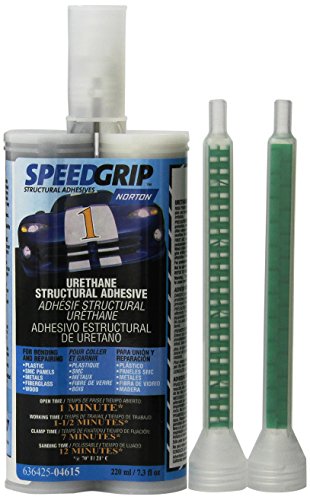
Norton Speedgrip is a two-component structural urethane adhesive designed for fast-cycle bonding of composites, metals, and plastics in production environments. The 1.5-minute working time is among the fastest in this category, followed by a full cure within 24 hours at room temperature.
The urethane chemistry provides exceptional impact resistance and flexibility compared to rigid epoxies, making it suitable for carbon fiber parts subjected to repeated shock loading. Users report using it to repair broken vehicle components where the bond must survive road vibration. The 215 ml cartridge size offers more material per cartridge than many epoxy competitors.
The ultra-short working time demands immediate clamping and zero trial-and-error positioning. You also must buy Norton’s dedicated applicator gun, which is not included and can be difficult to source. The urethane formulation produces a strong odor during application, requiring good ventilation or respiratory protection.
Why it’s great
- Fastest working time at 90 seconds for quick assembly
- High impact resistance suited for vibration-heavy use
- Larger 215 ml cartridge provides more bond area
Good to know
- Requires dedicated Norton applicator gun
- Very short working window with no repositioning
- Strong odor requires ventilation during use
7. Titebond Instant Bond Medium CA – Jet Black
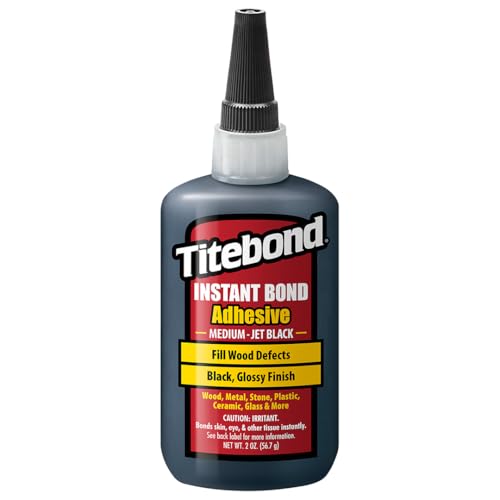
Titebond Instant Bond Medium CA is a rubber-toughened ethyl cyanoacrylate super glue with a jet black pigment designed to blend into dark materials like carbon fiber. The medium viscosity fills small gaps, knots, and cracks while hiding the repair behind a glossy black finish that matches carbon weave aesthetics.
The 40–60 second set time offers a brief alignment window before the adhesive locks. Users consistently praise it for bonding 3D printed parts and woodworking inlays, but the CA formula is inherently brittle under shear stress. It resists heat and solvents after full cure, making it suitable for cosmetic repairs on non-structural carbon fiber trims, handles, or accent pieces.
This product should not be used for load-bearing carbon fiber joints because CA has low peel strength and will fracture under flex. The 2 oz bottle is economical for small projects, but the black pigment can stain surrounding surfaces if applied carelessly. Not recommended for bonding carbon fiber to metal where structural integrity is required.
Why it’s great
- Jet black color blends with carbon fiber weave
- Medium viscosity fills gaps and small voids
- Fast 40–60 second set for quick touch-ups
Good to know
- Brittle bond unsuitable for structural loads
- Black pigment can stain surrounding surfaces
- Low peel strength under flex or vibration
FAQ
Can I use regular CA super glue on carbon fiber?
How do I prepare carbon fiber before bonding?
Is a flexible or rigid adhesive better for carbon fiber?
Final Thoughts: The Verdict
For most users, the best adhesive for carbon fiber winner is the 3M Scotch-Weld DP420 because its ultra-high shear strength and fatigue resistance meet the demands of real structural composite bonding. If you need a sag-free vertical repair with generous working time, grab the TotalBoat Thixo. And for cosmetic touch-ups where color match matters, nothing beats the Titebond Instant Bond Jet Black.