
Our readers keep the lights on and the weekend projects moving. As an Amazon Associate, I earn from qualifying purchases.
Mating wood to concrete is one of the most demanding bonds in any construction or repair project. Concrete is porous, alkaline, and dimensionally stable, while wood expands and contracts with moisture — finding an adhesive that bridges these two opposites without failing under shear or peel stress is the entire challenge.
I’m Rikta — the co-founder and writer behind FitlyFast. I’ve spent hundreds of hours analyzing construction adhesive formulations, cure chemistry, and real-world performance data to identify which products deliver a lasting structural grip on this tricky material interface.
This guide breaks down the best candidates for the job, comparing polyurethane, hybrid polymer, epoxy, and spray-contact formulas so you can match the right chemistry to your specific project. Whether you are attaching furring strips, gluing a subfloor, or repairing a landscape feature, this is your complete resource for finding the best adhesive for gluing wood to concrete.
How To Choose The Best Adhesive For Gluing Wood To Concrete
Selecting the right adhesive for this specific material pairing comes down to understanding three things: the chemistry of the bond, the environmental conditions it will face, and the physical demands of the application. A poor choice leads to creeping joints, brittle failures, or adhesive that never cures because the concrete’s pH or moisture content interfered with the formula.
Polyurethane vs. Hybrid Polymer vs. Epoxy
Polyurethane construction adhesives (like Loctite PL Premium) are the workhorse choice for wood-to-concrete because they cure through moisture, expand slightly to fill gaps, and remain flexible after curing. Hybrid polymer formulas (like Gorilla Max Strength) offer similar strength with a cleaner, paintable finish and less foaming. Epoxy pastes (like PC-7) give you the highest shear strength and chemical resistance, but require exact mixing ratios and longer cure times — best for load-bearing repairs where the joint will be heavily stressed.
Gap Filling and Open Time
Concrete surfaces are rarely perfectly flat, so a gap-filling adhesive that can bridge a 1/8-inch or larger gap is a must for a full bond line. Open time — how long you can reposition the wood after initial contact — ranges from 30 seconds to 5 minutes depending on the formula. Quick-grab adhesives are ideal for vertical applications where the wood would otherwise slide, while longer open time helps align large panels or multiple pieces at once.
Water and Temperature Resistance
If the bond is in a basement, exterior landscape feature, or anywhere moisture is present, you need a waterproof adhesive rated for wet surfaces and sub-freezing application. Most polyurethane adhesives can be applied to damp lumber and concrete at temperatures as low as 0°F, while epoxy formulas have a narrower service window and require a completely dry surface for proper adhesion.
Quick Comparison
On smaller screens, swipe sideways to see the full table.
| Model | Category | Best For | Key Spec | Amazon |
|---|---|---|---|---|
| Loctite PL Premium Polyurethane (12-Pack) | Polyurethane | Premium all-purpose wood-to-concrete | 3X stronger than standard adhesives | Amazon |
| Loctite PL 500 Landscape (12-Pack) | Polyurethane | Outdoor block & stone bonding | Gunnable down to 0°F | Amazon |
| Gorilla Max Strength Construction Adhesive (2-Pack) | Hybrid Polymer | Clear, gap-filling indoor/outdoor bonds | 2X stronger than Gorilla Heavy Duty | Amazon |
| PC Products PC-7 Epoxy Adhesive Paste | Epoxy Paste | Heavy-duty repairs & fill | Service temp: -20°F to +200°F | Amazon |
| Titebond TiteGrab Plus Construction Adhesive | Advanced Polymer | Instant grab on vertical surfaces | Instant grab, no bracing needed | Amazon |
| 3M Max Strength 90 Contact Adhesive | Spray Contact | Large surface area lamination | Max bond in 10 minutes | Amazon |
| Professional Soma Fix Chemical Anchor | Polyester Resin | Anchoring fasteners in concrete | Extra mixing nozzle included | Amazon |
In‑Depth Reviews
1. Loctite PL Premium Polyurethane Construction Adhesive (12-Pack)

Loctite PL Premium is the standard against which all other wood-to-concrete adhesives are measured. Its one-component polyurethane formula cures by reacting with ambient moisture, which makes it naturally suited for concrete’s damp environment. The foam expansion during cure fills gaps up to 3/8 inch, ensuring a full bond line even on uneven slab surfaces.
What sets PL Premium apart is its sheer strength — it is rated three times stronger than ordinary construction adhesives. This matters most for subfloor installations and furring strips, where the wood must stay locked down without screw reinforcement. The adhesive is paintable, has a low solvent odor, and can be applied to wet or frozen lumber without degrading performance, a feature few competitors match.
For large projects, the 12-pack cartridge format offers the best per-tube value in the premium tier. Each 10-ounce cartridge loads into a standard caulk gun, and users report that about three tubes are needed for 16 linear feet of furring strips. The 24-hour full cure is standard for polyurethane, but the initial grab is strong enough within 30 minutes to hold most vertical work without bracing.
Why it’s great
- 3X stronger than standard construction adhesives
- Moisture-curing formula works on damp surfaces
- Excellent gap-filling capability
Good to know
- Expands during cure — can ooze if over-applied
- Requires a caulk gun for application
2. Loctite PL 500 Landscape Block & Stone Construction Adhesive (12-Pack)
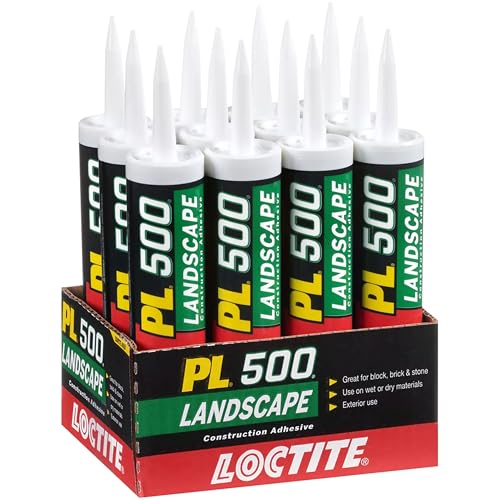
When the project moves outdoors, Loctite PL 500 is the specialized formulation for bonding wood to concrete, stone, and block in landscape settings. The adhesive is engineered for extreme temperature resilience, remaining gunnable at 0°F and performing up to 100°F. This cold-weather capability allows late-fall and early-spring jobs without pre-warming the cartridge.
The formula excels on irregular surfaces. It stays thick enough to bridge gaps between rough-cut stone and concrete pavers without running, and it does not roll up on wet or frozen lumber — a common failure mode for cheaper adhesives. Users working on retaining walls and capstone installations report that the bond holds back soil pressure effectively, even when the adhesive is applied thickly enough to squish through bracket holes.
The 12-pack volume makes sense for continuous landscape work. Each tube covers roughly 10 linear feet of a 2-inch-wide bead, and the adhesive remains flexible after curing, accommodating minor ground shift without cracking. If your wood-to-concrete bond will live outside, this is the formulation that weathers best.
Why it’s great
- Remains gunnable at 0°F for cold-weather work
- Waterproof and weather-resistant after cure
- Bonds strong to irregular stone surfaces
Good to know
- Thicker consistency can be harder to extrude in cold temps
- Best suited for landscape-specific materials
3. Gorilla Max Strength Construction Adhesive, Clear (2-Pack)
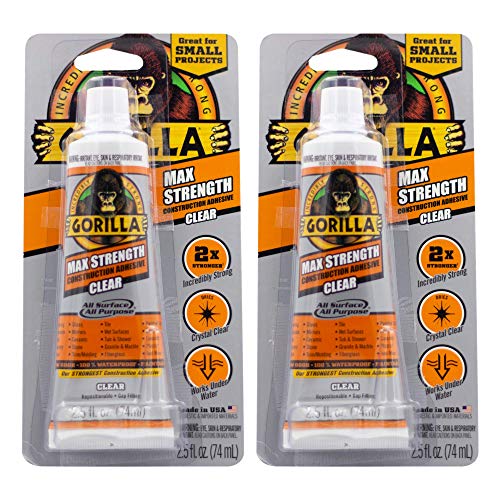
Gorilla’s Max Strength formula delivers hybrid polymer performance at a mid-range price point, with the unique advantage of a clear finish. The crystal-clear appearance is a meaningful benefit when the bond line might be visible — think glass-to-concrete projects or aesthetic wood trim where you do not want a dark glue line showing through.
The hybrid chemistry provides 2X the strength of Gorilla’s own Heavy Duty Construction Adhesive. It is waterproof and gap-filling, curing to a hard but slightly flexible rubber-like consistency that handles vibration well. Users report that the 30-second initial tack allows quick positioning, while the 5-minute repositioning window gives enough time to adjust furring strips before the bond locks permanently. Cleanup with rubbing alcohol is straightforward before the 24-hour full cure.
One limitation is the squeeze tube format — the 2.5-ounce tubes lack the precision of a caulk-gun cartridge, making it harder to lay a consistent bead along a long concrete contact line. For small repairs, furniture attachment, or discrete spot-bonding, the clarity and ease of use make this a top choice. For full subfloor or wall assemblies, you will need several tubes.
Why it’s great
- Dries crystal clear for invisible bond lines
- Waterproof and gap-filling formula
- 30-second initial tack for fast positioning
Good to know
- Small tube size limits large-project viability
- Full 24-hour cure required before stressing
4. PC Products PC-7 Epoxy Adhesive Paste

PC-7 is not a construction adhesive in the caulk-gun sense — it is a two-part epoxy paste that comes in two separate cans that you mix by hand. This is the right choice when the wood-to-concrete bond must withstand extreme loads, chemical exposure, or temperature swings from -20°F to +200°F. It functions as an adhesive, sealant, and filler all in one.
The paste consistency is a major advantage on vertical applications. It stays put without sagging, even when applied in thick layers to fill voids or build up a joint. With a full hour of working time, you can shape the epoxy with a putty knife or your finger, and once cured after 48 hours, PC-7 sands and paints like a dense plastic. Users repairing cracked fountain basins, oil tank leaks, and metal-to-concrete joints report that the bond outlasts the surrounding material.
The trade-off is preparation and patience. Both concrete and wood must be absolutely clean, dry, and free of dust or oil for the epoxy to achieve its full shear strength. The 48-hour full cure means this is not a same-day solution. For small, high-stakes repairs where a polyurethane bead would not provide enough structural integrity, PC-7 is the heavy lifter.
Why it’s great
- Superior shear strength and chemical resistance
- Non-sag paste stays put on vertical surfaces
- Can be sanded, drilled, and painted after cure
Good to know
- Requires precise mixing of two parts
- Full 48-hour cure time before stressing
5. Titebond TiteGrab Plus Construction Adhesive
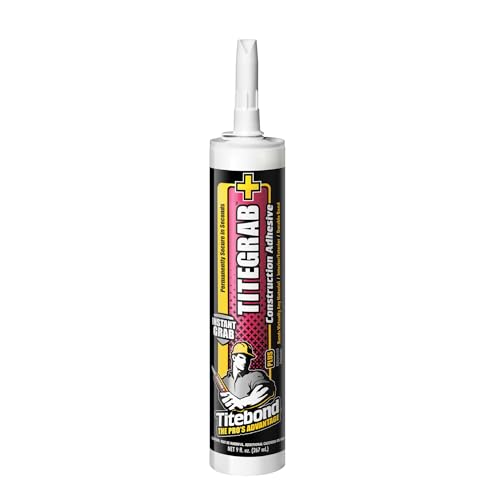
Titebond TiteGrab Plus is engineered specifically to eliminate the need for bracing, nails, or screws while the adhesive cures. Its advanced polymer formula delivers an immediate initial grab that holds wood furring strips in place on a vertical concrete wall without sliding. This instant-grip characteristic is its defining feature and a genuine time-saver for interior framing and paneling projects.
The creamy, high-solids formula extrudes smoothly through a caulk gun and bonds to both porous and non-porous materials, including wood, concrete, metal, tile, and foam. Users installing ceiling tiles report that the 2-to-3-minute repositioning window is generous enough to get alignment right before the bond locks. The adhesive is fully waterproof and all-weather rated for both indoor and exterior use.
One reported drawback is reduced effectiveness on very smooth, non-porous concrete surfaces — the texture of the concrete matters for peak adhesion. On standard poured concrete or concrete block, the bond is excellent. For large-scale subfloor installations or exterior deck framing where a premium structural bond is needed, the Loctite PL Premium offers higher overall strength, but for speed of installation, TiteGrab Plus is hard to beat.
Why it’s great
- Instant grab holds wood vertically without bracing
- Creamy, easy-to-extrude formula
- Waterproof and all-weather rated
Good to know
- Less effective on ultra-smooth, polished concrete
- Not as strong as polyurethane for structural loads
6. 3M Max Strength 90 Multi-Surface Contact Adhesive
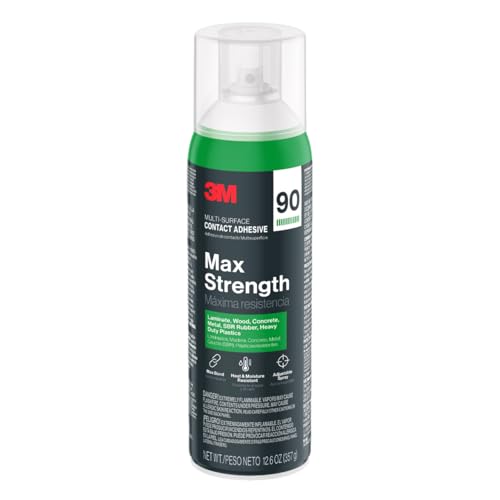
3M Max Strength 90 is a contact adhesive in aerosol form, which makes it a completely different application method than the caulk-gun adhesives above. It is designed for bonding large, flat surfaces — laminating wood veneer to concrete countertops, attaching foam insulation panels to a foundation wall, or securing acoustic panels. The contact adhesive bonds on contact, meaning both surfaces must be aligned perfectly before they touch because repositioning is impossible.
The spray pattern is adjustable via the nozzle, and the low-VOC formulation meets California CARB requirements, making it suitable for interior use where odor and air quality are concerns. Users report very consistent coverage with little waste, and a single can lasts a long time for intermittent projects. The max bond forms in 10 minutes, which is extremely fast compared to the 24-hour cure of most construction adhesives.
However, contact adhesive is not ideal for structural shear loads. It excels at sheer surface area bonding rather than gap filling or load-bearing joints. For gluing a plywood subfloor directly to a concrete slab, the full-surface spray application of 3M 90 provides uniform hold, but it will not bridge uneven concrete the way a bead of Loctite PL Premium will. Use this when speed and full coverage matter more than gap tolerance.
Why it’s great
- Quick, even coverage on large surfaces
- Bonds in 10 minutes with no clamping needed
- Low-VOC formulation for interior air quality
Good to know
- No repositioning possible once surfaces touch
- Does not fill gaps between uneven surfaces
7. Professional Soma Fix Chemical Anchor (300ml)
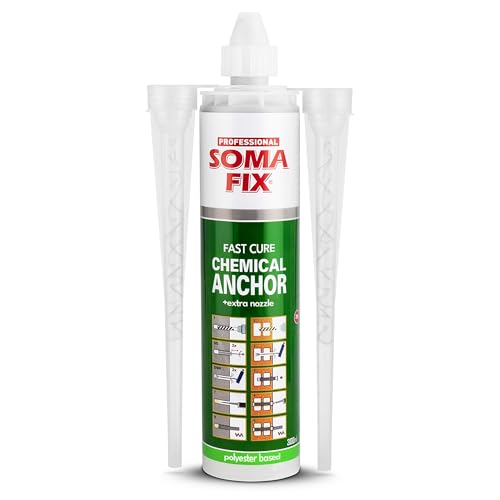
The Soma Fix Chemical Anchor is a polyester resin system purpose-built for anchoring threaded rods, rebar, and other fasteners into concrete. While it is not a surface-bonding adhesive, it is the go-to solution when you need to attach wood to concrete mechanically — you drill a hole, inject the resin, insert the fastener, and then mount the wood. This is the strongest possible method for wood-to-concrete connections because the fastener transfers the load into the concrete internally.
The polyester resin cures fast, with users reporting that the fastener can be lightly loaded within minutes of insertion. The extra included mixing nozzle is a practical bonus for multi-point anchor jobs. The injection is clean and non-expanding, meaning no pressure cracks in the concrete substrate. For hollow materials, a mesh sleeve is used to contain the resin and ensure proper encapsulation of the fastener.
This is not a substitute for a construction adhesive when you want to glue a 2×4 flat to a slab — you still need the wood-to-concrete surface bond. But for attaching wood ledgers, mounting posts to concrete, or fastening any structure that needs genuine mechanical anchorage, this chemical anchor provides the holding power of an epoxy at a budget-friendly per-cartridge price. It occupies the budget tier because it solves a narrower problem than the all-purpose adhesives above.
Why it’s great
- Provides true mechanical anchoring in concrete
- Fast-curing polyester resin sets within minutes
- Extra mixing nozzle included for multiple applications
Good to know
- Not a surface-bonding adhesive for flat wood-to-concrete glue-ups
- Requires drilling and correct hole preparation
FAQ
Can I glue wood directly to a concrete floor without mechanical fasteners?
How do I prepare a concrete surface for adhesive bonding?
Will standard construction adhesive work on damp or wet concrete?
Final Thoughts: The Verdict
For most users, the adhesive for gluing wood to concrete winner is the Loctite PL Premium Polyurethane Construction Adhesive because it combines the highest overall strength with excellent moisture tolerance, gap filling, and a proven track record on subfloor and furring-strip installations. If you need an instant grab to eliminate bracing on vertical work, grab the Titebond TiteGrab Plus. And for outdoor landscape block or stone bonding where weather resistance is paramount, nothing beats the Loctite PL 500 Landscape Block & Stone Adhesive.