
Our readers keep the lights on and the weekend projects moving. As an Amazon Associate, I earn from qualifying purchases.
Finding a reliable adhesive for metal to metal bonding isn’t about hoping for the best — it’s about knowing which specific chemistry (epoxy putty, liquid cyanoacrylate, neoprene, or cold-weld paste) will actually hold against the shear stress, vibration, and temperature swings your repair demands. The wrong choice leads to delaminated joints and wasted hours.
I’m Rikta — the co-founder and writer behind FitlyFast. I’ve spent countless hours analyzing the tensile strength ratings, cure schedules, thermal limits, and surface compatibility specifications of these metal-to-metal bonding systems so you don’t have to guess.
This guide breaks down the top-performing options available now to help you match the right formula to your specific repair. Here is the definitive analysis of the best adhesive for metal to metal repairs on the market today.
How To Choose The Best Adhesive For Metal To Metal
Selecting the correct adhesive for bonding metal starts with a clear assessment of the forces the bond must withstand. A static repair on a decorative bracket faces far different demands than a load-bearing joint on an engine component or an automotive panel exposed to constant vibration. You need to match the adhesive’s tensile strength, working time, and cure schedule to the specific metal alloy and the environment it will inhabit.
Tensile Strength and Load-Bearing Capacity
Tensile strength, measured in pounds per square inch (PSI), is the primary spec that determines how much pulling force a bonded joint can handle before failing. For light-duty metal repairs like trim reattachment or small brackets, adhesives in the 2500–3500 PSI range often suffice. For structural repairs — cracked engine housings, load-bearing brackets, or stressed frames — target adhesives with a tensile strength of 4000 PSI or higher. The J-B Weld SteelStik provides a reliable 4000 PSI bond, while the Starbond 5 Minute Epoxy delivers an impressive 2600 lb shear strength for demanding applications.
Working Time and Cure Speed
The window between mixing and initial set, known as working time, dictates how much control you have over alignment and clamping. Fast-setting options like the J-B Weld SteelStik (5-minute set, 1-hour cure) are ideal for small, simple repairs where speed matters. However, for complex assemblies or repairs requiring precise positioning — like rebuilding a cracked crankcase or bonding multiple aluminum chair straps — a longer working time of 30 minutes or more, such as that provided by the AOJEL S300, is invaluable. Always verify the full cure time, which for most quality epoxy systems is 12–24 hours before the bond reaches maximum strength and becomes drillable or paintable.
Temperature and Chemical Resistance
Metal repairs often encounter heat, oil, and moisture. An adhesive designed for under-the-hood automotive use must withstand continuous temperatures of at least 250°F and intermittent exposure up to 400°F. The AOJEL S300 handles heat up to 392°F, while the J-B Weld SteelStik withstands continuous temperatures up to 350°F. For outdoor or marine applications, water resistance is critical — the RH Adhesives S-18 formula offers excellent water resistance for marine use, and the Polymix Metal Panel Bond 60 is a self-sealing adhesive that eliminates the need for separate sealers on automotive panel joints.
Surface Preparation Requirements
No adhesive can compensate for poor surface prep on metal. Every bond requires a clean, dry, oil-free surface. For maximum mechanical grip, roughen smooth metal with sandpaper or a wire brush before applying the adhesive. Epoxy putties like the SteelStik are forgiving on slightly uneven surfaces and can fill gaps, while thin cyanoacrylate formulas like the Kraftprotz require tight-fitting joints with minimal gap. Urethane panel bonders like the Polymix system are designed specifically for clean sheet metal surfaces on automotive panels and require precise application with a mixing nozzle.
Quick Comparison
On smaller screens, swipe sideways to see the full table.
| Model | Category | Best For | Key Spec | Amazon |
|---|---|---|---|---|
| AOJEL S300 | Cold-Weld Epoxy | Load-bearing rigid metal repairs | 392°F heat resistance | Amazon |
| Starbond 5 Min Epoxy | Flexible Epoxy Gel | Vibration-prone & multi-material bonds | 2600 lb shear strength | Amazon |
| J-B Weld SteelStik | Epoxy Putty Stick | Quick gap-filling & plumbing repairs | 4000 PSI tensile strength | Amazon |
| Polymix Metal Panel Bond 60 | Urethane Panel Adhesive | Automotive body panel replacements | Self-sealing bond | Amazon |
| Kraftprotz Auto Super Glue | Liquid Cyanoacrylate | Penetrating cracks & trim bonds | -40°F to 230°F range | Amazon |
| RH Adhesives S-18 | Neoprene Contact Adhesive | Rubber-to-metal & marine use | Water-resistant film | Amazon |
| PC Products PC-Masonry | Masonry Epoxy Paste | Concrete-to-metal adhesion & filling | Non-sag paste formula | Amazon |
In‑Depth Reviews
1. AOJEL S300 Metal Epoxy Repair System
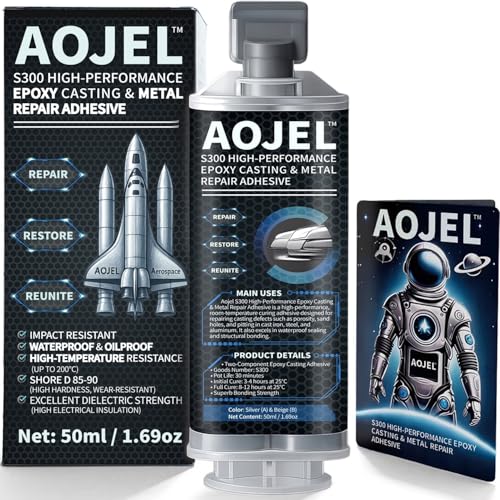
The AOJEL S300 sets the standard for structural metal-to-metal repairs where a cold-weld joint must hold under real load. Its 30-minute working time gives you the control to precisely align, clamp, and build thickness on cracked aluminum brackets, steel frames, cast iron parts, and stainless fittings — no rushed 5-minute panic here. The two-part epoxy cures to a hard, drillable, sandable, and paintable body that withstands heat up to 392°F and resists oil and moisture.
This system is purpose-built for rigid, non-flexing metal repairs like engine housings, stripped bolt holes, and tool restorations where flame welding is impractical. The 1:1 mix ratio is straightforward, though some users note the plungers can be finicky at the start of the syringe. Patience during dispensing ensures a uniform mix and a bond that lives up to its load-bearing claims.
For anyone rebuilding a cracked crankcase, reinforcing an aluminum patio chair frame, or repairing a fence post, the AOJEL S300 delivers the controlled working window and the thermal resilience required for a permanent fix. It is the most versatile cold-weld system in this lineup for serious metal restoration.
Why it’s great
- 30-minute working time allows precise positioning on complex repairs
- High heat resistance (392°F) suits under-hood and engine-adjacent bonds
- Cured body is fully drillable, sandable, and paintable
Good to know
- Syringe plungers can dispense unevenly — dispense a test amount first
- Full 24-hour cure required before stress-testing the bond
2. Starbond 5 Minute Epoxy Pro Kit

The Starbond 5 Minute Epoxy stands apart with its flexible toughened formula engineered to absorb vibration and stress without the brittle cracking that plagues standard epoxy gels. With a reported shear strength of 2600 lb, this clear-curing adhesive bonds reliably across metal, wood, plastic, glass, and ceramics, making it a universal fix for household repairs, furniture, and automotive interior components.
The 8 oz Pro Kit includes screw-cap bottles, reusable mixing trays, and tools for clean application — a welcome upgrade from leaky syringes and guesswork ratios. The 5-minute fast set gives you a reasonable window for positioning, and the 24-hour full cure ensures maximum holding power. Users consistently praise the easy measurement and the frustration-free cleanup.
This is the best choice for repairs where the bonded joint will experience some flex or vibration, such as attaching trim to a vehicle body or fixing a tool handle. The clear finish also makes it ideal for visible repairs on glass or metal where aesthetics matter. The only noted limitation is on crown molding butt joints, where some users found it less effective than specialized wood epoxies.
Why it’s great
- Toughened formula resists cracking under vibration and stress
- Clear cure is virtually invisible on glass, metal, and finished surfaces
- Pro Kit includes trays and tools for controlled, low-waste mixing
Good to know
- Some users report reduced effectiveness on specific wood joints
- 5-minute working time requires prepared clamps and positioning
3. J-B Weld SteelStik Epoxy Putty

The J-B Weld SteelStik is the definitive hand-mixable epoxy putty stick for emergency metal repairs where speed and simplicity matter most. With a tensile strength of 4000 PSI, this steel-reinforced putty bonds iron, stainless steel, aluminum, copper, and bronze after just a 5-minute set and a 1-hour cure. The NSF certification means it is safe for contact with potable water, adding plumbing repairs to its range of applications.
The putty stick format is uniquely forgiving — just cut what you need, knead until the two-part formula turns uniform dark grey, and press it into place. It can be molded, shaped, sanded, drilled, and tapped after cure, making it a practical choice for rebuilding stripped threads, filling holes in oil pans, or reattaching chair screws. Users consistently report easy mixing and surprising strength on chair frames, stool arms, and even outdoor barbecue storage doors.
Where the SteelStik truly excels is its 5-minute set time, which also imposes a strict limitation: you must work fast. Beginners may waste material as the putty hardens before it can be positioned. For quick repairs with immediate clamping, this is a budget-friendly powerhouse that delivers professional-grade results.
Why it’s great
- 4000 PSI tensile strength with NSF certification for potable water contact
- Putty format is easy to cut, knead, and mold without measuring
- Drillable and paintable after a short 1-hour cure
Good to know
- 5-minute set time is fast — measure and knead without delay
- Dark grey finish may not match all visible repair areas
4. Polymix Metal Panel Bond 60

The Polymix Metal Panel Bond 60 is a professional-grade two-part urethane adhesive specifically formulated for bonding steel and aluminum automotive body panels. Its primary application is replacing quarter panels, roofs, box sides, van sides, and door skins without the heat distortion, grinding, and rust protection requirements of traditional welding. The 200ml cartridge with two mixing nozzles delivers consistent bead application for clean panel joints.
This product eliminates several steps required by welding — no need to remove internal panels or gaskets, no reshaping of heat-deformed metal, and no separate seam sealer because the urethane bond is self-sealing. After the 24-hour full cure, the bonded area maintains its structural integrity against road vibration and weather exposure.
The Polymix system is the correct tool for anyone replacing automotive body panels who wants a factory-quality bond without a welder. For smaller metal repairs or non-automotive applications, a traditional epoxy might be more practical. Users with experience in panel bonding consistently rate this as equal or superior to premium brands at a fair price point.
Why it’s great
- Self-sealing urethane eliminates need for separate seam sealers
- No heat deformation or grinding required versus welding
- Designed specifically for automotive panel replacement
Good to know
- Requires a caulking-style gun for cartridge application
- Best suited for sheet metal panels — not for small gap-filling repairs
5. Kraftprotz Automotive Super Glue
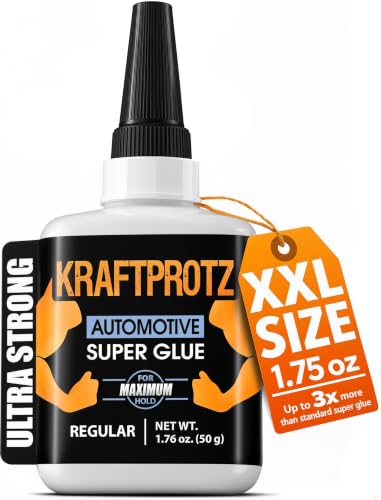
The Kraftprotz Automotive Super Glue is a thin cyanoacrylate liquid engineered to flow into tight gaps and microcracks that gel adhesives cannot reach. Its capillary action makes it ideal for bonding trim, panels, headlight housings, and dashboard components where the mating surfaces are narrow and inaccessible. The formula withstands temperature shifts from -40°F to 230°F and resists oil and engine vibration, making it a practical addition to any garage or emergency vehicle kit.
The precision dropper tip provides controlled flow without overspill, and the anti-clog cap prevents crusting between uses. Users have successfully repaired a Golf R front bumper, a car mirror, truck trim, and a flagpole hook with this glue — and reported that the bond held through months of heat and rain. The 4-hour cure time is acceptable for non-structural repairs, though the 2-3 minute initial set requires clamping or holding force.
This is not a structural adhesive for load-bearing metal joints — it is a precision repair tool for penetrating cracks and bonding thin metal or plastic to metal in automotive interiors and exteriors. The thin format also means it works poorly on porous materials or surfaces with significant gaps. For its intended use of micro-crack repair and trim attachment, it performs excellently.
Why it’s great
- Thin formula penetrates hairline cracks and tight spaces via capillary action
- Withstands automotive temperature range (-40°F to 230°F)
- Large 1.76 oz bottle with anti-clog cap for multiple uses
Good to know
- Not suitable for gap-filling or porous materials
- Requires clamping for 2-3 minutes before initial set
6. RH Adhesives S-18 All-Purpose Adhesive
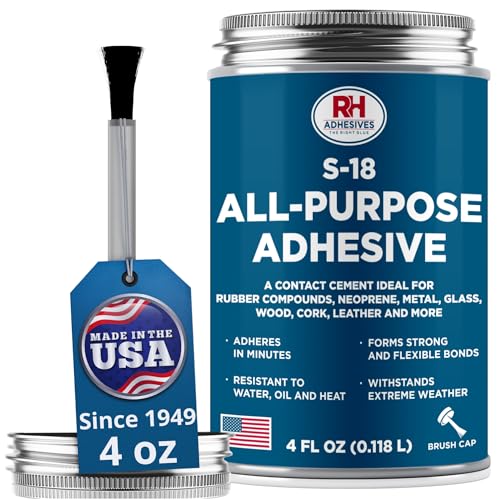
The RH Adhesives S-18 All-Purpose Adhesive is a neoprene-based contact adhesive with a proven track record for bonding rubber to metal, along with other porous and non-porous materials. Made in America since 1949, this formula creates flexible, water-resistant films with excellent peel strength and resistance to oil and aging. It is particularly suited for marine applications where moisture exposure is constant, as well as leather repair and foam insulation bonding.
The 4 oz can is a liquid that requires brush application or careful spreading. The 24-hour full cure ensures a durable bond, but users note that the adhesive can gum up at the nozzle if not properly sealed between uses. On neoprene-to-metal bonds, the S-18 delivers strong initial hold, though its performance in extended outdoor heat and rain has shown mixed results — some users report failure in high-temperature conditions. This makes it best suited for interior or protected outdoor applications.
For those specifically needing a contact adhesive that bonds rubber, felt, cork, or fabric to metal, the S-18 is a reliable and affordable choice. It is not a structural epoxy and should not be relied upon for load-bearing metal-to-metal repairs where high shear stress is present.
Why it’s great
- Excellent peel strength for rubber-to-metal bonding
- Water-resistant film works well in marine applications
- Flexible bond absorbs vibration without cracking
Good to know
- Limited heat tolerance — may fail in direct summer sun or high-temperature environments
- Liquid format requires careful application to avoid mess
7. PC Products PC-Masonry Epoxy Adhesive Paste
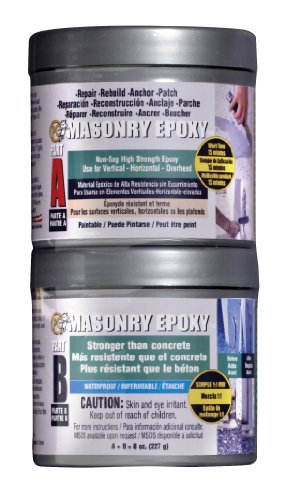
The PC Products PC-Masonry Epoxy Adhesive Paste is a two-part epoxy formulated specifically for bonding and repairing concrete and masonry surfaces, but its strong adhesion to metal makes it a useful option for embedding metal brackets, anchors, or fixtures into masonry. The non-sagging paste consistency allows application on vertical and overhead surfaces without dripping, and the material can be applied to wet or dry surfaces — a practical advantage for outdoor repair in damp conditions.
With an application temperature range of 35°F to 115°F and a service temperature range of -20°F to 200°F, this paste handles seasonal extremes. Users report excellent results for flagstone repair, bonding thin slate pavers to concrete, patching pool tile and gunite, and even repairing cracked plastic sliding door thresholds. The paste cures to a sandable and paintable finish, though it requires a 1-2 day full cure before machining or staining.
This is not a general-purpose metal-to-metal adhesive — it is a masonry epoxy that incidentally bonds metal well when the metal is being attached to concrete or stone. For someone repairing a concrete step with a metal handrail base or embedding steel brackets into a foundation wall, this paste is the correct tool. For direct metal-to-metal bonding, choose one of the dedicated epoxy systems above.
Why it’s great
- Non-sag paste stays in place on vertical and overhead surfaces
- Can be applied to wet surfaces for outdoor repair convenience
- Sandable and paintable after full cure
Good to know
- Designed primarily for masonry — not optimized for direct metal-to-metal bonds
- 1-2 day cure time before full strength is achieved
FAQ
Do I need to roughen the metal surface before applying the adhesive?
Can I use any of these adhesives on aluminum?
How long should I clamp a metal-to-metal epoxy bond?
What is the difference between cold-weld epoxy and cyanoacrylate for metal?
Can these adhesives withstand engine heat and oil exposure?
Final Thoughts: The Verdict
For most users, the best adhesive for metal to metal repairs is the AOJEL S300 because its 30-minute working time, 392°F heat resistance, and fully machinable cured body cover the widest range of structural repair scenarios — from engine housings to aluminum brackets. If you need a fast, gap-filling putty for emergency plumbing and quick fixes, grab the J-B Weld SteelStik with its 4000 PSI strength and 1-hour cure. And for automotive panel replacements requiring a self-sealing bond that eliminates traditional welding steps, nothing beats the Polymix Metal Panel Bond 60.