
Our readers keep the lights on and the weekend projects moving. As an Amazon Associate, I earn from qualifying purchases.
Matching the right adhesive to plaster is a specific science. A bond that fails under humidity, temperature shifts, or sheer gravity means a repair that returns, costing time and effort. The right formulation — whether a construction-grade grabber in a tube or a specialized bonding agent in a quart — acts as a silent partner, locking patching compound or new plaster board to wood, concrete, brick, or old lath without compromise.
I’m Rikta — the founder and writer behind FitlyFast. I’ve worked through hundreds of product data sheets and customer reviews on construction adhesives and plaster bonding agents to isolate the formulations that deliver repeatable, long-term grip.
This guide breaks down the specific chemical makeups, cure behaviors, and real-world application methods that separate an anchor that actually holds from one that lets go. To find the best adhesive for plaster, we examine water resistance, open time, substrate compatibility, and holding power across seven different formulations.
How To Choose The Best Adhesive For Plaster
An adhesive that works well on a wooden shelf may fail catastrophically on a plaster wall. Plaster is porous, brittle, and often rests on a base of gypsum, concrete, or wood lath. The wrong adhesive can pull chunks of material away or simply peel off when the wall flexes. Focus on the bonding mechanism, the surface you are sticking to, and the cure profile of the product.
Bonding Mechanism: Grab vs. Chemical Weld
Construction adhesives rely on immediate physical grab and a chemical cure that builds strength over 24 hours. A fast-grab formula like the Titebond TiteGrab uses an advanced polymer that holds the plaster board in place almost instantly, reducing the need for mechanical fasteners. A bonding agent like Larsen Plaster-Weld works differently — it penetrates the porous plaster surface and creates a tacky base for new plaster to lock into. For patching holes or reattaching loose sections, a bonding agent is the correct starting point. For fixing a full sheet of drywall or plasterboard to studs, a heavy-duty construction adhesive with instant grab is the better choice.
Water Resistance and Interior vs. Exterior Use
Not every repair is inside a climate-controlled room. A basement, bathroom, or exterior wall repair demands a waterproof formulation that will not shrink, become brittle, or re-emulsify under moisture exposure. The Titebond TiteGrab and the Sika concrete adhesive both specify all-weather and freeze-thaw resistance, making them suitable for exterior-grade plaster patching or anchoring. A standard wood glue like a PVA-based bonding agent may degrade if repeatedly exposed to damp conditions. Always check the product’s weather resistance rating before applying near a shower, a sill, or an exterior wall.
Open Time: Your Window for Adjustment
Open time refers to how long the adhesive remains workable after application. A spray contact cement such as the 3M Hi-Strength 94 offers up to 60 minutes of open time, which is ideal for large surface laminations where you need to align the material perfectly before the bond sets. A fast-curing anchoring adhesive like the Somafix construction adhesive sets in minutes, leaving almost zero tolerance for repositioning. For large plaster sheets or complex alignment, choose a product with at least 15 minutes of open time. For small patches or fastener anchoring, a faster cure saves time and reduces the risk of the material shifting before it dries.
Quick Comparison
On smaller screens, swipe sideways to see the full table.
| Model | Category | Best For | Key Spec | Amazon |
|---|---|---|---|---|
| Titebond TiteGrab Plus | Construction Adhesive | Vertical plasterboard and trim | Instant Grab polymer formula | Amazon |
| Gorilla Heavy Duty Adhesive | Construction Adhesive | Gap-filling on uneven plaster | 30-second fast grab | Amazon |
| 3M Hi-Strength 94 ET | Spray Adhesive | Large-surface laminations | 60-minute open time | Amazon |
| Larsen Plaster-Weld | Bonding Agent | Prepping old plaster for patches | Pink-dyed PVA formulation | Amazon |
| Somafix S700 | Anchoring Adhesive | Fastening heavy items into masonry | 10.1 fl oz polyester resin | Amazon |
| SIKA SikaLatex R | Concrete Admix | Bonding fresh plaster to concrete | 500 psi bond strength | Amazon |
| Liquid Nails LN903 | Construction Adhesive | Budget multi-pack for large jobs | Low VOC acrylic formula | Amazon |
In‑Depth Reviews
1. Titebond TiteGrab Plus Construction Adhesive
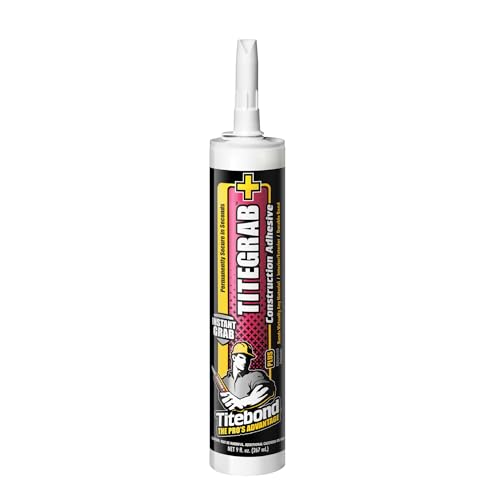
The Titebond TiteGrab Plus uses an advanced polymer formula designed to grip materials immediately upon contact. For vertical plasterboard installations or reattaching loose trim to a plaster wall, this instant grab eliminates the need for temporary bracing or multiple fasteners. The creamy, high-solids formula extrudes smoothly from a standard caulk gun and provides about two to three minutes of workable adjustment time before it begins to set.
This adhesive bonds to a wide range of substrates including wood, concrete, metal, tile, foam board, and painted surfaces. Its waterproof, all-weather rating makes it equally suitable for interior patch work and exterior repairs where moisture or temperature swings could compromise a weaker bond. The full cure time of 24 hours is standard for this category, but the initial grab happens fast enough to support weight almost immediately.
Cusumers consistently note its reliability on tile backsplashes and ceiling tiles, though one reviewer points out that smooth, non-porous surfaces can challenge its grip — a common limitation for polymer-based construction adhesives. For most plaster-related anchoring jobs, this product delivers a predictable, strong hold that outlasts many general-purpose alternatives.
Why it’s great
- Instant grab holds heavy materials without bracing
- Waterproof and all-weather for indoor and outdoor use
- Bonds to a wide variety of porous and non-porous surfaces
Good to know
- Not ideal for completely smooth, non-porous surfaces
- 24-hour full cure requires patience before full load
2. Gorilla Heavy Duty Construction Adhesive
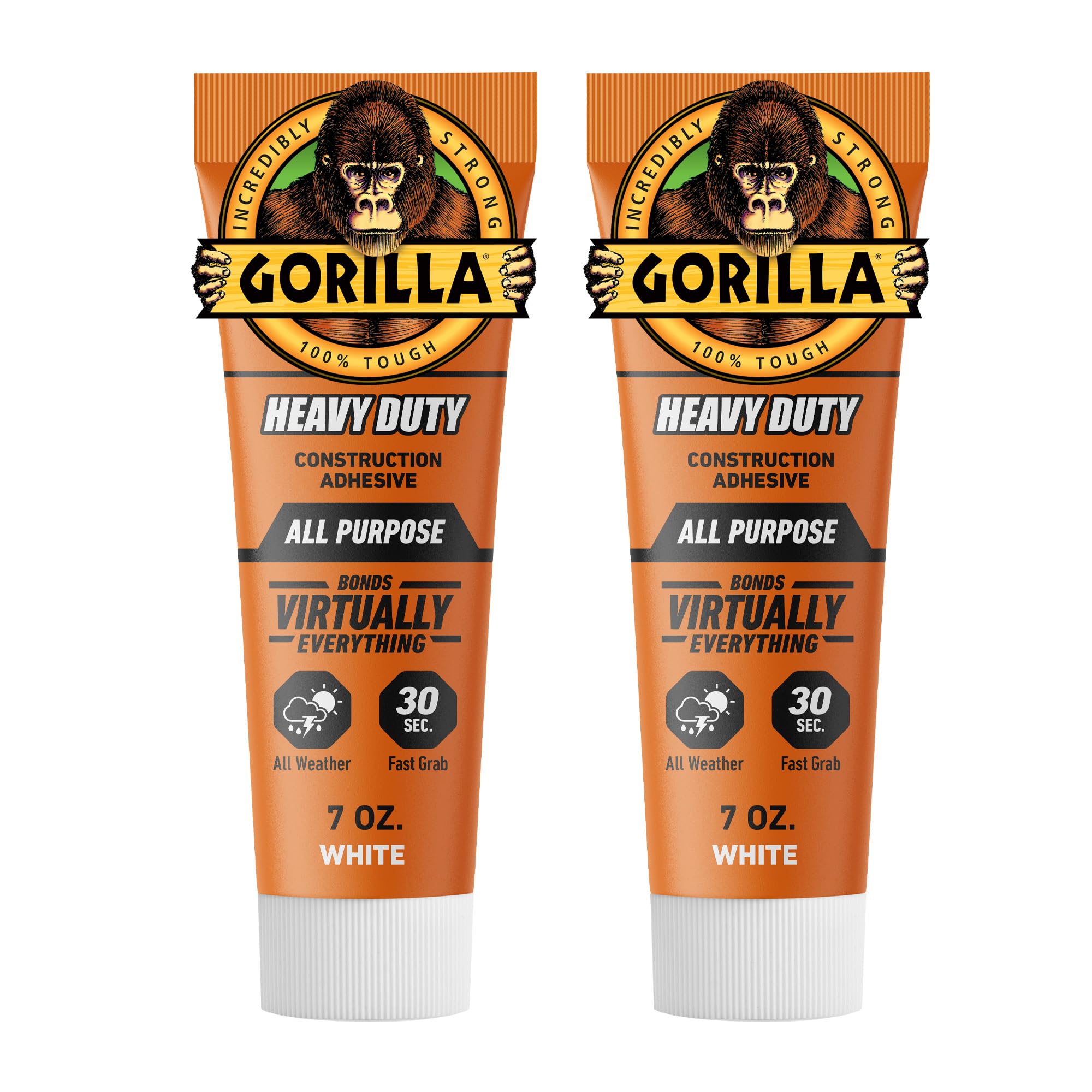
Gorilla’s heavy duty construction adhesive comes in a convenient squeeze tube and is formulated to fill gaps in uneven surfaces. For plaster repairs where the substrate is not perfectly flush — such as old lath with irregular spacing or a rough brick wall behind a patch — the gap-filling nature of this paste prevents voids that could weaken the bond over time.
The adhesive grabs in just 30 seconds, making it one of the fastest-setting options in this list. It bonds to brick, concrete, granite, stone, tile, metal, and drywall, and remains paintable once fully cured. The two-pack format offers good value for projects requiring multiple points of adhesion, such as fixing floorboards or securing subfloor panels.
Some users note that the paste is quite thick, requiring a strong squeeze from the tube, and that coverage is low compared to a caulk-gun cartridge. One reviewer points out that the white paste can look messy on visible areas and wishes for a clear alternative. For hidden structural bonds where gap filling is the priority, this is a solid mid-range choice.
Why it’s great
- Fast grab in 30 seconds speeds up installation
- Gap-filling formula works on uneven substrates
- Paintable finish blends with surrounding surfaces
Good to know
- Thick paste is hard to squeeze from the tube
- Low coverage compared to cartridge formats
3. 3M Hi-Strength 94 ET Spray Adhesive
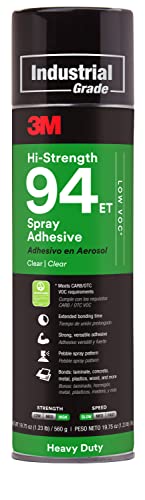
This spray contact cement from 3M is engineered for large surface laminations where even distribution matters. If you are bonding a sheet of plasterboard to a foam core or attaching fabric-backed insulation to a wall, the spray format allows you to coat an entire surface in seconds without the squeeze-tube mess. The low-VOC formula is GREENGUARD certified and contributes to LEED credits, making it suitable for indoor air quality-sensitive spaces.
The standout spec here is the 60-minute open time — far longer than any tube-based construction adhesive on this list. That long working window gives you a full hour to position the substrate, peel it back for adjustment, or re-align a large panel before the bond locks. The aggressive tack holds foam, fabric, wood, and metal securely once the two surfaces make contact.
Users praise its strength for van insulation and woodworking projects, but several note the strong odor and recommend using a respirator and gloves. The product is not intended for structural anchoring of heavy plaster sections — its wheelhouse is flat, broad surface lamination where the bond area is large and the weight distribution is even.
Why it’s great
- Long 60-minute open time for precise alignment
- Low VOC and GREENGUARD certified for indoor use
- Even coverage on large surface areas
Good to know
- Strong odor requires proper ventilation and PPE
- Not for structural anchoring of heavy items
4. Larsen Plaster-Weld Bonding Agent

Larsen Plaster-Weld is not a construction adhesive — it is a bonding agent designed specifically to prepare old or dusty plaster surfaces for a new layer of patching compound. The pink-dyed PVA liquid is brushed or rolled onto the substrate and allowed to dry to a tacky finish. When the new plaster is applied over it, the chemical bond prevents delamination that often occurs when fresh plaster is spread over a smooth or contaminated base.
Professional plasterers have relied on this product for decades, with one reviewer noting 40 years of consistent use. The quart size is sufficient for a small number of patch repairs or a single room of skim coating. Users report that if the product drips onto unpainted surfaces, the dried drips can be peeled off easily, which reflects its non-structural nature once fully dry.
Some users mistakenly expect it to act as an adhesive for bonding objects to plaster. It is a primer, not a grab adhesive. When used correctly before applying plaster or joint compound, it dramatically reduces the risk of the patch falling off. For any repair that involves applying new plaster over an old, smooth, or painted wall, this is the correct first step.
Why it’s great
- Creates a tacky base for new plaster to bond
- Trusted by professionals for decades
- Easy to apply with a brush or roller
Good to know
- Not a construction adhesive for bonding objects
- Dries pink, which may show through thin paint
5. Somafix S700 Fast Curing Anchoring Adhesive
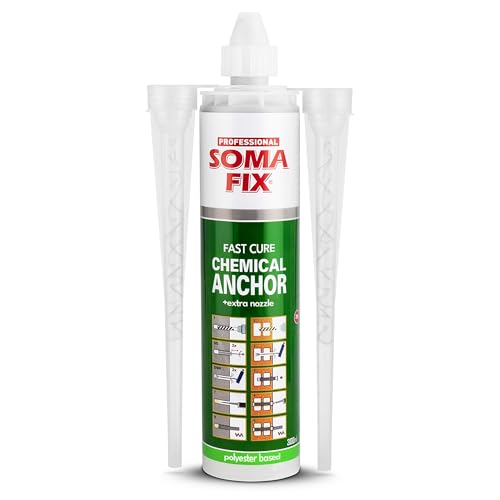
This polyester resin anchoring adhesive is designed for a very specific task: bonding fasteners into concrete, brick, and stone. If you need to attach a railing or a shelf to a plaster wall over masonry, the Somafix S700 provides the mechanical strength that a standard construction adhesive cannot match. The included extra mixing nozzle allows for multiple applications without downtime.
The fast-curing nature of this product means you must have the fastener ready before you mix the resin. Once injected into a drilled and cleaned hole, the adhesive sets in minutes, holding the anchor tightly in place with no expansion pressure that could crack surrounding plaster. For hollow block or cavity walls, the product requires a mesh sleeve to create a proper anchor point.
Users appreciate its strength for fixing loose railings and concrete anchors, noting it sets faster and at a more accessible price point than comparable products from larger brands. This is not a general-purpose plaster adhesive — it is a specialist tool for anchoring heavy objects into the solid base material behind the plaster.
Why it’s great
- Fast cure holds anchors securely in masonry
- Extra nozzle included for multi-application projects
- No expansion pressure protects surrounding material
Good to know
- Sets too fast for repositioning after injection
- Requires mesh sleeve for hollow wall applications
6. SIKA SikaLatex R Concrete Bonding Adhesive

SikaLatex R is an acrylic-polymer liquid designed to be mixed into Portland-cement mortar or concrete, not used as a standalone adhesive. Its primary function is to increase the tensile strength of the cementitious mix, achieving a bond strength of 500 psi. For plaster repairs over concrete walls, adding SikaLatex R to the plaster mix creates a chemical bridge that prevents the new material from peeling away from the dense concrete substrate.
The product resists damage from repeated freezing and thawing cycles, making it suitable for exterior foundation walls or basement repairs. No dilution is required — it is designed to replace the water in the cement mix entirely. The one-gallon size provides enough additive for several small to medium repair batches.
Users confirm that concrete repairs made with this additive hold for years, with one reviewer reporting a bond that lasted until a full renovation removed the patched bricks. The 30-day full cure time is the longest on this list, though the initial set happens within standard cement working times. For any plaster-to-concrete application, this additive is the professional choice.
Why it’s great
- Boosts cement bond strength to 500 psi
- Resists freeze-thaw damage for exterior use
- Easy to use with no dilution needed
Good to know
- 30-day full cure is the longest on this list
- Not a standalone adhesive, must be mixed with cement
7. Liquid Nails Heavy Duty Construction Adhesive (LN903)
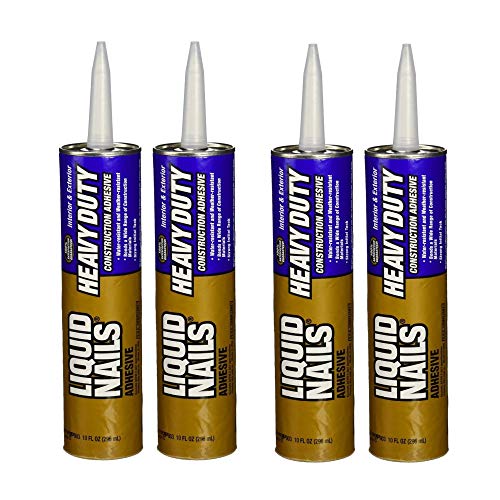
The Liquid Nails LN903 is a classic, budget-friendly construction adhesive sold in a four-pack. The acrylic-based formula is low in volatile organic compounds, making it more comfortable to work with indoors than some solvent-based alternatives. The cartridge format fits a standard caulk gun and provides a consistent bead for bonding trim, drywall, subfloor, and paneling to various substrates including brick and plaster.
This product is the most affordable option per cartridge in this roundup, and the multi-pack ensures you have enough adhesive for a full-room installation without a separate trip to the hardware store. Users have successfully used it for shower panels, vinyl wall tiles, and garage flooring, though structural applications may require supplemental mechanical fasteners like brads for immediate hold while the adhesive cures.
Some users note that the bond works well for paneling and planks but still requires brad nails to prevent the material from sliding before the 24-hour full cure. For standard non-load-bearing plaster repairs where speed and cost are priorities, the LN903 delivers reliable performance at a accessible price point.
Why it’s great
- Four-pack offers excellent value for large projects
- Low VOC formula for safer indoor use
- Versatile bonding on brick, wood, and paneling
Good to know
- May require brad nails for initial hold on vertical surfaces
- Not suitable for heavy structural loads alone
FAQ
Can I use a construction adhesive to patch a hole in my plaster wall?
How do I bond plaster to concrete without it peeling off?
Is a bonding agent necessary before skimming over old painted plaster?
Final Thoughts: The Verdict
For most users, the best adhesive for plaster winner is the Titebond TiteGrab Plus because it offers instant vertical grab, waterproof performance, and broad substrate compatibility in a single tube. If you need a specialized primer for patching old plaster over smooth walls, grab the Larsen Plaster-Weld. And for anchoring heavy fasteners into masonry behind plaster, nothing beats the fast-curing strength of the Somafix S700.