
Our readers keep the lights on and the weekend projects moving. As an Amazon Associate, I earn from qualifying purchases.
Nothing is more frustrating than a repair that peels apart after one day because the adhesive simply couldn’t flex between a rigid plastic part and a soft rubber surface. The chemical incompatibility between these two materials means most general-purpose glues deliver a brittle joint that fails under the slightest vibration or thermal expansion.
I’m Rikta — the co-founder and writer behind FitlyFast. I’ve spent years analyzing polymer chemistry and industrial adhesive specifications to separate the formulas that chemically weld across this material boundary from those that just mask the problem.
Whether you want a flexible seal for an RV trim piece or a high-strength epoxy for a load-bearing fixture, this guide breaks down the top contenders for finding the real adhesive for plastic to rubber that holds.
How To Choose The Best Adhesive For Plastic To Rubber
Selecting the right adhesive for this dissimilar-material joint requires understanding two key facts: most plastics are low-energy surfaces (non-porous and slick), while rubber is flexible and often contains plasticizers that can migrate and weaken a bond. The wrong glue will either bead up on the plastic or become brittle when the rubber moves.
Flexibility Is Non-Negotiable
Rigid glues (standard CA super glues, brittle epoxies) crystallize when the rubber substrate bends, creating stress fractures that peel the bond at the interface. Neoprene-based contact adhesives and polyurethane formulas retain elastomeric properties, allowing the joint to flex with temperature changes and normal mechanical movement.
Check Your Plastic’s Surface Energy
High-density polyethylene (HDPE), polypropylene (PP), and silicone rubber require surface roughening or a dedicated plastic primer before any adhesive can achieve a structural hold. Without mechanical abrasion, even the strongest formula sits on top of the substrate rather than penetrating and chemically locking. For problem plastics, look for adhesives that specifically list those materials in their compatible substrates.
Consider the Service Environment
Outdoor or automotive repairs demand an adhesive that handles UV exposure, standing moisture, and temperature swings. Polyurethane sealants offer excellent weather resistance and remain flexible from sub-zero to over 200°F, while certain formulated CA gels can resist engine-bay heat but become brittle in direct sunlight without a protective paint layer.
Quick Comparison
On smaller screens, swipe sideways to see the full table.
| Model | Category | Best For | Key Spec | Amazon |
|---|---|---|---|---|
| 3M Scotch-Weld PR100 | Instant Adhesive | EPDM, silicone rubber, low-energy plastics | Low viscosity, handling in 20 seconds | Amazon |
| S-18 All-Purpose Adhesive | Contact Cement | Neoprene-to-metal, porous/flexible joints | Water-resistant, 24-hour full cure | Amazon |
| Sikaflex-221 | Polyurethane | Outdoor seals, seawater immersion, RV | NSF-approved, subzero to 200°F | Amazon |
| Gorilla Max Strength Construction | Hybrid Polymer | Gap-filling, clear finish, vertical repairs | 2x stronger than heavy-duty, waterproof | Amazon |
| KRAFTPROTZ Automotive Gel | CA Gel | Vehicle trim, mirror housings, engine bay | Heat resistant to 230°F, no-drip gel | Amazon |
| Bob Smith Slow-Cure Epoxy | Epoxy | Structural joints, gap filling, non-flexible bonds | 30-minute working time, impact resistant | Amazon |
| Loctite Instant Mix 5 Minute | Epoxy Syringe | Quick repairs, rigid bonds, small joints | Self-mixing, handling strength in 1 hour | Amazon |
In‑Depth Reviews
1. 3M Scotch-Weld Plastic & Rubber Instant Adhesive PR100

The 3M Scotch-Weld PR100 is the standout choice for bonding low-surface-energy plastics like EPDM, silicone rubber, and heavily plasticized PVC. Its low-viscosity formula wicks into tight crevices and reaches handling strength in under 20 seconds, making it ideal for production-level assembly and precision fixes where every second of clamp time counts.
Users consistently report this adhesive outperforming standard CA glues on problematic rubber substrates, with multiple verified reviews noting permanent fixes on radiator leaks, silicone-to-silicone seals, and cracked plastic components that saved hundreds in replacement costs. The 0.7-ounce bottle is surprisingly long-lasting because a single drop holds more tensile strength than a bead of generic super glue.
The main trade-off is cost per ounce — this is the most expensive adhesive on the list — and the requirement to use it fresh, as the product has a limited shelf life and should be stored in the refrigerator after opening. It is also labeled for industrial/occupational use, so gloves and ventilation are mandatory.
Why it’s great
- Fastest handling time (under 20 seconds) for quick assembly
- Specially formulated for difficult plastics like EPDM and silicone rubber
- High overlap shear strength for a super glue
Good to know
- Premium price per ounce compared to other instant adhesives
- Limited shelf life; best kept in the refrigerator
- Requires adhesive primer for polypropylene and polyethylene
2. S-18 All-Purpose Adhesive from RH Adhesives
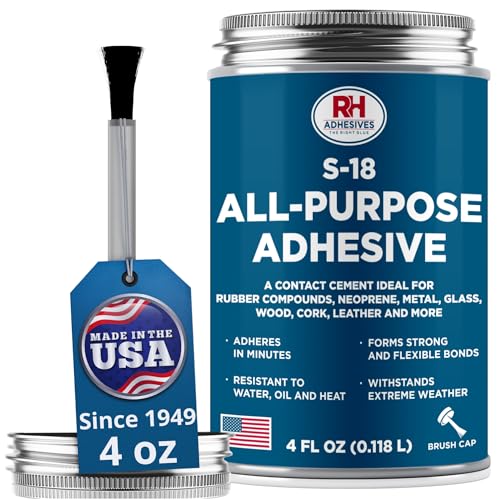
The S-18 is a time-tested neoprene-based contact cement that forms a permanently flexible film between porous rubber and non-porous plastics. Its solvent-based formula creates a strong peel-resistant bond for applications like gluing neoprene yoga mats to car panels or attaching rubber trim to plastic bumpers, and it handles water exposure better than most brush-on cements.
Customer reviews highlight excellent results for leather-to-plastic repairs and neoprene-to-metal bonding, with the adhesive holding up through heat cycles in automotive interiors. The 4-ounce can provides generous coverage for multiple small-to-medium repair jobs, and the American manufacturing since 1949 adds a layer of consistency that DIYers appreciate.
The main caution is ventilation — this is a solvent-based product with strong fumes that require application in a well-ventilated area. Some users also noted that the glue thickens or dries out if the can is not sealed tightly between uses, so proper storage is essential for long-term usability.
Why it’s great
- Flexible, water-resistant bond ideal for neoprene and rubber
- Affordable price for a 4-ounce can with broad coverage
- Strong peel strength for porous-to-non-porous joints
Good to know
- Strong solvent fumes require good ventilation
- Can thicken in can if not stored airtight
- Full bond strength requires clamping or contact pressure
3. Sikaflex-221 Multi-Purpose Polyurethane Sealant/Adhesive

The Sikaflex-221 is a one-component polyurethane adhesive that forms a permanently elastic seal with strong resistance to aging, seawater, diluted acids, and caustic solutions. Its 10.1-ounce cartridge is the go-to choice for bonding plastic boat components to rubber gaskets, RV roof patches, and any exterior application where the joint will experience both UV exposure and mechanical flex.
This product holds NSF approval for use near drinking water systems and food production areas, a certification that signals minimal chemical leaching. Verified reviews praise its ability to bond thick plastic panels to rubber seals on RVs and boats, withstanding standing water and temperature swings without cracking. The paste consistency allows for vertical application without sagging, though cleanup requires a solvent and blue tape for a clean edge.
The primary limitation is that it requires a cartridge caulking gun for application, and partial tubes can expire within months of being opened if not stored properly. Users also note that the product ships with an expiration date, so checking the manufacturer date before purchase is important.
Why it’s great
- Excellent weather resistance and permanent elasticity
- NSF approved for drinking water and food-grade applications
- Bonds well to ceramics, metals, and coated plastics
Good to know
- Requires a caulking gun for application
- Has a limited shelf life; partial tubes can expire quickly
- Can be messy; gloves and solvent are necessary for cleanup
4. Gorilla Max Strength Construction Adhesive
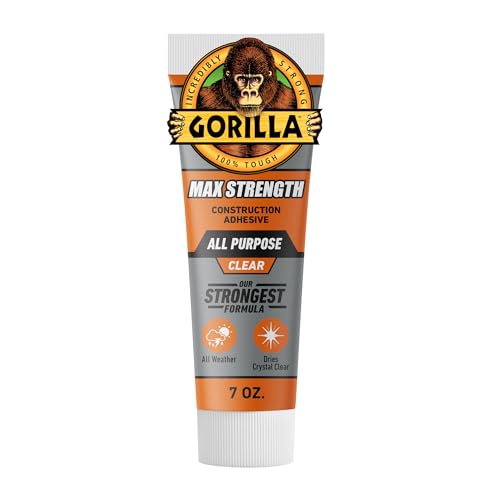
Gorilla’s Max Strength formula is a hybrid polymer that combines gap-filling capability with a crystal-clear finish, making it a strong candidate for visible plastic-to-rubber repairs where aesthetics matter. It markets at twice the strength of their heavy-duty construction adhesive, and users confirm it holds on vertical surfaces and resists flow during curing.
Reviews from real buyers note that this glue handles automotive environments well — one user glued a magnet to a plastic armrest lid and reported it withstood car heat without peeling. The clear drying characteristic is a genuine advantage for glass or transparent plastic parts. The 7-ounce squeeze tube provides good value for medium-sized projects, and the waterproof bond extends its utility to outdoor applications.
The main drawbacks are the long 24-hour full cure time and the thick, stringy consistency that can produce messy beads if the nozzle doesn’t match the joint gap. The bond is very sticky immediately, which makes repositioning difficult if you aim imprecisely. It also requires clamping for best results.
Why it’s great
- Bonds clear with no visible residue
- Waterproof and heat-resistant for automotive use
- Excellent gap-filling capability for uneven surfaces
Good to know
- Long 24-hour cure time for full structural strength
- Very sticky; can be messy if over-applied
- Requires clamping during cure for best joint
5. KRAFTPROTZ Automotive Super Glue Gel
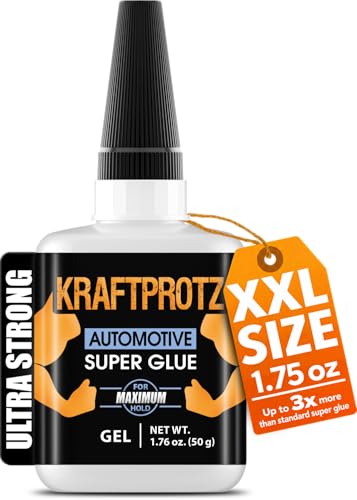
The KRAFTPROTZ gel is a no-drip cyanoacrylate formulated specifically for automotive plastic-to-rubber joints like bumpers, trim brackets, and mirror housings. Its thixotropic gel stays put on vertical panels without running, and the heat resistance up to 230°F makes it suitable for underhood repairs where engine bay temperatures would degrade standard CA glues.
Verified buyers report excellent results on car side mirrors, front bumper separations, and rubber RV moldings, with the bond holding through rain and temperature swings for many months. The 1.76-ounce bottle provides roughly three times the glue of standard automotive tubes, and the anti-clog tip keeps the nozzle clear for multiple uses over weeks.
Some users noted that the gel has a slower initial set than typical super glue — requiring 2-3 minutes of clamping — which can be an advantage for positioning but a frustration for those expecting instant bonding. The chemical smell is strong, and the bottle’s labeling is in German, though the product is intuitive to use.
Why it’s great
- No-drip gel stays exactly where you apply it
- Engineered for vibration and heat in automotive environments
- Large XXL bottle reduces per-use cost
Good to know
- Requires 2-3 minutes of clamping for initial set
- Strong chemical odor during application
- Bottle labeling is in a foreign language
6. Bob Smith Industries Slow-Cure Epoxy
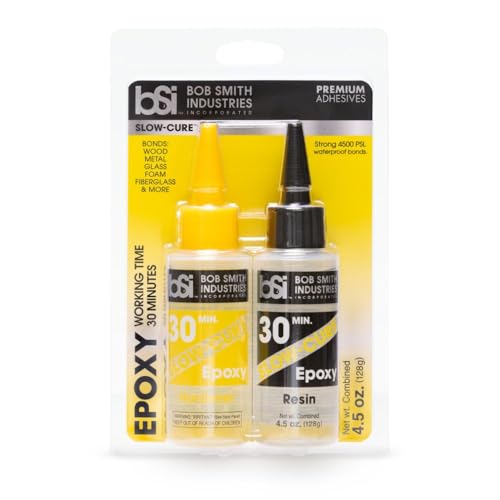
The Bob Smith Slow-Cure Epoxy is the pick for structural repairs where you need substantial working time to align parts and fill gaps. Its 30-minute work window and 8-hour full cure allow for precise positioning of complicated assemblies, and the cured bond is impact-resistant without being brittle — ideal for tool handles, fiberglass overlays, and load-bearing plastic-to-rubber joints that will endure repeated stress.
Users praise the easy-to-use syringe dispensers that simplify mixing to a 1:1 ratio, and the clear cure is a plus for visible repairs. The epoxy fills gaps well and bonds to wood, fiberglass, metal, and most plastics. Hobbyists and fabricators note it is less stinky than polyester resin and cleans up easily with nail polish remover before curing.
The 30-minute work time is significantly shorter when mixing large batches in a narrow container, as the exothermic reaction accelerates curing. Users recommend mixing quarter-sized dollops in a shallow dish to maintain the full work window. The product is also available in smaller bottles if the 4.5-ounce set is more than needed.
Why it’s great
- Extended 30-minute working time for complex assemblies
- Impact-resistant bond suitable for load-bearing joints
- Clear cure and easy-to-use syringe dispensers
Good to know
- Large batches set much faster than stated 30 minutes
- Not as flexible as neoprene or polyurethane options
- Requires 8 hours for full cure strength
7. Loctite Epoxy Instant Mix 5 Minute

The Loctite Epoxy Instant Mix 5 Minute is the fastest-setting two-part epoxy on the list, curing to handling strength in just one hour. Its self-mixing syringe removes the guesswork from ratio measurement, and the rigid, high-strength bond is ideal for small plastic-to-rubber repairs where speed matters — such as reattaching a speaker cone surround or fixing a cracked ABS plastic part.
Users consistently describe the consistency as similar to cold maple syrup, flowing into tight crevices without running excessively, then hardening to a non-brittle state that can be sanded, drilled, and painted. One reviewer used it to fill driveway hairline cracks and reported it outperformed expensive epoxy caulk through multiple freeze-thaw cycles. The pack of two syringes provides redundancy for multi-part repairs.
Because this is a rigid epoxy, it is not suited for flexible rubber joints that will experience repeated bending or vibration — the bond can crack under constant flex. The mixing nozzle is single-use and must be replaced for each application, adding recurring cost if you use the product frequently.
Why it’s great
- Fastest curing time among two-part epoxies
- Self-mixing syringe removes ratio errors
- High-strength, sandable, and paintable finish
Good to know
- Rigid bond not suitable for flexible rubber joints
- Mixing nozzle is one-time use and must be replaced
- Small 0.47-ounce syringes per pack are best for small repairs
FAQ
Can I use super glue for plastic to rubber bonding?
Do I need to sand the plastic before applying adhesive?
What is the strongest adhesive for rubber to plastic?
Final Thoughts: The Verdict
For most users, the best adhesive for plastic to rubber is the S-18 All-Purpose Adhesive because it delivers a permanently flexible, water-resistant joint at a very reasonable cost. If you need a fast instant bond for low-energy plastics like silicone or EPDM, grab the 3M Scotch-Weld PR100. And for outdoor or marine applications where elasticity and weather resistance are critical, nothing beats the Sikaflex-221.