
Our readers keep the lights on and the weekend projects moving. As an Amazon Associate, I earn from qualifying purchases.
Polypropylene is the plastic that seems impossible to glue. Its low surface energy repels most standard adhesives, leaving repairs weak or failing completely. Whether you are fixing a car bumper, bonding a 3D print, or repairing a household item, you need a specialty formula engineered to grip this notoriously slippery material.
I’m Rikta — the co-founder and writer behind FitlyFast. My work involves dissecting the chemical makeup and real-world performance of niche adhesives, analyzing hundreds of user reports to identify which formulas truly overcome the wet-out and surface energy challenges of polypropylene.
This guide cuts through the marketing to deliver the absolute best adhesive for polypropylene, based on rigorous spec comparison and verified user outcomes for every major application scenario.
How To Choose The Best Adhesive For Polypropylene
Choosing the right adhesive for polypropylene is not about picking the strongest glue on the shelf. It is about selecting a formulation that can wet out the surface, chemically key into the polymer chains, and accommodate the material’s inherent flexibility. Standard cyanoacrylates and two-part epoxies often bead up and peel off because they cannot overcome polypropylene’s low surface energy (around 29 mJ/m²).
One-Part vs. Two-Part vs. Primer-Based Systems
One-part adhesives, like solvent-based plastic cements, work by chemically dissolving and fusing the plastic surfaces. They are fast and create strong bonds on similar plastics, but they lack the versatility for bonding PP to metals or dissimilar materials. Two-part systems, such as acrylics and structural urethanes, use a catalyst and resin to create a durable, gap-filling bond that works across many substrates. They offer superior strength but require a dispensing gun and exact mixing ratios. Primer-based systems use a separate surface activator to raise the surface energy of PP, allowing a standard adhesive like cyanoacrylate or epoxy to then grip effectively. Primers add an extra step but can often salvage projects where the adhesive alone would fail.
Working Time and Cure Speed
Polypropylene parts are often used in applications that experience vibration, thermal cycling, or stress. A fast-setting adhesive might feel convenient, but it can become brittle and crack under movement. A slower-curing structural adhesive—with a working time of 3 to 10 minutes and a full cure of 24 to 48 hours—provides a more flexible, stress-resistant bond line. For small hobbyist repairs on static items, a fast-drying brush-on cement is adequate. For automotive or load-bearing repairs, a toughened epoxy or acrylic with a longer cure window is non-negotiable.
Quick Comparison
On smaller screens, swipe sideways to see the full table.
| Model | Category | Best For | Key Spec | Amazon |
|---|---|---|---|---|
| 3M DP8010 | Structural Acrylic | Bonding PP to metals & LSE plastics | 10-minute repositioning time | Amazon |
| 3M DP8005 | Structural Acrylic | Polyolefin & composite repairs | 3-minute work life, 3-hour handling | Amazon |
| WEST SYSTEM G/flex | Toughened Epoxy | Waterproof, flexible structural repairs | 2-day full cure, flexible bond | Amazon |
| Polymix Rigid | Polyurethane | Automotive plastic repair | 1-minute working time | Amazon |
| Deluxe Materials Magic Plastic | Solvent Cement | DIY models & polystyrene kits | Brush-on precision applicator | Amazon |
| Magigoo MPP2018 | 3D Printing Adhesive | PP filament bed adhesion | 100+ prints per application | Amazon |
| Technicqll PP Glue | Primer + Adhesive | General PP & PE bonding | Includes separate base primer | Amazon |
In‑Depth Reviews
1. 3M Scotch-Weld DP8010
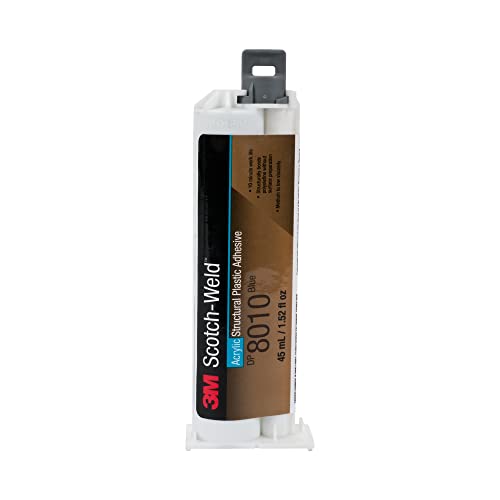
The 3M Scotch-Weld DP8010 is the gold standard for structural bonding of polypropylene to a wide variety of materials, including metals and other low-surface-energy plastics. This two-part acrylic is engineered to require little to no surface preparation—a massive time-saver when dealing with oily or contaminated PP parts. Its 10-minute repositioning window allows you to align components perfectly before the bond sets, which is essential for complex assemblies.
With a full cure time of 48 hours, the DP8010 delivers an exceptionally robust bond that can replace mechanical fasteners like screws and rivets. User reports confirm its success in repairing polypropylene car bumpers and bonding heavy-duty enclosures. The adhesive is thick and non-running, making it suitable for vertical applications without sagging.
The main consideration is the requirement for a specialized 10:1 ratio dispensing gun and mixing nozzles, which adds to the upfront cost. The odor is strong, requiring very good ventilation. For critical one-off repairs where failure is not an option, this is the most reliable choice on the market.
Why it’s great
- Bonds LSE plastics like PP and PE with no surface prep
- 10-minute repositioning for complex alignments
- Replaces mechanical fasteners in many applications
Good to know
- Requires a special 10:1 dispenser gun
- Strong chemical odor; use with ventilation
- Premium cost per application
2. 3M Scotch-Weld DP8005 Black
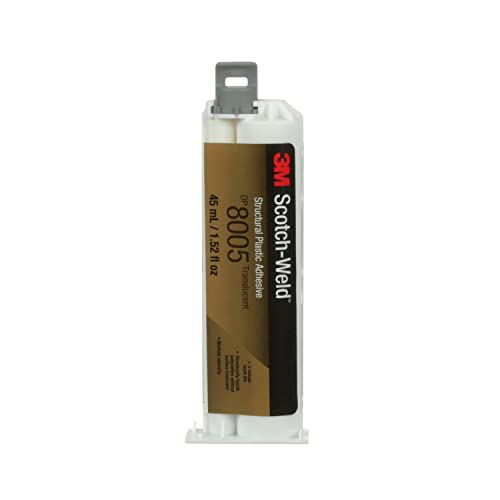
The 3M Scotch-Weld DP8005 is designed specifically for bonding low-surface-energy plastics like polyolefins, composites, and thermoplastics. This black, medium-viscosity acrylic provides excellent chemical and moisture resistance, making it ideal for outdoor or harsh-environment repairs. Its 3-minute work life is shorter than the DP8010, but it offers a faster handling strength of 3 hours, getting your project back in service much quicker.
Real-world applications have been impressive, with one user repairing a cracked diesel tank on a John Deere tractor—a repair that saved them over a thousand dollars. The DP8005 fills gaps of up to 1/8-inch and forms an incredibly strong bond with HDPE channel drains and automotive plastics where other adhesives have failed. Its ability to work with minimal prep is a consistent benefit across reports.
The downsides mirror the DP8010: it requires the same 10:1 applicator gun and mixing tips, adding cost and complexity. The bond is messy and leaves a visible bead. A small number of users found it ineffective on certain specialized plastics like Delrin, so testing on a scrap piece is wise before committing to a repair.
Why it’s great
- Strong bond on HDPE and polyolefins with no prep
- Resists chemicals, humidity, and corrosion
- Fills 1/16″ to 1/8″ gaps effectively
Good to know
- Requires a 10:1 professional dispensing gun
- Short 3-minute work time limits complex alignments
- High cost for occasional use
3. WEST SYSTEM G/flex Epoxy

The WEST SYSTEM G/flex 650 is a toughened, two-part epoxy that provides a unique combination of strength and flexibility. Unlike brittle epoxies, G/flex can absorb shock and vibration—critical for bonding polypropylene parts that experience movement, such as kayak hulls, snowboards, or outdoor equipment. It also bonds exceptionally well to damp woods and difficult-to-glue tropical hardwoods, giving it a broader utility beyond just plastics.
User feedback shows it works excellently for large, structural repairs. One user used it to repair a massive crack in their Old Town kayak, saving the boat from disposal. Others have successfully used it for waterproof repairs on snowboards and ceramic fountains. The long pot life and slow cure (2 days to full strength) allow for careful application and clamping, which is ideal for complex or multi-layer repairs.
This is not a quick-fix product. The slow cure requires patience, and the two-part mixing process involves precise measuring. It is also not ideal for small, precise hobby applications where a brush-on cement is more appropriate. For demanding, high-stress repairs that need to last, G/flex is a top-tier performer.
Why it’s great
- Flexible bond absorbs shock and vibration
- Waterproof; can even be applied to damp surfaces
- Strong adhesion to difficult woods and LSE plastics
Good to know
- 2-day full cure requires patience
- Not for quick, small spot repairs
- Requires precise mixing of resin and hardener
4. Polymix Rigid Automotive Adhesive

The Polymix Rigid Adhesive is a two-component polyurethane specifically formulated for structural bonding in the automotive refinishing industry. It is odorless, thixotropic (meaning it won’t run or sag), and cures at room temperature. With a 1-minute working time, it is designed for fast, small-size repairs on plastic parts like bumpers, grilles, and fender clips.
User reports highlight its excellent adhesion to sun-damaged and brittle plastics, such as the cracked dashboard of a 2004 Dodge Dakota. One user paired it with a mesh backing for a durable repair that held up well. Another used it on vintage Mopar grilles, noting its performance is on par with more expensive products from SEM and 3M. It sands in 20 minutes and can be painted in one hour, allowing for a quick turnaround.
The Ultra-Fast 1-minute work life is a double-edged sword—it provides no room for error or repositioning, and the dual-syringe cartridge requires a standard caulking gun. One user noted it is not resistant to gasoline, so it should not be used on fuel-system components. For automotive plastic repair where time is money, this is a solid choice.
Why it’s great
- Fast 1-minute working time for quick repairs
- Odorless and non-sagging thixotropic formula
- Great value compared to leading automotive brands
Good to know
- Ultra-fast set time—no room for repositioning
- Not resistant to gasoline or fuel
- Requires a caulking gun for dispensing
5. Deluxe Materials Magic Plastic Adhesive
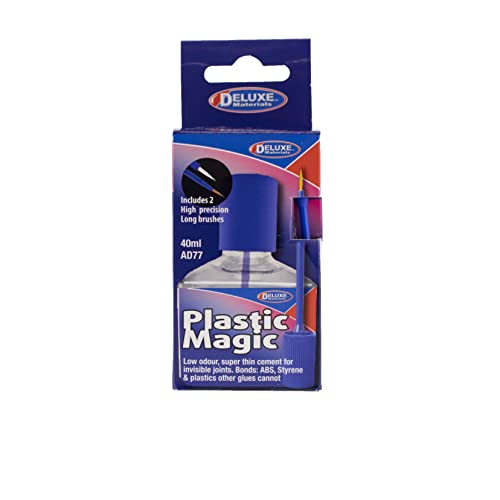
The Deluxe Materials Magic Plastic Adhesive is a solvent-based cement that works by chemically welding plastics together. It is a favorite in the hobby and model-building community for its precision brush-on applicator, which allows for pinpoint application without flooding or melting fine details. It dries clear and forms an invisible bond line, making it perfect for visible repairs on polystyrene kits and miniature projects.
Users consistently praise its control and speed of drying. One review noted it is “beautifully controllable, thin enough to wick into joints but thick enough to avoid runs,” which is the hallmark of a premium modeling cement. It bonds in about a minute, allowing for quick assembly but providing just enough time for minor adjustments. It is an excellent alternative to games-workshop-brand plastic glues at a significantly lower cost.
This adhesive is specialized for styrene-based plastics (polystyrene, ABS). It is not effective on polyethylene, polypropylene, or other industrial LSE plastics. For models, miniatures, and small plastic repairs where appearance matters, this is the top pick. For structural or outdoor PP repairs, you need a different chemistry.
Why it’s great
- Precision brush applicator for detailed work
- Dries crystal clear with invisible glue lines
- Fast ~1-minute dry time with adjustment window
Good to know
- Only works on styrene plastics, not true PP/PE
- Not for load-bearing or structural repairs
- Solvent fumes require ventilation
6. Magigoo MPP2018 3D Printer Adhesive
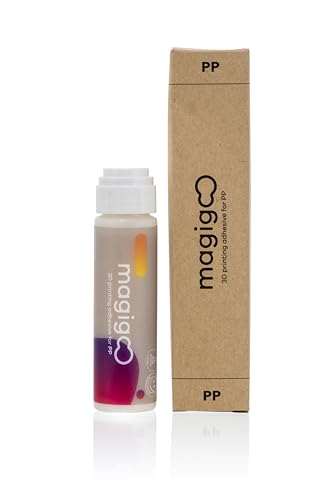
The Magigoo MPP2018 is a specialized 3D printing adhesive formulated to solve the specific problem of getting polypropylene filament to stick to a build plate. PP is notoriously prone to warping and lifting during printing. This gel-like adhesive is applied to the print surface (glass, PEI, BuildTak, Kapton) and creates a temporary high-adhesion layer that holds the print firmly at temperature.
Users report that it works as advertised, enabling successful prints with PP-CF filament on printers like the Qidi Max4 where nothing else worked. The key technique involves a thick coat, reduced cooling, and specific bed and chamber temperatures. Once the print finishes and the bed cools, the adhesive releases effortlessly, and the part can be removed cleanly. It is water-soluble for easy cleaning and reapplies quickly.
This is a niche product with a single, specific purpose. It does not bond polypropylene parts to other things—it bonds the print to the printer’s surface. The dauber tip tends to clog after the first use. If you are in the 3D printing community and need to work with PP filament, this is an essential consumable. For all other polypropylene bonding tasks, it is not the right tool.
Why it’s great
- Enables reliable PP filament bed adhesion
- Auto-releases when the build plate cools
- Supports over 100 prints per application
Good to know
- Single-purpose 3D printing consumable
- Dauber applicator clogs after first use
- Requires specific temperature profiles to work
7. Technicqll Clear Adhesive Glue for PP & PE

The Technicqll Adhesive Glue is a budget-friendly entry point for bonding polypropylene, polyethylene, PTFE, and silicone. It comes as a small kit containing a base primer and a clear gel adhesive. The primer works by increasing the surface energy of the plastic, allowing the adhesive to wet out and grip the otherwise non-stick surface. This two-step process is the correct technical approach for LSE plastics.
Feedback is mixed, which is common for products in this price tier. Some users report good results, particularly when using the primer, and note that the bond seems reliable. However, a significant number of reviews describe total failure, with the adhesive sitting on the surface like “adding water to a slip-n-slide” on polyethylene. The bottles are also very small (8ml + 8g), which limits the scope of projects.
This kit is best suited for small, low-stress household repairs where the cost of failure is low. It is not suitable for structural, outdoor, or high-impact applications. For someone who wants to test whether a primer-based approach works for their specific plastic without a large investment, this is a reasonable trial tool. For critical repairs, the premium 3M or West System options are a far safer bet.
Why it’s great
- Includes a primer designed for PP and PE surfaces
- Transparent gel dries clear
- Budget-friendly way to test PP bonding
Good to know
- Very small quantity (8ml + 8g)
- Inconsistent results, especially on PE
- Not for structural or load-bearing repairs
FAQ
Will Gorilla Glue or Super Glue work on polypropylene?
Do I need to sand polypropylene before gluing?
What is the difference between the 3M DP8005 and DP8010 for PP?
Can I use an epoxy primer on polypropylene before using any glue?
Final Thoughts: The Verdict
For most users, the adhesive for polypropylene winner is the 3M Scotch-Weld DP8010 because it offers the most reliable, high-strength bond on low-surface-energy plastics with minimal prep work and a generous 10-minute adjustment window. If you need a faster handling time for a quick repair, the 3M Scotch-Weld DP8005 is your pick for its 3-hour strength and excellent gap-filling. And for flexible, waterproof structural repairs that must withstand vibration, nothing beats the WEST SYSTEM G/flex Epoxy.