
Our readers keep the lights on and the weekend projects moving. As an Amazon Associate, I earn from qualifying purchases.
A cracked porcelain tile, a loose floorboard, or a chipped sink edge — few things ruin the look of a finished room faster, and finding the right adhesive to fix it without a second trip to the hardware store is the real challenge. Most general-purpose glues lack the grab, flexibility, or moisture resistance that dense, non-porous porcelain demands.
I’m Rikta — the founder and writer behind FitlyFast. I’ve spent years analyzing construction adhesives, thin-set formulas, and repair kits, cross-referencing chemical compositions against real-world application data to separate genuine solutions from marketing claims.
This guide breaks down the seven most capable products on the market, explaining exactly when to use a squeeze-tube mortar, a color-match epoxy, or a peel-and-stick mat. Choosing the right adhesive for porcelain means the difference between a repair that disappears into the grout line and one that fails under the first bout of foot traffic.
How To Choose The Best Adhesive For Porcelain
Porcelain is fired at high temperatures, making it dense, hard, and nearly non-porous. That same quality that makes it durable also makes it tough for adhesives to mechanically bond. The right choice depends entirely on whether you are filling a chip, rebonding a loose tile, or installing a new tile from scratch.
Assess the Repair Type: Fill vs. Re-Bond vs. Install
For filling chips or cracks in an existing glazed surface, a two-part epoxy or color-matched resin kit delivers the best aesthetic result because it cures hard and can be sanded flush. For re-bonding a hollow-sounding or loose tile, a low-viscosity acrylic mortar injected through the grout line works best — it flows under the tile without lifting it. Full tile installation on walls may benefit from a double-sided adhesive mat that eliminates mortar mixing and drying time.
Moisture and Substrate Compatibility
Bathroom and kitchen repairs demand a waterproof or water-resistant cure. Standard caulk will fail under porcelain’s weight in wet zones. Look for formulas labeled “water resistant” or “for submerged installations,” and always confirm the full cure time — some acrylic mortars take up to a week to reach full strength when applied thickly.
Color and Texture Matching
Visible repairs on glazed porcelain require a product that either comes in multiple pigments or can be overpainted. Epoxy kits with separate colorants offer the most control, while sanded acrylic mortars blend best with existing grout or stone surfaces. Test a small amount in an inconspicuous area before committing to the full repair.
Quick Comparison
On smaller screens, swipe sideways to see the full table.
| Model | Category | Best For | Key Spec | Amazon |
|---|---|---|---|---|
| Mapei Adesilex-P10 | Premium Thinset | Mosaic & glass tile installs | Nonsag bright white formula | Amazon |
| Quikrete Acrylic Mortar 5-Pack | Acrylic Mortar | Mortar joint & gap filling | 10 oz tube, sanded acrylic | Amazon |
| MusselBound Adhesive Mat | Peel & Stick | DIY wall tile installs | 15 sq ft roll with spacers | Amazon |
| Fix-A-Floor Pack of 2 | Injection Adhesive | Rebonding hollow floor tiles | Self-leveling, 24 hr cure | Amazon |
| Ankita Tile Repair Kit | Color-Match Epoxy | Visible chip & crack repair | 7 pigments included | Amazon |
| Stone Pro Traverfill | Stone Void Putty | Travertine hole & void fill | Matte finish, water mix | Amazon |
| Quikrete 8620-05 3-Pack | Squeeze-Tube Mortar | Brick & stone gap repair | 5.5 oz tube, black color | Amazon |
In‑Depth Reviews
1. Mapei Adesilex-P10 Premium Mosaic & Glass Tile Mortar

Mapei’s Adesilex-P10 is a premium, bright white, nonsag thinset mortar engineered specifically for sheet-mounted mosaics and glass tiles where bleed-through or staining would ruin the finished look. Its quality-controlled color consistency ensures that grout lines remain uniform even when the mortar is visible behind translucent tiles. The powdered formula delivers approximately 11 to 24 square feet of coverage per bag, making it a practical choice for backsplash or accent wall projects rather than large floor areas.
Mixing with Keraply additive boosts performance for submerged or shower-floor installations, giving you waterproof assurance that standard thin-set lacks. Customers consistently rate it five stars for ease of workability, noting the smooth consistency and strong grab that prevents tiles from sliding during placement. This is not a repair product — it is a professional-grade installation mortar for new work where appearance and holding power matter most.
The bag is heavy at nearly ten pounds, which reinforces that this is serious material for serious installations rather than a quick fix. If your project involves small-format tiles on a vertical surface and you want zero sag, this thinset is hard to beat for the price per square foot.
Why it’s great
- Nonsag formula holds mosaics vertical without slumping
- Bright white base prevents color bleed under glass tile
- Can be fortified with Keraply for wet-area use
Good to know
- Requires mixing — not a ready-to-use squeeze tube
- Heavy bag may be excessive for small one-tile repairs
2. Quikrete Acrylic Mortar Repair 10 Oz Pack of 5

Quikrete’s Acrylic Mortar Repair in the 10-ounce size arrives as a five-pack, giving you multiple tubes for larger jobs or repeat repairs. The sanded acrylic formula is designed to adhere to brick, block, stone, and concrete surfaces while blending texture and color with existing mortar joints. Users report that it works well for filling non-structural gaps around faucets or patching cracks in masonry, and it dries to a cement-like hardness that resists weather exposure.
Customer feedback reveals a split on batch consistency — some find the gray color and coarse texture perfectly match traditional mortar, while others received tubes that were noticeably lighter and smoother, almost like fine caulk. The formula can be runny when first applied, so it works best when injected into gaps rather than spread across flat surfaces. Full cure can take over a week if applied thickly, so patience is required before painting or sealing over the repair.
The five-tube format offers excellent value for anyone with multiple small-point repairs around a patio, foundation, or brick wall. For visible repairs on glazed porcelain surfaces, however, the color-match inconsistency and runny consistency make it less ideal than a dedicated epoxy kit.
Why it’s great
- Sanded acrylic blends well with existing mortar texture
- Five-pack covers multiple repair points affordably
- Dries hard and weather-resistant for exterior use
Good to know
- Batch-to-batch color and consistency can vary
- Runny formula difficult to control on vertical cracks
3. MusselBound Adhesive Tile Mat with Spacers
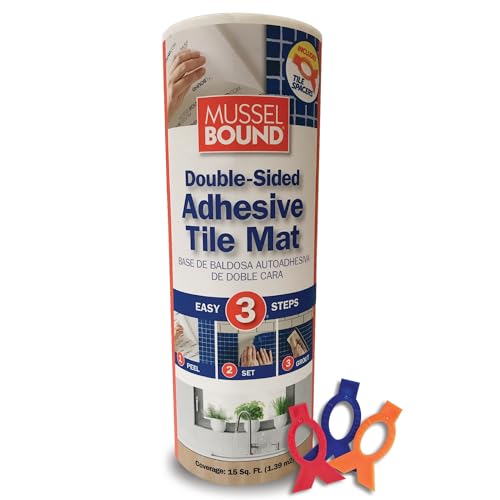
MusselBound replaces traditional thin-set mortar with a double-sided adhesive mat that you roll onto the wall, then press tiles directly onto. Each roll covers 15 square feet and includes engineered spacers, so you get perfectly uniform grout lines without any mixing, troweling, or drying time. The bond is immediate but forgiving — you can lift and realign tiles within a few minutes, which is a massive advantage for beginners or weekend projects.
Customer reviews highlight the gripping power: tiles adhere securely enough for backsplashes and accent walls, yet the mat can be removed without damaging drywall if you make a mistake. The system is best suited for wall tiles up to one square foot and dry or low-moisture areas like kitchen backsplashes or laundry rooms. Multiple users note they would not trust it in a direct shower spray zone without additional waterproofing.
The roll format with spacers simplifies the math and layout for small spaces, and the ability to grout immediately after tiling dramatically speeds up project completion. If you want a mess-free installation of real porcelain wall tile without learning to mix thinset, this is your fastest path to a finished result.
Why it’s great
- Zero mixing, zero drying time — grout immediately
- Lift-and-realign capability for perfect layout
- Includes spacers for consistent grout lines
Good to know
- Not recommended for wet shower or submerged applications
- Requires perfectly clean, dry wall surface for maximum grab
4. The Original Fix-A-Floor Loose Tile Repair Adhesive Pack of 2
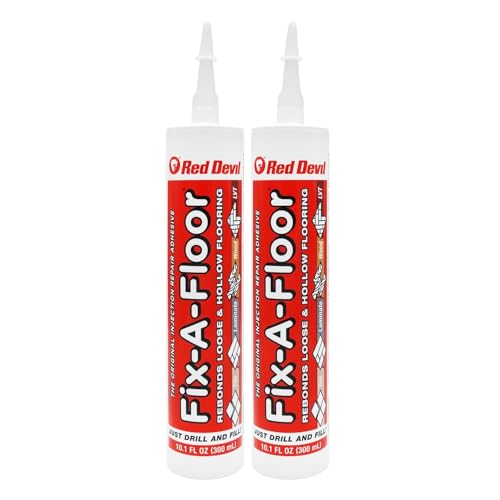
Fix-A-Floor is the only product on this list specifically engineered to rebond loose or hollow-feeling floor tiles without removing them. Its extra-strength copolymer formula is self-leveling, so it flows through small drilled holes in the grout line and spreads evenly under the tile. The kit comes with four precision tip applicators (1/8, 3/16, 1/4, and 2.5mm) so you can match the nozzle to your grout line width — a thoughtful detail that reduces waste and mess.
Real-world users report dramatic results: tiles that sounded hollow or moved underfoot become solid after a single injection session. The recommended method involves drilling holes in the grout, injecting adhesive until it seeps from an adjacent hole, then covering the tile with a weight for 24 hours. The product is compatible with underfloor heating systems and can be used on wood, marble, concrete, and porcelain alike.
Some experienced users find the caulking-tube delivery system messy, recommending transfer to 30ml syringes with blunt tips for better control. But for homeowners facing a roomful of loose tiles, this kit eliminates the nightmare of breaking out and resetting expensive porcelain. It is messy by nature, but the results speak for themselves in the reviews.
Why it’s great
- Rebonds loose tiles without removal
- Self-leveling formula ensures even under-tile fill
- Four nozzle sizes fit different grout widths
Good to know
- Caulking tube delivery can be messy
- Requires drilling into grout and 24-hour weighted cure
5. Ankita Tile Repair Kit, Ceramic & Porcelain Chip Repair
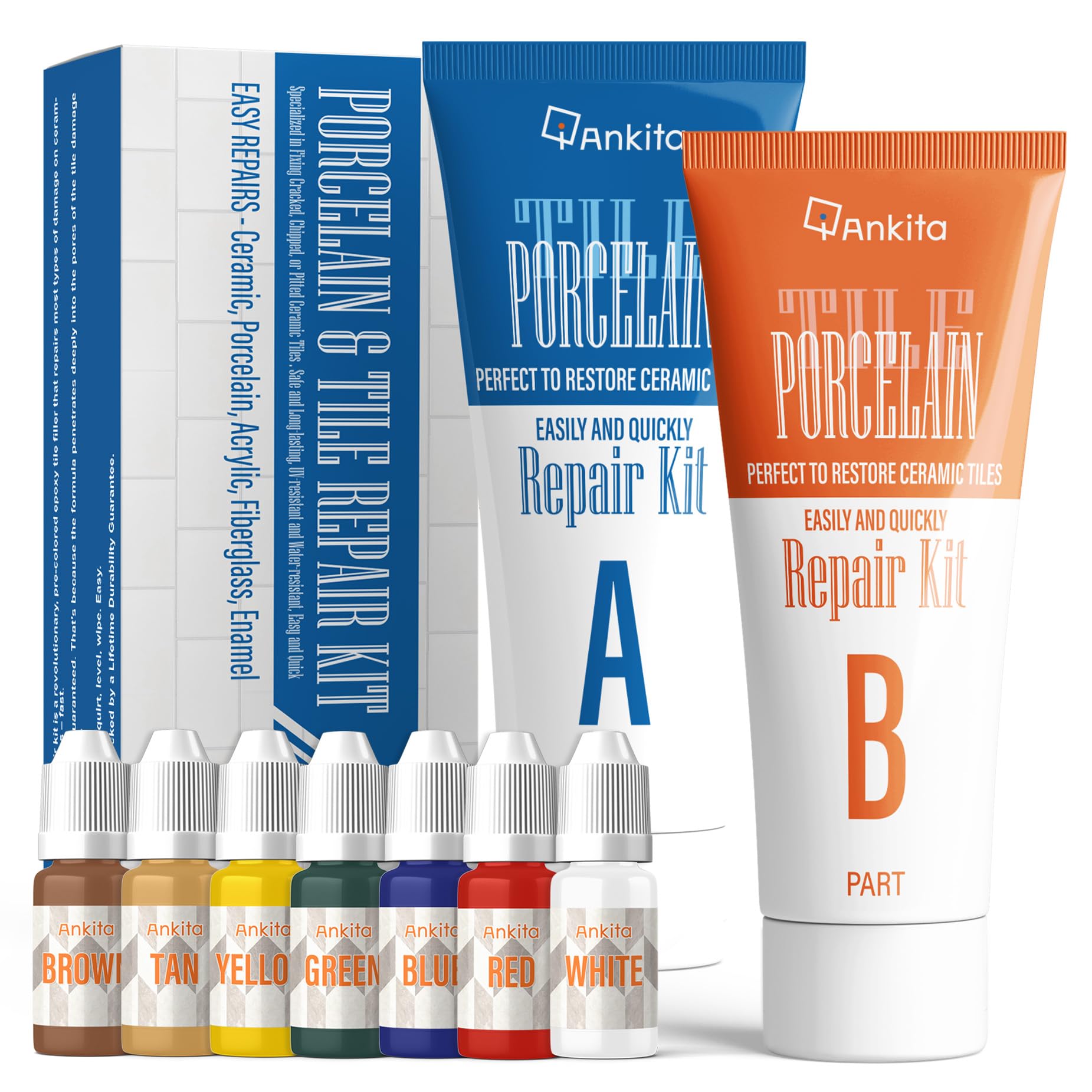
The Ankita Tile Repair Kit is a two-part epoxy system that includes seven separate pigments, letting you mix a custom color to match white, beige, gray, almond, blue, black, and common tile shades. This level of color control is essential for repairing visible damage on glazed porcelain where a white or gray filler would stand out like a sore thumb. The kit is designed for chips, cracks, scratches, and small holes in ceramic, porcelain, acrylic, and even granite surfaces.
Users praise the strong adhesion and the natural look of the cured epoxy, especially when applied to bathroom tub surrounds, kitchen sink edges, and floor tiles. The process is straightforward: mix Part A and Part B, add pigment, apply with the included tool, and sand once cured. The result can be nearly invisible if the color match is dialed in properly. However, some reviews note that the color can shift slightly as the epoxy cures, and the material is hard to smooth perfectly without leaving faint rough spots.
The kit is waterproof after curing, making it suitable for wet areas, but it requires several hours of setting time before the surface can be used. For a single chipped tile where aesthetics matter more than structural strength, this kit delivers professional-looking results at a fraction of a contractor’s fee. Beginners should practice on a scrap surface first to get the hang of mixing pigments.
Why it’s great
- Seven pigments for custom color matching
- Waterproof after full cure for wet-area repair
- Strong epoxy bond for chips and cracks
Good to know
- Color can shift slightly during curing
- Smoothing requires practice to avoid rough spots
6. Stone Pro Traverfill – Travertine Hole and Void Repair – Light

Stone Pro Traverfill is a powdered putty that you mix with water to create a paste for filling holes, voids, and cracks in travertine and other natural stones. It dries to a matte finish that mimics the look of raw stone, which is critical for repairs on honed or tumbled tile where a glossy epoxy would be an obvious mismatch. The light shade is best suited for lighter travertine, although you can mix light and dark versions to fine-tune the color.
Users consistently report excellent results on travertine floor tiles, exterior sandblasted tiles, and even countertops. Application is fast — mix, press into the void with a putty knife, wipe excess with a damp sponge, then let it dry for 24 hours before sanding gently flush. One reviewer repaired a hairline crack in a travertine countertop in under five minutes with nearly invisible results. The matte finish accepts sealer well, helping the repair blend into the surrounding stone.
The biggest limitation is that this product is specifically formulated for porous stone, not glazed porcelain. On dense, non-porous porcelain, the water-mix putty may not achieve the same mechanical bond. Within its intended category, however, it is remarkably effective and far cheaper than professional stone restoration.
Why it’s great
- Matte finish blends naturally with stone surfaces
- Fast 5-minute application, 24-hour cure
- Accepts sealer for seamless color integration
Good to know
- Designed for porous stone, not glazed porcelain
- Color range limited to light and dark base shades
7. Quikrete 8620-05 862009 Mortar Repair 5.5 oz Squeeze Tube Pack of 3

Quikrete’s 8620-05 three-pack delivers a black acrylic mortar in a squeeze tube, ideal for repairing gaps and chips in dark-colored brick, concrete, and stone that match the black pigment. The 5.5-ounce tubes are small enough to fit in a tool pouch, and the slanted tip allows precise application into narrow mortar joints. The acrylic formula is water-resistant, making it suitable for outdoor step repairs where freeze-thaw cycles are a concern.
Customer reviews are generally positive, with many praising the color match for aged cement and the ease of finger-smoothing into thin gaps. However, the three-pack format has a defect rate that shows up in reviews: several customers received tubes with small holes or bottom slits that caused the product to dry out or leak watery fluid before use. One reviewer described multiple unusable tubes with an extremely thick, sour-smelling consistency that had to be discarded.
Despite the quality-control variance, this pack is an affordable way to tackle multiple small repairs around the house, provided you inspect each tube before starting. The black color is niche but perfect for dark masonry work. For general-purpose porcelain tile repair on lighter surfaces, the color limitation makes it a poor candidate.
Why it’s great
- Affordable three-pack for multiple small repairs
- Slanted tip delivers precise application into narrow joints
- Water-resistant formula suitable for outdoor use
Good to know
- Black color only — not suitable for light masonry
- Quality control issues reported with damaged tubes
FAQ
Can I use standard super glue to fix a chipped porcelain tile?
How long should I wait before walking on a floor tile repaired with injection adhesive?
Do I need to remove old grout before using a hollow-tile repair adhesive?
Final Thoughts: The Verdict
For most users, the adhesive for porcelain winner is the Fix-A-Floor Pack of 2 because it solves the most expensive problem — loose floor tiles — without requiring tile removal or professional help. If you need a seamless cosmetic repair on a visible chip or crack, grab the Ankita Tile Repair Kit for its unmatched color-matching capability. And for a fast, mess-free wall tile installation, nothing beats the convenience of the MusselBound Adhesive Mat.