
Our readers keep the lights on and the weekend projects moving. As an Amazon Associate, I earn from qualifying purchases.
Matching the right solvent cement to your PVC project is the difference between a pressure-rated seal that lasts decades and a joint that fails under load. Whether you are plumbing a potable water line, building an irrigation manifold, or fabricating furniture from schedule 80 fittings, the adhesive you choose dictates the bond strength, cure time, and chemical resistance of every connection.
I’m Rikta — the founder and writer behind FitlyFast. I analyze solvent cement formulations, viscosity grades, and VOC compliance data to help you pick the exact adhesive for your pipe diameter, pressure requirements, and working conditions.
After reviewing the leading options for pressure pipe, DWV, conduit, and flexible PVC applications, I have assembled this guide to the adhesive for pvc that delivers reliable, code-compliant joints every time you apply the brush.
How To Choose The Best Adhesive For PVC
Selecting a PVC adhesive is not a one-size-fits-all decision. The pipe diameter, pressure rating, application temperature, and code requirements all dictate which solvent cement will create a permanent, leak-free bond. Here are the three factors that matter most.
Viscosity and Body Type: Matching Cement to Pipe Size
Solvent cements are classified as thin-bodied, medium-bodied, or heavy-bodied. Thin-bodied cements flow easily into small-diameter pressure pipes (up to 2 inches) and set quickly. Medium-bodied cements handle pipes up to 6 inches and offer a balance of open time and gap-filling ability. Heavy-bodied (thick) cements are formulated for large-diameter pipes — 6 inches and above — where gravity and loose-fitting joints demand a gap-filling formula that stays put during assembly. For schedule 80 fittings, a medium-to-heavy body is preferred because the thicker walls require more aggressive solvent action and a longer cure at the joint.
VOC Content and Code Compliance
Low-VOC solvent cements (meeting SCAQMD Rule 1168/316A or BAAQMD Method 40) are mandatory in many states and contribute toward LEED v4 credits for indoor environmental quality. These formulations reduce solvent emissions without sacrificing bond strength. If you are working on potable water lines, the cement must also meet NSF/ANSI 61 for drinking water safety. All major brands now offer low-VOC options that are fully code-compliant, so there is little reason to choose a high-VOC product for indoor or below-grade work.
Flexible PVC vs. Rigid PVC Requirements
Standard solvent cements are designed for rigid PVC. When bonding flexible PVC pipe — commonly used in pool plumbing, spa lines, and certain irrigation applications — you need a cement formulated with an elastomeric additive that remains flexible after curing. Using a rigid cement on flex PVC will result in a brittle joint that cracks under movement or pressure cycling. Look for a cement explicitly labeled for flexible PVC to ensure the bond can accommodate the pipe’s inherent flexibility.
Quick Comparison
On smaller screens, swipe sideways to see the full table.
| Model | Category | Best For | Key Spec | Amazon |
|---|---|---|---|---|
| Weld-On 10280 795 Flex PVC | Premium | Flexible & rigid PVC bonds | Elastomer-modified, 32 fl oz | Amazon |
| Oatey 31105 Gray, 32 oz | Premium | Schedule 80 & large-diameter | Heavy-body, 32 fl oz | Amazon |
| Weld-On 10258 790 Medium-Bodied | Premium | Multi-purpose 6″ pressure pipe | Medium-body, 16 fl oz | Amazon |
| Oatey 038753308760, 16 oz | Mid-Range | Potable water & DWV systems | Heavy-duty, 16 fl oz | Amazon |
| Titebond PVC Trim Joint | Mid-Range | PVC trim & column wrap joints | Cyanoacrylate gel, 4 oz | Amazon |
| HOOK UP Vinyl Contact Cement | Budget | Inflatable & vinyl repairs | Waterproof, 4 fl oz | Amazon |
| Bellisinno Vinyl Cement | Budget | Pool liner & air mattress patches | Medium-high viscosity, 4 oz | Amazon |
In‑Depth Reviews
1. Weld-On 10280 795 Flex PVC Solvent Cement
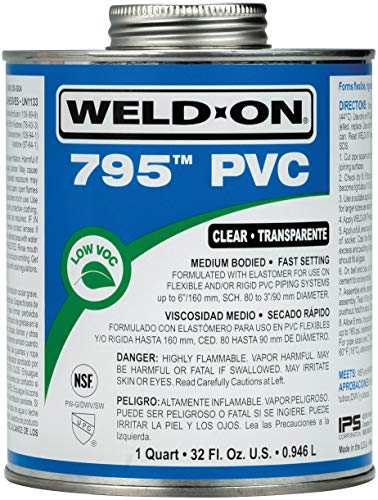
The Weld-On 795 is the only cement on this list formulated with an elastomeric additive, making it the definitive choice when bonding flexible PVC to rigid PVC — a critical capability for pool plumbing, spa lines, and irrigation systems that experience thermal expansion or vibration. The medium-bodied consistency flows evenly into joints up to 6 inches in diameter and works on schedule 80 fittings up to 3 inches, giving it the broadest compatibility among premium options. It meets ASTM D2564, NSF/ANSI 14, and NSF/ANSI 61, so you can use it confidently on potable water systems.
Open time is very short — about 15 to 20 seconds in warm conditions — so you must assemble immediately after brushing both surfaces. The low-VOC formulation (SCAQMD Rule 1168 compliant) makes it suitable for indoor renovation work where solvent fumes are a concern. The quart-size metal can with a screw-on applicator cap allows for clean dispensing and resealing.
The primary limitation is that this cement is not intended for pressure-free DWV systems where a heavy-bodied cement would be overkill. For its target use — joining flex PVC to rigid pipe — it outperforms every general-purpose cement because the cured bond retains flexibility rather than becoming brittle under stress.
Why it’s great
- Elastomer-modified formula creates flexible, fatigue-resistant joints
- NSF/ANSI 61 certified for potable water
- Low-VOC and LEED v4 compliant
Good to know
- Very short open time requires fast assembly
- Not optimized for large-diameter DWV gravity applications
2. Oatey 31105 Gray PVC Cement, 32 oz

Oatey’s gray cement is the benchmark for heavy-bodied solvent cements used on schedule 80 pressure fittings and large-diameter pipe. The thick formula fills gaps in loose-fitting joints and accommodates pipes up to 12 inches with interference fit (18 inches for non-pressure applications), which is more capacity than any other product in this roundup. It meets SCAQMD 1168/316A low-VOC standards and is rated for potable water, pressure pipe, conduit, and DWV systems.
The gray color visually distinguishes the cement from primer and helps inspectors verify that the joint has been fully wetted. Application temperature ranges from 40°F to 110°F, giving you a wide working window. Users report that this cement bonds schedule 80 fittings so aggressively that couplers cannot be popped off even under irrigation line pressure.
The main downside is the brush applicator included with the can — it is serviceable but not as durable as a dedicated daubing tool, especially if you are applying cement frequently or on large-diameter pipe. The 32-ounce can is also heavy; for occasional use, a smaller size would be more practical.
Why it’s great
- Heavy-body formula fills gaps on loose fittings and large diameters
- Rated for schedule 80 and potable water systems
- Low-VOC and SCAQMD compliant
Good to know
- Included applicator brush is not heavy-duty
- Large can size is overkill for small repairs
3. Weld-On 10258 790 Medium-Bodied Solvent Cement
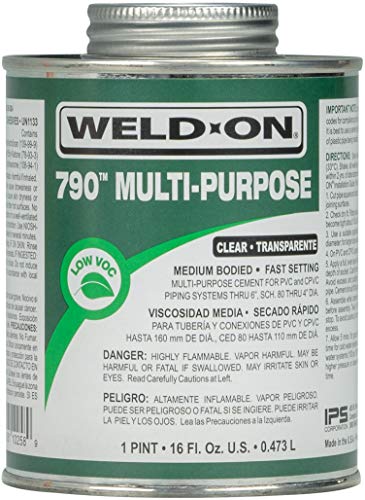
The Weld-On 790 strikes the optimal balance between workability and bond strength for the majority of residential and light-commercial PVC jobs. As a medium-bodied, fast-setting cement, it handles pipes up to 6 inches in diameter with interference fit and schedule 80 fittings up to 4 inches. The light amber color gives you visual feedback during application, helping you ensure full coverage without over-application.
This cement is low-VOC and meets SCAQMD Rule 1168/316A, making it code-compliant in regulated areas. It also satisfies NSF/ANSI 14 performance specifications and contributes to LEED v4 Indoor Environmental Quality credits. The 16-ounce (pint) size is ideal for medium-scale projects — enough for dozens of joints without the waste of a quart can.
One limitation: the 790 is not formulated for flexible PVC, so keep it on rigid pipe and fittings. It also has a shorter shelf life once opened compared to heavy-bodied cements, so you should use it within a few weeks of breaking the seal for best results.
Why it’s great
- Medium body flows well on pipes up to 6 inches
- NSF/ANSI 14 and LEED v4 compliant
- Fast-setting for efficient assembly
Good to know
- Not intended for flexible PVC
- Shorter open-can shelf life than heavy cements
4. Oatey 038753308760 Heavy-Duty Clear Cement, 16 oz

This Oatey clear cement delivers pro-grade performance at a mid-range price point. The heavy-duty formula is rated for all schedules and classes of PVC pipe up to 12 inches with interference fit, making it suitable for pressure pipe, DWV, conduit, and potable water applications. It is UL Greenguard Gold certified and meets SCAQMD 1168/316A requirements, ensuring low emissions for indoor use.
The clear color is a notable advantage when aesthetic appearance matters — if you are building furniture, display structures, or visible conduit runs, the joint remains nearly invisible compared to gray or amber cements. Application temperature range (40°F to 110°F) matches the Oatey gray cement, and the thick formula fills gaps in oversized or loose fittings effectively.
Because the cement is clear, it is harder to inspect for full coverage compared to pigmented cements. You need to be meticulous about applying a uniform coating on both surfaces. The 16-ounce can includes a standard daubing brush that works fine for pipes up to 4 inches.
Why it’s great
- Clear finish for aesthetically clean joints
- Greenguard Gold certified for low emissions
- Works on pipes up to 12 inches with interference fit
Good to know
- Clear color makes coverage inspection harder
- Applicator brush is basic for large-diameter work
5. Titebond PVC Trim Joint Adhesive, 4 oz

The Titebond PVC Trim Joint Adhesive is a specialized cyanoacrylate (CA) gel designed specifically for PVC trim, miter joints, shiplap connections, and column wrap installations — not for pipe or pressure applications. Its gel consistency stays where you put it without running, making it ideal for vertical or overhead joint assembly. The 4-ounce bottle is compact and has a precision applicator tip that allows controlled placement.
This adhesive sets in about 60 seconds when clamped and achieves a permanent, waterproof bond. It is thicker than standard CA glues, so it can fill small gaps in imperfect miter cuts. Reviews from trim carpenters confirm that mitered joints on PVC decking and fascia stay tight for years despite thermal cycling.
The biggest caveat: this is a CA-based glue, meaning it has very little open time and will bond your fingers instantly if you are careless. Once the bottle is opened, the remaining gel can thicken or cure in the tip after several weeks, so treat it as a single-project consumable rather than a stock-up item. It is not appropriate for pressure-rated PVC pipe connections.
Why it’s great
- Gel consistency enables precise placement on vertical joints
- 100% waterproof after full cure
- Gap-filling for imperfect miter cuts
Good to know
- CA glue has very short open time
- Not suitable for pressurized PVC pipe joints
6. HOOK UP Vinyl Contact Cement, 4 oz

The HOOK UP Vinyl Contact Cement is formulated as a contact adhesive rather than a solvent cement, meaning it bonds on contact after the solvent has flashed off. This makes it an excellent choice for repairs on inflatable boats, air mattresses, pool liners, tarps, and vinyl upholstery where the materials are flexible and the bond area is large. The clear finish keeps patches discreet, and the waterproof rating ensures the repair survives submersion.
The built-in brush applicator allows direct application to both surfaces, which is the correct method for contact cement. The formula dries to the touch in minutes, and full curing occurs within 24 hours. Because it retains flexibility after curing, patched areas can conform to rounded or moving surfaces without cracking.
The main limitation is that this is not a solvent cement for rigid PVC pipe joints. The bond strength on smooth, rigid PVC is significantly lower than what you would get from a proper solvent cement. It also requires good ventilation, as the solvent fumes are strong during application.
Why it’s great
- Strong, flexible bond ideal for inflatables and vinyl
- Waterproof and weather-resistant after curing
- Clear finish for invisible patches
Good to know
- Not a substitute for rigid PVC solvent cement
- Strong fumes require good ventilation
7. Bellisinno Vinyl Cement, 4.4 oz

The Bellisinno Vinyl Cement is a budget-friendly contact adhesive that punches above its price point for small vinyl and PVC repairs. The medium-to-high viscosity liquid stays on vertical surfaces well, and the built-in brush applicator makes it easy to coat patch areas evenly. It bonds PVC, ABS, EVA, and rubber to themselves or each other, making it a versatile choice for household repairs on pool liners, hot tub covers, air mattresses, and kayaks.
The instructions recommend a 24-hour full cure, which is longer than some competitors, but the resulting bond holds up to submersion, salt, and chemical exposure. Users particularly praise its performance on inflatable repair — patches stay sealed against air pressure after the recommended drying period. The clear finish and UV resistance prevent yellowing.
The tight lid is intentionally hard to open (instructions recommend pliers or a second person) to prevent air leakage that causes hardening. This is a clever design choice, but it can be frustrating when you need to use the adhesive quickly. Like the HOOK UP cement, this is not a substitute for solvent cement on pressure-rated rigid PVC pipe joints.
Why it’s great
- Built-in brush for precise, mess-free application
- UV-resistant clear finish prevents yellowing
- Strong bond on vinyl, PVC, ABS, and rubber
Good to know
- Requires 24-hour full cure time
- Tight lid can be difficult to open without tools
FAQ
Can I use flexible PVC cement on rigid PVC pipe?
What is the difference between clear and gray PVC cement?
How long should I wait before pressurizing a PVC joint?
Final Thoughts: The Verdict
For most users, the adhesive for pvc winner is the Weld-On 795 Flex PVC because it is the only cement that reliably bonds flexible to rigid PVC while maintaining NSF/ANSI 61 potable water certification. If you need a heavy-bodied cement for schedule 80 fittings and large-diameter pipe, grab the Oatey 31105 Gray. And for clean, invisible joints on trim and furniture, nothing beats the Oatey Clear 16 oz for its Greenguard Gold-certified low-VOC formula and professional finish.