
Our readers keep the lights on and the weekend projects moving. As an Amazon Associate, I earn from qualifying purchases.
The difference between a flawless resin pendant and a tacky, yellowed disappointment often comes down to which bottle you grab. Whether you are bonding earring posts, sealing a polymer clay charm, or doming a keychain, the UV resin you choose directly controls cure speed, clarity, flexibility, and odor — factors that separate a professional finish from a frustrating redo.
I’m Rikta — the co-founder and writer behind FitlyFast. I’ve spent countless hours analyzing UV resin formulations, poring over spec sheets, and cross-referencing viscosity numbers, hardness ratings, and real-world cure reports to identify the adhesives that deliver on their promises without the sticky surprises.
This guide breaks down the top options on the market to help you confidently pick the adhesive for resin that matches your specific project demands.
How To Choose The Best Adhesive For Resin
Not all UV resins behave the same way. Your project’s geometry, the material you’re bonding, and your curing setup all influence which formula will give you the best results. Focus on these four factors to narrow your choice quickly.
Viscosity: Thin Flow vs. Thick Hold
Low-viscosity resin (around 1100-1300 cps) flows like water, making it ideal for thin coatings, intricate bezels, and self-leveling domes where you want the resin to settle flat without manual coaxing. High-viscosity resin (5000-6000 cps) stays put on vertical surfaces and curved objects, perfect for 3D effects, doming round cabochons, or using the resin as a true adhesive to bond items like crystal decorations or earring backs.
Hardness and Flexibility
Hard UV resins cure to 80D or 90D Shore D hardness, delivering scratch-resistant, rigid finishes that protect jewelry and tabletops. Soft UV resins, around 15D Shore A hardness, remain bendable and elastic — these are essential for coating phone cases, fabric, or any surface that needs to flex without cracking. Mixing hard and soft types can create a custom feel between the two extremes.
Cure Speed and Tackiness
Most UV resins cure in 1 to 5 minutes under a 24W to 86W UV lamp, but thicker pours or highly pigmented layers require longer exposures. A common frustration is surface tackiness after curing, which often indicates incomplete polymerization. Resins with higher refractive index materials or those formulated for deep curing reduce this issue, and a quick submersion in water under the lamp can sometimes resolve residual stickiness.
Odor and Yellowing Resistance
Low-odor formulas make indoor crafting more comfortable, but the smell when curing is not always zero. For projects displayed in sunlight or expected to last for years, look for resins with added UV inhibitors that slow yellowing over time. Crystal-clear clarity from the start is not enough — the formula must resist chemical degradation to stay optically clear as the months pass.
Quick Comparison
On smaller screens, swipe sideways to see the full table.
| Model | Category | Best For | Key Spec | Amazon |
|---|---|---|---|---|
| JDiction UV Resin 300g | Premium Thin | Crystal-clear thin coatings & casting | 1100-1300 cps Viscosity | Amazon |
| LET’S RESIN High Viscosity 200g | Premium Thick | Doming & vertical-surface bonding | 5000-6000 cps Viscosity | Amazon |
| Craft Resin 500g | Mid-Range | Large-quantity beginners’ projects | 85D Hardness | Amazon |
| Honcaring UV Resin Kit 200g | Mid-Range | All-in-one starter kit | 8W UV Light Included | Amazon |
| Bond Craftor UV Resin 300g | Budget | Budget-friendly small repairs | 10-Minute Full Cure | Amazon |
| LET’S RESIN Soft Type 100g | Specialty | Bendable & fabric projects | 15D Shore Hardness | Amazon |
| Counter Culture DIY UV Resin 4 oz | Specialty | Quick, no-tacky small projects | 120-Minute Full Cure | Amazon |
In‑Depth Reviews
1. JDiction UV Resin 300g

The JDiction UV Resin stands out for its exceptionally low viscosity of 1100-1300 cps, which allows it to flow effortlessly into the finest bezels and self-level without leaving ridges. After curing, it reaches an 80D hardness that resists scratches and maintains a high-gloss, crystal-clear finish that users consistently describe as bubble-free. The chemical formula is engineered with strong UV inhibitors to resist yellowing over time, making it a favorite for jewelry and casting work where optical clarity must last.
Customer reports confirm that thin pours cure in 1 to 3 minutes under a standard UV lamp, though some users note that thicker layers or alcohol-ink additions can require longer exposure or result in temporary surface tackiness. The included nozzle caps with twist-on seals prevent leaks and allow precise application, a refinement that simplifies clean-up. The brand’s responsive customer service, replacing a batch that yellowed in extreme heat, adds confidence for repeat buyers.
For crafters who prioritize a watery consistency that eliminates bubbles before they form, this is the reference standard. It behaves predictably across projects from resin painting to coaster casting, though anyone needing a gel-like hold for vertical doming should look at thicker alternatives.
Why it’s great
- Ultra-low viscosity flows into tiny details without trapping air
- Excellent anti-yellowing performance for long-lasting clarity
- Responsive customer service stands behind the product
Good to know
- Thick layers or dark pigments may require longer cure cycles
- Some users experience temporary tackiness that resolves after longer curing
2. LET’S RESIN UV Resin High Viscosity 200g
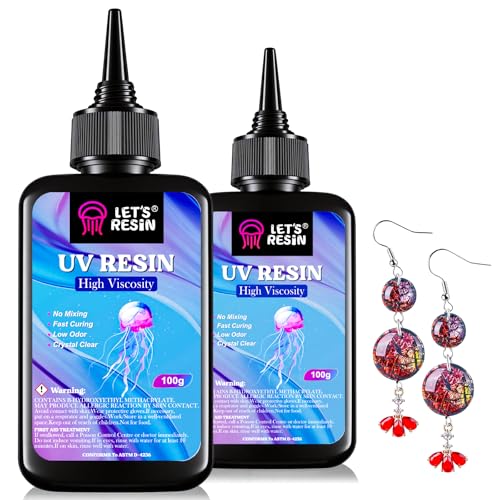
When your project demands a raised, rounded dome that holds its shape without dripping off the edges, the LET’S RESIN High Viscosity formula is the specialist. Its 5000-6000 cps viscosity sits thick like a gel, making it ideal for sphere molds, cabochon doming, and sealing curved surfaces where a thin resin would run away. After curing, the 90D hardness yields a surface more scratch-resistant than most competitors, and the high refractive index creates an optical depth that makes transparent pieces look almost glass-like.
Users report fast, even curing with minimal bubbles when handled gently, though rough pouring can trap air pockets that require a heat gun or prolonged exposure to release. The formula has a mild odor that some users find more noticeable than claimed, but the final finish is consistently hard, glossy, and non-tacky. The bottle cap is designed to be leak-proof, and the optional DIY outlet cap lets you customize the nozzle size for different resin bead shapes.
This resin excels in three specific scenarios: doming jewelry backs, creating 3D water-drop effects, and bonding glass or crystal items where the adhesive needs to bridge a gap without sagging. If your work stays flat or requires thin flooding, this thick resin will fight you — stick to a low-viscosity alternative instead.
Why it’s great
- Thick gel consistency holds domes and 3D shapes perfectly
- 90D hardness offers superior scratch and impact resistance
- High refractive index delivers glass-like optical transparency
Good to know
- Can trap bubbles if poured too aggressively
- Mild odor may linger more than some low-odor claims suggest
3. Craft Resin 500g UV Resin Kit
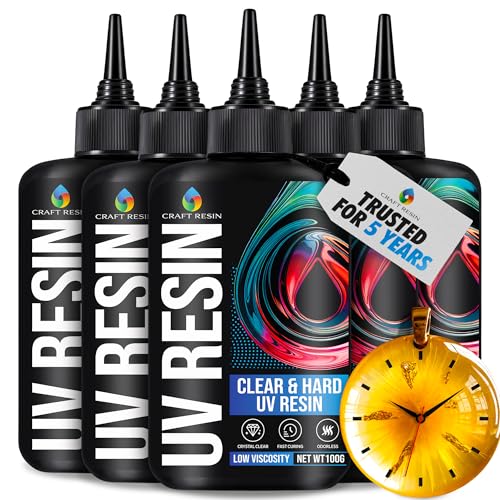
Offering 500 grams of resin across multiple bottles, the Craft Resin kit delivers the most material per purchase in this lineup without sacrificing quality. The low-viscosity formula flows smoothly into small molds and over polymer clay, self-leveling quickly to reduce the need for manual coaxing. At 85D hardness, it strikes a practical balance between rigidity for durability and enough subtle give to resist chipping on thin edges.
Users consistently praise the minimal bubble formation — a handful of trapped air pockets are easily removed with a light pass from a heat gun or a brief wait before curing. The cure speed is reliable at 1-3 minutes under the recommended 24W lamp, producing a glossy, hard surface with no residual tackiness. The low odor is a recurring positive note, making it comfortable for indoor crafting sessions without ventilation setups.
This kit is ideal for beginners working on bookmarks, coasters, and small jewelry pieces who want generous volume to practice without worrying about running out. The multi-bottle format also helps prevent the entire supply from being exposed to air and moisture over time, preserving freshness across multiple sessions.
Why it’s great
- Generous 500g quantity offers excellent material value
- Self-leveling low viscosity reduces finishing effort
- Low odor and minimal bubbles suit indoor crafting
Good to know
- Not suitable for thick vertical doming or 3D effects
- Yellowing resistance is decent but not class-leading
4. Honcaring UV Resin Kit 200g
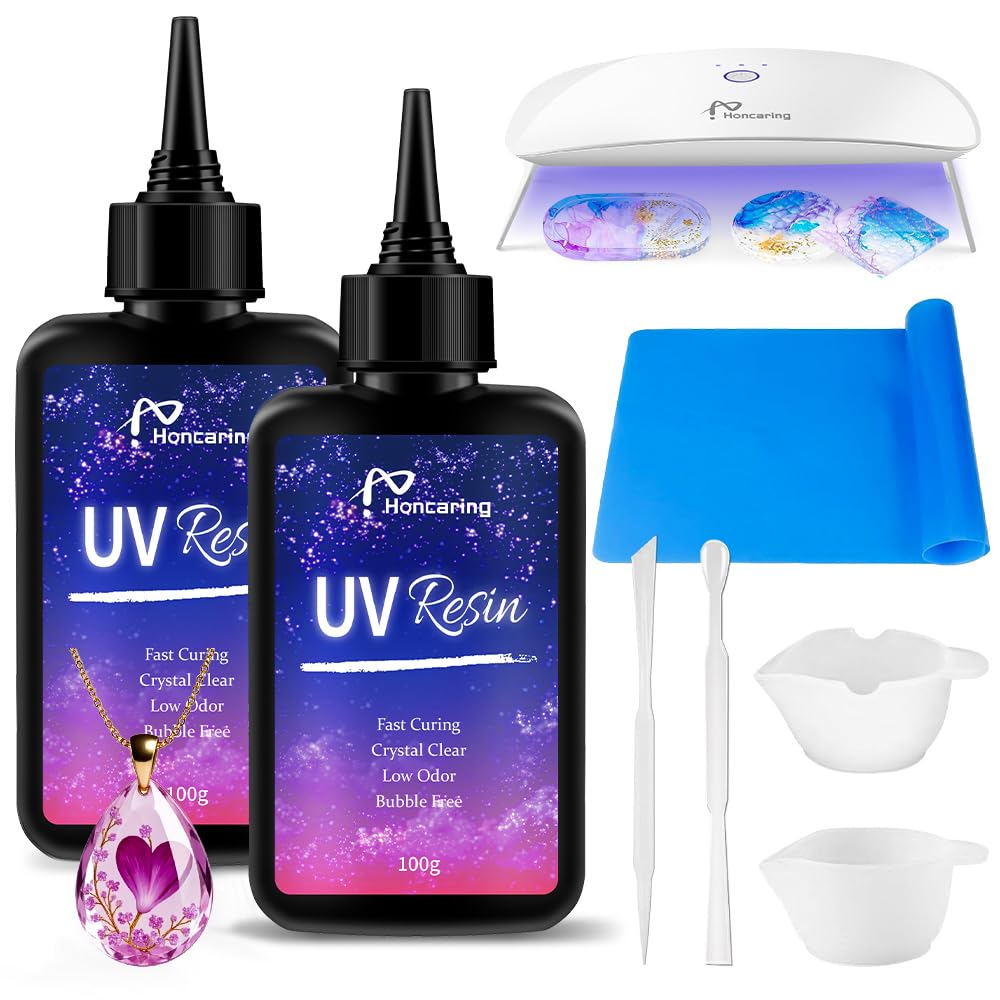
The Honcaring kit bundles 200 grams of UV resin with an 8W UV curing light, silicone cups, gloves, and a silicone mat — everything a newcomer needs to start crafting on day one. The resin itself uses an upgraded formula that cures clear and hard with low odor and reduced bubble formation, making the learning curve gentler than with more temperamental resins. The included light is modest at 8W, meaning cure times will run longer than with a dedicated 24W+ lamp, but it is sufficient for thin layers and small pieces.
User feedback highlights the resin’s excellent flow and clarity, with many reporting that pieces cure smooth and non-sticky when thin layers are applied. The kit format eliminates the frustration of sourcing individual tools, and the instructions cover basic tips like warming the bottle in winter to reduce winter-thickening bubbles. Some users note that the 8W light is underpowered for thicker or deeply colored pours, so upgrading the lamp is a natural next step as skills advance.
For someone uncertain about investing in separate equipment, this all-in-one package removes the guesswork. It’s a practical entry point that proves the concept of UV resin crafting before you commit to premium standalone resins and higher-wattage lights.
Why it’s great
- Complete starter kit includes lamp, gloves, and mixing tools
- Low-odor formula comfortable for indoor use
- Good clarity and reduced bubbles for beginner projects
Good to know
- 8W light is underpowered for thick or heavily pigmented pours
- Resin thickens in cold weather and needs pre-warming
5. Bond Craftor UV Resin 300g

Bond Craftor offers 300 grams of UV resin split into three separate bottles, giving you backup supply without committing to a single large container. The formula is described as hard, heat-resistant, and anti-yellowing, with a watery consistency that self-levels for thin coatings. Cure times are impressively short — some users report full hardness in seconds under a strong UV lamp, making it a viable option for quick repairs like glass bonding.
However, multiple users note a noticeable odor even when the bottle is closed, which requires working in a ventilated area. The thin, watery viscosity, while excellent for flowing into cracks and thin coatings, makes it less suitable for thicker pours or doming where you need the resin to stay put. A small number of recent batches showed minor bubble issues, though these were easily resolved with heat. Several repeat buyers swear by it for clay sealing and glass repair, valuing the speed above all else.
This is the best option for budget-conscious crafters who primarily need a fast-curing, thin adhesive for small repairs or coating flat surfaces. If low odor or a thick gel consistency matters more, a mid-range resin will better serve the purpose.
Why it’s great
- Very fast cure time suitable for quick repairs
- Triple-bottle packaging maintains freshness
- Self-leveling and flows into tight spaces easily
Good to know
- Strong odor even when sealed — ventilation is a must
- Watery consistency unsuitable for doming or vertical applications
6. LET’S RESIN UV Resin Soft Type 100g

Standard hard resins become brittle under stress, but the LET’S RESIN Soft Type cures to a 15D Shore A hardness that stays elastic and bendable — similar to firm silicone or gummy candy. This unique property makes it the only resin in this list suitable for coating phone cases, fabric, and silicone surfaces that must flex repeatedly without cracking. The low shrinkage (under 2%) ensures that even large-area applications maintain dimensional accuracy after curing.
Users report that it cures in 60 seconds per thin layer under a high-wattage UV lamp, and the surface remains slightly tacky after curing — a characteristic of the soft formula that typically resolves with a water-curing technique or a final topcoat of hard UV resin. It impregnates cloth and paper towels to create flexible, vinyl-like sheets, opening creative possibilities beyond traditional resin crafting. The mild smell is noticeable during curing but dissipates quickly.
This resin is a specialist tool, not a generalist. If you make custom action figures, flexible phone grips, or wearable fabric accessories, its bendable nature is irreplaceable. For rigid jewelry or coasters, stick with hard resins that sand and polish like glass.
Why it’s great
- Remains flexible after curing — perfect for fabric and cases
- Low shrinkage prevents warping on large surfaces
- Can be blended with hard resin for a custom firmness
Good to know
- Surface tackiness may require water-curing or a hard topcoat
- Smaller 100g bottle runs out faster than standard resins
7. Counter Culture DIY Clear UV Resin 4 oz
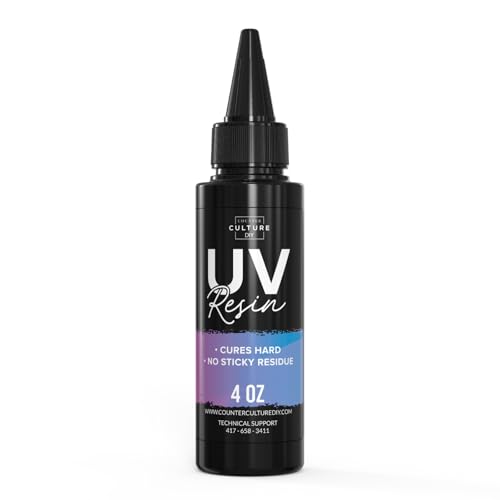
Counter Culture DIY positions itself as a premium small-batch resin for artisans who prioritize a rock-hard, tack-free finish above all else. Users consistently report that it cures faster and harder than many competitors — polymer clay pendants cure solid in 1-3 minutes under a 24W lamp versus lingering tackiness with other brands. The clarity is exceptional, with zero yellow tint or bubbles reported across dozens of jewelry and keychain projects.
The 4-ounce size is significantly smaller than other options here, so it is best suited for crafters who work on small quantities or need a reliable topcoat rather than a bulk supply. Multiple customers note that it works brilliantly as an adhesive for attaching earring backs or securing components to phone grip bases — outperforming standard superglue because the UV cure allows positioning adjustments before locking. Sunny windowsills can substitute for a UV lamp, though curing will be slower and weather-dependent.
This is the go-to choice for perfectionists who hate dealing with sticky residues and want a finish that feels like glass straight out of the lamp. Budget is less of a concern here; you pay for the consistent, fuss-free performance that eliminates the most common frustration in UV resin crafting.
Why it’s great
- Consistently cures hard with zero sticky residue
- Excellent clarity and bubble-free finish
- Works as a superior adhesive for jewelry findings
Good to know
- Small 4 oz quantity offers less material per purchase
- UV lamp not included and a 24W lamp is recommended
FAQ
Why is my UV resin still tacky after curing under the lamp for 5 minutes?
Can I use UV resin as a glue to bond metal or glass earring backs?
What is the difference between hard type and soft type UV resin?
How do I prevent bubbles from forming in my UV resin pours?
Will UV resin yellow over time if I use it for jewelry that sits in sunlight?
Can I use UV resin without a UV lamp?
Final Thoughts: The Verdict
For most users, the adhesive for resin winner is the JDiction UV Resin 300g because its low viscosity, fast cure, and superior anti-yellowing performance make it the most versatile choice for jewelry, casting, and thin coatings. If you need a thick, gel-like resin that holds a perfect dome on curved surfaces, grab the LET’S RESIN High Viscosity 200g. And for projects that demand flexibility — coating phone cases or fabric — nothing beats the LET’S RESIN Soft Type 100g.