
Our readers keep the lights on and the weekend projects moving. As an Amazon Associate, I earn from qualifying purchases.
Specs are compiled from manufacturer listings and verified buyer reviews and can change over time — please confirm the key details on the product page before buying.
Glue that actually holds rubber to metal is its own animal — not all adhesives can handle the constant vibration, temperature swings, or the fact that neither surface is porous. Pick the wrong one and that car trim, shoe sole, or broken bracket pops right off again.
I’m Rikta — the founder and writer behind FitlyFast. This guide is built by comparing the manufacturers’ published specifications and the patterns across verified customer reviews, so you get each pick’s real strengths and trade-offs instead of marketing spin.
Whether you are fixing a bumper, reattaching weatherstripping, or bonding a rubber gasket to a steel frame, finding the best adhesive for rubber to metal starts with knowing which formula can handle the unique stress of that joint.
Our Picks at a Glance

How To Choose The Best Adhesive For Rubber To Metal
Matching rubber to metal is tricky because the two materials flex and expand at different rates when hot or cold. The right adhesive not only bonds on contact but also stays flexible enough to absorb movement without snapping.
Formula Type Matters Most
Cyanoacrylate gels work well on vertical parts because they do not drip, and they set fast — often within seconds. Contact cement, on the other hand, bonds on contact after both surfaces are coated and left to dry, making it great for large flat areas like laminate or foam-backed rubber. Epoxy creates a thick, tough fill that can be drilled and sanded but takes longer to cure.
Temperature and Vibration Tolerance
An adhesive that works inside a climate-controlled workshop can fail under a hot car hood within a week. Check the heat ceiling in the data — some hold up to 230°F. Vibration resistance is just as critical for engine bays, motorcycle parts, or any moving assembly.
Viscosity and Application Control
Thin super glues run right off a vertical rubber strip. Thicker gels stay put and also fill small gaps, which is essential when the two surfaces do not mate perfectly. A built-in brush or an anti-clog nozzle makes all the difference when you are working in a tight spot under a dashboard.
Quick Comparison
| Model | Best For | Formula Type | Heat Ceiling | Volume | Amazon |
|---|---|---|---|---|---|
| KRAFTPROTZ Automotive Gel★ Best Overall | Car trim and bumpers | Cyanoacrylate Gel | 230°F | 1.76 oz | Amazon |
| Cerca de Metal EpoxyValue Pick | Heavy-duty structural repairs | Epoxy Resin | — | 1.6 oz | Amazon |
| JAOJAO Contact Cement | Large flat surfaces and laminates | Contact Cement | 176°F | 6 oz | Amazon |
| VIKAGU 416 Super Bonder | Precision gluing of small parts | Cyanoacrylate (High Viscosity) | — | 40 g (2x20g) | Amazon |
| TotalBoat TotalBond Black | Black repairs and RC builds | Rubber-Toughened CA | — | 2 oz | Amazon |
| Loctite 404 Rubber Instant | Critical rubber-specific bonds | Cyanoacrylate (Rubber) | — | 0.333 oz | Amazon |
In‑Depth Reviews
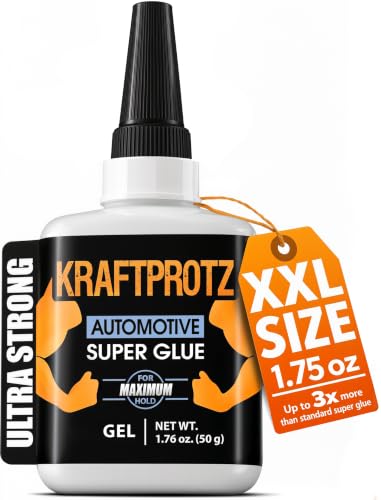
1. KRAFTPROTZ Automotive Super Glue Gel
Our pick — 4.5★ from 800+ verified ratings; the strongest balance of quality and price.
The go-to gel that holds bumpers together under brutal heat and constant road chatter.
This is the crowd favorite for a reason — it tackles the exact rubber-to-metal jobs that other glues bail on. The no-drip gel formula stays put on vertical surfaces, so you are not fighting a runny mess on a door panel or mirror housing. It also shrugs off engine bay temperatures up to 230°F, which is the main thing that kills standard super glue in automotive use.
Buyers report it handles oil, grime, and vibration without letting go. The bottle holds 1.76 oz — that is over three times the volume of many small tubes, and the anti-clog tip keeps it alive between uses. One owner glued a Nissan Pathfinder bumper corner that “kept coming loose” and it held for months through extreme heat and humidity. Another fixed a known Golf R bumper separation and called it “not a perfect fix by any stretch — but also not a body shop bill.”
The catch is time. A few owners note it needs a full 24-hour clamp period to reach a rock-solid bond, so you cannot rush the cure. Effectiveness is what people praise most here, with the adhesion quality coming in a close second.
Why it wins
- No-drip gel stays on vertical car parts without running
- Withstands engine vibration and temperature cycles up to 230°F
- Large 1.76 oz bottle with anti-clog tip for repeated use
The honest trade-off
- Needs 24 hours of clamping for the strongest bond
- Instructions are in German — but the bottle is simple to use
The repair-bay staple: Reach for this one if your job lives in a hot, vibrating environment like a car or truck.
The patience check: Not ideal if you need a grab-in-seconds hold without clamping time.
2. Cerca de Metal Epoxy Glue
The epoxy that dries rock solid and can be drilled, sanded, or painted after cure.
When the rubber-to-metal joint needs to handle serious load — not just hold a trim piece — this epoxy steps in. It is infused with metal powder that gives it a hard, dense finish with some flexibility, so it handles shock better than standard epoxy. The 1:1 dual-syringe design means you squeeze both parts out at once and mix; no guesswork. Initial set happens in 10 minutes, and full use strength arrives at 12 hours.
The strength of the bond is what owners highlight most — 63 separate mentions. One buyer used it to repair a metal bracket and called it “strong bond for metal bracket repair” with a smooth, easy mix. Another noted it is waterproof, so it works fine outdoors. The kit includes a small spatula and other gluing tools, which removes the hassle of finding your own applicator.
Keep in mind that this is a two-part epoxy, not a one-step squeeze — you need to mix each time. And at 1.6 oz, one tube covers several small projects but might run out fast on a large surface.
What stands out
- Rock-solid bond that can be drilled, sanded, and painted after curing
- 10-minute initial set and 12-hour full cure for fast turnaround
- Waterproof and great for both indoor and outdoor repairs
The fair warning
- Two-part mixing required every time — not as simple as a one-step glue
- 1.6 oz tube is small for larger lamination-style jobs
The structural fix: Grab this if you need a thick, load-bearing bond that can be machined after it cures.
The reach-check: skip it if you want a squeeze-and-forget gel for a quick trim repair.
3. TotalBoat TotalBond Black Medium CA Glue
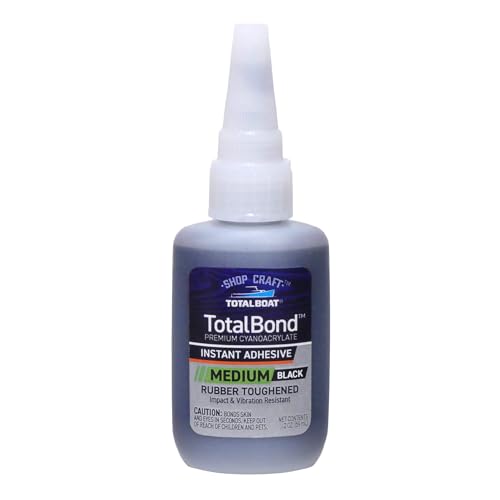
The black, rubber-toughened super glue that blends invisibly into dark repairs.
Standard clear CA glue looks awful on dark rubber parts — it leaves a white ghost ring. TotalBond Black solves that by curing to a dark matte finish that disappears into black trim, gaskets, and RC car tires. The rubberized additive also means it flexes under vibration and impact instead of cracking, which is a common death for regular super glue on a moving joint.
At 300 CPS medium viscosity, it flows into a knot or a crack as small as 0.006″ but stays thick enough to bridge gaps. Set time is fast — 10 to 45 seconds with no clamp needed for most jobs. Owners praise its shock resistance for RC parts and woodworking. One user called it “outstanding shock resistance & perfect for invisible repairs.”
The trade-off is that it is not water-resistant, so it will not hold in a wet environment. And on metal, some owners mention it does not set instantly without accelerator and clamping, unlike the speed advertised for wood.
Why it stands out
- Cures matte black for invisible repairs on dark rubber and plastic
- 300 CPS viscosity balances gap-filling with crack penetration
- Sets in 10-45 seconds with no clamping on most materials
The honest limit
- Not water-resistant — avoid for wet or outdoor applications
- On metal, it may need accelerator and clamping for a fast set
The aesthetic fix: This is your glue when the repair is visible and needs to disappear into a black surface.
The environment check: Not the choice for anything that sits in rain, snow, or a wash bay.
4. VIKAGU 416 Super Bonder Instant Adhesive

The thick, syrup-like super glue that stays put on vertical rubber and fills ragged gaps.
Watery super glue runs off a rubber edge before it bonds. The Vikagu 416 uses a high viscosity of 1500 cps — think warm honey — so it stays where you put it even on a vertical plastic or rubber part. The thickness also lets it fill uneven breaks where the two surfaces do not touch perfectly. It sets in 15 to 30 seconds, giving you just enough time to nudge the parts into alignment before it locks up.
Owners put it to work on tough combinations: rubber to pot metal, rubber to plastic, and metal to metal. One buyer who used it three separate times said “everything is holding good so far.” Another used it to glue a window gasket to a windshield with success. The 2-pack gives you 40g total, so a second bottle stays fresh in the fridge for later.
The drawback is that it is not water-resistant at all — avoid it on anything that sees moisture. And a few owners wish it came in a larger single bottle rather than two smaller ones.
What works
- Thick 1500 cps viscosity stays on vertical surfaces and fills gaps
- Sets in 15-30 seconds for fast positioning
- 2-pack provides 40g total with a backup bottle
The trade-off
- Not water-resistant — no good for wet or outdoor exposure
- Smaller two-bottle format rather than one large container
The precise gluer: Best for small, intricate repairs where you need the glue to stay exactly where you put it.
The moisture watch: Skip it for any job near water, rain, or a car wash.
5. JAOJAO Contact Cement Adhesive
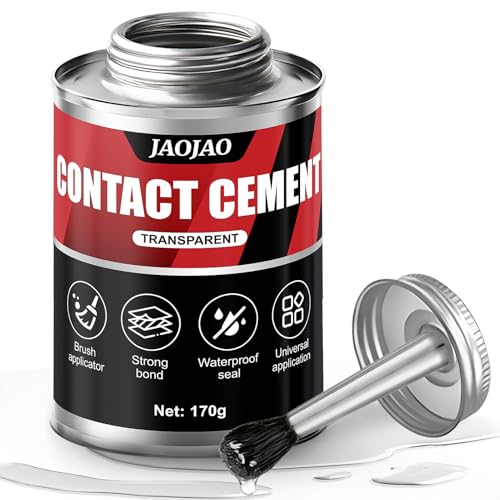
The brush-in-cap contact cement that bonds instantly once both sides touch.
Contact cement works differently to super glue — you coat both surfaces, let them dry for about 5 minutes, and then press them together. The bond happens on contact and is instant. The JAOJAO 6 oz can comes with a built-in brush that fits into the lid, so you can paint the adhesive onto rubber, metal, wood, leather, or foam without needing a separate applicator.
It handles heat up to 176°F and resists water and humidity, making it a solid choice for outdoor furniture, shoe repair, or countertop laminating. The full cure takes 24 hours, but the contact bond is immediate after the initial set. Owners describe it as convenient and effective — one called it “contact cement [that] performs as it should” for the price.
The downside is that contact cement bonds instantly on contact, so there is zero room for sliding or repositioning. Line it up perfectly the first time. Also, the can has arrived damaged in a few shipments, with glue leaking into the packaging.
What you get
- Instant bond on contact after a 5-minute dry time
- Built-in brush makes application clean and controlled
- Waterproof and heat-resistant to 176°F for outdoor use
The caution
- Zero repositioning — line up both parts perfectly before they touch
- Occasional shipping damage has caused leaks in transit
The lamination pro: Reach for this one when you are bonding large, flat surfaces like a countertop laminate or a shoe sole.
The alignment call: Not for jobs where you need to nudge parts into place after they meet.
6. Loctite 404 General Purpose Rubber Instant Adhesive

The specialist Loctite engineered specifically for bonding rubber to other materials.
Loctite 404 is not a general super glue — it is a dedicated rubber instant adhesive with a 3500 psi tensile strength that outperforms standard CA on flexible, stretchy substrates. It is the pick for critical bonds where a cheaper glue would crystallize and snap under movement. The clear liquid dries transparent and bonds rubber to metal and plastic with real authority.
Adhesiveness is what owners praise most here. One buyer called it “better than any super glue I’ve ever used” after it held a disintegrated headphone band under strain for two days. Another uses it professionally for attaching gem material to dop sticks for faceting, saying it “is much easier than the traditional melted shellac.” The bond can be undone with acetone, which is useful for repositioning or cleanup.
The honest friction is the price — the bottle is just 0.333 oz and owners openly call it “SOOOOOO expensive!” It is a purpose-specific tool, not a value buy. And the small volume means one bottle covers only a few small repairs.
Why it earns its spot
- Specifically designed for rubber, with 3500 PSI tensile strength
- Outperforms standard super glues on flexible, stretchy materials
- Bond dissolves in acetone for easy cleanup or repositioning
The real trade-off
- Very small 0.333 oz bottle — runs out fast on a big repair
- Noticeably expensive for the volume you get
The professional’s call: Buy this when nothing else holds a rubber-to-metal bond and you need a guarantee.
The value check: pass on it if you have a big area to cover or need a budget-friendly quantity.
Understanding the Specs
Viscosity
Viscosity is how thick or runny the glue is. A low number like 50 cps (centipoise) means the glue is thin and watery — it soaks into porous surfaces but runs off vertical parts. A high number like 1500 cps means the glue is thick like honey or syrup, staying on vertical surfaces and filling small gaps between uneven parts.
Heat Resistance Ceiling
Rubber-to-metal joints inside a car engine bay or under a motorcycle seat get hot — often well above 200°F. The heat ceiling is the highest temperature the cured adhesive can tolerate before its bond weakens. Standard household super glues fail around 180°F, while automotive-grade options can hold up to 230°F.
FAQ
Will regular super glue hold rubber to metal?
How do I prepare rubber and metal surfaces before gluing?
What is the difference between contact cement and cyanoacrylate for rubber to metal?
Can I use an epoxy for rubber to metal bonding?
How long does a rubber-to-metal glue bond last?
What does heat resistance up to 230°F mean for my repair?
Is a gel or a liquid glue better for vertical surfaces?
Does the black CA glue work for invisible repairs on light surfaces?
Can these adhesives be sanded or painted after curing?
Which adhesive works best for a car bumper repair?
Final Thoughts: The Verdict
For the majority of shoppers, the adhesive for rubber to metal winner is the KRAFTPROTZ Automotive Super Glue Gel because it handles the heat, vibration, and vertical surfaces that define the tough rubber-to-metal jobs. If you need a structural load-bearing repair that can be drilled afterward, grab the Cerca de Metal Epoxy. And for an invisible fix on dark trim or RC parts, the TotalBoat TotalBond Black is the one to reach for.
How We Picked
We do not accept paid placement. Every pick is matched to a real buyer and a real use-case; we do not hands-on test units.
Sources & Methodology
Specifications: manufacturer listings and product documentation. Review insights: verified customer reviews, as of July 2026. Pricing: not shown on this page (it changes often); check the current price via the retailer link.
As an Amazon Associate, FitlyFast earns from qualifying purchases. This does not affect which products we feature.