
Our readers keep the lights on and the weekend projects moving. As an Amazon Associate, I earn from qualifying purchases.
A separated sole flopping with every step is the final, frustrating signal that your favorite boots or sneakers are headed for the trash. But before you toss them, consider that the right flexible, waterproof adhesive can actually outlast the original factory bond, restoring work boots, leather dress shoes, and rubber soles to near-new condition.
I’m Rikta — the co-founder and writer behind FitlyFast. This buying guide is built on hours of analyzing customer reports, comparing cure times, bond flexibility, and material compatibility across the most popular shoe repair adhesives on the market today.
After reviewing seven of the top contenders, one formula stands apart for its balance of strength and precision. This guide breaks down everything you need to confidently select the best adhesive for shoe repair.
How To Choose The Best Adhesive For Shoe Repair
Not all glues are built for the constant flexing, moisture, and weight that shoes endure. Selecting the wrong type leads to brittle bonds that crack or water-soluble formulas that peel off after one wet walk. Focus on these three factors to get a repair that lasts.
Bond Flexibility vs. Rigidity
A shoe sole bends with every step. An adhesive that dries rock-hard will snap under that repetitive stress. The best formulas — like urethane-based or contact cements — remain slightly flexible after curing, allowing the bond to move with the shoe material without breaking the seal.
Material Compatibility
Leather, rubber, EVA foam, vinyl, and canvas each require a specific grip. A glue optimized for rubber may not penetrate leather fibers, while a general construction adhesive can be too thick for delicate sneaker mesh. Check the label for explicit material lists — the more materials listed, the more versatile the adhesive.
Cure Time and Application Method
Quick-dry formulas let you test the repair within an hour, but some need overnight pressure to achieve full strength. Precision tips or included spreader tools make a huge difference in keeping the glue exactly where you want it, avoiding messy squeeze-out that ruins the shoe’s appearance.
Quick Comparison
On smaller screens, swipe sideways to see the full table.
| Model | Category | Best For | Key Spec | Amazon |
|---|---|---|---|---|
| Eagle Shoe Cement | Contact Cement | General sole reattachment | 4 oz paste with precision tip | Amazon |
| Barge Contact Cement Bundle | Contact Cement | Detailed, small repairs | 2 oz tube + 5 spreader tools | Amazon |
| GEAR AID Aquaseal SR | Urethane | Heavy-duty outdoor boots | 2-pack, 1 oz tubes, urethane | Amazon |
| Shoe Goo Repair Bundle | Urethane | Versatile repairs with tools | 3.7 oz bottle + 10 tips | Amazon |
| Shoe GOO Black | Urethane | Cosmetic repairs on dark shoes | Black color, 3.7 oz tube | Amazon |
| Shoe GOO 6-Pack Clear | Urethane | Bulk users / multiple repairs | 6 x 3.7 oz tubes | Amazon |
| MIIDII Soling Sheet | Repair Material | Replacing worn soles entirely | 4 mm thick, 15×11 inch sheet | Amazon |
In‑Depth Reviews
1. Eagle Shoe Cement

Eagle Shoe Cement lands at the top because it nails the essentials: a medium-viscosity paste that stays where you put it, a precision tip for controlled application, and a waterproof bond that holds up to wet weather without peeling. Customer reports confirm it outlasts rain and heavy wear on work shoes and heels alike, making it a reliable one-stop solution for typical sole separations.
The formula is compatible with leather, faux leather, and rubber — the three most common materials in casual and work footwear. It dries clear and remains flexible enough to handle the constant flexing of a boot sole without cracking. A single 4-ounce bottle provides enough material for multiple repairs, which improves the overall value considerably.
A small number of users reported packaging issues where the lid was not fully sealed, causing leakage. This appears to be an isolated manufacturing defect rather than a formula flaw, but it is worth inspecting the seal upon arrival. For most buyers, the adhesive itself performs exactly as a heavy-duty shoe cement should.
Why it’s great
- Precision tip prevents messy application
- Strong, flexible, and waterproof bond
- Compatible with leather, rubber, and vinyl
Good to know
- Check lid seal on arrival for possible leakage
- Best for sole reattachment, not hole filling
2. Barge Contact Cement Bundle

Barge is a legendary name in contact cement, and this bundle pairs a 2-ounce tube with five Pixiss paste spreaders for precise, clean work. The formula is toluene-free but still delivers the aggressive tack that professionals rely on for leather, rubber, vinyl, and even wood. Users consistently report that it holds Birkenstock soles and sneaker separations after a single application.
The fast-dry nature means you can clamp the repair and test within minutes, but the full bond needs about 24 hours to reach maximum strength. The included spreaders eliminate the mess that often plagues tube adhesives, letting you coat both surfaces evenly — which is critical for contact cement to achieve its signature grab.
The small tube size limits this to minor repairs or a few shoes at a time. The cap can also clog if not cleaned immediately after use. The strong solvent smell, while typical for contact cement, requires ventilation during application.
Why it’s great
- Includes spreader tools for even application
- Toluene-free with strong, flexible bond
- Fast dry time for quick testing
Good to know
- Small 2 oz tube — best for small repairs
- Strong chemical odor requires ventilation
3. GEAR AID Aquaseal SR
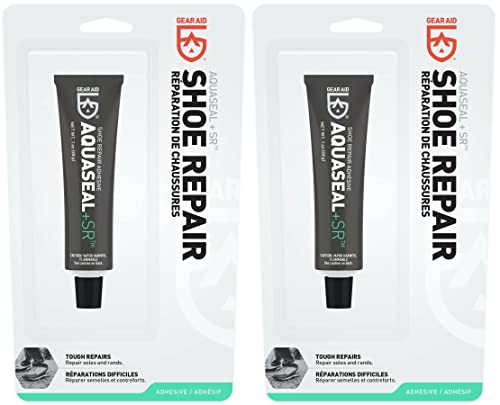
GEAR AID Aquaseal SR is the urethane-based champion for heavy-duty outdoor footwear. Unlike contact cements, this formula cures into a clear, flexible rubber that is highly abrasion resistant — perfect for rebuilding worn heels on hiking boots or sealing leaks in GORE-TEX liners. It bonds to leather, rubber, neoprene, and canvas with a tenacity that outlasts most competitors.
The self-leveling nature makes it easy to create a smooth, flat surface, though one user noted that on wet surfaces the smooth finish can be slightly slick. A 12-hour full cure time is required for maximum strength, and many experienced users recommend clamping the repair for at least 2 hours. The two-pack provides a backup tube for later repairs.
Storage is a consideration: the tube hardens if left open, so storing it in the freezer between uses extends its life significantly. This is a premium adhesive optimized for performance hikers and workers who need a bond that stands up to mud, snow, and salt.
Why it’s great
- Forms a clear, flexible rubber that resists abrasion
- Self-leveling for easy, smooth application
- Works on GORE-TEX, leather, and rubber
Good to know
- Requires 12-hour full cure time
- Can be slick on wet surfaces if applied flat
4. Shoe Goo Repair Adhesive Bundle
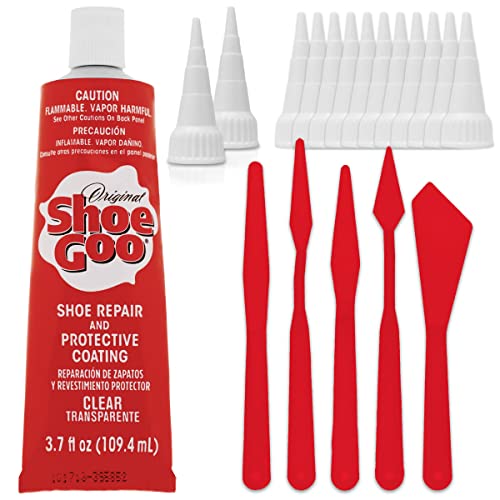
Shoe Goo has been a household name in shoe repair for good reason. This bundle includes a 3.7-ounce bottle and ten snip-tip applicator tips plus five spreaders, giving you everything needed for precise application. The thick, spreadable liquid bonds to leather, vinyl, rubber, and canvas, and cures into a flexible, waterproof seal that holds up to wet conditions.
Users successfully repaired golf shoes, garden boots, and active kid sneakers with this kit. The formula is thick enough to fill small holes and rebuild worn edges, not just reattach soles. The overnight cure time is a mild trade-off for the durable, flexible finish it produces. The included spreaders help keep the mess in check.
Shoe Goo dries clear but can look milky if applied too thickly. It is not ideal for cosmetic top-coats on smooth leather. The tube can also be messy if the snip tip is cut too far up, so start with a small opening and trim as needed.
Why it’s great
- Includes applicator tips and spreaders
- Waterproof and flexible when cured
- Can fill small holes and rebuild edges
Good to know
- Overnight cure time is required
- Can look milky if applied too thickly
5. Shoe GOO Black

For dark-colored boots and sneakers, Shoe GOO Black solves the cosmetic problem that clear adhesives create. This formula delivers the same thick, flexible, waterproof bond as the original Shoe Goo, but in a black finish that blends invisibly into black rubber soles and uppers. It works for every application — sole reattachment, hole filling, and edge rebuilding.
Users have even repurposed it for non-shoe repairs like insulating spliced wire ends and fixing bumpers, which speaks to the toughness of the cured material. The 3.7-ounce tube provides a generous amount for several repairs. The black pigment does not affect the bond strength or flexibility compared to the clear version.
Like all Shoe Goo, it requires overnight curing and can be messy if not applied carefully. The black color makes squeeze-out less noticeable than the clear version, but it is still difficult to remove from fabric if it spreads beyond the repair area.
Why it’s great
- Black color blends into dark soles
- Flexible, waterproof, and tough bond
- Same formula as original Shoe Goo
Good to know
- Requires overnight cure
- Messy application without careful control
6. Shoe GOO 6-Pack Clear

If you maintain multiple pairs of shoes or tackle frequent repairs around the home and farm, the Shoe GOO 6-Pack Clear offers the lowest cost per tube of any option in this lineup. Each 3.7-ounce tube contains the same reliable urethane formula that has earned a cult following for its strength and flexibility. Users describe it as “the best shoe sole repair glue around.”
The adhesive cures to a clear, hard-wearing finish that is water resistant immediately upon application. Thin coats built up in layers produce the best durability on smooth surfaces like plastic and rubber. The 6-pack format ensures you always have a fresh tube on hand, avoiding the frustration of a dried-out half-used tube.
The inconvenience is the same as any single tube: it requires overnight cure, and the thick consistency can be tricky to control. The multiple tubes also mean a larger upfront commitment, but for heavy users, the long-term value is undeniable.
Why it’s great
- Best per-tube value for frequent repairs
- Water resistant immediately after application
- Trusted formula with proven durability
Good to know
- Large 6-pack is a big upfront commitment
- Thick consistency can be messy to handle
7. MIIDII Soling Sheet

This soling sheet is not an adhesive — it is the rubber material you bond onto a completely worn-out sole to rebuild the bottom of a shoe. Paired with any good contact cement (like Barge or Eagle), this 4 mm thick, 15×11 inch sheet of high-quality rubber can double the life of boots and sandals that have lost all tread. Users compare its quality to Vibram at a fraction of the price.
The diamond-patterned surface provides excellent anti-slip traction, and the material is flexible enough to contour to curved soles without cracking. It is tough — several reviewers noted it is hard to cut and requires a sharp utility knife or strong scissors. The rough side of the sheet is designed to accept cement, creating a strong mechanical bond.
This is an intermediate-level repair product. If you have never trimmed and glued a soling sheet before, expect a learning curve. The material is less forgiving than applying a tube of glue to a small separation. But for shoes where the original sole is completely smooth or damaged, this is the only real solution for a full resoling.
Why it’s great
- 4 mm thickness provides excellent cushion and protection
- Diamond pattern for great traction
- Tough, durable rubber extends shoe life significantly
Good to know
- Requires strong adhesive and sharp cutting tools
- Best for intermediate-level DIY shoe repairers
FAQ
Can I use super glue for shoe repair?
How do I prepare the surface before applying shoe glue?
Why did my shoe glue repair fail after a few days?
Final Thoughts: The Verdict
For most users, the adhesive for shoe repair winner is the Eagle Shoe Cement because it delivers a strong, waterproof, flexible bond with a precision tip that makes application simple and clean. If you need a tough, abrasion-resistant fix for hiking boots, grab the GEAR AID Aquaseal SR. And for rebuilding a completely worn-out sole from scratch, nothing beats the MIIDII Soling Sheet paired with a quality contact cement.