
Our readers keep the lights on and the weekend projects moving. As an Amazon Associate, I earn from qualifying purchases.
Specs are compiled from manufacturer listings and verified buyer reviews and can change over time — please confirm the key details on the product page before buying.
Adhesives hate silicone — its low-surface-energy chemistry shrugs off most glues like a raincoat sheds water. A dab of super glue that fuses plastic to wood will curl off a silicone seam hours later, leaving a weak, cracked mess. That is the core frustration: finding something that chemically bites into a material designed to be inert. This guide cuts through the chemistry confusion to the formulas that actually lock onto silicone rubber and stay flexible once cured.
I’m Rikta — the founder and writer behind FitlyFast. This guide is built by comparing the manufacturers’ published specifications and the patterns across verified customer reviews, so you get each pick’s real strengths and trade-offs instead of marketing spin.
From prosthetics to cosplay armour, the right bond keeps moving parts intact — here is the shortlist of the best adhesive for silicone rubber, ranked by real-world holding power.
Our Picks at a Glance
How To Choose The Best Adhesive For Silicone Rubber
Picking the wrong glue is a two-step waste: the bond fails, and you have to clean half-cured residue off silicone that rejects solvents. Focus on these four decision points to get it right the first time.
Pure Silicone Chemistry (RTV vs. Modified vs. Primer)
A true RTV (room-temperature-vulcanising) silicone adhesive like Smooth-On SIL-Poxy cures by reacting with moisture in the air and cross-linking with the silicone molecule chains. That weld is a permanent chemical bond, not a surface grip. Products labelled “silicone adhesive” that come in a tube but never mention RTV or platinum/tin-cure compatibility are often modified cyanoacrylates — they hold initially but grow brittle over time with flexing.
Cured Flexibility
A silicone seam on a mermaid tail or a doll limb bends constantly, so the cured glue must stretch with the substrate. Check the cured durometer (hardness) if available — a rating around Shore 00-10A or the phrase “high-elongation” means you get a bond that moves rather than fractures. A glue that dries hard as acrylic is fine for static repairs but fails on wearable silicone.
Full Cure Time vs. Handling Time
Many silicone adhesives tack in minutes but need a full 24 hours (or longer for thick fills) to reach full strength. The data shows a consistent trade-off: surface dry in 5–10 minutes buys convenience, but the chemical weld beneath is still building strength for a day. The mistake is loading the joint early — thin applications cure faster, so for deep tears, plan several thin layers with overnight waits.
Thickness & Application Control
Runny adhesives wick into tight cracks beautifully but can drip away from vertical seams. Cream or paste consistency sits where you put it, filling gaps without sagging. For repair work on a thin silicone sheet, a runny liquid is actually an advantage — capillary action pulls it into the tear. For bonding a strap mount to a thick silicone base, a thicker gel holds its bead better.
Quick Comparison
| Model | Best For | Cure Time | Flexibility | Application Form | Amazon |
|---|---|---|---|---|---|
| SIL-Poxy 3 oz★ Best Overall | Heavy-duty repairs & FX | 24 hours | High-elongation | Gel (tube) | Amazon |
| Smooth-On SIL-Poxy 0.5 ozPro Grade | Precision & small repairs | 24 hours | High-elongation | Gel (tube) | Amazon |
| JAOJAO Silicone Glue | Sex-doll & model repair | 11–12 hours | Soft / high elasticity | Cream / paste | Amazon |
| YOTEBLE Silicone Glue | Flexible thin-film repairs | Sets 6 hrs / cures 3 days | ~0A-10A soft | Liquid (runny) | Amazon |
| Lounsweer Silicone Adhesive | Budget doll & cavity fill | Surface 5–10 min / thin 3–4 hr / thick 24 hr | Soft, wheat-colour | Liquid (slightly runny) | Amazon |
| 3M Scotch-Weld Primer AC79 | Primer for tough LSE rubbers | Fast-drying (accelerator) | N/A (primer only) | Liquid (bottle with brush) | Amazon |
In‑Depth Reviews
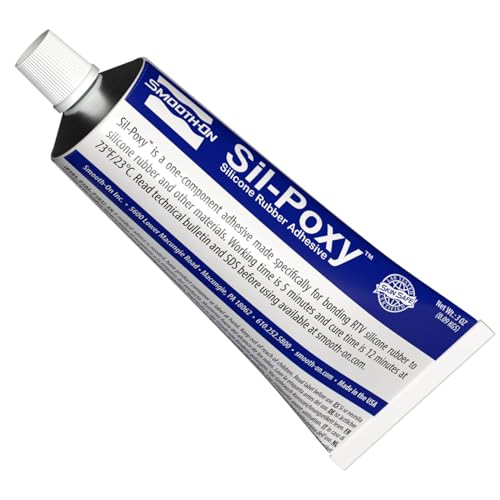
1. SIL-Poxy – Silicone Rubber Adhesive (3 oz Tube)
Our pick — 4.5★ from 550+ verified ratings; the strongest balance of quality and price.
The three-ounce tube that cosplayers and FX artists treat as the gold standard for silicone welding.
This is pure RTV silicone chemistry in a gel that stays where you put it. The 24-hour full cure produces a flexible joint that buyers describe as “like a silicone weld” — strong enough to survive a mermaid tail being submerged repeatedly or a zipper on a silicone bodysuit pulling tight day after day. The formulation works with both tin-cure and platinum-cure silicones, so you are not locked into a specific mold-making brand. That three-ounce tube is roughly six times the volume of the 0.5-ounce version, making it the right choice when you have a large seam or multiple repairs ahead of you.
The trade-off is the odour — buyers report the room stinks for about a day during cure, and the bond leaves a slightly shiny finish on matte silicone. But the adhesion is what wins the room: the data shows adhesion is easily the top-cited positive, with 92 people singling it out. As owners put it, “the bond is strong, like a silicone weld.” It is not cheap, but a single tube replaces several failed attempts from general-purpose glues.
Who it locks onto: Cosplayers, FX makers, and anyone repairing a thick silicone piece that needs to flex and stay waterproof. The value makes sense when you are covering a big area — the 3-oz tube is roughly six times the adhesive for a reasonable step up.
The single caveat: The odour is real — plan to ventilate the room for a full day, and test on a hidden spot first because the cured seam is slightly glossier than the original surface.
Reach for this if: you need a waterproof, UV-resistant silicone weld that bends without cracking — costumes, props, prosthetics.
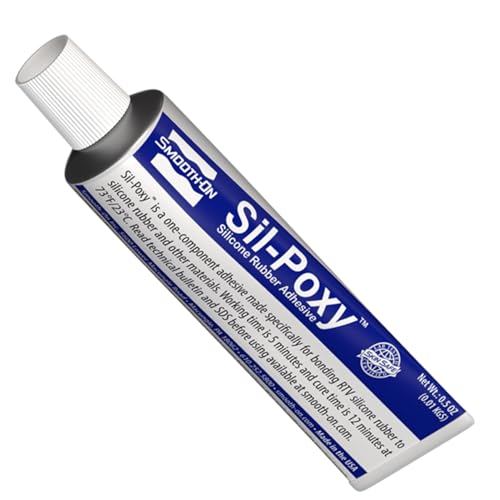
2. Smooth-On SIL-Poxy (0.5 oz Tube)
The half-ounce precision tube that FX artists call the gold standard for silicone-seam repair.
Same chemistry as the 3-oz tube above, but in a small tube for targeted fixes. The clear gel cures translucent, tacks in about five minutes, and handles light stress in roughly twenty. That speed makes it ideal for reattaching a doll arm, sealing a tear in an FX mask, or bonding silicone to silicone on a small prosthetic. The bond is strong and flexible — buyers who stress-tested a deep tear repair on a silicone doll report that after three days the item was “nearly new” with no issues at the repair site.
The crowd — well over 1,500 ratings — calls effectiveness the standout quality, with 174 people noting it. But durability carries a mixed verdict in the data: some owners found the bond held for months of play, while others describe it as a “Band-Aid” that extends the life of expensive silicone pieces but is not permanent. The half-ounce size also means the price per ounce is noticeably higher than buying the larger tube — for a single small job it is efficient, but anyone with multiple repairs is better off with the 3-oz version.
What wins people over
- Tacks fast (~5 min) and handles gentle use in ~20 min — keeps projects moving
- Translucent finish blends well on clear or light-coloured silicone
- Works on both tin-cure and platinum-cure RTV silicones
What to weigh up
- Some owners find the bond is more of a long-term repair than a permanent fix for high-stress areas
- Small tube is expensive per ounce compared to the 3-oz version
Pick this for: one-off repairs on masks, dolls, or prosthetic lining where a small dab is all you need. Think twice if: you are covering large seams — grab the 3-oz tube instead for better value per gram.
3. YOTEBLE Silicone Glue (30 ml)
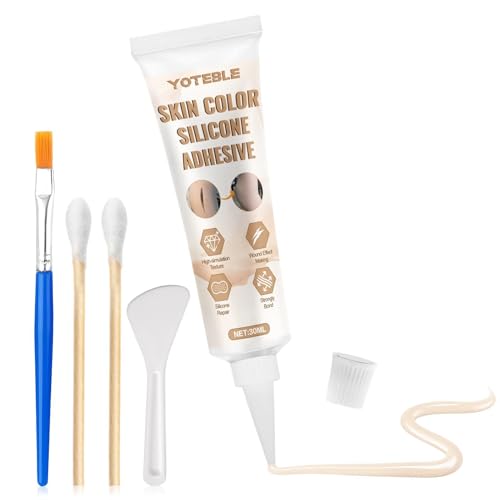
The runny, skin-coloured liquid that soaks into thin tears and dries as soft as the original silicone.
This is the pick for repairing delicate silicone items where a stiff weld would ruin the feel. The cured adhesive is exceptionally soft — right around Shore 00-10A, which is roughly the squishiness of a soft silicone kitchen spatula. Owners mention restoring airtight seals on silicone suction toys and fixing split rings that survived multiple uses after repair. The liquid consistency is stringy and runny, which is a superpower for cracks: it wicks into the gap and bonds from the inside. The data shows a 20-minute working time, with an inner layer firming up in two hours and a full set in six hours, though the manufacturer says full cure takes three days.
The colour is a mixed bag: several owners found the glue was clear rather than the “tan skin colour” shown in the listing. One buyer who was in a pinch used it anyway and confirmed the bond held well — but if colour-match matters, order expecting clear. The other recurring note is that application takes a little finesse — apply thin layers for deep rips, let each dry overnight, and keep rubbing alcohol handy for clean-up.
What makes it stand out: The cured softness (~0A-10A) is noticeably lower than most silicone adhesives, which sit around Shore A 20–30. That means a repair that flexes exactly like the surrounding material — no stiff ridge.
The honest trade-off: The colour mismatch (clear vs. advertised tan) is frustrating if you need an invisible fix. Also plan for the long cure — three days to full strength means no stress on the joint for 72 hours.
Best for: thin silicone sheet repairs — panties, suction toys, soft straps — where bond flexibility is everything. skip it if: you need an instant grab or an exact skin-colour match.
4. JAOJAO Silicone Adhesive Glue (30 ml)
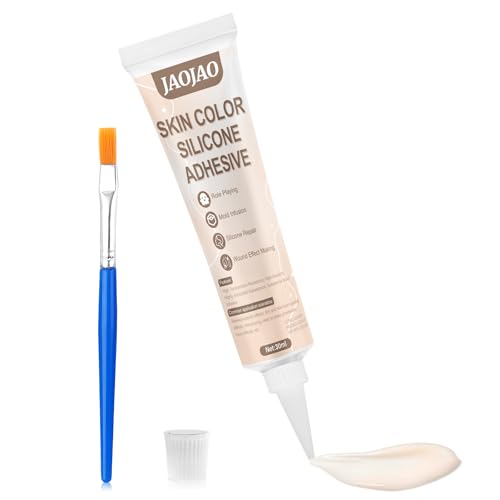
The budget tube that leans into soft elasticity and comes with a scraper and brush in the box.
This skin-coloured cream-paste adhesive targets the doll-repair and special-effects crowd with a texture that stays put rather than running. The data pins the cure schedule at liquid-to-sticky in one to six hours, then fully solid in eleven to twelve hours — which is significantly faster than the three-day wait on some alternatives. Customers note effective fixes on breastforms and soft doll limbs, noting that the bond does not harden excessively and maintains a high-simulation (real) touch. The included scraper and brush mean you can open the tube and start working without buying separate tools.
The catch is colour consistency: several reviewers point out the glue arrives clear, not the skin tone shown in the listing, which earned a two-star subtraction from one owner. It works fine once applied, but if you need a true flesh-colour match for a visible repair, this is not guaranteed. The other limitation is the lack of printed instructions — the data shows the tube ships without a how-to guide, so first-time users should test on scrap silicone and learn the tacky-step timing before committing to the main repair.
Why it appeals
- Fast cure — fully solid in 11–12 hours
- High elasticity; won’t crack or peel under flex
- Comes with applicator scraper and brush
What to watch for
- Colour is often clear, not the advertised skin colour
- No instructions included — you learn by trial
Reach for this if: you want a fast-curing, flexible silicone glue with a tool kit included for the price. Look elsewhere if: an exact skin-tone colour match is critical, or you want pre-written application guidance.
5. Lounsweer Silicone Adhesive Glue (1 Tube)
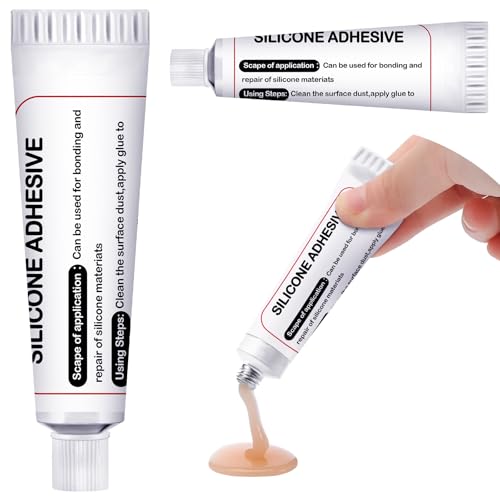
The entry-level tube that surfaces fast but asks for patience on thick fills — a full 24-hour cure for deep repairs.
This is the most affordable dedicated silicone adhesive on the list, and it wears its budget positioning honestly. The surface skins in five to ten minutes — fast enough that you can press a seam and walk away. Thin layers dry in three to four hours, which is competitive with pricier options. The glue is waterproof and sweat-resistant once cured, making it viable for wearable silicone props or doll limbs that see daily handling. The natural colour is described as “wheat” — a warm, fair-beige tone that one owner said “matches pretty well” with their light skin, though another found it milky white and translucent rather than a true flesh colour.
The 1.12-ounce tube is compact, and the runny consistency works well for cavity fills but can be messy for vertical seams. The big limitation — and the reason it lands as a budget pick rather than a top performer — is compatibility: the data states this adhesive works with silicone and platinum silicone, but explicitly not with TPE. If your item is thermoplastic elastomer rather than pure silicone, look at the YOTEBLE or JAOJAO options instead. Also, a handful of owners received their tube with no instructions, so first-timers should plan an extra test-run on scrap.
The strong point: At roughly a third the cost of the premium options, this gets you a functional silicone bond for small repairs — fast surface cure and a waterproof seam.
The honest trade-off: Colour is unpredictable (wheat/beige vs. translucent), compatibility excludes TPE entirely, and the runny liquid does not hold a bead on vertical work.
Best for: a no-regrets first tube if you are experimenting with silicone repair on a budget. pass on it if: your item is TPE, you need an exact colour match, or you are bonding a vertical seam that needs a thick gel.
6. 3M Scotch-Weld Instant Adhesive Primer AC79 (2 fl oz)

The fast-drying surface prep that makes cyanoacrylate glue finally bite into silicone and EPDM rubber.
This is not an adhesive itself — it is a primer designed to prep low-surface-energy rubbers (silicone, fluoroelastomers, EPDM, TPE) so that instant adhesives form a real chemical grip. Brush it on, let it dry fast (the built-in cure accelerator speeds evaporation), then apply a compatible cyanoacrylate glue. The data shows owners reporting success bonding silicone to silicone and even rubber to POM (acetal) without a secondary primer, using the capillary action of thin glue. That “one-shot” capability saves time on projects where silicone needs to mate with hard plastic or metal.
The controversy is obvious: several buyers call the product “plain old acetone” or “expensive acetone,” arguing the formula smells identical to pure solvent and could be replaced with a swipe of nail-polish remover. The counterpoint from the data is that 3M’s engineering-grade primer includes a cure accelerator that plain acetone lacks, which changes how the glue sets. For one-off repairs, acetone might work in a pinch. For production or critical-hold applications where bond consistency matters, the engineered formula is the safer bet — but the price per 2-ounce bottle stings for what feels (and smells) like solvent.
Where it earns its keep
- Enables cyanoacrylate bonding on silicone — a notoriously difficult surface
- Fast drying with cure accelerator keeps jobs moving
- Works on EPDM, TPE, fluoroelastomers, and rubber
What holds it back
- Several experienced owners argue it is just acetone with a strong price tag
- Requires a separate cyanoacrylate glue — not a standalone adhesive
Reach for this if: you are bonding silicone to a hard plastic or metal using cyanoacrylate glue and need reliable surface prep. Think twice if: you want a single-tube silicone adhesive — this is a primer, not a glue.
Understanding the Specs
RTV Silicone Chemistry (Room-Temperature Vulcanising)
This is the key distinction. An RTV silicone adhesive contains cross-linking agents that react with moisture in the air to form a true chemical bond with the silicone substrate — it literally merges with the material rather than sitting on top. General-purpose glues (epoxy, cyanoacrylate without primer) rely on surface grip, which fails on silicone because its low surface energy wont let most liquids wet out and grab. When a product says “RTV” or “platinum-cure compatible,” you are getting the chemistry that actually forms a weld with silicone molecules.
Durometer / Shore Hardness
Shore 00 and Shore A are the two scales used for soft materials. A silicone adhesive that cures to Shore 00-10A (like the YOTEBLE) is roughly as soft as a gel insole — it bends and compresses easily. A Shore A 20–30 material (typical of many RTV adhesives) is closer to a pencil eraser — firm but still flexible. For wearable items that stretch and twist, lower hardness numbers mean the repair area wont feel stiff or dig in. For structural repairs on a thick mold, a slightly firmer Shore A bond provides better load-bearing strength.
FAQ
Can I use super glue on silicone?
Will silicone adhesive cure underwater or in high moisture?
How do I clean up silicone adhesive before it cures?
What is the difference between tin-cure and platinum-cure silicone compatibility?
How long does silicone adhesive take to cure fully?
Can I paint over cured silicone adhesive?
Will silicone adhesive work on TPE or TPU?
Why does silicone adhesive smell so strong?
Can I use silicone adhesive for special-effects prosthetics?
Is silicone adhesive permanent?
Final Thoughts: The Verdict
If you want one dependable pick, the adhesive for silicone rubber winner is the SIL-Poxy 3 oz — the highest-rated product with the most owner feedback on the list, built on true RTV silicone chemistry that bonds a wide range of silicone types with a flexible, waterproof hold. If you only need a dab for a single tear and want fast tack, the Smooth-On SIL-Poxy 0.5 oz is the precision choice. For soft-flex repairs on thin silicone sheet or TPE, the YOTEBLE offers an exceptionally soft cure. And if you are working with a low-surface-energy rubber that needs surface prep before gluing, the 3M Scotch-Weld AC79 is the primer that makes other adhesives finally work on silicone.
How We Picked
We do not accept paid placement. Every pick is matched to a real buyer and a real use-case; we do not hands-on test units.
Sources & Methodology
Specifications: manufacturer listings and product documentation. Review insights: verified customer reviews, as of July 2026. Pricing: not shown on this page (it changes often); check the current price via the retailer link.
As an Amazon Associate, FitlyFast earns from qualifying purchases. This does not affect which products we feature.