
Our readers keep the lights on and the weekend projects moving. As an Amazon Associate, I earn from qualifying purchases.
Specs are compiled from manufacturer listings and verified buyer reviews and can change over time — please confirm the key details on the product page before buying.
The hardest part of a sudden cardiac arrest isn’t the CPR — it’s the moment you realize help is still minutes away and you’re the one holding the response. That’s why the Philips HeartStart line has become the default choice for homes, churches, and small businesses: these are genuinely ready-to-use devices that talk you through every step, no medical background required.
I’m Rikta — the founder and writer behind FitlyFast. This guide is built by comparing the manufacturers’ published specifications and the patterns across verified customer reviews, so you get each pick’s real strengths and trade-offs instead of marketing spin.
You want an aed defibrillator that won’t fail you in the one moment that matters, and this breakdown shows you exactly which Philips HeartStart model fits your home, your travel habits, or your public space.
Our Picks at a Glance


How To Choose The Best AED Defibrillator
Every AED on this list saves lives the same way — by analyzing a heart rhythm and delivering a shock when needed. The real differences come down to where you’ll keep it, how it guides a panicked first responder, and what else is in the box when you open it.
Decide: home, travel, or public space
A home unit lives in a drawer or a closet and gets checked once a month. A business unit gets mounted on a wall where anyone can grab it. The right pick changes how much case, cabinet, and extra supplies you need — a sturdy wall mount and sign mean nothing if you just want something to slip into a suitcase.
Look past the shock, at the guidance
The moment that matters most is the first time you use it, and that’s when clear step-by-step voice prompts earn their keep. Every Philips HeartStart here speaks instructions aloud, tells you when to start CPR, and only shocks when the heart rhythm actually calls for it — the tech does the thinking, you do the doing.
Check the package, not just the device
The base unit is identical across most of these picks — the real difference is what ships with it. Training pads, spare SMART Pads Cartridges, wall mounts, first aid kits, and cabinets all change the price and the readiness. A package with extras can save you a second purchase later.
Quick Comparison
In-depth Reviews
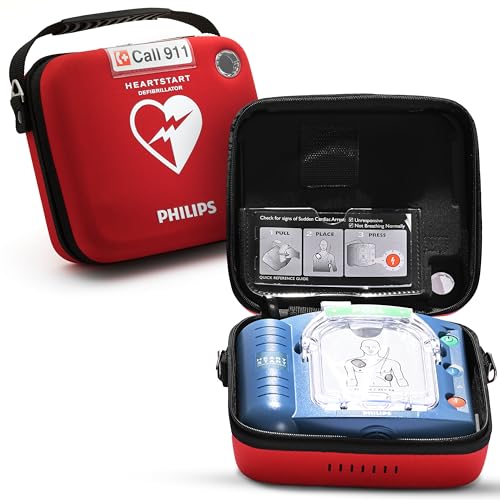
1. Philips HeartStart Home AED Defibrillator with Slim Carry Case, M5068A-C01
Our pick — over 4.5★ from 300+ verified ratings; the strongest balance of quality and price.
The traveler’s AED — a life-saving brick that packs into a carry-on when the battery’s out.
You get a home defibrillator that also travels with you, because it fits into a carry-on suitcase once you remove the battery. Frequent travelers treat it as a regular flight companion, which matters when you’re in remote spots like the Philippines or Thailand where emergency response times stretch out.
The guidance is where it shines. SMART Analysis reads the heart’s rhythm before deciding to shock, and the Quick Shock feature delivers within 8 seconds, followed by voice coaching on CPR. You don’t need training to use it — it walks you through each step aloud, and owners note it’s easy to train someone with limited English, though the interface is English-only. Weighing 5.5 pounds in a 6 x 6 x 6 inch case, it’s no bigger than an office lunchbox.
What wins people over is ease of use — the single most-praised trait in the owner feedback, with quality close behind. The emotional stories are impossible to ignore: one buyer’s cardiac arrest was handled by a coworker using this exact AED that guided them through one shock and 45 seconds of CPR, reviving them. Another credits it with saving a wife’s life during a SCAD heart attack. It performs daily, weekly, and monthly self-tests, so there’s no manual calibration to remember.
Why it’s the crowd favorite
- Compact 6-inch cube design fits small spaces and carry-ons
- Voice prompts walk first-timers through every step
- Self-tests daily, weekly, and monthly for low-maintenance readiness
- Strong owner stories of lives saved in real emergencies
The honest trade-offs
- Voice guidance is English-only, limiting non-English speakers
- Some find the price steep, though owners call it worth it
Who it suits: The home buyer who wants one device that works at home and on the road, without sacrificing portability or lifesaving capability.
Who should look elsewhere: Anyone who needs a wall-mounted, business-style setup with a cabinet — those live lower in this list.
2. Philips HeartStart OnSite AED Defibrillator, Slim Carry Case M5066A-C02
Built for restaurants, gyms, and churches — the no-fuss AED for spaces where anyone might grab it.
This is the near-identical twin of our top pick, but tuned for public environments like offices, restaurants, gyms, and airports. The core tech matches exactly — SMART Analysis for rhythm assessment, Quick Shock within 8 seconds, and real-time CPR voice prompts. The difference is that it’s built for spaces where strangers, not family, might be the ones reaching for it.
At 5.34 pounds, it’s actually lighter than the Home unit above — a 35% weight gap that makes it even easier to carry in an emergency bag. The owner stories lean practical: buyers use it after a spouse’s cardiac episode in a rural area that was a 40-minute drive from the hospital, and one owner keeps three units across home, parents’ house, and travel. Churches call it “the perfect addition,” and it’s usable by kids as young as 10 in a pinch.
Owners repeatedly mention confidence, with “easy to use instructions” echoing through feedback from families and venues alike. It self-tests daily, weekly, and monthly, so it stays ready without babysitting. The common gripe is the English-only interface, which matters less in public spaces where English comprehension is often higher.
Built for the crowd
- Lighter than the Home model at 5.34 pounds
- Voice prompts designed for first-time, untrained users
- Proven in rural emergency scenarios with slow EMS response
- Self-tests keep it ready for public use
Keep in mind
- English-only voice guidance
- A few owners note the automated test isn’t a live shock test
Reach for this if: You manage a small business, church, or community space and want a grab-and-go AED without the wall-mount cabinet.
Look elsewhere if: You want the full business kit with the cabinet and wall sign — that’s further down.
3. Philips HeartStart Home AED Defibrillator with Training Pads Cartridge, M5068A-C02
The home AED that lets you practice — training pads and a DVD turn the whole family into responders.
This Home unit adds two things the base model doesn’t: a set of training pads and an instructional DVD. You can convert the device into an AED trainer using adult or infant/child training pad cartridges, so your family rehearses the motions before a crisis hits.
The trust factor is personal. A retired ER nurse with decades of experience bought it after her husband’s heart bypass and stents, knowing EMT response in her area could take over 20 minutes. Another family bought it for two nieces with heare paramedics arrived. Another retired after 41 years in health care and bought it for the family farm, saying it “didn’t feel right” not having an AED within reach. A business owner trained 25 staff members across two units that ran about 2 years, with the original batteries still working.
At 21 pounds including the cabinet, this is a fixed installation, not a portable device — the trade-off for a protected, always-ready unit. The recurring criticism is isolated to pad quality, with some owners reporting faulty pads in their units. That’s worth an inspection on arrival, given the solid 4.6-star crowd approval and what owners call “amazing” value for a complete starter kit.
The protected setup
- Basic cabinet secures the AED and keeps it visible
- CPR pocket mask in the Fast Response Kit
- Proven in a real cardiac arrest with a restored pulse
- Mountable 4-5 feet high, one-handed and accessible
Watch for this
- Some buyers report faulty pads — inspect on arrival
- 21 pounds means a permanent installation, not portability
Choose this for: Offices, venues, and facilities that need a secure, mounted, signposted AED with a full response kit.
Not the one if: You want a unit to carry or move — the cabinet locks it in place.
Understanding the Specs
SMART Analysis and Quick Shock
SMART Analysis is the software that reads the heart’s rhythm and decides whether a shock is actually needed — it refuses to shock a heart that isn’t in a shockable rhythm. The Quick Shock feature then delivers that shock within 8 seconds of the analysis, which is the decisive window in a cardiac arrest. You don’t make the call; the device does.
Self-Test and Warranty
Every HeartStart runs a daily, weekly, and monthly self-test, which is how a device that sits untouched for years stays ready without manual calibration. The warranty covers the AED unit for 8 years, the battery for 4 years, and pads until their expiration date. That’s why owners trust a device they may never actually use.
FAQ
Do I need training to use a Philips HeartStart AED?
How does the AED decide whether to shock someone?
How often do the pads and battery need replacing?
What is the 8-second Quick Shock feature?
Can a Philips HeartStart be used on children?
What’s the difference between the Home and OnSite models?
Can I travel with an AED in a carry-on bag?
How do I know my AED is still working if I never use it?
Final Thoughts: The Verdict
For the majority of shoppers, the aed defibrillator winner is the Philips HeartStart Home with Slim Carry Case because it balances true portability with the same lifesaving tech as the pro units. If you want training pads and a DVD for family practice, grab the Home with Training Pads. And for a full business installation, the OnSite Business Package with its cabinet and wall sign is the one to reach for.
How We Picked
We do not accept paid placement. Every pick is matched to a real buyer and a real use-case; we do not hands-on test units.
Sources & Methodology
Specifications: manufacturer listings and product documentation. Review insights: verified customer reviews, as of August 2026. Pricing: not shown on this page (it changes often); check the current price via the retailer link.
As an Amazon Associate, FitlyFast earns from qualifying purchases. This does not affect which products we feature.