
Our readers keep the lights on and the weekend projects moving. As an Amazon Associate, I earn from qualifying purchases.
Dealing with rust on a vehicle frame, trailer, or metal outdoor fixture usually ends with hours of grinding, wire brushing, and frustration. A dedicated aerosol rust converter changes that workflow entirely by using a chemical reaction to turn iron oxide into a stable, paintable coating — no bare-metal sanding required.
I’m Rikta — the co-founder and writer behind FitlyFast. This guide breaks down the performance differences between mid-range and premium aerosol rust converters based on immersion in customer feedback, real-world application reports, and technical analysis of curing chemistry and coverage claims.
Whether you are refreshing an old truck frame or protecting garden tools, finding the right formula matters, and I have sorted through the top contenders to help you choose the best aerosol rust converter for your specific project.
How To Choose The Best Aerosol Rust Converter
Not every can of spray paint labeled “rust converter” actually performs a chemical transformation. Some are just black primer with a marketing claim. Understanding the format, chemistry, and application method will keep you from wasting time on a product that only masks the problem.
True Chemical Conversion vs. Encapsulation
A genuine converter uses tannic acid or a similar agent to react with iron oxide (rust) and form a stable, inert black layer. An encapsulator, by contrast, seals the rust under a moisture-cured urethane barrier. Both are valid approaches, but they behave differently when chipped or scratched — converters leave no exposed rust underneath, while encapsulators rely entirely on film integrity.
Cohesive Coverage and Dry Time
Look for products that list square-foot coverage per can and a realistic recoat window. Thin, watery converters require multiple passes and longer dry times between coats. A thicker gel-like consistency or a high-solids aerosol (like 17 oz or 35 oz equivalents) skips the need for four or five layers, saving you labor and money on larger repairs.
Top-Coat Compatibility
Some converters dry to a flat matte finish that can be painted over with oil-based or urethane top coats. Others are designed as a final finish and may wrinkle or peel if overcoated. Check whether the product explicitly recommends a top coat — if you plan to match body paint, choose a converter that lists compatible refinish systems.
Quick Comparison
On smaller screens, swipe sideways to see the full table.
| Model | Category | Best For | Key Spec | Amazon |
|---|---|---|---|---|
| Eastwood Matte Black Rust Encapsulator Plus | Encapsulator | Maximum long-term protection | 1000+ hr salt spray resistance | Amazon |
| cocomfix Ultra 2-in-1 Rust Converter | Converter + Primer | Direct-to-rust painting | 350°F heat stable | Amazon |
| Polar Rust Converter Spray (2-pack) | Aerosol | Large surface coverage | 17 oz per can | Amazon |
| Dupli-Color Rust Fix Spray Paint | Converter | Clear-to-black auto touch-up | Dries in 2 hours | Amazon |
| Rust-Oleum Stops Rust Rust Reformer | Reformer | Quick DIY garden repairs | 8 oz can | Amazon |
| Limino Rust Converter (32 oz) | Liquid/Gel | Brush-on precision work | 32 oz liquid | Amazon |
| Fluid Film Rust and Corrosion Protection | Lanolin Coating | Underbody moisture barrier | 11.75 oz aerosol | Amazon |
In‑Depth Reviews
1. Eastwood Matte Black Rust Encapsulator Plus

The Eastwood Rust Encapsulator Plus uses a moisture-cured urethane formula that penetrates deep into rust scale and cures to a tough, matte black barrier. This is not a simple tannic-acid converter — it is a high-build coating that physically locks out oxygen and moisture, providing over 1000 hours of salt spray resistance in lab testing. That level of corrosion protection rivals professional-grade chassis paints.
Application requires careful prep: wire-wheel the loose flakes, sand to 220 grit, then apply two coats once the surface is tack-free. Users report excellent coverage on truck frames and bumpers, with the black finish blending well into OEM underbody areas. The included straw hose is useful for tight box-section cavities, though some cans suffer from nozzle clogging if the tip is not cleared immediately after use.
One important limitation: this product cannot be shipped to California due to VOC restrictions, and it requires a top coat if exposed to direct sunlight. For full-frame restorations or heavy equipment stored outdoors, the Encapsulator Plus provides the most durable barrier in this roundup, but it demands disciplined application to avoid tip blockages.
Why it’s great
- Industry-leading salt spray resistance
- Deep penetration into existing rust
- Withstands 350°F without degrading
Good to know
- Nozzle clogs reported if not cleaned immediately
- Requires top coat in direct sunlight
- Not available for California shipping
2. cocomfix Ultra 2-in-1 Rust Converter Paint
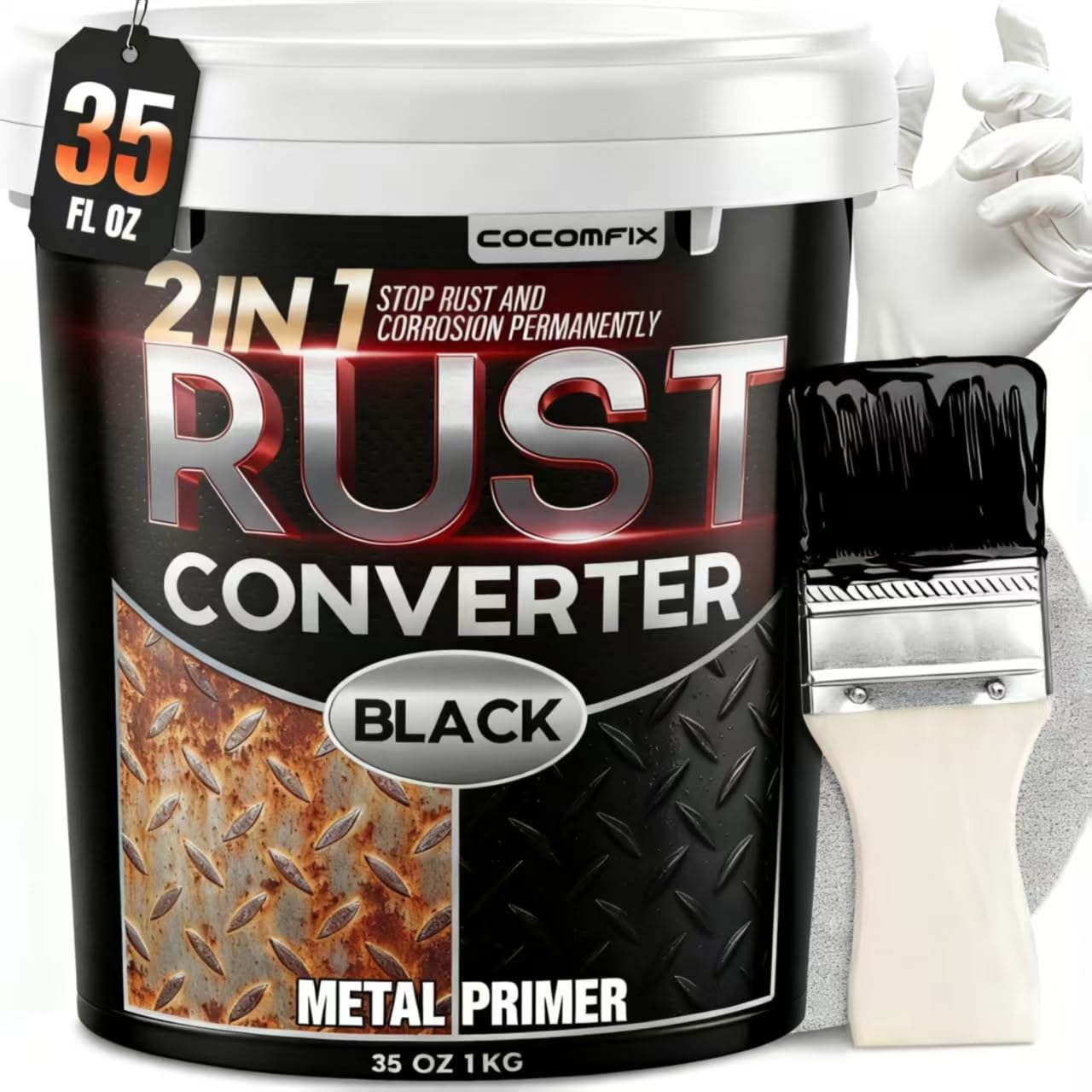
The cocomfix Ultra 2-in-1 positions itself as a direct-to-rust solution that requires no primer, top coat, or sanding down to bare metal. It is a water-based formulation that converts up to 50 microns of rust into a hard, matte black coating while also forming a heat-stable barrier up to 350°F. The included kit — brush, gloves, sandpapers, and detailed instructions — makes this a strong contender for first-time converter users.
Reviews note that the paint goes on grey and dries to a uniform black with a matte finish. Users applying it to flatbed trailers and heavy-duty frames report excellent adhesion and a tough, peel-proof feel after full cure. The one recurring caution is extended cure time: while the surface feels dry within hours, moisture contact before several days of curing can turn the coating grey again, indicating incomplete chemical conversion.
For the money, this delivers an unusually complete package — the 35-ounce volume covers large areas, the water-based formula means low odor during application, and the heat stability makes it usable on exhaust-adjacent components. Just plan your work around the extended cure window if your project will see rain or pressure washing soon after.
Why it’s great
- Comes with gloves, brush, and sandpaper
- Heat-stable up to 350°F
- Water-based with low odor
Good to know
- Long cure time before moisture exposure
- Dries grey, turns black — color can be surprising
- Water-based may need multiple coats on heavy rust
3. Polar Rust Converter Spray (2-pack)
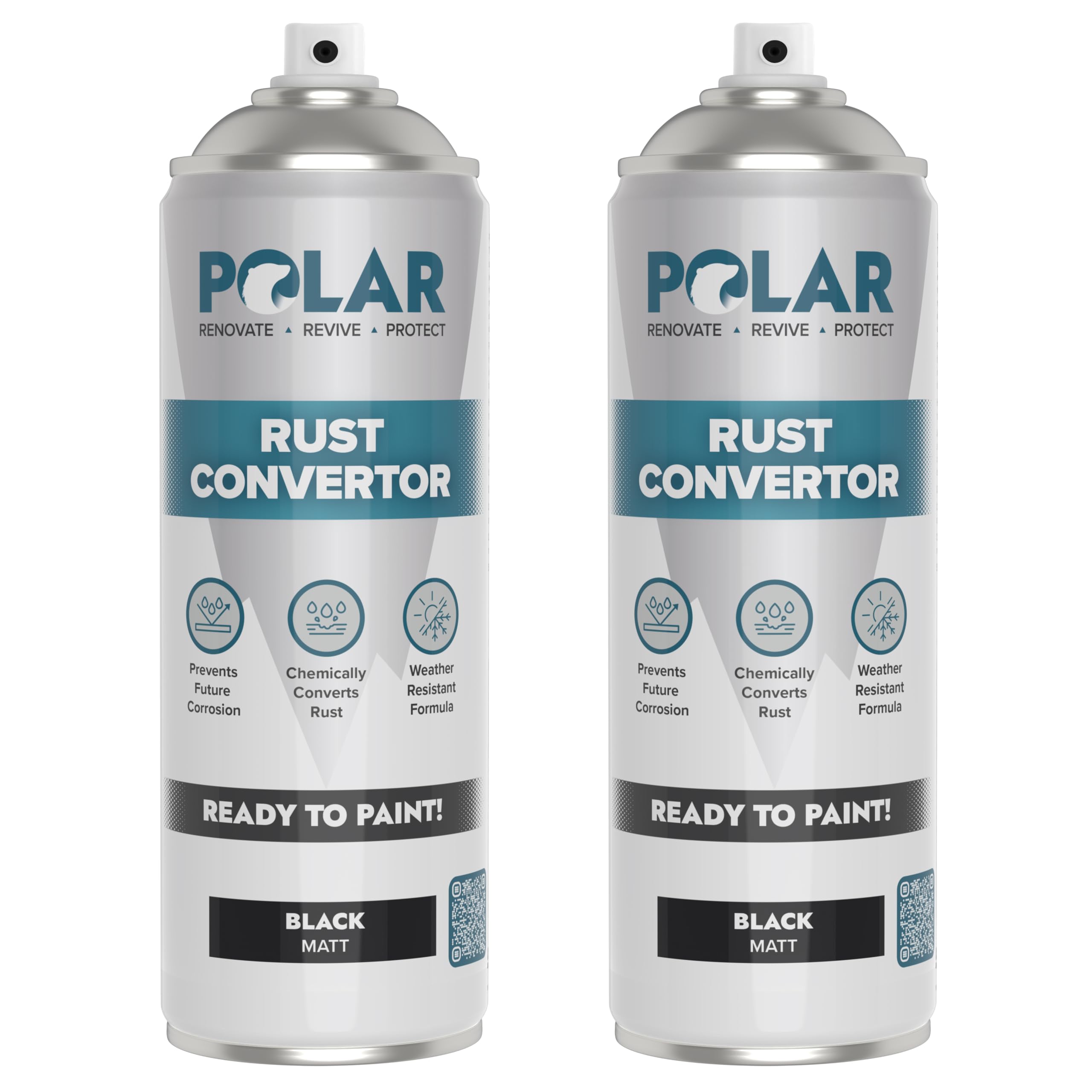
Polar’s Rust Converter comes in a two-pack of 17-ounce aerosol cans, giving you double the volume of most single-can converters at a price point that undercuts many premium options. The formula is designed to chemically convert rust into a stable matte black finish with weather-resistant properties that hold up against rain and UV. Each can claims coverage of roughly two square meters, making this a practical choice for trailers, fences, and storage tanks.
User feedback highlights excellent spray coverage and a consistency that is neither too watery nor too thick — reviewers describe it as soaking into the steel rather than pooling on the surface. The fast dry-between-coats time (15 minutes) speeds up the job significantly. However, a few users note that spray orientation matters: holding the can at an angle or upside down causes spattering, so vertical passes are recommended for a clean finish.
The matte black finish accepts top coats well if you want to color-match later, but the product looks finished on its own for most underbody applications. Between the generous volume, short recoat window, and durable final film, this is the most efficient aerosol for covering large areas without running out halfway through the job.
Why it’s great
- Two 17-ounce cans for large projects
- Fast 15-minute recoat window
- Dries to a tough, paintable finish
Good to know
- Spatters if sprayed at an angle
- Only available as a two-pack
- May require top coat for UV-prone areas
4. Dupli-Color Rust Fix Spray Paint

Dupli-Color Rust Fix works differently from the others in this list: it sprays on as a clear liquid that only turns black upon chemically reacting with rust. This visual feedback lets you see exactly where the conversion is happening and where you may have missed a spot. The clear-to-black mechanism also means any overspray on non-rusted surfaces remains transparent, reducing cleanup compared to black pigments.
The formula bonds with rust to create a sandable and paintable surface, and it is rated for exterior use including auto panels, truck frames, and motorcycle parts. Drying time is listed at two hours to touch, with full cure in one hour — significantly faster than the water-based options. Reviewers consistently call it effective for light to moderate rust, especially after wire-wheel prep, and many use it as a rust-preventive base before body filler.
The 10.25-ounce can is on the smaller side, so coverage is best suited for spot repairs rather than full-frame jobs. And because the product relies on the chemical reaction for color change, applying it over thick, flaking rust without mechanical prep will leave weak spots in the conversion layer.
Why it’s great
- Clear spray shows exactly where conversion happens
- Fast 2-hour dry time
- Sandable and paintable after cure
Good to know
- Small can size limits large applications
- Requires good mechanical prep for thick rust
- Not designed as a final top coat
5. Rust-Oleum Stops Rust Rust Reformer

Rust-Oleum’s Rust Reformer is a longtime staple in the DIY rust-fighting category. It chemically converts rust into a flat black, paintable surface and claims to reduce the need for sanding down to bare metal. At 8 ounces, the can is compact, making it an easy addition to the toolbox for quick repairs on mower decks, metal chairs, and garden stakes.
User feedback is overwhelmingly positive for light-duty, decorative, and outdoor metal items. The product dries quickly, does not create a messy overspray when used carefully, and holds up well under top coats of oil-based paint. However, for structural applications like truck frames or reassembled suspension components, some reviewers note the film can peel under mechanical stress, raising questions about adhesion strength on heavily worked surfaces.
The Rust Reformer is best approached as a maintenance tool for surface rust rather than a restoration-grade encapsulator. If your project involves parts that will be torqued, flexed, or rubbed during reassembly, a higher-build encapsulator from Eastwood or cocomfix will provide better film integrity. For the price, it is a solid entry-level converter with an established track record.
Why it’s great
- Proven formula used for over a decade
- Quick-drying and easy to top-coat
- Works well on light surface rust
Good to know
- Small 8-ounce can for small jobs
- Film can peel under mechanical stress
- Not a moisture-cured encapsulator
6. Limino Rust Converter (32 oz)

Limino’s Rust Converter breaks from the aerosol format and comes as a thick, matte black gel in a 32-ounce container. It is designed for brush, roller, or spray-gun application, making it a practical choice for intricate shapes, railings, and structural corners where an aerosol would cause overspray waste. The included brush and gloves remove the guesswork for first-time users.
The thick gel consistency works as both a converter and a paint stripper: reviewers mention it effectively loosens thick, flaking rust layers from metal, allowing you to scrub them away after a short dwell time. Once cleaned and recoated, the gel leaves a durable, waterproof matte finish that blocks moisture, chemicals, and salts. The 24-hour full-cure time is standard for water-based formulations.
Note that this is a liquid product, not an aerosol, so the application speed is slower and cleanup requires soap and water. Some users also reported difficulty extracting the product from the packaging — the gel can be stiff straight out of the container, so thorough mixing before application is important. For spot repairs on cars, trailers, or outdoor furniture where precision matters more than speed, the Limino converter is a capable and cost-effective choice.
Why it’s great
- Thick gel clings to vertical surfaces
- Includes brush and gloves
- Effective at loosening heavy rust scale
Good to know
- Not an aerosol — slower application
- Packaging can be difficult to open
- Requires full 24-hour cure
7. Fluid Film Rust and Corrosion Protection

Fluid Film differs fundamentally from the chemical converters above: it is a lanolin-based coating that clings to metal and forms a waxy, moisture-displacing barrier rather than chemically altering rust. The 11.75-ounce aerosol sprays on black and leaves a sticky, long-lasting film that stops oxygen and water from reaching the metal surface. It is especially popular in northern climates for underbody protection during winter salt exposure.
Reviews from truck owners in Minnesota and the Midwest praise its ability to refresh old undercoatings and protect SUV frames through multiple winters. The black color blends neatly with factory underbody finishes, and one can covers a full-size Suburban frame in a single coat. Users note the product is messy — it drips and requires gloves — but the lack of odor makes indoor garage application tolerable if you lay down drop cloths.
Because Fluid Film is not a true converter, it will not turn rust into a paintable solid layer. It is a preservative coating best applied over rust that has been wire-brushed of loose scale. For long-term storage or seasonal vehicles, the lanolin barrier is effective, but it cannot be used as a paint primer or finish coat for body panels.
Why it’s great
- Excellent moisture displacement for underbodies
- Black color matches OEM finishes
- No odor during application
Good to know
- Does not chemically convert rust
- Messy, drippy application
- Not paintable — stays tacky
FAQ
Can I paint over an aerosol rust converter?
Do I need to sand off all rust before applying a converter?
How long does an aerosol rust converter last after application?
Final Thoughts: The Verdict
For most users, the best aerosol rust converter winner is the Eastwood Matte Black Rust Encapsulator Plus because its moisture-cured urethane base provides unmatched salt spray resistance and deep rust penetration for automotive and heavy equipment protection. If you want a value-packed kit with heat stability and no top-coat requirement, grab the cocomfix Ultra 2-in-1 Rust Converter Paint. And for large-area coverage on trailers and fences where aerosol efficiency matters most, nothing beats the Polar Rust Converter Spray (2-pack).