
Our readers keep the lights on and the weekend projects moving. As an Amazon Associate, I earn from qualifying purchases.
Finding an amplifier that delivers clean, usable power without forcing you to dip into savings is harder than it should be. Many budget-friendly options skimp on vital components — cheap capacitors, weak power supplies, and overstated wattage ratings — leaving you with a unit that hisses, overheats, or fails to drive your speakers to their potential. The real trick is identifying which specs actually matter for your setup and which numbers are just marketing hype.
I’m Rikta — the co-founder and writer behind FitlyFast. I’ve spent hundreds of hours cross-referencing amplifier chipset specs, power supply ratings, and real-world user measurements to separate genuine performance from inflated claims in this crowded category.
Whether you need a compact desktop solution, a home theater hub, or a hybrid tube amp for warmer listening, this guide breaks down the top-tier options to help you choose the best affordable amplifier for your specific audio needs.
How To Choose The Best Affordable Amplifier
An amplifier’s job is simple on paper — take a low-level audio signal and boost it cleanly to drive passive speakers. The challenge is that the cheapest units often deliver heavily distorted power, run hot due to inefficient design, or omit critical inputs like subwoofer pre-outs. Matching the amp to your speaker impedance and sensitivity is the first step before looking at any other feature.
Power Ratings: Peak vs. RMS
A common trap in this category is the inflated peak power number printed on the box. A unit claiming 1000W peak might only deliver 25W RMS per channel, which is barely enough to fill a small room with efficient bookshelf speakers. Always check the continuous RMS rating at your speaker’s nominal impedance (usually 4 or 8 ohms) — that’s the number that tells you how loud the amp can actually play without distortion.
Inputs and Connectivity
Consider what sources you plan to connect. If you have a TV, an HDMI ARC port simplifies control by letting the TV remote manage volume. For turntables without a built-in preamp, you’ll need a phono input. Bluetooth is convenient for casual streaming, but a wired USB or optical connection from a computer or TV will deliver noticeably cleaner audio. A subwoofer pre-out is also essential if you plan to add a powered sub for deeper bass.
Quick Comparison
On smaller screens, swipe sideways to see the full table.
| Model | Category | Best For | Key Spec | Amazon |
|---|---|---|---|---|
| Ampapa D1 | Integrated | Desktop HiFi & 2.1 Systems | 300W x2 @ 4Ω (TPA3255) | Amazon |
| WiiM Amp | Streaming | Multiroom & TV Audio | 60W x2 @ 8Ω (HDMI ARC) | Amazon |
| Dayton Audio HTA100 | Hybrid Tube | Warm Vintage Aesthetic | 50W x2 RMS (Class A/B) | Amazon |
| WiiM Amp Pro | Streaming | High-Res Multiroom Systems | 60W x2 @ 8Ω (Wi-Fi 6) | Amazon |
| Fosi Audio MC331 | Integrated | Compact Desktop & Headphone | 105W x2 @ 4Ω (Tube DAC) | Amazon |
| AIYIMA A07 MAX | Power Amp | Pure Stereo/Mono Flexibility | 300W x2 @ 4Ω (TPA3255) | Amazon |
| Donner MAMP6 | AV Receiver | Multi-Speaker Karaoke | 25W x6 RMS | Amazon |
| Donner 4-Channel | AV Receiver | Entry-Level Karaoke Parties | 25W x4 RMS (1000W Peak) | Amazon |
In‑Depth Reviews
1. Ampapa D1 (Douk Audio Collaboration)
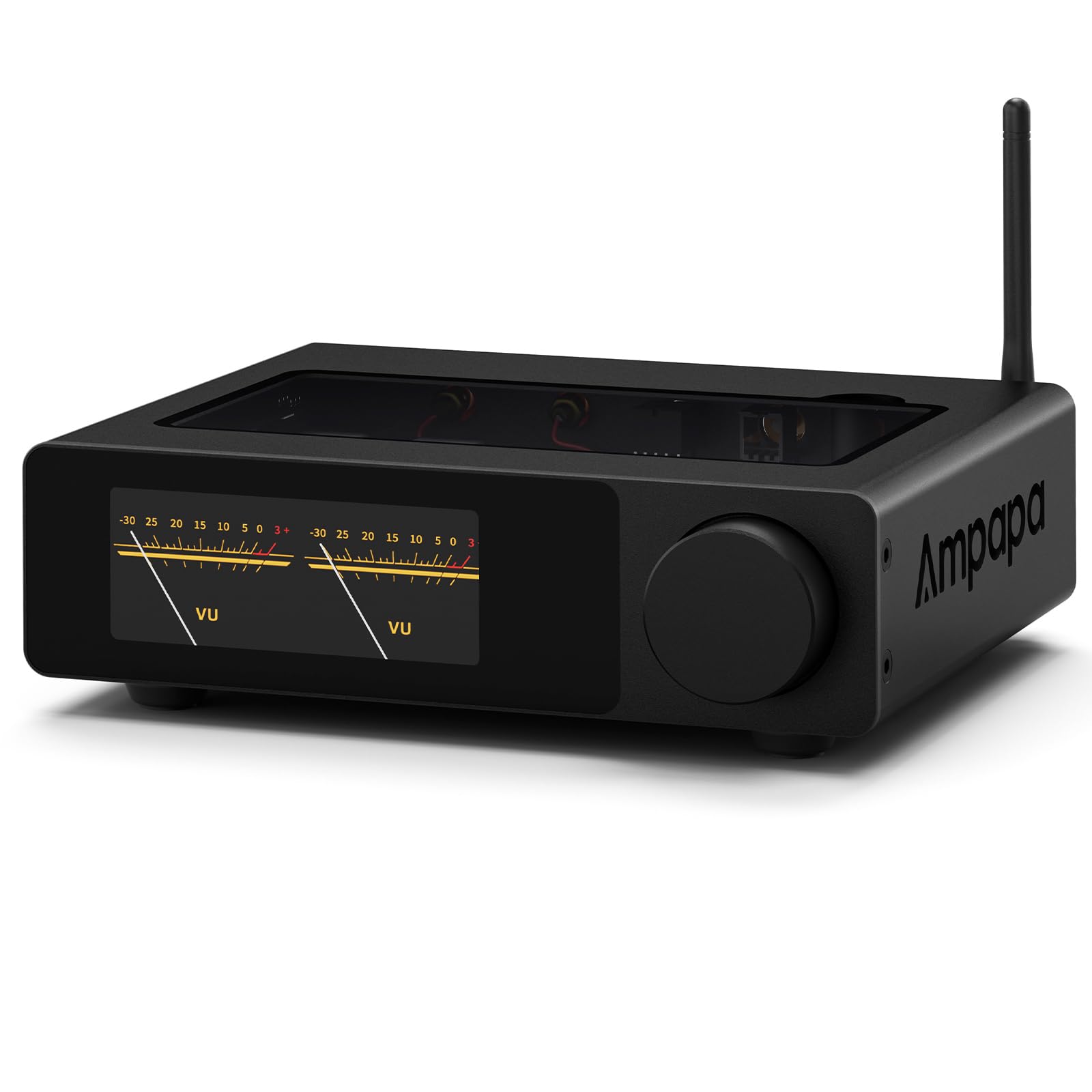
The Ampapa D1 is a collaboration with Douk Audio that refines the well-regarded A5 platform into a feature-packed integrated amp. It uses the TPA3255 chipset with PFFB technology for load-independent performance, and includes a glass top for easy op-amp swapping. The digital OLED VU meter offers seven display styles and adds serious visual appeal to any desktop.
Connectivity is excellent for the price bracket: TRS balanced inputs, RCA, Bluetooth 5.2, a subwoofer pre-out, and an adjustable 30–200Hz high-pass filter. The high-pass filter is a standout feature for 2.1 systems, taking low frequencies off the main channels so your bookshelf speakers can play cleaner and louder. The included GaN 48V/5A power supply provides ample headroom.
The five-minute auto-standby timer cannot be disabled, which is a minor nuisance for some users. Near-field listening reveals real-world wattage slightly below advertised peaks, but power is still generous for desktop setups with 8-ohm speakers. The build quality, sound clarity, and versatility make this the best-balanced affordable amplifier on the list.
Why it’s great
- Digital VU meter with multiple styles and colors
- Adjustable high-pass filter for clean 2.1 operation
- Socketed op-amps for easy sound signature upgrades
Good to know
- Auto-standby after 5 minutes cannot be defeated
- Real-world 8-ohm wattage is lower than peak spec
2. WiiM Amp

The WiiM Amp is a streaming integrated amplifier that transforms passive speakers into a smart multiroom system. It outputs 60 watts per channel at 8 ohms and 120 watts at 4 ohms, which is sufficient for most bookshelf and floor-standing speakers in medium-sized rooms. The HDMI ARC port allows seamless TV connection, letting you control volume with the TV remote.
The WiiM Home App is the central hub for music streaming from Spotify, TIDAL, Amazon Music, and Qobuz, with support for Google Cast, Alexa, and AirPlay 2. Advanced room correction and parametric EQ let you fine-tune the sound to your space. The compact chassis fits neatly into any entertainment center without ventilation concerns.
This amp lacks a dedicated headphone jack and phono input, so turntable users will need an external preamp. Some users report that subwoofer auto-power triggers can be inconsistent. For anyone seeking a minimalist all-in-one streaming solution with app-based control, the WiiM Amp is the clear pick.
Why it’s great
- Full smart streaming with app-based EQ and room correction
- HDMI ARC for simple TV integration
- Multiroom sync with other WiiM devices and AirPlay 2 speakers
Good to know
- No headphone output or phono preamp
- Subwoofer auto-power may not always trigger
3. Dayton Audio HTA100

The Dayton Audio HTA100 delivers 50 watts RMS per channel via a hybrid design that uses vacuum tubes in the preamp stage and a class A/B amplifier topology. The result is a warm, musical character that many describe as “rounder” than typical solid-state units, with smooth mids and relaxed treble that reduces listening fatigue during long sessions.
Input selection is generous for a hybrid tube amp: RCA, Bluetooth 5.0, USB DAC, and a built-in phono preamp for turntables. The front panel features classic VU meters, bass and treble tone knobs, and a headphone jack for private listening. The exposed tubes and amber glow add a refined aesthetic that stands out on any shelf.
The included remote control is sluggish and requires direct line-of-sight. Users report that factory tubes can fail early, and upgrading to aftermarket tubes further improves clarity. For listeners who prioritize tonal warmth and a vintage look over maximum raw power, the HTA100 is a compelling choice.
Why it’s great
- Warm, non-fatiguing tube preamp sound signature
- Built-in phono preamp for direct turntable connection
- Classic VU meters and exposed tube design
Good to know
- Remote control is slow and requires direct line-of-sight
- Factory tubes may need early replacement for best performance
4. WiiM Amp Pro
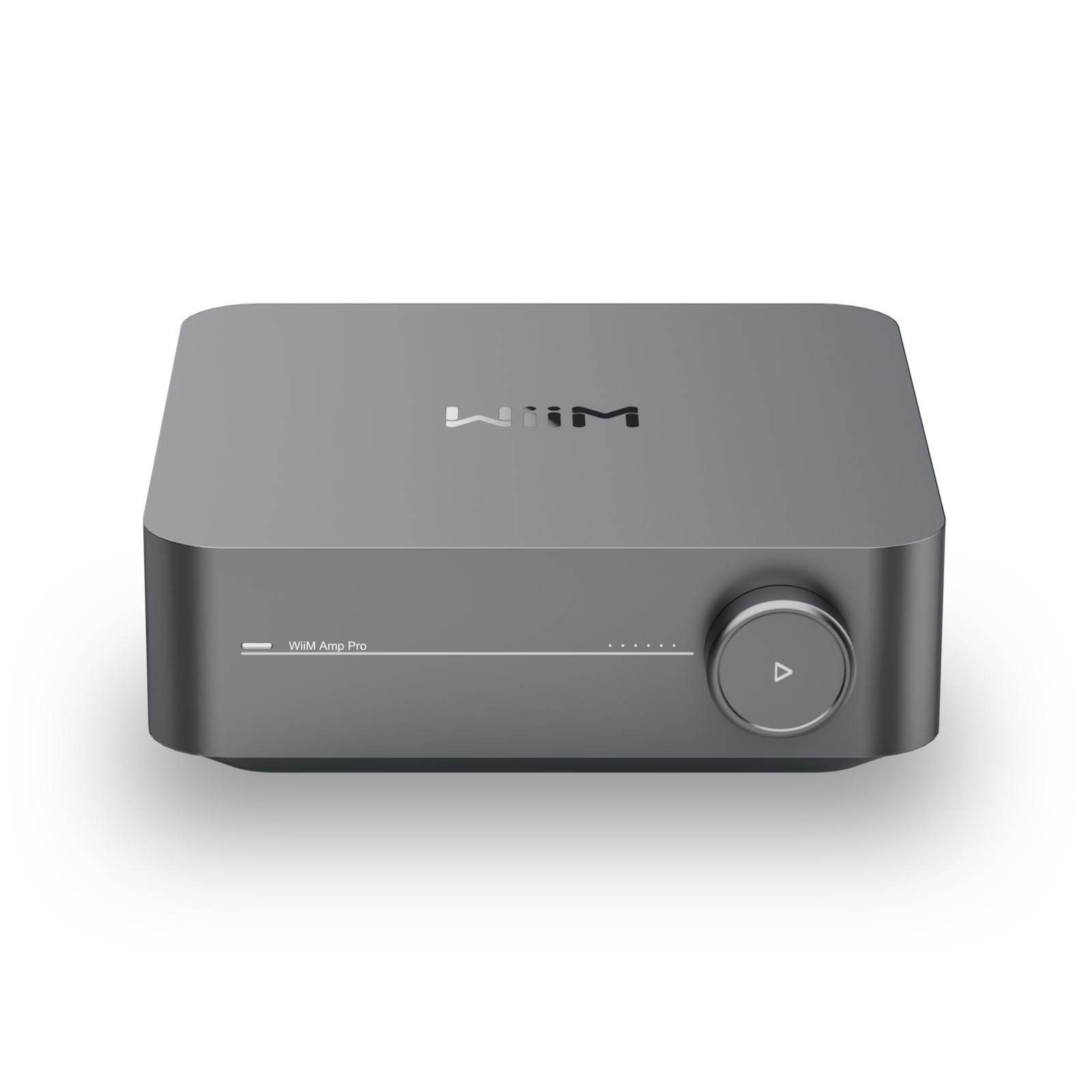
The WiiM Amp Pro builds on the standard Amp with several key upgrades: PFFB (Post-Filter Feedback) technology for better load immunity, a premium DAC, Wi-Fi 6 for stable high-bandwidth streaming, and Bluetooth 5.3 with dual antennas. Power output remains the same at 60W per channel into 8 ohms and 120W into 4 ohms, but the noise floor is lower and channel separation is tighter.
All the smart features from the standard WiiM Amp carry over — HDMI ARC, subwoofer pre-out, advanced room correction, parametric EQ, and the full WiiM Home app. Gamers and movie watchers benefit from lip-sync adjustment and the ability to play hi-res audio up to 24-bit/192 kHz from TIDAL, Qobuz, or local files.
AirPlay 2 support has been removed, so iPhone users cannot stream directly through Apple’s protocol — they must use Google Cast or the WiiM app instead. There is still no headphone jack or phono input. For those who want the cleanest possible signal path from a streaming amp, the Pro delivers measurable improvements over its already-excellent sibling.
Why it’s great
- PFFB technology for improved load immunity and lower distortion
- Wi-Fi 6 and Bluetooth 5.3 for rock-solid wireless streaming
- Premium DAC with 24-bit/192 kHz support
Good to know
- No AirPlay 2 support
- Still lacks headphone jack and phono input
5. Fosi Audio MC331

The Fosi Audio MC331 is an all-in-one tube DAC amplifier that integrates a preamp, power amp, DAC, and headphone amplifier into a compact chassis. It outputs 105 watts per channel at 4 ohms, enough to drive most bookshelf speakers to satisfying volume levels in a desktop or near-field setup. The 5725W vacuum tubes and VU meter add a retro visual flair.
Inputs include Bluetooth, USB, coaxial, optical, and RCA, making it compatible with computers, CD players, game consoles, and TVs. The replaceable tube design lets you swap tubes to tailor the sound signature, and the remote control includes bass and treble adjustment. The built-in TI DAC noticeably improves audio quality from a PC’s internal sound card.
Several users report that factory tubes failed within days and needed replacement. The remote has a two-second latency, and the power supply is locked to the included 24V unit — higher-end PSUs will not work. For desktop listeners who enjoy tube rolling and want a warm DAC-amp combo, the MC331 delivers strong value once the tube issue is addressed.
Why it’s great
- Integrated tube DAC with VU meter and replaceable tubes
- Wide input selection including USB and optical
- Compact footprint with built-in headphone amplifier
Good to know
- Factory vacuum tubes may fail early
- Remote control has noticeable input lag
6. AIYIMA A07 MAX

The AIYIMA A07 MAX is a straightforward Class D power amp built around the TI TPA3255 chipset, with a switchable design that lets you run it in stereo mode (300W x2 at 4 ohms) or mono mode (600W x1) via a bottom switch. The stereo mode delivers punchy, musical sound, while mono mode improves channel separation for more refined midrange reproduction when paired with a second unit.
Component quality is a step above typical budget amps: Japanese ELNA and Nichicon capacitors, German WIMA film capacitors, and IT power management chips. The large heatsink and side-bottom venting keep the chassis around 100°F under load, but the unit never goes into thermal protection during normal use. The volume knob doubles as a power switch with a logarithmic taper.
There is no Bluetooth, no tone controls, and the volume curve has poor low-level control — audible output begins around the 9 o’clock position. The included DC 36V 6A power supply is sufficient, but upgrading to a 48V 10A unit unlocks higher power in mono mode. For users who want a no-frills, high-powered stereo amplifier with an upgrade path, the A07 MAX is a strong contender.
Why it’s great
- Switchable stereo/mono mode for flexible system building
- High-quality Nichicon and WIMA capacitors
- Upgradeable power supply for more headroom
Good to know
- No Bluetooth, tone controls, or phono input
- Volume knob has poor low-level control
7. Donner MAMP6

The Donner MAMP6 is a 6-channel AV receiver designed for multi-speaker installations with karaoke capabilities. It delivers 25W RMS per channel (1000W peak across all channels combined) and can drive up to 12 speakers with 4–16 ohm impedance. Each channel has an independent volume knob, giving you granular control over zone levels.
Input options are extensive: Bluetooth 5.3, USB (up to 64GB), dual RCA pairs, two 1/4-inch microphone jacks with echo and Talkover functions, AUX, FM radio, optical, and coaxial. The EQ controls include separate treble, midrange, and bass knobs, and the unit remembers your settings after power-off. The upgraded FM function lets you enter a frequency numerically for quick tuning.
The 6-channel sticker price is low, but the RMS rating is modest — 25W per channel is enough for background music in a large room but not for filling it with high volume. Some users report incompatibility with certain smart TV optical outputs. For a budget-friendly whole-home audio or karaoke station, the MAMP6 offers unmatched channel count and input flexibility.
Why it’s great
- Six independent channels for multi-zone setups
- Dual mic inputs with echo and Talkover for karaoke
- Broad input selection including optical and coaxial
Good to know
- Only 25W RMS per channel — modest power output
- Optical input may have compatibility issues with some TVs
8. Donner 4-Channel Amplifier

The Donner 4-Channel stereo receiver is an entry-level karaoke amplifier rated for 1000W peak power (25W x4 RMS). It supports up to 8 speakers across four independently controlled channels, each with its own volume knob. The front panel includes dual 1/4-inch microphone jacks with echo and Talkover functions for clear vocals during events.
Connectivity covers most bases: Bluetooth 5.0, USB playback up to 64GB, two pairs of RCA inputs, AUX, FM radio, and now optical and coaxial digital inputs for TV connection. The remote control offers separate treble, midrange, and bass adjustment across all input modes. The unit remembers EQ and volume settings after shutdown.
The 25W RMS power is insufficient for driving demanding floor-standing or low-sensitivity speakers to satisfying levels. Several users report disappointing bass performance even with EQ maxed out, and some describe the sound as thin compared to similarly priced alternatives. The 6-channel MAMP6 is a better buy for a modest upcharge. This unit works best for casual background music with efficient speakers.
Why it’s great
- Four independent channels with dedicated volume control
- Dual mic inputs with echo and Talkover for karaoke
- Includes optical and coaxial inputs for TV connection
Good to know
- Only 25W RMS per channel — struggles with demanding speakers
- Bass output is weak even with full EQ boost
FAQ
How many watts do I actually need for my speakers?
Can I use a budget amplifier with 4-ohm speakers?
What is the difference between a power amp and an integrated amp?
Do I need a DAC with a modern affordable amplifier?
Final Thoughts: The Verdict
For most users, the affordable amplifier winner is the Ampapa D1 because it combines a flexible high-pass filter, numerous input options, and a digital VU meter at a mid-range price that outperforms many competitors in raw usability. If you want a streaming-first, app-controlled system, grab the WiiM Amp. And for a warm, vintage-inspired sound with a built-in phono stage, nothing beats the Dayton Audio HTA100.