
Our readers keep the lights on and the weekend projects moving. As an Amazon Associate, I earn from qualifying purchases.
Finding a camera that delivers professional-grade image quality without draining your savings feels like chasing a mirage. The market is flooded with options that promise the world but deliver lackluster sensors, sluggish autofocus, and plastic build quality that fails within a year. Your goal is to capture sharp, vibrant images—portraits, landscapes, street scenes—not to fund a second mortgage on glass and bodies.
I’m Rikta — the co-founder and writer behind FitlyFast. I’ve spent years analyzing sensor performance, autofocus point layouts, image stabilization effectiveness, and real-world output from budget to premium mirrorless and DSLR bodies to separate genuine value from marketing hype.
This guide dissects the top contenders on the market today, weighing sensor size, autofocus speed, lens ecosystem, and build durability to help you invest wisely in the affordable camera for photography you’ll actually enjoy using for years.
How To Choose The Best Affordable Camera For Photography
The most common mistake beginners make is fixating on megapixel count while ignoring sensor size, autofocus capability, and the cost of building a lens kit. A 24-megapixel APS-C sensor from a few years ago will produce cleaner, more detailed images than a 30-megapixel smartphone sensor could ever dream of, and the lens you pair with the body matters just as much.
Sensor Size: The Foundation of Image Quality
For an affordable photography setup, APS-C sensors offer the best balance of image quality, low-light performance, and system cost. Full-frame sensors deliver shallower depth of field and better high-ISO noise control, but bodies and lenses cost significantly more. A Micro Four Thirds sensor is smaller but allows for more compact bodies and lenses, though it struggles more in low light and with subject isolation.
Autofocus System: The Difference Between Keepers and Misses
Phase-detection autofocus points are the standard for tracking moving subjects—people, pets, vehicles. Look for at least 100 phase-detection points covering a wide area of the frame for reliable tracking. Contrast-detection systems are slower and hunt more in low light. Many modern mirrorless cameras also offer eye and face detection, which dramatically simplifies portrait and candid shooting.
Lens Ecosystem: Your Real Long-Term Investment
A camera body is a temporary home for your sensor, but lenses are a lifelong relationship. Canon’s EF/EF-S mount and Nikon’s F-mount have massive, affordable used lens markets. Sony’s E-mount and Canon’s RF mount have growing but pricier native options. Panasonic’s Micro Four Thirds mount has an excellent selection of affordable, high-quality lenses. Consider what focal lengths you’ll shoot most and whether third-party lenses are available before committing to a mount.
Quick Comparison
On smaller screens, swipe sideways to see the full table.
| Model | Category | Best For | Key Spec | Amazon |
|---|---|---|---|---|
| Canon EOS R6 Mark II | Premium Mirrorless | Any scenario | 24.2MP Full-Frame, 40fps, IBIS | Amazon |
| Panasonic LUMIX S5II | Premium Mirrorless | Video + photo hybrid | 24.2MP Full-Frame, Phase AF, Active IS | Amazon |
| Canon EOS RP | Econo Full-Frame | Entry-level full-frame | 26.2MP Full-Frame, 4K cropped | Amazon |
| Sony Alpha a6100 | Mirrorless | Real-time eye/face tracking | 24.2MP APS-C, 425 AF points, 11fps | Amazon |
| Sony Alpha ZV-E10 | Vlogging Camera | Vloggers shifting to stills | 24.2MP APS-C, 4K from 6K, 425 AF | Amazon |
| Canon EOS R100 | Entry-Level Mirrorless | Absolute beginners | 24.1MP APS-C, 4K 24p, 143 AF zones | Amazon |
| Panasonic LUMIX G85 | Mirrorless | Video-centric on a budget | 16MP MFT, 5-axis IBIS, 4K 30p | Amazon |
| Canon EOS Rebel T7 (Kit) | Budget DSLR | First-time DSLR buyers | 24.1MP APS-C, 9 AF points, Wi-Fi | Amazon |
| Canon EOS Rebel T7 (Bundle) | Budget DSLR | Value bundle seekers | 24.1MP APS-C, 9 AF points, Wi-Fi | Amazon |
| Sony Alpha a3000 | Budget Mirrorless | Travel on a shoestring | 20.1MP APS-C, 25 AF points, 3.5fps | Amazon |
| Nikon D3300 (Renewed) | Refurbished DSLR | Absolute entry level | 24.2MP APS-C, 50 AF points, 5fps | Amazon |
In‑Depth Reviews
1. Canon EOS R6 Mark II (Body Only)

The Canon EOS R6 Mark II sits at the pinnacle of this list for a reason: it combines a full-frame 24.2-megapixel CMOS sensor with a blistering 40fps electronic shutter and dual-pixel CMOS AF II that locks onto eyes, faces, animals, and vehicles without missing a beat. The DIGIC X processor ensures 14-bit color depth and minimal noise up to ISO 102400, making it a low-light monster that handles action, portraits, and events with equal composure.
In-body image stabilization delivers up to 8 stops of correction, allowing you to hand-hold at shutter speeds that would have required a tripod a decade ago. The vari-angle touchscreen and high-refresh-rate OLED viewfinder make composition effortless from any angle, and the weather-sealed magnesium-alloy body is built to endure years of regular use.
The biggest trade-off here is price—this is the most expensive option on the list by a wide margin. If you can stretch your budget, the AF speed, low-light performance, and IBIS make it the most versatile and future-proof camera in the group. It is a serious investment in your photography growth.
Why it’s great
- 40fps electronic shutter freezes any action
- Up to 8 stops of IBIS for handheld low-light shooting
- Excellent dual-pixel AF with vehicle and animal tracking
Good to know
- Premium price point puts it out of the true budget range
- Kit lens not included, adding lens cost
2. Panasonic LUMIX S5II
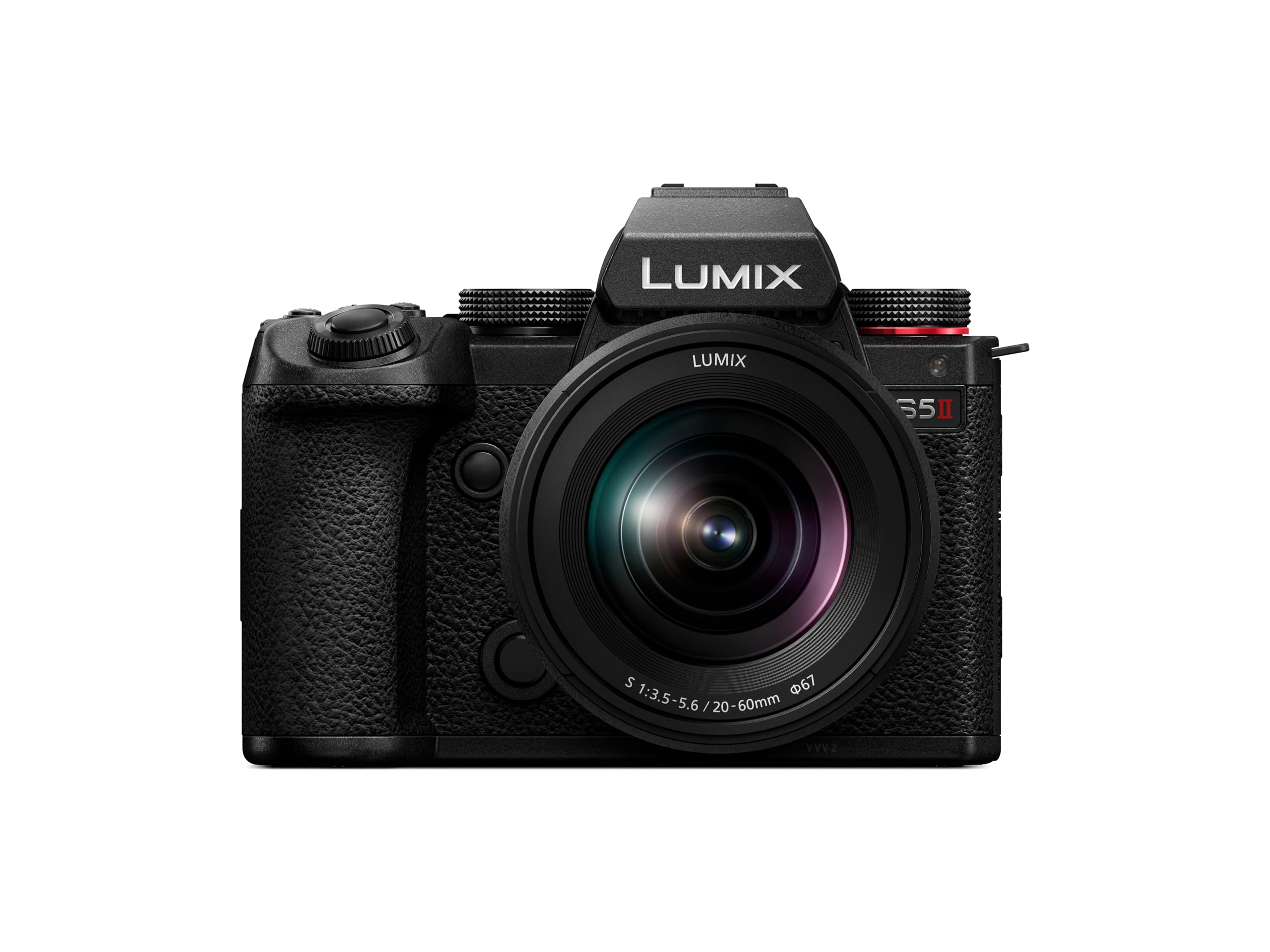
The Panasonic LUMIX S5II finally addresses the biggest criticism of Panasonic’s full-frame lineup: autofocus. Its new phase-hybrid AF system delivers fast, reliable tracking for both stills and video, a massive leap from the contrast-only systems of previous generations. The 24.2-megapixel full-frame sensor produces natural colors and excellent dynamic range, and the 14+ stop V-Log capture is a dream for video shooters who also want serious stills capability.
The Active I.S. technology is genuinely impressive—walking shots look gimbal-like out of the camera, making it a compelling option for run-and-gun shooters. The included 20-60mm kit lens is a versatile starting point, and the unlimited 10-bit 4:2:2 recording means you never have to stop and restart a clip. The L-mount ecosystem, shared with Leica and Sigma, offers a wide selection of native lenses.
Battery life is mediocre—you will likely want a grip or spare batteries for a full day of shooting. High ISO performance begins to show noise above 12800, though it remains usable for most web and print applications. For hybrid shooters who want reliable autofocus and excellent stabilization, this is a standout in the mid-premium segment.
Why it’s great
- Reliable phase-hybrid AF finally fixes Panasonic’s biggest weakness
- Active I.S. delivers near-gimbal handheld footage
- L-mount ecosystem with Sigma and Leica glass
Good to know
- Battery life requires spare packs or a grip
- High ISO gets noisy above 12800
3. Canon EOS RP

The Canon EOS RP is the most affordable entry point into the full-frame mirrorless world, and it does not compromise on the core benefits: shallow depth of field, superior low-light performance, and the full-frame look that APS-C sensors can only approximate. The 26.2-megapixel sensor, paired with the DIGIC 8 processor, delivers sharp, detailed images with accurate colors straight out of camera.
The RF 24-105mm F4-7.1 IS STM kit lens is a versatile travel companion with up to 5 stops of optical stabilization, though its variable aperture limits low-light performance at the telephoto end. The body is compact and lightweight, making it an excellent choice for travel and casual shooting. The menu system is beginner-friendly and the electronic viewfinder is a clear upgrade from any optical finder in the same price bracket.
4K video is heavily cropped and limited to 24p, which disqualifies it for serious video work. The burst rate is modest at 5fps, and the single SD card slot is a limitation for event shooters. If stills photography is your primary focus and you want full-frame quality without paying full-frame prices, this is your best bet.
Why it’s great
- Most affordable full-frame mirrorless body available
- Compact and lightweight form factor
- Excellent color science and JPEGs out of camera
Good to know
- 4K video has a heavy crop and is limited to 24p
- Only one SD card slot and modest burst rate
4. Sony Alpha a6100 (Bundle)
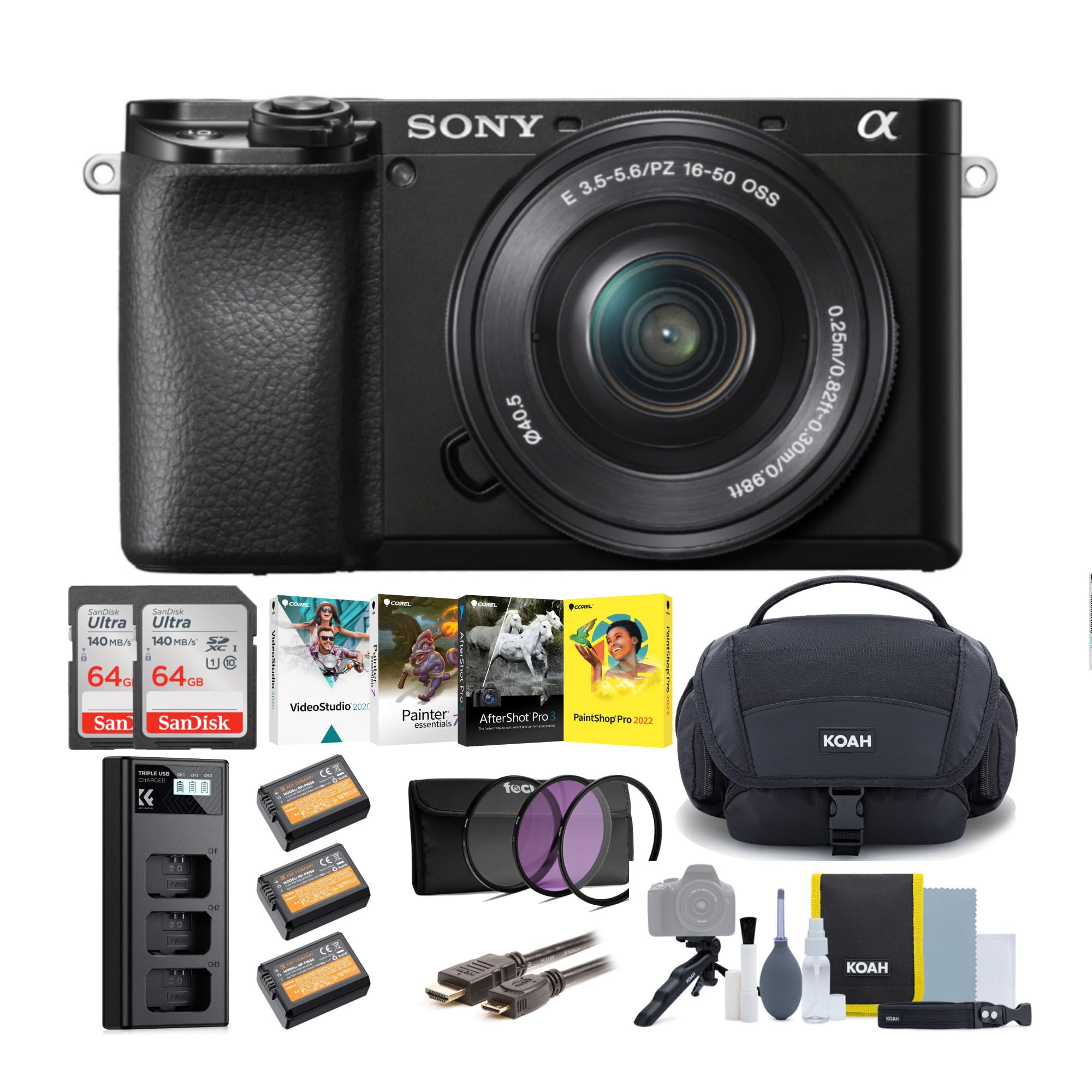
The Sony Alpha a6100 packs Sony’s industry-leading real-time tracking autofocus into an affordable APS-C body. With 425 phase-detection points covering almost the entire frame, it locks onto eyes and faces with startling speed and accuracy—ideal for photographing kids, pets, or any unpredictable subject. The 24.2-megapixel Exmor CMOS sensor delivers crisp, detailed images with pleasing color rendition.
The bundled kit includes two 64GB SD cards, spare batteries, a charger, and a gadget bag—everything a beginner needs to start shooting immediately. The 16-50mm power zoom lens collapses to a very compact size for travel, though its image quality is merely decent. The 11fps continuous shooting with AF/AE tracking makes it capable for action and sports.
The biggest shortcoming is the lack of in-body image stabilization—you must rely on lens-based stabilization. The menu system is Sony’s notoriously complex older interface, and the 16-50mm kit lens is optically average. Still, for autofocus performance at this price point, nothing else in the list comes close.
Why it’s great
- Real-time Eye AF is the best in class for tracking subjects
- Excellent bundle with batteries, cards, and bag
- Compact body with good ergonomics
Good to know
- No in-body stabilization; relies on OSS lenses
- Sony menu interface is less intuitive than competitors
5. Sony Alpha ZV-E10
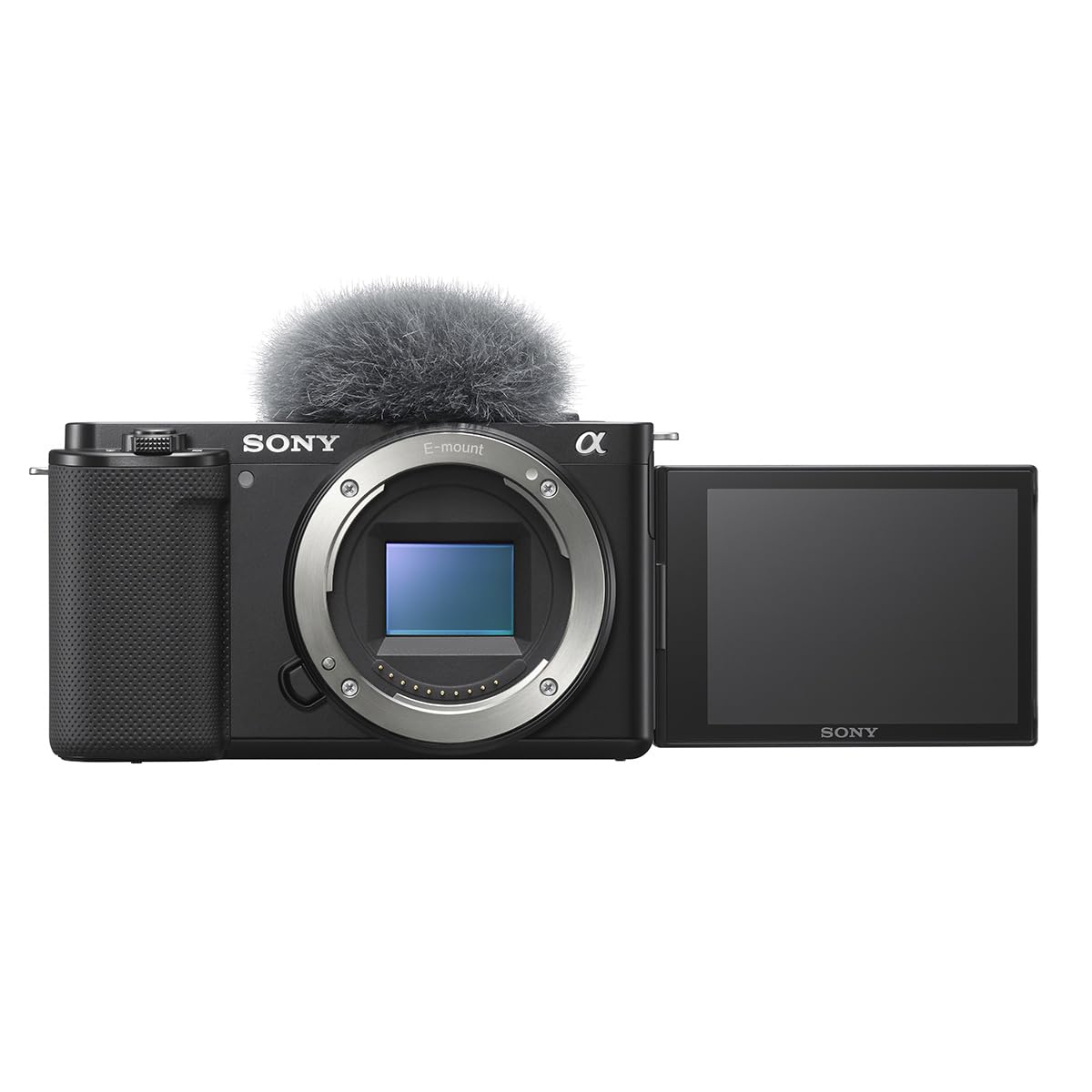
The Sony ZV-E10 was designed primarily as a vlogging camera, but its 24.2-megapixel APS-C sensor and oversampled 4K video from a 6K readout make it a surprisingly capable stills camera. The real-time eye AF and face detection are borrowed directly from Sony’s higher-end bodies, ensuring sharp focus on subjects in nearly any condition. The product showcase mode is a unique feature for content creators who shoot reviews.
The body is lightweight and features a fully articulating touchscreen, a directional microphone, and a headphone jack—rare at this price. The background defocus button provides instant adjustment of depth of field, and the S-Log/HLG profiles allow for advanced color grading. The E-mount ecosystem gives access to a wide range of native and third-party lenses.
The lack of in-body stabilization is a significant limitation for handheld photography, forcing you to rely on lens-based stabilization or a gimbal. The battery life is below average, especially when shooting 4K. It is best suited for hybrid creators who prioritize video but still want solid photo quality.
Why it’s great
- Excellent 4K quality oversampled from 6K
- Best-in-class eye/face tracking for video and stills
- Compact with useful features for content creators
Good to know
- No IBIS makes handheld photography harder
- Below-average battery life
6. Canon EOS R100

The Canon EOS R100 is the smallest and lightest body in the EOS R series, designed explicitly for beginners who want to step up from a smartphone. The 24.1-megapixel APS-C sensor paired with the DIGIC 8 processor delivers clear, detailed images with natural bokeh, and the Dual Pixel CMOS AF covers 143 zones with human face and eye detection that works reliably for static portraits.
The RF-S 18-45mm kit lens is compact and offers optical image stabilization at up to 4 stops, making it usable in moderate low light. The GUI includes a creative assist mode and custom quick menus that help beginners understand exposure without feeling overwhelmed. The camera can shoot 4K video at 24p, though it is not oversampled and has a crop.
The electronic viewfinder is basic and the autofocus, while decent for static subjects, struggles with fast-moving children or pets. The lens selection for RF-S is limited compared to Canon’s EF-M system. It is a perfect starting point for a brand-new photographer who wants a simple, small camera to learn on.
Why it’s great
- Compact, lightweight body ideal for travel and beginners
- Dual Pixel CMOS AF with face/eye detection
- Beginner-friendly GUI with creative assist mode
Good to know
- Limited native RF-S lens selection
- AF struggles with fast-moving subjects
7. Panasonic LUMIX G85

The Panasonic LUMIX G85 is a Micro Four Thirds mirrorless camera that punches far above its price in video capability. It houses a 16-megapixel sensor with no low-pass filter, boosting fine-detail resolving power by nearly 10 percent over standard 16MP sensors. The 5-axis in-body stabilization works with the lens IS for dual stabilization, producing shockingly smooth handheld footage even when walking.
The 12-60mm Power O.I.S. kit lens offers a versatile zoom range with good clarity throughout. The magnesium-alloy body with weather sealing is rare at this price point, and the OLED live viewfinder is bright and detailed. It shoots 4K QFHD video at up to 30fps and offers exclusive LUMIX 4K Photo mode, which captures bursts at 30fps for perfect timing.
The 16-megapixel sensor has lower resolution than its APS-C competitors, resulting in slightly less cropping headroom and detail for stills. Autofocus in low light can be sluggish, especially for 4K video. Battery life is poor—expect to carry spares. For photographers who shoot primarily stills and need high-resolution cropping, an APS-C sensor may be better.
Why it’s great
- Outstanding dual IBIS/OIS for steady handheld video
- Weather-sealed magnesium alloy body
- Excellent value for video-first creators
Good to know
- 16MP sensor limits cropping and still detail
- Poor battery life and sluggish low-light AF
8. Canon EOS Rebel T7 (Kit)

The Canon EOS Rebel T7 remains one of the best-selling entry-level DSLRs for good reason—it combines a time-tested 24.1-megapixel APS-C sensor with a reliable optical viewfinder and the vast, affordable Canon EF/EF-S lens ecosystem. The built-in Wi-Fi and NFC allow easy photo transfer to your phone, which is particularly useful for beginners who want to share their work immediately.
The included 18-55mm IS II kit lens provides optical image stabilization and a standard zoom range that covers landscapes, portraits, and everyday subjects. The camera is comfortable to hold, has excellent battery life compared to mirrorless options, and the Guide mode helps beginners learn exposure without reading the manual. The DIGIC 4+ processor delivers clean JPEGs with Canon’s excellent color science.
The autofocus system is the weakest link—only 9 points, all cross-type, which feels dated in 2024. Low-light AF is slow and hunts frequently. The optical viewfinder covers only 95% of the frame and the rear LCD is a low-resolution 920k dot panel. For anyone who needs responsive tracking or shoots in dim conditions, a mirrorless option will serve you better.
Why it’s great
- Excellent battery life (one of the best on this list)
- Access to Canon’s huge, cheap used EF/EF-S lens market
- Solid image quality and color science for the price
Good to know
- Only 9 autofocus points—feels dated
- Poor low-light AF performance
9. Canon EOS Rebel T7 (Kit with Bag + 64GB Card)
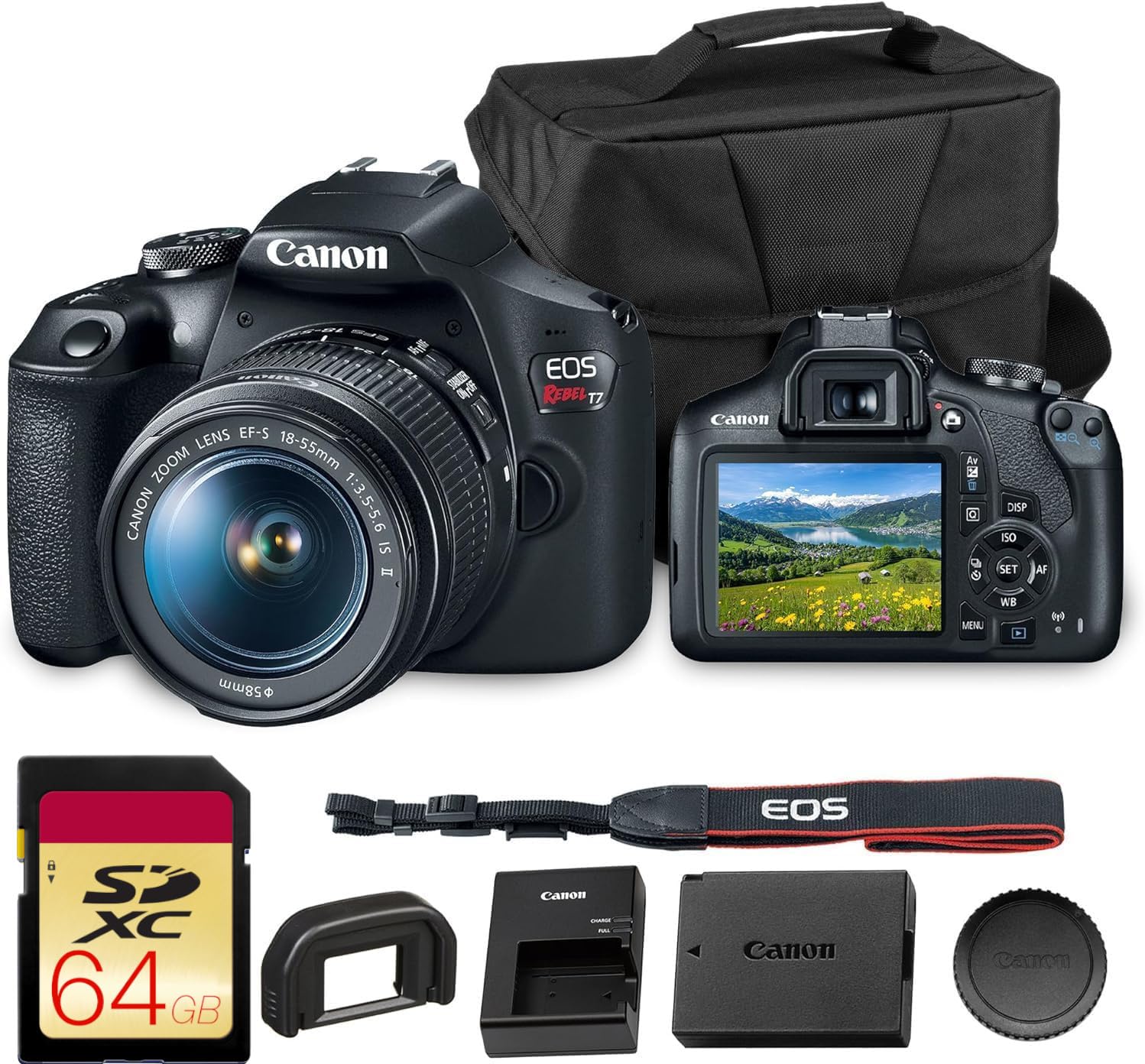
This bundle packages the same Canon Rebel T7 body we love with practical accessories: a shoulder bag, a 64GB SD card, and a cleaning kit. The camera itself retains all the strengths of the standard T7 kit—reliable image quality, great battery life, and access to Canon’s massive lens ecosystem—but the extras make it truly ready to use out of the box.
The bag is padded and spacious enough for the body, a couple of extra lenses, and accessories. The 64GB card allows for extensive shooting without worrying about storage. The video stabilization is a nice bonus for handheld clips, and the Wi-Fi connectivity via the Canon Camera Connect app works well for sharing and remote shooting.
The same limitations apply as the standard T7: a 9-point AF system that hunts in low light, a viewfinder with only 95% coverage, and a low-resolution rear LCD. The accessories in the bundle are entry-level quality—the bag is decent but not rugged, and the cleaning kit is basic. If you know you want a DSLR and want everything in one box, this is a hassle-free choice.
Why it’s great
- Ready to shoot out of the box with bag and card
- Classic image quality and color rendering
- Wi-Fi sharing works well with Canon’s app
Good to know
- Same 9-point AF system as base Rebel T7
- Included accessories are budget quality
10. Sony Alpha a3000

The Sony Alpha a3000 is an older mirrorless camera that remains on shelves thanks to its ridiculously low price. It packs a 20.1-megapixel APS-C Exmor sensor into a body that feels surprisingly DSLR-like, with a deep grip and an eye-level electronic viewfinder—rare at this price point. The 18-55mm OSS kit lens provides optical stabilization and decent image quality for the money.
It shoots Full HD video, which is fine for casual clips, and the battery life is good enough for a day of shooting. The Sony E-mount system means you can use any modern Sony E-mount lens, though the camera’s age means autofocus is contrast-detect only—slow and prone to hunting in low light. The EVF and rear LCD resolutions are both quite low, making it hard to judge sharpness.
The build is entirely plastic but light enough for extended travel. The UI is clunky by modern standards, and the burst rate of 3.5fps is laughable for action. This camera is a reasonable choice only if your absolute budget cannot stretch to anything newer, and you are comfortable with its limitations. There are better options for a small additional investment.
Why it’s great
- Very affordable entry into E-mount system
- APS-C sensor outperforms smartphones
- Good battery life for travel
Good to know
- Contrast-only AF is slow and hunts in low light
- Very low-resolution EVF and LCD
11. Nikon D3300 (Renewed)

The Nikon D3300, even as a certified refurbished unit, remains a phenomenal entry-level camera. Its 24.2-megapixel APS-C sensor with no optical low-pass filter delivers sharp images with excellent dynamic range for its class. The 11-point autofocus system, while limited by today’s standards, is fast and accurate in good light, and the 5fps burst is adequate for modest action shooting.
The included 18-55mm Nikkor lens is optically good and compact. The Guide mode is one of the best beginner teaching tools on any camera—it explains settings in plain language and shows you how each adjustment affects the image. The battery life is outstanding, often lasting over 700 shots per charge. As a refurbished unit, it ships tested and with a warranty, making it a low-risk purchase.
The D3300 lacks built-in Wi-Fi, so you must use a separate adapter or card for wireless transfers. The optical viewfinder covers only 95% of the frame, and the 3-inch LCD has a disappointingly low resolution at 921k dots. It cannot shoot 4K video. For a pure stills camera at the lowest possible budget, this is hard to beat.
Why it’s great
- 50 AF points provide good coverage for the price
- Superb battery life for long days of shooting
- Refurbished with warranty—low-risk budget entry
Good to know
- No built-in Wi-Fi for photo sharing
- Low-resolution rear LCD
FAQ
Is it worth buying a refurbished camera for photography?
What does the number of autofocus points actually mean for a beginner?
Can a budget camera still achieve professional-looking portraits?
Final Thoughts: The Verdict
For most users, the affordable camera for photography winner is the Canon EOS R100 because it combines a modern mirrorless interface, reliable Dual Pixel autofocus, and a compact size at a price that genuinely respects a beginner’s budget. If you want the absolute best autofocus tracking and fastest burst rate, grab the Canon EOS R6 Mark II. And for hybrid stills and video on a tight budget, nothing beats the Panasonic LUMIX G85.