
Our readers keep the lights on and the weekend projects moving. As an Amazon Associate, I earn from qualifying purchases.
Choosing a camera for podcasting means balancing crisp 4K video, reliable autofocus that won’t hunt while you talk, and clean audio inputs—all without draining your production budget. The wrong pick leaves you with grainy footage, a recording that stops at 30 minutes, or a setup so bulky it kills your on-camera energy.
I’m Rikta — the co-founder and writer behind FitlyFast. I’ve spent countless hours cross-referencing sensor sizes, IBIS capabilities, recording limits, and microphone preamp quality to find the cameras that actually deliver for podcasters without breaking the bank.
Whether you shoot solo video podcasts, interview-style shows, or hybrid livestreams, finding the right affordable camera for podcasting is about matching sensor performance with practical features like USB-C streaming and unlimited recording.
How To Choose The Best Affordable Camera For Podcasting
Picking the right camera for your podcast setup isn’t about megapixel count alone. You need to weigh sensor size for low light, recording duration for long interviews, and connectivity for painless livestreaming. Here are the three critical factors to get right.
Sensor Size and Low-Light Performance
A 1-inch CMOS sensor (found in vlogging-oriented cameras like the DJI Osmo Pocket 3) is compact and capable in decent light, but an APS-C sensor (Sony ZV-E10, Nikon Z 30) captures more light and delivers shallower depth of field for that professional blurred-background look. If your podcast space isn’t perfectly lit, prioritize a larger sensor over sheer 4K resolution.
Recording Limits and Streaming Support
Many entry-level DSLRs and older mirrorless cameras impose a 29-minute 59-second recording limit. That’s a dealbreaker for hour-long podcast episodes. The Nikon Z 30 and Panasonic LUMIX G100 offer unlimited 4K recording, while the Canon EOS R100 cuts out at 24fps 4K. Also check USB-C compatibility for plug-and-play webcam streaming without a capture card.
Audio Inputs and Built-in Mic Quality
For a podcast, clean audio is as important as clean video. Cameras like the Zoom Q8n-4K and Sony ZV-1F include serious built-in microphone arrays or dual XLR inputs that save you from buying a separate audio recorder. If you plan to use an external lavalier or shotgun mic, ensure the camera has a 3.5mm mic jack or cold shoe adapter.
Quick Comparison
On smaller screens, swipe sideways to see the full table.
| Model | Category | Best For | Key Spec | Amazon |
|---|---|---|---|---|
| DJI Osmo Pocket 3 | Pocket Gimbal | Ultra-portable vlog-style podcasts | 1″ CMOS / 4K 120fps | Amazon |
| Sony ZV-E10 Bundle | Mirrorless APS-C | Versatile studio & on-the-go shoots | 24.2MP APS-C / UHD 4K30p | Amazon |
| Nikon Z 30 | Mirrorless APS-C | Unlimited 4K streaming & webcam use | 20.9MP DX / 4K 30p | Amazon |
| Sony ZV-1F | Compact Point & Shoot | Easy selfie-style podcasting | 1″ Sensor / 20mm F2.0 | Amazon |
| Panasonic G85 | Mirrorless MFT | Rugged hybrid with in-body stabilization | 16MP MFT / 5-Axis IBIS | Amazon |
| Xtra Muse vlog cam | Pocket Gimbal | Budget alternative to DJI Pocket 3 | 1″ CMOS / 3-Axis Gimbal | Amazon |
| Panasonic LUMIX G100 | Mirrorless MFT | Built-in 360° tracking audio | 20.3MP MFT / 4K 24p | Amazon |
| Zoom Q8n-4K | Audio-Focused Recorder | Multi-track audio with video | 2 XLR Inputs / 4‑track | Amazon |
| Canon EOS R100 | Mirrorless APS-C | Entry-level photography & occasional video | 24.1MP APS-C / 4K 24p | Amazon |
In‑Depth Reviews
1. DJI Osmo Pocket 3 Creator Combo
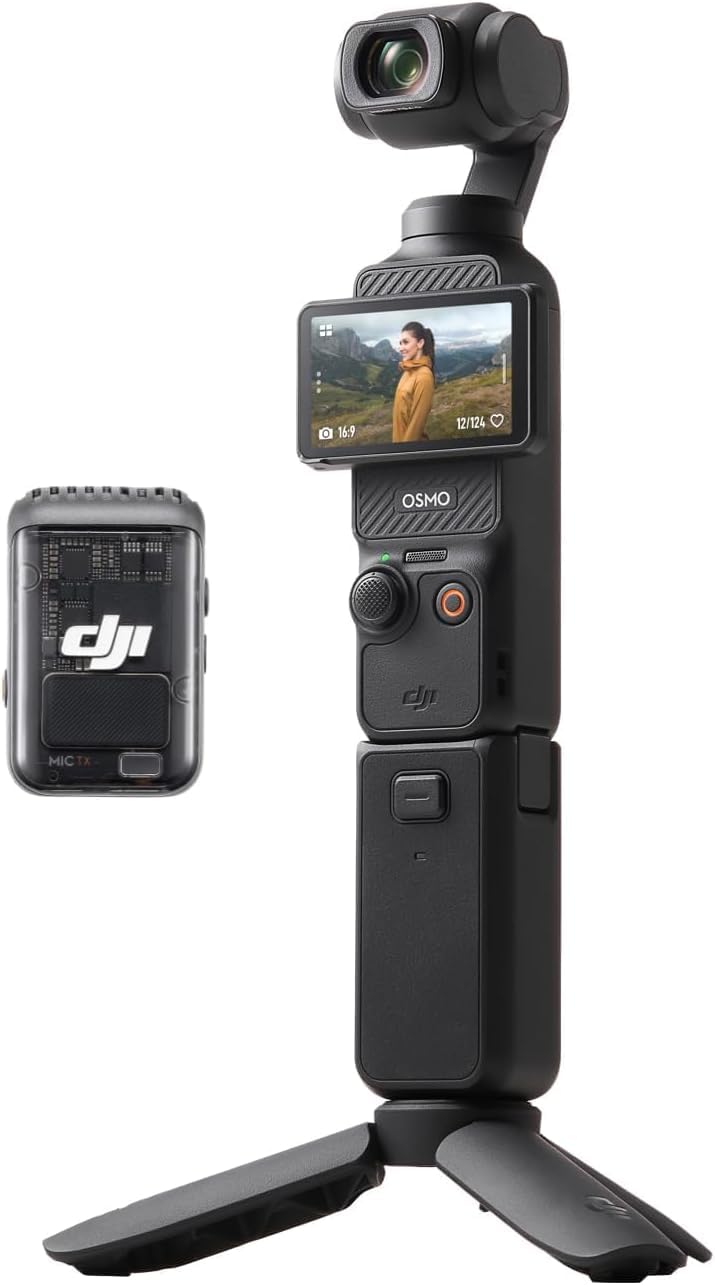
The DJI Osmo Pocket 3 delivers a 1-inch CMOS sensor and 4K resolution at 120fps wrapped in a 3-axis gimbal body that fits in a jacket pocket. For podcasters who shoot on location or in a small home studio, this eliminates the need for a tripod and external stabilizer, and the 2-inch rotatable touchscreen makes switching between horizontal and vertical framing instant.
The Creator Combo bundles a DJI Mic 2 transmitter, battery handle, wide-angle lens, and mini tripod—turning this into a complete solo-podcaster kit. You get ActiveTrack 6.0 face tracking, D-Log M 10-bit color for grading, and up to 166 minutes of battery life. The direct connection to DJI Mic transmitters over Bluetooth means you don’t need a separate receiver.
Some podcasters might prefer the larger sensor of an APS-C camera for extreme low light, but the Pocket 3’s combination of portability, stabilization, and included audio gear makes it the most practical affordable camera for a vlog-style or mobile podcast setup.
Why it’s great
- Built-in 3-axis stabilization eliminates jittery handheld shots
- Bundled DJI Mic 2 transmitter simplifies audio capture
- D-Log M 10-bit color depth for professional-grade post-processing
Good to know
- 1-inch sensor struggles in very dim spaces without supplemental lighting
- No interchangeable lens limits creative depth-of-field control
2. Sony ZV-E10 Mirrorless Camera Bundle

The Sony ZV-E10 is a purpose-built vlogging mirrorless camera with a 24.2MP APS-C sensor, 425-point phase-detect autofocus, and Real-Time Eye AF that locks onto a speaker’s face and stays there. It records UHD 4K at 30fps and Full HD at 120fps for slow-motion inserts. The side flip-out 3-inch touchscreen and directional 3-capsule mic with windscreen are made for talking-head captures.
This deluxe bundle includes the 16-50mm power zoom lens, a 64GB Extreme PRO SD card, a wide-angle adapter, a 2X telephoto lens, a tripod, filter kit, spare battery, and Movavi editing software. It’s the most complete out-of-box kit for a podcaster who wants to hit the ground running without buying accessories separately.
One real-world advantage over cheaper options: the ZV-E10 does not have a 30-minute recording limit, and it includes a clean HDMI output and headphone/mic jacks. The bundled tripod and extra battery mean you can run through back-to-back interviews without stopping to recharge.
Why it’s great
- APS-C sensor delivers superior low-light performance and background bokeh
- Bundle includes all essentials: extra battery, tripod, SD card, editing software
- No 30-minute recording limit—perfect for long podcast sessions
Good to know
- Kit lens (16-50mm) is serviceable but upgrading to a prime f/1.8 yields much sharper video
- Some bundled items may vary—confirm wide-angle adapter and software are included upon delivery
3. Nikon Z 30 with 16-50mm Lens

Nikon’s Z 30 is the company’s most compact mirrorless camera designed specifically for creators, vloggers, and streamers. It packs a 20.9MP DX-format APS-C sensor with eye-tracking autofocus for people and pets, and records 4K 30p video with no recording time limit. The flip-out selfie touchscreen and built-in stereo mic with adjustable sensitivity make it straightforward to set up a podcast rig quickly.
What sets the Z 30 apart for podcasters is its plug-and-play USB-C streaming: you can run 4K at 30fps over HDMI or Full HD 60fps over USB-C directly into OBS or Zoom without a capture card. The 16-50mm retractable lens is optically stabilized, and the constant power over USB-C means you never worry about battery dying mid-interview.
On the downside, there’s no built-in viewfinder, which is not an issue for a tripod-mounted podcast setup, and the kit lens aperture (f/3.5-6.3) requires decent lighting to avoid noise. But for pure usability as a webcam and unlimited recording, the Z 30 is tough to beat in this price range.
Why it’s great
- Unlimited 4K recording—essential for long podcast episodes
- USB-C streaming works natively with OBS and video conferencing apps
- Compact and lightweight design fits easily into a backpack studio
Good to know
- Kit lens aperture is dark—plan to add a fast prime lens for better low-light video
- No viewfinder; rely on the flip-out screen for composition
4. Sony ZV-1F Vlog Camera

The Sony ZV-1F features an ultra-wide 20mm equivalent lens paired with a 1-inch sensor and an F2.0 maximum aperture. This combination is excellent for arm’s-length selfie-style podcasting, because you don’t need to hold the camera far away to get everything in frame. The side-articulating touchscreen LCD and directional 3-capsule mic with included windscreen make solo recording effortless.
Eye-AF and autofocus tracking keep the speaker’s face locked and sharp, while the one-press Background Defocus button instantly switches between a blurred or sharp backdrop—helpful for podcasters who change shooting locations. The Product Showcase mode works well for unboxing or demonstration segments during a show.
The biggest trade-off: the ZV-1F has a fixed lens with no zoom ring (only digital zoom), and battery life is roughly 45 minutes of continuous recording. For a seated podcast with planned breaks to swap batteries or plug into USB power, this is manageable, but it’s not a set-it-and-forget-it solution for marathon sessions.
Why it’s great
- Ultra-wide 20mm lens is ideal for close-up selfie shots
- Background Defocus button gives instant cinematic depth of field
- Built-in directional mic produces clear audio without an external mic
Good to know
- No interchangeable lens—limited to the fixed 20mm wide angle
- Battery lasts only around 45 minutes under continuous recording
5. Panasonic LUMIX G85 with 12-60mm Lens

The Panasonic G85 is a weather-sealed Micro Four Thirds mirrorless camera with a 16-megapixel sensor, 5-axis in-body image stabilization (IBIS), and 4K QFHD video recording. The 12-60mm Power O.I.S. kit lens adds another layer of stabilization, making handheld podcast shots incredibly smooth without a gimbal. The OLED live viewfinder and tilt/touch LCD offer flexibility in framing.
For podcasters, the G85’s magnesium alloy body and weather sealing mean it can withstand regular travel and less forgiving environments. The dual stabilization works in both photo and video mode, and you get 4K Photo mode with 30fps burst capture for pulling stills from your video. It also includes a hot shoe and mic jack for connecting an external shotgun or lavalier mic.
The main drawback is the 16MP Micro Four Thirds sensor, which doesn’t gather as much light as an APS-C sensor in dimly lit rooms. The kit lens also runs sluggish in autofocus when the light drops. For a well-lit podcast studio, the G85 is a rugged workhorse with outstanding stabilization.
Why it’s great
- 5-axis IBIS delivers rock-steady handheld footage without a gimbal
- Weather-sealed magnesium alloy body built for frequent use and travel
- 12-60mm lens offers versatile framing from wide to medium-telephoto
Good to know
- Micro Four Thirds sensor has less dynamic range than APS-C alternatives
- Autofocus slows in low-light conditions—use manual focus or add lighting
6. Xtra Muse Vlogging Camera with 1” CMOS & 4K/120fps

The Xtra Muse is essentially a budget-friendly alternative to the DJI Pocket 3, pairing a 1-inch CMOS sensor with a built-in 3-axis gimbal stabilizer and 4K recording at 120fps. It includes 10-bit X-Log color grading for up to one billion colors, face and object tracking, and fast autofocus—all features that typically cost much more in a pocket camera format.
User feedback highlights that DJI Pocket 3 accessories (like the SmallRig wireless mic) work with this camera, and the recent firmware allows DJI Mics to connect easily. The battery lasts just over two hours, and the 2-inch touchscreen is intuitive for framing and playback. The standard bundle includes a carrying bag, wrist strap, and 1/4-inch threaded handle.
The video quality is sharp and well-stabilized for the price, though it doesn’t quite match the Pocket 3’s low-light performance or ecosystem polish. For podcasters who want the pocket-gimbal form factor at a lower entry point, the Xtra Muse delivers surprising value for solo vlog-style recording.
Why it’s great
- Built-in 3-axis gimbal eliminates separate stabilizer costs
- X-Log 10-bit color for professional-grade color grading
- Compatible with DJI mic accessories for easy audio upgrade
Good to know
- Low-light performance is decent but noticeably softer than high-end competitors
- Ecosystem and firmware maturity still behind established brands like DJI
7. Panasonic LUMIX G100 with 12-32mm Lens

The Panasonic G100 is built around a unique selling point for podcasters: a high-performance built-in microphone with 360-degree tracking audio that auto-adjusts based on whether you’re recording indoors, outdoors, in a crowd, or in one-on-one conversation. This OZO Audio system captures spatial sound that follows the subject, reducing the need for an external mic in many solo scenarios.
It records 4K video at 24fps, includes V-Log L recording for color grading, and uses the Micro Four Thirds system for lens interchangeability. The camera weighs only 412g with the 12-32mm lens, making it one of the lightest interchangeable-lens options for a podcaster who moves between locations. It also functions as a plug-and-play webcam over USB.
The camera auto-stops recording after 20 minutes, which is a hard limit for long-form podcast episodes—you’ll need to restart or use an external recorder. The kit lens (12-32mm) is also quite dim at f/3.5-5.6, so a brighter prime like the 25mm f/1.7 is a recommended add-on for better low-light performance.
Why it’s great
- Built-in 360-degree tracking mic adapts audio to your recording environment
- Ultra-lightweight design for portable podcast setups
- V-Log L recording allows professional color grading in post
Good to know
- Recording stops at 20 minutes—a dealbreaker for uninterrupted long interviews
- Kit lens is slow; budget for a fast prime lens to improve low-light video
8. Zoom Q8n-4K Video Recorder

The Zoom Q8n-4K prioritizes audio in a way no other camera on this list does: it records up to four simultaneous audio tracks, includes two XLR inputs with phantom power, and a built-in stereo microphone. For podcasters who need professional multi-mic setups (host mic + guest mic + room capture), this is the only all-in-one device that handles it without needing an external audio interface.
It captures 4K video at 30fps with a 150-degree wide-angle F2.8 lens and offers five scene presets for indoor, outdoor, nighttime, and concert lighting. The flip-out screen and USB streaming mode let you livestream while recording locally to an SD card up to 512GB. The swappable capsule system also allows adapting the built-in mic capsule to different recording scenarios.
The video quality, however, is the weakest link—it’s acceptable with good lighting but becomes grainy quickly in dim environments, and it lacks image stabilization and optical zoom. Users consistently rate the audio build quality as excellent while noting the video quality lags behind even smartphone cameras in some conditions.
Why it’s great
- Two XLR inputs with phantom power eliminate the need for a separate audio recorder
- Four-track simultaneous recording perfect for multi-mic podcast setups
- Built-in 150-degree wide-angle lens captures entire desk setup easily
Good to know
- Video quality degrades significantly in low light—requires good studio lighting
- No optical zoom or stabilization—you must frame with preset field-of-view widths
9. Canon EOS R100 with 18-45mm Lens

The Canon EOS R100 is the smallest and lightest camera in the EOS R series, pairing a 24.1-megapixel APS-C sensor with the DIGIC 8 processor and Dual Pixel CMOS AF. It records 4K video at 24fps and Full HD at 60fps. For a podcaster on a tight budget who wants the versatility of a mirrorless system with interchangeable lenses, this is the most affordable entry into the Canon RF ecosystem.
It includes human, face, and eye-detection autofocus for video, plus vehicle and animal detection for other uses. The 18-45mm kit lens is compact and optically stabilized, offering a decent range for desktop podcast setups. Wi-Fi and Bluetooth allow easy transfer to a smartphone for quick social media clips.
The main limitations for podcasters: 4K recording is limited to 24fps and subjects the sensor to a crop, and there’s a practical recording limit of 29 minutes 59 seconds per clip. The screen is fixed (not articulating), so it’s harder to monitor yourself while recording. Battery life is rated at roughly 300 shots or about 45–60 minutes of video.
Why it’s great
- 24.1MP APS-C sensor captures excellent image quality for the price
- Interchangeable RF mount gives you a clear upgrade path for lenses
- Dual Pixel CMOS AF is fast and reliable for talking-head autofocus
Good to know
- 4K video is limited to 24fps and crops the sensor—Full HD 60fps is more practical
- Fixed screen makes self-monitoring difficult without an external monitor
FAQ
Can I use a cheap action camera like a GoPro for podcasting instead of a dedicated mirrorless or vlog camera?
What is the 30-minute recording limit and which cameras in this list bypass it?
Do I need a camera with interchangeable lenses or is a fixed-lens vlog camera enough for podcasts?
Can I use these cameras as a webcam for livestreaming my podcast?
Final Thoughts: The Verdict
For most podcasters, the affordable camera for podcasting winner is the DJI Osmo Pocket 3 Creator Combo because it bundles a pro-grade 1-inch sensor, 3-axis stabilization, and a wireless mic into one pocketable package that’s ready for solo vlog-style or interview podcasts out of the box. If you want the versatility of an interchangeable lens APS-C system with unlimited recording and plug-and-play streaming, grab the Nikon Z 30. And for multi-mic interview setups where audio quality is your highest priority, nothing beats the Zoom Q8n-4K with its dual XLR inputs and four-track recording.