
Our readers keep the lights on and the weekend projects moving. As an Amazon Associate, I earn from qualifying purchases.
Bouncing footage and muffled audio from a smartphone can instantly kill a viewer’s attention. A dedicated vlogging camera solves shaky walking shots, unreliable autofocus that loses your face, and bad low-light performance—turning your content from amateur to polished without draining your budget.
I’m Rikta — the co-founder and writer behind FitlyFast. I’ve spent countless hours dissecting camcorder specs, sensor sizes, stabilization systems, and autofocus algorithms to identify the cameras that deliver professional-grade video for creators who don’t want to break the bank.
Whether you’re starting a YouTube channel, live streaming, or creating social media clips, finding the right tool is crucial. This guide breaks down the specs that actually matter to help you choose the perfect affordable camera for vlogging that matches your style and budget.
How To Choose The Best Affordable Camera For Vlogging
Choosing the right vlogging camera means balancing image quality, portability, stabilization, and ease of use. Not every camera is built for the specific demands of solo content creation where you’re both the talent and the camera operator. Here’s what separates a great vlogging camera from a confusing one.
Sensor Size and Low-Light Performance
Larger sensors like APS-C and Full-Frame capture more light, giving you cleaner footage in dim rooms and more natural background blur (bokeh). 1-inch sensors are a solid middle ground—they offer a significant upgrade over smartphone sensors without the bulk of larger systems. If you often film indoors or at dusk, prioritize a camera with a sensor that has a larger physical area.
Autofocus That Trusts Your Face
Reliable face and eye tracking autofocus (AF) is non-negotiable for vlogging. Without it, the camera will hunt for focus behind you or lock onto the background. Look for phase-detection or hybrid AF systems (like Canon Dual Pixel or Sony Real-time Eye AF) that can keep you sharp even as you move the camera or bring objects into the frame.
Image Stabilization: Optical vs. Digital
Shaky footage screams “beginner.” Optical stabilization (OIS) inside the lens or sensor-shift IBIS is always preferred because it doesn’t crop the frame. Digital stabilization (electronic) is common on entry-level cameras but introduces a crop and can degrade sharpness. For walking vlogs, a camera with OIS or a built-in gimbal (like a 3-axis system) is worth the investment.
Audio Input and Flip Screen
Viewers forgive average video quality much less than bad audio. A 3.5mm microphone jack is essential for hooking up a lapel or shotgun mic. A flip-out or vari-angle touchscreen that faces you makes framing and monitoring much easier when you’re filming alone. Without it, composition becomes guesswork.
Quick Comparison
On smaller screens, swipe sideways to see the full table.
| Model | Category | Best For | Key Spec | Amazon |
|---|---|---|---|---|
| Xtra Muse | Pocket Gimbal | Travel & daily vlogs | 3-axis gimbal, 1” CMOS | Amazon |
| Sony ZV-1F | Ultra-Wide | Entry-level arm’s length | 20mm lens, 1” sensor | Amazon |
| Canon EOS R100 | Entry Mirrorless | Photo & video hybrid | 24.1MP APS-C, 4K 24p | Amazon |
| Nikon Z 30 | Creator Mirrorless | Streaming & vlogging | 16-50mm VR, 4K 30p | Amazon |
| Sony ZV-1 | Compact Pro | High-end point & shoot | 24-70mm f/1.8-2.8 | Amazon |
| Canon EOS RP (Body) | Full-Frame Start | Low-light photography | 26.2MP Full-Frame | Amazon |
| Canon EOS R50 Kit | Beginner Mirrorless | Social media content | Oversampled 4K, DPAF II | Amazon |
| Canon EOS RP + 24-105mm | Full-Frame Kit | Versatile travel vlog | 24-105mm, 5-stop IS | Amazon |
| Sony Alpha ZV-E10 II | APS-C Creator | Interchangeable lens vlog | 26MP APS-C, Real-time AF | Amazon |
| Canon EOS R8 | Light Full-Frame | Pro-grade hybrid | 4K 60p uncropped | Amazon |
| Canon EOS R10 Kit | Speed Focus | Fast action & sports | 15 fps, 651 AF points | Amazon |
In‑Depth Reviews
1. Xtra Muse Vlogging Camera

The Xtra Muse is a standout because it packs a 1-inch CMOS sensor and a dedicated 3-axis gimbal stabilizer into a body that fits in your pocket. This is the same stabilization tech that makes DJI’s pocket cameras expensive, but here it’s built right in without an extra accessory. The 4K resolution at 120 frames per second gives you silky slow-motion playback, and the fast hybrid autofocus with face and object tracking keeps you sharp even when you spin or walk away from the lens.
User feedback highlights the Master Follow mode that locks onto your face while you move, making solo vlogging feel effortless. The 2-inch touchscreen flips between horizontal and vertical shooting, a smart feature for cross-platform creators who publish on both YouTube and TikTok. The 10-bit X-Log color profile delivers a billion colors for flexible grading in post, and the bundled carrying case and handle add immediate value.
Battery life is rated at roughly two hours of continuous use, which is decent for a camera this small. Some users note that external USB-C power can extend sessions. The micro SD slot supports high-speed cards for the 4K/120fps data rate. This is the most portable, stabilization-forward option for serious vloggers who want smooth footage without spending on a separate gimbal.
Why it’s great
- Integrated 3-axis gimbal eliminates shaky walking footage
- 4K/120fps slow-motion capture for creative shots
- True 10-bit X-Log color for professional grading
Good to know
- Micro SD required for high-bitrate recording
- Battery life is adequate but not class-leading
- Expensive for a pocket camera, but cheaper than DJI alternative
2. Sony ZV-1F Vlog Camera

The Sony ZV-1F is engineered for one specific task: arm’s-length selfie vlogging where you need everything in the frame. Its 20mm ultra-wide lens is wider than most compact cameras, so you don’t have to hold the camera at full extension to fit your face and background. The 1-inch sensor and F2 lens deliver a nice defocused background effect that separates you from distracting environments, even in moderate light.
The camera includes Eye-AF and real-time autofocus tracking, which content creators rave about for its reliability. The directional 3-capsule microphone with a windscreen accessory captures clear audio better than most built-in mics. The side-articulating touchscreen flips forward for easy framing, and the Product Showcase mode instantly transitions focus from your face to an object you hold up—perfect for reviews or unboxings.
Reviews note that battery life is around 45 minutes of continuous recording, so a spare battery is essential for day-long shoots. The fixed lens means no optical zoom, and digital stabilization introduces a crop, making walking shots feel tight. For beginners who mostly film static or seated vlogs, this is a simple, high-quality tool with very few extra buttons to learn.
Why it’s great
- Ultra-wide 20mm lens fits everything at arm’s length
- Excellent background defocus for solo vloggers
- Product Showcase mode is perfect for demos
Good to know
- Battery drains fast—carry spares
- No optical zoom; digital crop only
- Digital stabilization not great for walking
3. Canon EOS R100 Mirrorless Camera Kit

The Canon EOS R100 is the lightest body in the EOS R series, making it a natural choice for creators who want interchangeable lenses without a heavy backpack. Its 24.1-megapixel APS-C sensor combined with the DIGIC 8 processor delivers sharp stills and 4K video at 24 fps. The Dual Pixel CMOS AF covers 143 zones with human face and eye detection, which is a reliable system for keeping yourself in focus during a vlog.
Users consistently mention that the camera’s interface is beginner-friendly, with custom quick menus that make switching between photo and video modes easy. The included RF-S18-45mm f/4.5-6.3 IS STM lens has optical image stabilization, which helps reduce handheld shake. The 4K video is a good entry point, though it’s capped at 24 fps which can feel less smooth for fast movement.
This camera is more photography-forward than the Sony ZV-1F, so video features like high-frame-rate capture (120 fps only at HD) are limited. It lacks a fully articulating screen for forward-facing selfies (the screen tilts). If your focus is primarily still photography with occasional vlogs, the R100 offers exceptional image quality and lens flexibility at a price that undercuts many competitors.
Why it’s great
- Excellent image quality from 24.1MP APS-C sensor
- Interchangeable lens system for creative growth
- Dual Pixel AF with face detection is reliable
Good to know
- 4K limited to 24 fps—not ideal for action
- Screen tilts but does not flip forward
- Kit lens is slow in low light (f/4.5-6.3)
4. Nikon Z 30 with 16-50mm Lens

Nikon designed the Z 30 specifically for creators and streamers. It’s the lightest and most compact mirrorless in Nikon’s Z lineup, and the 16-50mm VR lens covers a wide angle that’s well-suited for handheld vlogs. The autofocus uses a hybrid system with eye tracking for both people and pets, which is a unique bonus if your content involves animals. The 4K video resolution at 30p looks sharp, and the built-in stereo microphone has adjustable sensitivity to reduce wind rumble.
The vari-angle touchscreen flips out to face you, and there’s a red REC light on the front so you always know when the camera is rolling—a small but crucial convenience for solo shooters. This camera excels at live streaming: it works as a plug-and-play webcam over USB-C at Full HD 60p and supports 4K streaming over HDMI with constant power from USB-C. No extra capture card is required for most setups.
Reviews report exceptional ergonomics, with intuitive dials and a comfortable grip. The battery life is respectable for a mirrorless body, but note that there is no built-in viewfinder, so you rely entirely on the rear screen for composition. The Z 30 is compatible with all NIKKOR Z lenses, so you can upgrade as your needs grow. This is the strongest option for streamers who want a single camera that handles live production and on-the-go vlogs.
Why it’s great
- Plug-and-play USB-C streaming at Full HD 60p
- Eye tracking AF for humans and animals
- Compact and comfortable for all-day use
Good to know
- No built-in electronic viewfinder
- Kit lens aperture is slow in dim light
- Battery life is adequate, not exceptional
5. Sony ZV-1 Digital Camera

The Sony ZV-1 is a step up from the ZV-1F, adding a ZEISS Vario-Sonnar T lens with a bright F1.8-2.8 aperture and a 24-70mm equivalent zoom range. The larger aperture allows for noticeably better low-light performance and more pronounced background blur. The 20.1MP stacked 1-inch Exmor RS sensor with DRAM enables fast readout and Real-time Eye Autofocus that locks onto your eye and tracks it reliably, even when you move quickly in the frame.
This camera introduced the now-famous Product Showcase Setting, which smoothly transitions focus from your face to an object you bring near the lens—a killer feature for unboxing and tutorial channels. The forward-directional on-board mic with a detachable windscreen delivers good audio, and the standard 3.5mm mic jack allows for external upgrades. The side flip-out screen is essential for solo framing, and the built-in image stabilization helps smooth out walking shake.
Battery performance is a known weakness, with users averaging about two hours of mixed use. The camera is small, which can feel cramped for larger hands. It lacks a headphone jack for real-time audio monitoring, and the fixed lens means you cannot swap optics. For creators who want a premium all-in-one compact with industry-leading autofocus and a bright zoom lens, the ZV-1 remains a top pick.
Why it’s great
- F1.8-2.8 zoom lens for better low light and bokeh
- Real-time Eye AF is incredibly sticky and accurate
- Product Showcase mode handles focus transitions smoothly
Good to know
- Battery life is below average—carry spares
- No headphone jack for audio monitoring
- Small body may feel cramped for larger hands
6. Canon EOS RP Body (Full-Frame)

Canon’s EOS RP is the lightest full-frame mirrorless camera they’ve ever made, and it remains an exceptional value for creators who want the look of a large sensor. The 26.2MP full-frame CMOS sensor paired with the DIGIC 8 processor delivers images with excellent dynamic range, natural color science, and very low noise at high ISO settings. That full-frame sensor gives you a shallower depth of field and better low-light performance than any APS-C or 1-inch camera in this guide.
The Dual Pixel CMOS AF system is fast and accurate, and it works with Canon’s RF lenses natively, as well as with EF/EF-S lenses via an optional mount adapter. The 3-inch vari-angle touchscreen is useful for shooting from odd angles or for selfie-style framing when mounted on a tripod. This camera also works as a webcam via the EOS Utility software or clean HDMI output, adding versatility for live streaming.
Reviewers consistently highlight the RP’s lightweight feel and comfortable grip. The 4K video recording is cropped and limited to 24p, which is a notable limitation for vloggers who shoot a lot of video. Battery life is modest, but USB-C charging is convenient. For photographers who occasionally vlog and prize sensor size and image quality above all else, the RP is a remarkable entry point into full-frame.
Why it’s great
- Full-frame sensor offers best-in-class low light and bokeh
- Lightest and smallest full-frame Canon mirrorless
- Excellent color science and dynamic range
Good to know
- 4K video is cropped and limited to 24p
- No IBIS; relies on lens stabilization
- Battery life is modest for extensive video
7. Canon EOS R50 Mirrorless Kit
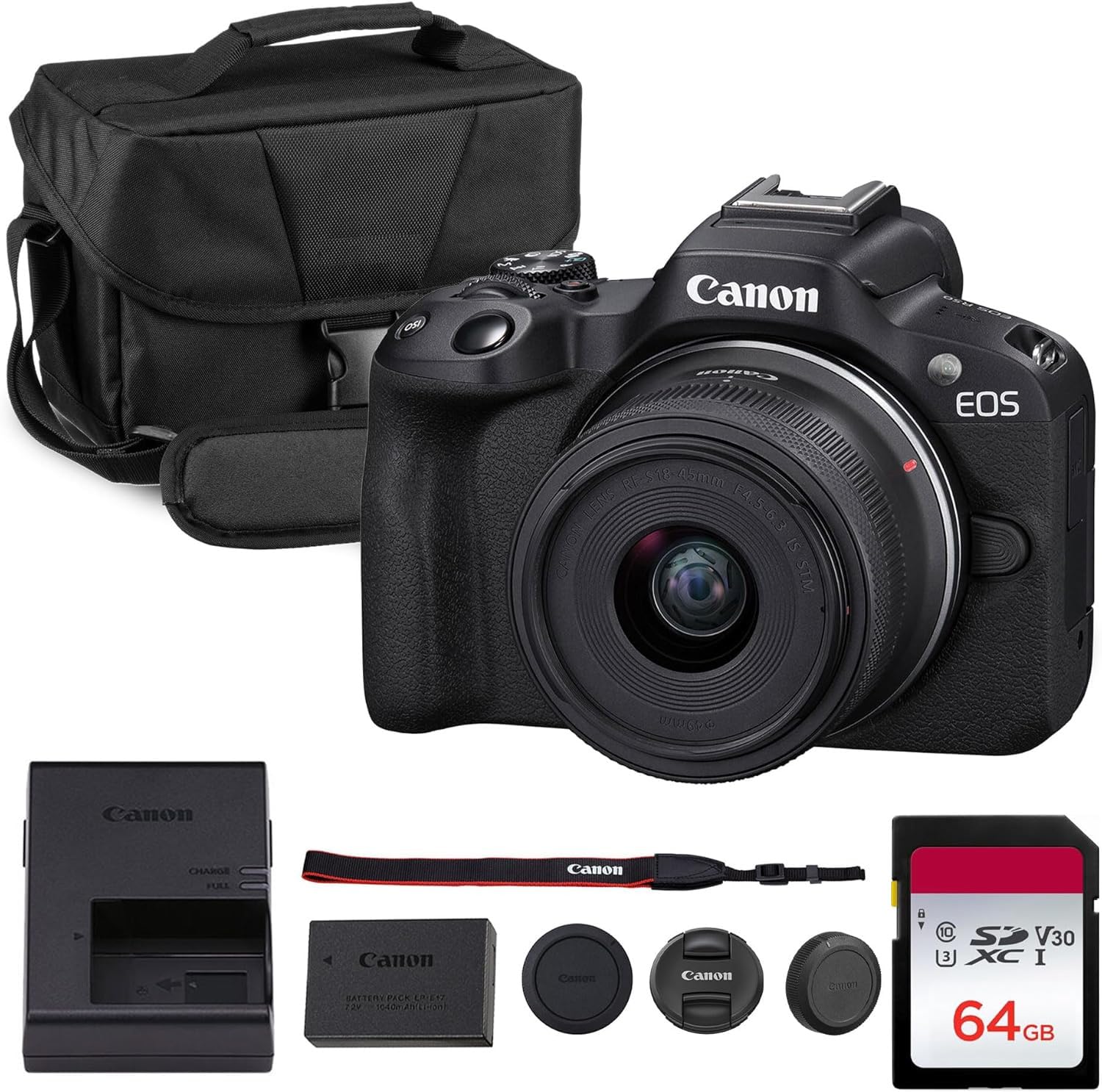
The Canon EOS R50 is a compact APS-C mirrorless that punches well above its weight for vloggers and beginners. The camera oversamples 4K from a higher-resolution readout, producing sharper and more detailed footage than many competitors at this level. Dual Pixel CMOS AF II with subject tracking covers the entire frame and detects faces, eyes, animals, and vehicles—making it incredibly simple to just press record and stay in focus.
The kit includes the RF-S 18-45mm f/4.5-6.3 IS STM lens, which offers a versatile zoom range and built-in stabilization. The vari-angle touchscreen flips out fully for selfie shots, and the camera supports vertical video for social media without any cropping. Creative Assist provides in-camera guides that help beginners understand how aperture, shutter speed, and ISO affect the look of their footage.
User feedback emphasizes how lightweight and easy to use the R50 is straight out of the box. The included shoulder bag and 64GB SD card add immediate value. The kit lens is functional but slow in low light, so many purchasers eventually add a brighter prime lens. For the price, this is one of the most complete beginner kits for social media content creation.
Why it’s great
- Oversampled 4K video is exceptionally sharp
- Dual Pixel AF II covers entire frame with reliable tracking
- Comes with bag, memory card, and versatile zoom lens
Good to know
- Kit lens is slow in low light (f/4.5-6.3)
- No in-body stabilization; relies on lens IS
- Limited to UHS-I SD card slot only
8. Canon EOS RP + 24-105mm Lens Kit

This kit bundles the Canon EOS RP full-frame body with the RF 24-105mm F4-7.1 IS STM lens, creating a travel-friendly pair that covers wide-angle to medium telephoto. The 24-105mm range is extremely versatile—you can shoot a wide landscape, frame a portrait, and zoom in for detail shots without swapping lenses. The lens delivers up to 5 stops of optical image stabilization, which dramatically reduces handheld shakiness.
The full-frame 26.2MP sensor provides excellent detail and color, and the Dual Pixel CMOS AF is fast and reliable. The vari-angle touchscreen is useful for vlogging, though the RP’s 4K video is cropped and limited to 24 fps, making it more of a hybrid photo/video camera than a pure vlogging tool. The lightweight body is easy to carry all day, and the lens locks down for secure travel.
Users upgrading from older DSLR systems praise the image quality and comfortable grip. The kit lens performs well in good light, but the variable aperture narrows at longer focal lengths, which can be challenging in dim conditions. The EOS RP also functions as a webcam via HDMI, adding value for creators who stream. This package is ideal for travelers who want one lens that does it all without compromising on sensor size.
Why it’s great
- Full-frame sensor delivers exceptional photo and video quality
- 24-105mm lens is versatile for travel and daily use
- Up to 5 stops of optical stabilization in the lens
Good to know
- 4K video is cropped and limited to 24 fps
- Lens aperture narrows at longer focal lengths
- No IBIS for non-stabilized lenses
9. Sony Alpha ZV-E10 II

The Sony ZV-E10 II is a purpose-built APS-C creator camera that takes everything the ZV-1 does well and gives you an interchangeable lens mount. The 26MP Exmor R CMOS sensor is roughly ten times larger than a smartphone sensor and three times larger than a 1-inch sensor, yielding richer detail and cleaner high-ISO footage. The bundled E PZ 16-50mm f/3.5-5.6 OSS II power zoom lens provides optical stabilization and a useful zoom range for vlogging.
Real-time Eye AF for humans, animals, and birds is Sony’s class-leading autofocus technology, and it works flawlessly for tracking faces while you move naturally in front of the lens. The Creative Look function offers ten presets that adjust color and contrast in-camera, so you can achieve a finished look without editing. Slow & Quick mode captures up to 5x slow motion at Full HD 120 fps or 60 fps in 4K, giving you professional flexibility for high-impact shots.
Users note that the camera lacks an electronic viewfinder, which some photographers miss. Battery life is average, but USB-C power delivery allows for extended streaming sessions. The ZV-E10 II also functions as a high-quality webcam with excellent autofocus via USB. If you want the flexibility of Sony’s E-mount lens system with a body optimized for video creators, this is the current top recommendation.
Why it’s great
- APS-C sensor delivers excellent image quality and low-light performance
- Interchangeable lens system offers unlimited creative options
- Real-time Eye AF tracks humans, animals, and birds
Good to know
- No built-in electronic viewfinder
- Battery life is average for video work
- Can overheat in extended 4K use in warm rooms
10. Canon EOS R8 (Body)

The Canon EOS R8 is essentially an R6 Mark II with a few corners trimmed to hit a more accessible price. It uses the same 24.2MP full-frame sensor and DIGIC X processor, delivering uncropped 4K video at 60 fps oversampled from 6K, plus Full HD recording at up to 180 fps for smooth slow-motion. The Dual Pixel CMOS AF II covers 100% of the frame with 1,053 AF zones, including automatic detection of people, animals, and vehicles.
This camera is built for hybrid shooters who want professional-level video and still photography in one lightweight body. The 0.39-inch OLED EVF with 2.36 million dots and water-drop-resistant coating provides a clear viewfinder even in bright conditions. Canon Log 3 or HDR PQ gamma curves allow for advanced color grading, and the UVC/UAC over USB-C makes it a webcam without extra software.
Reviewers note that the battery is a minor weak point—getting about 500 photos or one hour of 4K video. There’s no in-body image stabilization (IBIS), so you need stabilized RF lenses for smooth handheld footage. The single UHS-II card slot is another compromise. For creators who want the best video specs in the lightest full-frame body and are willing to manage battery life carefully, the R8 is a brilliant tool.
Why it’s great
- Uncropped 4K 60p oversampled from 6K video
- Canon Log 3 and HDR PQ for professional color grading
- Dual Pixel AF II with extensive subject detection
Good to know
- Battery life is short for intensive video shooting
- No in-body stabilization; requires stabilized lenses
- Single UHS-II SD card slot only
11. Canon EOS R10 with 18-150mm Lens

The Canon EOS R10 is a fast-shooting APS-C mirrorless that prioritizes speed and autofocus capability. Its DIGIC X processor drives a 24.2MP CMOS sensor capable of shooting 15 fps with the mechanical shutter, making it one of the most responsive cameras in this price range for capturing fast-moving subjects. The 651 autofocus points cover a large portion of the frame and work with subject detection for people, animals, and vehicles.
The included RF-S 18-150mm f/3.5-6.3 IS STM lens covers a massive zoom range—from 18mm wide to 150mm telephoto—so you can shoot everything from wide vlogs to compressed portraits without swapping glass. The lens has built-in image stabilization that works with the camera’s digital stabilization for reasonable handheld smoothness. The vari-angle touchscreen and built-in flash add convenience for different shooting conditions.
User reviews highlight the impressive speed and tracking ability of the R10, though the kit lens performs poorly in low light due to its slow variable aperture. Many users recommend upgrading to a faster prime lens or the RF 50mm f/1.8 for better indoor performance. The single UHS-II card slot and average battery life are the main trade-offs. This is a strong choice for sports, action vlogging, and hybrid shooters who need burst speed.
Why it’s great
- Extremely fast 15 fps burst shooting for action shots
- Versatile 18-150mm lens covers wide to telephoto
- Subject detection AF works for animals, people, and vehicles
Good to know
- Kit lens is very slow in low light (f/6.3 at telephoto)
- Single UHS-II SD card slot
- Battery lasts about a day of moderate shooting
FAQ
Is a 1-inch sensor good enough for professional YouTube vlogs?
Can I use an external microphone with these vlogging cameras?
Do I need image stabilization for vlogging?
What frame rate should I record in for vlogging?
How important is a flip-out screen for vlogging?
Final Thoughts: The Verdict
For most users, the best affordable camera for vlogging winner is the Xtra Muse because its integrated 3-axis gimbal and 1-inch CMOS sensor deliver exceptionally smooth 4K/120fps footage without the need for external stabilization. If you want interchangeable lenses and professional color grading, grab the Canon EOS R8. And for streaming and plug-and-play webcam use, nothing beats the Nikon Z 30.