
Our readers keep the lights on and the weekend projects moving. As an Amazon Associate, I earn from qualifying purchases.
A circular saw that binds, motor that bogs down on wet lumber, or a base plate that bends after three cuts—this is the reality of buying the wrong saw on a budget. The difference between a frustrating day at the jobsite and a clean, fast cut comes down to three things: motor torque, base plate rigidity, and blade quality. For anyone cutting framing lumber, plywood sheets, or pressure-treated deck boards, an affordable circular saw that delivers on these specs without the premium price tag is the goal.
I’m Rikta — the co-founder and writer behind FitlyFast. My approach to this guide relies on cross-referencing motor amperage ratings, no-load RPM claims, bevel range specifications, and real-world user stress tests for saws under heavy ripping and crosscut loads.
To cut through marketing noise, I compared seven top-tiers and value-focused models side by side to find the best affordable circular saw that holds up to daily use without emptying your wallet.
How To Choose The Best Affordable Circular Saw
The sheer number of corded circular saws under a certain price point can be overwhelming. To zero in on the right one for your workshop or jobsite, you need to focus on the specific components that affect cut accuracy, motor longevity, and user fatigue. Ignore the paint color; look at the specs that actually matter.
Motor Power: Amps and RPM
A 15-amp motor is the industry standard for 7-1/4-inch saws because it provides enough torque to rip through wet 2x10s and LVL beams without stalling. Combined with no-load RPM (target 5,300 or higher), this combo determines how fast and smoothly the blade spins through material. A 14-amp or lower motor may struggle under continuous heavy load, leading to burned edges and slower work.
Base Plate Material: Stamped vs. Cast Aluminum
The base plate—the flat metal shoe that rides on your workpiece—is where budget saws cut corners. Stamped steel or stamped aluminum bases are cheaper to produce but can bend if dropped or subjected to heat, leading to inaccurate cuts. A rigid cast aluminum base or heavy-gauge wraparound aluminum base maintains trueness over years of use, ensuring your bevel and depth settings stay locked.
Weight and Ergonomics
A saw that weighs over 10 pounds will cause fatigue when you are cutting a sheet of plywood or a stack of studs. Lighter saws around 8.5 to 9.5 pounds reduce arm strain without sacrificing motor power if the design is well-balanced. The handle position relative to the blade also matters—a closer-to-blade design offers better leverage and control during plunge cuts.
Quick Comparison
On smaller screens, swipe sideways to see the full table.
| Model | Category | Best For | Key Spec | Amazon |
|---|---|---|---|---|
| Metabo HPT C7UR RipMax | Premium Corded | Fast framing & ripping | 6800 RPM / 15A | Amazon |
| Makita HS7600 | Jobsite Pro | Precision & light weight | 5200 RPM / 10.5A | Amazon |
| Bosch CS5 | Left-Blade | Clear line-of-sight cuts | 15A / Left-Side Blade | Amazon |
| Metabo HPT C7SB3 | Budget Pro | Solid daily driver | 6000 RPM / Cast Base | Amazon |
| Skil 5280-01 | DIY Laser | Guided straight cuts | 5300 RPM / Laser Guide | Amazon |
| Skil 5180-01 | Lightweight | Reducing user fatigue | 7.2 lbs / 14A Motor | Amazon |
| WEN 3625 | Compact | Tight-space trimming | 4-1/2″ Blade / 5A | Amazon |
In‑Depth Reviews
1. Metabo HPT C7UR RipMax

The Metabo HPT C7UR RipMax is the saw that makes other corded saws in its class feel slow. Its 15-amp motor spins at an impressive 6,800 RPM—roughly 40% faster than typical 5,300 RPM models—which translates directly to smoother cuts through dense framing lumber and LVL beams without burning the wood. This speed advantage is paired with an anti-vibration system that keeps the saw steady and controlled during aggressive rips, reducing fatigue on long cutting runs.
Build quality is a step above budget contenders. The ribbed stamped aluminum base provides rigidity for accurate cuts without the high cost of a fully cast base, and the positive stops at 0°, 45°, and 55° make angle adjustments quick and repeatable. The cord hook on the back is a small but practical touch that keeps the power cord out of the cutting path, a feature that saves time and prevents the frustration of accidentally cutting your own extension cord.
The included 24-tooth premium framing VPR blade is good enough for immediate use on framing and rip cuts, though you will want a finer-tooth blade for crosscuts or plywood. Weighing 11.1 pounds, it is on the heavier side, but the well-balanced design and ergonomic handle closer to the blade mitigate fatigue. This is a pro-grade saw sold at a price that makes it the clear top pick for anyone needing fast, accurate cuts daily.
Why it’s great
- Fastest no-load RPM (6800) in its class reduces bogging and burning.
- Ribbed stamped aluminum base improves durability and accuracy.
- 55° bevel capacity with positive stops for repeatable angled cuts.
Good to know
- Heavier than some competitors at 11.1 pounds.
- Stock 24-tooth blade is best for ripping, not fine crosscuts.
2. Makita HS7600

The Makita HS7600 delivers a unique compromise: a lighter-weight saw that still feels solid and precise for repeated cuts. At 8.6 pounds with a well-balanced design, it is one of the lightest full-size 7-1/4-inch saws on the market, making it an excellent choice for overhead cutting or long sessions of sheet good breakdown. The 10.5-amp motor producing 5,200 RPM is less raw power than the 15-amp competitors, but it delivers clean cuts through plywood and 2x lumber without excessive vibration.
What sets the HS7600 apart is its heavy-gauge aluminum wraparound base. This base encircles the blade more than typical stamped soles, providing superior stability for straight cuts and maintaining its squareness over time. The lower guard design is also optimized for bevel cuts, preventing binding when you tilt the saw to 45 degrees. For DIYers and contractors who value weight reduction and accuracy over raw speed, this saw is a standout.
One limitation is the lack of an included premium blade—the stock blade is adequate but basic, so swapping in a quality 40-tooth or 24-tooth blade immediately improves cut quality. The saw also does not include a dust blower or a carrying bag, which may be minor inconveniences depending on your workflow. For track-saw conversions, this model pairs exceptionally well with aftermarket guide rails, turning it into a precise panel cutter.
Why it’s great
- Lightest full-size saw at 8.6 pounds reduces fatigue on long jobs.
- Wraparound aluminum base provides superior rigidity and accuracy.
- Excellent for track-saw conversions with aftermarket guide rails.
Good to know
- Stock blade is basic; expect to upgrade for optimal performance.
- No dust blower or carrying bag included.
3. Bosch CS5

The Bosch CS5 is a left-blade circular saw, meaning the blade sits to the left of the motor, giving right-handed users an unobstructed view of the cut line. This design choice alone makes it a favorite among carpenters who struggle with standard right-blade saws, as you no longer need to lean over to see your pencil mark. The 15-amp motor delivers ample torque for hardwoods and pressure-treated lumber without bogging down, a testament to Bosch’s motor winding and gear train engineering.
Built with cast-metal parts including the base and blade guard, the CS5 feels more substantial than many saws at its price point. The integrated wrench storage and spindle lock make blade changes tool-free and fast on the jobsite. However, the saw lacks positive stops for common bevel angles, meaning you have to manually set 0° and 45° each time using the scale, which is less convenient than the detents found on the Metabo HPT models.
The stock 24-tooth blade is a wide-kerf design that produces scorch marks on plywood and melamine, so swapping it out for a thin-kerf blade is recommended for cleaner cuts. The dust ejection is also directed toward the user’s shoes and face—a known annoyance that some users mitigate with a shop vac attachment. Overall, the CS5 is a powerful, lightweight (9.3 pounds) saw that excels in visibility, making it ideal for continuous rip cuts on panels.
Why it’s great
- Left-side blade design gives clear line-of-sight for accurate cuts.
- 15-amp motor handles hardwoods and wet lumber without stalling.
- Lightweight at 9.3 pounds with cast-metal durability.
Good to know
- No positive bevel stops; must manually set angles.
- Stock blade produces scorch marks; upgrade recommended.
4. Metabo HPT C7SB3

The Metabo HPT C7SB3 is the budget-conscious pro’s choice—it delivers the same brand reliability and motor power as the RipMax but at a more accessible price point. The 15-amp motor spinning at 6,000 RPM is still significantly faster than many entry-level saws, providing smooth cuts through OSB, plywood, and 2x framing. Its cast aluminum base is the standout feature at this price level; most saws in this range use stamped steel that bends, but this base stays true for accurate cuts over years of use.
Weighing 9.5 pounds, the C7SB3 is reasonably well-balanced for continuous use. The dust blower is effective at clearing the cut line of sawdust, improving visibility during long cuts. The included 24-tooth framing blade is actually quite impressive for a stock blade, capable of handling ripping and crosscutting without excessive tearout. The depth and bevel adjustments are smooth thanks to the single-handed bevel lever, saving time when switching between straight and angled cuts.
On the downside, the carrying bag is a thin fabric bag with limited padding, and there is no built-in dust collection port for connecting a shop vac. Some users also note that the depth adjustment lever loosens too easily, allowing the saw to drift out of setting during extended use. For the price, however, the C7SB3 offers a cast base and a fast motor that rivals saws costing nearly twice as much, making it a no-brainer for serious DIYers and tradespeople on a budget.
Why it’s great
- Cast aluminum base provides exceptional rigidity for accurate cuts.
- Fast 6000 RPM motor with a quality 24-tooth framing blade included.
- Single-handed bevel adjustment speeds up workflow.
Good to know
- Depth adjustment lever can loosen during extended use.
- No dust collection port; bag is basic.
5. Skil 5280-01
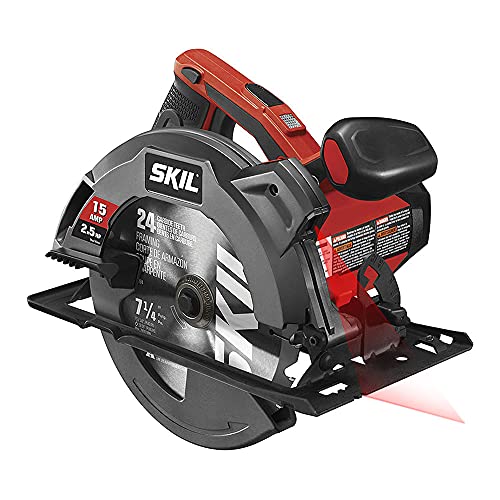
The Skil 5280-01 is a classic name with a modern twist: a single-beam laser guide integrated into the saw. This laser projects a line onto your workpiece, making it noticeably easier for DIYers and beginners to follow a straight cut. Underneath that feature is a capable 15-amp motor producing 5,300 RPM, which is enough for framing lumber and plywood without stalling. The 51° bevel capacity with a positive stop at 45° covers common angle cuts like rafters and decking.
The included 24-tooth carbide-tipped blade is serviceable but not exceptional—most users report cleaner cuts after upgrading to a finer-tooth blade. The dust blower is functional, keeping the cut line visible, though the laser can be difficult to see in bright sunlight, limiting its usefulness on outdoor jobsites. The saw comes with a carry bag and a wrench for blade changes, adding convenience for storage and transport.
At 8.7 pounds, it is lighter than many 15-amp saws, reducing arm strain during continuous use. However, some users note that the saw feels heavy despite the weight figure due to poor weight distribution. The safety lock and guarded trigger are welcome additions for preventing accidental starts, though they add a bit of resistance to the trigger pull. Overall, the 5280-01 is a solid entry-level choice for the garage and light construction, especially if you value the laser guide for precision.
Why it’s great
- Laser guide makes straight cuts easier for beginners.
- 15-amp motor cuts plywood and 2x lumber without bogging.
- 51° bevel capacity with positive stop at 45°.
Good to know
- Laser is nearly invisible in direct sunlight.
- Stock blade is basic; upgrade for cleaner crosscuts.
6. Skil 5180-01

The Skil 5180-01 is the lightest full-size circular saw in this comparison at just 7.2 pounds, making it the go-to option for overhead cutting, tight crawlspaces, and long days where every ounce of weight reduction matters. Its 14-amp motor is a slight downgrade from the 15-amp standard, but it still delivers enough torque to cut through 2x4s and plywood without frequent bogging. The 15% weight reduction over the Skil 5480 is achieved through a largely plastic housing, which keeps the price low and the weight down.
The 51° bevel capacity with a positive stop at 45° is identical to the 5280-01, offering the same range for angled cuts. The improved dust blower keeps the cut line clear of debris, improving visibility during continuous ripping. The included 20-tooth carbide blade is aggressive but produces rougher cuts than the 24-tooth blades found on other models, so swapping it is recommended for finish work.
The all-plastic build is the biggest trade-off here: the base is stamped aluminum, but the upper housing and guard are plastic, which some users worry about regarding long-term durability. For light-duty DIY tasks and occasional use, this is less of a concern. The cord is 10 feet long, which is standard but may require an extension cord for many projects. For those prioritizing weight savings and budget above all else, the 5180-01 is a capable companion for small jobs.
Why it’s great
- Lightest saw in the list at 7.2 pounds reduces fatigue.
- 14-amp motor handles most DIY tasks without issue.
- Effective dust blower improves cut line visibility.
Good to know
- Plastic build may not hold up to heavy daily use.
- 20-tooth blade produces rough cuts; upgrade recommended.
7. WEN 3625

The WEN 3625 is a different animal—a compact 4-1/2-inch saw designed for precision in tight spaces rather than raw power. Its 5-amp motor spins a smaller blade at 3,500 RPM, giving a maximum cut depth of 1-11/16 inches, which is enough for 1x lumber, plywood, drywall, tile, and even thin sheet metal. This saw excels in scenarios where a full-size 7-1/4-inch saw is too cumbersome, such as cutting trim installed against a wall, flush cutting door jambs, or slicing through PVC pipes.
The included laser guide aids accuracy, though it is not adjustable and may need calibration out of the box. The aluminum faceplate is functional but can bend if dropped, so careful handling is advised. The dust extraction tube is a thoughtful addition for connecting to a shop vac, keeping the workspace cleaner than the open-port designs of larger saws. It comes with a 24-tooth carbide-tipped wood blade and a sturdy carrying case that includes blade storage.
This saw struggles with material thicker than 1 inch, bogging down if pushed too hard. The bevel range of 0° to 45° is present but requires a single adjustment knob, and the angle and depth scales may need manual calibration for accuracy. For light-duty tasks like cutting trim, plywood, and tiles, the WEN 3625 is a fantastic value. For heavy framing work, stick with the larger 7-1/4-inch models on this list.
Why it’s great
- Ultra-compact design for trimming and tight-space cuts.
- Laser guide and dust extraction tube improve accuracy and cleanliness.
- Versatile material support: wood, tile, drywall, PVC, metal.
Good to know
- Underpowered for materials thicker than 1 inch.
- Aluminum faceplate can bend if dropped.
FAQ
Is a 15-amp motor always better than a 14-amp motor in a circular saw?
What does the laser guide actually do for cut accuracy?
Can I use a 7-1/4-inch circular saw with an aftermarket track guide?
Final Thoughts: The Verdict
For most users, the best affordable circular saw winner is the Metabo HPT C7UR RipMax because it combines a 6,800 RPM motor, a durable ribbed aluminum base, and anti-vibration technology at a mid-range price that outperforms many premium models. If you want the lightest full-size saw for reducing fatigue, grab the Makita HS7600. And for clear line-of-sight cuts on panels, nothing beats the Bosch CS5 with its left-side blade design.