
Our readers keep the lights on and the weekend projects moving. As an Amazon Associate, I earn from qualifying purchases.
The hardest part of getting into drones isn’t the joysticks—it’s the fear of crashing a hundred-dollar mistake on day one. Most beginner drones either lack the GPS smarts to save you from yourself or cost so much that the first crash feels like a financial gut punch. The sweet spot is a sub-250-gram quadcopter that pairs brushless motor stability with smart return-to-home features, all without triggering FAA registration.
I’m Rikta — the co-founder and writer behind FitlyFast. I have spent dozens of hours digging through customer feedback and spec sheets to separate the genuinely beginner-friendly models from the ones that just look good in marketing photos.
Finding a drone that balances ease of use, camera quality, and flight time at a reasonable price takes more than just reading the headline specs. This guide walks through the seven best options so you can pick the right affordable drones for beginners without wasting time on models that overpromise and underdeliver.
How To Choose The Best Affordable Drones For Beginners
Not every lightweight drone is beginner-friendly, and not every beginner drone can handle a breeze. Here are the three specs that separate a confidence-building first flight from a frustrating hover test.
Weight and Registration Requirements
Models under 249 grams do not require FAA registration or Remote ID in the United States. This makes them the obvious entry point for anyone who wants to unbox and fly without administrative hurdles. Heavier drones bring more regulation and paperwork.
Motor Type and Wind Resistance
Brushless motors run quieter, last longer, and handle wind far better than the older brushed designs. A drone claiming Level 5 wind resistance (approximately 20–30 mph gusts) will stay stable when a budget brushed model would drift uncontrollably. That stability directly improves beginner confidence.
GPS and Auto Return Features
A drone with GPS-enabled auto return is the single most important safety net for a new pilot. If the signal drops or the battery runs low, the drone flies itself back to the takeoff point. Models without this feature demand constant manual control and many beginners lose them on the first outdoor flight.
Quick Comparison
On smaller screens, swipe sideways to see the full table.
| Model | Category | Best For | Key Spec | Amazon |
|---|---|---|---|---|
| Bwine F7MINI | Premium | Built-in screen & smooth gimbal | 3-Axis Gimbal + 6KM Range | Amazon |
| Ruko 4K UHD | Premium | Flight time & 8K photos | 48MP CMOS + 96 Min Total | Amazon |
| Potensic ATOM LT | Mid-Range | Long battery & GPS precision | 3000mAh Battery + 4KM Range | Amazon |
| SIMREX G29 | Mid-Range | Gesture control & smart modes | Optical Flow + 40 Min Flight | Amazon |
| Oddire HK11 | Mid-Range | GPS follow & route planning | 48 Min Total + 500m Range | Amazon |
| REDRIE HK33 | Budget | Beginner-friendly durability | 2-Axis Gimbal + 249g Under | Amazon |
| Ameta S20 Lite | Budget | Lost drone finder & compact | 12MP Sony Sensor + 36 Min | Amazon |
In‑Depth Reviews
1. Bwine F7MINI
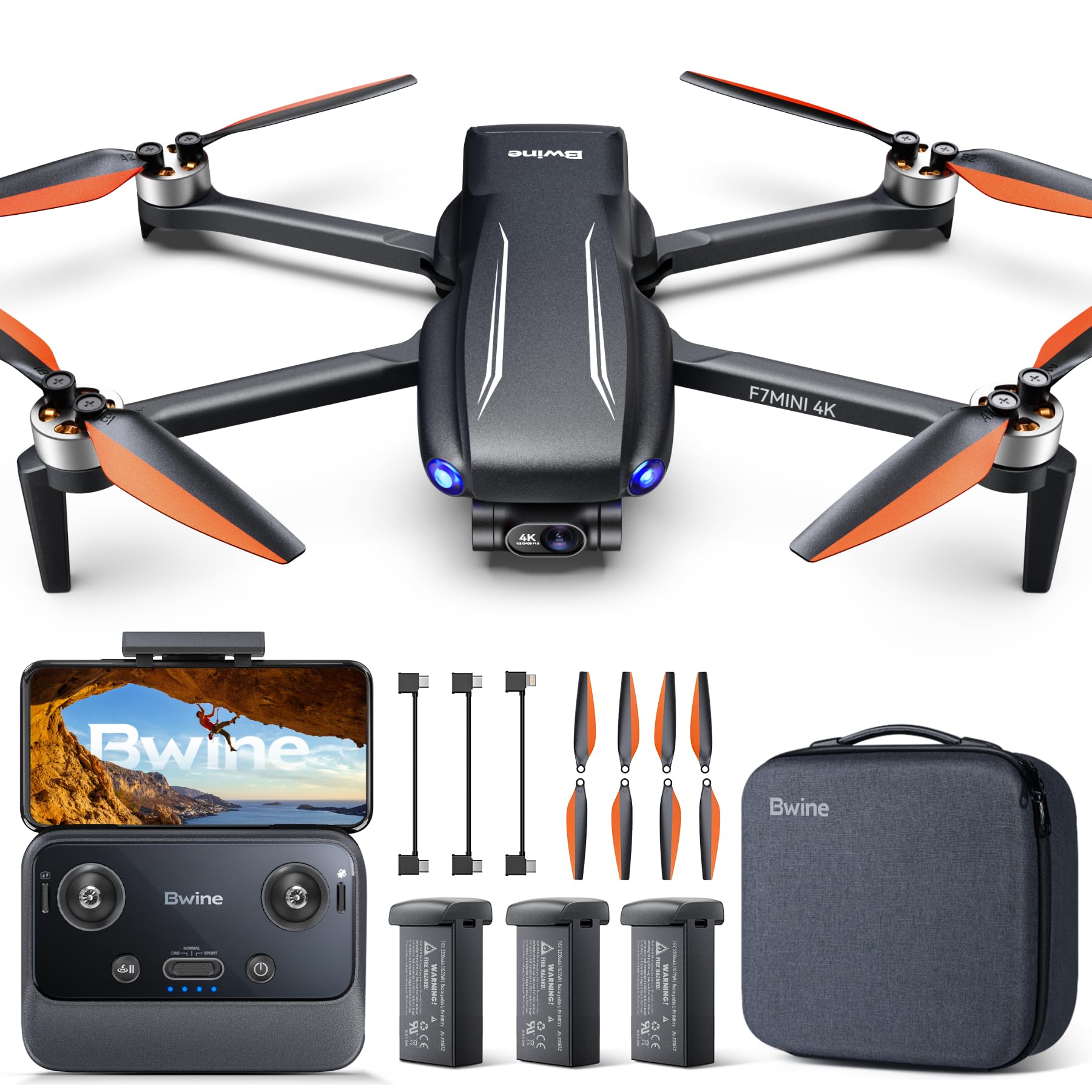
The Bwine F7MINI stands apart because its remote controller includes a 5.5-inch built-in screen, meaning you do not need to clamp a phone onto the transmitter to see the live feed. This simplifies setup and keeps your phone free for other tasks. The drone itself weighs under 249 grams, dodging FAA registration, and packs a 48MP 1/2-inch CMOS sensor with an F1.8 aperture that captures 8K photos and 4K/30fps video.
The three-axis stabilized gimbal uses motors and sensors to cancel out drone movement in real time, producing smooth footage even in gusty conditions. The 1503 brushless motor pushes the top speed to 31 mph and delivers Level 5 wind resistance, so beginners do not panic when the breeze picks up. The transmission range reaches 6 kilometers with zero-latency digital feed.
Three high-density 2200mAh batteries provide a total flight time of 96 minutes (32 minutes per battery), with PD 3.0 fast charge support. GPS features include smart return-to-home, dynamic home point, orbit fly, waypoint, and a 120dB locator buzzer for recovery. The controller’s own touchscreen displays flight instructions, reducing the learning curve for first-time pilots.
Why it’s great
- Built-in screen removes phone dependency
- 3-axis gimbal delivers professional stability
- 96-minute flight time with fast charging
Good to know
- Photo/video transfer to phone is slow
- Premium price point above mid-range options
2. Ruko 4K UHD Drone

The Ruko drone uses a high-performance 1/2-inch 48MP CMOS sensor to capture 8K photos and smooth 4K/30fps video, placing it among the best imaging options for this price tier. A three-axis brushless gimbal works with electronic image stabilization to keep footage steady even in moderate wind, while cruise control locks the drone onto a steady track for cinematic recording without constant stick adjustments.
Three intelligent 2200mAh batteries push total flight time to 96 minutes, making it one of the longest-flying sub-250-gram drones available. The R2 digital transmission system provides a 20,000-foot range without relying on Wi-Fi, which avoids the signal interference issues common to cheaper models. Beginner safety features include one-button takeoff and landing plus three auto-return modes: one-click return, low-battery return, and signal-loss return.
AI-assisted takeoff and landing, combined with quadruple positioning (GPS, barometric altitude hold, TOF, and optical flow), gives new pilots extra stability during critical moments. The drone weighs under 249 grams and includes a carrying case, three batteries, and a full accessory kit. Customer reviews frequently highlight responsive support and easy setup.
Why it’s great
- 96-minute total flight with three batteries
- 48MP sensor for detailed 8K stills
- Non-Wi-Fi digital transmission avoids interference
Good to know
- Sensitive joysticks take adjustment
- No audio recording in video mode
3. Potensic ATOM LT

The Potensic ATOM LT uses a Sony sensor to capture 2.5K video at 30fps and 2560×1440 stills, backed by ShakeVanish 2.0 stabilization that keeps footage smooth without a physical gimbal. The 118-degree field of view with vertical adjustment from +20° to -90° gives beginner pilots flexible framing options. The PixSync 2.0 transmission system reaches 4 kilometers with minimal latency using a dedicated remote controller.
Two 3000mAh intelligent batteries deliver 40 minutes of flight time each, totaling 80 minutes of airborne practice. This is significantly more battery capacity than most competitors at this tier. The drone supports four satellite positioning systems (GPS, GLONASS, Galileo, and BeiDou) for high-accuracy GPS positioning, enabling reliable auto return, follow me, waypoint fly, and circle fly modes.
The brushless motor handles Level 5 wind conditions, and the three flight modes (including a beginner mode) ease new pilots into increasing control complexity. The drone folds down to 3.5×5.6×2.3 inches and weighs under 249 grams for FAA-exempt portability. Firmware updates are delivered via FOTA, so the drone improves over time. Customer feedback emphasizes easy controls and excellent flight transmission range.
Why it’s great
- 80-minute total flight with large-capacity batteries
- 4KM digital video transmission range
- Four-GNSS support for precise GPS functions
Good to know
- Camera resolution is 2.5K, not 4K
- GPS satellite acquisition can be slow
4. SIMREX G29
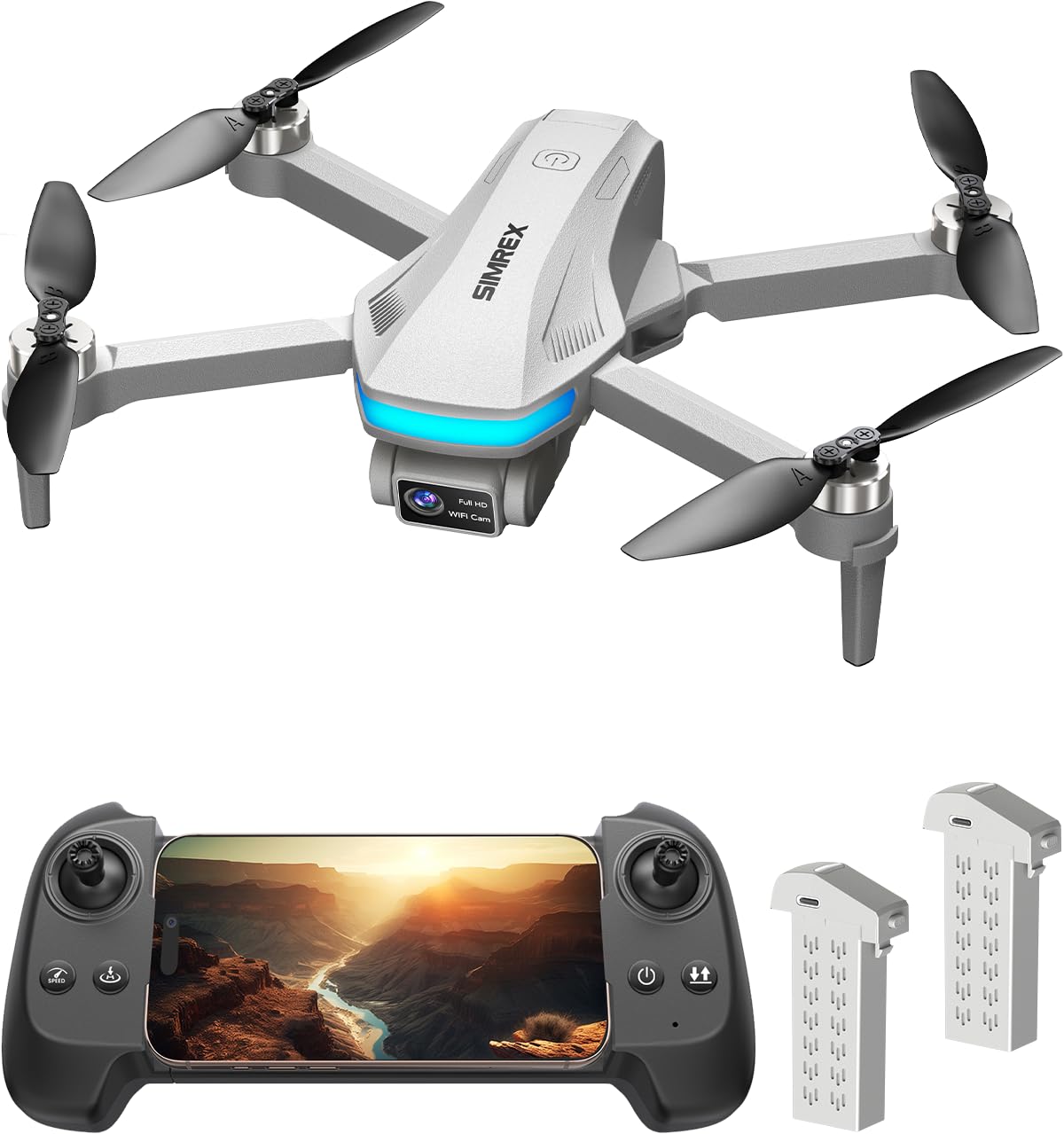
The SIMREX G29 integrates a 90-degree electrically adjustable 4K camera with optical flow positioning and altitude hold for stable hovering. The 5G WiFi FPV system streams a live view up to 500 meters outdoors, giving beginners real-time feedback on their framing. The drone’s brushless motors provide quieter operation and stronger wind resistance than brushed alternatives at this price bracket.
GPS auto return triggers on signal loss or low battery, while the Find My Drone feature on the app helps locate the craft on a map if it lands beyond visual range. Intelligent flight modes include Follow Me, Waypoint Flight, Circle Around, and Gesture Control for hands-free selfies and video recording. This suite of automated modes helps beginners capture cinematic shots without manual piloting skill.
The foldable arms collapse to 7.87×3.23×1.17 inches, and the total weight sits well under the FAA registration threshold. The package includes two batteries for a combined 40-minute flight time. Altitude Hold and Headless Mode simplify orientation for new pilots, removing the mental challenge of keeping track of the drone’s front direction. Customer reviews consistently call it easy to fly and packed with value features.
Why it’s great
- Gesture control for hands-free operation
- Compact foldable design for travel
- GPS auto return with map-based finder
Good to know
- 5G WiFi can face interference in crowded areas
- USB-C charging for batteries is a plus but batteries charge individually
5. Oddire HK11

The Oddire HK11 uses an intelligent GPS module that enables automatic return to home when the battery runs low or the connection breaks. Intelligent flight features like GPS Follow, Route Planning, and Fly Around simplify operation so beginners can capture professional-looking footage without complex manual controls. The adjustable 4K UHD camera features an F2.15 110-degree wide-angle lens that tilts within a 90-degree range via remote control or app.
Two 7.7V 1800mAh batteries power a total flight time of 48 minutes, giving pilots more airtime than the 7.4V and 3.7V batteries used in many competing models. The higher voltage translates to stronger motor performance and longer-lasting power. The 5G WiFi module with a signal repeater in the remote controller maintains a robust connection up to 500 meters.
The brushless motor delivers Level 5 wind resistance, and the 249-gram weight keeps FAA registration off the table. Smart features include waypoint flight, fly around, gravity control, 3D flip, one-key takeoff and landing, gesture photo, and VR compatibility. The X DRONE app includes built-in filters and background music for quick video editing and social sharing. Customer reviews praise the durability after crashes and straightforward setup process.
Why it’s great
- 7.7V high-voltage batteries outperform standard 3.7V packs
- GPS follow and route planning for hands-free shooting
- Extremely durable, survives beginner crashes
Good to know
- App requires calibration on every power cycle
- Main app had issues; XDRONE GO is the working alternative
6. REDRIE HK33
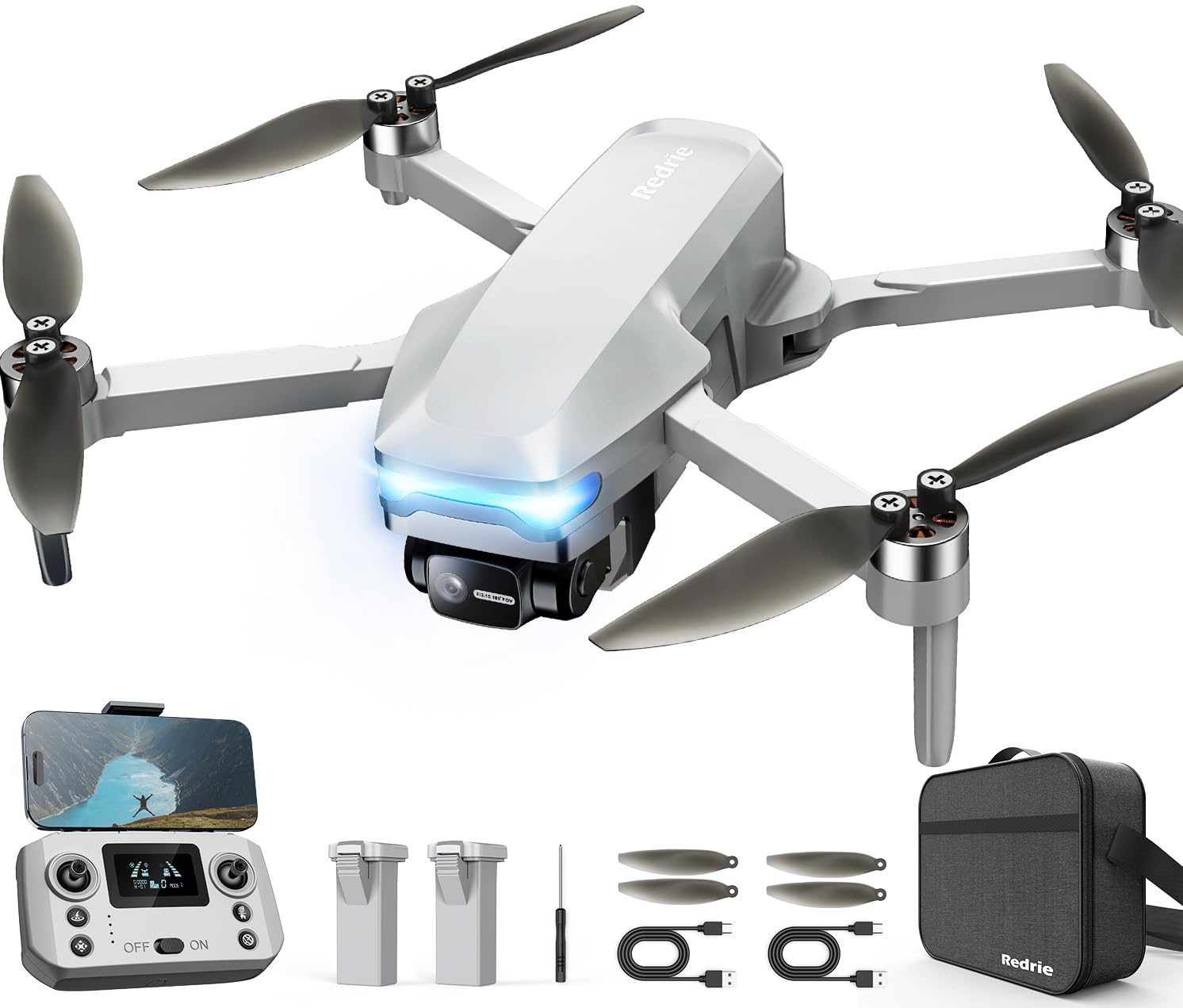
The REDRIE HK33 pairs a 2-axis gimbal with an F2.15 aperture and 110-degree ultra-wide lens to capture 4K photos at 4096x3072P and smooth 2K video at 2048x1088P. The 90-degree remote-controlled angle adjuster lets pilots switch between horizontal and vertical framing without landing. Files save to a MicroSD card or sync directly to a mobile device for real-time sharing.
High-performance brushless motors provide thrust and stability even in Level 5 winds, while 5G WiFi enables low-latency FPV transmission. The signal range reaches 500 meters using the integrated repeater, and the video transmission holds steady at 300 meters. The high-precision GPS module triggers automatic return home on signal loss, low battery, or range exceedance, plus it supports GPS Follow, Route Planning, and Fly Around modes.
Two 1800mAh rechargeable batteries deliver a total flight time of 40 to 45 minutes. The foldable design and included carrying case make travel simple, and the sub-249-gram weight eliminates FAA paperwork. A real-time battery indicator in the app and remote helps pilots plan landings. Customer feedback consistently calls it durable after crashes and an unbeatable value for the price.
Why it’s great
- 2-axis gimbal reduces camera shake
- Durable frame survives repeated beginner crashes
- Includes carrying case and spare parts
Good to know
- Camera stabilization could be better in high wind
- Cell phone holder on remote is flimsy
7. Ameta S20 Lite
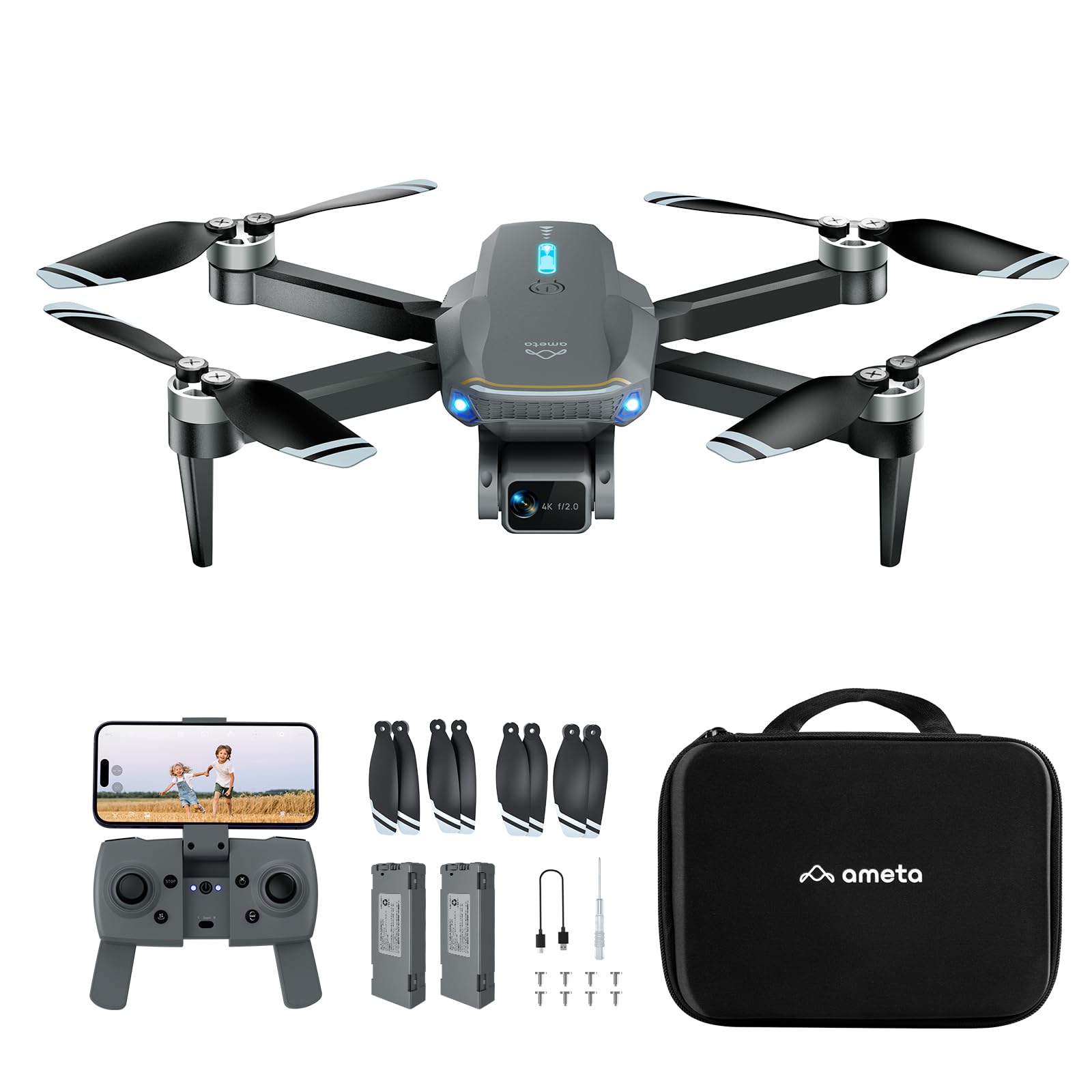
The Ameta S20 Lite equips a 12MP Sony CMOS sensor and a 90-degree adjustable lens to capture 4K UHD photos at 4096×3072 resolution. The 5G FPV transmission provides a low-latency first-person view through the app, helping beginners compose shots from the ground. A built-in buzzer powers the Find My Drone function, which helps locate the craft if it lands out of sight—a practical safety net for nervous first-time pilots.
Brushless motors deliver stable flight even in challenging conditions, and the drone offers beginner mode with optical flow positioning for precise hovering without GPS. One-key takeoff and landing, altitude hold, and headless mode remove the most common beginner frustrations. Speed mode adjustments let pilots progress at their own pace as their skills improve.
Two intelligent batteries provide 18 minutes of flight time each, totaling 36 minutes. The compact foldable design weighs under 249 grams, avoiding FAA registration. The package includes a premium carrying bag, spare propellers, and the remote control with phone holder. Customer reviews praise the easy setup, quiet operation, and overall value for a starter drone.
Why it’s great
- Sony CMOS sensor produces vivid images
- Find My Drone buzzer saves lost crafts
- Beginner mode with optical flow for indoor stability
Good to know
- Video resolution may not match true 4K claims
- Drone has slight drift tendency in calm air
FAQ
How much flight time do beginner drones actually get?
Does the 249-gram limit really matter for beginners?
Is a 4K camera on a budget drone actually 4K?
Final Thoughts: The Verdict
For most users, the affordable drones for beginners winner is the Bwine F7MINI because its built-in screen removes the phone-clamping hassle, the 3-axis gimbal delivers footage that looks far more expensive than the price suggests, and the 96-minute total flight time with three batteries lets you keep flying without constantly running back to the charger. If you want the longest battery life at a lower price point, grab the Potensic ATOM LT for its 80-minute runtime and 4-kilometer transmission. And for a durable, budget-friendly entry point that can survive the inevitable beginner mistakes, nothing beats the REDRIE HK33.