
Our readers keep the lights on and the weekend projects moving. As an Amazon Associate, I earn from qualifying purchases.
The moment the lights go out, the clock starts ticking on your refrigerator, your sump pump, and your peace of mind. But the real anxiety isn’t the outage—it’s the fear of buying a generator that either can’t handle your load or burns through your budget faster than a space heater in January. The affordable segment is where most homeowners get trapped, lured by low wattage numbers and missing the critical specs around dual-fuel capability, runtime, and clean power delivery that actually protect your home and your electronics.
I’m Rikta — the co-founder and writer behind FitlyFast. I’ve spent countless hours analyzing the specs, customer feedback, and real-world stress tests on the most popular home backup generators to find the ones that deliver genuine value without hidden compromise. This guide cuts through the marketing noise to give you clear, data-backed recommendations.
Whether you need to keep the fridge running, power a well pump, or charge medical devices, you need the right affordable generator for home that balances upfront cost with long-term reliability and fuel flexibility.
How To Choose The Best Affordable Generator For Home
The market is flooded with options ranging from compact inverter units that are whisper-quiet to massive open-frame workhorses designed for whole-house backup. The key to picking the right one isn’t just about wattage—it’s about matching the generator’s real-world output, fuel type, and runtime to your specific needs. A camping generator won’t save your basement from flooding, and a 13,000-watt behemoth is overkill for a few lights and a mini-fridge.
Starting Watts vs. Running Watts: The Real Number
Every motor in your home—from your refrigerator compressor to your sump pump—needs a surge of power to start, often 2-3 times its running wattage. The “starting watts” (or surge watts) is the peak the generator can handle for a few seconds. The “running watts” is what it can sustain. Always size your generator so the running watts cover your essential loads, and the starting watts can handle the biggest motor kicking on without bogging down the engine.
Dual Fuel: Gasoline vs. Propane
Storing gasoline is a hassle—it degrades in months, attracts moisture, and is a fire hazard in your garage. Propane, on the other hand, stores indefinitely in standard 20-pound BBQ tanks and burns cleaner, extending engine life and reducing maintenance. A dual-fuel generator gives you the flexibility to use whichever fuel is available during an extended outage, which is a massive advantage over single-fuel models.
Inverter vs. Conventional: Clean Power Matters
Conventional generators spin at a fixed speed to produce 60Hz AC power, which often results in “dirty” electricity with voltage fluctuations and harmonic distortion that can damage sensitive electronics like laptops, TVs, and modern refrigerator control boards. Inverter generators electronically condition the power to produce a clean sine wave—safe for all your gear. Inverter models are also quieter and more fuel-efficient because they can throttle the engine down when the load is light.
Safety Features You Must Not Skip
Carbon monoxide is an invisible, odorless killer. Any modern home backup generator should include an automatic CO shutdown sensor that kills the engine if dangerous levels build up. Low-oil shutdown prevents expensive engine damage when you forget to check the dipstick. Overload protection trips the breaker instead of frying your appliances. These three features are non-negotiable for a safe and durable purchase.
Runtime and Noise: The Practical Details
A generator that needs refueling every 4 hours isn’t useful for overnight emergencies. Look for models with at least 8-10 hours of runtime at 25-50% load. Noise level is measured in decibels (dBA) at 23 feet—anything under 70 dBA is considered conversational; above 80 dBA will disturb your neighbors and make you dread running it. Inverter models are typically the quietest, often operating around 50-60 dBA.
Quick Comparison
On smaller screens, swipe sideways to see the full table.
| Model | Category | Best For | Key Spec | Amazon |
|---|---|---|---|---|
| Westinghouse 12500W | Open Frame Dual Fuel | Whole-home backup | 12500W peak / 9500W run (gas) | Amazon |
| DuroStar DS13000MX | Open Frame Dual Fuel | Heavy-duty home + welder | 13000W peak / 500cc engine | Amazon |
| Generac iQ5200 | Inverter Dual Fuel | Quiet clean power for essentials | 5200W peak / 107 lbs weight | Amazon |
| WEN DF480iX | Inverter Dual Fuel | RV + home backup combo | 4800W peak / 4000W run (gas) | Amazon |
| Jackery Explorer 1000 v2 | Solar Power Station | Zero-emission, electronics-only | 1500W AC / 1070Wh LFP battery | Amazon |
| A-iPower GXS5000D | Open Frame Dual Fuel | High-wattage job site + home | 5000W peak / 68 dBA noise | Amazon |
| PowerSmart 4800W Inverter | Inverter Gas Only | Quiet electric start for RV | 4800W peak / electric start | Amazon |
| WEN 4800W Inverter (56477i) | Inverter Gas Only | Quiet RV-ready backup | 4800W peak / 224cc engine | Amazon |
| Generac GP3300i | Inverter Gas Only | Lightweight camping + light home | 3300W peak / 59.5 lbs weight | Amazon |
| PowerSmart 4400W Dual Fuel | Inverter Dual Fuel | Budget-friendly inverter | 4400W peak / 76 dBA noise | Amazon |
| WEN DF280iX | Inverter Dual Fuel | Compact entry-level backup | 2800W peak / 45 lbs weight | Amazon |
In‑Depth Reviews
1. Westinghouse 12500 Peak Watt Dual Fuel Portable Generator

The Westinghouse 12500W is the benchmark for affordable whole-home backup. With 12,500 peak watts on gasoline (11,200 on propane), it powers your well pump, refrigerator, lights, and even a window AC simultaneously without breaking a sweat. The 457cc cast-iron sleeved engine is built for longevity, and the remote start key fob means you can fire it up from inside the house during a storm. Users consistently report easy assembly and flawless performance during multi-day outages, running fridges, freezers, and even water heaters with stable voltage.
Crucially, it includes a transfer-switch-ready 50-amp outlet, making professional installation straightforward. The CO shutdown sensor and low-oil alert provide essential safety margins. At 212 pounds, it’s not a carry-around unit, but the wheel kit and fold-down handle make garage-to-driveway movement manageable. The only common complaint is that the owner’s manual has some clarity issues, but the build quality and power output at this price tier are exceptional.
For homeowners who want a single generator that can truly run most of the house without compromise, this is the pick. It delivers premium-class power at a mid-range investment, backed by a solid 3-year warranty and a nationwide service network.
Why it’s great
- True whole-home power (9500W running on gas) with a 50A outlet for direct transfer switch hookup.
- Remote electric start and dual fuel flexibility for extended outages.
- 3-year warranty and strong service network add long-term peace of mind.
Good to know
- Heavy at 212 lbs; needs a permanent or semi-permanent spot.
- No eco-mode throttle—runs at full engine speed regardless of load.
- Requires a high-altitude kit for operation above 2,000 feet.
2. DuroStar DS13000MX 13,000-Watt Dual Fuel Generator

If you need raw power for a large home, a workshop, or even a welder, the DuroStar DS13000MX is a standout. Its 500cc engine churns out 13,000 peak watts on gasoline and a robust 10,000 peak watts on propane—enough to start a central AC unit and a well pump at the same time. The push-button electric start works reliably, and the all-metal construction feels substantial compared to plastic-body competitors. Real-world reviews confirm it powers entire homes during storms with minimal fuel consumption, running a 1.5-ton AC, stove, fridge, and TVs without bogging.
The CO alert system adds critical safety, and the transfer-switch-ready 50-amp outlet means you can hardwire it into your panel. It includes a propane regulator and a toolkit for assembly, which takes about 30 minutes. At 220 pounds, it’s a beast, but the wheel kit makes rolling it into position feasible. Users praise its instant start-up reliability and quiet operation for its class, though it is louder than an inverter unit.
The remote control feature is a rare convenience at this price point, letting you start it from inside the house. If your priority is sheer, unbreakable grunt for a larger home, this generator delivers exceptional value.
Why it’s great
- Massive 13,000W peak capacity with a 500cc engine that powers heavy loads easily.
- Remote electric start and all-metal frame for durability.
- Dual fuel with included propane regulator for instant fuel switching.
Good to know
- Very heavy at 220 lbs—requires a hand truck for initial placement.
- No inverter technology—not ideal for sensitive electronics without an external UPS.
- Fuel tank run time around 10 hours at half load; plan refueling during extended outages.
3. Generac 5,200-Watt Dual-Fuel Portable Inverter Generator (iQ5200)
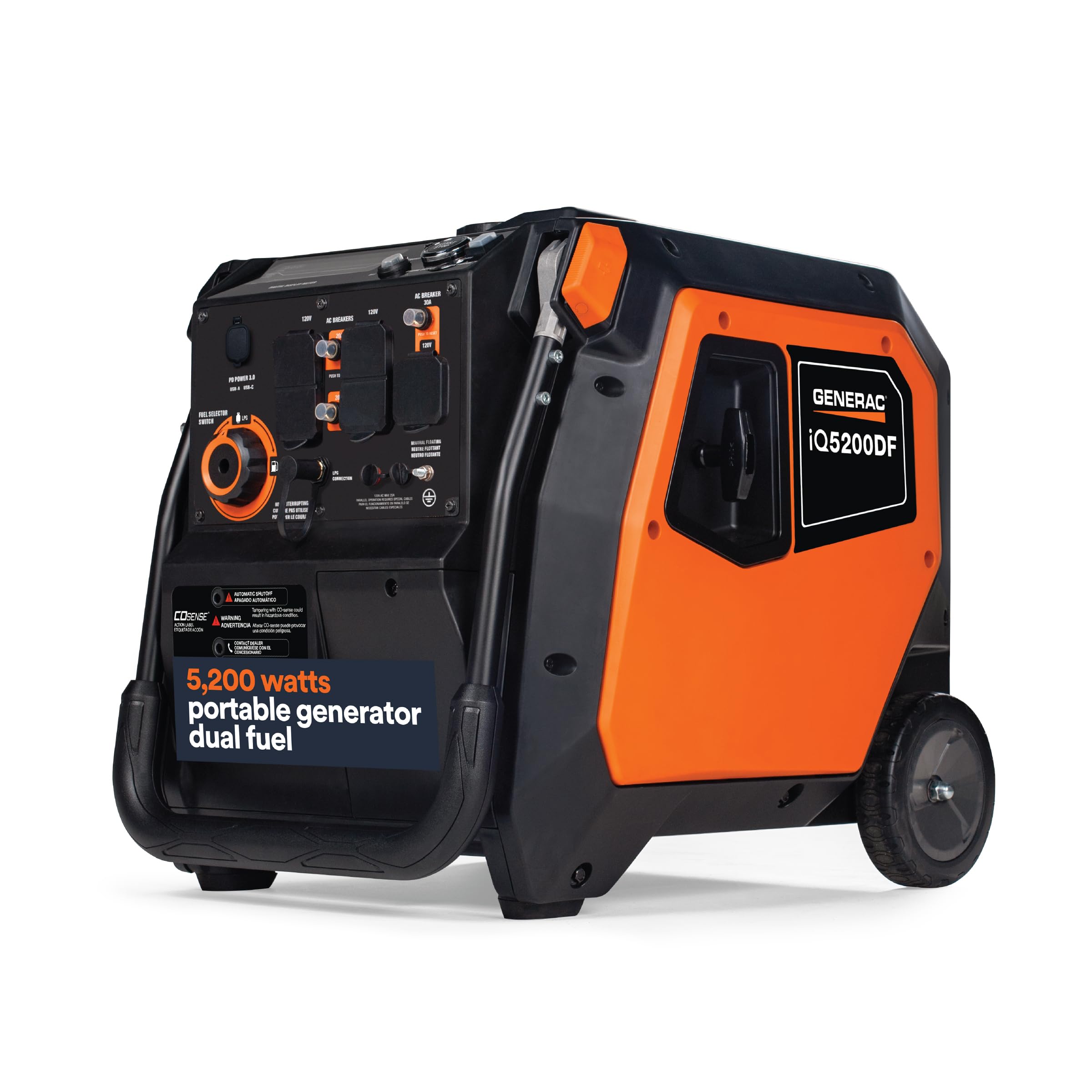
The Generac iQ5200 is the premium inverter option in the affordable space, delivering clean, stable power that is perfectly safe for laptops, TVs, and modern refrigerators. It runs on gasoline or propane, and the electric start with the included battery makes operation effortless. The fully enclosed case keeps noise levels very low—users report running it near campsites or in residential neighborhoods without complaints. With 5,200 peak watts (gas) and 4,000 running watts, it handles a fridge, freezer, sump pump, and a few lights with ease.
The COsense technology automatically shuts the generator down if dangerous carbon monoxide builds up, and the fuel source selector lets you switch seamlessly between gas and LPG without stopping the engine. Parallel-ready capability means you can combine two units for double the output. Reviews highlight its quiet operation even under load, though some early units had minor starting issues that were quickly resolved under warranty.
At 107 pounds, it is portable enough for most adults to roll on its built-in wheels. The main trade-off is that the propane output is lower than gasoline, so heavy loads are best run on gas. For a quiet, clean-power solution that can run essential home loads and charge sensitive devices, the iQ5200 is a top-tier choice.
Why it’s great
- Inverter technology produces clean sine wave power safe for electronics.
- Seamless fuel switching between gas and propane without stopping the engine.
- Very quiet operation and parallel-ready for future capacity upgrade.
Good to know
- Propane running watts are lower than gasoline; best for medium loads on LPG.
- Heavier than smaller inverter models at 107 lbs.
- Some users report the oil-fill bottle from factory can easily overfill—check dipstick carefully.
4. WEN 4800W Dual Fuel RV-Ready Inverter (DF480iX)
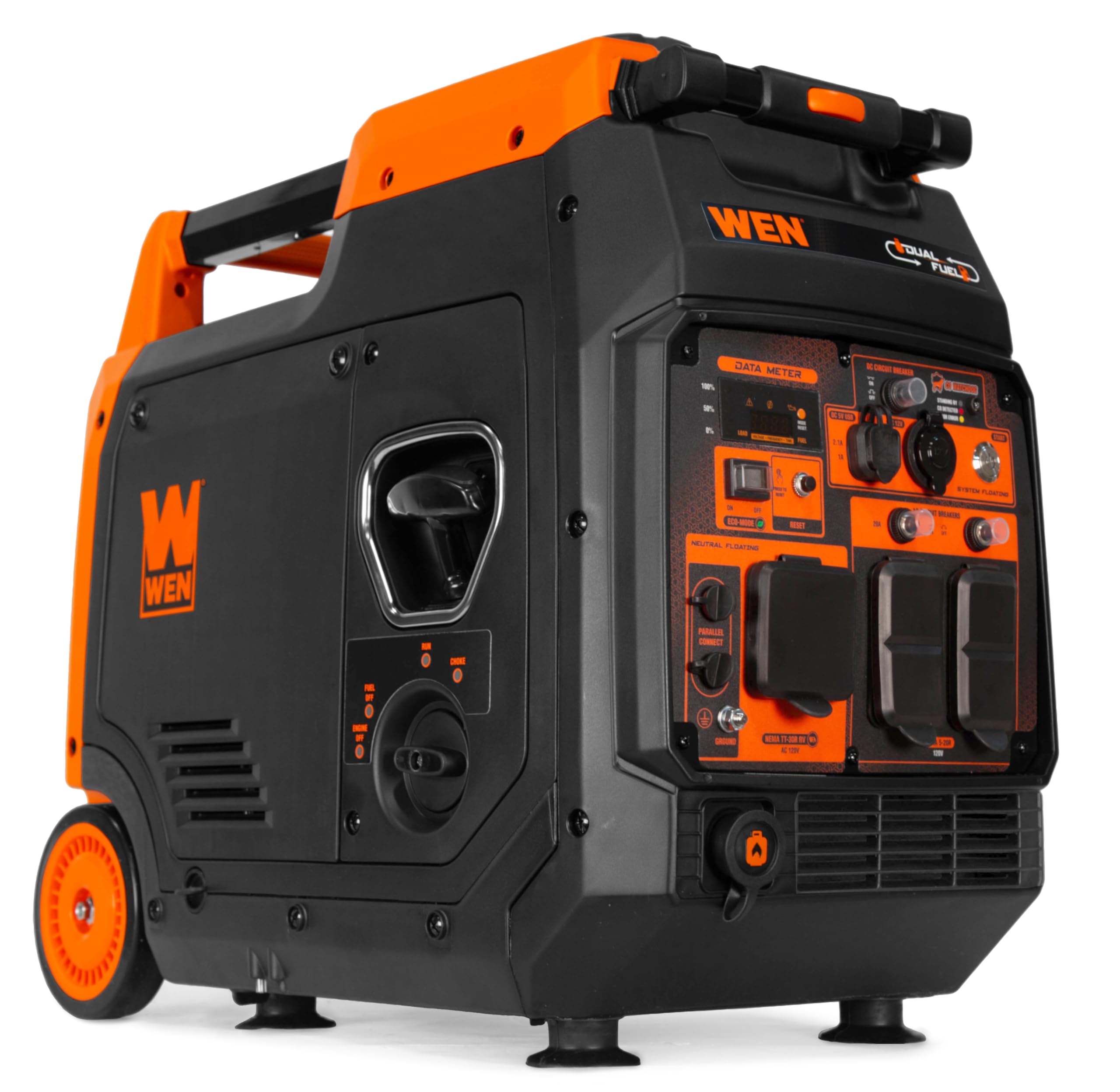
The WEN DF480iX strikes an exceptional balance between price, features, and performance. It is a true dual-fuel inverter with electric start, producing 4,800 surge watts on gas and 4,320 on propane—enough to power an RV air conditioner or a home fridge plus essentials. The WEN Watchdog CO Sensor automatically shuts down the generator if CO levels rise, a vital safety feature. The fuel shut-off valve is a smart touch, letting you run the carburetor dry to prevent gumming when storing the unit.
Real-world users consistently praise its quiet operation, describing it as comparable to a normal conversation. The telescoping handle and onboard wheels make it easy to maneuver despite its 78.5-pound heft. Owners report using it for over 100 hours on propane alone with zero issues, noting that the oil stays clean and the engine runs smoothly. The three-year warranty adds significant confidence at this price tier.
The only notable drawback is the lack of an automatic fuel switchover—you must manually select the fuel source. Additionally, the access panel for the battery connection can be tricky to reattach. Still, for a dual-fuel inverter with electric start and CO protection, this is a steal.
Why it’s great
- Dual-fuel inverter with electric start at a very competitive price point.
- Fuel shut-off prolongs engine life by preventing carburetor clogging.
- Quiet, clean power safe for all sensitive electronics.
Good to know
- Manual fuel selection—no automatic switching between gas and propane.
- Battery connection access panel is finicky to reinstall.
- At 78.5 lbs, it is not backpack-portable but the wheels help.
5. Jackery Explorer 1000 v2 Portable Power Station

The Jackery Explorer 1000 v2 is an entirely different category—a lithium iron phosphate (LiFePO4) battery power station that produces zero emissions, zero noise, and requires zero maintenance compared to gas generators. With 1,070 watt-hours of capacity and a 1,500W pure sine wave inverter, it can run a fridge for 4-8 hours, charge laptops and phones dozens of times, or power CPAP machines all night. The 100W USB-C PD output means you can fast-charge modern laptops directly.
Its true superpower is the recharge speed: using the emergency charging mode in the Jackery app, you can go from 0 to 100% in just one hour. The LFP battery chemistry delivers over 4,000 charge cycles before dropping to 70% capacity—a lifespan exceeding 10 years. Real users report running power tools, microwaves, and even small air conditioners without issue, and the app control lets you optimize charging speed or switch to a silent overnight mode at 30 dB.
The main limitation is total capacity. You cannot run a central AC, well pump, or electric oven. It is best for electronics, medical devices, small refrigerators, and lighting. If your goal is silent, emission-free backup for sensitive equipment and you have solar panels for extended recharging, this is a modern upgrade over a traditional generator.
Why it’s great
- Silent, zero-emission operation safe for indoor use in emergencies.
- 1-hour ultra-fast AC recharge via app; 10-year battery lifespan.
- True pure sine wave inverter with high-wattage USB-C for fast laptop charging.
Good to know
- Limited to 1,500W surge—cannot power high-draw appliances like well pumps or electric heaters.
- Solar panels sold separately; the unit is significantly more expensive if you add panels.
- Must be recharged after extended use; not a “run forever” solution like a gas generator.
6. A-iPower 5000W Dual Fuel Portable Generator (GXS5000D)
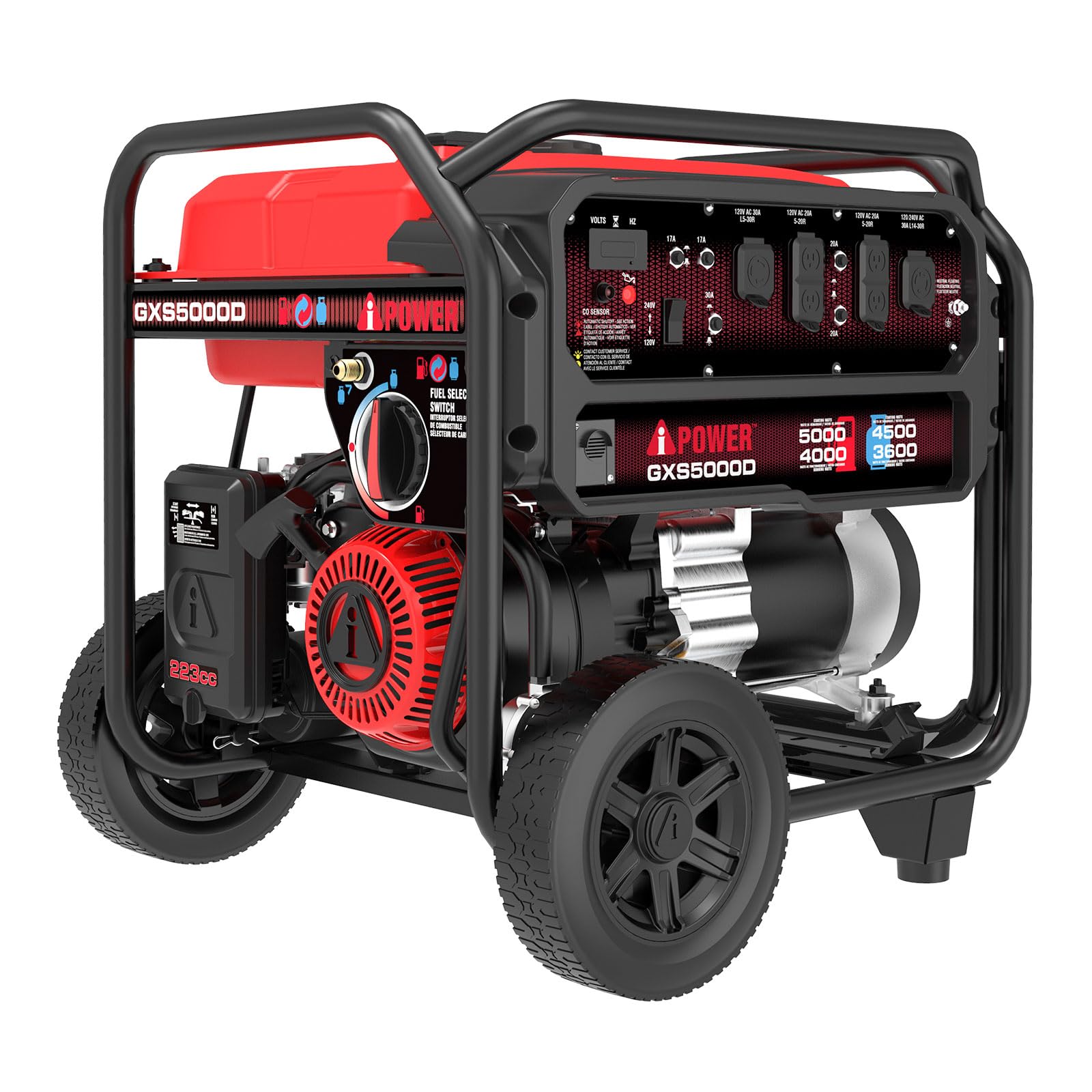
The A-iPower GXS5000D is a classic open-frame dual-fuel generator built for serious power at a mid-range investment. Its 223cc OHV engine with a cast-iron sleeve delivers 5,000 starting watts on gas (4,500 on LPG), making it suitable for running a 3.5-ton AC unit and a 2HP well pump simultaneously. The 6.3-gallon fuel tank provides up to 20 hours of runtime at 25% load on gas, and switching to propane extends that even further with cleaner emissions. The control panel includes a 240V twist-lock outlet, making it transfer-switch ready.
Customer reviews consistently highlight its robust build and easy starting, with many using it during hurricanes to power full home loads for days. The 68 dBA noise rating is relatively low for an open-frame model. It includes a CO sensor for automatic shutdown, which is a critical safety feature that many competitors in this class omit. The three-year warranty is a strong bonus, and users report excellent customer support when issues arise.
The main downsides are its weight (114.6 lbs) and bulk. It is not easily portable without a dolly. Some users also note that the GFCI outlets can trip during startup, requiring a reset, but this is a common safety feature. For homeowners who need robust power and aren’t afraid of a larger unit, the A-iPower delivers exceptional bang for the buck.
Why it’s great
- Dual fuel with long 20-hour runtime on gas at 25% load.
- Cast-iron sleeved engine for durability; 68 dBA is quiet for the power class.
- 240V outlet and transfer-switch ready for whole-home hookup.
Good to know
- Heavy at 114.6 lbs; wheels are included but still a two-person move.
- Open-frame design is louder than inverter models; needs outdoor placement.
- GFCI outlets may need manual reset after first startup.
7. PowerSmart 4800W Portable Inverter Generator (PS5046CE)
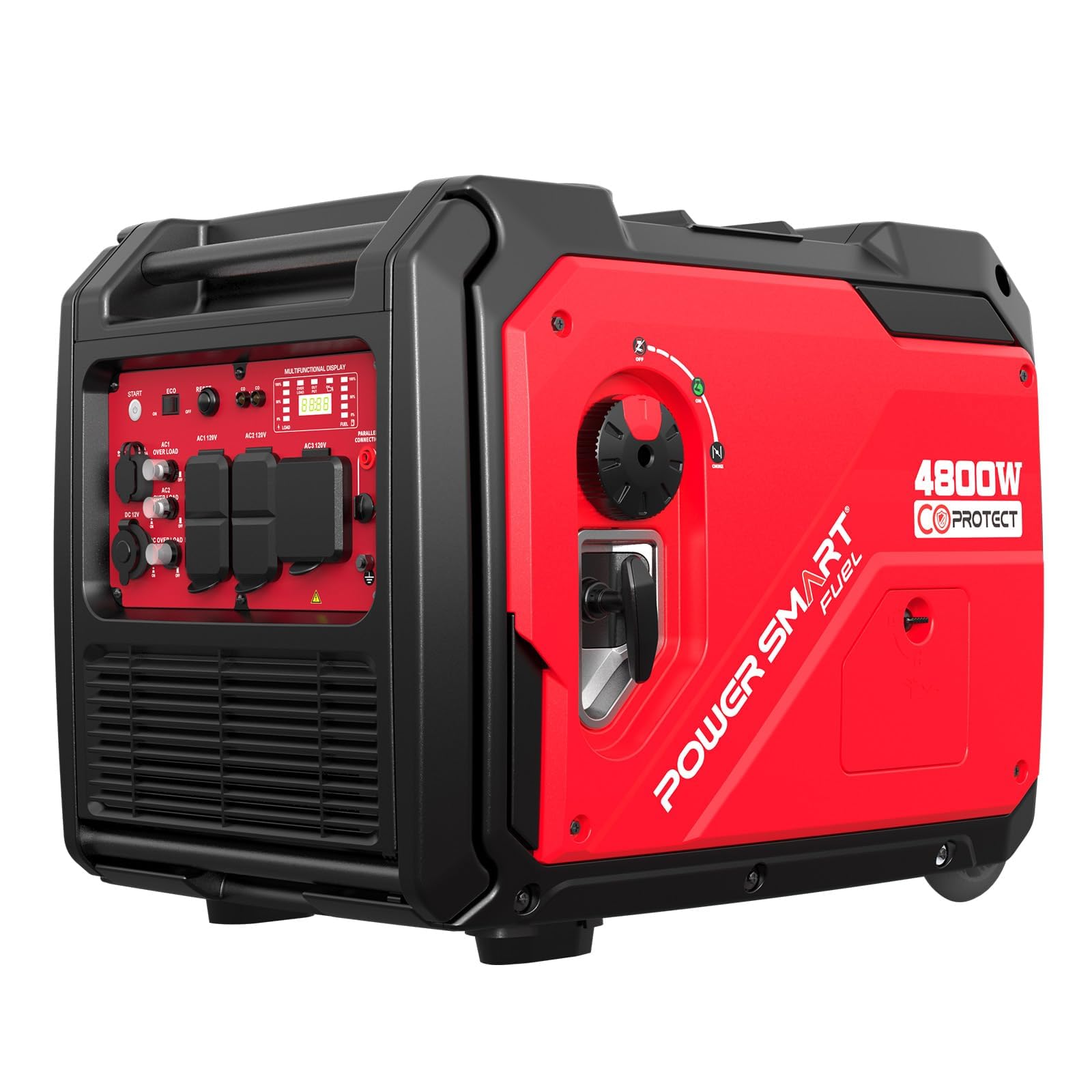
The PowerSmart PS5046CE is a gasoline-only inverter generator that emphasizes convenience and quiet operation. It produces 4,800 surge watts and uses inverter technology to deliver clean power safe for electronics. The one-touch electric start is a genuine luxury—no pull cords, no frustration, just a button press. The fully enclosed body keeps noise levels very low, making it a neighbor-friendly option for home backup or trailer use. With a 3.4-gallon tank, it runs up to 5 hours at full load and much longer in ECO mode.
It includes a dedicated 30-amp RV outlet, two standard 20-amp household outlets, and USB ports, covering most portable needs. Parallel-ready capability lets you link two units for double the power output. Users consistently describe it as quiet and lightweight for its output class, with easy starting even in cold weather. The CO shield, low-oil shutdown, and overload protection complete the safety package. The two-year warranty and lifetime tech support add value.
The biggest concern from long-term reviews is after-sales support. Some users had difficulty reaching customer service for outlet failures after months of use. However, for short-duration backup and RV use where reliability in the first few years is key, this is a strong performer.
Why it’s great
- One-touch electric start for effortless operation.
- Quiet, enclosed inverter design with clean power output.
- Parallel-ready and includes a dedicated 30A RV outlet.
Good to know
- Gasoline only—no dual fuel flexibility.
- Customer service has mixed reviews for long-term issues.
- Short 5-hour runtime at full load; ECO mode is essential for longer use.
8. WEN 4800-Watt Portable Inverter Generator (56477i)

The WEN 56477i is a gasoline inverter generator that directly competes with the PowerSmart model but adds onboard wheels and a telescoping pull handle, making it significantly easier to move. Its 224cc engine produces 4,800 surge watts and 4,000 rated watts, which comfortably runs a refrigerator, freezer, lights, and TV for days. The WEN Watchdog CO Sensor provides automatic shutdown if carbon monoxide accumulates. The fuel shut-off feature is included, allowing you to drain the carburetor before storage to prevent ethanol damage.
Real-world users consistently praise its reliability during extended outages—one review noted running it for 9 days straight without a single hiccup, powering an entire household. The noise level is appreciably low for an inverter, and the telescoping handle with large wheels makes it a breeze to roll around compared to models that require lifting. The three-year warranty is a solid safety net. It includes four standard 120V outlets, one TT-30R RV receptacle, and USB ports.
The major limitation is the lack of dual fuel—you are locked into gasoline. Additionally, at 72.7 pounds, it is heavier than the PowerSmart, though the wheels offset this for transport. If you are a dedicated gas user who prioritizes easy portability and proven reliability, this is a fantastic choice.
Why it’s great
- Onboard wheels and telescoping handle for effortless portability.
- Proven reliability with user reports of 9+ days of continuous use.
- Clean inverter power with CO Watchdog and fuel shut-off.
Good to know
- Gasoline only; no propane compatibility.
- Heavier than some competitors at 72.7 lbs.
- Fuel tank lasts around 8 hours at half load; plan refueling for long outages.
9. Generac 3,300-Watt Gas Powered Portable Inverter Generator (GP3300i)

The Generac GP3300i is the lightweight champion of this list, weighing only 59.5 pounds while still producing 3,300 surge watts. Its PowerRush Advance Technology provides over 50% more starting capacity, meaning it can handle the surge from a refrigerator or small AC that a standard 3,300W unit might struggle with. The TruePower Technology ensures clean, stable power safe for all sensitive electronics. It is notably quiet, making it ideal for camping, tailgating, or light home backup where noise is a concern.
Economy Mode automatically adjusts engine speed to match the load, resulting in impressive fuel efficiency—users report running a fridge, TV, WiFi, and fans for 9 hours on less than 1 gallon of gas. The COsense technology provides automatic shutdown protection. It includes two USB ports for device charging and is parallel-ready for pairing with another GP3300i. The electric start is simple and reliable, and the included tool kit and oil make setup straightforward.
The trade-off is limited total power. It can’t run a well pump, central AC, or electric oven. Some users at altitude (above 5,000 feet) note a significant derating, which is common for carbureted engines. For those whose emergency needs are limited to a refrigerator, lights, and electronics, this is a premium pick in a compact, portable package.
Why it’s great
- Extremely lightweight (59.5 lbs) and portable for its power class.
- PowerRush tech provides 50% more starting capacity for tough loads.
- Excellent fuel economy; runs essential loads for 9+ hours on under 1 gallon.
Good to know
- Gasoline only, with limited 3,300W peak—not for whole-home backup.
- Performance degrades significantly at altitudes above 5,000 feet.
- Not designed for high-draw appliances like well pumps or electric heaters.
10. PowerSmart 4400-Watt Dual Fuel Portable Inverter Generator (MB5040DC)
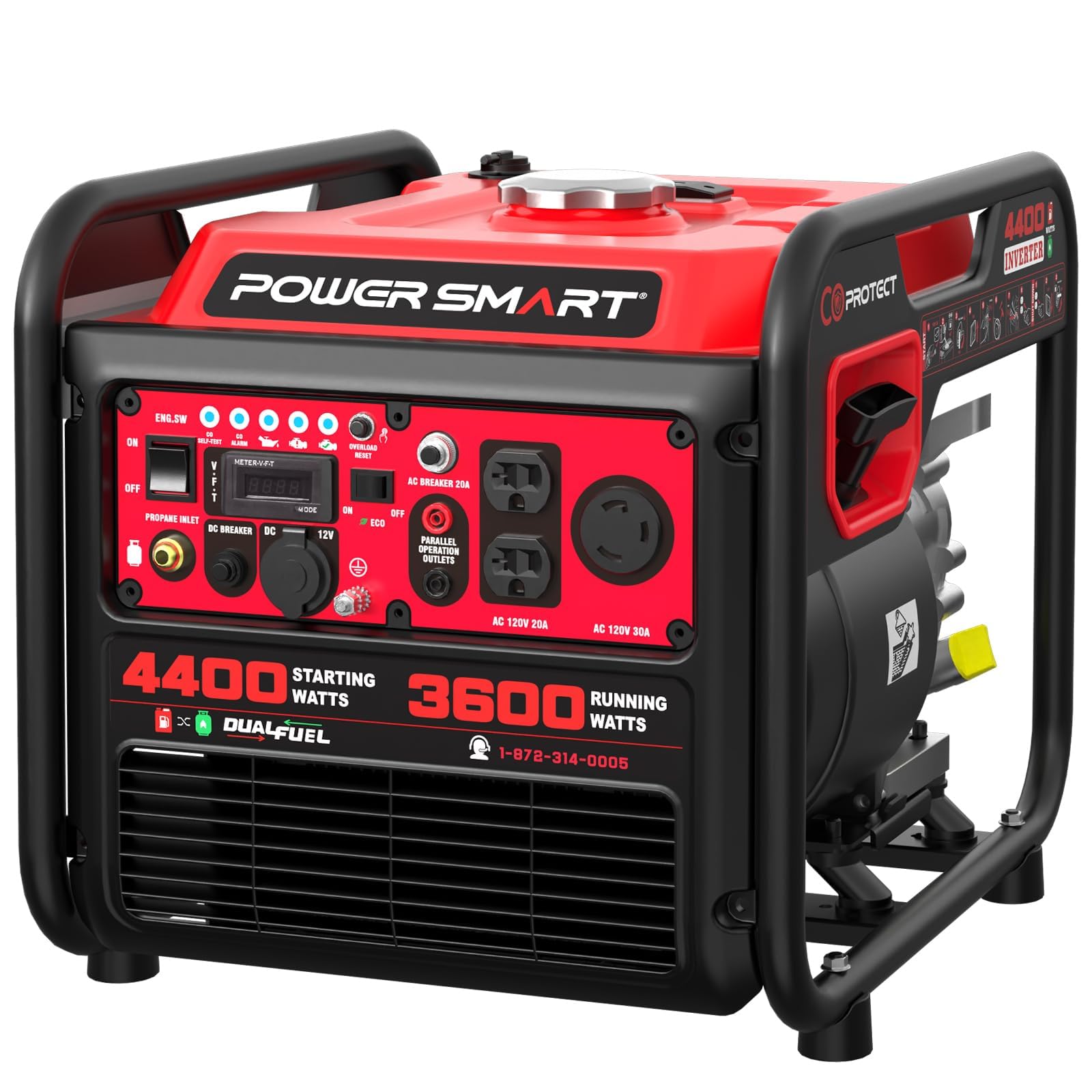
The PowerSmart MB5040DC is the entry-level dual-fuel inverter generator that brings propane compatibility and CO sensor safety to a budget-conscious buyer. It delivers 4,400 starting watts on gas and similar power on propane, which is enough to run a refrigerator, lights, a sump pump, and electronics. The inverter technology produces clean power, and the 76 dBA noise level is acceptable for its class—quieter than an open-frame but louder than premium inverters. The 1.6-gallon tank provides up to 11 hours of runtime at 25% load, which is solid for the price.
Real-world users appreciate its lightweight (61.29 lbs) and compact dimensions, making it easy to store in a garage or take camping. It starts reliably, and the ECO mode reduces engine speed for quieter operation and better fuel economy. The low-oil shutdown and overload protection add essential durability. At this price, getting both dual fuel and inverter technology is an outstanding value proposition.
The primary risk is reliability—while many users report great experiences, there are isolated reports of units arriving with defects or failing early, though the manufacturer’s support resolves these. The warranty coverage is shorter than some competitors. For a backup generator that will see occasional use, this is a smart, low-risk buy that delivers all the core features.
Why it’s great
- Budget-friendly dual-fuel inverter with clean power and CO sensor.
- Lightweight (61 lbs) and compact for easy storage.
- 11-hour runtime at 25% load with ECO mode for efficiency.
Good to know
- Noise level is 76 dBA—acceptable but not the quietest inverter.
- Mixed reliability reviews; some units have early defects.
- Shorter warranty compared to premium brands.
11. WEN 2800-Watt Dual Fuel Inverter Generator (DF280iX)
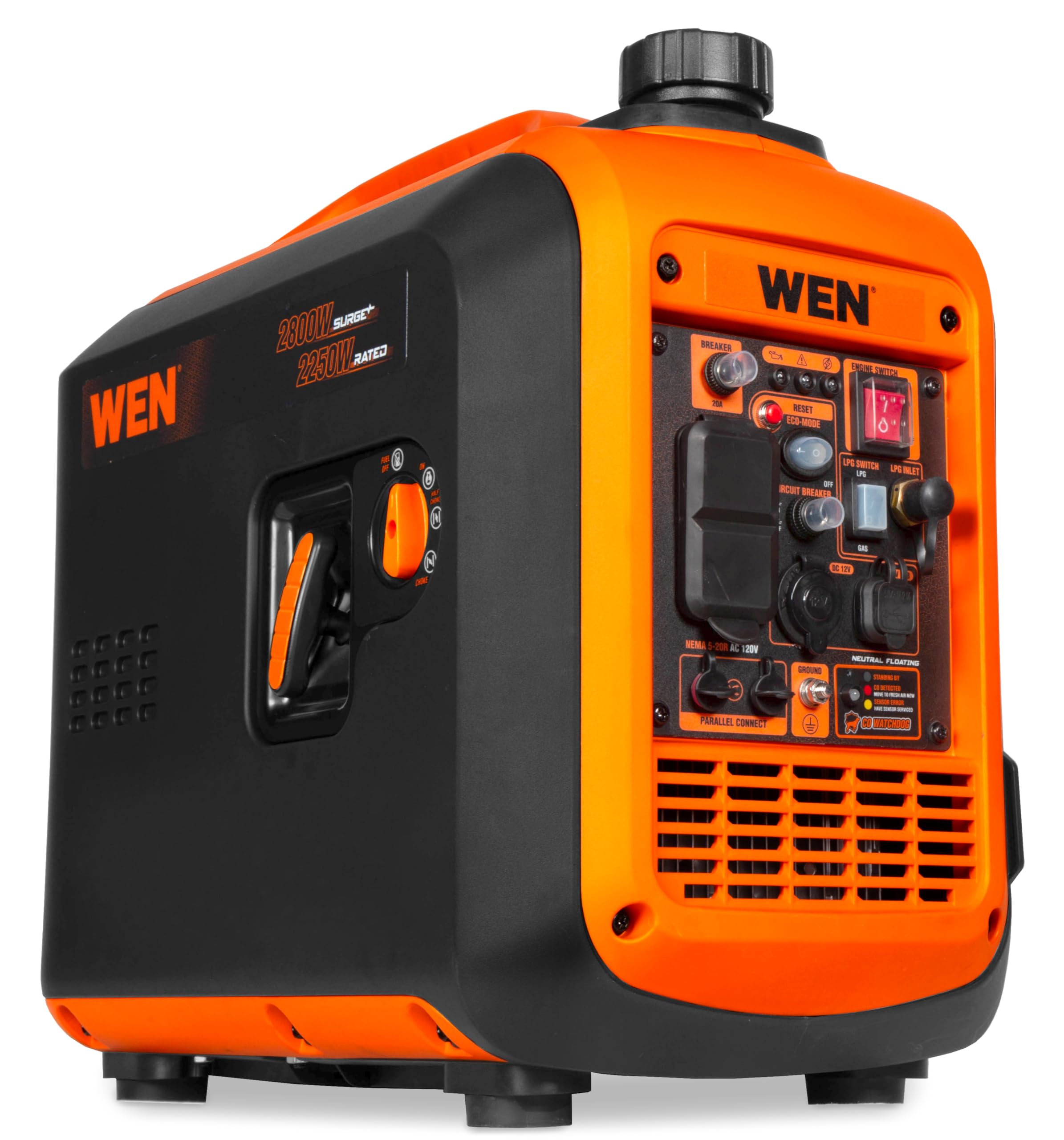
The WEN DF280iX is the smallest and most affordable dual-fuel inverter generator on this list, designed for those who need just enough power to keep a fridge running, charge phones, and power a few lights during an outage. It produces 2,800 surge watts on both gasoline and propane—enough for essential electronics and a small refrigerator, but not for heavy appliances. The inverter technology produces clean power safe for laptops and smartphones, and the WEN Watchdog CO Sensor provides automatic shutdown protection. The fuel shut-off feature lets you run the carburetor dry to prevent buildup during storage.
Users consistently highlight its excellent build quality for the price, noting that it starts easily on both fuels and runs quietly. Weighing only 45 pounds, it is genuinely portable and easy to lift into a car or storage shelf. It includes two standard 120V outlets, one 12V DC receptacle, and two USB ports, offering good connectivity for its size. The three-year warranty is generous for a unit at this budget tier. Many buyers use it primarily for camping or as a supplementary backup for their home’s critical loads.
The obvious limitation is its low power output—it cannot run a sump pump, well pump, or even a larger window AC unit. Some owners report that it requires a few extra pulls to start on propane compared to gas, which is typical for cold-fuel starting. If your needs are minimal and budget is the primary constraint, this is a reliable, feature-rich entry point.
Why it’s great
- Most affordable dual-fuel inverter generator with CO protection.
- Lightweight (45 lbs) and truly portable for any user.
- Clean power output safe for sensitive electronics and small essentials.
Good to know
- Low power (2,800W peak) limits use to fridge, lights, and small electronics.
- Propane starting can require more pulls than gasoline.
- Not suitable for any motor-driven appliances like pumps or large ACs.
FAQ
Can a dual-fuel generator run on propane and gasoline at the same time?
How many watts do I need for a typical home refrigerator and freezer?
Is it safe to run a generator in the rain or snow?
What does a “transfer switch” do and do I need one?
How often should I change the oil in a home backup generator?
Final Thoughts: The Verdict
For most users, the affordable generator for home winner is the Westinghouse 12500W Dual Fuel because it offers true whole-home power with remote start, dual fuel flexibility, and a strong warranty at a price that undercuts the competition. If you want a dual-fuel inverter with quiet, clean power for your RV and home essentials, the WEN DF480iX is your best value pick. And for a compact, zero-emission solution for electronics and small appliances that you can charge via solar, the Jackery Explorer 1000 v2 is a modern, silent alternative that pairs perfectly with a traditional generator for layered backup.